Rear climate control Hyundai Genesis 2012 Owner's Manual
[x] Cancel search | Manufacturer: HYUNDAI, Model Year: 2012, Model line: Genesis, Model: Hyundai Genesis 2012Pages: 393, PDF Size: 8.81 MB
Page 18 of 393
Safety features of your vehicle
2 3
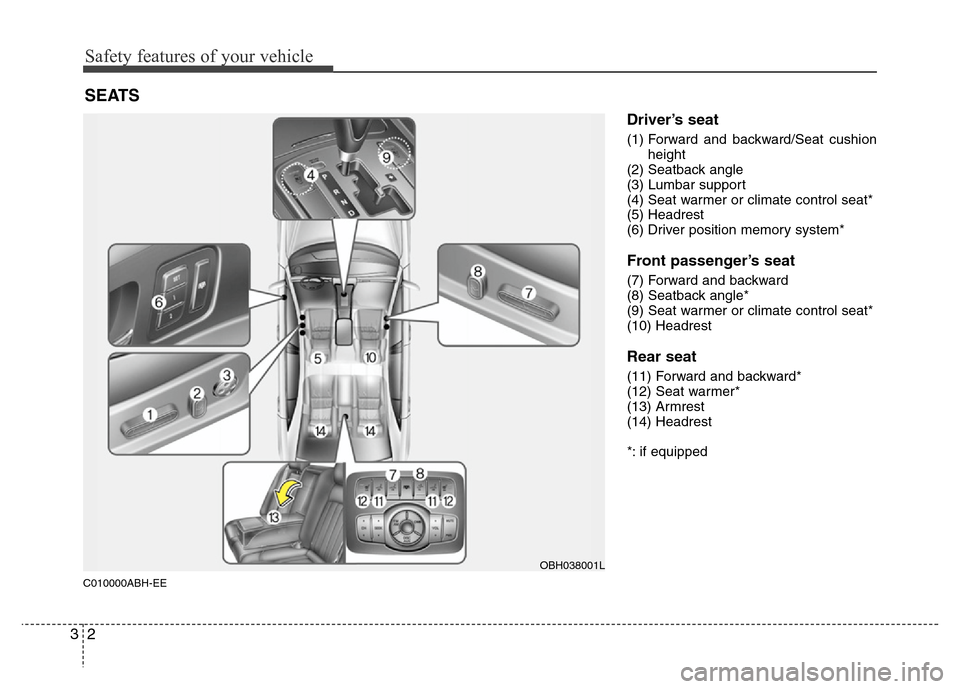
C010000ABH-EE
Driver’s seat
(1) Forward and backward/Seat cushion
height
(2) Seatback angle
(3) Lumbar support
(4) Seat warmer or climate control seat*
(5) Headrest
(6) Driver position memory system*
Front passenger’s seat
(7) Forward and backward
(8) Seatback angle*
(9) Seat warmer or climate control seat*
(10) Headrest
Rear seat
(11) Forward and backward*
(12) Seat warmer*
(13) Armrest
(14) Headrest
*: if equipped
SEATS
OBH038001L
Page 25 of 393
39
Safety features of your vehicle
C010109ABH
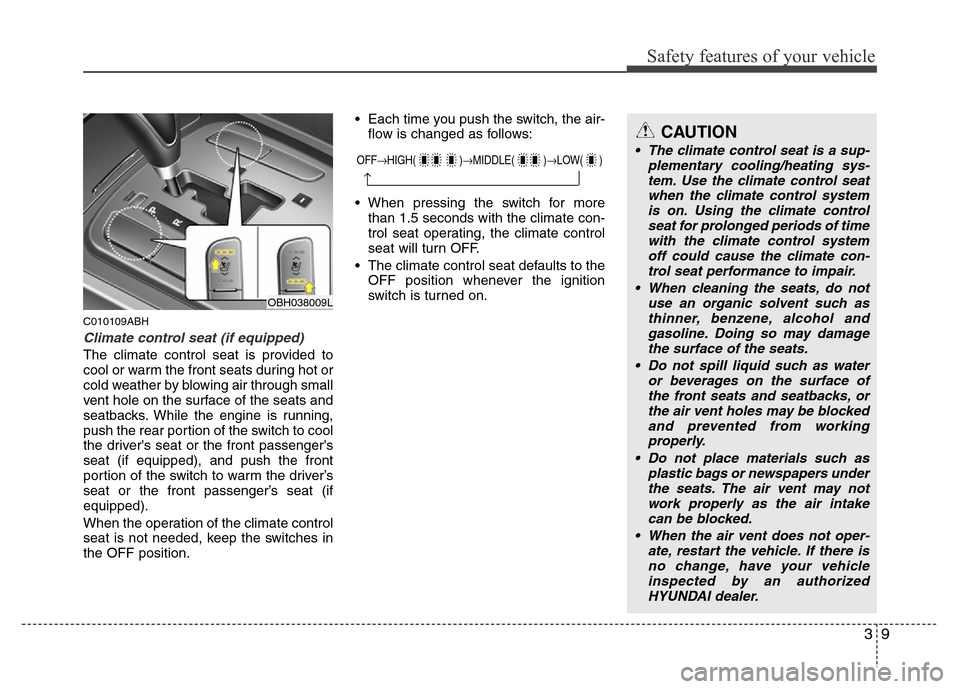
Climate control seat (if equipped)
The climate control seat is provided to
cool or warm the front seats during hot or
cold weather by blowing air through small
vent hole on the surface of the seats and
seatbacks. While the engine is running,
push the rear portion of the switch to cool
the driver's seat or the front passenger's
seat (if equipped), and push the front
portion of the switch to warm the driver’s
seat or the front passenger’s seat (if
equipped).
When the operation of the climate control
seat is not needed, keep the switches in
the OFF position.• Each time you push the switch, the air-
flow is changed as follows:
• When pressing the switch for more
than 1.5 seconds with the climate con-
trol seat operating, the climate control
seat will turn OFF.
• The climate control seat defaults to the
OFF position whenever the ignition
switch is turned on.
OBH038009L
CAUTION
• The climate control seat is a sup-
plementary cooling/heating sys-
tem. Use the climate control seat
when the climate control system
is on. Using the climate control
seat for prolonged periods of time
with the climate control system
off could cause the climate con-
trol seat performance to impair.
• When cleaning the seats, do not
use an organic solvent such as
thinner, benzene, alcohol and
gasoline. Doing so may damage
the surface of the seats.
• Do not spill liquid such as water
or beverages on the surface of
the front seats and seatbacks, or
the air vent holes may be blocked
and prevented from working
properly.
• Do not place materials such as
plastic bags or newspapers under
the seats. The air vent may not
work properly as the air intake
can be blocked.
• When the air vent does not oper-
ate, restart the vehicle. If there is
no change, have your vehicle
inspected by an authorized
HYUNDAI dealer.OFF→HIGH( )→MIDDLE( )→LOW( )
→
Page 26 of 393
Safety features of your vehicle
10 3
C010108AUN
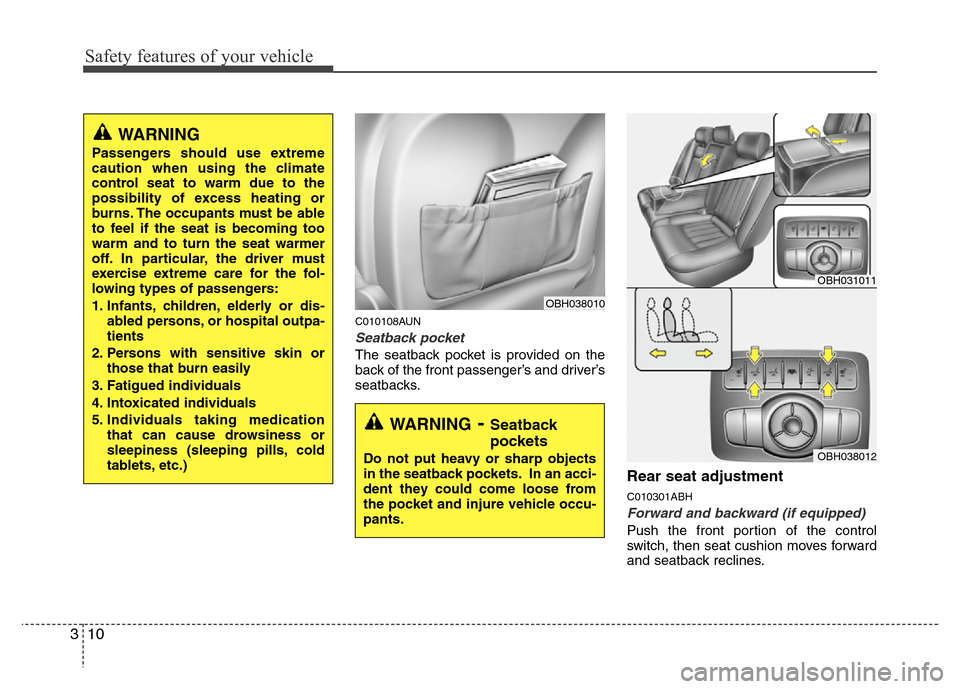
Seatback pocket
The seatback pocket is provided on the
back of the front passenger’s and driver’s
seatbacks.
Rear seat adjustment
C010301ABH
Forward and backward (if equipped)
Push the front portion of the control
switch, then seat cushion moves forward
and seatback reclines.
WARNING
Passengers should use extreme
caution when using the climate
control seat to warm due to the
possibility of excess heating or
burns. The occupants must be able
to feel if the seat is becoming too
warm and to turn the seat warmer
off. In particular, the driver must
exercise extreme care for the fol-
lowing types of passengers:
1. Infants, children, elderly or dis-
abled persons, or hospital outpa-
tients
2. Persons with sensitive skin or
those that burn easily
3. Fatigued individuals
4. Intoxicated individuals
5. Individuals taking medication
that can cause drowsiness or
sleepiness (sleeping pills, cold
tablets, etc.)
WARNING- Seatback
pockets
Do not put heavy or sharp objects
in the seatback pockets. In an acci-
dent they could come loose from
the pocket and injure vehicle occu-
pants.
OBH038010
OBH031011
OBH038012
Page 74 of 393
4
Keys / 4-3
Smart key / 4-6
Remote keyless entry / 4-10
Theft-alarm system / 4-13
Door locks / 4-15
Trunk / 4-19
Windows / 4-27
Hood / 4-30
Fuel filler lid / 4-32
Sunroof / 4-35
Driver position memory system / 4-39
Steering wheel / 4-42
Mirrors / 4-45
Instrument cluster / 4-48
Parking assist system / 4-73
Front blind spot monitoring system / 4-76
Rearview camera / 4-77
Hazard warning flasher / 4-77
Lighting / 4-78
Wipers and washers / 4-85
Interior light / 4-89
Defroster / 4-92
Automatic climate control system / 4-93
Features of your vehicle
Page 166 of 393
493
Features of your vehicle
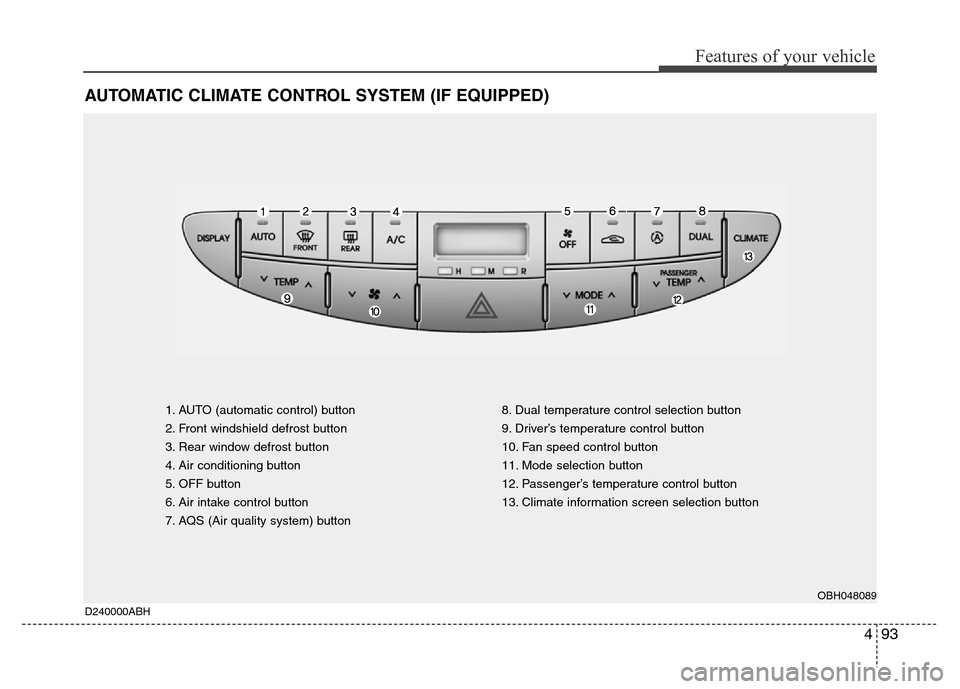
AUTOMATIC CLIMATE CONTROL SYSTEM (IF EQUIPPED)
1. AUTO (automatic control) button
2. Front windshield defrost button
3. Rear window defrost button
4. Air conditioning button
5. OFF button
6. Air intake control button
7. AQS (Air quality system) button8. Dual temperature control selection button
9. Driver’s temperature control button
10. Fan speed control button
11. Mode selection button
12. Passenger’s temperature control button
13. Climate information screen selection button
OBH048089
D240000ABH
Page 169 of 393
Features of your vehicle
96 4
❈ Rear outlet vents (F)
• The air flow of the Rear outlet vents is
controlled by the front climate control
system and delivered through the
inside air duct of the front doors. If the
door is open or not closed completely,
the air flow of the Rear outlet vent is
not delivered properly. Make sure the
front doors are closed completely.
• The air flow of the Rear outlet vents
may be weaker than the instrument
panel vents for the long air duct in the
front doors.
D240201ABH
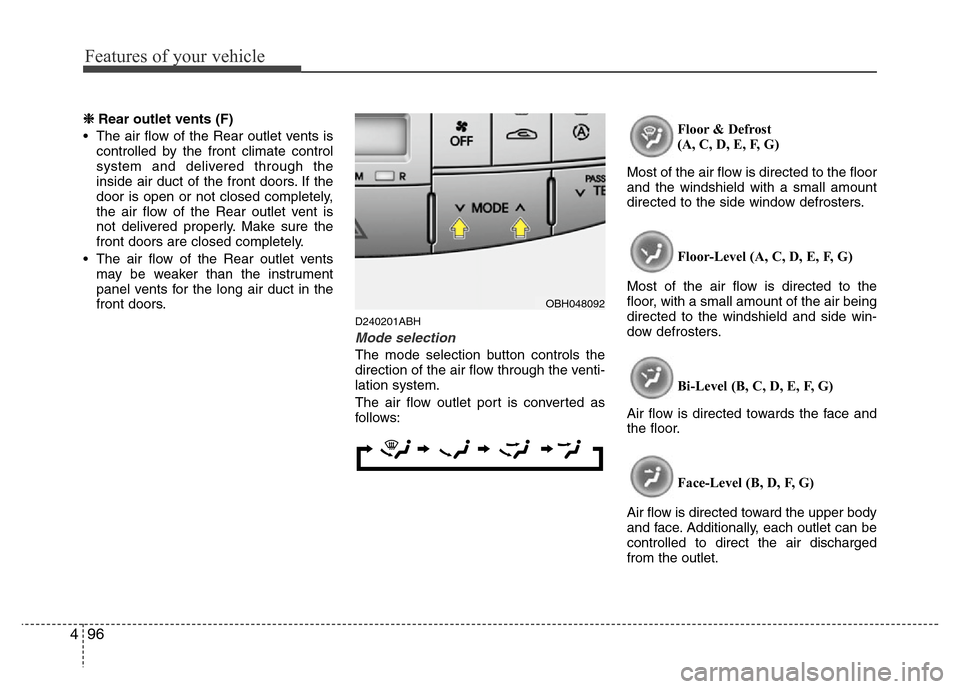
Mode selection
The mode selection button controls the
direction of the air flow through the venti-
lation system.
The air flow outlet port is converted as
follows:Floor & Defrost
(A, C, D, E, F, G)
Most of the air flow is directed to the floor
and the windshield with a small amount
directed to the side window defrosters.
Floor-Level (A, C, D, E, F, G)
Most of the air flow is directed to the
floor, with a small amount of the air being
directed to the windshield and side win-
dow defrosters.
Bi-Level (B, C, D, E, F, G)
Air flow is directed towards the face and
the floor.
Face-Level (B, D, F, G)
Air flow is directed toward the upper body
and face. Additionally, each outlet can be
controlled to direct the air discharged
from the outlet.
OBH048092
Page 177 of 393
Features of your vehicle
104 4
✽NOTICE
• Replace the filter every 15,000 km
(10,000 miles) or once a year.
If the car is being driven in severe
conditions such as dusty or rough
roads, more frequent air conditioner
filter inspections and changes are
required.
• When the air flow rate suddenly
decreases, the system should be
checked at an authorized HYUNDAI
dealer.
D230400AEN
Checking the amount of air con-
ditioner refrigerant and compres-
sor lubricant
When the amount of refrigerant is low,
the performance of the air conditioning is
reduced. Overfilling also has a negative
impact on the air conditioning system.
Therefore, if abnormal operation is
found, have the system inspected by an
authorized HYUNDAI dealer.
✽NOTICE
It is important when servicing the air
conditioning system that the correct
type and amount of oil and refrigerant is
used. Otherwise, damage to the com-
pressor and abnormal system operation
may occur. D2301000BBH-EE
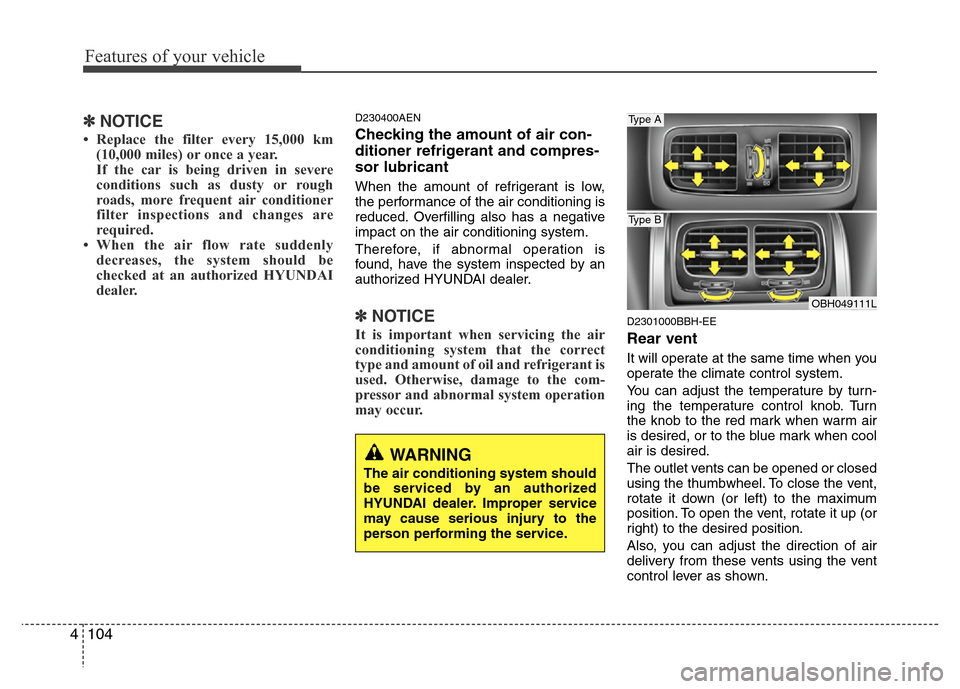
Rear vent
It will operate at the same time when you
operate the climate control system.
You can adjust the temperature by turn-
ing the temperature control knob. Turn
the knob to the red mark when warm air
is desired, or to the blue mark when cool
air is desired.
The outlet vents can be opened or closed
using the thumbwheel. To close the vent,
rotate it down (or left) to the maximum
position. To open the vent, rotate it up (or
right) to the desired position.
Also, you can adjust the direction of air
delivery from these vents using the vent
control lever as shown.
WARNING
The air conditioning system should
be serviced by an authorized
HYUNDAI dealer. Improper service
may cause serious injury to the
person performing the service.
OBH049111L
Type A
Type B
Page 240 of 393
Driving your vehicle
18 5
E070101AUN
In the event of brake failure
If service brakes fail to operate while the
vehicle is in motion, you can make an
emergency stop with the parking brake.
The stopping distance, however, will be
much greater than normal.
E070102AUN
Disc brakes wear indicator
Your vehicle has disc brakes.
When your brake pads are worn and new
pads are required, you will hear a high-
pitched warning sound from your front
brakes or rear brakes. You may hear this
sound come and go or it may occur
whenever you depress the brake pedal.
Please remember that some driving con-
ditions or climates may cause a brake
squeal when you first apply (or lightly
apply) the brakes. This is normal and
does not indicate a problem with your
brakes.
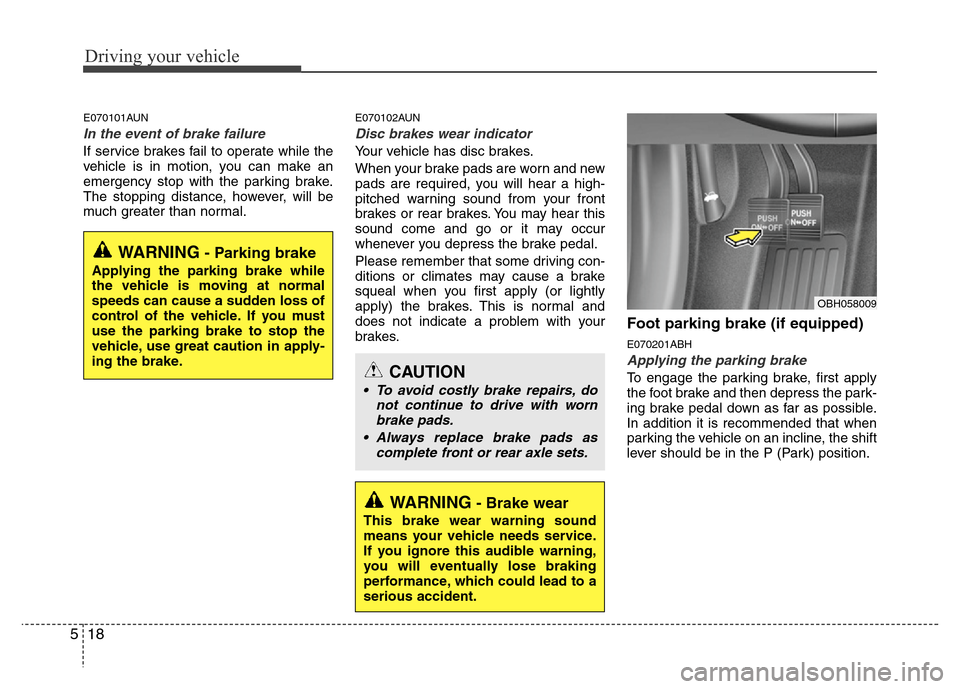
Foot parking brake (if equipped)
E070201ABH
Applying the parking brake
To engage the parking brake, first apply
the foot brake and then depress the park-
ing brake pedal down as far as possible.
In addition it is recommended that when
parking the vehicle on an incline, the shift
lever should be in the P (Park) position.
OBH058009
WARNING- Parking brake
Applying the parking brake while
the vehicle is moving at normal
speeds can cause a sudden loss of
control of the vehicle. If you must
use the parking brake to stop the
vehicle, use great caution in apply-
ing the brake.
WARNING- Brake wear
This brake wear warning sound
means your vehicle needs service.
If you ignore this audible warning,
you will eventually lose braking
performance, which could lead to a
serious accident.
CAUTION
• To avoid costly brake repairs, do
not continue to drive with worn
brake pads.
• Always replace brake pads as
complete front or rear axle sets.
Page 329 of 393
711
Maintenance
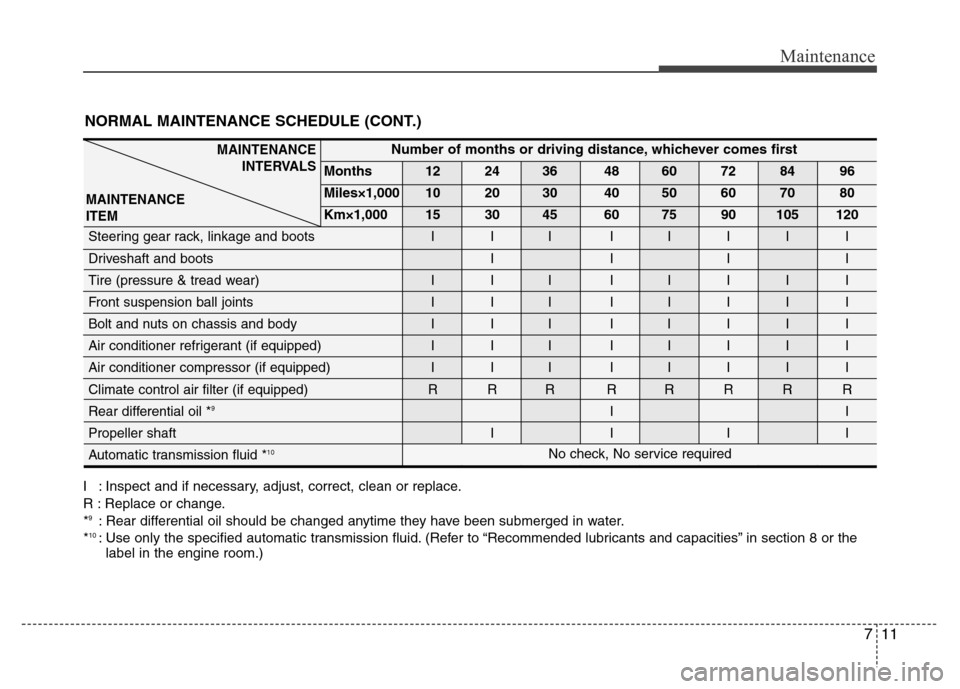
NORMAL MAINTENANCE SCHEDULE (CONT.)
I : Inspect and if necessary, adjust, correct, clean or replace.
R : Replace or change.
*
9: Rear differential oil should be changed anytime they have been submerged in water.
*10: Use only the specified automatic transmission fluid. (Refer to “Recommended lubricants and capacities” in section 8 or the
label in the engine room.)
Number of months or driving distance, whichever comes first
Months 12 24 36 48 60 72 84 96
Miles×1,000 10 20 30 40 50 60 70 80
Km×1,000 15 30 45 60 75 90 105 120
Steering gear rack, linkage and boots I I I I I I I I
Driveshaft and boots I I I I
Tire (pressure & tread wear) I I I I I I I I
Front suspension ball joints I I I I I I I I
Bolt and nuts on chassis and body I I I I I I I I
Air conditioner refrigerant (if equipped) I I I I I I I I
Air conditioner compressor (if equipped) I I I I I I I I
Climate control air filter (if equipped) R R R R R R R R
Rear differential oil *
9II
Propeller shaft
IIII
Automatic transmission fluid *10
MAINTENANCE
INTERVALS
MAINTENANCE
ITEM
No check, No service required
Page 331 of 393
713
Maintenance
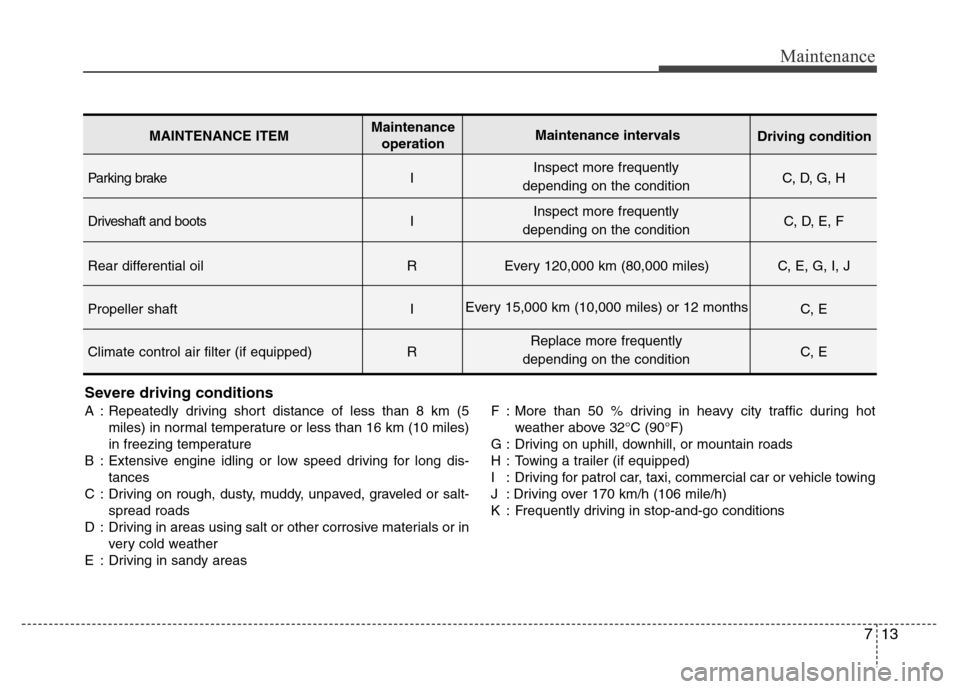
Severe driving conditions
A : Repeatedly driving short distance of less than 8 km (5
miles) in normal temperature or less than 16 km (10 miles)
in freezing temperature
B : Extensive engine idling or low speed driving for long dis-
tances
C : Driving on rough, dusty, muddy, unpaved, graveled or salt-
spread roads
D : Driving in areas using salt or other corrosive materials or in
very cold weather
E : Driving in sandy areasF : More than 50 % driving in heavy city traffic during hot
weather above 32°C (90°F)
G : Driving on uphill, downhill, or mountain roads
H : Towing a trailer (if equipped)
I : Driving for patrol car, taxi, commercial car or vehicle towing
J : Driving over 170 km/h (106 mile/h)
K : Frequently driving in stop-and-go conditions
Parking brake I C, D, G, H
Driveshaft and boots I C, D, E, F
Rear differential oil R Every 120,000 km (80,000 miles) C, E, G, I, J
Propeller shaft IEvery 15,000 km (10,000 miles) or 12 months
C, E
Climate control air filter (if equipped) R C, E
MAINTENANCE ITEMMaintenance
operationMaintenance intervals
Driving condition
Inspect more frequently
depending on the condition
Inspect more frequently
depending on the condition
Replace more frequently
depending on the condition