ABS Hyundai Genesis 2013 User Guide
[x] Cancel search | Manufacturer: HYUNDAI, Model Year: 2013, Model line: Genesis, Model: Hyundai Genesis 2013Pages: 429, PDF Size: 8.94 MB
Page 272 of 429
533
Driving your vehicle
E070504ABH-EU
ESC OFF usage
When driving
ESC should be turned on for daily driv-ing whenever possible.
To turn ESC off while driving, press the ESC OFF button while driving on a flat
road surface.
Never press the ESC OFF button while
ESC is operating (ESC indicator light
blinks).
If ESC is turned off while ESC is operat-
ing, the vehicle may slip out of control.
✽ ✽ NOTICE
• When operating the vehicle on a
dynamometer, ensure that the ESC is
turned off (ESC OFF light illuminat-
ed).
• Turning the ESC off does not affect ABS or brake system operation.
CAUTION
Driving with varying tire or wheel
sizes may cause the ESC system tomalfunction. When replacing tires,make sure they are the same size asyour original tires.
Never operate the vehicle with dif-ferent diameter tires installed at the same time.
WARNING
The Electronic Stability Control sys-
tem is only a driving aid; use pre-
cautions for safe driving by slowing
down on curved, snowy, or icy
roads. Drive slowly and don’t
attempt to accelerate whenever the
ESC indicator light is blinking, or
when the road surface is slippery.
WARNING
Never press the ESC OFF button
while ESC is operating.
If the ESC is turned off while ESC is
operating, the vehicle may go out of
control.
To turn ESC off while driving, press
the ESC OFF button while driving
on a flat road surface.
Page 281 of 429
Driving your vehicle
42
5
E150300ABH
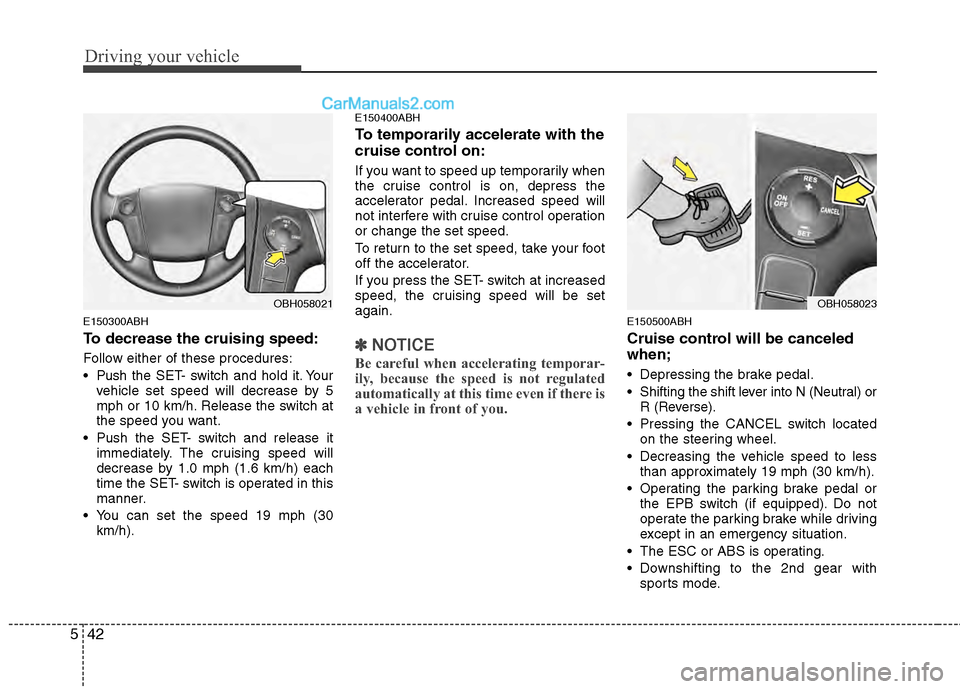
To decrease the cruising speed:
Follow either of these procedures:
Push the SET- switch and hold it. Your
vehicle set speed will decrease by 5
mph or 10 km/h. Release the switch at
the speed you want.
Push the SET- switch and release it immediately. The cruising speed will
decrease by 1.0 mph (1.6 km/h) each
time the SET- switch is operated in this
manner.
You can set the speed 19 mph (30 km/h).
E150400ABH
To temporarily accelerate with the
cruise control on:
If you want to speed up temporarily when
the cruise control is on, depress the
accelerator pedal. Increased speed will
not interfere with cruise control operation
or change the set speed.
To return to the set speed, take your foot
off the accelerator.
If you press the SET- switch at increased
speed, the cruising speed will be set
again.
✽ ✽ NOTICE
Be careful when accelerating temporar-
ily, because the speed is not regulated
automatically at this time even if there is
a vehicle in front of you.
E150500ABH
Cruise control will be canceled
when;
Depressing the brake pedal.
Shifting the shift lever into N (Neutral) or
R (Reverse).
Pressing the CANCEL switch located on the steering wheel.
Decreasing the vehicle speed to less than approximately 19 mph (30 km/h).
Operating the parking brake pedal or the EPB switch (if equipped). Do not
operate the parking brake while driving
except in an emergency situation.
The ESC or ABS is operating.
Downshifting to the 2nd gear with sports mode.
OBH058021OBH058023
Page 295 of 429
Driving your vehicle
56
5
E110100ABH
Hazardous driving conditions
When hazardous driving conditions are
encountered such as water, snow, ice,
mud, sand, or similar hazards, follow
these suggestions:
Drive cautiously and allow extra dis-
tance for braking.
Avoid sudden movements in braking or steering. If stalled in snow, mud, or sand, use
second gear. Accelerate slowly to
avoid spinning the drive wheels.
Use sand, rock salt, tire chains, or other non-slip material under the drive
wheels to provide traction when stalled
in ice, snow, or mud.
Leave ESC system on for best traction when attempting to get vehicle
unstuck.
E110200ABH-EU
Rocking the vehicle
If it is necessary to rock the vehicle to free
it from snow, sand, or mud, first turn the
steering wheel right and left to clear the
area around your front wheels. Then, shift
back and forth between R (Reverse) and
any forward gear in vehicles equipped
with an automatic transmission. Do not
race the engine, and spin the wheels as
little as possible. If you are still stuck after
a few tries, have the vehicle pulled out by
a tow vehicle to avoid engine overheating
and possible damage to the transmission.
SPECIAL DRIVING CONDITIONS
OBH058034
WARNING - ABS
Do not pump the brake pedal on a
vehicle equipped with ABS.
WARNING - Downshifting
Downshifting with an automatic
transmission, while driving on slip-
pery surfaces can cause an acci-
dent. The sudden change in tire
speed could cause the tires to skid.
Be careful when downshifting on
slippery surfaces.
CAUTION
Prolonged rocking may causeengine over-heating, transmissiondamage or failure, and tire damage.
Page 325 of 429
What to do in an emergency
16
6
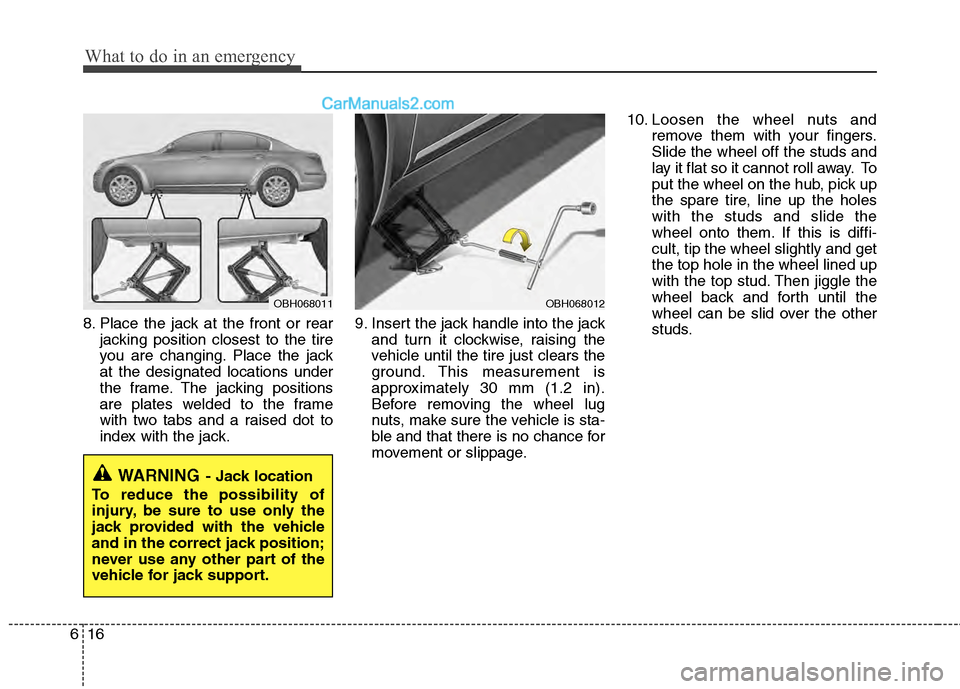
8. Place the jack at the front or rear
jacking position closest to the tire
you are changing. Place the jack
at the designated locations under
the frame. The jacking positions
are plates welded to the frame
with two tabs and a raised dot to
index with the jack. 9. Insert the jack handle into the jack
and turn it clockwise, raising the
vehicle until the tire just clears the
ground. This measurement is
approximately 30 mm (1.2 in).
Before removing the wheel lug
nuts, make sure the vehicle is sta-
ble and that there is no chance for
movement or slippage. 10. Loosen the wheel nuts and
remove them with your fingers.
Slide the wheel off the studs and
lay it flat so it cannot roll away. To
put the wheel on the hub, pick up
the spare tire, line up the holes
with the studs and slide the
wheel onto them. If this is diffi-
cult, tip the wheel slightly and get
the top hole in the wheel lined up
with the top stud. Then jiggle the
wheel back and forth until the
wheel can be slid over the other
studs.
WARNING- Jack location
To reduce the possibility of
injury, be sure to use only the
jack provided with the vehicle
and in the correct jack position;
never use any other part of the
vehicle for jack support.
OBH068011OBH068012
Page 373 of 429
739
Maintenance
G200600ABH
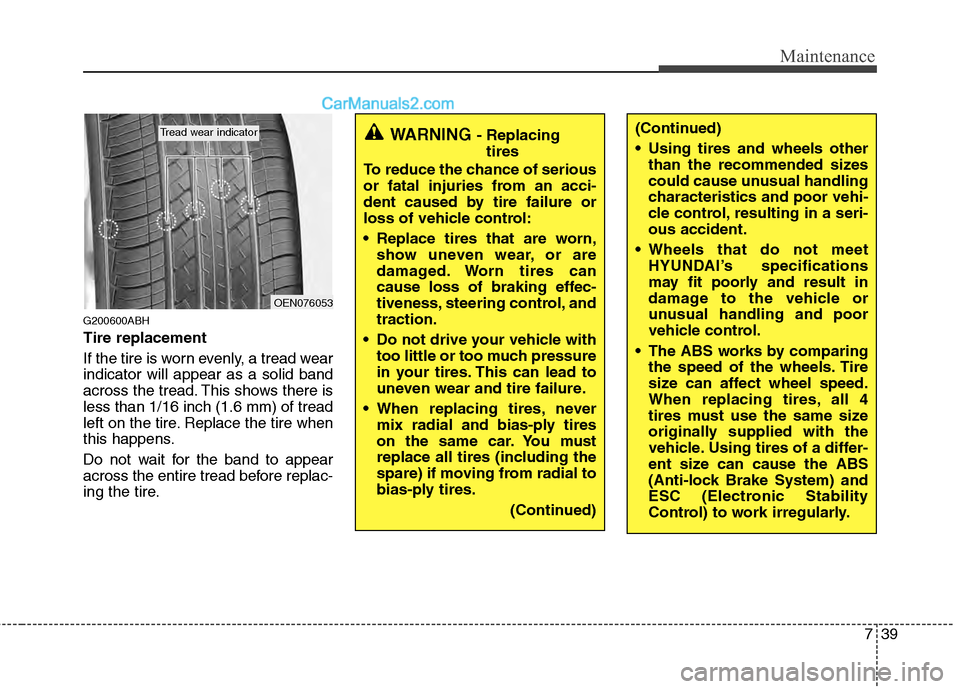
Tire replacement
If the tire is worn evenly, a tread wear
indicator will appear as a solid band
across the tread. This shows there is
less than 1/16 inch (1.6 mm) of tread
left on the tire. Replace the tire when
this happens.
Do not wait for the band to appear
across the entire tread before replac-
ing the tire.
OEN076053
Tread wear indicatorWARNING - Replacingtires
To reduce the chance of serious
or fatal injuries from an acci-
dent caused by tire failure or
loss of vehicle control:
Replace tires that are worn, show uneven wear, or are
damaged. Worn tires can
cause loss of braking effec-
tiveness, steering control, and
traction.
Do not drive your vehicle with too little or too much pressure
in your tires. This can lead to
uneven wear and tire failure.
When replacing tires, never mix radial and bias-ply tires
on the same car. You must
replace all tires (including the
spare) if moving from radial to
bias-ply tires.
(Continued)(Continued)
Using tires and wheels otherthan the recommended sizes
could cause unusual handling
characteristics and poor vehi-
cle control, resulting in a seri-
ous accident.
Wheels that do not meet HYUNDAI’s specifications
may fit poorly and result in
damage to the vehicle or
unusual handling and poor
vehicle control.
The ABS works by comparing the speed of the wheels. Tire
size can affect wheel speed.
When replacing tires, all 4
tires must use the same size
originally supplied with the
vehicle. Using tires of a differ-
ent size can cause the ABS
(Anti-lock Brake System) and
ESC (Electronic Stability
Control) to work irregularly.
Page 397 of 429
763
Maintenance
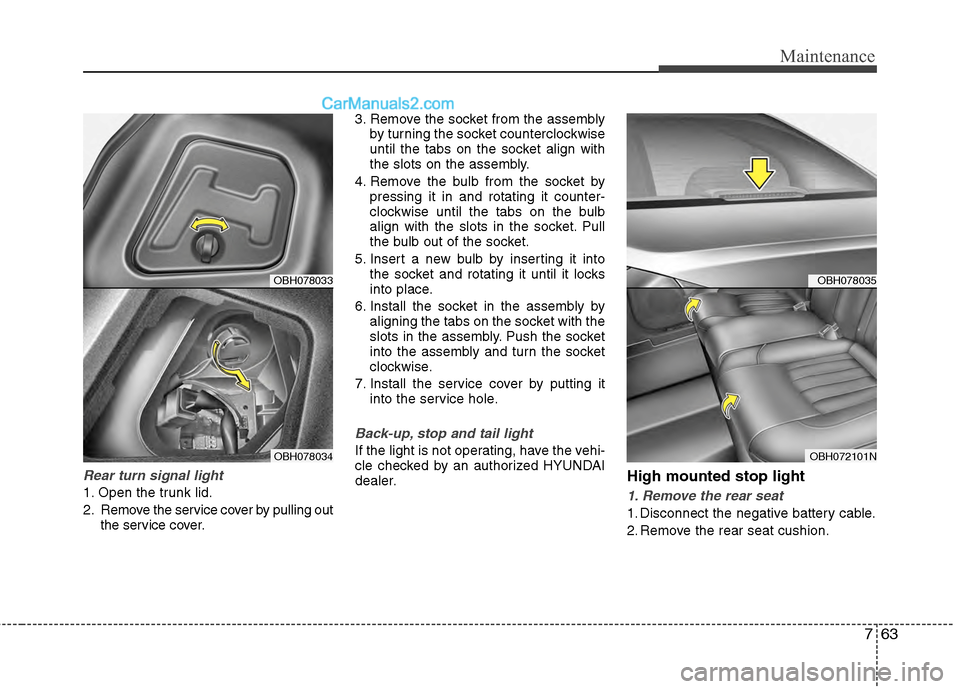
Rear turn signal light
1. Open the trunk lid.
2. Remove the service cover by pulling outthe service cover. 3. Remove the socket from the assembly
by turning the socket counterclockwise
until the tabs on the socket align with
the slots on the assembly.
4. Remove the bulb from the socket by pressing it in and rotating it counter-
clockwise until the tabs on the bulb
align with the slots in the socket. Pull
the bulb out of the socket.
5. Insert a new bulb by inserting it into the socket and rotating it until it locks
into place.
6. Install the socket in the assembly by aligning the tabs on the socket with the
slots in the assembly. Push the socket
into the assembly and turn the socket
clockwise.
7. Install the service cover by putting it into the service hole.
Back-up, stop and tail light
If the light is not operating, have the vehi-
cle checked by an authorized HYUNDAI
dealer.
High mounted stop light
1. Remove the rear seat
1. Disconnect the negative battery cable.
2. Remove the rear seat cushion.
OBH078033
OBH078034
OBH078035
OBH072101N
Page 402 of 429
Maintenance
68
7
G220900ABH
Door courtesy lamp bulb replace-
ment
If the light is not operating, have the vehi-
cle checked by an authorized HYUNDAI
dealer.
G220600BBH
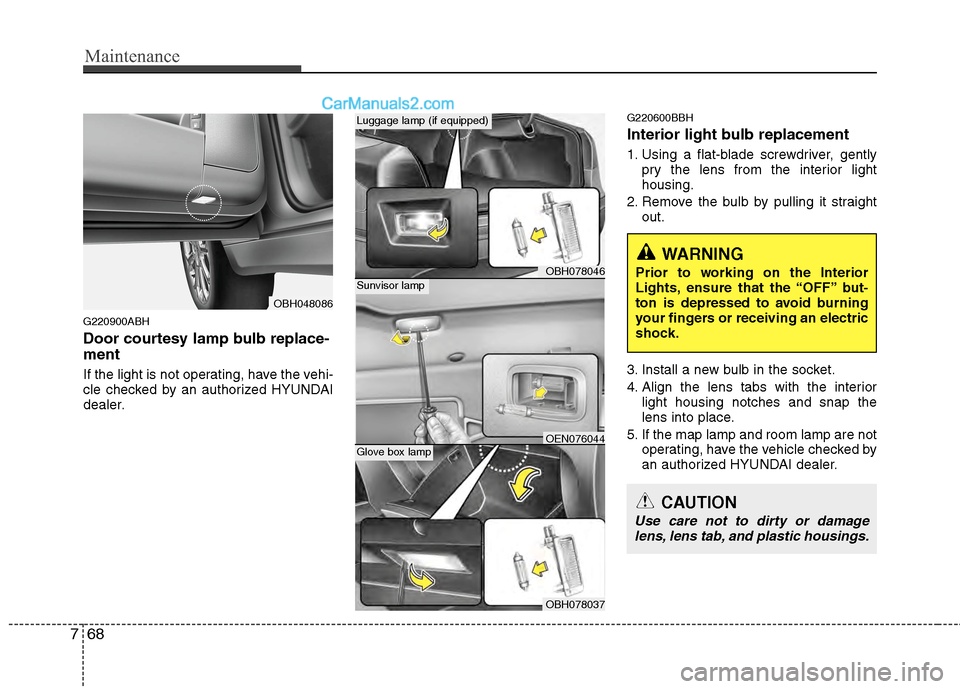
Interior light bulb replacement
1. Using a flat-blade screwdriver, gently
pry the lens from the interior light
housing.
2. Remove the bulb by pulling it straight out.
3. Install a new bulb in the socket.
4. Align the lens tabs with the interior light housing notches and snap the
lens into place.
5. If the map lamp and room lamp are not operating, have the vehicle checked by
an authorized HYUNDAI dealer.
OBH048086
OBH078046
Luggage lamp (if equipped)
OBH078037
OEN076044
Sunvisor lamp
Glove box lamp
WARNING
Prior to working on the Interior
Lights, ensure that the “OFF” but-
ton is depressed to avoid burning
your fingers or receiving an electric
shock.
CAUTION
Use care not to dirty or damagelens, lens tab, and plastic housings.
Page 410 of 429
Maintenance
76
7
G270201AUN
Canister
Fuel vapors generated inside the fuel
tank are absorbed and stored in the
onboard canister. When the engine is
running, the fuel vapors absorbed in the
canister are drawn into the engine intake
manifold through the purge control sole-
noid valve.
G270202AUN
Purge Control Solenoid Valve (PCSV)
The purge control solenoid valve is con-
trolled by the Engine Control Module
(ECM); when the engine coolant temper-
ature is low during idling, the PCSV clos-
es so that evaporated fuel is not taken
into the engine. After the engine warms-
up during ordinary driving, the PCSV
opens to introduce evaporated fuel to the
engine.
G270300AUN
3. Exhaust emission control
system
The Exhaust Emission Control System is
a highly effective system which controls
exhaust emissions while maintaining
good vehicle performance.
G270301AUN
Vehicle modifications
This vehicle should not be modified.
Modification of your vehicle could
affect its performance, safety or dura-
bility and may even violate governmen-
tal safety and emissions regulations.
In addition, damage or performance
problems resulting from any modification
may not be covered under warranty.
Use of unauthorized electric devices may cause: Abnormal vehicle operation,
Wire damage, Battery discharge, Fire.
Be careful not to damage your vehicle
by use of unauthorized electric devices.
G270302AUN-EU
Engine exhaust gas precautions (carbon monoxide)
Carbon monoxide can be present with other exhaust fumes. Therefore, if you
smell exhaust fumes of any kind inside
your vehicle, have it inspected and
repaired immediately. If you ever sus-
pect exhaust fumes are coming into
your vehicle, drive it only with all the
windows fully open. Have your vehicle
checked and repaired immediately.
WARNING- Exhaust
Engine exhaust gases contain car-
bon monoxide (CO). Though color-
less and odorless, it is dangerous
and could be lethal if inhaled.
Follow the instructions on this
page to avoid CO poisoning.
CALIFORNIA PROPOSI-
TION 65 WARNING
Engine exhaust and a wide variety
of automobile components and
parts, including components found
in the interior furnishings in a vehi-
cle, contain or emit chemicals
known to the State of California to
cause cancer and birth defects and
reproductive harm. In addition, cer-
tain fluids contained in vehicles
and certain products of component
wear contain or emit chemicals
known to the State of California to
cause cancer and birth defects or
other reproductive harm.
Page 424 of 429

Index
2I
Air bag - advanced supplemental restraint system ······ 3-35Air bag warning label ··················\
··················\
············ 3-60
Curtain air bag ··················\
··················\
··················\
····· 3-52
Driver's and passenger's front air bag ··················\
····· 3-46
Occupant classification system ··················\
··············· 3-41
Side impact air bag ··················\
··················\
················ 3-50
SRS components and functions ··················\
··············· 3-38
Air cleaner ··················\
··················\
··················\
············· 7-24
Appearance care ··················\
··················\
··················\
···· 7-69
Audio system ··················\
··················\
··················\
······· 4-115 Antenna ················\
··················\
··················\
··············· 4-115
Bluetooth
®Wireless Technology phone operation ····4-151
HD RadioTM··················\
··················\
··················\
··········4-147
PA710BH ·················\
··················\
··················\
············ 4-120
PA760BH ·················\
··················\
··················\
············ 4-133
Steering wheel audio control ··················\
················· 4-115
Automatic climate control system ··················\
············· 4-89 Air conditioning ··················\
··················\
··················\
·· 4-96
Automatic heating and air conditioning ··················\
·· 4-90
Manual heating and air conditioning ··················\
······ 4-91
Rear vent ··················\
··················\
··················\
··········· 4-100
Automatic transmission ··················\
··················\
··········· 5-11 Ignition key interlock system ··················\
··················\
5-15
Shift lock system ··················\
··················\
··················\
· 5-14
Sports mode ··················\
··················\
··················\
········· 5-14 Battery ················\
··················\
··················\
··················\
··· 7-32
Before driving ··················\
··················\
··················\
·········· 5-3
Binding arbitration ··················\
··················\
··················\
· 8-10
Brake fluid ··················\
··················\
··················\
············· 7-21
Brake system ··················\
··················\
··················\
········· 5-18
Anti-lock brake system (ABS) ··················\
················ 5-28
Auto hold ··················\
··················\
··················\
···············5-25
Electric parking brake (EPB) ··················\
··················\
··5-20
Electronic stability control (ESC) ··················\
··········· 5-30
Parking brake ··················\
··················\
··················\
······· 5-19
Power brakes ··················\
··················\
··················\
······· 5-18
Bulb wattage ··················\
··················\
··················\
············ 8-2
California perchlorate notice ··················\
··················\
··· 7-78
Child restraint system ··················\
··················\
·············· 3-27 Placing a passenger seat belt into the auto lock mode ·················\
··················\
··················\
··················\
· 3-29
Securing a child restraint seat with tether anchor system ·················\
··················\
··················\
················· 3-31
Securing a child restraint seat with child seat lower anchor system ··················\
··················\
··················\
···· 3-33
Climate control air filter ··················\
··················\
·········· 7-27
Consumer information ··················\
··················\
··············· 8-9
Cruise control system ··················\
··················\
·············· 5-36
AB
C