check oil Hyundai Genesis 2013 User Guide
[x] Cancel search | Manufacturer: HYUNDAI, Model Year: 2013, Model line: Genesis, Model: Hyundai Genesis 2013Pages: 429, PDF Size: 8.94 MB
Page 350 of 429
Maintenance
16
7
ENGINE OIL
G060100AEN-EU
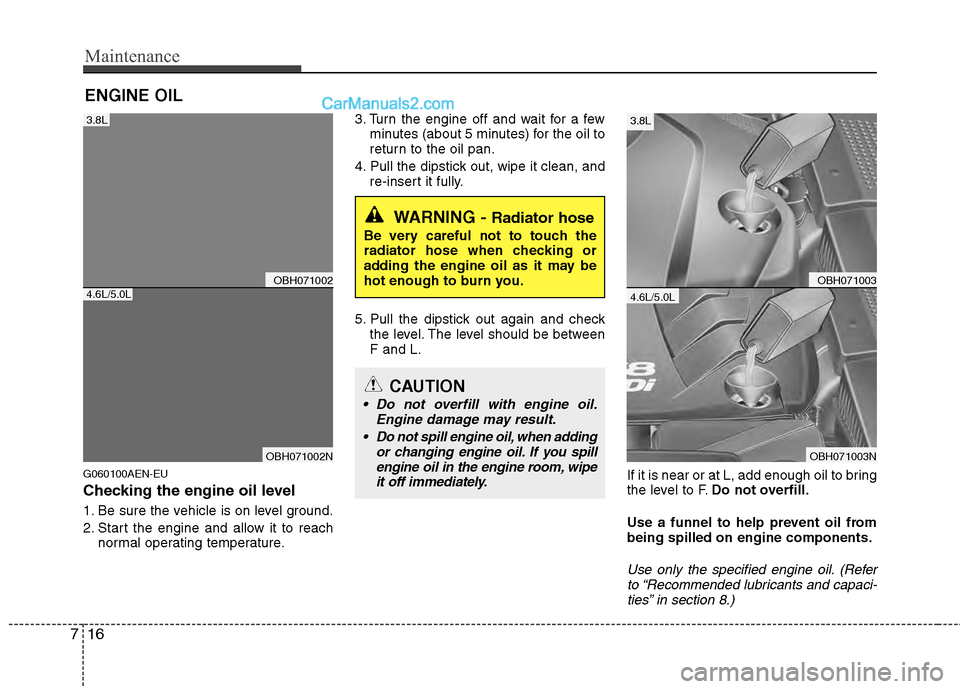
Checking the engine oil level
1. Be sure the vehicle is on level ground.
2. Start the engine and allow it to reach
normal operating temperature. 3. Turn the engine off and wait for a few
minutes (about 5 minutes) for the oil to
return to the oil pan.
4. Pull the dipstick out, wipe it clean, and re-insert it fully.
5. Pull the dipstick out again and check the level. The level should be between
F and L.
If it is near or at L, add enough oil to bring
the level to F.Do not overfill.
Use a funnel to help prevent oil from
being spilled on engine components.
Use only the specified engine oil. (Refer to “Recommended lubricants and capaci-ties” in section 8.)
OBH071002
OBH071002N
4.6L/5.0L
3.8L
OBH071003
OBH071003N
4.6L/5.0L
3.8L
WARNING - Radiator hose
Be very careful not to touch the
radiator hose when checking or
adding the engine oil as it may be
hot enough to burn you.
CAUTION
Do not overfill with engine oil. Engine damage may result.
Do not spill engine oil, when adding or changing engine oil. If you spillengine oil in the engine room, wipeit off immediately.
Page 355 of 429
721
Maintenance
BRAKE FLUID
G080100AEN
Checking the brake fluid level
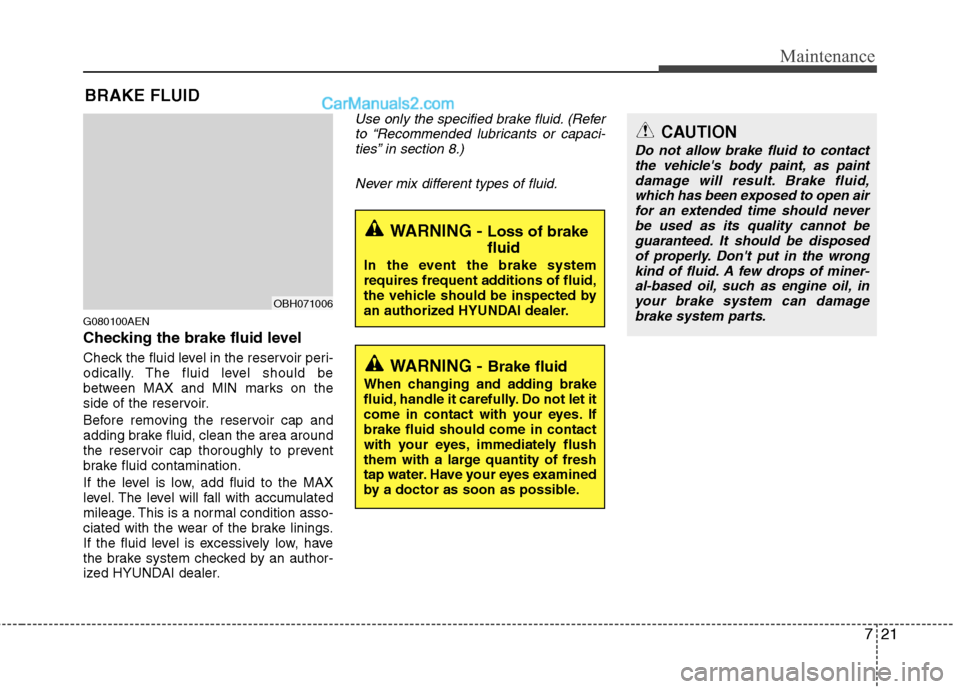
Check the fluid level in the reservoir peri-
odically. The fluid level should be
between MAX and MIN marks on the
side of the reservoir.
Before removing the reservoir cap and
adding brake fluid, clean the area around
the reservoir cap thoroughly to prevent
brake fluid contamination.
If the level is low, add fluid to the MAX
level. The level will fall with accumulated
mileage. This is a normal condition asso-
ciated with the wear of the brake linings.
If the fluid level is excessively low, have
the brake system checked by an author-
ized HYUNDAI dealer.
Use only the specified brake fluid. (Referto “Recommended lubricants or capaci-ties” in section 8.)
Never mix different types of fluid.
WARNING - Brake fluid
When changing and adding brake
fluid, handle it carefully. Do not let it
come in contact with your eyes. If
brake fluid should come in contact
with your eyes, immediately flush
them with a large quantity of fresh
tap water. Have your eyes examined
by a doctor as soon as possible.
WARNING - Loss of brake
fluid
In the event the brake system
requires frequent additions of fluid,
the vehicle should be inspected by
an authorized HYUNDAI dealer.
CAUTION
Do not allow brake fluid to contactthe vehicle's body paint, as paintdamage will result. Brake fluid, which has been exposed to open airfor an extended time should neverbe used as its quality cannot be guaranteed. It should be disposedof properly. Don't put in the wrong kind of fluid. A few drops of miner-al-based oil, such as engine oil, in your brake system can damagebrake system parts.
OBH071006
Page 356 of 429
Maintenance
22
7
POWER STEERING FLUID
G090100ABH
Checking the power steering fluid
level
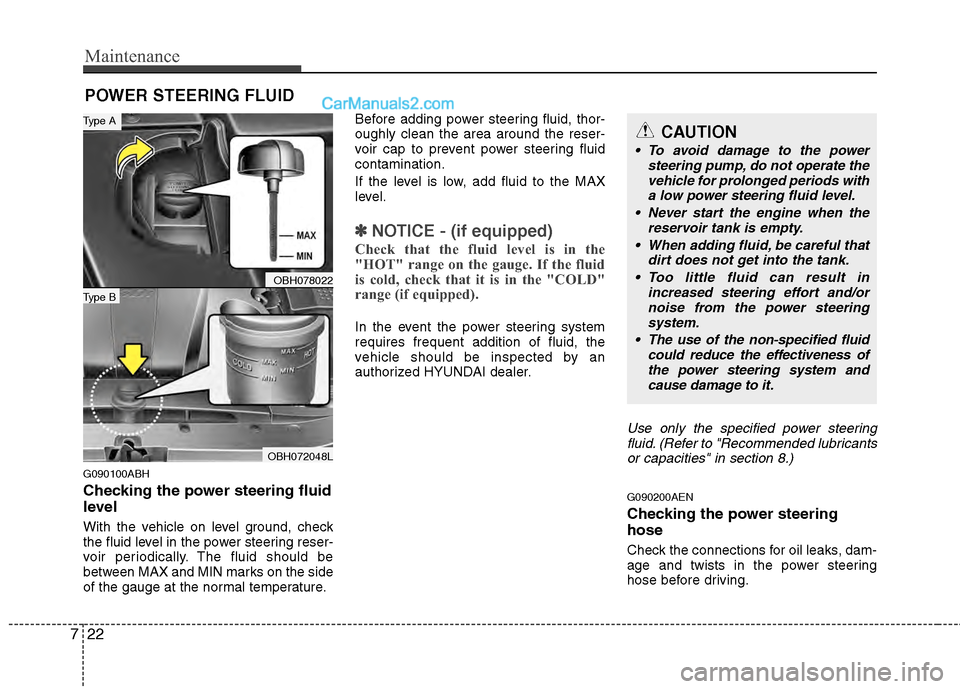
With the vehicle on level ground, check
the fluid level in the power steering reser-
voir periodically. The fluid should be
between MAX and MIN marks on the side
of the gauge at the normal temperature. Before adding power steering fluid, thor-
oughly clean the area around the reser-
voir cap to prevent power steering fluid
contamination.
If the level is low, add fluid to the MAX
level.
✽ ✽
NOTICE - (if equipped)
Check that the fluid level is in the
"HOT" range on the gauge. If the fluid
is cold, check that it is in the "COLD"
range (if equipped).
In the event the power steering system
requires frequent addition of fluid, the
vehicle should be inspected by an
authorized HYUNDAI dealer.
Use only the specified power steering
fluid. (Refer to "Recommended lubricantsor capacities" in section 8.)
G090200AEN
Checking the power steering
hose
Check the connections for oil leaks, dam-
age and twists in the power steering
hose before driving.
CAUTION
To avoid damage to the power steering pump, do not operate thevehicle for prolonged periods with a low power steering fluid level.
Never start the engine when the reservoir tank is empty.
When adding fluid, be careful that dirt does not get into the tank.
Too little fluid can result in increased steering effort and/ornoise from the power steeringsystem.
The use of the non-specified fluid could reduce the effectiveness ofthe power steering system and cause damage to it.
OBH078022
OBH072048L
Type B
Type A
Page 368 of 429
Maintenance
34
7
G190300ABH
Reset items
Items should be reset after the battery
has been discharged or the battery has
been disconnected.
Auto up/down window (See section 4)
Sunroof (See section 4)
Driver position memory system
(See section 4)
Trip computer (See section 4)
Climate control system (See section 4)
Clock (See section 4)
Audio (See section 4)
WARNING
Before performing maintenance or recharging the battery, turn off
all accessories and stop the
engine.
The negative battery cable must be removed first and installed
last when the battery is discon-
nected.
Operation related to the battery should be done at an authorized
HYUNDAI dealer.
CAUTION
Keep the battery away from water or any liquid.
The battery is in the trunk, so you should be careful when you loada container filled with liquid intothe trunk.
For your safety, use a genuine HYUNDAI approved battery whenyou replace the battery.
WARNING- Recharging battery
When recharging the battery,
observe the following precautions:
The battery must be removed
from the vehicle and placed in an
area with good ventilation.
Do not allow cigarettes, sparks, or flame near the battery.
Watch the battery during charg- ing, and stop or reduce the charg-
ing rate if the battery cells begin
gassing (boiling) violently or if
the temperature of the electrolyte
of any cell exceeds 120°F (49°C).
Wear eye protection when check- ing the battery during charging.
Disconnect the battery charger in the following order.
1. Turn off the battery charger main switch.
2. Unhook the negative clamp from the negative battery terminal.
3. Unhook the positive clamp from the positive battery terminal.
Page 383 of 429
749
Maintenance
FUSES
G210000ABH-EU
A vehicle’s electrical system is protected
from electrical overload damage by
fuses.This vehicle has 4 fuse panels, two locat-
ed in the driver’s side and passenger’s
side panel bolster, the others are in the
engine compartment.
If any of your vehicle’s lights, acces-
sories, or controls do not work, check the
appropriate circuit fuse. If a fuse has
blown, the element inside the fuse will be
melted.
If the electrical system does not work,
first check the driver’s side fuse panel.
Before replacing a blown fuse, discon-
nect the negative battery cable.
Always replace a blown fuse with one of
the same rating.
If the replacement fuse blows, this indi-
cates an electrical problem. Avoid using
the system involved and immediately
consult an authorized HYUNDAI dealer.
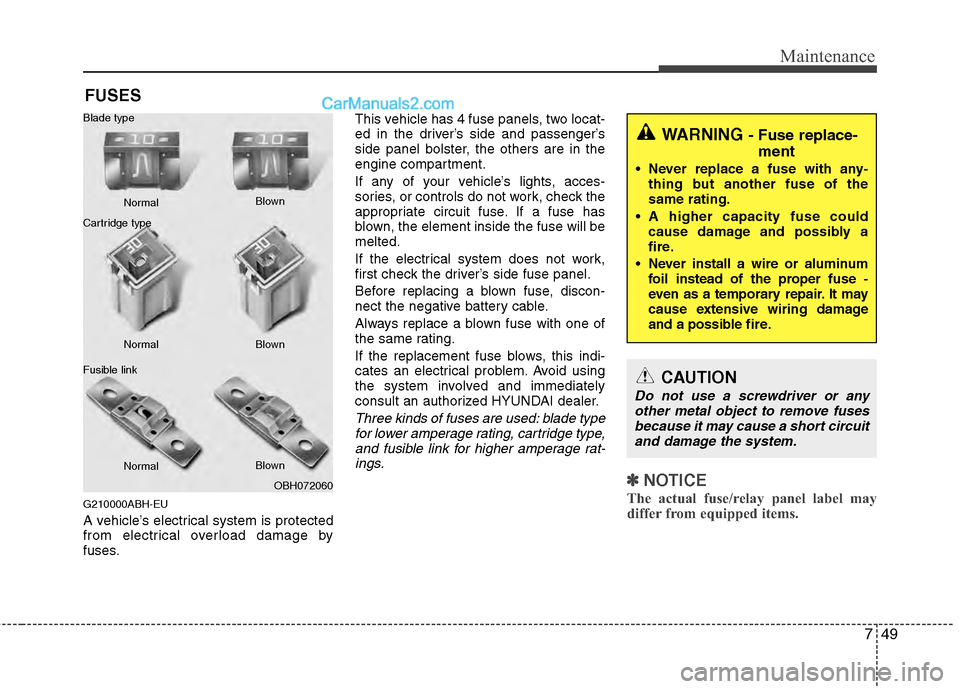
Three kinds of fuses are used: blade type
for lower amperage rating, cartridge type, and fusible link for higher amperage rat-ings.
✽ ✽ NOTICE
The actual fuse/relay panel label may
differ from equipped items.OBH072060
Normal Normal
Blade type
Cartridge type
Fusible link Blown
Blown
Normal Blown
WARNING - Fuse replace-
ment
Never replace a fuse with any-
thing but another fuse of the
same rating.
A higher capacity fuse could cause damage and possibly a
fire.
Never install a wire or aluminum foil instead of the proper fuse -
even as a temporary repair. It may
cause extensive wiring damage
and a possible fire.
CAUTION
Do not use a screwdriver or anyother metal object to remove fusesbecause it may cause a short circuit and damage the system.
Page 392 of 429
Maintenance
58
7
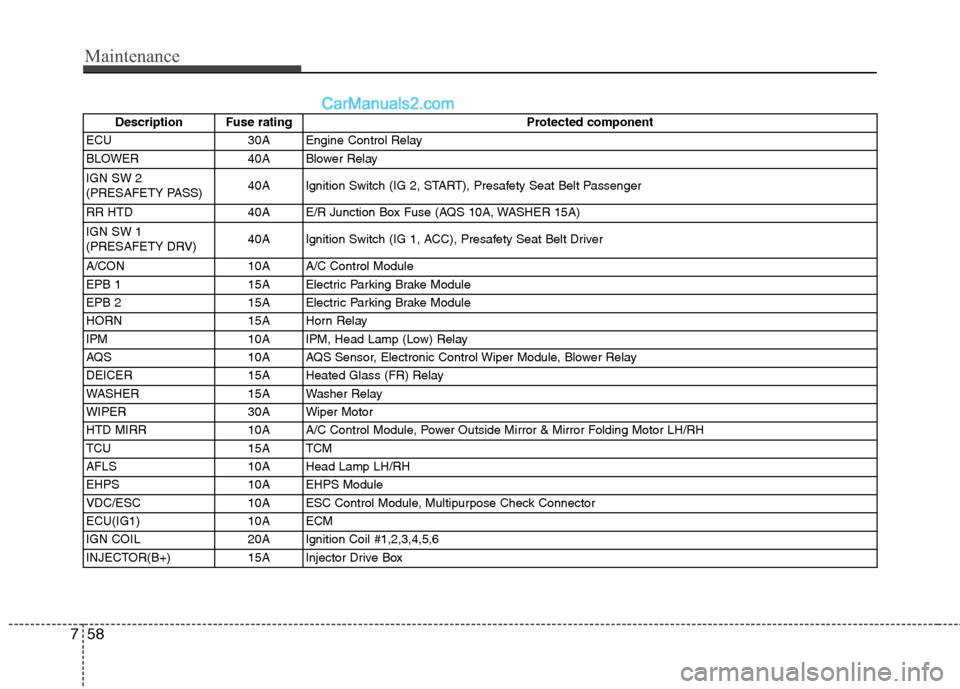
Description Fuse rating Protected component
ECU 30A Engine Control Relay
BLOWER 40A Blower Relay
IGN SW 2
(PRESAFETY PASS) 40A Ignition Switch (IG 2, START), Presafety Seat Belt Passenger
RR HTD 40A E/R Junction Box Fuse (AQS 10A, WASHER 15A)
IGN SW 1
(PRESAFETY DRV) 40A Ignition Switch (IG 1, ACC), Presafety Seat Belt Driver
A/CON 10A A/C Control Module
EPB 1 15A Electric Parking Brake Module
EPB 2 15A Electric Parking Brake Module
HORN 15A Horn Relay
IPM 10A IPM, Head Lamp (Low) Relay
AQS 10A AQS Sensor, Electronic Control Wiper Module, Blower Relay
DEICER 15A Heated Glass (FR) Relay
WASHER 15A Washer Relay
WIPER 30A Wiper Motor
HTD MIRR 10A A/C Control Module, Power Outside Mirror & Mirror Folding Motor LH/RH
TCU 15A TCM
AFLS 10A Head Lamp LH/RH
EHPS 10A EHPS Module
VDC/ESC 10A ESC Control Module, Multipurpose Check Connector
ECU(IG1) 10A ECM
IGN COIL 20A Ignition Coil #1,2,3,4,5,6
INJECTOR(B+) 15A Injector Drive Box
Page 395 of 429
761
Maintenance
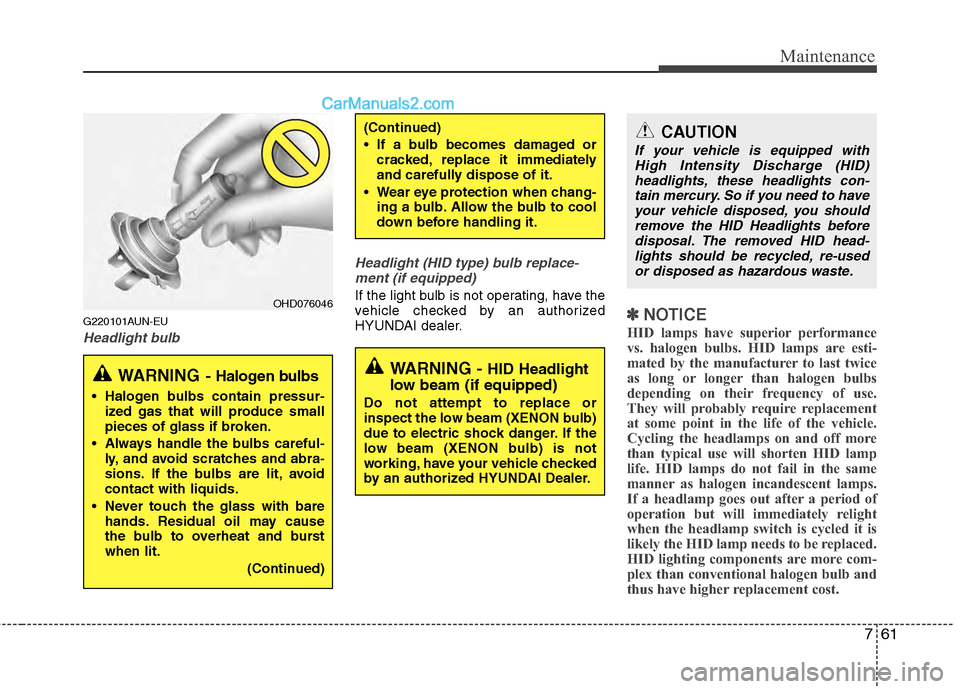
G220101AUN-EU
Headlight bulbHeadlight (HID type) bulb replace-
ment (if equipped)
If the light bulb is not operating, have the
vehicle checked by an authorized
HYUNDAI dealer.
✽ ✽ NOTICE
HID lamps have superior performance
vs. halogen bulbs. HID lamps are esti-
mated by the manufacturer to last twice
as long or longer than halogen bulbs
depending on their frequency of use.
They will probably require replacement
at some point in the life of the vehicle.
Cycling the headlamps on and off more
than typical use will shorten HID lamp
life. HID lamps do not fail in the same
manner as halogen incandescent lamps.
If a headlamp goes out after a period of
operation but will immediately relight
when the headlamp switch is cycled it is
likely the HID lamp needs to be replaced.
HID lighting components are more com-
plex than conventional halogen bulb and
thus have higher replacement cost.
OHD076046
WARNING- Halogen bulbs
Halogen bulbs contain pressur-
ized gas that will produce small
pieces of glass if broken.
Always handle the bulbs careful- ly, and avoid scratches and abra-
sions. If the bulbs are lit, avoid
contact with liquids.
Never touch the glass with bare hands. Residual oil may cause
the bulb to overheat and burst
when lit.
(Continued)
(Continued)
If a bulb becomes damaged orcracked, replace it immediately
and carefully dispose of it.
Wear eye protection when chang- ing a bulb. Allow the bulb to cool
down before handling it.
WARNING - HID Headlight
low beam (if equipped)
Do not attempt to replace or
inspect the low beam (XENON bulb)
due to electric shock danger. If the
low beam (XENON bulb) is not
working, have your vehicle checked
by an authorized HYUNDAI Dealer.
CAUTION
If your vehicle is equipped with
High Intensity Discharge (HID)headlights, these headlights con- tain mercury. So if you need to haveyour vehicle disposed, you shouldremove the HID Headlights before disposal. The removed HID head-lights should be recycled, re-used or disposed as hazardous waste.
Page 407 of 429
773
Maintenance
Keep your garage dry
Don't park your car in a damp, poorly
ventilated garage. This creates a favor-
able environment for corrosion. This is
particularly true if you wash your car in
the garage or drive it into the garage
when it is still wet or covered with snow,
ice or mud. Even a heated garage can
contribute to corrosion unless it is well
ventilated so moisture is dispersed.
Keep paint and trim in good condition
Scratches or chips in the finish should be
covered with "touch-up" paint as soon as
possible to reduce the possibility of cor-
rosion. If bare metal is showing through,
the attention of a qualified body and paint
shop is recommended.
Bird droppings : Bird droppings are high-
ly corrosive and may damage painted
surfaces in just a few hours. Always
remove bird droppings as soon as possi-
ble.Don't neglect the interior
Moisture can collect under the floor mats
and carpeting to cause corrosion. Check
under the mats periodically to be sure
the carpeting is dry. Use particular care if
you carry fertilizers, cleaning materials or
chemicals in the car.
These should be carried only in proper
containers and any spills or leaks should
be cleaned up, flushed with clean water
and thoroughly dried.Interior care
G230201AUN
Interior general precautions
Prevent chemicals such as perfume, cos-
metic oil, sun cream, hand cleaner, and
air freshener from contacting the interior
parts because they may cause damage
or discoloration. If they do contact the
interior parts, wipe them off immediately.
See the instructions for the proper way to
clean vinyl.
CAUTION
Never allow water or other liquids
to come in contact with electri-cal/electronic components insidethe vehicle as this may damagethem.
When cleaning leather products (steering wheel, seats etc.), useneutral detergents or low alcohol content solutions. If you use highalcohol content solutions or acid/alkaline detergents, the colorof the leather may fade or the sur- face may get stripped off.
Page 418 of 429
Specifications, Consumer information, Reporting safety defects
68
I040100ABH-EU
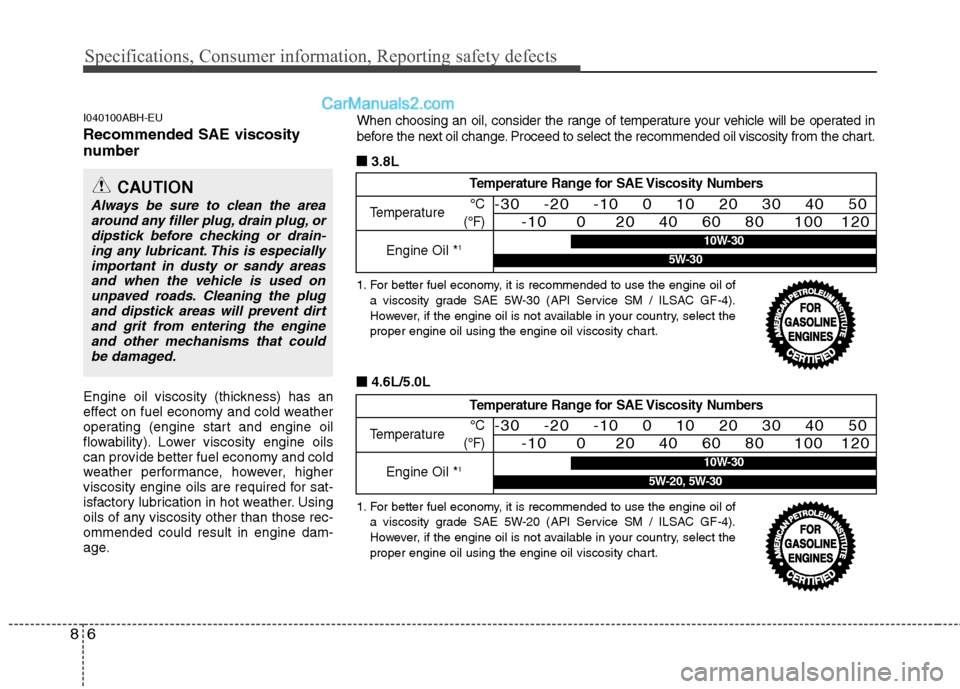
Recommended SAE viscosity
number
Engine oil viscosity (thickness) has an
effect on fuel economy and cold weather
operating (engine start and engine oil
flowability). Lower viscosity engine oils
can provide better fuel economy and cold
weather performance, however, higher
viscosity engine oils are required for sat-
isfactory lubrication in hot weather. Using
oils of any viscosity other than those rec-
ommended could result in engine dam-
age.
CAUTION
Always be sure to clean the areaaround any filler plug, drain plug, ordipstick before checking or drain-ing any lubricant. This is especiallyimportant in dusty or sandy areasand when the vehicle is used onunpaved roads. Cleaning the plugand dipstick areas will prevent dirt and grit from entering the engineand other mechanisms that couldbe damaged.
Temperature Range for SAE Viscosity Numbers
Temperature
Engine Oil *
1
°C
(°F)-30 -20 -10 0 10 20 30 40 50 -10 0 20 40 60 80 100 120
1. For better fuel economy, it is recommended to use the engine oil of
a viscosity grade SAE 5W-30 (API Service SM / ILSAC GF-4).
However, if the engine oil is not available in your country, select the
proper engine oil using the engine oil viscosity chart.
10W-30
5W-30
Temperature Range for SAE Viscosity Numbers
Temperature
Engine Oil *
1
°C
(°F)-30 -20 -10 0 10 20 30 40 50 -10 0 20 40 60 80 100 120
1. For better fuel economy, it is recommended to use the engine oil of
a viscosity grade SAE 5W-20 (API Service SM / ILSAC GF-4).
However, if the engine oil is not available in your country, select the
proper engine oil using the engine oil viscosity chart.
10W-30
5W-20, 5W-30
When choosing an oil, consider the range of temperature your vehicle will be operated in
before the next oil change. Proceed to select the recommended oil viscosity from the chart.
■ ■ 3.8L
■
■ 4.6L/5.0L