child lock Hyundai Genesis 2013 User Guide
[x] Cancel search | Manufacturer: HYUNDAI, Model Year: 2013, Model line: Genesis, Model: Hyundai Genesis 2013Pages: 429, PDF Size: 8.94 MB
Page 100 of 429
421
Features of your vehicle
D070200ABH
Closing the trunk
To close, lower the trunk lid, then press
down on it until it locks. To be sure the
trunk lid is securely fastened, always
check by trying to pull it up.
D070300ABH
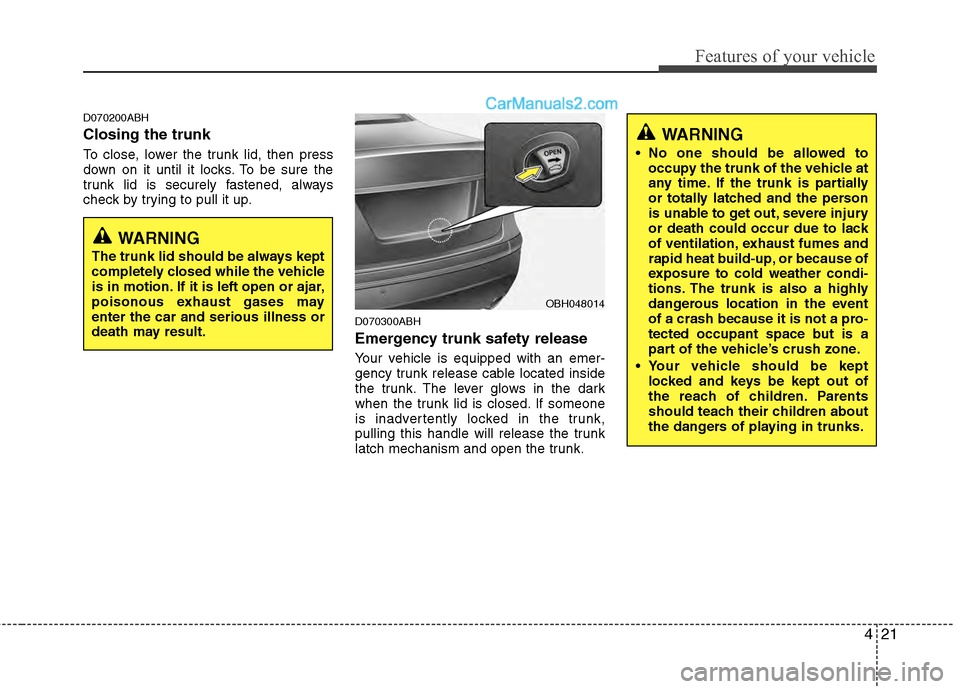
Emergency trunk safety release
Your vehicle is equipped with an emer-
gency trunk release cable located inside
the trunk. The lever glows in the dark
when the trunk lid is closed. If someone
is inadvertently locked in the trunk,
pulling this handle will release the trunk
latch mechanism and open the trunk.
OBH048014
WARNING
The trunk lid should be always kept
completely closed while the vehicle
is in motion. If it is left open or ajar,
poisonous exhaust gases may
enter the car and serious illness or
death may result.
WARNING
No one should be allowed tooccupy the trunk of the vehicle at
any time. If the trunk is partially
or totally latched and the person
is unable to get out, severe injury
or death could occur due to lack
of ventilation, exhaust fumes and
rapid heat build-up, or because of
exposure to cold weather condi-
tions. The trunk is also a highly
dangerous location in the event
of a crash because it is not a pro-
tected occupant space but is a
part of the vehicle’s crush zone.
Your vehicle should be kept locked and keys be kept out of
the reach of children. Parents
should teach their children about
the dangers of playing in trunks.
Page 105 of 429
Features of your vehicle
26
4
D080104AUN
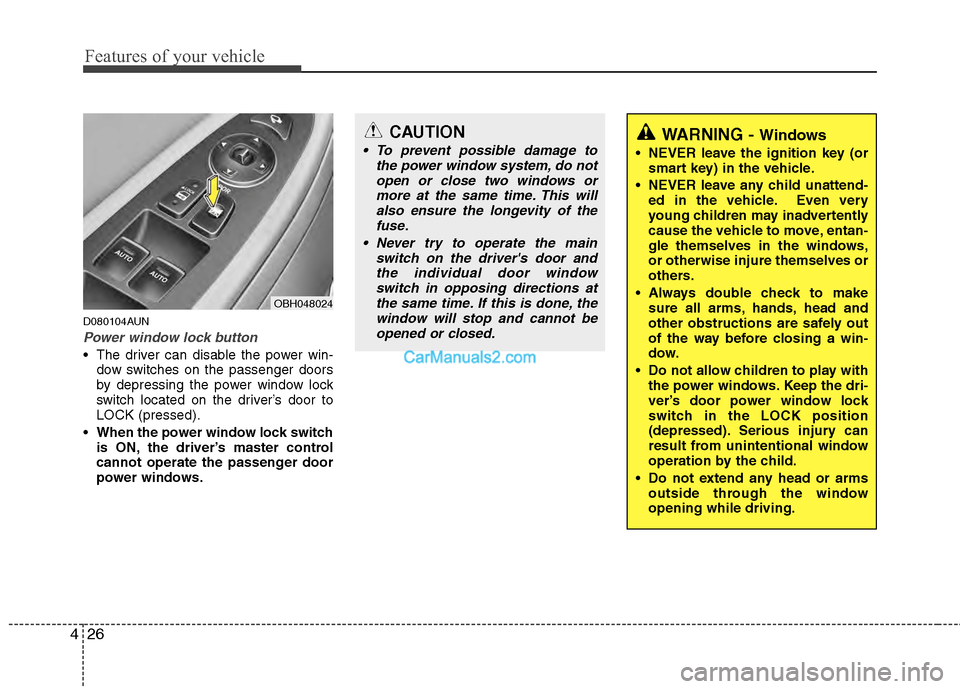
Power window lock button
The driver can disable the power win-
dow switches on the passenger doors
by depressing the power window lock
switch located on the driver’s door to
LOCK (pressed).
When the power window lock switch is ON, the driver’s master control
cannot operate the passenger door
power windows.
OBH048024
CAUTION
To prevent possible damage to the power window system, do notopen or close two windows ormore at the same time. This willalso ensure the longevity of the fuse.
Never try to operate the main switch on the driver's door andthe individual door windowswitch in opposing directions atthe same time. If this is done, thewindow will stop and cannot beopened or closed.WARNING - Windows
NEVER leave the ignition key (or smart key) in the vehicle.
NEVER leave any child unattend- ed in the vehicle. Even very
young children may inadvertently
cause the vehicle to move, entan-
gle themselves in the windows,
or otherwise injure themselves or
others.
Always double check to make sure all arms, hands, head and
other obstructions are safely out
of the way before closing a win-
dow.
Do not allow children to play with the power windows. Keep the dri-
ver’s door power window lock
switch in the LOCK position
(depressed). Serious injury can
result from unintentional window
operation by the child.
Do not extend any head or arms outside through the window
opening while driving.
Page 202 of 429
4123
Features of your vehicle
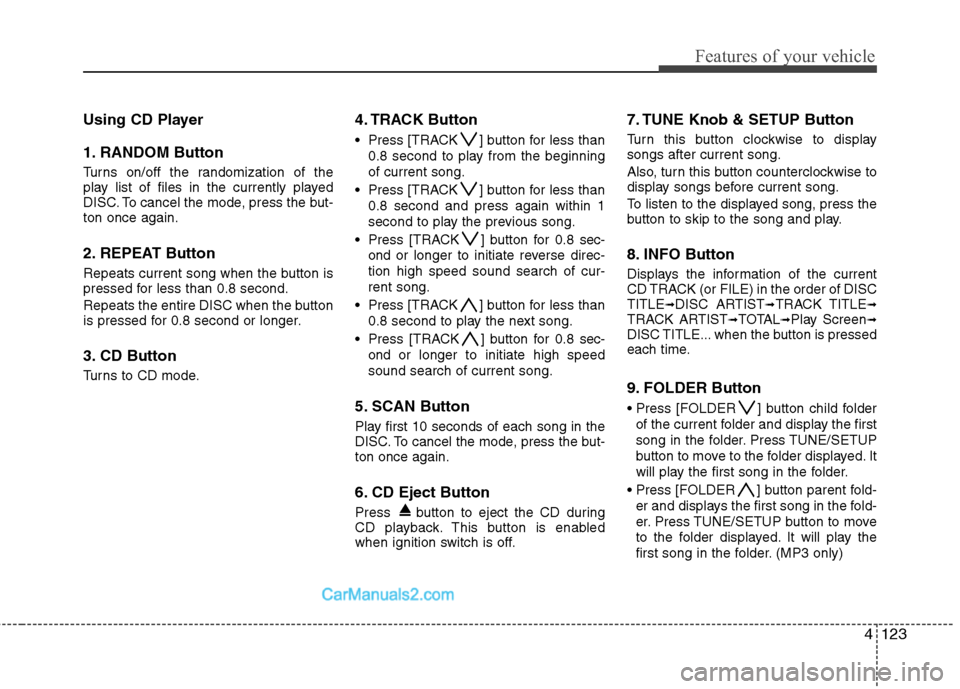
Using CD Player
1. RANDOM Button
Turns on/off the randomization of the
play list of files in the currently played
DISC. To cancel the mode, press the but-
ton once again.
2. REPEAT Button
Repeats current song when the button is
pressed for less than 0.8 second.
Repeats the entire DISC when the button
is pressed for 0.8 second or longer.
3. CD Button
Turns to CD mode.
4. TRACK Button
Press [TRACK ] button for less than0.8 second to play from the beginning
of current song.
Press [TRACK ] button for less than 0.8 second and press again within 1
second to play the previous song.
Press [TRACK ] button for 0.8 sec- ond or longer to initiate reverse direc-
tion high speed sound search of cur-
rent song.
Press [TRACK ] button for less than 0.8 second to play the next song.
Press [TRACK ] button for 0.8 sec- ond or longer to initiate high speed
sound search of current song.
5. SCAN Button
Play first 10 seconds of each song in the
DISC. To cancel the mode, press the but-
ton once again.
6. CD Eject Button
Press button to eject the CD during
CD playback. This button is enabled
when ignition switch is off.
7. TUNE Knob & SETUP Button
Turn this button clockwise to display
songs after current song.
Also, turn this button counterclockwise to
display songs before current song.
To listen to the displayed song, press the
button to skip to the song and play.
8. INFO Button
Displays the information of the current
CD TRACK (or FILE) in the order of DISC
TITLE
➟DISC ARTIST➟TRACK TITLE➟TRACK ARTIST➟TOTAL➟Play Screen➟DISC TITLE... when the button is pressed
each time.
9. FOLDER Button
Press [FOLDER ] button child folderof the current folder and display the first
song in the folder. Press TUNE/SETUP
button to move to the folder displayed. It
will play the first song in the folder.
Press [FOLDER ] button parent fold- er and displays the first song in the fold-
er. Press TUNE/SETUP button to move
to the folder displayed. It will play the
first song in the folder. (MP3 only)
Page 243 of 429
Driving your vehicle
45
E020300AUN
Before starting
Close and lock all doors.
Position the seat so that all controls areeasily reached.
Adjust the inside and outside rearview mirrors.
Be sure that all lights work.
Check all gauges.
Check the operation of warning lights when the ignition switch is turned to
the ON position.
Release the parking brake and make sure the brake warning light goes out.
For safe operation, be sure you are famil-
iar with your vehicle and its equipment.
WARNING
Always check the surrounding
areas near your vehicle for people,
especially children, before putting a
car into D (Drive) or R (Reverse).
WARNING
When you intend to park or stop the vehicle with the engine on, be
careful not to depress the accel-
erator pedal for a long period of
time. It may overheat the engine
or exhaust system and cause fire.
When you make a sudden stop or turn the steering wheel rapidly,
loose objects may drop on the
floor and it could interfere with
the operation of the foot pedals,
possibly causing an accident.
Keep all things in the vehicle
safely stored.
If you do not focus on driving, it may cause an accident. Be care-
ful when operating controls such
as the audio or heater. It is the
responsibility of the driver to
always be attentive to the task of
driving and drive safely.
WARNING- Driving under
the influence of alcohol or
drugs
Drinking and driving is dangerous.
Drunk driving is the number one
contributor to the highway death
toll each year. Even a small amount
of alcohol will affect your reflexes,
perceptions and judgment. Driving
while under the influence of drugs
is as dangerous or more dangerous
than driving drunk.
You are much more likely to have a
serious accident if you drink or
take drugs and drive.
If you are drinking or taking drugs,
don’t drive. Do not ride with a driv-
er who has been drinking or taking
drugs. Choose a designated driver
or call a cab.
WARNING
All passengers must be properly
belted whenever the vehicle is mov-
ing. Refer to “Seat belts” in section
3 for more information on their
proper use.
Page 251 of 429
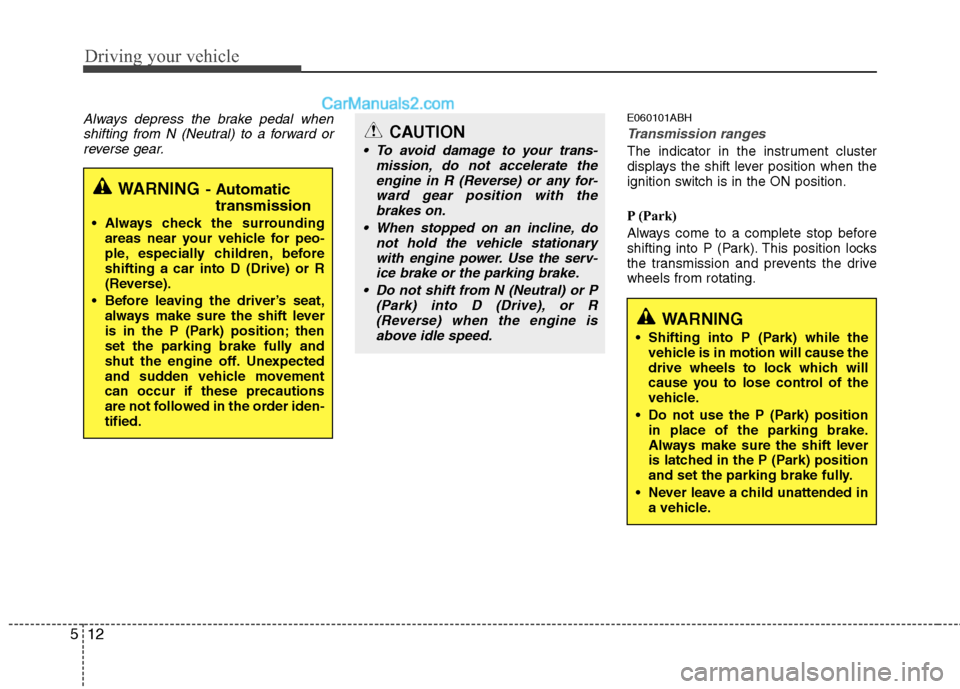
Driving your vehicle
12
5
Always depress the brake pedal when
shifting from N (Neutral) to a forward orreverse gear.E060101ABH
Transmission ranges
The indicator in the instrument cluster
displays the shift lever position when the
ignition switch is in the ON position.
P (Park)
Always come to a complete stop before
shifting into P (Park). This position locks
the transmission and prevents the drive
wheels from rotating.
WARNING- Automatic transmission
Always check the surrounding
areas near your vehicle for peo-
ple, especially children, before
shifting a car into D (Drive) or R
(Reverse).
Before leaving the driver’s seat, always make sure the shift lever
is in the P (Park) position; then
set the parking brake fully and
shut the engine off. Unexpected
and sudden vehicle movement
can occur if these precautions
are not followed in the order iden-
tified.
CAUTION
To avoid damage to your trans- mission, do not accelerate theengine in R (Reverse) or any for-ward gear position with thebrakes on.
When stopped on an incline, do not hold the vehicle stationarywith engine power. Use the serv-ice brake or the parking brake.
Do not shift from N (Neutral) or P (Park) into D (Drive), or R(Reverse) when the engine isabove idle speed.
WARNING
Shifting into P (Park) while the vehicle is in motion will cause the
drive wheels to lock which will
cause you to lose control of the
vehicle.
Do not use the P (Park) position in place of the parking brake.
Always make sure the shift lever
is latched in the P (Park) position
and set the parking brake fully.
Never leave a child unattended in a vehicle.
Page 424 of 429

Index
2I
Air bag - advanced supplemental restraint system ······ 3-35Air bag warning label ··················\
··················\
············ 3-60
Curtain air bag ··················\
··················\
··················\
····· 3-52
Driver's and passenger's front air bag ··················\
····· 3-46
Occupant classification system ··················\
··············· 3-41
Side impact air bag ··················\
··················\
················ 3-50
SRS components and functions ··················\
··············· 3-38
Air cleaner ··················\
··················\
··················\
············· 7-24
Appearance care ··················\
··················\
··················\
···· 7-69
Audio system ··················\
··················\
··················\
······· 4-115 Antenna ················\
··················\
··················\
··············· 4-115
Bluetooth
®Wireless Technology phone operation ····4-151
HD RadioTM··················\
··················\
··················\
··········4-147
PA710BH ·················\
··················\
··················\
············ 4-120
PA760BH ·················\
··················\
··················\
············ 4-133
Steering wheel audio control ··················\
················· 4-115
Automatic climate control system ··················\
············· 4-89 Air conditioning ··················\
··················\
··················\
·· 4-96
Automatic heating and air conditioning ··················\
·· 4-90
Manual heating and air conditioning ··················\
······ 4-91
Rear vent ··················\
··················\
··················\
··········· 4-100
Automatic transmission ··················\
··················\
··········· 5-11 Ignition key interlock system ··················\
··················\
5-15
Shift lock system ··················\
··················\
··················\
· 5-14
Sports mode ··················\
··················\
··················\
········· 5-14 Battery ················\
··················\
··················\
··················\
··· 7-32
Before driving ··················\
··················\
··················\
·········· 5-3
Binding arbitration ··················\
··················\
··················\
· 8-10
Brake fluid ··················\
··················\
··················\
············· 7-21
Brake system ··················\
··················\
··················\
········· 5-18
Anti-lock brake system (ABS) ··················\
················ 5-28
Auto hold ··················\
··················\
··················\
···············5-25
Electric parking brake (EPB) ··················\
··················\
··5-20
Electronic stability control (ESC) ··················\
··········· 5-30
Parking brake ··················\
··················\
··················\
······· 5-19
Power brakes ··················\
··················\
··················\
······· 5-18
Bulb wattage ··················\
··················\
··················\
············ 8-2
California perchlorate notice ··················\
··················\
··· 7-78
Child restraint system ··················\
··················\
·············· 3-27 Placing a passenger seat belt into the auto lock mode ·················\
··················\
··················\
··················\
· 3-29
Securing a child restraint seat with tether anchor system ·················\
··················\
··················\
················· 3-31
Securing a child restraint seat with child seat lower anchor system ··················\
··················\
··················\
···· 3-33
Climate control air filter ··················\
··················\
·········· 7-27
Consumer information ··················\
··················\
··············· 8-9
Cruise control system ··················\
··················\
·············· 5-36
AB
C
Page 425 of 429

I3
Index
Defroster ················\
··················\
··················\
··················\
4-88
Dimensions ················\
··················\
··················\
················ 8-2
Door locks ··················\
··················\
··················\
············· 4-16Central door lock switch ··················\
··················\
······· 4-17
Child-protector rear door lock ··················\
················· 4-19
Driver position memory system ··················\
················ 4-34
Economical operation ··················\
··················\
·············· 5-54
Emergency starting ··················\
··················\
··················\
·· 6-4 Jump starting ··················\
··················\
··················\
········· 6-4
Push starting ··················\
··················\
··················\
·········· 6-5
Emission control system ··················\
··················\
·········· 7-75 Crankcase emission control system ··················\
········ 7-75
Evaporative emission control (including ORVR: Onboard Refueling Vapor Recovery) System ········· 7-75
Exhaust emission control system ··················\
············ 7-76
Engine compartment ··················\
··················\
·········· 2-4, 7-2
Engine coolant ··················\
··················\
··················\
······· 7-18
Engine number ··················\
··················\
··················\
········· 8-7
Engine oil ··················\
··················\
··················\
··············· 7-16
Engine start/stop button ··················\
··················\
············· 5-7 Engine start/stop button position ··················\
··············· 5-7
Starting the engine ··················\
··················\
··················\
· 5-9
Explanation of scheduled maintenance items ············· 7-13 Foot parking brake ··················\
··················\
··················\
···7-25
Fuel filler lid ··················\
··················\
··················\
·········· 4-28
Emergency fuel filer lid release ··················\
·············· 4-30
Fuel requirements ··················\
··················\
··················\
···· 1-3
Fuses ·················\
··················\
··················\
··················\
····· 7-49 Fuse/relay panel description ··················\
··················\
·· 7-53
Main fuse ··················\
··················\
··················\
············· 7-52
Memory fuse ··················\
··················\
··················\
······· 7-51
Hazard warning flasher ··················\
··················\
············ 4-76
Headrest ··················\
··················\
··················\
············3-6, 3-11
Hood ·················\
··················\
··················\
··················\
····· 4-27
How to use this manual ··················\
··················\
············· 1-2
If the engine overheats ··················\
··················\
·············· 6-6
If the engine will not start ··················\
··················\
········· 6-3
If you have a flat tire ··················\
··················\
··············· 6-13 Changing tires ··················\
··················\
··················\
····· 6-14
Compact spare tire ··················\
··················\
················· 6-19
Jack and tools ··················\
··················\
··················\
······ 6-13
Removing and storing the spare tire ··················\
······· 6-14
In case of an emergency while driving ··················\
········ 6-2
D
E
F
H
I