eco off Hyundai Genesis 2013 User Guide
[x] Cancel search | Manufacturer: HYUNDAI, Model Year: 2013, Model line: Genesis, Model: Hyundai Genesis 2013Pages: 429, PDF Size: 8.94 MB
Page 61 of 429
Safety features of your vehicle
42
3
Always be sure that you and all vehicle
occupants are seated and restrained
properly (sitting upright with the seat in
an upright position, centered on the seat
cushion, with the person's legs comfort-
ably extended, feet on the floor, and
wearing the safety belt properly) for the
most effective protection by the air bag
and the safety belt.
The OCS may not function properly if
the passenger takes actions which can
affect the detection system. These
include:
(1) Failing to sit in an upright position.
(2) Leaning against the door or center console.
(3) Sitting towards the sides or the front of the seat.
(4) Putting legs on the dashboard or resting them on other locations
which reduce the passenger weight
on the front seat.
(5) Improperly wearing the safety belt.
(6) Reclining the seat back.C040301ABH
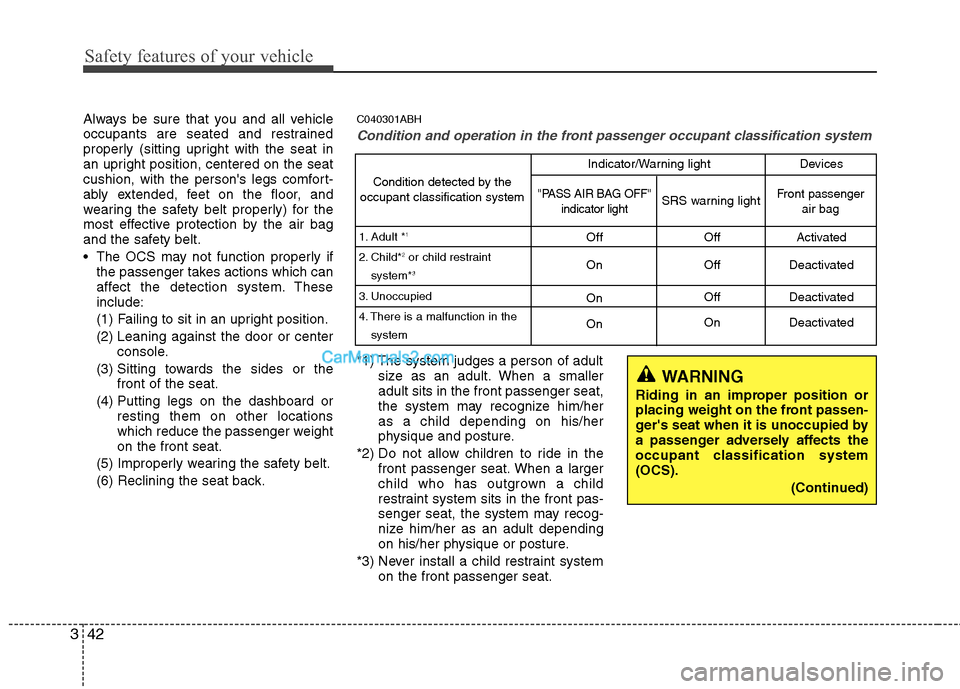
Condition and operation in the front passenger occupant classification system
*1) The system judges a person of adult size as an adult. When a smaller
adult sits in the front passenger seat,
the system may recognize him/her
as a child depending on his/her
physique and posture.
*2) Do not allow children to ride in the front passenger seat. When a larger
child who has outgrown a child
restraint system sits in the front pas-
senger seat, the system may recog-
nize him/her as an adult depending
on his/her physique or posture.
*3) Never install a child restraint system on the front passenger seat.
WARNING
Riding in an improper position or
placing weight on the front passen-
ger's seat when it is unoccupied by
a passenger adversely affects the
occupant classification system
(OCS).
(Continued)
Condition detected by the
occupant classification system
1. Adult *1
2. Child*2or child restraint
system*3
3. Unoccupied
4. There is a malfunction in the system
Off
On
On
On Off
Off
Off
On Activated
Deactivated
Deactivated
Deactivated
"PASS AIR BAG OFF" indicator lightSRS warning lightFront passenger air bag
Indicator/Warning light Devices
Page 63 of 429
Safety features of your vehicle
44
3
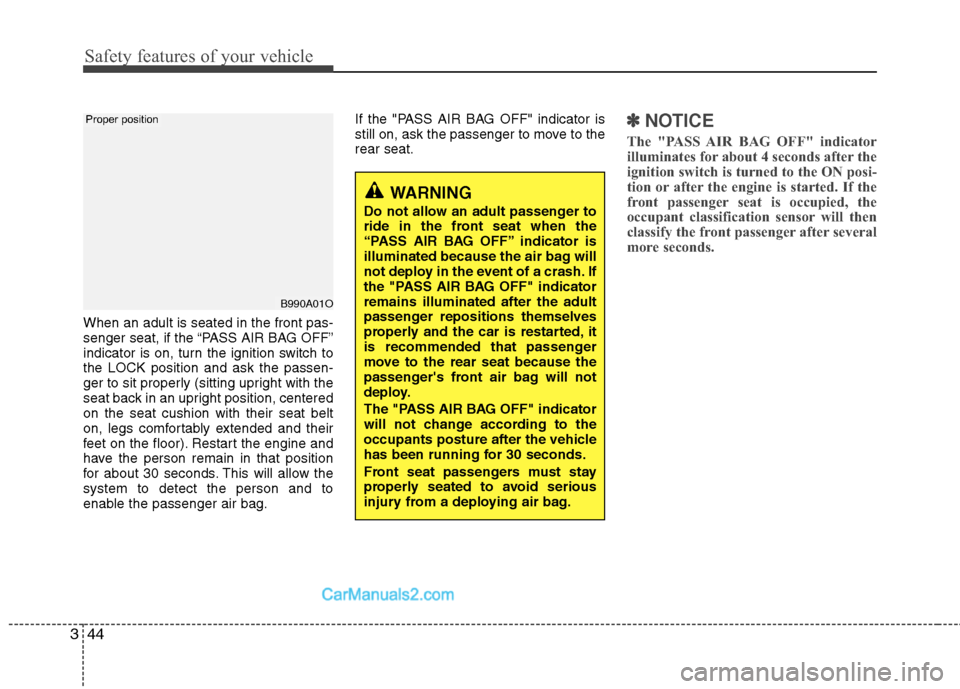
When an adult is seated in the front pas-
senger seat, if the “PASS AIR BAG OFF”
indicator is on, turn the ignition switch to
the LOCK position and ask the passen-
ger to sit properly (sitting upright with the
seat back in an upright position, centered
on the seat cushion with their seat belt
on, legs comfortably extended and their
feet on the floor). Restart the engine and
have the person remain in that position
for about 30 seconds. This will allow the
system to detect the person and to
enable the passenger air bag. If the "PASS AIR BAG OFF" indicator is
still on, ask the passenger to move to the
rear seat.
✽ ✽
NOTICE
The "PASS AIR BAG OFF" indicator
illuminates for about 4 seconds after the
ignition switch is turned to the ON posi-
tion or after the engine is started. If the
front passenger seat is occupied, the
occupant classification sensor will then
classify the front passenger after several
more seconds.
B990A01O
WARNING
Do not allow an adult passenger to
ride in the front seat when the
“PASS AIR BAG OFF” indicator is
illuminated because the air bag will
not deploy in the event of a crash. If
the "PASS AIR BAG OFF" indicator
remains illuminated after the adult
passenger repositions themselves
properly and the car is restarted, it
is recommended that passenger
move to the rear seat because the
passenger's front air bag will not
deploy.
The "PASS AIR BAG OFF" indicator
will not change according to the
occupants posture after the vehicle
has been running for 30 seconds.
Front seat passengers must stay
properly seated to avoid serious
injury from a deploying air bag.
Proper position
Page 64 of 429
345
Safety features of your vehicle
(Continued)
Air bags can only be used once –have an authorized HYUNDAI
dealer replace the air bag imme-
diately after deployment.
A smaller-stature adult who is not seated correctly (for example:
seat excessively reclined, leaning
on the door or center console, or
hips shifted forward in the seat)
can cause a condition where the
advanced frontal air bag system
senses less weight than if the
occupant were seated properly
(sitting upright with the seatback
in an upright position, centered
on the seat cushion with their
seat belt on, legs comfortably
extended and their feet on the
floor).
This condition can result in an
adult potentially being misclassi-
fied and illumination of the
"PASS AIR BAG OFF" indicator.(Continued)
Do not modify or replace the frontpassenger seat. Don't place any-
thing on or attach anything such
as a blanket or seat heater to the
front passenger seat. This can
adversely affect the occupant
classification system.
Do not sit on sharp objects such as tools when occupying the
front passenger seat. This can
adversely affect the occupant
classification system.
Do not use accessory seat cov- ers on the front seats.
Accident statistics show that children are safer if they are
restrained in the rear, as opposed
to the front seat. It is recom-
mended that child restraints be
secured in a rear seat, including
an infant riding in a rear-facing
infant seat, a child riding in a for-
ward-facing child seat and an
older child riding in a booster
seat.
(Continued)WARNING
Even though your vehicle isequipped with the occupant clas-
sification system, never install a
child restraint system in the front
passenger's seat. A deploying air
bag can forcefully strike a child
resulting in serious injuries or
death. Any child age 12 and
under should ride in the rear seat.
Children too large for child
restraints should use the avail-
able lap/shoulder belts. No mat-
ter what type of crash, children of
all ages are safer when restrained
in the rear seat.
If the "PASS AIR BAG OFF" indi- cator is illuminated when the
front passenger's seat is occu-
pied by an adult and he/she sits
properly (sitting upright with the
seatback in an upright position,
centered on the seat cushion
with their seat belt on, legs com-
fortably extended and their feet
on the floor), have that person sit
in the rear seat.
(Continued)
Page 65 of 429
Safety features of your vehicle
46
3
C040400BBH-EU
Driver's and passenger's front air
bag
Your vehicle is equipped with a
Supplemental Restraint (Air Bag) System
and the lap/shoulder belts at both the
driver and passenger seating positions.
The indications of the system's presence
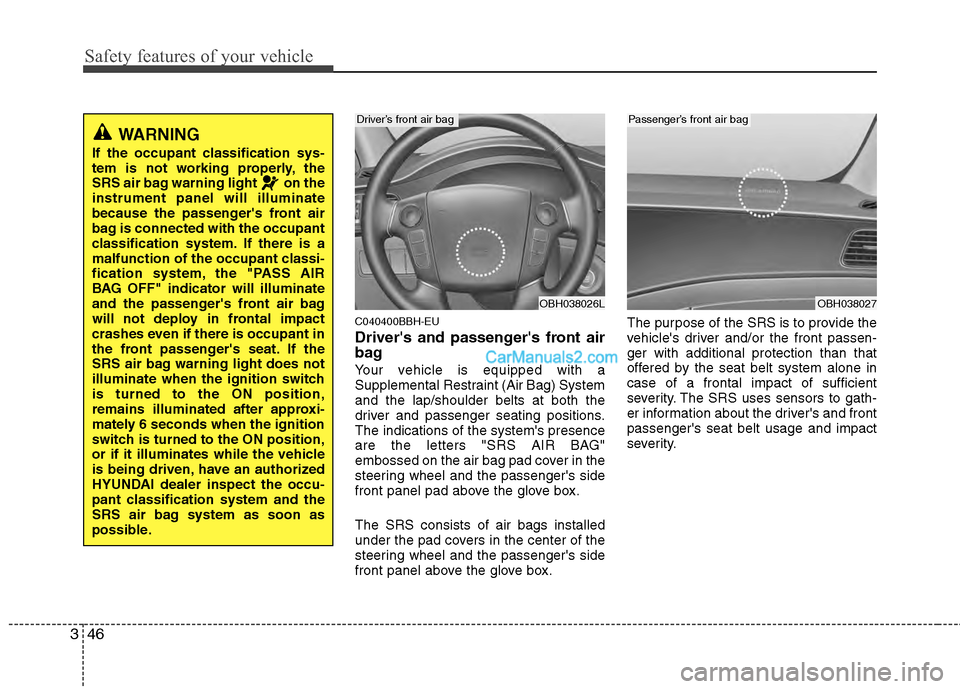
are the letters "SRS AIR BAG"
embossed on the air bag pad cover in the
steering wheel and the passenger's side
front panel pad above the glove box.
The SRS consists of air bags installed
under the pad covers in the center of the
steering wheel and the passenger's side
front panel above the glove box. The purpose of the SRS is to provide the
vehicle's driver and/or the front passen-
ger with additional protection than that
offered by the seat belt system alone in
case of a frontal impact of sufficient
severity. The SRS uses sensors to gath-
er information about the driver's and front
passenger's seat belt usage and impact
severity.
OBH038026L
Driver’s front air bag
WARNING
If the occupant classification sys-
tem is not working properly, the
SRS air bag warning light on the
instrument panel will illuminate
because the passenger's front air
bag is connected with the occupant
classification system. If there is a
malfunction of the occupant classi-
fication system, the "PASS AIR
BAG OFF" indicator will illuminate
and the passenger's front air bag
will not deploy in frontal impact
crashes even if there is occupant in
the front passenger's seat. If the
SRS air bag warning light does not
illuminate when the ignition switch
is turned to the ON position,
remains illuminated after approxi-
mately 6 seconds when the ignition
switch is turned to the ON position,
or if it illuminates while the vehicle
is being driven, have an authorized
HYUNDAI dealer inspect the occu-
pant classification system and the
SRS air bag system as soon as
possible.
OBH038027
Passenger’s front air bag
Page 66 of 429
347
Safety features of your vehicle
The seat belt buckle sensors determine if
the driver and front passenger's seat
belts are fastened. These sensors pro-
vide the ability to control the SRS deploy-
ment based on whether or not the seat
belts are fastened, and how severe the
impact is.
The advanced SRS offers the ability to
control the air bag inflation within two lev-
els. A first stage level is provided for mod-
erate-severity impacts. A second stage
level is provided for more severe impacts.
According to the impact severity, and
seat belt usage, the SRSCM (SRS
Control Module) controls the air bag
inflation. Failure to properly wear seat
belts can increase the risk or severity of
injury in an accident.Additionally, your vehicle is equipped
with an occupant classification system in
the front passenger's seat. The occupant
classification system detects the pres-
ence of a passenger in the front passen-
ger's seat and will turn off the front pas-
senger's air bag under certain condi-
tions. For more detail, see "Occupant
classification system" in this section.
WARNING
If the occupant classification sys-
tem is not working properly, the
SRS air bag warning light on the
instrument panel will illuminate
because the SRS air bag warning
light is connected with the occu-
pant classification system. If the
SRS air bag warning light does not
illuminate when the ignition switch
is turned to the ON position,
remains illuminated after approxi-
mately 6 seconds when the ignition
switch is turned to the ON position,
or if it illuminates while the vehicle
is being driven, have an authorized
HYUNDAI dealer inspect the
advanced SRS air bag system as
soon as possible.
WARNING
Do not place any objects under-
neath the front seats as they could
interfere with the occupant classifi-
cation system.
Page 70 of 429
351
Safety features of your vehicle
Your vehicle is equipped with a side
impact air bag in each front and outboard
rear seat. The purpose of the air bag is to
provide the vehicle's driver and/or the
front and outboard rear passenger with
additional protection than that offered by
the seat belt alone.
The side impact air bags are designed to
deploy only during certain side-impact
collisions, depending on the crash sever-
ity, angle, speed and point of impact. The
side impact air bags are not designed to
deploy in all side impact situations.(Continued)
Do not install any accessories onthe side or near the side impact
air bag.
Do not place any objects over the air bag or between the air bag
and yourself.
Do not place any objects (an umbrella, bag, etc.) between the
door and the seat. Such objects
may become dangerous projec-
tiles and cause injury if the sup-
plemental side impact air bag
inflates.
To prevent unexpected deploy- ment of the side impact air bag
that may result in personal injury,
avoid impact to the side impact
sensor when the ignition switch
is on.
If the seat or seat cover is dam- aged, have the vehicle checked
and repaired by an authorized
HYUNDAI dealer because your
vehicle is equipped with side
impact air bags and an occupant
classification system.WARNING
The side impact air bag is sup-plemental to the seat belt sys-
tems and is not a substitute for
them. Therefore your seat belts
must be worn at all times while
the vehicle is in motion. The air
bags deploy only in certain side
impact conditions severe enough
to cause significant injury to the
vehicle occupants.
For best protection from the side impact air bag system and to
avoid being injured by the
deploying side impact air bag, all
seat occupants should sit in an
upright position with the seat belt
properly fastened. The driver's
hands should be placed on the
steering wheel at the 9:00 and
3:00 positions. The passengers'
arms and hands should be
placed on their laps.
Do not use any accessory seat covers.
Use of seat covers could reduce or prevent the effectiveness of
the system.
(Continued)
WARNING
Do not allow the passengers to lean
their heads or bodies onto doors,
put their arms on the doors, stretch
their arms out of the window, or
place objects between the doors
and passengers when they are
seated on seats equipped with side
and/or curtain air bags.
Page 72 of 429
353
Safety features of your vehicle
C040800ABH
Why didn’t my air bag go off in a
collision? (Inflation and non-infla-
tion conditions of the air bag)
There are many types of accidents in
which the air bag would not be expect-
ed to provide additional protection.
These include rear impacts, second or
third collisions in multiple impact
accidents, as well as low speed
impacts.
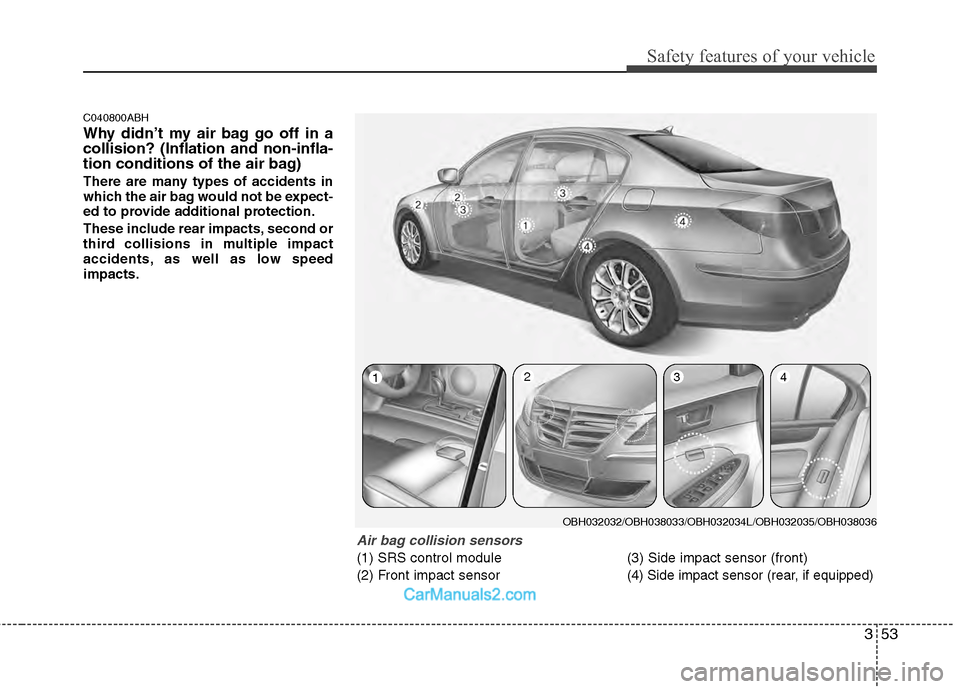
Air bag collision sensors
(1) SRS control module
(2) Front impact sensor(3) Side impact sensor (front)
(4) Side impact sensor (rear, if equipped)
OBH032032/OBH038033/OBH032034L/OBH032035/OBH038036
1234
Page 93 of 429
Features of your vehicle
14
4
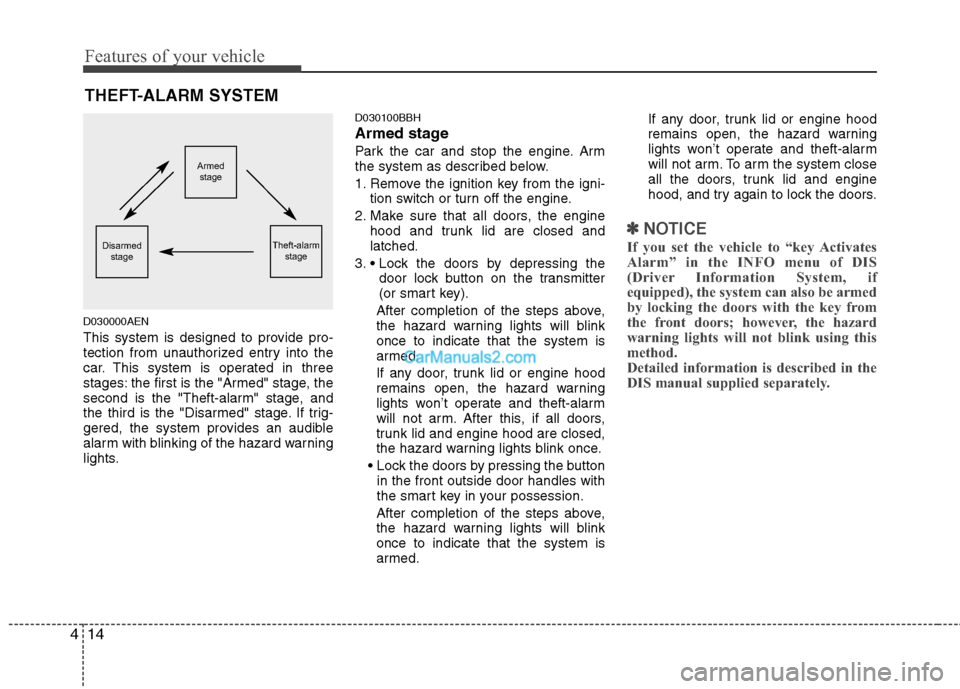
D030000AEN
This system is designed to provide pro-
tection from unauthorized entry into the
car. This system is operated in three
stages: the first is the "Armed" stage, the
second is the "Theft-alarm" stage, and
the third is the "Disarmed" stage. If trig-
gered, the system provides an audible
alarm with blinking of the hazard warning
lights.
D030100BBH
Armed stage
Park the car and stop the engine. Arm
the system as described below.
1. Remove the ignition key from the igni-
tion switch or turn off the engine.
2. Make sure that all doors, the engine hood and trunk lid are closed and
latched.
3. door lock button on the transmitter
(or smart key).
After completion of the steps above,
the hazard warning lights will blink
once to indicate that the system is
armed.
If any door, trunk lid or engine hood
remains open, the hazard warning
lights won’t operate and theft-alarm
will not arm. After this, if all doors,
trunk lid and engine hood are closed,
the hazard warning lights blink once.
in the front outside door handles with
the smart key in your possession.
After completion of the steps above,
the hazard warning lights will blink
once to indicate that the system is
armed. If any door, trunk lid or engine hood
remains open, the hazard warning
lights won’t operate and theft-alarm
will not arm. To arm the system close
all the doors, trunk lid and engine
hood, and try again to lock the doors.
✽ ✽
NOTICE
If you set the vehicle to “key Activates
Alarm” in the INFO menu of DIS
(Driver Information System, if
equipped), the system can also be armed
by locking the doors with the key from
the front doors; however, the hazard
warning lights will not blink using this
method.
Detailed information is described in the
DIS manual supplied separately.
THEFT-ALARM SYSTEM
Armed
stage
Theft-alarm stageDisarmedstage
Page 94 of 429
415
Features of your vehicle
Do not arm the system until all pas-
sengers have left the vehicle. If the
system is armed while a passenger(s)
remains in the vehicle, the alarm may
be activated when the remaining pas-
senger(s) leave the vehicle. If any
door (or trunk) or engine hood is
opened within 30 seconds after the
system enters the armed stage, the
system is disarmed to prevent an
unnecessary alarm.
D030200ABH-EU
Theft-alarm stage
The alarm will be activated if any of the
following occurs while the system is
armed.
A door is opened without using thetransmitter (or smart key).
The trunk is opened without using the transmitter (or smart key).
The engine hood is opened.
The horn will sound and the hazard
warning lights will blink continuously for
approximately 30 seconds, and the alarm
will repeat once more unless the system
is disarmed. To turn off the system,
unlock the doors with the ignition key or
transmitter.
D020106ABH
Opening the trunk with the alarm
armed (if equipped)
When the alarm is armed, the alarm will
not sound if the trunk lid is opened with
the transmitter (or the smart key).
Once the trunk is opened and then
closed, the trunk will be locked automati-
cally and the system will be armed again.
Also, if any of the doors or hood is
opened while the trunk lid open and the
alarm armed, the alarm will sound.
D030400ABH-EE
Disarmed stage
The system will be disarmed when the
doors are unlocked with the transmitter
(or smart key).
After depressing the unlock button, the
hazard warning lights will blink and the
chime will sound twice to indicate that the
system is disarmed.
After depressing the unlock button, if any
door (or trunk) is not opened within 30
seconds, the system will be rearmed.
✽ ✽ NOTICE
• Avoid trying to start the engine while
the alarm is activated. The vehicle
starter motor is disabled during the
theft-alarm stage.
If the system is not disarmed with the
transmitter, insert the key into the
ignition switch, turn the ignition
switch to the ON position and wait for
30 seconds. Then the system will be
disarmed. (for Canada)
• If you lose your keys, consult your authorized HYUNDAI dealer.
CAUTION
Do not change, alter or adjust the
theft-alarm system because it couldcause the theft-alarm system tomalfunction. The system should only be serviced by an authorizedHYUNDAI dealer.
Malfunctions caused by improperalterations, adjustments or modifi-cations to the theft-alarm systemare not covered by your vehicle manufacturer warranty.
Page 97 of 429
Features of your vehicle
18
4
When pushing down on the front por-
tion (1) of the switch, all vehicle doors
will lock.
When pushing down on the rear por- tion (2) of the switch, all vehicle doors
will unlock.
If the key is in the ignition switch or the smart key is in the vehicle, and any
door is open, the doors will not lock
even though the front portion (1) of
central door lock switch is pressed.D050300AAM-EE
Impact sensing door unlock system
(if equipped)
In the event of air bag deployment result-
ing from a vehicle impact, all doors will
automatically unlock.
D050400ABH-EU
Speed sensing door lock system
(if equipped)
All doors will be automatically locked
when the vehicle speed exceeds 9 mph
(15 km/h). And all doors will be automat-
ically unlocked after you turn the engine
off or when you remove the ignition key.
(if equipped)
WARNING- Unlocked
vehicles
Leaving your vehicle unlocked can
invite theft or possible harm to you
or others from someone hiding in
your vehicle while you are gone.
Always remove the ignition key,
engage the parking brake, close all
windows and lock all doors when
leaving your vehicle unattended.
WARNING- Unattendedchildren
An enclosed vehicle can become
extremely hot, causing death or
severe injury to unattended chil-
dren or animals who cannot escape
the vehicle. Furthermore, children
might operate features of the vehi-
cle that could injure them, or they
could encounter other harm, possi-
bly from someone gaining entry to
the vehicle. Never leave children or
animals unattended in your vehicle.
WARNING - Doors
The doors should always be fully
closed and locked while the vehi-
cle is in motion to prevent acci-
dental opening of the door.
Locked doors will also discour-
age potential intruders when the
vehicle stops or traveling slowly.
Be careful when opening doors and watch for vehicles, motorcy-
cles, bicycles or pedestrians
approaching the vehicle in the
path of the door. Opening a door
when something is approaching
can cause damage or injury.