engine overheat Hyundai Genesis 2013 User Guide
[x] Cancel search | Manufacturer: HYUNDAI, Model Year: 2013, Model line: Genesis, Model: Hyundai Genesis 2013Pages: 429, PDF Size: 8.94 MB
Page 298 of 429
559
Driving your vehicle
E110700ABH
Highway driving
Tires
Adjust the tire inflation pressures to
specification. Low tire inflation pressures
will result in overheating and possible
failure of the tires.
Avoid using worn or damaged tires which
may result in reduced traction or tire fail-
ure.
✽ ✽NOTICE
Never exceed the maximum tire inflation
pressure shown on the tires.
Fuel, engine coolant and engine oil
High speed travel consumes more fuel
than urban motoring. Do not forget to
check both engine coolant and engine
oil.
Drive belt
A loose or damaged drive belt may result
in overheating of the engine.
WARNING
Underinflated or overinflated
tires can cause poor handling,
loss of vehicle control, and sud-
den tire failure leading to acci-
dents, injuries, and even death.
Always check tires for proper
inflation before driving. For prop-
er tire pressures, refer to “Tires
and wheels” in section 8.
Driving on tires with no or insuffi- cient tread is dangerous. Worn-
out tires can result in loss of
vehicle control, collisions, injury,
and even death. Worn-out tires
should be replaced as soon as
possible and should never be
used for driving. Always check
the tire tread before driving your
car. For further information and
tread limits, refer to “Tires and
wheels” in section 7.
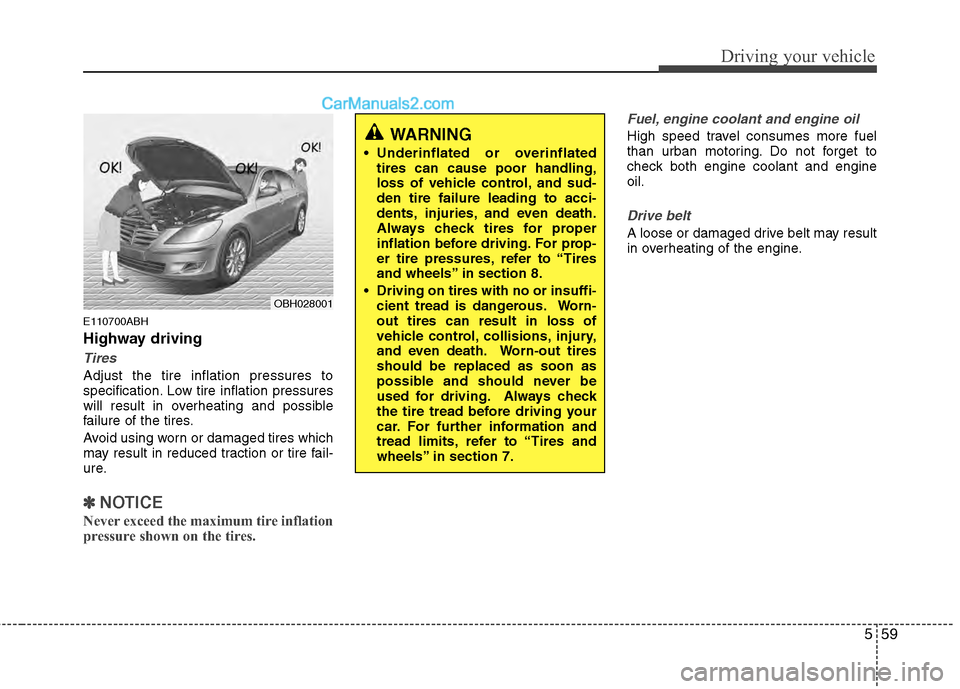
OBH028001
Page 310 of 429
6
Road warning / 6-2
In case of an emergency while driving / 6-2
If the engine will not start / 6-3
Emergency starting / 6-4
If the engine overheats / 6-6
Tire pressure monitoring system (TPMS) / 6-7
If you have a flat tire / 6-13
Towing / 6-21
What to do in an emergency
Page 314 of 429
65
What to do in an emergency
F040101ABH-EU
Jump starting procedure
✽
✽NOTICE
Your vehicle has a battery in the trunk
compartment, but when you jump start
your vehicle, use the jumper terminal in
the engine compartment.
1. Make sure the booster battery is 12-
volt and that its negative terminal is
grounded.
2. If the booster battery is in another vehicle, do not allow the vehicles to
touch.
3. Turn off all unnecessary electrical loads.
4. Connect the jumper cables in the exact sequence shown in the illustration.
First connect one end of a jumper
cable to the positive terminal of the
jumper terminal (1), then connect the
other end to the positive terminal on
the booster battery (2).
Proceed to connect one end of the
other jumper cable to the negative ter-
minal of the booster battery (3), then
the other end to the negative terminal
of the jumper terminal (4). Do not con-
nect it to or near any part that moves
when the engine is cranked. Do not allow the jumper cables to con-
tact anything except the correct battery
terminals or the correct ground. Do not
lean over the battery when making
connections.
5. Start the engine of the vehicle with the booster battery and let it run at 2,000
rpm, then start the engine of the vehi-
cle with the discharged battery. 6. Let the discharged battery run for at
least 20 minutes either by engine
idling or by driving before you turn it off
else the discharged battery may not be
recharged enough to restart the car.
If the cause of your battery discharging isnot apparent, you should have your vehi- cle checked by an authorized HYUNDAIdealer.
F040200BBH-EU
Push-starting
Vehicles equipped with automatic trans-
mission cannot be push-started.
Follow the directions in this section for
jump-starting.
CAUTION - Battery cables
If you jump start the dischargedbattery in the trunk compartment, do not connect the jumper cablefrom the negative terminal of the booster battery to the negative ter-minal of the discharged battery.This can cause the discharged bat-tery to overheat and crack, releas-ing battery acid.
Connect the jumper cable from thenegative terminal of the boosterbattery to a solid, stationary or metallic point away from the dis-charged battery.
Page 315 of 429
What to do in an emergency
66
IF THE ENGINE OVERHEATS
F050000ABH
If your temperature gauge indicates over-
heating, you experience a loss of power,
or hear loud pinging or knocking, the
engine is probably too hot. If this hap-
pens, you should:
1. Pull off the road and stop as soon as itis safe to do so.
2. Place the shift lever in P and set the parking brake. If the air conditioning is
on, turn it off.
3. If engine coolant is running out under the car or steam is coming out from
the hood, stop the engine. Do not open
the hood until the coolant has stopped
running or the steaming has stopped.
If there is no visible loss of engine
coolant and no steam, leave the
engine running and check to be sure
the engine cooling fan is operating. If
the fan is not running, turn the engine
off. 4. Check to see if the water pump drive
belt is missing. If it is not missing,
check to see that it is tight. If the drive
belt seems to be satisfactory, check for
coolant leaking from the radiator,
hoses or under the car. (If the air con-
ditioning had been in use, it is normal
for cold water to be draining from it
when you stop.)
5. If the water pump drive belt is broken or engine coolant is leaking out, stop
the engine immediately and call the
nearest authorized HYUNDAI dealer
for assistance. 6. If you cannot find the cause of the
overheating, wait until the engine tem-
perature has returned to normal. Then,
if coolant has been lost, carefully add
coolant to the reservoir to bring the
fluid level in the reservoir up to the
halfway mark.
7. Proceed with caution, keeping alert for further signs of overheating. If over-
heating happens again, call an author-
ized HYUNDAI dealer for assistance.
WARNING
While the engine is running, keep
hair, hands and clothing away from
moving parts such as the fan and
drive belts to prevent injury.CAUTION
Serious loss of coolant indicates
there is a leak in the cooling systemand this should be checked as soonas possible by an authorizedHYUNDAI dealer.
WARNING
Do not remove the radi-
ator cap when the
engine is hot. This may
result in coolant being
blown out of the open-
ing and cause serious burns.
Page 425 of 429

I3
Index
Defroster ················\
··················\
··················\
··················\
4-88
Dimensions ················\
··················\
··················\
················ 8-2
Door locks ··················\
··················\
··················\
············· 4-16Central door lock switch ··················\
··················\
······· 4-17
Child-protector rear door lock ··················\
················· 4-19
Driver position memory system ··················\
················ 4-34
Economical operation ··················\
··················\
·············· 5-54
Emergency starting ··················\
··················\
··················\
·· 6-4 Jump starting ··················\
··················\
··················\
········· 6-4
Push starting ··················\
··················\
··················\
·········· 6-5
Emission control system ··················\
··················\
·········· 7-75 Crankcase emission control system ··················\
········ 7-75
Evaporative emission control (including ORVR: Onboard Refueling Vapor Recovery) System ········· 7-75
Exhaust emission control system ··················\
············ 7-76
Engine compartment ··················\
··················\
·········· 2-4, 7-2
Engine coolant ··················\
··················\
··················\
······· 7-18
Engine number ··················\
··················\
··················\
········· 8-7
Engine oil ··················\
··················\
··················\
··············· 7-16
Engine start/stop button ··················\
··················\
············· 5-7 Engine start/stop button position ··················\
··············· 5-7
Starting the engine ··················\
··················\
··················\
· 5-9
Explanation of scheduled maintenance items ············· 7-13 Foot parking brake ··················\
··················\
··················\
···7-25
Fuel filler lid ··················\
··················\
··················\
·········· 4-28
Emergency fuel filer lid release ··················\
·············· 4-30
Fuel requirements ··················\
··················\
··················\
···· 1-3
Fuses ·················\
··················\
··················\
··················\
····· 7-49 Fuse/relay panel description ··················\
··················\
·· 7-53
Main fuse ··················\
··················\
··················\
············· 7-52
Memory fuse ··················\
··················\
··················\
······· 7-51
Hazard warning flasher ··················\
··················\
············ 4-76
Headrest ··················\
··················\
··················\
············3-6, 3-11
Hood ·················\
··················\
··················\
··················\
····· 4-27
How to use this manual ··················\
··················\
············· 1-2
If the engine overheats ··················\
··················\
·············· 6-6
If the engine will not start ··················\
··················\
········· 6-3
If you have a flat tire ··················\
··················\
··············· 6-13 Changing tires ··················\
··················\
··················\
····· 6-14
Compact spare tire ··················\
··················\
················· 6-19
Jack and tools ··················\
··················\
··················\
······ 6-13
Removing and storing the spare tire ··················\
······· 6-14
In case of an emergency while driving ··················\
········ 6-2
D
E
F
H
I