towing Hyundai Genesis 2013 Owner's Manual
[x] Cancel search | Manufacturer: HYUNDAI, Model Year: 2013, Model line: Genesis, Model: Hyundai Genesis 2013Pages: 429, PDF Size: 8.94 MB
Page 240 of 429
5
Before driving / 5-3
Key / 5-5
Engine start/stop button / 5-7
Automatic transmission / 5-11
Brake system / 5-18
Cruise control system / 5-36
Smart cruise control system / 5-40
Lane departure warning system (LDWS) / 5-51
Economical operation / 5-54
Special driving conditions / 5-56
Winter driving / 5-60
Vehicle load limit / 5-64
Vehicle weight / 5-69
Trailer towing / 5-70
Driving your vehicle
Page 304 of 429
565
Driving your vehicle
Towing capacity:
We do not recommend using this
vehicle for trailer towing.
Cargo capacity:
The cargo capacity of your vehicle
will increase or decrease depending
on the weight and the number of
occupants.
R1-090003
Steps For Determining Correct LoadLimit -
1. Locate the statement "The com- bined weight of occupants and
cargo should never exceed XXX
kg or XXX lbs.'' on your vehicle's
placard.
2. Determine the combined weight of the driver and passengers that will
be riding in your vehicle.
3. Subtract the combined weight of the driver and passengers from
XXX kg or XXX lbs.
4. The resulting figure equals the available amount of cargo and lug-
gage load capacity. For example, if
the "XXX" amount equals 1400
lbs. and there will be five 150 lb
passengers in your vehicle, the
amount of available cargo and lug-
gage load capacity is 650 lbs.
(1400-750 (5 x 150) = 650 lbs.) 5. Determine the combined weight of
luggage and cargo being loaded
on the vehicle. That weight may
not safely exceed the available
cargo and luggage load capacity
calculated in Step 4.
6. If your vehicle will be towing a trail- er, load from your trailer will be
transferred to your vehicle. Consult
this manual to determine how this
reduces the available cargo and
luggage load capacity of your
vehicle.
✽ ✽NOTICE
We do not recommend using this
vehicle for trailer towing.
Page 309 of 429
E140000ABH
We do not recommend using this
vehicle for trailer towing.
TRAILER TOWING
570
Driving your vehicle
Page 310 of 429
6
Road warning / 6-2
In case of an emergency while driving / 6-2
If the engine will not start / 6-3
Emergency starting / 6-4
If the engine overheats / 6-6
Tire pressure monitoring system (TPMS) / 6-7
If you have a flat tire / 6-13
Towing / 6-21
What to do in an emergency
Page 313 of 429

What to do in an emergency
46
EMERGENCY STARTING
F040000ABH
Connect cables in numerical order and
disconnect in reverse order.
✽ ✽NOTICE
Your vehicle has a battery in the trunk
compartment, but when you jump start
your vehicle, use the jumper terminal in
the engine compartment.
F040100AEN
Jump starting
Jump starting can be dangerous if done
incorrectly. Therefore, to avoid harm to
yourself or damage to your vehicle or
battery, follow the jump starting proce-
dures. If in doubt, we strongly recom-
mend that you have a competent techni-
cian or towing service jump start your
vehicle.
CAUTION
Use only a 12-volt jumper system.
You can damage a 12-volt startingmotor, ignition system, and otherelectrical parts beyond repair by use of a 24-volt power supply (eithertwo 12-volt batteries in series or a24-volt motor generator set).
WARNING- Battery
• Keep all flames or sparks away from the battery. The battery pro-
duces hydrogen gas which may
explode if exposed to flame or
sparks.
If these instructions are not fol-
lowed exactly, serious personal
injury and damage to the vehicle
may occur! If you are not sure
how to follow this procedure,
seek qualified assistance.
Automobile batteries contain sul-
furic acid. This is poisonous and
highly corrosive. When jump
starting, wear protective glasses
and be careful not to get acid on
yourself, your clothing or on the
car.
Do not attempt to jump start the vehicle if the discharged battery
is frozen or if the electrolyte level
is low; the battery may rupture or
explode.
WARNING- Battery
Never attempt to check the elec-
trolyte level of the battery as this
may cause the battery to rupture or
explode causing serious injury.
OBH068003L
Jumper
terminal
Jumper Cables
Booster
battery
Page 330 of 429
621
What to do in an emergency
TOWING
F080100ABH-EU
Towing service
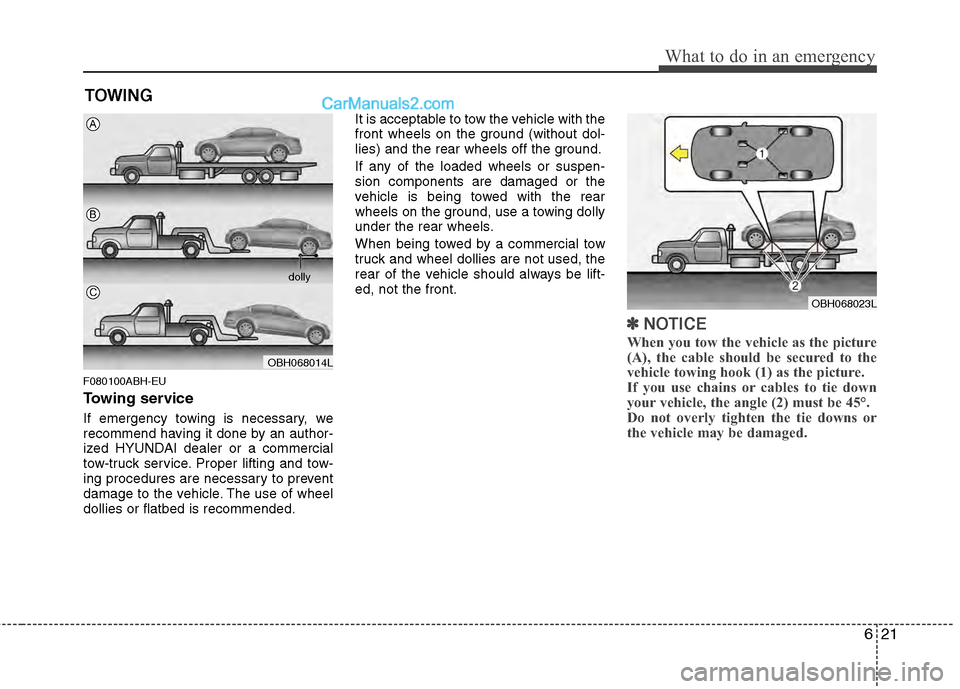
If emergency towing is necessary, we
recommend having it done by an author-
ized HYUNDAI dealer or a commercial
tow-truck service. Proper lifting and tow-
ing procedures are necessary to prevent
damage to the vehicle. The use of wheel
dollies or flatbed is recommended.It is acceptable to tow the vehicle with the
front wheels on the ground (without dol-
lies) and the rear wheels off the ground.
If any of the loaded wheels or suspen-
sion components are damaged or the
vehicle is being towed with the rear
wheels on the ground, use a towing dolly
under the rear wheels.
When being towed by a commercial tow
truck and wheel dollies are not used, the
rear of the vehicle should always be lift-
ed, not the front.
✽ ✽
NOTICE
When you tow the vehicle as the picture
(A), the cable should be secured to the
vehicle towing hook (1) as the picture.
If you use chains or cables to tie down
your vehicle, the angle (2) must be 45°.
Do not overly tighten the tie downs or
the vehicle may be damaged.
OBH068014L dolly
OBH068023L
A
B
C
Page 331 of 429
What to do in an emergency
22
6
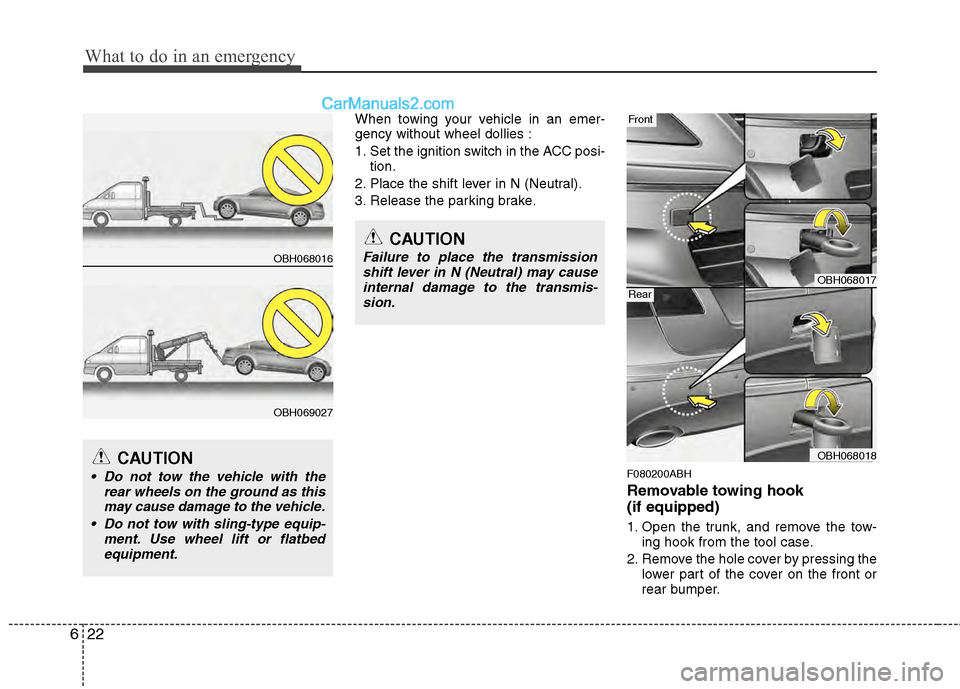
When towing your vehicle in an emer-
gency without wheel dollies :
1. Set the ignition switch in the ACC posi-
tion.
2. Place the shift lever in N (Neutral).
3. Release the parking brake.
F080200ABH
Removable towing hook
(if equipped)
1. Open the trunk, and remove the tow- ing hook from the tool case.
2. Remove the hole cover by pressing the lower part of the cover on the front or
rear bumper.
OBH068016
OBH069027
CAUTION
Do not tow the vehicle with the rear wheels on the ground as thismay cause damage to the vehicle.
Do not tow with sling-type equip- ment. Use wheel lift or flatbedequipment.
CAUTION
Failure to place the transmissionshift lever in N (Neutral) may causeinternal damage to the transmis-sion.
OBH068017
OBH068018
Front
Rear
Page 332 of 429
623
What to do in an emergency
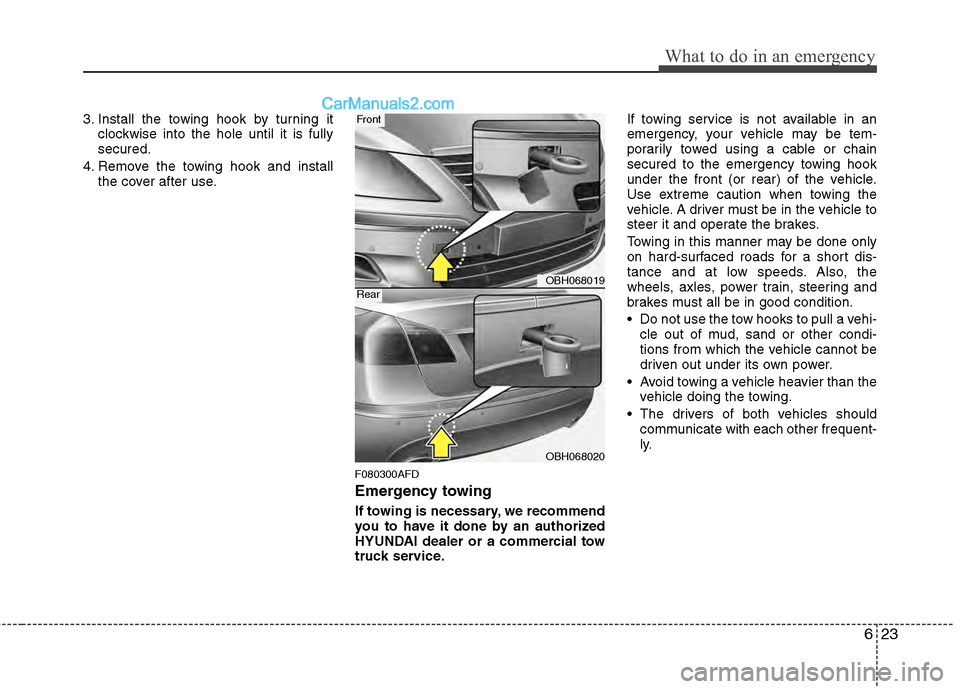
3. Install the towing hook by turning itclockwise into the hole until it is fully
secured.
4. Remove the towing hook and install the cover after use.
F080300AFD
Emergency towing
If towing is necessary, we recommend
you to have it done by an authorized
HYUNDAI dealer or a commercial tow
truck service. If towing service is not available in an
emergency, your vehicle may be tem-
porarily towed using a cable or chain
secured to the emergency towing hook
under the front (or rear) of the vehicle.
Use extreme caution when towing the
vehicle. A driver must be in the vehicle to
steer it and operate the brakes.
Towing in this manner may be done only
on hard-surfaced roads for a short dis-
tance and at low speeds. Also, the
wheels, axles, power train, steering and
brakes must all be in good condition.
Do not use the tow hooks to pull a vehi-
cle out of mud, sand or other condi-
tions from which the vehicle cannot be
driven out under its own power.
Avoid towing a vehicle heavier than the vehicle doing the towing.
The drivers of both vehicles should communicate with each other frequent-
ly.
OBH068019
OBH068020
Front
Rear
Page 333 of 429
What to do in an emergency
24
6
Before emergency towing, check that
the hook is not broken or damaged.
Fasten the towing cable or chain securely to the hook.
Do not jerk the hook. Apply steady and even force.
To avoid damaging the hook, do not pull from the side or at a vertical angle.
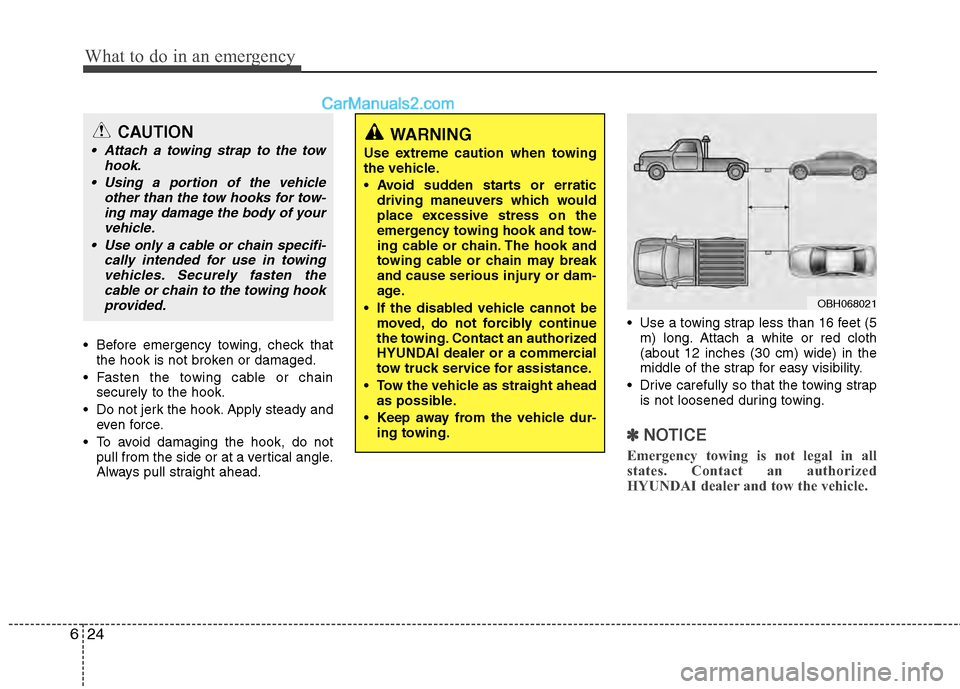
Always pull straight ahead. Use a towing strap less than 16 feet (5
m) long. Attach a white or red cloth
(about 12 inches (30 cm) wide) in the
middle of the strap for easy visibility.
Drive carefully so that the towing strap is not loosened during towing.
✽ ✽ NOTICE
Emergency towing is not legal in all
states. Contact an authorized
HYUNDAI dealer and tow the vehicle.
CAUTION
Attach a towing strap to the tow
hook.
Using a portion of the vehicle other than the tow hooks for tow-ing may damage the body of yourvehicle.
Use only a cable or chain specifi- cally intended for use in towingvehicles. Securely fasten thecable or chain to the towing hook provided.WARNING
Use extreme caution when towing
the vehicle.
driving maneuvers which would
place excessive stress on the
emergency towing hook and tow-
ing cable or chain. The hook and
towing cable or chain may break
and cause serious injury or dam-
age.
If the disabled vehicle cannot be moved, do not forcibly continue
the towing. Contact an authorized
HYUNDAI dealer or a commercial
tow truck service for assistance.
Tow the vehicle as straight ahead as possible.
Keep away from the vehicle dur- ing towing.
OBH068021
Page 334 of 429
625
What to do in an emergency
F080301ABH
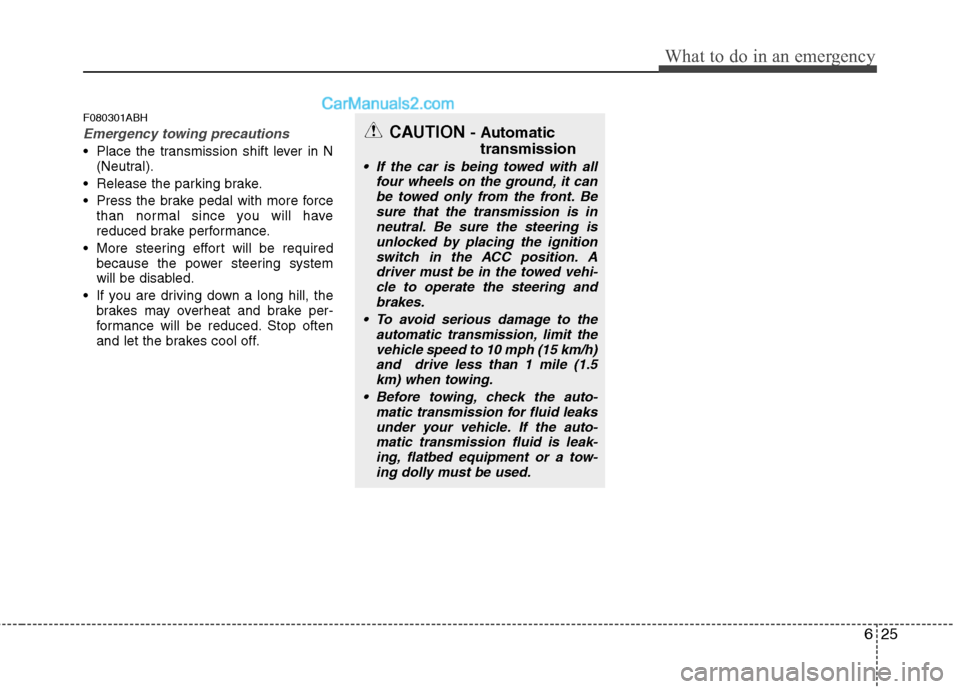
Emergency towing precautions
Place the transmission shift lever in N(Neutral).
Release the parking brake.
Press the brake pedal with more force than normal since you will have
reduced brake performance.
More steering effort will be required because the power steering system
will be disabled.
If you are driving down a long hill, the brakes may overheat and brake per-
formance will be reduced. Stop often
and let the brakes cool off.
CAUTION - Automatictransmission
If the car is being towed with all
four wheels on the ground, it canbe towed only from the front. Besure that the transmission is inneutral. Be sure the steering is unlocked by placing the ignitionswitch in the ACC position. Adriver must be in the towed vehi-cle to operate the steering andbrakes.
To avoid serious damage to the automatic transmission, limit thevehicle speed to 10 mph (15 km/h)and drive less than 1 mile (1.5km) when towing.
Before towing, check the auto- matic transmission for fluid leaksunder your vehicle. If the auto- matic transmission fluid is leak-ing, flatbed equipment or a tow-ing dolly must be used.