cooling Hyundai Genesis 2014 User Guide
[x] Cancel search | Manufacturer: HYUNDAI, Model Year: 2014, Model line: Genesis, Model: Hyundai Genesis 2014Pages: 546, PDF Size: 13.59 MB
Page 459 of 546
7-23
7
Maintenance
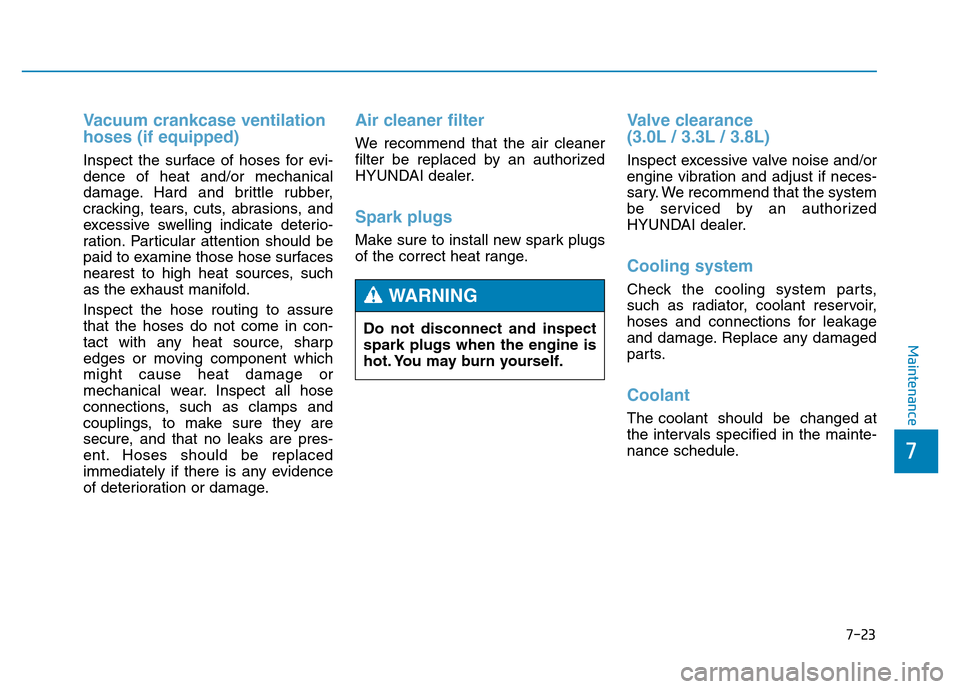
Vacuum crankcase ventilation
hoses (if equipped)
Inspect the surface of hoses for evi-
dence of heat and/or mechanical
damage. Hard and brittle rubber,
cracking, tears, cuts, abrasions, and
excessive swelling indicate deterio-
ration. Particular attention should be
paid to examine those hose surfaces
nearest to high heat sources, such
as the exhaust manifold.
Inspect the hose routing to assure
that the hoses do not come in con-
tact with any heat source, sharp
edges or moving component which
might cause heat damage or
mechanical wear. Inspect all hose
connections, such as clamps and
couplings, to make sure they are
secure, and that no leaks are pres-
ent. Hoses should be replaced
immediately if there is any evidence
of deterioration or damage.
Air cleaner filter
We recommend that the air cleaner
filter be replaced by an authorized
HYUNDAI dealer.
Spark plugs
Make sure to install new spark plugs
of the correct heat range.
Valve clearance
(3.0L / 3.3L / 3.8L)
Inspect excessive valve noise and/or
engine vibration and adjust if neces-
sary. We recommend that the system
be serviced by an authorized
HYUNDAI dealer.
Cooling system
Check the cooling system parts,
such as radiator, coolant reservoir,
hoses and connections for leakage
and damage. Replace any damaged
parts.
Coolant
The coolant should be changed at
the intervals specified in the mainte-
nance schedule. Do not disconnect and inspect
spark plugs when the engine is
hot. You may burn yourself.
WARNING
Page 464 of 546
7-28
Maintenance
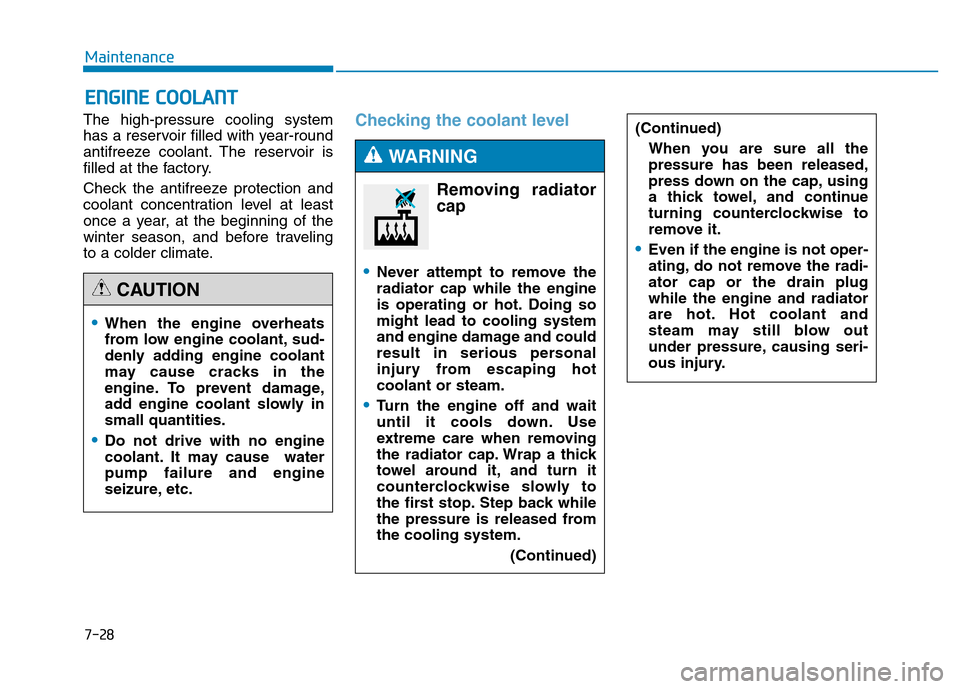
ENGINE COOLANT
The high-pressure cooling system
has a reservoir filled with year-round
antifreeze coolant. The reservoir is
filled at the factory.
Check the antifreeze protection and
coolant concentration level at least
once a year, at the beginning of the
winter season, and before traveling
to a colder climate.Checking the coolant level
Removing radiator
cap
•
Never attempt to remove the
radiator cap while the engine
is operating or hot. Doing so
might lead to cooling system
and engine damage and could
result in serious personal
injury from escaping hot
coolant or steam.
•Turn the engine off and wait
until it cools down. Use
extreme care when removing
the radiator cap. Wrap a thick
towel around it, and turn it
counterclockwise slowly to
the first stop. Step back while
the pressure is released from
the cooling system.
(Continued)
WARNING
(Continued)
When you are sure all the
pressure has been released,
press down on the cap, using
a thick towel, and continue
turning counterclockwise to
remove it.
•Even if the engine is not oper-
ating, do not remove the radi-
ator cap or the drain plug
while the engine and radiator
are hot. Hot coolant and
steam may still blow out
under pressure, causing seri-
ous injury.
•When the engine overheats
from low engine coolant, sud-
denly adding engine coolant
may cause cracks in the
engine. To prevent damage,
add engine coolant slowly in
small quantities.
•Do not drive with no engine
coolant. It may cause water
pump failure and engine
seizure, etc.
CAUTION
Page 465 of 546
7-29
7
Maintenance
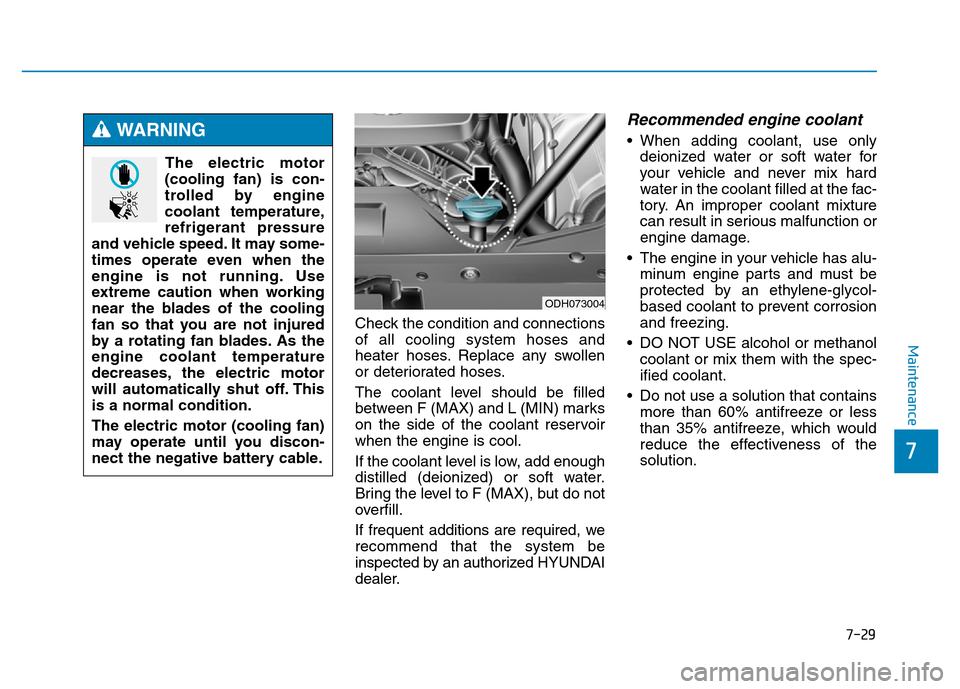
Check the condition and connections
of all cooling system hoses and
heater hoses. Replace any swollen
or deteriorated hoses.
The coolant level should be filled
between F (MAX) and L (MIN) marks
on the side of the coolant reservoir
when the engine is cool.
If the coolant level is low, add enough
distilled (deionized) or soft water.
Bring the level to F (MAX), but do not
overfill.
If frequent additions are required, we
recommend that the system be
inspected by an authorized HYUNDAI
dealer.
Recommended engine coolant
• When adding coolant, use only
deionized water or soft water for
your vehicle and never mix hard
water in the coolant filled at the fac-
tory. An improper coolant mixture
can result in serious malfunction or
engine damage.
• The engine in your vehicle has alu-
minum engine parts and must be
protected by an ethylene-glycol-
based coolant to prevent corrosion
and freezing.
• DO NOT USE alcohol or methanol
coolant or mix them with the spec-
ified coolant.
• Do not use a solution that contains
more than 60% antifreeze or less
than 35% antifreeze, which would
reduce the effectiveness of the
solution.
ODH073004
The electric motor
(cooling fan) is con-
trolled by engine
coolant temperature,
refrigerant pressure
and vehicle speed. It may some-
times operate even when the
engine is not running. Use
extreme caution when working
near the blades of the cooling
fan so that you are not injured
by a rotating fan blades. As the
engine coolant temperature
decreases, the electric motor
will automatically shut off. This
is a normal condition.
The electric motor (cooling fan)
may operate until you discon-
nect the negative battery cable.
WARNING
Page 501 of 546
7-65
7
Maintenance
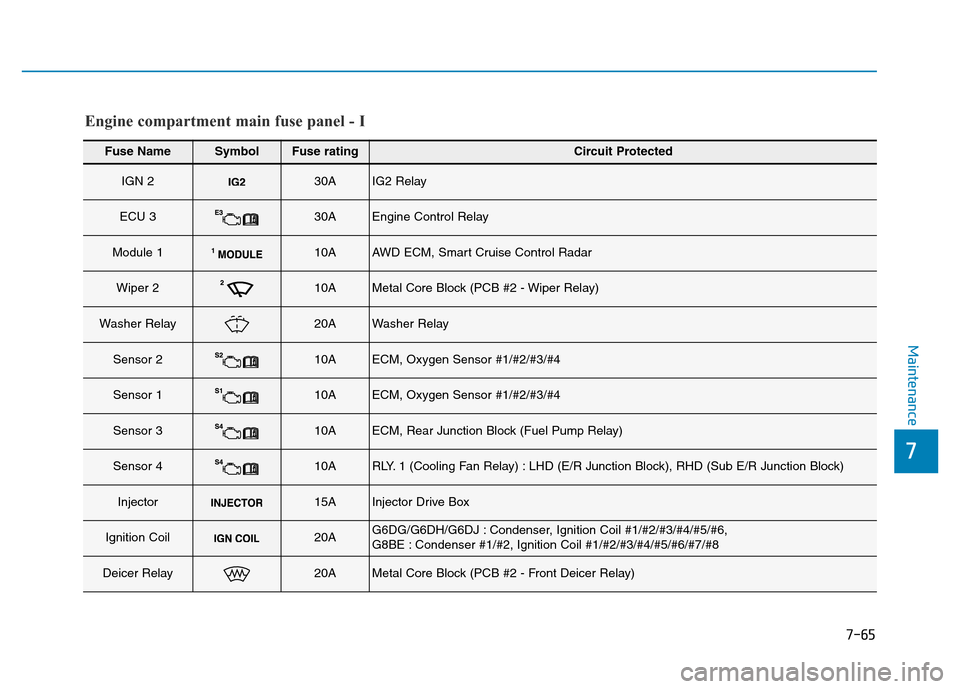
Fuse NameSymbolFuse ratingCircuit Protected
IGN 230AIG2 Relay
ECU 330AEngine Control Relay
Module 110AAWD ECM, Smart Cruise Control Radar
Wiper 210AMetal Core Block (PCB #2 - Wiper Relay)
Washer Relay20AWasher Relay
Sensor 210AECM, Oxygen Sensor #1/#2/#3/#4
Sensor 110AECM, Oxygen Sensor #1/#2/#3/#4
Sensor 310AECM, Rear Junction Block (Fuel Pump Relay)
Sensor 410ARLY. 1 (Cooling Fan Relay) : LHD (E/R Junction Block), RHD (Sub E/R Junction Block)
Injector15AInjector Drive Box
Ignition Coil20AG6DG/G6DH/G6DJ : Condenser, Ignition Coil #1/#2/#3/#4/#5/#6,
G8BE : Condenser #1/#2, Ignition Coil #1/#2/#3/#4/#5/#6/#7/#8
Deicer Relay20AMetal Core Block (PCB #2 - Front Deicer Relay)
Engine compartment main fuse panel - I
Page 504 of 546
7-68
Maintenance
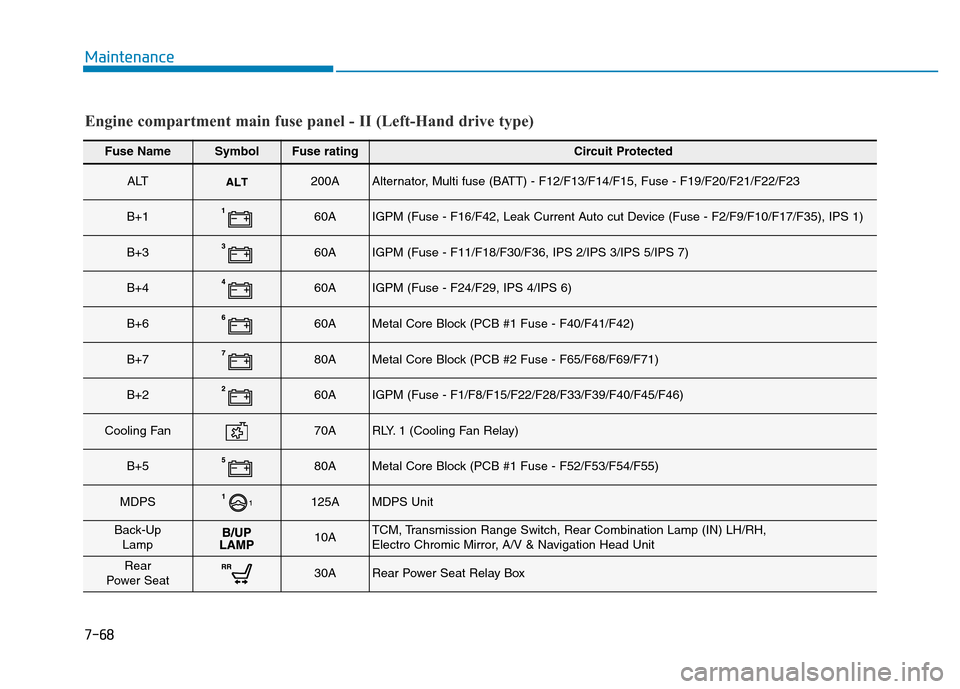
Fuse NameSymbolFuse ratingCircuit Protected
ALT200AAlternator, Multi fuse (BATT) - F12/F13/F14/F15, Fuse - F19/F20/F21/F22/F23
B+160AIGPM (Fuse - F16/F42, Leak Current Auto cut Device (Fuse - F2/F9/F10/F17/F35), IPS 1)
B+360AIGPM (Fuse - F11/F18/F30/F36, IPS 2/IPS 3/IPS 5/IPS 7)
B+460AIGPM (Fuse - F24/F29, IPS 4/IPS 6)
B+660AMetal Core Block (PCB #1 Fuse - F40/F41/F42)
B+780AMetal Core Block (PCB #2 Fuse - F65/F68/F69/F71)
B+260AIGPM (Fuse - F1/F8/F15/F22/F28/F33/F39/F40/F45/F46)
Cooling Fan70ARLY. 1 (Cooling Fan Relay)
B+580AMetal Core Block (PCB #1 Fuse - F52/F53/F54/F55)
MDPS125AMDPS Unit
Back-Up
Lamp10ATCM, Transmission Range Switch, Rear Combination Lamp (IN) LH/RH,
Electro Chromic Mirror, A/V & Navigation Head Unit
Rear
Power Seat30ARear Power Seat Relay Box
Engine compartment main fuse panel - II (Left-Hand drive type)
Page 506 of 546
7-70
Maintenance
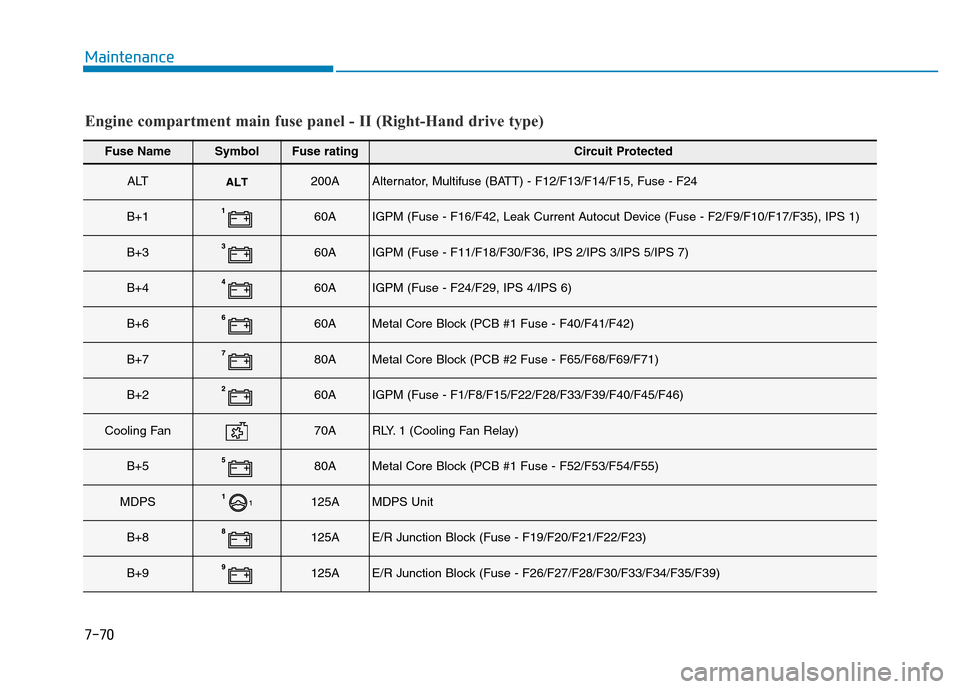
Fuse NameSymbolFuse ratingCircuit Protected
ALT200AAlternator, Multifuse (BATT) - F12/F13/F14/F15, Fuse - F24
B+160AIGPM (Fuse - F16/F42, Leak Current Autocut Device (Fuse - F2/F9/F10/F17/F35), IPS 1)
B+360AIGPM (Fuse - F11/F18/F30/F36, IPS 2/IPS 3/IPS 5/IPS 7)
B+460AIGPM (Fuse - F24/F29, IPS 4/IPS 6)
B+660AMetal Core Block (PCB #1 Fuse - F40/F41/F42)
B+780AMetal Core Block (PCB #2 Fuse - F65/F68/F69/F71)
B+260AIGPM (Fuse - F1/F8/F15/F22/F28/F33/F39/F40/F45/F46)
Cooling Fan70ARLY. 1 (Cooling Fan Relay)
B+580AMetal Core Block (PCB #1 Fuse - F52/F53/F54/F55)
MDPS125AMDPS Unit
B+8125AE/R Junction Block (Fuse - F19/F20/F21/F22/F23)
B+9125AE/R Junction Block (Fuse - F26/F27/F28/F30/F33/F34/F35/F39)
Engine compartment main fuse panel - II (Right-Hand drive type)