engine Hyundai Genesis 2014 User Guide
[x] Cancel search | Manufacturer: HYUNDAI, Model Year: 2014, Model line: Genesis, Model: Hyundai Genesis 2014Pages: 546, PDF Size: 13.59 MB
Page 30 of 546
2-12
Safety system of your vehicle
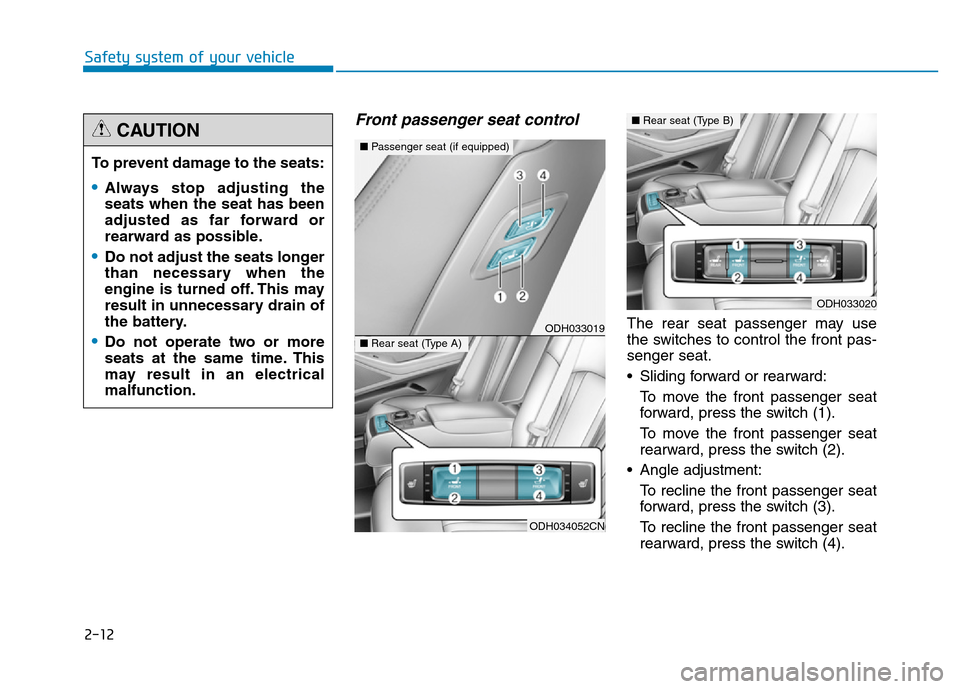
Front passenger seat control
The rear seat passenger may use
the switches to control the front pas-
senger seat.
• Sliding forward or rearward:
To move the front passenger seat
forward, press the switch (1).
To move the front passenger seat
rearward, press the switch (2).
• Angle adjustment:
To recline the front passenger seat
forward, press the switch (3).
To recline the front passenger seat
rearward, press the switch (4).
ODH033020
ODH033019
ODH034052CN
■Passenger seat (if equipped)
■Rear seat (Type A)
■Rear seat (Type B)■Rear seat (Type B)
To prevent damage to the seats:
•Always stop adjusting the
seats when the seat has been
adjusted as far forward or
rearward as possible.
•Do not adjust the seats longer
than necessary when the
engine is turned off. This may
result in unnecessary drain of
the battery.
•Do not operate two or more
seats at the same time. This
may result in an electrical
malfunction.
CAUTION
Page 33 of 546
2-15
Safety system of your vehicle
2
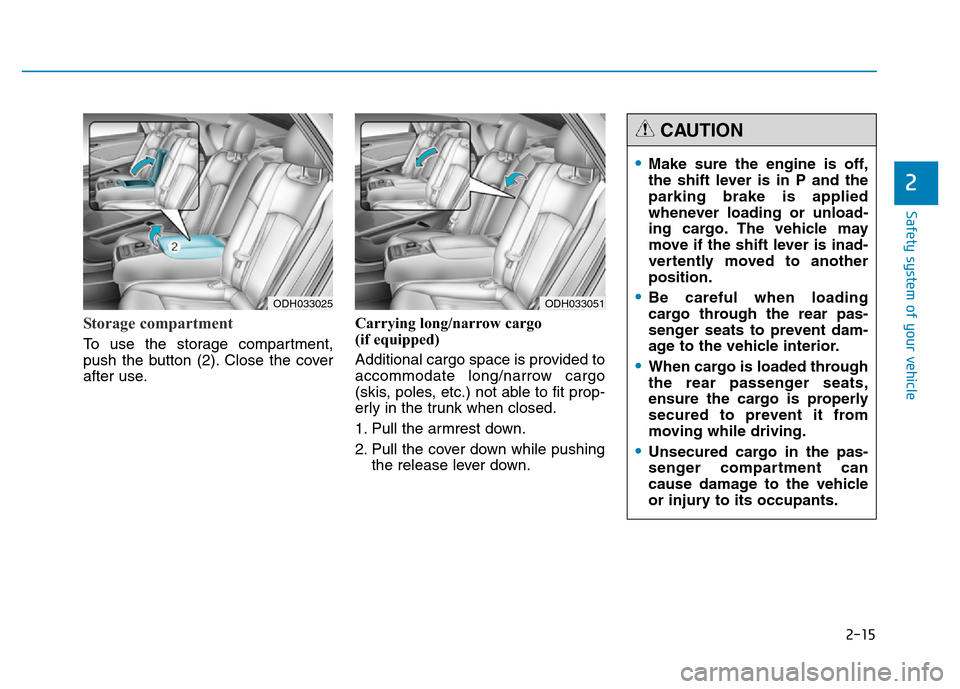
Storage compartment
To use the storage compartment,
push the button (2). Close the cover
after use.Carrying long/narrow cargo
(if equipped)
Additional cargo space is provided to
accommodate long/narrow cargo
(skis, poles, etc.) not able to fit prop-
erly in the trunk when closed.
1. Pull the armrest down.
2. Pull the cover down while pushing
the release lever down.
ODH033051ODH033025
•Make sure the engine is off,
the shift lever is in P and the
parking brake is applied
whenever loading or unload-
ing cargo. The vehicle may
move if the shift lever is inad-
vertently moved to another
position.
•Be careful when loading
cargo through the rear pas-
senger seats to prevent dam-
age to the vehicle interior.
•When cargo is loaded through
the rear passenger seats,
ensure the cargo is properly
secured to prevent it from
moving while driving.
•Unsecured cargo in the pas-
senger compartment can
cause damage to the vehicle
or injury to its occupants.
CAUTION
Page 34 of 546
2-16
Headrest
The vehicle’s front and rear seats
have adjustable headrests. The head-
rests provide comfort for passengers,
but more importantly they are
designed to help protect passengers
from whiplash and other neck and
spinal injuries during an accident,
especially in a rear impact collision.
Safety system of your vehicle
To reduce the risk of serious
injury or death in an accident,
take the following precautions
when adjusting your headrests:
•Always properly adjust the
headrests for all passengers
BEFORE starting the vehicle.
•NEVER let anyone ride in a seat
with the headrest removed.
•Adjust the headrests so the
middle of the headrests is at
the same height as the height
of the top of the eyes.
(Continued)
WARNING
(Continued)
•NEVER adjust the headrest
position of the driver’s seat
when the vehicle is in motion.
•Adjust the headrest as close
to the passenger’s head as
possible. Do not use a seat
cushion that holds the body
away from the seatback.
•Make sure the headrest locks
into position after adjusting it.
To prevent damage, NEVER hit
or pull on the headrests.
CAUTION
When there is no occupant in
the rear seats, adjust the height
of the headrest to the lowest
position. The rear seat headrest
can reduce the visibility of the
rear area.
CAUTION
Cargo
Cargo should always be
secured to prevent it from being
thrown about the vehicle in a
collision and causing injury to
the vehicle occupants. Do not
place objects in the rear seats,
since they cannot be properly
secured and may hit the front
seat occupants in a collision.
WARNING
Cargo loading
Make sure the engine is off, the
automatic transmission is in P
(Park) and the parking brake is
securely applied whenever load-
ing or unloading cargo.
Failure to take these steps may
allow the vehicle to move if the
shift lever is inadvertently moved
to another position.
WARNING
Page 39 of 546
2-21
Safety system of your vehicle
2
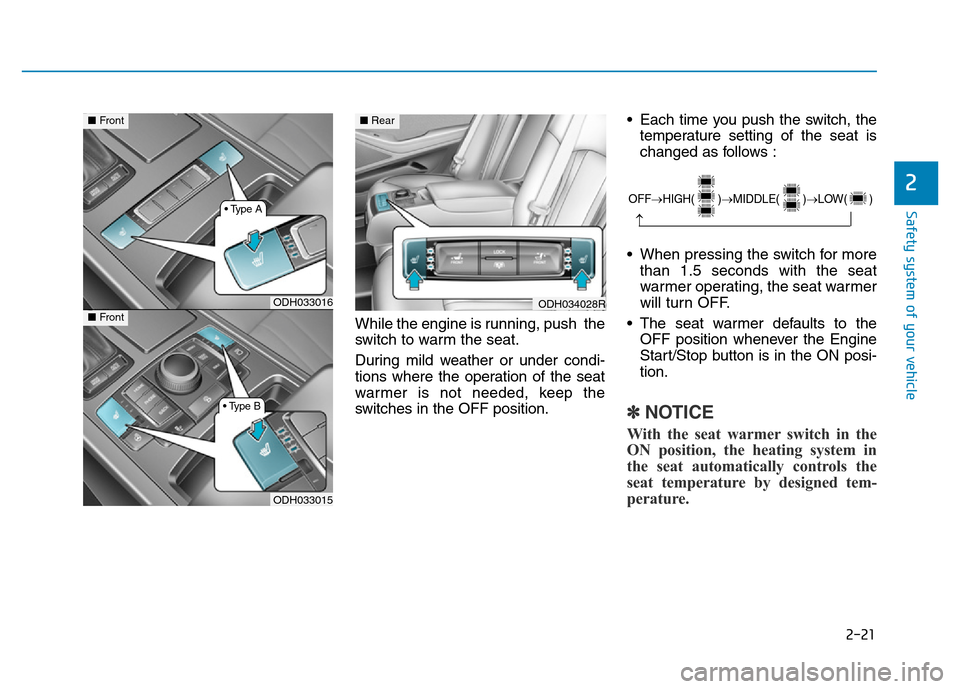
While the engine is running, push the
switch to warm the seat.
During mild weather or under condi-
tions where the operation of the seat
warmer is not needed, keep the
switches in the OFF position.• Each time you push the switch, the
temperature setting of the seat is
changed as follows :
• When pressing the switch for more
than 1.5 seconds with the seat
warmer operating, the seat warmer
will turn OFF.
• The seat warmer defaults to the
OFF position whenever the Engine
Start/Stop button is in the ON posi-
tion.
✽NOTICE
With the seat warmer switch in the
ON position, the heating system in
the seat automatically controls the
seat temperature by designed tem-
perature.
OFF→HIGH( )→MIDDLE( )→LOW( )
→
ODH034028RODH033016
ODH033015
■Front■Rear
■Front
• Type A
• Type B
Page 40 of 546
2-22
Safety system of your vehicle
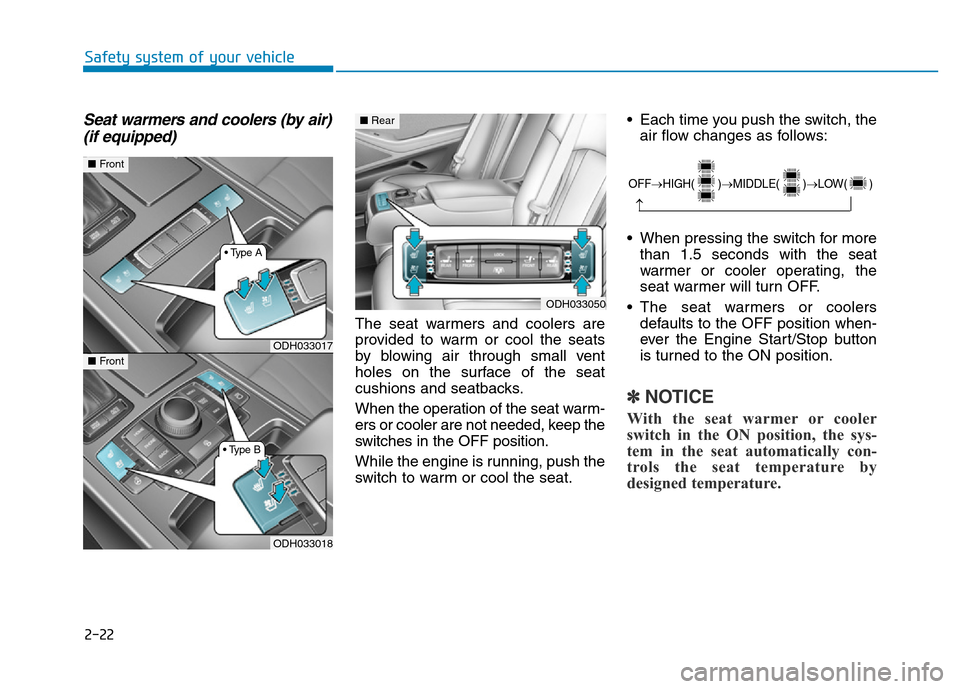
Seat warmers and coolers (by air)
(if equipped)
The seat warmers and coolers are
provided to warm or cool the seats
by blowing air through small vent
holes on the surface of the seat
cushions and seatbacks.
When the operation of the seat warm-
ers or cooler are not needed, keep the
switches in the OFF position.
While the engine is running, push the
switch to warm or cool the seat.• Each time you push the switch, the
air flow changes as follows:
• When pressing the switch for more
than 1.5 seconds with the seat
warmer or cooler operating, the
seat warmer will turn OFF.
• The seat warmers or coolers
defaults to the OFF position when-
ever the Engine Start/Stop button
is turned to the ON position.
✽NOTICE
With the seat warmer or cooler
switch in the ON position, the sys-
tem in the seat automatically con-
trols the seat temperature by
designed temperature.
OFF→HIGH( )→MIDDLE( )→LOW( )
→
ODH033050
ODH033017
ODH033018
■Front
■Rear
■Front
• Type A
• Type B
Page 43 of 546
2-25
Safety system of your vehicle
2
Seat belt warning light
Seat belt warning
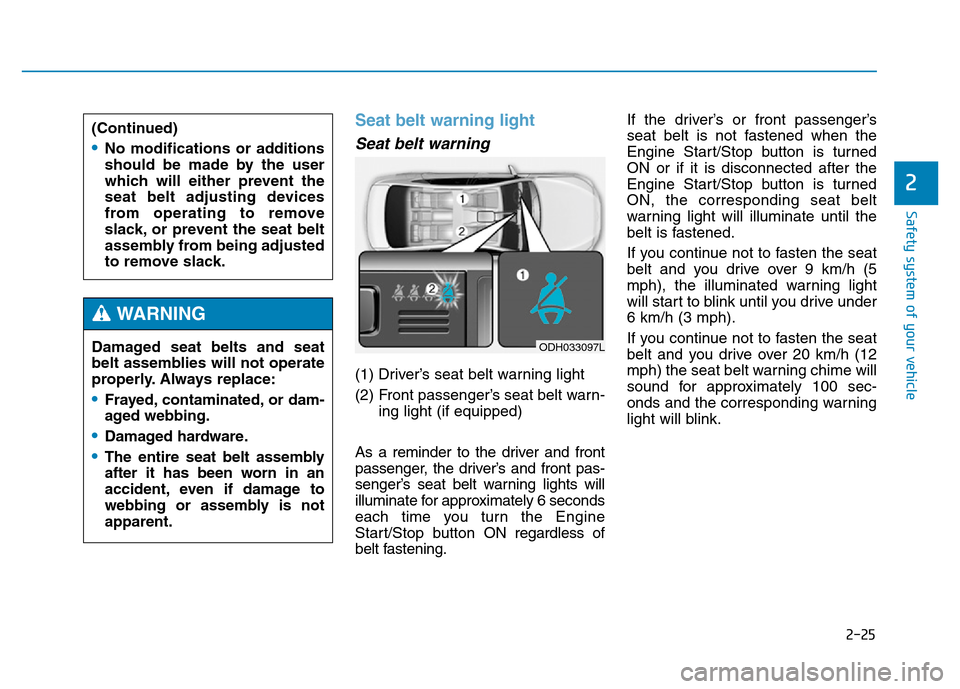
(1) Driver’s seat belt warning light
(2) Front passenger’s seat belt warn-
ing light (if equipped)
As a reminder to the driver and front
passenger, the driver’s and front pas-
senger’s seat belt warning lights will
illuminate for approximately 6 seconds
each time you turn the Engine
Start/Stop button ON regardless of
belt fastening.If the driver’s or front passenger’s
seat belt is not fastened when the
Engine Start/Stop button is turned
ON or if it is disconnected after the
Engine Start/Stop button is turned
ON, the corresponding seat belt
warning light will illuminate until the
belt is fastened.
If you continue not to fasten the seat
belt and you drive over 9 km/h (5
mph), the illuminated warning light
will start to blink until you drive under
6 km/h (3 mph).
If you continue not to fasten the seat
belt and you drive over 20 km/h (12
mph) the seat belt warning chime will
sound for approximately 100 sec-
onds and the corresponding warning
light will blink. Damaged seat belts and seat
belt assemblies will not operate
properly. Always replace:
•Frayed, contaminated, or dam-
aged webbing.
•Damaged hardware.
•The entire seat belt assembly
after it has been worn in an
accident, even if damage to
webbing or assembly is not
apparent.
WARNING
(Continued)
•No modifications or additions
should be made by the user
which will either prevent the
seat belt adjusting devices
from operating to remove
slack, or prevent the seat belt
assembly from being adjusted
to remove slack.
ODH033097L
Page 44 of 546
2-26
Safety system of your vehicle
✽NOTICE
• You can find the front passenger’s
seat belt warning light on the cen-
ter fascia panel.
• Although the front passenger seat
is not occupied, the seat belt warn-
ing light will illuminate for 6 sec-
onds.
• The front passenger's seat belt
warning may operate when lug-
gage is placed on the front passen-
ger seat.
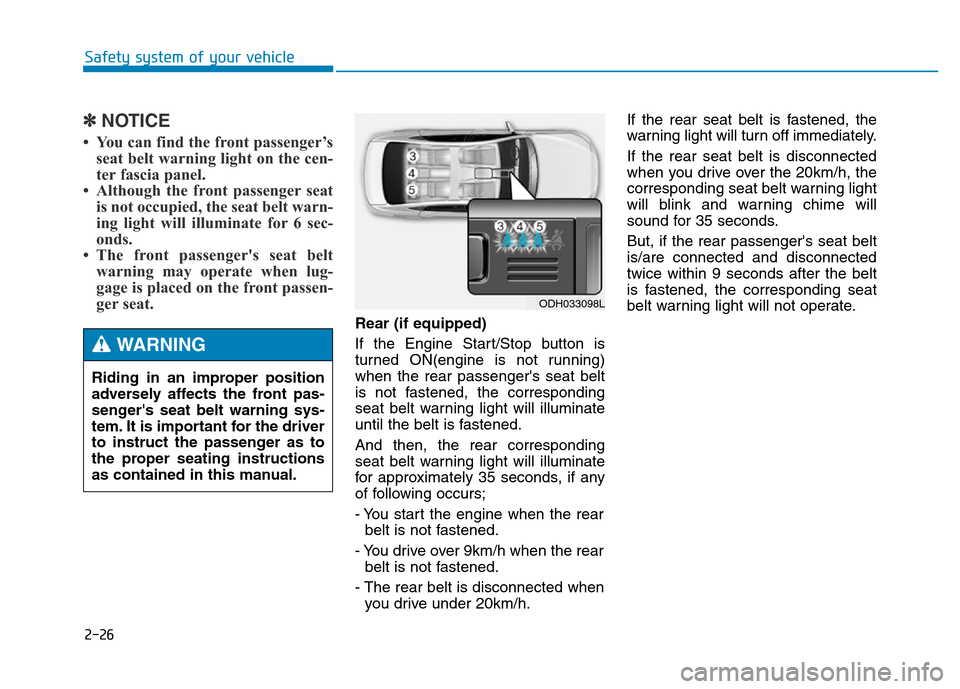
Rear (if equipped)
If the Engine Start/Stop button is
turned ON(engine is not running)
when the rear passenger's seat belt
is not fastened, the corresponding
seat belt warning light will illuminate
until the belt is fastened.
And then, the rear corresponding
seat belt warning light will illuminate
for approximately 35 seconds, if any
of following occurs;
- You start the engine when the rear
belt is not fastened.
- You drive over 9km/h when the rear
belt is not fastened.
- The rear belt is disconnected when
you drive under 20km/h.If the rear seat belt is fastened, the
warning light will turn off immediately.
If the rear seat belt is disconnected
when you drive over the 20km/h, the
corresponding seat belt warning light
will blink and warning chime will
sound for 35 seconds.
But, if the rear passenger's seat belt
is/are connected and disconnected
twice within 9 seconds after the belt
is fastened, the corresponding seat
belt warning light will not operate.
Riding in an improper position
adversely affects the front pas-
senger's seat belt warning sys-
tem. It is important for the driver
to instruct the passenger as to
the proper seating instructions
as contained in this manual.
WARNING
ODH033098L
Page 49 of 546
2-31
Safety system of your vehicle
2
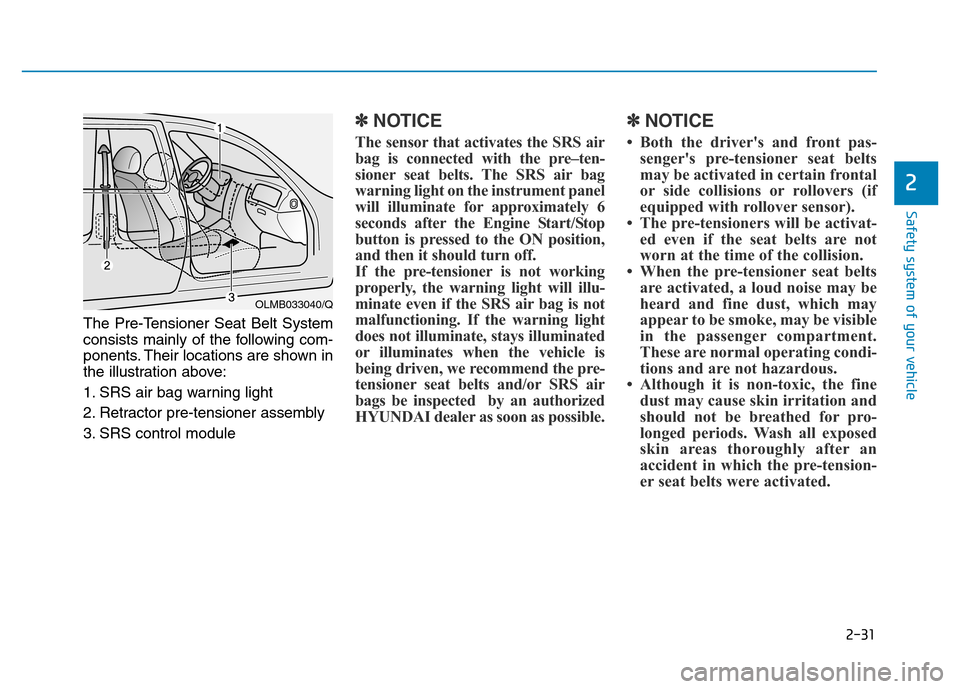
The Pre-Tensioner Seat Belt System
consists mainly of the following com-
ponents. Their locations are shown in
the illustration above:
1. SRS air bag warning light
2. Retractor pre-tensioner assembly
3. SRS control module
✽NOTICE
The sensor that activates the SRS air
bag is connected with the pre–ten-
sioner seat belts. The SRS air bag
warning light on the instrument panel
will illuminate for approximately 6
seconds after the Engine Start/Stop
button is pressed to the ON position,
and then it should turn off.
If the pre-tensioner is not working
properly, the warning light will illu-
minate even if the SRS air bag is not
malfunctioning. If the warning light
does not illuminate, stays illuminated
or illuminates when the vehicle is
being driven, we recommend the pre-
tensioner seat belts and/or SRS air
bags be inspected by an authorized
HYUNDAI dealer as soon as possible.
✽NOTICE
• Both the driver's and front pas-
senger's pre-tensioner seat belts
may be activated in certain frontal
or side collisions or rollovers (if
equipped with rollover sensor).
• The pre-tensioners will be activat-
ed even if the seat belts are not
worn at the time of the collision.
• When the pre-tensioner seat belts
are activated, a loud noise may be
heard and fine dust, which may
appear to be smoke, may be visible
in the passenger compartment.
These are normal operating condi-
tions and are not hazardous.
• Although it is non-toxic, the fine
dust may cause skin irritation and
should not be breathed for pro-
longed periods. Wash all exposed
skin areas thoroughly after an
accident in which the pre-tension-
er seat belts were activated.
OLMB033040/Q
Page 69 of 546
2-51
Safety system of your vehicle
2
Vehicles are equipped with a
Supplemental Air Bag System for the
driver’s seat, front passenger’s seats
and/or rear seats.
The front air bags are designed to
supplement the three-point seat
belts. For these air bags to provide
protection, the seat belts must be
worn at all times when driving.
You can be severely injured or killed
in an accident if you are not wearing
a seat belt. Air bags are designed to
supplement seat belts, but do not
replace them. Also, air bags are not
designed to deploy in every collision.
In some accidents, the seat belts are
the only restraint protecting you.AIR BAG SAFETY PRECAUTIONS
ALWAYS use seat belts and child restraints - every trip, every time,
everyone! Even with air bags, you can be seriously injured or killed in
a collision if you are improperly belted or not wearing your seat belt
when the air bag inflates.
NEVER place a child in any child restraint or booster seat in the front
passenger seat. An inflating air bag could forcefully strike the infant
or child causing serious or fatal injuries.
ABC - Always Buckle Children under age 13 in the back seat. It is the
safest place for children of any age to ride. If a child age 13 or older
must be seated in the front seat, he or she must be properly belted
and the seat should be moved as far back as possible.
All occupants should sit upright with the seatback in an upright posi-
tion, centered on the seat cushion with their seat belt on, legs com-
fortably extended and their feet on the floor until the vehicle is parked
and the engine is turned off. If an occupant is out of position during
an accident, the rapidly deploying air bag may forcefully contact the
occupant causing serious or fatal injuries.
You and your passengers should never sit or lean unnecessarily
close to the air bags or lean against the door or center console.
Move your seat as far back as possible from front air bags, while still
maintaining control of the vehicle. It is recommended that drivers
allow at least 25 cm (10 in) between the center of the steering wheel
and the chest.
WARNING (Continued)
•Keep the SRS parts and
wirings away from water or any
liquid. If the SRS components
are inoperative due to expo-
sure to water or liquids, it may
cause fire or severe injury.
Page 72 of 546
2-54
Safety system of your vehicle
Curtain air bags (if equipped)
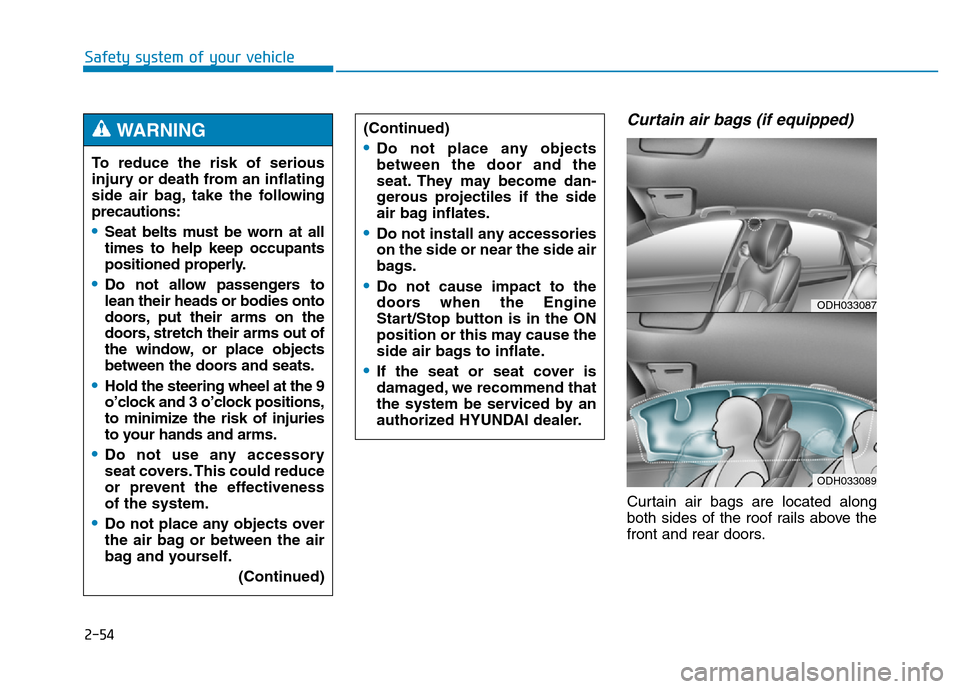
Curtain air bags are located along
both sides of the roof rails above the
front and rear doors. To reduce the risk of serious
injury or death from an inflating
side air bag, take the following
precautions:
•Seat belts must be worn at all
times to help keep occupants
positioned properly.
•Do not allow passengers to
lean their heads or bodies onto
doors, put their arms on the
doors, stretch their arms out of
the window, or place objects
between the doors and seats.
•Hold the steering wheel at the 9
o’clock and 3 o’clock positions,
to minimize the risk of injuries
to your hands and arms.
•Do not use any accessory
seat covers. This could reduce
or prevent the effectiveness
of the system.
•Do not place any objects over
the air bag or between the air
bag and yourself.
(Continued)
WARNING (Continued)
•Do not place any objects
between the door and the
seat. They may become dan-
gerous projectiles if the side
air bag inflates.
•Do not install any accessories
on the side or near the side air
bags.
•Do not cause impact to the
doors when the Engine
Start/Stop button is in the ON
position or this may cause the
side air bags to inflate.
•If the seat or seat cover is
damaged, we recommend that
the system be serviced by an
authorized HYUNDAI dealer.
ODH033087
ODH033089