seats Hyundai Genesis 2014 User Guide
[x] Cancel search | Manufacturer: HYUNDAI, Model Year: 2014, Model line: Genesis, Model: Hyundai Genesis 2014Pages: 546, PDF Size: 13.59 MB
Page 35 of 546
2-17
Safety system of your vehicle
2
Front seat headrests
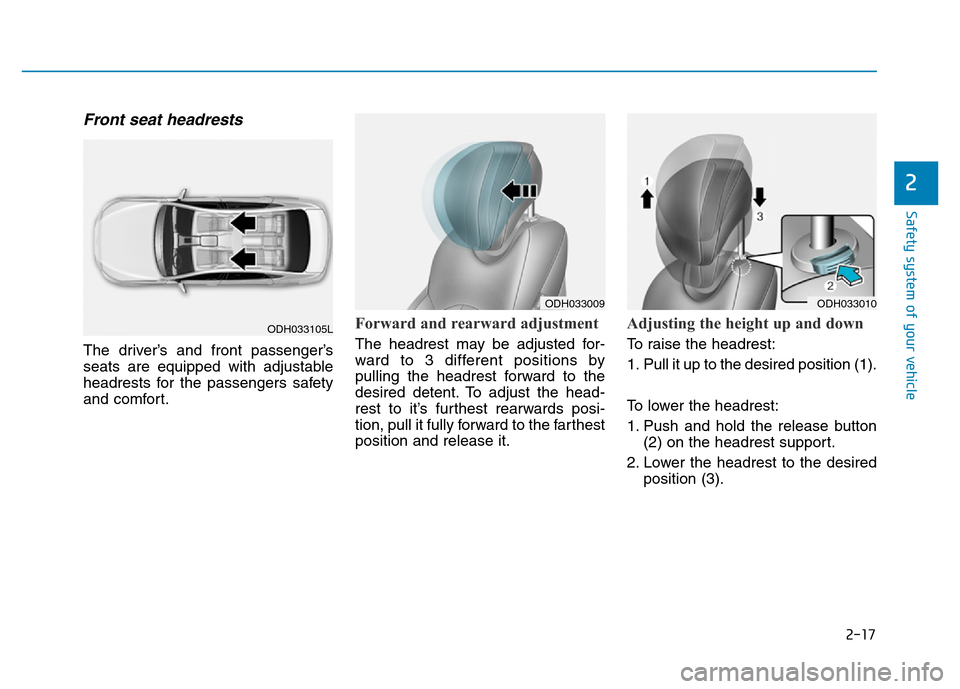
The driver’s and front passenger’s
seats are equipped with adjustable
headrests for the passengers safety
and comfort.
Forward and rearward adjustment
The headrest may be adjusted for-
ward to 3 different positions by
pulling the headrest forward to the
desired detent. To adjust the head-
rest to it’s furthest rearwards posi-
tion, pull it fully forward to the farthest
position and release it.
Adjusting the height up and down
To raise the headrest:
1. Pull it up to the desired position (1).
To lower the headrest:
1. Push and hold the release button
(2) on the headrest support.
2. Lower the headrest to the desired
position (3).
ODH033105L
ODH033009ODH033010
Page 37 of 546
2-19
Safety system of your vehicle
2
Rear seat headrests
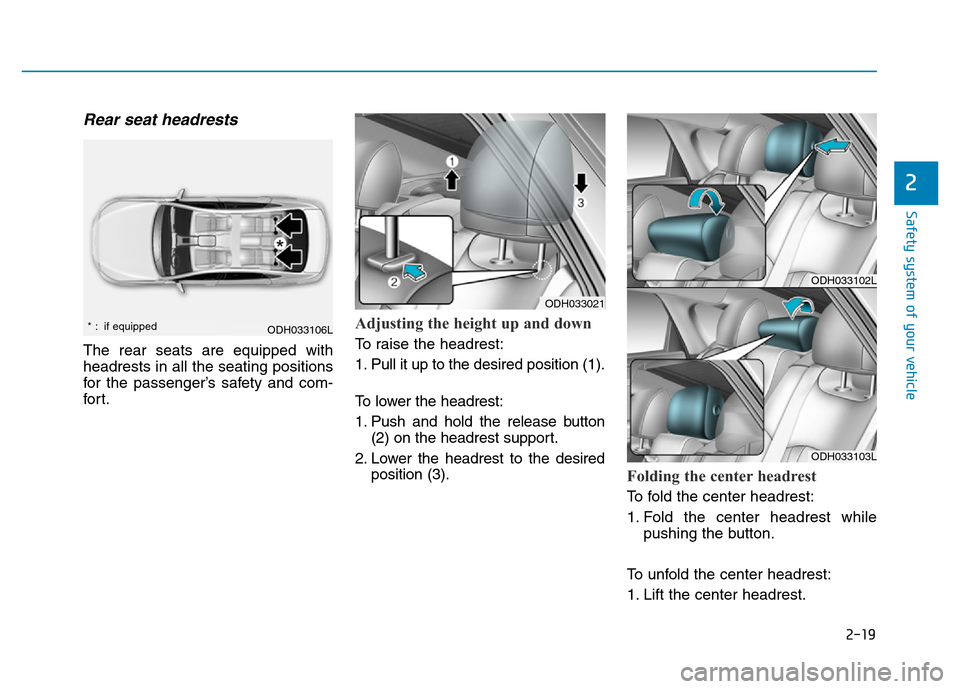
The rear seats are equipped with
headrests in all the seating positions
for the passenger’s safety and com-
for t.
Adjusting the height up and down
To raise the headrest:
1. Pull it up to the desired position (1).
To lower the headrest:
1. Push and hold the release button
(2) on the headrest support.
2. Lower the headrest to the desired
position (3).
Folding the center headrest
To fold the center headrest:
1. Fold the center headrest while
pushing the button.
To unfold the center headrest:
1. Lift the center headrest.
ODH033021
ODH033102L
ODH033103L
ODH033106L* : if equipped
*
Page 38 of 546
2-20
Safety system of your vehicle
Seat warmers and coolers
Seat warmers (if equipped)
Seat warmers are provided to warm
the seats during cold weather.
The seat warmers can cause a
SERIOUS BURN, even at low
temperatures and especially if
used for long periods of time.
Passengers must be able to feel
if the seat is becoming too warm
so they can turn it off, if needed.
People who cannot detect tem-
perature change or pain to the
skin should use extreme cau-
tion, especially the following
types of passengers:
•Infants, children, elderly or
disabled persons, or hospital
outpatients.
•People with sensitive skin or
who burn easily.
(Continued)
(Continued)
•Fatigued individuals.
•Intoxicated individuals.
•People taking medication that
can cause drowsiness or
sleepiness.
WARNING
NEVER place anything on the
seat that insulates against heat
when the seat warmer is in oper-
ation, such as a blanket or seat
cushion. This may cause the
seat warmer to overheat, caus-
ing a burn or damage to the seat.
WARNING
To prevent damage to the seat
warmers and seats:
•Never use a solvent such as
paint thinner, benzene, alco-
hol or gasoline to clean the
seats.
•Do not place heavy or sharp
objects on seats equipped
with seat warmers.
•Do not change the seat cover.
It may damage the seat
warmer or air ventilation sys-
tem.
CAUTION
Page 40 of 546
2-22
Safety system of your vehicle
Seat warmers and coolers (by air)
(if equipped)
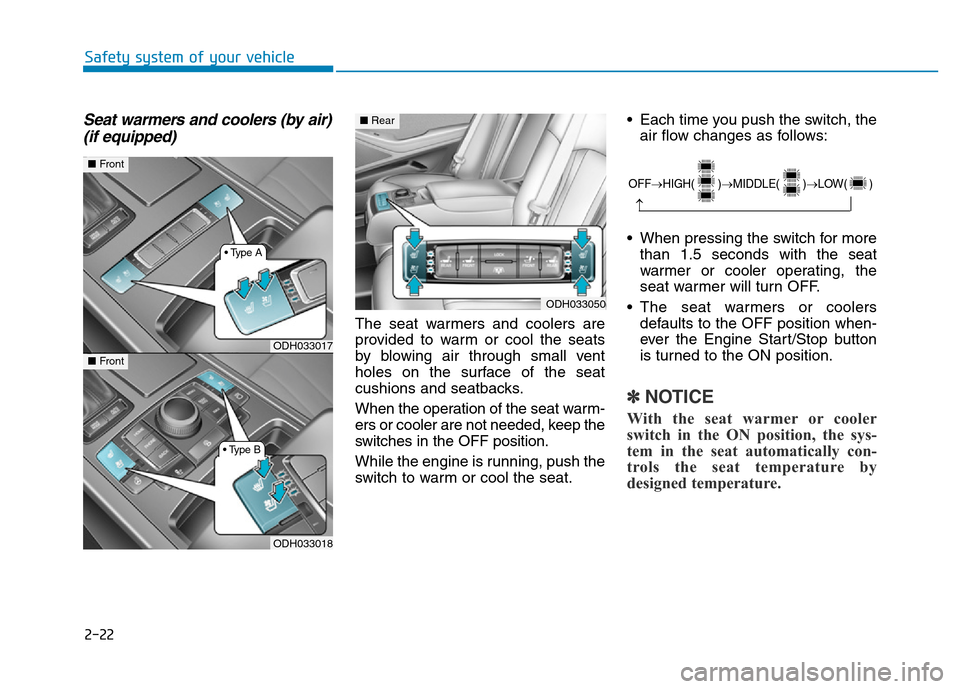
The seat warmers and coolers are
provided to warm or cool the seats
by blowing air through small vent
holes on the surface of the seat
cushions and seatbacks.
When the operation of the seat warm-
ers or cooler are not needed, keep the
switches in the OFF position.
While the engine is running, push the
switch to warm or cool the seat.• Each time you push the switch, the
air flow changes as follows:
• When pressing the switch for more
than 1.5 seconds with the seat
warmer or cooler operating, the
seat warmer will turn OFF.
• The seat warmers or coolers
defaults to the OFF position when-
ever the Engine Start/Stop button
is turned to the ON position.
✽NOTICE
With the seat warmer or cooler
switch in the ON position, the sys-
tem in the seat automatically con-
trols the seat temperature by
designed temperature.
OFF→HIGH( )→MIDDLE( )→LOW( )
→
ODH033050
ODH033017
ODH033018
■Front
■Rear
■Front
• Type A
• Type B
Page 41 of 546
2-23
Safety system of your vehicle
2
(Continued)
•Do not place materials such as
plastic bags or newspapers
under the seats. They may
block the air intake causing
the air vents to not work prop-
erly.
•Do not change the seat cov-
ers. It may damage the seat
warmer or cooler.
•If the air vents do not operate,
restart the vehicle. If there is
no change, we recommend
that you have your vehicle
inspected by an authorized
HYUNDAI dealer.
To prevent damage to the seat
warmer, seat cooler and seats:
•Use the seat warmer and cool-
er ONLY when the climate
control system is on. Using
the seat warmer and cooler
for prolonged periods of time
with the climate control sys-
tem off could cause the seat
warmer and cooler to mal-
function.
•Never use a solvent such as
paint thinner, benzene, alco-
hol or gasoline to clean the
seats.
•Avoid spilling liquids on the
surface of the seats and seat-
backs; this may cause the air
vent holes to become blocked
and not work properly.
(Continued)
CAUTION
Page 42 of 546
2-24
Safety system of your vehicle
This section describes how to use the
seat belts properly. It also describes
some of the things not to do when
using seat belts.
Seat belt safety precautions
Always fasten your seat belt and
make sure all passengers have fas-
tened their seat belts before starting
any trip. Air bags (if equipped) are
designed to supplement the seat belt
as an additional safety device, but
they are not a substitute. Most coun-
tries require all occupants of a vehicle
to wear seat belts.
SEAT BELTS
Seat belts must be used by ALL
passengers whenever the vehi-
cle is moving. Take the following
precautions when adjusting and
wearing seat belts:
•ALWAYS properly restrain
children under age 13 in the
rear seats.
•NEVER allow children to ride
in the front passenger seat. If
a child age 13 or older must be
seated in the front seat, move
the seat as far back as possi-
ble and properly restrain them
in the seat.
•NEVER allow an infant or child
to be carried on an occupant’s
lap.
•NEVER ride with the seatback
reclined when the vehicle is
moving.
•Do not allow children to share
a seat or seat belt.
(Continued)
WARNING (Continued)
•Do not wear the shoulder belt
under your arm or behind your
back.
•Never wear a seat belt over
fragile objects. If there is a
sudden stop or impact, the
seat belt can damage it.
•Do not use the seat belt if it is
twisted. A twisted seat belt
will not protect you properly
in an accident.
•Do not use a seat belt if the
webbing or hardware is dam-
aged.
•Do not latch the seat belt into
the buckles of other seats.
•NEVER unfasten the seat belt
while driving. This may cause
loss of vehicle control result-
ing in an accident.
•Make sure there is nothing in
the buckle interfering with the
seat belt latch mechanism.
This may prevent the seat belt
from fastening securely.
(Continued)
Page 51 of 546
2-33
Safety system of your vehicle
2
Additional seat belt safety pre-
cautions
Seat belt use during pregnancy
The seat belt should always be used
during pregnancy. The best way to
protect your unborn child is to protect
yourself by always wearing the seat
belt.
Pregnant women should always wear
a lap-shoulder seat belt. Place the
shoulder belt across your chest, rout-
ed between your breasts and away
from your neck. Place the lap belt
below your belly so that it fits SNUGLY
across your hips and pelvic bone,
under the rounded part of the belly.
Seat belt use and children
Infant and small children
Most countries have child restraint
laws which require children to travel
in approved child restraint devices,
including booster seats. The age at
which seat belts can be used instead
of child restraints differs among
countries, so you should be aware of
the specific requirements in your
country, and where you are travel-
ling. Infant and child restraints must
be properly placed and installed in a
rear seat. For more information refer
to the “Child Restraint Systems” in
this chapter.
To reduce the risk of serious
injury or death to an unborn
child during an accident, preg-
nant women should NEVER
place the lap portion of the seat
belt above or over the area of
the abdomen where the unborn
child is located.
WARNING
ALWAYS properly restrain infants
and small children in a child
restraint appropriate for the
child’s height and weight.
To reduce the risk of serious
injury or death to a child and
other passengers, NEVER hold a
child in your lap or arms when
the vehicle is moving. The violent
forces created during an acci-
dent will tear the child from your
arms and throw the child against
the interior of the vehicle.
WARNING
Page 53 of 546
2-35
Safety system of your vehicle
2
Seat belt use and injured people
A seat belt should be used when an
injured person is being transported.
Consult a physician for specific rec-
ommendations.
One person per belt
Two people (including children) should
never attempt to use a single seat belt.
This could increase the severity of
injuries in case of an accident.
Do not lie down
Sitting in a reclined position when
the vehicle is in motion can be dan-
gerous. Even when buckled up, the
protections of your restraint system
(seat belts and/or air bags) is greatly
reduced by reclining your seatback.
Seat belts must be snug against your
hips and chest to work properly.
During an accident, you could be
thrown into the seat belt, causing
neck or other injuries.
The more the seatback is reclined,
the greater chance the passenger’s
hips will slide under the lap belt or
the passenger’s neck will strike the
shoulder belt.
•NEVER ride with a reclined
seatback when the vehicle is
moving.
•Riding with a reclined seatback
increases your chance of seri-
ous or fatal injuries in the event
of a collision or sudden stop.
•Driver and passengers should
always sit well back in their
seats, properly belted, and with
the seatbacks upright.
WARNING
Page 55 of 546
2-37
Safety system of your vehicle
2
Children always in the rear
Children under age 13 must always
ride in the rear seats and must
always be properly restrained to min-
imize the risk of injury in an accident,
sudden stop or sudden maneuver.
According to accident statistics, chil-
dren are safer when properly
restrained in the rear seats than in
the front seat.Even with air bags,
children can be seriously injured
or killed.Children too large for a
child restraint must use the seat belts
provided.Most countries have child restraint
laws which require children to travel
in approved child restraint devices.
The laws governing the age or
height/weight restrictions at which
seat belts can be used instead of
child restraints differs among coun-
tries, so you should be aware of the
specific requirements in your coun-
try, and where you are travelling.
Child restraint systems must be
properly placed and installed in the
rear seat. You must use a commer-
cially available child restraint system
that meets the requirements of the
Safety Standards of your country.
Child restraint systems are generally
designed to be secured in a vehicle
seat by lap belt or the lap belt portion
of a lap/shoulder belt, or by a top-
tether anchorage and/or ISOFIX
lower anchorage in the rear seats of
the vehicle.
Child Restraint System (CRS)
always in the rear
Infants and younger children must be
restrained in an appropriate rear-fac-
ing or forward-facing CRS that has
first been properly secured to the
rear seat of the vehicle. Read and
comply with the instructions for
installation and use provided by the
manufacturer of the child restraint.
CHILD RESTRAINT SYSTEM (CRS)
Always properly restrain chil-
dren in the rear seats of the
vehicle.
Children of all ages are safer
when restrained in the rear seat.
A child riding in the front pas-
senger seat can be forcefully
struck by an inflating air bag
resulting in SERIOUS INJURY
or DEATH.
WARNING
An improperly secured child
restraint can increase the risk
of SERIOUS INJURY or DEATH
in an accident. Always take the
following precautions when
using a child restraint system:
•NEVER install a child or infant
restraint in the front passen-
ger’s seat.
•Always properly secure the
child restraint to a rear seat of
the vehicle.
(Continued)
WARNING
Page 56 of 546
2-38
Safety system of your vehicle
Selecting a Child Restraint
System (CRS)
When selecting a CRS for your child,
always:
• Make sure the CRS has a label
certifying that it meets applicable
Safety Standards of your country.
• Select a child restraint based on
your child’s height and weight. The
required label or the instructions
for use typically provide this infor-
mation.
• Select a child restraint that fits the
vehicle seating position where it
will be used.
• Read and comply with the warn-
ings and instructions for installation
and use provided with the child
restraint system.
Child restraint system types
There are three main types of child
restraint systems: rear-facing seats,
forward-facing seats, and booster
seats. They are classified according
to the child’s age, height and weight.
Rear-facing child restraints
(Continued)
•Always follow the child
restraint system manufactur-
er’s instructions for installa-
tion and use.
•Always properly restrain your
child in the child restraint.
•Do not use an infant carrier or
a child safety seat that
“hooks” over a seatback, it
may not provide adequate
protection in an accident.
•After an accident, we recom-
mend a HYUNDAI dealer
check the child restraint sys-
tem, seat belts, ISOFIX lower
anchorages and top-tether
anchorages.
NEVER install a child or infant
restraint in the front passen-
ger’s seat.
Placing a rear-facing child
restraint in the front seat can
result in SERIOUS INJURY or
DEATH if the child restraint is
struck by an inflating air bag.
WARNING