towing Hyundai Genesis 2014 User Guide
[x] Cancel search | Manufacturer: HYUNDAI, Model Year: 2014, Model line: Genesis, Model: Hyundai Genesis 2014Pages: 546, PDF Size: 13.59 MB
Page 431 of 546
6-28
What to do in an emergency
When towing your vehicle in an
emergency without wheel dollies:
1.Set the Engine Start/Stop button in
the ACC position.
2.Place the shift lever in N (Neutral).
3.Release the parking brake.
Failure to place the shift lever in
N (Neutral) may cause internal
damage to the transmission.
CAUTION
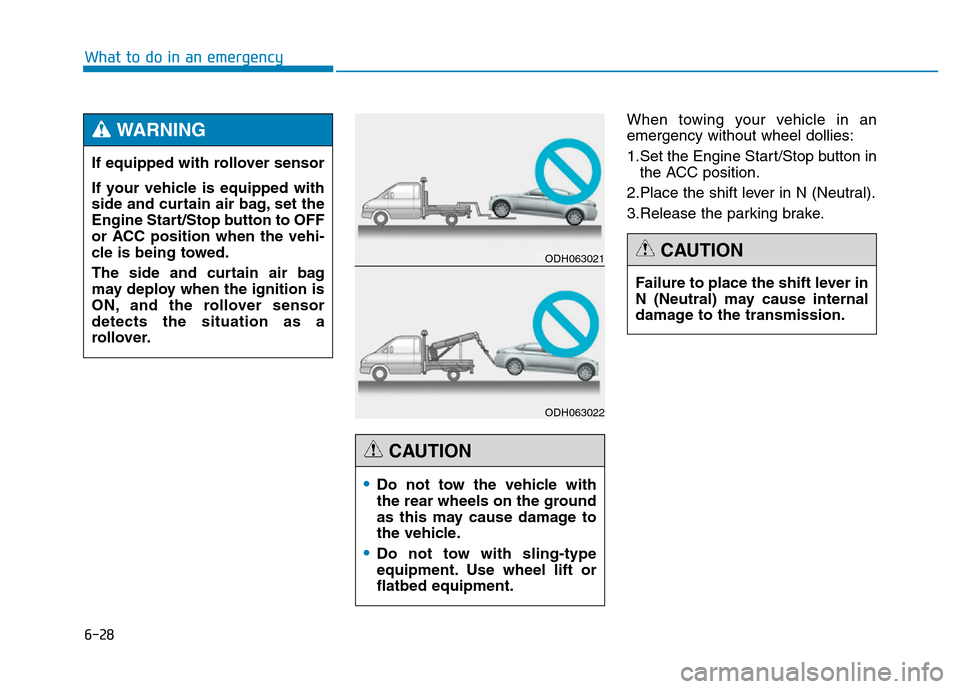
•Do not tow the vehicle with
the rear wheels on the ground
as this may cause damage to
the vehicle.
•Do not tow with sling-type
equipment. Use wheel lift or
flatbed equipment.
CAUTION
ODH063021
ODH063022
If equipped with rollover sensor
If your vehicle is equipped with
side and curtain air bag, set the
Engine Start/Stop button to OFF
or ACC position when the vehi-
cle is being towed.
The side and curtain air bag
may deploy when the ignition is
ON, and the rollover sensor
detects the situation as a
rollover.
WARNING
Page 432 of 546
6-29
What to do in an emergency
6
Removable towing hook
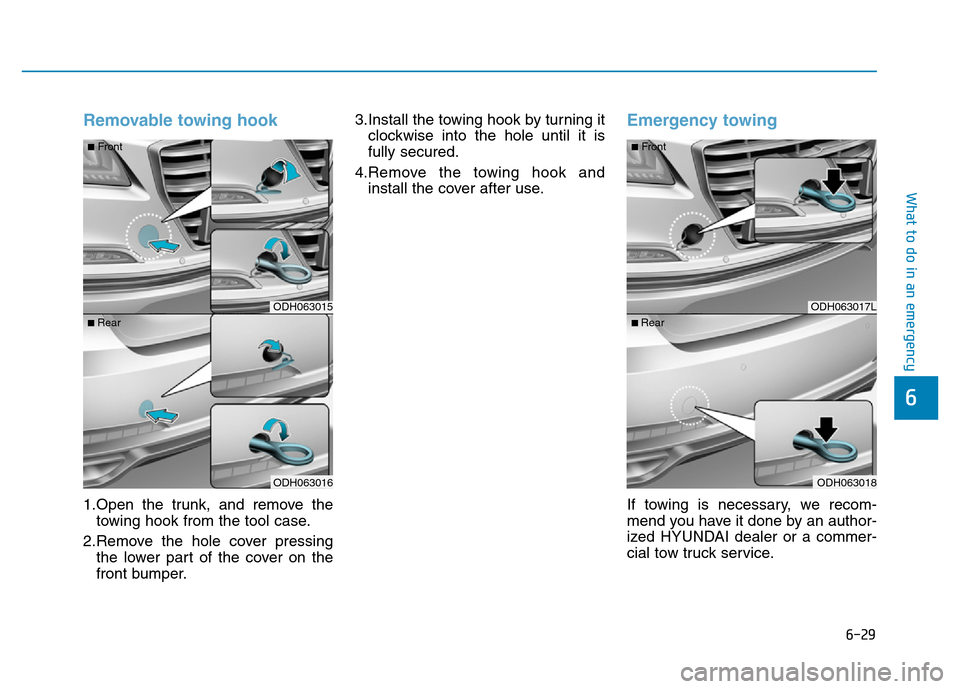
1.Open the trunk, and remove the
towing hook from the tool case.
2.Remove the hole cover pressing
the lower part of the cover on the
front bumper.3.Install the towing hook by turning it
clockwise into the hole until it is
fully secured.
4.Remove the towing hook and
install the cover after use.
Emergency towing
If towing is necessary, we recom-
mend you have it done by an author-
ized HYUNDAI dealer or a commer-
cial tow truck service.
ODH063017L
ODH063018
■Front
■ Rear
ODH063015
ODH063016
■Front
■ Rear
Page 433 of 546
6-30
What to do in an emergency
If towing service is not available in an
emergency, your vehicle may be
temporarily towed using a cable or
chain secured to the emergency tow-
ing hook at the front (or rear) of the
vehicle.
Use extreme caution when towing
the vehicle with a cable or chain. A
driver must be in the vehicle to steer
it and operate the brakes.
Towing in this manner may be done
only on hard-surfaced roads for a
short distance and at low speeds.
Also, the wheels, axles, power train,
steering and brakes must all be in
good condition.Always follow these emergency tow-
ing precautions:
• Place the Engine Start/Stop button
in the ACC position so the steering
wheel is not locked.
• Place the shift lever in N (Neutral).
• Release the parking brake.
• Depress the brake pedal with more
force than normal since you will
have reduced braking perform-
ance.
• More steering effort will be
required because the power steer-
ing system will be disabled.
• Use a vehicle heavier than your
own to tow your vehicle.
• The drivers of both vehicles should
communicate with each other fre-
quently.
• Before emergency towing, check
that the hook is not broken or dam-
aged.
• Fasten the towing cable or chain
securely to the hook.
• Do not jerk the hook. Apply steady
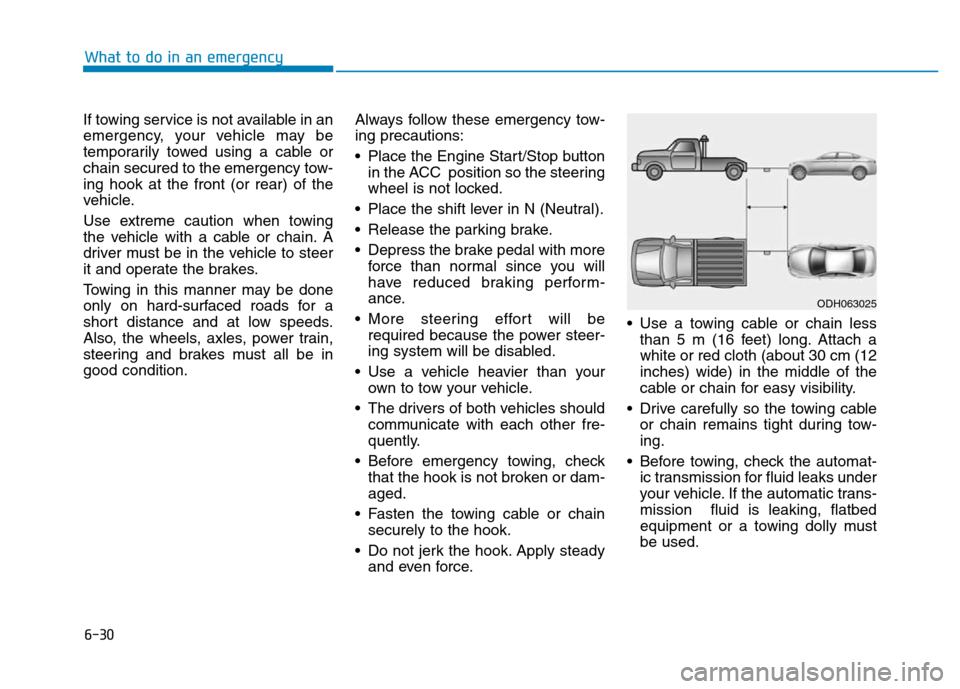
and even force.• Use a towing cable or chain less
than 5 m (16 feet) long. Attach a
white or red cloth (about 30 cm (12
inches) wide) in the middle of the
cable or chain for easy visibility.
• Drive carefully so the towing cable
or chain remains tight during tow-
ing.
• Before towing, check the automat-
ic transmission for fluid leaks under
your vehicle. If the automatic trans-
mission fluid is leaking, flatbed
equipment or a towing dolly must
be used.
ODH063025
Page 434 of 546
6-31
What to do in an emergency
6
To avoid damage to your vehicle
and vehicle components when
towing:
•Always pull straight ahead
when using the towing hooks.
Do not pull from the side or at
a vertical angle.
•Do not use the towing hooks
to pull a vehicle out of mud,
sand or other conditions from
which the vehicle cannot be
driven out under its own
power.
•Limit the vehicle speed to
15 km/h (10 mph) and drive
less than 1.5 km (1 mile) when
towing to avoid serious dam-
age to the automatic trans-
mission.
CAUTION
Page 451 of 546
7-15
7
Maintenance
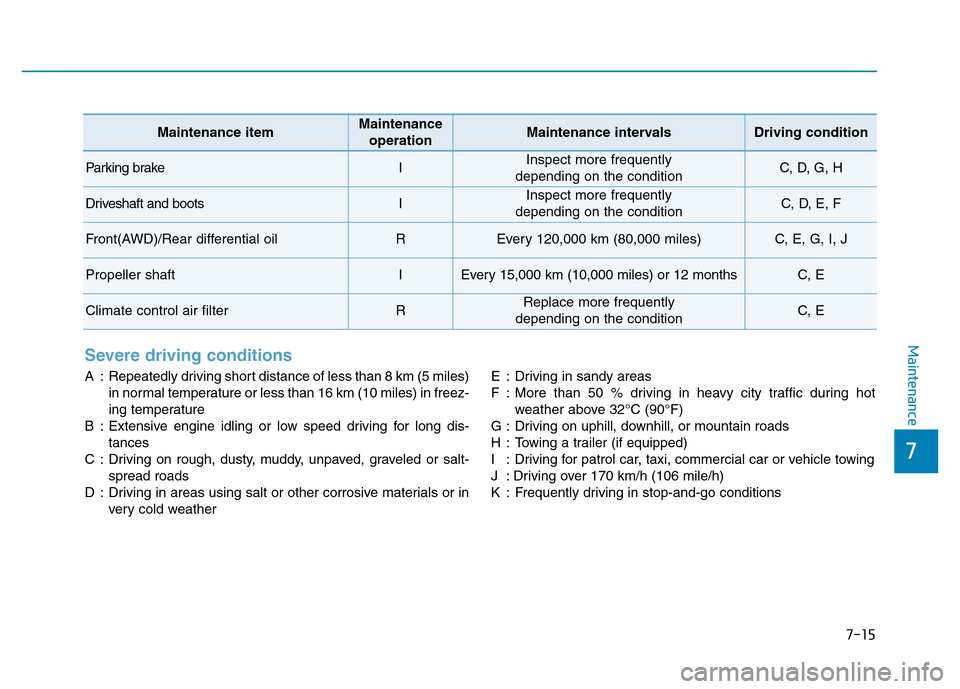
Severe driving conditions
A : Repeatedly driving short distance of less than 8 km (5 miles)
in normal temperature or less than 16 km (10 miles) in freez-
ing temperature
B : Extensive engine idling or low speed driving for long dis-
tances
C : Driving on rough, dusty, muddy, unpaved, graveled or salt-
spread roads
D : Driving in areas using salt or other corrosive materials or in
very cold weatherE : Driving in sandy areas
F : More than 50 % driving in heavy city traffic during hot
weather above 32°C (90°F)
G : Driving on uphill, downhill, or mountain roads
H : Towing a trailer (if equipped)
I : Driving for patrol car, taxi, commercial car or vehicle towing
J : Driving over 170 km/h (106 mile/h)
K : Frequently driving in stop-and-go conditions
Maintenance itemMaintenance
operationMaintenance intervalsDriving condition
Parking brakeIInspect more frequently
depending on the conditionC, D, G, H
Driveshaft and bootsIInspect more frequently
depending on the conditionC, D, E, F
Front(AWD)/Rear differential oilREvery 120,000 km (80,000 miles)C, E, G, I, J
Propeller shaftIEvery 15,000 km (10,000 miles) or 12 monthsC, E
Climate control air filter RReplace more frequently
depending on the conditionC, E
Page 457 of 546
7-21
7
Maintenance
21
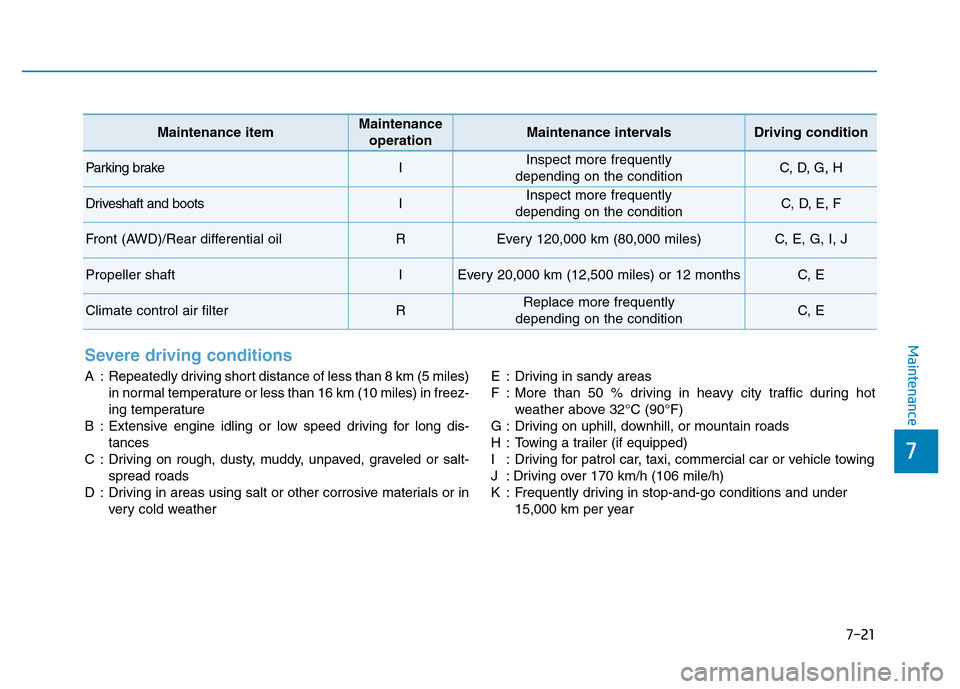
Severe driving conditions
A : Repeatedly driving short distance of less than 8 km (5 miles)
in normal temperature or less than 16 km (10 miles) in freez-
ing temperature
B : Extensive engine idling or low speed driving for long dis-
tances
C : Driving on rough, dusty, muddy, unpaved, graveled or salt-
spread roads
D : Driving in areas using salt or other corrosive materials or in
very cold weatherE : Driving in sandy areas
F : More than 50 % driving in heavy city traffic during hot
weather above 32°C (90°F)
G : Driving on uphill, downhill, or mountain roads
H : Towing a trailer (if equipped)
I : Driving for patrol car, taxi, commercial car or vehicle towing
J : Driving over 170 km/h (106 mile/h)
K : Frequently driving in stop-and-go conditions and under
15,000 km per year
Maintenance itemMaintenance
operationMaintenance intervalsDriving condition
Parking brakeIInspect more frequently
depending on the conditionC, D, G, H
Driveshaft and bootsIInspect more frequently
depending on the conditionC, D, E, F
Front (AWD)/Rear differential oilREvery 120,000 km (80,000 miles)C, E, G, I, J
Propeller shaftIEvery 20,000 km (12,500 miles) or 12 monthsC, E
Climate control air filter RReplace more frequently
depending on the conditionC, E