Maintenance Hyundai Genesis 2014 Service Manual
[x] Cancel search | Manufacturer: HYUNDAI, Model Year: 2014, Model line: Genesis, Model: Hyundai Genesis 2014Pages: 546, PDF Size: 13.59 MB
Page 467 of 546
7-31
7
Maintenance
BRAKE FLUID
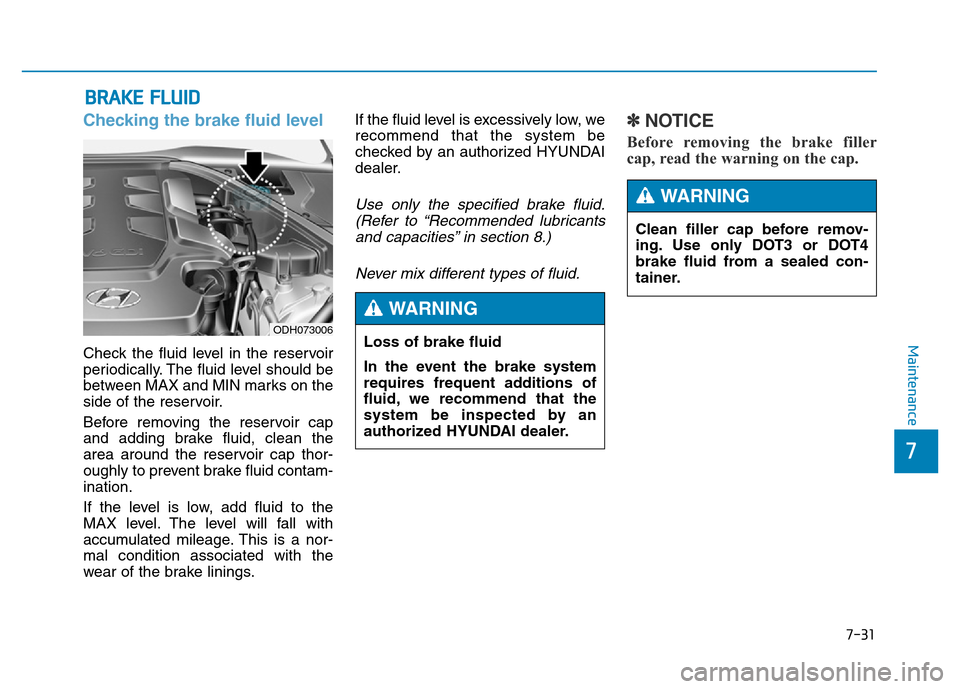
Checking the brake fluid level
Check the fluid level in the reservoir
periodically. The fluid level should be
between MAX and MIN marks on the
side of the reservoir.
Before removing the reservoir cap
and adding brake fluid, clean the
area around the reservoir cap thor-
oughly to prevent brake fluid contam-
ination.
If the level is low, add fluid to the
MAX level. The level will fall with
accumulated mileage. This is a nor-
mal condition associated with the
wear of the brake linings.If the fluid level is excessively low, we
recommend that the system be
checked by an authorized HYUNDAI
dealer.
Use only the specified brake fluid.
(Refer to “Recommended lubricants
and capacities” in section 8.)
Never mix different types of fluid.
✽NOTICE
Before removing the brake filler
cap, read the warning on the cap.
ODH073006Loss of brake fluid
In the event the brake system
requires frequent additions of
fluid, we recommend that the
system be inspected by an
authorized HYUNDAI dealer.
WARNING
Clean filler cap before remov-
ing. Use only DOT3 or DOT4
brake fluid from a sealed con-
tainer.
WARNING
Page 468 of 546
7-32
Maintenance
Brake fluid
When changing and adding
brake fluid, handle it carefully.
Do not let it come in contact
with your eyes. If brake fluid
should come in contact with
your eyes, immediately flush
them with a large quantity of
fresh tap water. Have your eyes
examined by a doctor as soon
as possible.
WARNING
Do not allow brake fluid to con-
tact the vehicle's body paint, as
paint damage will result. Brake
fluid, which has been exposed
to open air for an extended time
should never be used as its
quality cannot be guaranteed. It
should be disposed of properly.
Don't put in the wrong kind of
fluid.
A few drops of mineral-based
oil, such as engine oil, in your
brake system can damage
brake system parts.
CAUTION
Page 469 of 546
7-33
7
Maintenance
WASHER FLUID
Checking the washer fluid
level
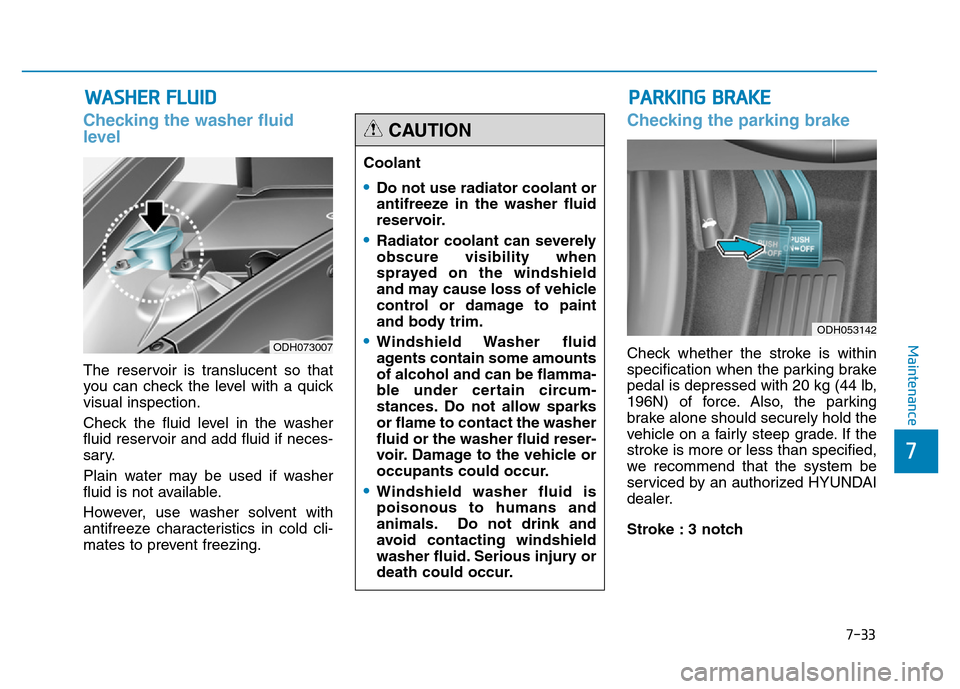
The reservoir is translucent so that
you can check the level with a quick
visual inspection.
Check the fluid level in the washer
fluid reservoir and add fluid if neces-
sary.
Plain water may be used if washer
fluid is not available.
However, use washer solvent with
antifreeze characteristics in cold cli-
mates to prevent freezing.
Checking the parking brake
Check whether the stroke is within
specification when the parking brake
pedal is depressed with 20 kg (44 lb,
196N) of force. Also, the parking
brake alone should securely hold the
vehicle on a fairly steep grade. If the
stroke is more or less than specified,
we recommend that the system be
serviced by an authorized HYUNDAI
dealer.
Stroke : 3 notchODH073007
Coolant
•Do not use radiator coolant or
antifreeze in the washer fluid
reservoir.
•Radiator coolant can severely
obscure visibility when
sprayed on the windshield
and may cause loss of vehicle
control or damage to paint
and body trim.
•Windshield Washer fluid
agents contain some amounts
of alcohol and can be flamma-
ble under certain circum-
stances. Do not allow sparks
or flame to contact the washer
fluid or the washer fluid reser-
voir. Damage to the vehicle or
occupants could occur.
•Windshield washer fluid is
poisonous to humans and
animals. Do not drink and
avoid contacting windshield
washer fluid. Serious injury or
death could occur.
CAUTION
ODH053142
PARKING BRAKE
Page 470 of 546
7-34
Maintenance
AIR CLEANER
Filter replacement
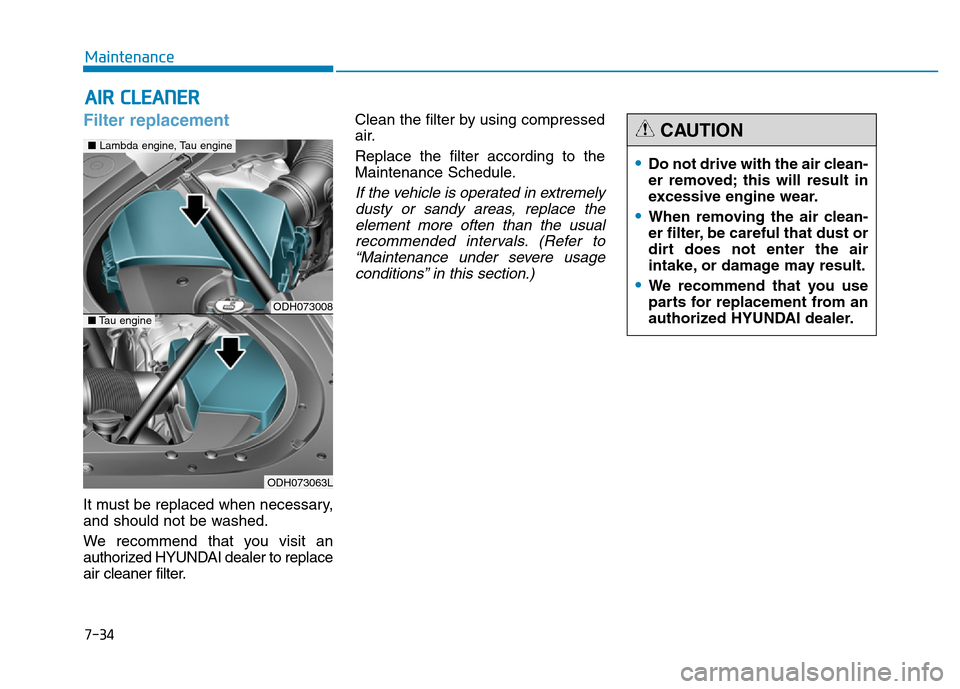
It must be replaced when necessary,
and should not be washed.
We recommend that you visit an
authorized HYUNDAI dealer to replace
air cleaner filter.Clean the filter by using compressed
air.
Replace the filter according to the
Maintenance Schedule.
If the vehicle is operated in extremely
dusty or sandy areas, replace the
element more often than the usual
recommended intervals. (Refer to
“Maintenance under severe usage
conditions” in this section.)
•Do not drive with the air clean-
er removed; this will result in
excessive engine wear.
•When removing the air clean-
er filter, be careful that dust or
dirt does not enter the air
intake, or damage may result.
•We recommend that you use
parts for replacement from an
authorized HYUNDAI dealer.
CAUTION
ODH073008
ODH073063L
■Lambda engine, Tau engine
■Tau engine
Page 471 of 546
7-35
7
Maintenance
CLIMATE CONTROL AIR FILTER
Filter inspection
If the vehicle is operated in the
severely air-polluted cities or on dusty
rough roads for a long period, it
should be inspected more frequently
and replaced earlier. When you, the
owner, replace the climate control air
filter, replace it performing the follow-
ing procedure, and be careful to
avoid damaging other components.
Replace the filter according to the
Maintenance Schedule.
✽NOTICE
Install a new climate control air fil-
ter in the correct direction with the
arrow symbol (
↓) facing downwards.
Otherwise, the climate control effects
may decrease, possibly with a noise.
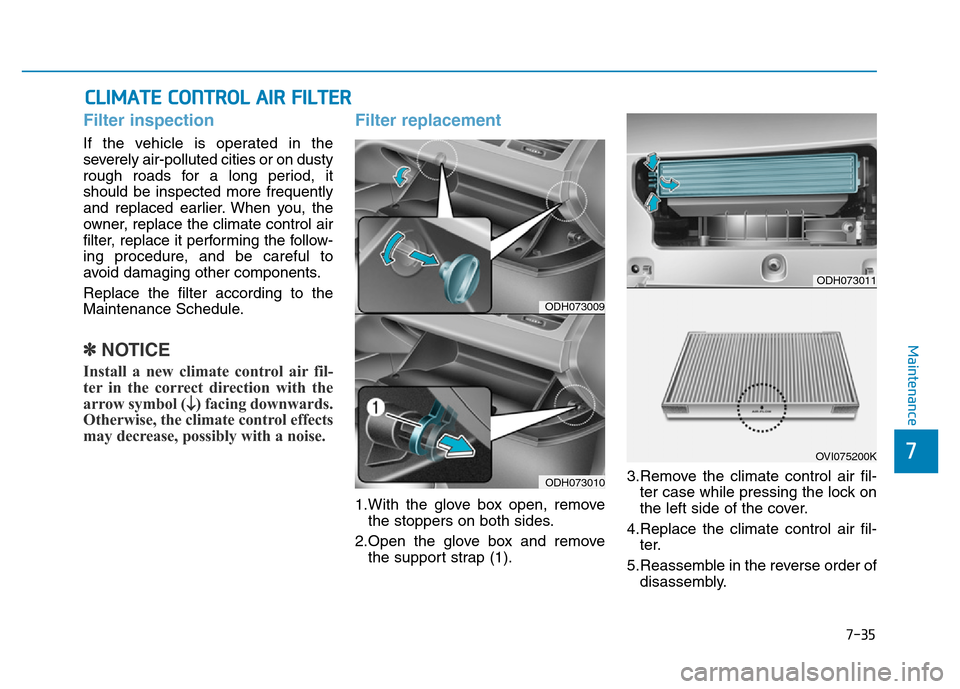
Filter replacement
1.With the glove box open, remove
the stoppers on both sides.
2.Open the glove box and remove
the support strap (1).3.Remove the climate control air fil-
ter case while pressing the lock on
the left side of the cover.
4.Replace the climate control air fil-
ter.
5.Reassemble in the reverse order of
disassembly.
ODH073009
ODH073010
ODH073011
OVI075200K
Page 472 of 546
7-36
Maintenance
WIPER BLADES
Blade inspection
✽NOTICE
Commercial hot waxes applied by
automatic car washes have been
known to make the windshield diffi-
cult to clean.
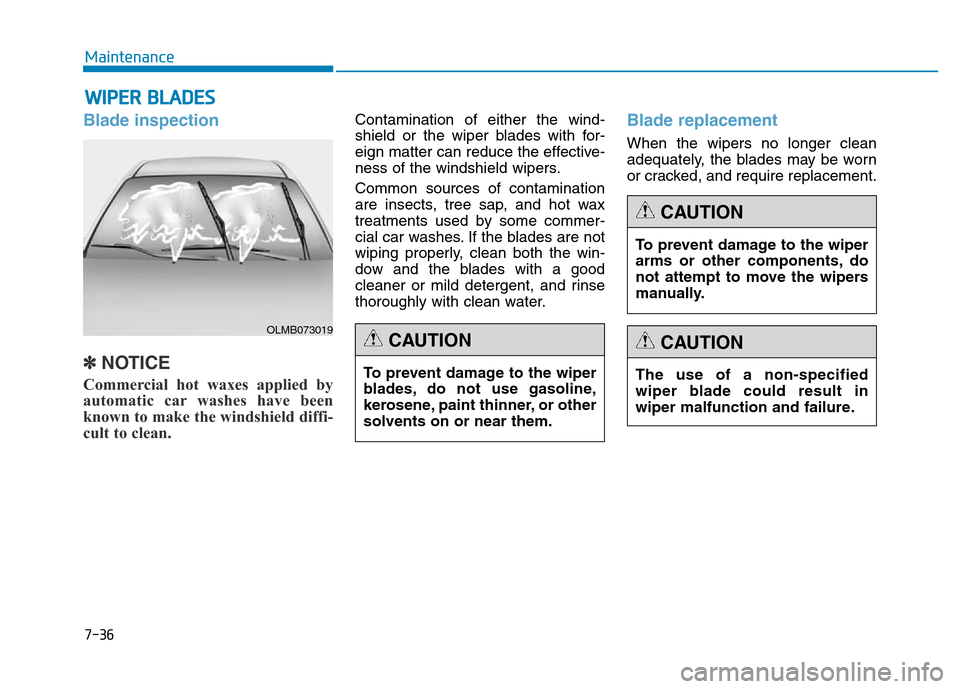
Contamination of either the wind-
shield or the wiper blades with for-
eign matter can reduce the effective-
ness of the windshield wipers.
Common sources of contamination
are insects, tree sap, and hot wax
treatments used by some commer-
cial car washes. If the blades are not
wiping properly, clean both the win-
dow and the blades with a good
cleaner or mild detergent, and rinse
thoroughly with clean water.Blade replacement
When the wipers no longer clean
adequately, the blades may be worn
or cracked, and require replacement.
OLMB073019
To prevent damage to the wiper
blades, do not use gasoline,
kerosene, paint thinner, or other
solvents on or near them.
CAUTION
To prevent damage to the wiper
arms or other components, do
not attempt to move the wipers
manually.
CAUTION
The use of a non-specified
wiper blade could result in
wiper malfunction and failure.
CAUTION
Page 473 of 546
7-37
7
Maintenance
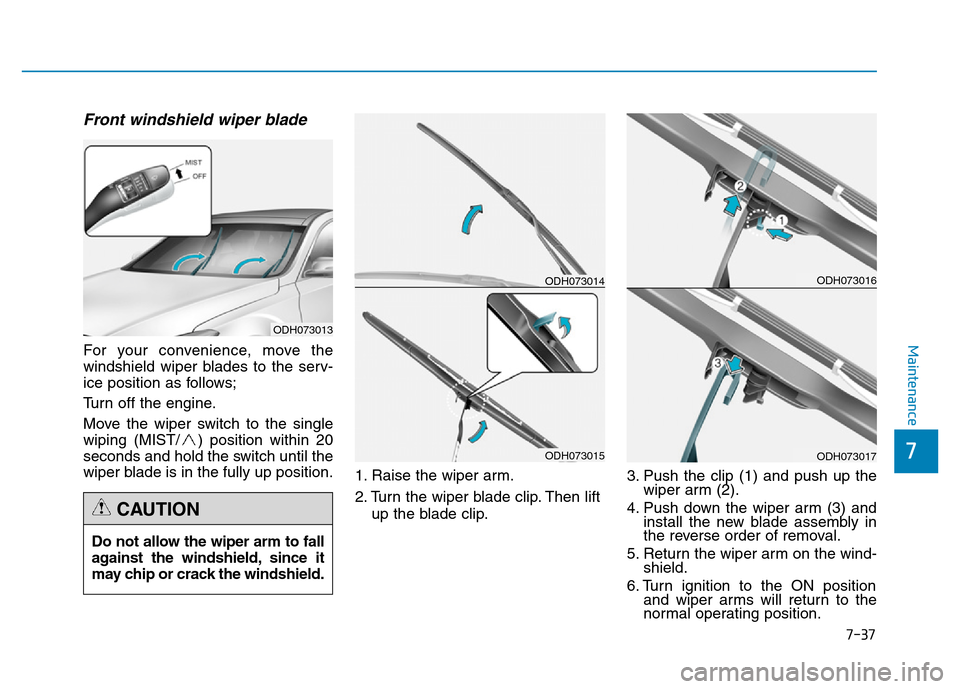
Front windshield wiper blade
For your convenience, move the
windshield wiper blades to the serv-
ice position as follows;
Turn off the engine.
Move the wiper switch to the single
wiping (MIST/ ) position within 20
seconds and hold the switch until the
wiper blade is in the fully up position.
1. Raise the wiper arm.
2. Turn the wiper blade clip. Then lift
up the blade clip.3. Push the clip (1) and push up the
wiper arm (2).
4. Push down the wiper arm (3) and
install the new blade assembly in
the reverse order of removal.
5. Return the wiper arm on the wind-
shield.
6. Turn ignition to the ON position
and wiper arms will return to the
normal operating position.
Do not allow the wiper arm to fall
against the windshield, since it
may chip or crack the windshield.
CAUTION
ODH073013
ODH073015
ODH073016
ODH073017
ODH073014
Page 474 of 546
7-38
Maintenance
BATTERY
For best battery service
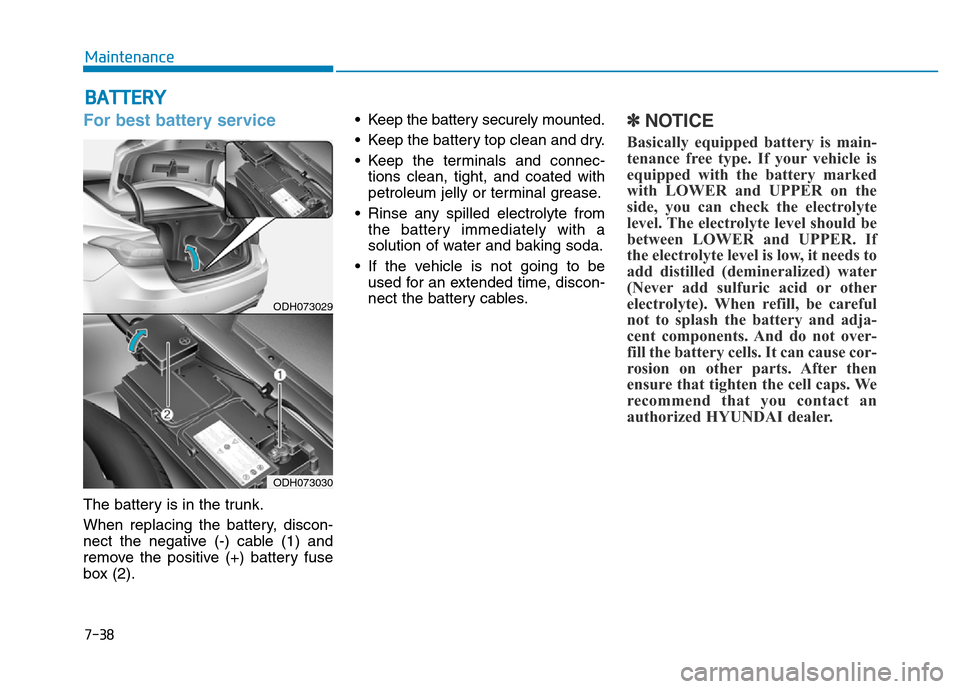
The battery is in the trunk.
When replacing the battery, discon-
nect the negative (-) cable (1) and
remove the positive (+) battery fuse
box (2).• Keep the battery securely mounted.
• Keep the battery top clean and dry.
• Keep the terminals and connec-
tions clean, tight, and coated with
petroleum jelly or terminal grease.
• Rinse any spilled electrolyte from
the battery immediately with a
solution of water and baking soda.
• If the vehicle is not going to be
used for an extended time, discon-
nect the battery cables.
✽NOTICE
Basically equipped battery is main-
tenance free type. If your vehicle is
equipped with the battery marked
with LOWER and UPPER on the
side, you can check the electrolyte
level. The electrolyte level should be
between LOWER and UPPER. If
the electrolyte level is low, it needs to
add distilled (demineralized) water
(Never add sulfuric acid or other
electrolyte). When refill, be careful
not to splash the battery and adja-
cent components. And do not over-
fill the battery cells. It can cause cor-
rosion on other parts. After then
ensure that tighten the cell caps. We
recommend that you contact an
authorized HYUNDAI dealer.
ODH073029
ODH073030
Page 475 of 546
7-39
7
Maintenance
(Continued)
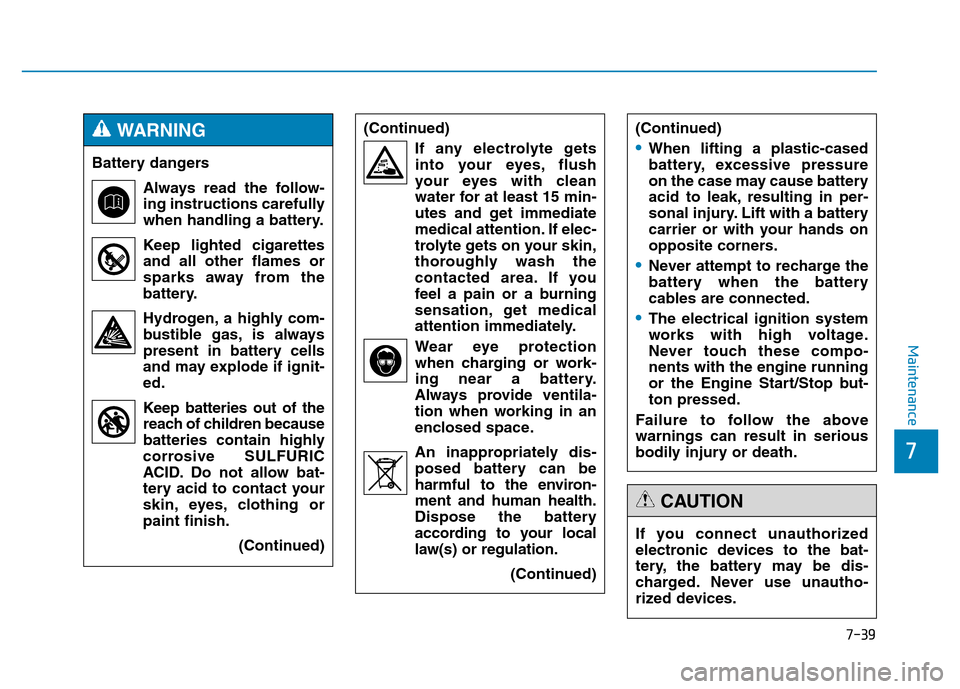
If any electrolyte gets
into your eyes, flush
your eyes with clean
water for at least 15 min-
utes and get immediate
medical attention. If elec-
trolyte gets on your skin,
thoroughly wash the
contacted area. If you
feel a pain or a burning
sensation, get medical
attention immediately.
Wear eye protection
when charging or work-
ing near a battery.
Always provide ventila-
tion when working in an
enclosed space.
An inappropriately dis-
posed battery can be
harmful to the environ-
ment and human health.
Dispose the battery
according to your local
law(s) or regulation.
(Continued)(Continued)
•When lifting a plastic-cased
battery, excessive pressure
on the case may cause battery
acid to leak, resulting in per-
sonal injury. Lift with a battery
carrier or with your hands on
opposite corners.
•Never attempt to recharge the
battery when the battery
cables are connected.
•The electrical ignition system
works with high voltage.
Never touch these compo-
nents with the engine running
or the Engine Start/Stop but-
ton pressed.
Failure to follow the above
warnings can result in serious
bodily injury or death.
If you connect unauthorized
electronic devices to the bat-
tery, the battery may be dis-
charged. Never use unautho-
rized devices.
CAUTION
Battery dangers
Always read the follow-
ing instructions carefully
when handling a battery.
Keep lighted cigarettes
and all other flames or
sparks away from the
battery.
Hydrogen, a highly com-
bustible gas, is always
present in battery cells
and may explode if ignit-
ed.
Keep batteries out of the
reach of children because
batteries contain highly
corrosive SULFURIC
ACID. Do not allow bat-
tery acid to contact your
skin, eyes, clothing or
paint finish.
(Continued)
WARNING
Page 476 of 546
7-40
Maintenance
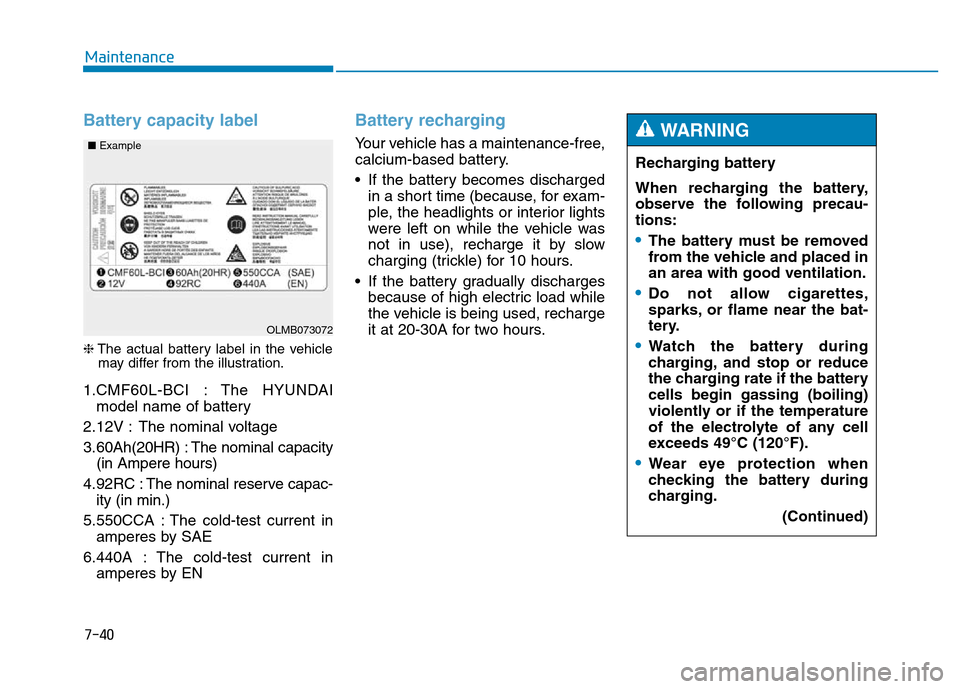
Battery capacity label
❈The actual battery label in the vehicle
may differ from the illustration.
1.CMF60L-BCI : The HYUNDAI
model name of battery
2.12V : The nominal voltage
3.60Ah(20HR) : The nominal capacity
(in Ampere hours)
4.92RC : The nominal reserve capac-
ity (in min.)
5.550CCA : The cold-test current in
amperes by SAE
6.440A : The cold-test current in
amperes by EN
Battery recharging
Your vehicle has a maintenance-free,
calcium-based battery.
• If the battery becomes discharged
in a short time (because, for exam-
ple, the headlights or interior lights
were left on while the vehicle was
not in use), recharge it by slow
charging (trickle) for 10 hours.
• If the battery gradually discharges
because of high electric load while
the vehicle is being used, recharge
it at 20-30A for two hours.
OLMB073072 ■Example
Recharging battery
When recharging the battery,
observe the following precau-
tions:
•The battery must be removed
from the vehicle and placed in
an area with good ventilation.
•Do not allow cigarettes,
sparks, or flame near the bat-
tery.
•Watch the battery during
charging, and stop or reduce
the charging rate if the battery
cells begin gassing (boiling)
violently or if the temperature
of the electrolyte of any cell
exceeds 49°C (120°F).
•Wear eye protection when
checking the battery during
charging.
(Continued)
WARNING