belt Hyundai Genesis 2014 Repair Manual
[x] Cancel search | Manufacturer: HYUNDAI, Model Year: 2014, Model line: Genesis, Model: Hyundai Genesis 2014Pages: 546, PDF Size: 13.59 MB
Page 412 of 546
6-9
What to do in an emergency
6
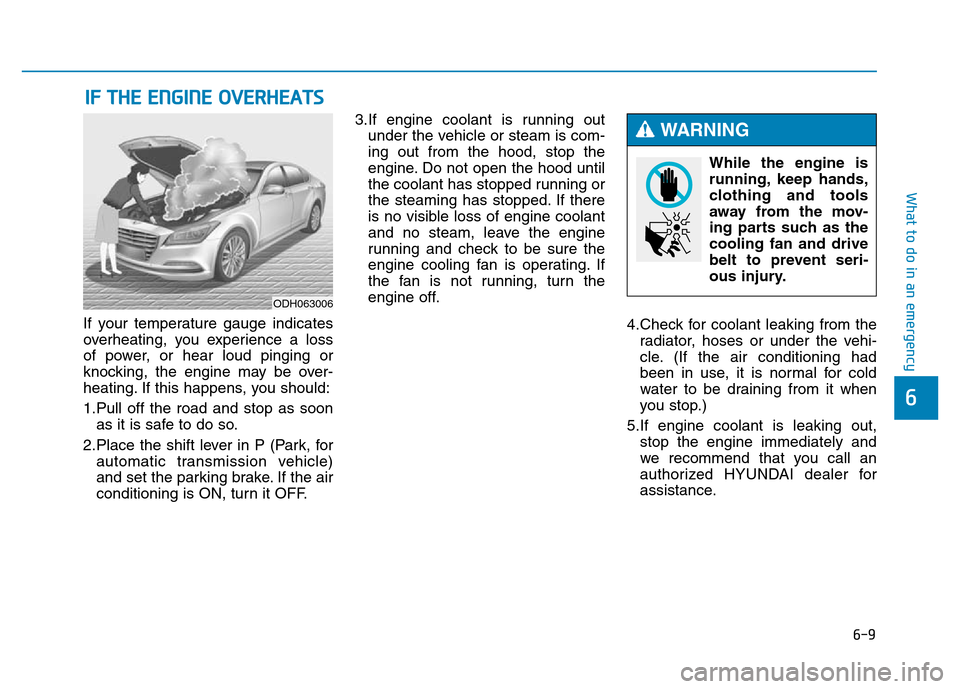
If your temperature gauge indicates
overheating, you experience a loss
of power, or hear loud pinging or
knocking, the engine may be over-
heating. If this happens, you should:
1.Pull off the road and stop as soon
as it is safe to do so.
2.Place the shift lever in P (Park, for
automatic transmission vehicle)
and set the parking brake. If the air
conditioning is ON, turn it OFF.3.If engine coolant is running out
under the vehicle or steam is com-
ing out from the hood, stop the
engine. Do not open the hood until
the coolant has stopped running or
the steaming has stopped. If there
is no visible loss of engine coolant
and no steam, leave the engine
running and check to be sure the
engine cooling fan is operating. If
the fan is not running, turn the
engine off.
4.Check for coolant leaking from the
radiator, hoses or under the vehi-
cle. (If the air conditioning had
been in use, it is normal for cold
water to be draining from it when
you stop.)
5.If engine coolant is leaking out,
stop the engine immediately and
we recommend that you call an
authorized HYUNDAI dealer for
assistance.
IF THE ENGINE OVERHEATS
While the engine is
running, keep hands,
clothing and tools
away from the mov-
ing parts such as the
cooling fan and drive
belt to prevent seri-
ous injury.
WARNING
ODH063006
Page 430 of 546
6-27
What to do in an emergency
6
Towing service
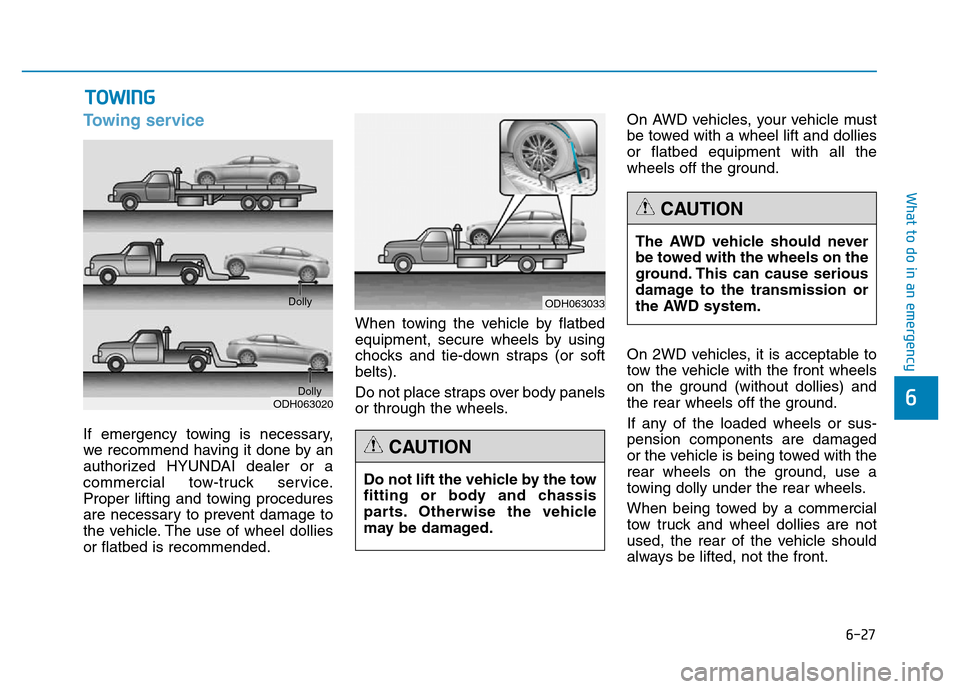
If emergency towing is necessary,
we recommend having it done by an
authorized HYUNDAI dealer or a
commercial tow-truck service.
Proper lifting and towing procedures
are necessary to prevent damage to
the vehicle. The use of wheel dollies
or flatbed is recommended.When towing the vehicle by flatbed
equipment, secure wheels by using
chocks and tie-down straps (or soft
belts).
Do not place straps over body panels
or through the wheels.On AWD vehicles, your vehicle must
be towed with a wheel lift and dollies
or flatbed equipment with all the
wheels off the ground.
On 2WD vehicles, it is acceptable to
tow the vehicle with the front wheels
on the ground (without dollies) and
the rear wheels off the ground.
If any of the loaded wheels or sus-
pension components are damaged
or the vehicle is being towed with the
rear wheels on the ground, use a
towing dolly under the rear wheels.
When being towed by a commercial
tow truck and wheel dollies are not
used, the rear of the vehicle should
always be lifted, not the front.
TOWING
ODH063020Dolly
Dolly
Do not lift the vehicle by the tow
fitting or body and chassis
parts. Otherwise the vehicle
may be damaged.
CAUTION
The AWD vehicle should never
be towed with the wheels on the
ground. This can cause serious
damage to the transmission or
the AWD system.
CAUTION
ODH063033
Page 444 of 546
7-8
Maintenance
At least monthly:
• Check coolant level in the engine
coolant reservoir.
• Check the operation of all exterior
lights, including the stop lamps,
turn signals and hazard warning
flashers.
• Check the inflation pressures of all
tires including the spare.
At least twice a year
(i.e., every Spring and Fall) :
• Check radiator, heater and air con-
ditioning hoses for leaks or dam-
age.
• Check windshield washer spray
and wiper operation. Clean wiper
blades with clean cloth dampened
with washer fluid.
• Check headlamp alignment.
• Check muffler, exhaust pipes,
shields and clamps.
• Check the lap/shoulder belts for
wear and function.
• Check for worn tires and loose
wheel lug nuts.
At least once a year :
• Clean body and door drain holes.
• Lubricate door hinges and checks,
and hood hinges.
• Lubricate door and hood locks and
latches.
• Lubricate door rubber weather-
strips.
• Check the air conditioning system.
• Inspect and lubricate automatic
transmission linkage and controls.
• Clean battery and terminals.
• Check the brake fluid level.
Page 446 of 546
7-10
Maintenance
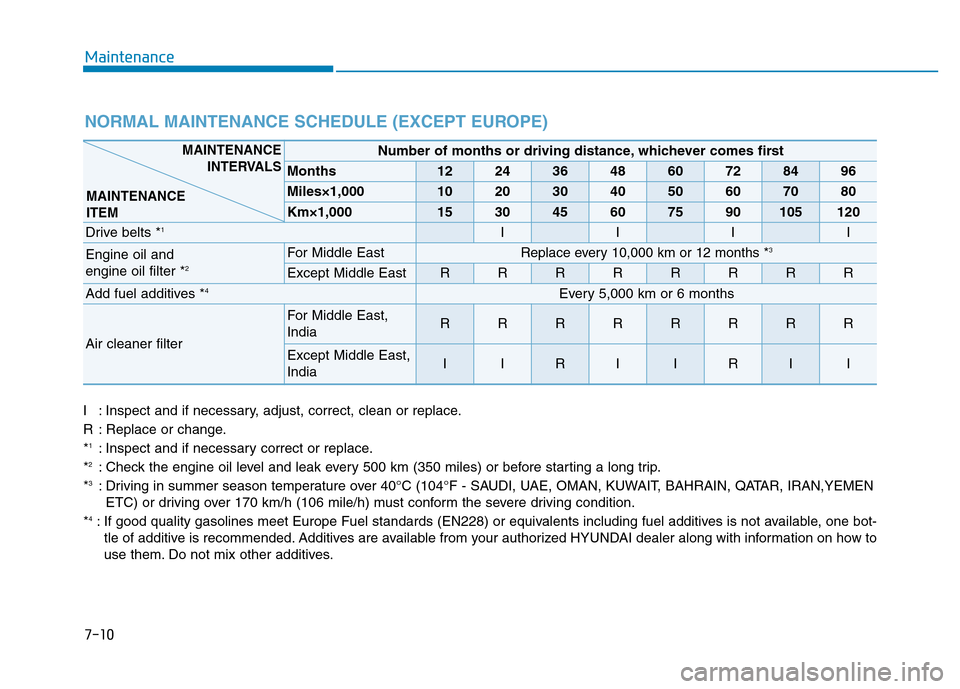
NORMAL MAINTENANCE SCHEDULE (EXCEPT EUROPE)
I : Inspect and if necessary, adjust, correct, clean or replace.
R : Replace or change.
*
1: Inspect and if necessary correct or replace.
*2: Check the engine oil level and leak every 500 km (350 miles) or before starting a long trip.
*3: Driving in summer season temperature over 40°C (104°F - SAUDI, UAE, OMAN, KUWAIT, BAHRAIN, QATAR, IRAN,YEMEN
ETC) or driving over 170 km/h (106 mile/h) must conform the severe driving condition.
*
4: If good quality gasolines meet Europe Fuel standards (EN228) or equivalents including fuel additives is not available, one bot-
tle of additive is recommended. Additives are available from your authorized HYUNDAI dealer along with information on how to
use them. Do not mix other additives.
Number of months or driving distance, whichever comes first
Months1224364860728496
Miles×1,0001020304050607080
Km×1,000153045607590105120
Drive belts *1IIII
Engine oil and
engine oil filter *2For Middle EastReplace every 10,000 km or 12 months *3
Except Middle EastRRRRRRRR
Add fuel additives *4Every 5,000 km or 6 months
Air cleaner filter
For Middle East,
IndiaRRRRRRRR
Except Middle East,
IndiaIIRIIRII
MAINTENANCE
INTERVALS
MAINTENANCE
ITEM
Page 447 of 546
7-11
7
Maintenance
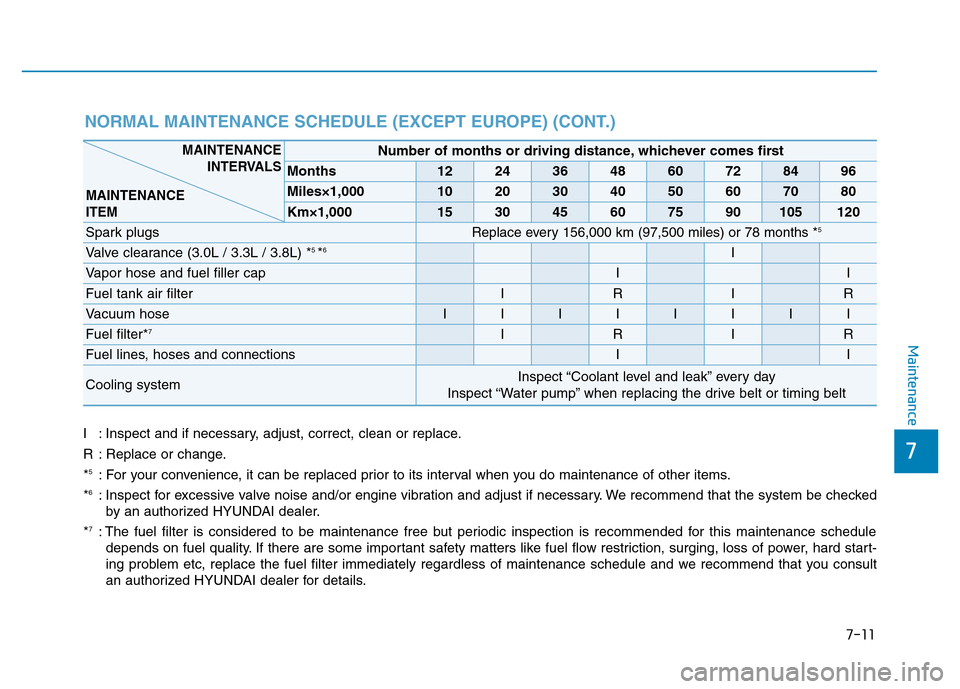
NORMAL MAINTENANCE SCHEDULE (EXCEPT EUROPE) (CONT.)
I : Inspect and if necessary, adjust, correct, clean or replace.
R : Replace or change.
*
5: For your convenience, it can be replaced prior to its interval when you do maintenance of other items.
*
6: Inspect for excessive valve noise and/or engine vibration and adjust if necessary. We recommend that the system be checked
by an authorized HYUNDAI dealer.
*
7: The fuel filter is considered to be maintenance free but periodic inspection is recommended for this maintenance schedule
depends on fuel quality. If there are some important safety matters like fuel flow restriction, surging, loss of power, hard start-
ing problem etc, replace the fuel filter immediately regardless of maintenance schedule and we recommend that you consult
an authorized HYUNDAI dealer for details.
Number of months or driving distance, whichever comes first
Months1224364860728496
Miles×1,0001020304050607080
Km×1,000153045607590105120
Spark plugsReplace every 156,000 km (97,500 miles) or 78 months *5
Valve clearance (3.0L / 3.3L / 3.8L) *5 *6I
Vapor hose and fuel filler capII
Fuel tank air filterIRIR
Vacuum hoseIIIIIIII
Fuel filter*7IRIR
Fuel lines, hoses and connectionsII
Cooling systemInspect “Coolant level and leak” every day
Inspect “Water pump” when replacing the drive belt or timing belt
MAINTENANCE
INTERVALS
MAINTENANCE
ITEM
Page 452 of 546
7-16
Maintenance
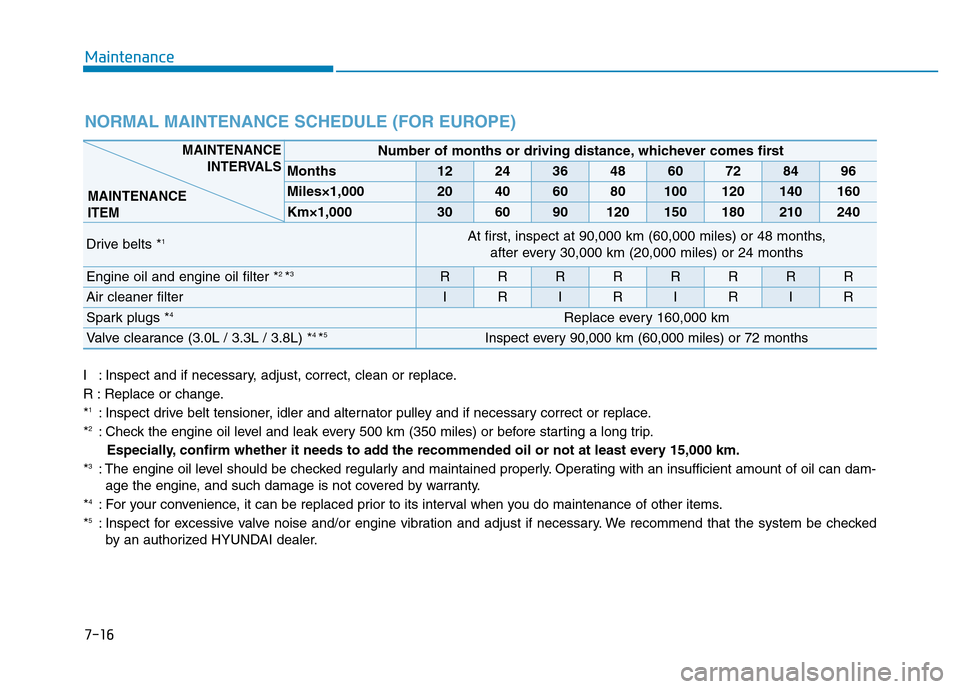
NORMAL MAINTENANCE SCHEDULE (FOR EUROPE)
I : Inspect and if necessary, adjust, correct, clean or replace.
R : Replace or change.
*
1: Inspect drive belt tensioner, idler and alternator pulley and if necessary correct or replace.
*2: Check the engine oil level and leak every 500 km (350 miles) or before starting a long trip.
Especially, confirm whether it needs to add the recommended oil or not at least every 15,000 km.
*
3: The engine oil level should be checked regularly and maintained properly. Operating with an insufficient amount of oil can dam-
age the engine, and such damage is not covered by warranty.
*
4: For your convenience, it can be replaced prior to its interval when you do maintenance of other items.
*5: Inspect for excessive valve noise and/or engine vibration and adjust if necessary. We recommend that the system be checked
by an authorized HYUNDAI dealer.
Number of months or driving distance, whichever comes first
Months1224364860728496
Miles×1,00020406080100120140160
Km×1,000306090120150180210240
Drive belts *1At first, inspect at 90,000 km (60,000 miles) or 48 months,
after every 30,000 km (20,000 miles) or 24 months
Engine oil and engine oil filter *2 *3RRRRRRRR
Air cleaner filterIRIRIRIR
Spark plugs *4Replace every 160,000 km
Valve clearance (3.0L / 3.3L / 3.8L) *4 *5Inspect every 90,000 km (60,000 miles) or 72 months
MAINTENANCE
INTERVALS
MAINTENANCE
ITEM
Page 458 of 546
7-22
Maintenance
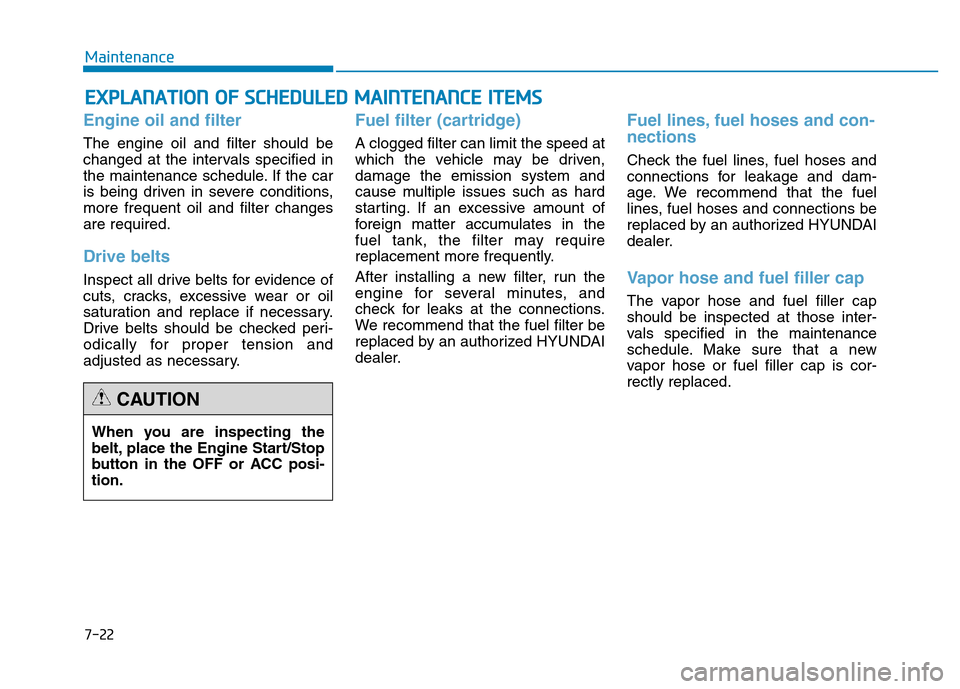
EXPLANATION OF SCHEDULED MAINTENANCE ITEMS
Engine oil and filter
The engine oil and filter should be
changed at the intervals specified in
the maintenance schedule. If the car
is being driven in severe conditions,
more frequent oil and filter changes
are required.
Drive belts
Inspect all drive belts for evidence of
cuts, cracks, excessive wear or oil
saturation and replace if necessary.
Drive belts should be checked peri-
odically for proper tension and
adjusted as necessary.
Fuel filter (cartridge)
A clogged filter can limit the speed at
which the vehicle may be driven,
damage the emission system and
cause multiple issues such as hard
starting. If an excessive amount of
foreign matter accumulates in the
fuel tank, the filter may require
replacement more frequently.
After installing a new filter, run the
engine for several minutes, and
check for leaks at the connections.
We recommend that the fuel filter be
replaced by an authorized HYUNDAI
dealer.
Fuel lines, fuel hoses and con-
nections
Check the fuel lines, fuel hoses and
connections for leakage and dam-
age. We recommend that the fuel
lines, fuel hoses and connections be
replaced by an authorized HYUNDAI
dealer.
Vapor hose and fuel filler cap
The vapor hose and fuel filler cap
should be inspected at those inter-
vals specified in the maintenance
schedule. Make sure that a new
vapor hose or fuel filler cap is cor-
rectly replaced.
When you are inspecting the
belt, place the Engine Start/Stop
button in the OFF or ACC posi-
tion.
CAUTION
Page 487 of 546
7-51
7
Maintenance
4. Tire ply composition and
material
The number of layers or plies of rub-
ber-coated fabric are in the tire. Tire
manufacturers also must indicate the
materials in the tire, which include
steel, nylon, polyester, and others.
The letter "R" means radial ply con-
struction; the letter "D" means diago-
nal or bias ply construction; and the
letter "B" means belted-bias ply con-
struction.
5. Maximum permissible infla-
tion pressure
This number is the greatest amount
of air pressure that should be put in
the tire. Do not exceed the maximum
permissible inflation pressure. Refer
to the Tire and Loading Information
label for recommended inflation
pressure.
6. Maximum load rating
This number indicates the maximum
load in kilograms and pounds that
can be carried by the tire. When
replacing the tires on the vehicle,
always use a tire that has the same
load rating as the factory installed
tire.
7. Uniform tire quality grading
Quality grades can be found where
applicable on the tire sidewall
between tread shoulder and maxi-
mum section width.
For example:
TREADWEAR 200
TRACTION AA
TEMPERATURE A
Tread wear
The tread wear grade is a compara-
tive rating based on the wear rate of
the tire when tested under controlled
conditions on a specified govern-
ment test course. For example, a tire
graded 150 would wear one-and-a-
half times (1½) as well on the gov-
ernment course as a tire graded 100.
The relative performance of tires
depends upon the actual conditions
of their use, however, and may
depart significantly from the norm
because of variations in driving
habits, service practices and differ-
ences in road characteristics and cli-
mate.
These grades are molded on the
side-walls of passenger vehicle tires.
The tires available as standard or
optional equipment on your vehicles
may vary with respect to grade.
Page 498 of 546
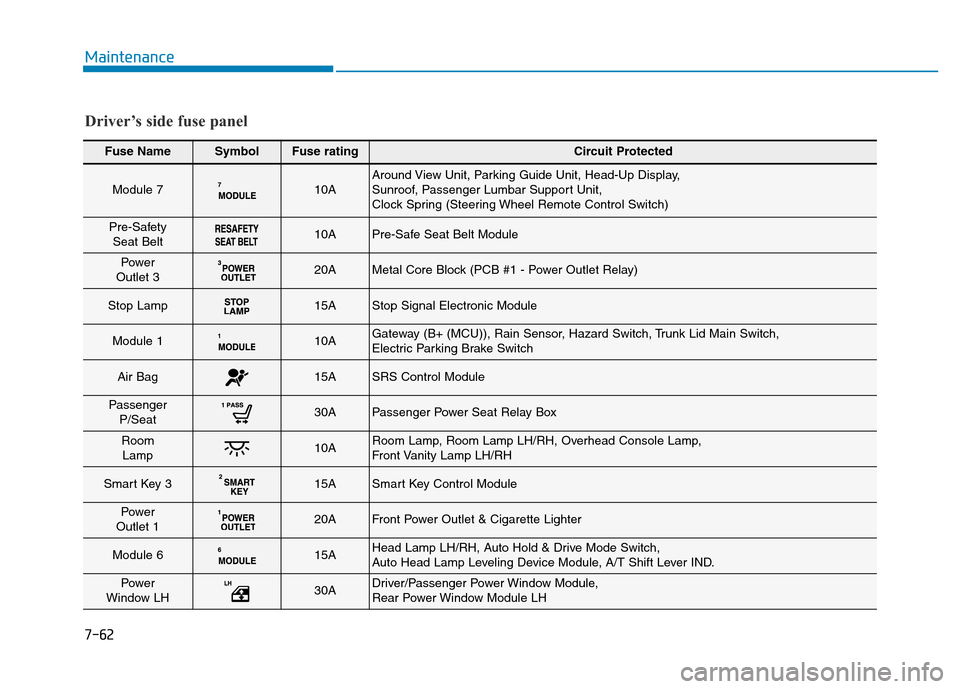
7-62
Maintenance
Fuse NameSymbolFuse ratingCircuit Protected
Module 710AAround View Unit, Parking Guide Unit, Head-Up Display,
Sunroof, Passenger Lumbar Support Unit,
Clock Spring (Steering Wheel Remote Control Switch)
Pre-Safety
Seat Belt10APre-Safe Seat Belt Module
Power
Outlet 320AMetal Core Block (PCB #1 - Power Outlet Relay)
Stop Lamp15AStop Signal Electronic Module
Module 110AGateway (B+ (MCU)), Rain Sensor, Hazard Switch, Trunk Lid Main Switch,
Electric Parking Brake Switch
Air Bag15ASRS Control Module
Passenger
P/Seat30APassenger Power Seat Relay Box
Room
Lamp10ARoom Lamp, Room Lamp LH/RH, Overhead Console Lamp,
Front Vanity Lamp LH/RH
Smart Key 315ASmart Key Control Module
Power
Outlet 120AFront Power Outlet & Cigarette Lighter
Module 615AHead Lamp LH/RH, Auto Hold & Drive Mode Switch,
Auto Head Lamp Leveling Device Module, A/T Shift Lever IND.
Power
Window LH30ADriver/Passenger Power Window Module,
Rear Power Window Module LH
Driver’s side fuse panel
Page 505 of 546
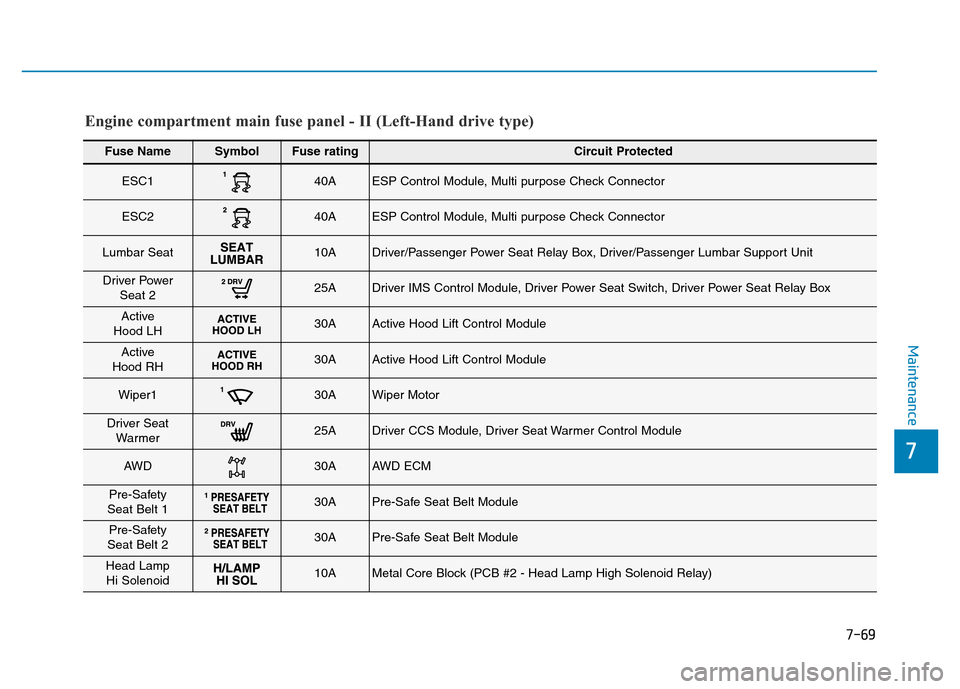
7-69
7
Maintenance
Fuse NameSymbolFuse ratingCircuit Protected
ESC140AESP Control Module, Multi purpose Check Connector
ESC240AESP Control Module, Multi purpose Check Connector
Lumbar Seat10ADriver/Passenger Power Seat Relay Box, Driver/Passenger Lumbar Support Unit
Driver Power
Seat 225ADriver IMS Control Module, Driver Power Seat Switch, Driver Power Seat Relay Box
Active
Hood LH30AActive Hood Lift Control Module
Active
Hood RH30AActive Hood Lift Control Module
Wiper130AWiper Motor
Driver Seat
Warmer25ADriver CCS Module, Driver Seat Warmer Control Module
AWD30AAWD ECM
Pre-Safety
Seat Belt 130APre-Safe Seat Belt Module
Pre-Safety
Seat Belt 230APre-Safe Seat Belt Module
Head Lamp
Hi Solenoid10AMetal Core Block (PCB #2 - Head Lamp High Solenoid Relay)
Engine compartment main fuse panel - II (Left-Hand drive type)