height Hyundai Genesis 2015 Owner's Guide
[x] Cancel search | Manufacturer: HYUNDAI, Model Year: 2015, Model line: Genesis, Model: Hyundai Genesis 2015Pages: 501, PDF Size: 38.76 MB
Page 202 of 501
3-108
Convenient features of your vehicle
7. Blind Spot Detection (BSD) sys-
tem information (if equipped)
8. Warning lights (Low fuel)
9. Audio/Video information
On the "User settings Mode" of the
LCD display, you can activate or
deactivate the Turn By Turn (TBT)
navigation, smart cruise control
(scc), Lane Keeping Assist
System(LKAS), and Blind Spot
Detection (BSD) system information.
✽ ✽
NOTICE
If you select the Turn By Turn
(TBT) navigation information as
HUD contents, the Turn By Turn
(TBT) navigation information will
not be displayed on the LCD
Display.
Head Up Display Setting
On the LCD display, you can change
the head up display settings as fol-
lows.
1. Head up display ON/OFF
2. Display height
3. Illumination
4. Contents setting
5. Speedometer number size
6. Speedometer number color
For more details, refer to "LCD
Display" in this chapter.
Page 224 of 501
3-130
Convenient features of your vehicle
There is a possibility of Parking
Assist System malfunction when:
Driving on uneven road surfaces
such as unpaved roads, gravel,
bumps, or gradient.
Objects generating excessive noise
such as vehicle horns, loud motor-
cycle engines, or truck air brakes
can interfere with the sensor.
Heavy rain or water spray is present.
Wireless transmitters or mobile
phones are present near the sensor.
The sensor is covered with snow.
Any non-factory equipment or
accessories have been installed, or
if the vehicle bumper height or sen-
sor installation has been modified.
Detecting range may decrease
when:
Outside air temperature is
extremely hot or cold.
Undetectable objects smaller than
40 inches (1 m) and narrower than
6 inches (14 cm) in diameter.
The following objects may not be
recognized by the sensor:
Sharp or slim objects such as
ropes, chains or small poles.
Objects, which tend to absorb sen-
sor frequency such as clothes,
spongy material or snow.
✽ ✽
NOTICE
Sensor may not recognize objects
less than 12 inches (30 cm) from the
sensor, or it may sense an incorrect
distance.
Do not push, scratch or strike
the sensor with any hard
objects that could damage the
surface of the sensor. Sensor
damage could occur.
CAUTION
Your new vehicle warranty does
not cover any accidents or dam-
age to the vehicle or injuries to
its occupants related to a
Parking Assist System. Always
drive safely and cautiously.
WARNING
Page 295 of 501
![Hyundai Genesis 2015 Owners Guide 5-35
Driving your vehicle
5
AUTO HOLD conditions not met.
Close door, hood, trunk, and fasten
seatbelt
When you press the [AUTO HOLD]
switch, if the drivers door, engine
hood and trunk are not closed](/img/35/14663/w960_14663-294.png "Hyundai Genesis 2015 Owners Guide 5-35
Driving your vehicle
5
AUTO HOLD conditions not met.
Close door, hood, trunk, and fasten
seatbelt
When you press the [AUTO HOLD]
switch, if the drivers door, engine
hood and trunk are not closed")
5-35
Driving your vehicle
5
AUTO HOLD conditions not met.
Close door, hood, trunk, and fasten
seatbelt
When you press the [AUTO HOLD]
switch, if the driver's door, engine
hood and trunk are not closed or the
driver's seat belt is not fastened, a
warning will sound and a message
will appear on the LCD display. In
that time, press the [AUTO HOLD]
button after closing the driver's door,
engine hood and trunk and fastening
the seat belt.
Anti-lock Brake System (ABS)
ODH053055L
An Anti-Lock Braking System
(ABS) or an Electronic Stability
Control (ESC) system will not
prevent accidents due to
improper or dangerous driving
maneuvers. Even though vehi-
cle control is improved during
emergency braking, always
maintain a safe distance
between you and objects ahead
of you. Vehicle speeds should
always be reduced during
extreme road conditions. The
braking distance for cars
equipped with ABS or ESC may
be longer than for those without
these systems in the following
road conditions.
(Continued)
(Continued)
Drive your vehicle at reduced
speeds during the following
conditions:
Rough, gravel or snow-cov-
ered roads.
On roads where the road sur-
face is pitted or has different
surface height.
Tire chains are installed on
your vehicle.
The safety features of an ABS
or ESC equipped vehicle should
not be tested by high speed
driving or cornering. This could
endanger the safety of yourself
or others.
WARNING
Page 327 of 501
5-67
Driving your vehicle
5
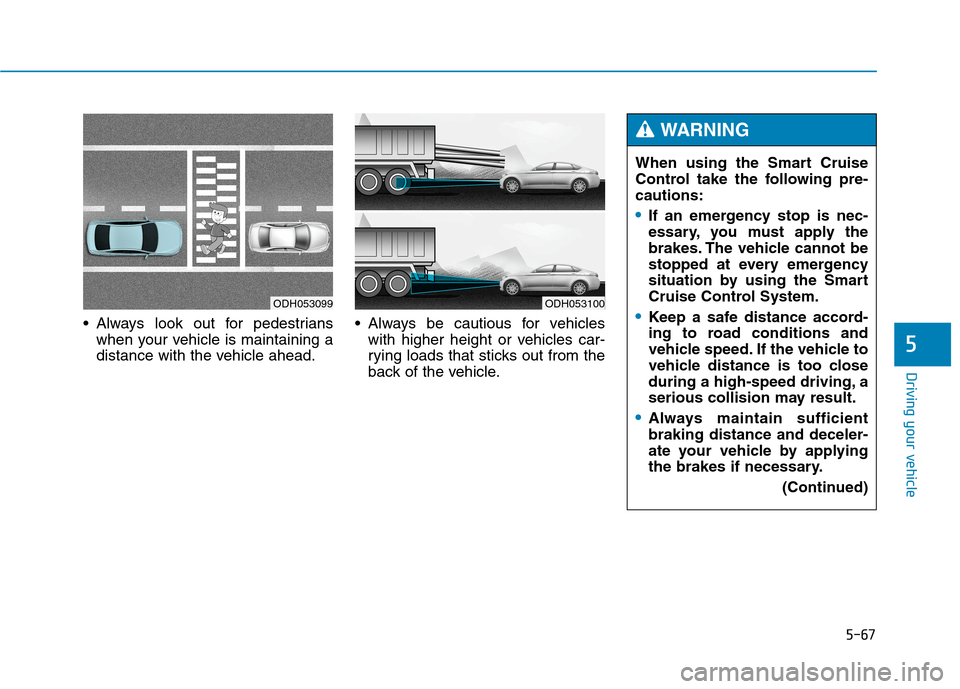
Always look out for pedestrians
when your vehicle is maintaining a
distance with the vehicle ahead. Always be cautious for vehicles
with higher height or vehicles car-
rying loads that sticks out from the
back of the vehicle.
ODH053099ODH053100
When using the Smart Cruise
Control take the following pre-
cautions:
If an emergency stop is nec-
essary, you must apply the
brakes. The vehicle cannot be
stopped at every emergency
situation by using the Smart
Cruise Control System.
Keep a safe distance accord-
ing to road conditions and
vehicle speed. If the vehicle to
vehicle distance is too close
during a high-speed driving, a
serious collision may result.
Always maintain sufficient
braking distance and deceler-
ate your vehicle by applying
the brakes if necessary.
(Continued)
WARNING
Page 344 of 501
5-84
Driving your vehicle
Non-operating condition
Outside rearview mirror may not
alert the driver when:
- The outside rearview mirror hous-
ing is damaged or covered with
debris.
- The window is covered with debris.
- The windows are severely tinted.
DRIVER'S ATTENTION
The driver must be cautious in the
below situations for the system may
not detect other vehicles or objects
in certain circumstances.
- Curved roads, tollgates, etc.
- The surrounding of the sensor is
polluted with rain, snow, mud, etc
- The rear bumper near the sensor is
covered or hidden with a foreign
matter such as a sticker, bumper
guard, bicycle stand etc.
- The rear bumper is damaged or
the sensor is out of place.
- The height of the vehicle is altered
such as when the trunk is loaded
with heavy objects, or there is low
tire pressure etc.
- Bad weather such as heavy rain or
snow.
- A fixed object is near such as a
guardrail, tunnel, human and ani-
mal etc.
- Metal substances are near the vehi-
cles such as in a construction area.
- A big vehicle is near such as a bus
or truck.
(Continued)
The system may not work
properly if the bumper has
been replaced or if repair work
has been done near the sensor.
The detection area differs
according to the roads width. If
the road is narrow the system
may detect other vehicles in
the next lane. In addition, if the
road is very wide the system
may not detect other vehicles.
The system may turn off due to
strong electromagnetic waves.
CAUTION
Page 345 of 501
5-85
Driving your vehicle
5
(Continued)
- A motorcycle or bicycle is near.
- A flat trailer is near.
- If the vehicle has started at the
same time as the vehicle next to
you and has accelerated.
- When the other vehicle passes by
at a higher rate of speed.
- When changing lanes.
- When going down or up a steep
road where the height of the lane is
different.
- When the other vehicle drives very
close.
- When a trailer or carrier is
installed.
- When the temperature of the rear
bumper is high.
- When the sensors are covered by a
wall or a pillar of a parking lot.
- When your vehicle is backing up, if
the detected vehicle also backs up.
- Small objects like shopping carts
and strollers.
- If there is a vehicle with decreased
ride height (lowered).
(Continued)(Continued)
- When the vehicle is close to anoth-
er vehicle.
- When the vehicle in the next lane
moves two lanes away from you
OR when the vehicle two lanes
away moves to the next lane from
you. This device complies with Part 15
of the FCC rules.
Operation is subject to the following
two conditions:
1. This device may not cause harm-
ful interference, and
2. This device must accept any inter-
ference received, including inter-
ference that may cause undesired
operation.
Page 433 of 501
7-51
7
Maintenance
Tire maintenance
In addition to proper inflation, correct
wheel alignment helps to decrease
tire wear. If you find a tire is worn
unevenly, have your dealer check the
wheel alignment.
When you have new tires installed,
make sure they are balanced. This
will increase vehicle ride comfort and
tire life. Additionally, a tire should
always be rebalanced if it is removed
from the wheel.
Tire sidewall labeling
This information identifies and
describes the fundamental charac-
teristics of the tire and also provides
the tire identification number (TIN)
for safety standard certification. The
TIN can be used to identify the tire in
case of a recall.
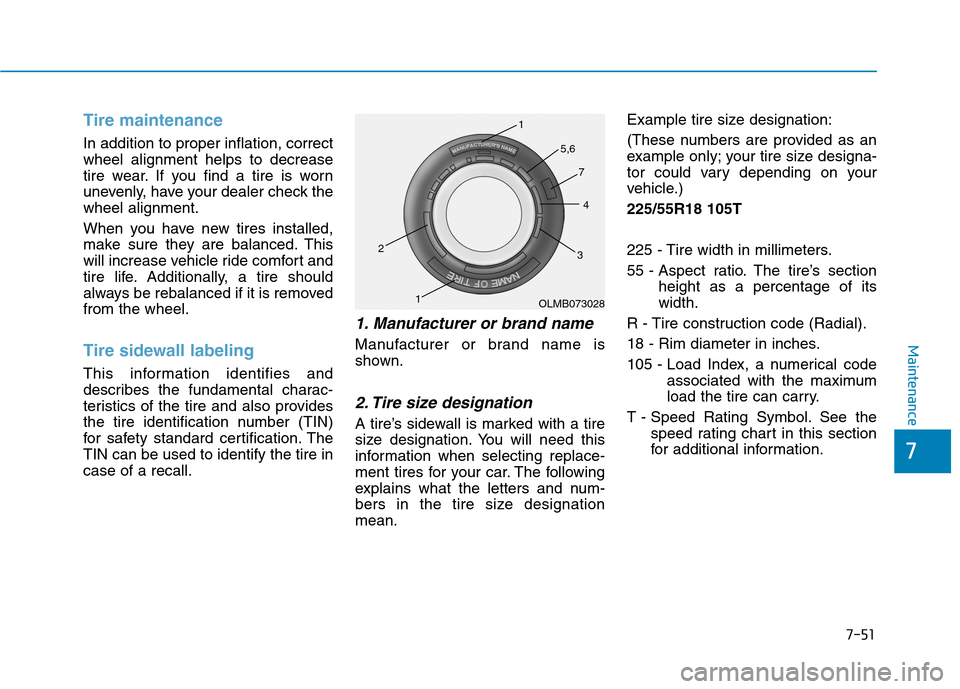
1. Manufacturer or brand name
Manufacturer or brand name is
shown.
2. Tire size designation
A tire’s sidewall is marked with a tire
size designation. You will need this
information when selecting replace-
ment tires for your car. The following
explains what the letters and num-
bers in the tire size designation
mean.Example tire size designation:
(These numbers are provided as an
example only; your tire size designa-
tor could vary depending on your
vehicle.)
225/55R18 105T
225 - Tire width in millimeters.
55 - Aspect ratio. The tire’s section
height as a percentage of its
width.
R - Tire construction code (Radial).
18 - Rim diameter in inches.
105 - Load Index, a numerical code
associated with the maximum
load the tire can carry.
T - Speed Rating Symbol. See the
speed rating chart in this section
for additional information.
OLMB073028 1
1 2
34 5,6
7
Page 437 of 501
7-55
7
Maintenance
Tire terminology and defini-
tions
Air Pressure
The amount of air inside the tire
pressing outward on the tire. Air
pressure is expressed in pounds per
square inch (psi) or kilopascal (kPa).
Accessory Weight
This means the combined weight of
optional accessories. Some exam-
ples of optional accessories are
automatic transmission, power
seats, and air conditioning.
Aspect Ratio
The relationship of a tire's height to
its width.
Belt
A rubber coated layer of cords that is
located between the plies and the
tread. Cords may be made from steel
or other reinforcing materials.
Bead
The tire bead contains steel wires
wrapped by steel cords that hold the
tire onto the rim.
Bias Ply Tire
A pneumatic tire in which the plies
are laid at alternate angles less than
90 degrees to the centerline of the
tread.
Cold Tire Pressure
The amount of air pressure in a tire,
measured in pounds per square inch
(psi) or kilopascals (kPa) before a tire
has built up heat from driving.
Curb Weight
This means the weight of a motor
vehicle with standard and optional
equipment including the maximum
capacity of fuel, oil and coolant, but
without passengers and cargo.
DOT Markings
A code molded into the sidewall of a
tire signifying that the tire is in com-
pliance with the U.S. Department of
Transportation motor vehicle safety
standards. The DOT code includes
the Tire Identification Number (TIN),
an alphanumeric designator which
can also identify the tire manufactur-
er, production plant, brand and date
of production.
Page 482 of 501
D DI
IM
ME
EN
NS
SI
IO
ON
NS
S
8-2
Specifications, Consumer information and Reporting safety defects
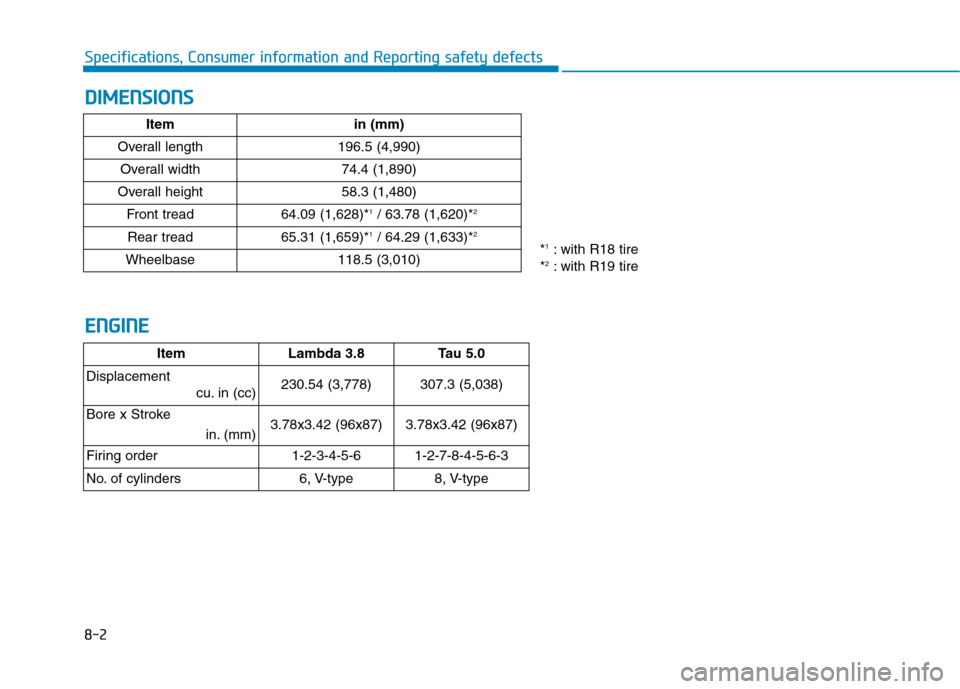
Item in (mm)
Overall length 196.5 (4,990)
Overall width 74.4 (1,890)
Overall height 58.3 (1,480)
Front tread 64.09 (1,628)*
1/ 63.78 (1,620)*2
Rear tread 65.31 (1,659)*1/ 64.29 (1,633)*2
Wheelbase 118.5 (3,010)*1: with R18 tire
*2: with R19 tire
E EN
NG
GI
IN
NE
E
ItemLambda 3.8Tau 5.0
Displacement
cu. in (cc)
230.54 (3,778)307.3 (5,038)
Bore x Stroke
in. (mm)
3.78x3.42 (96x87)3.78x3.42 (96x87)
Firing order
1-2-3-4-5-61-2-7-8-4-5-6-3
No. of cylinders
6, V-type8, V-type
Page 499 of 501
I-8
Road warning ....................................................................6-2
Rocking the vehicle ........................................................5-86
Rotation (Tire) ................................................................7-48
Scheduled maintenance service ........................................7-8
Normal maintenance schedule .....................................7-9
Maintenance under severe usage conditions ..............7-22
Seat belts .........................................................................2-22
Seat belt safety precautions ........................................2-22
Seat belt warning light ...............................................2-23
Seat belt restraint system............................................2-25
Pre-tensioner seat belt ................................................2-28
Pre-safe seat belt (PSB)..............................................2-30
Additional seat belt safety precautions ......................2-31
Care of seat belts ........................................................2-34
Seat warmers and coolers ...............................................2-18
Seat warmers ..............................................................2-18
Seat warmers and coolers ...........................................2-20
Seatback pocket ..............................................................2-11
Seats ..................................................................................2-4
Front seats ....................................................................2-6
Seatback angle ..............................................................2-8
Seat cushion height ......................................................2-9
Lumbar support ..........................................................2-10
Rear seats ....................................................................2-11
Shift lock system.............................................................5-16Side air bag .....................................................................2-49
Smart high beam ...........................................................3-111
Smart key ..........................................................................3-4
Smart trunk .....................................................................3-54
Smooth cornering............................................................5-87
Snow tires .......................................................................5-89
Spare tire
Compact spare tire replacement .................................7-50
Special driving conditions ..............................................5-86
Hazardous driving conditions ....................................5-86
Rocking the vehicle ....................................................5-86
Smooth cornering .......................................................5-87
Driving at night ..........................................................5-87
Driving in the rain ......................................................5-88
Driving in flooded areas .............................................5-88
Speedometer....................................................................3-63
Sports mode ....................................................................5-14
Starting difficulties, see engine will not start ...................6-4
Starting the engine ............................................................5-9
Steering wheel.................................................................3-18
Electric power steering (EPS) ....................................3-18
Tilt steering / Telescope steering................................3-18
Heated steering wheel ................................................3-19
Horn ............................................................................3-20
Steering wheel audio control ............................................4-4
Index
S