child seat Hyundai Genesis 2016 - RHD (UK, Australia) Owner's Guide
[x] Cancel search | Manufacturer: HYUNDAI, Model Year: 2016, Model line: Genesis, Model: Hyundai Genesis 2016Pages: 502, PDF Size: 13.19 MB
Page 65 of 502
2-47
Safety system of your vehicle
2
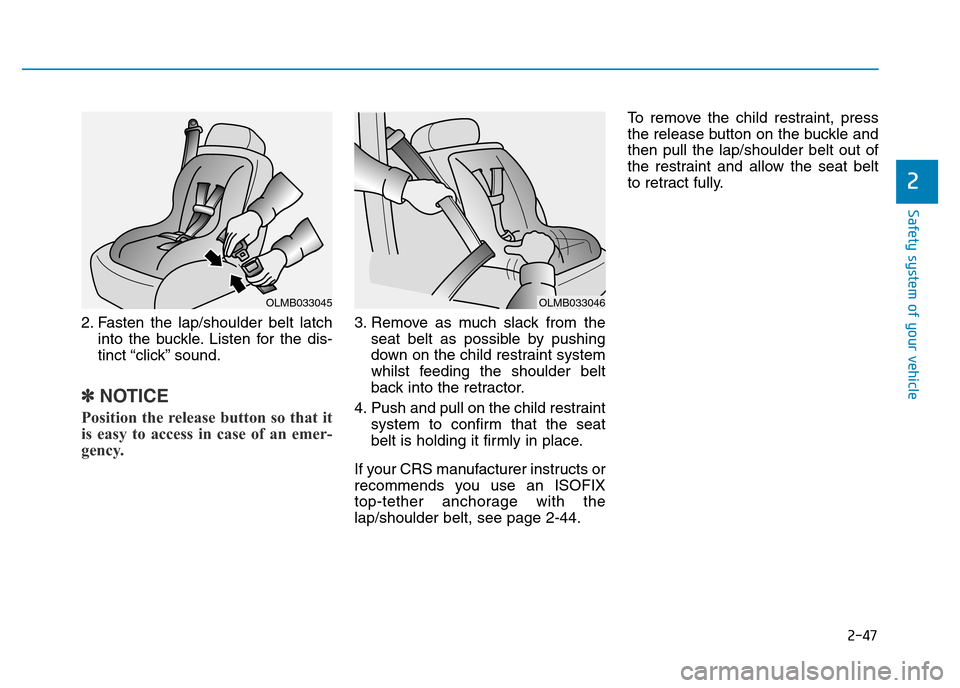
2. Fasten the lap/shoulder belt latch
into the buckle. Listen for the dis-
tinct “click” sound.
✽NOTICE
Position the release button so that it
is easy to access in case of an emer-
gency.
3. Remove as much slack from the
seat belt as possible by pushing
down on the child restraint system
whilst feeding the shoulder belt
back into the retractor.
4. Push and pull on the child restraint
system to confirm that the seat
belt is holding it firmly in place.
If your CRS manufacturer instructs or
recommends you use an ISOFIX
top-tether anchorage with the
lap/shoulder belt, see page 2-44.To remove the child restraint, press
the release button on the buckle and
then pull the lap/shoulder belt out of
the restraint and allow the seat belt
to retract fully.
OLMB033045OLMB033046
Page 66 of 502
2-48
Safety system of your vehicle
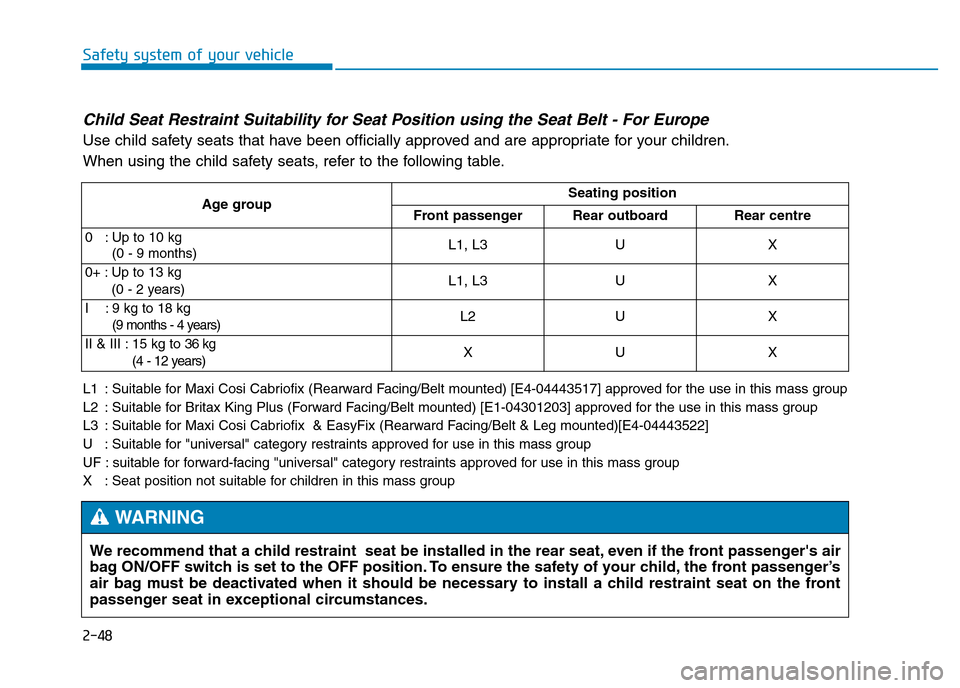
Child Seat Restraint Suitability for Seat Position using the Seat Belt - For Europe
Use child safety seats that have been officially approved and are appropriate for your children.
When using the child safety seats, refer to the following table.
L1 : Suitable for Maxi Cosi Cabriofix (Rearward Facing/Belt mounted) [E4-04443517] approved for the use in this mass group
L2 : Suitable for Britax King Plus (Forward Facing/Belt mounted) [E1-04301203] approved for the use in this mass group
L3 : Suitable for Maxi Cosi Cabriofix & EasyFix (Rearward Facing/Belt & Leg mounted)[E4-04443522]
U : Suitable for "universal" category restraints approved for use in this mass group
UF : suitable for forward-facing "universal" category restraints approved for use in this mass group
X : Seat position not suitable for children in this mass group
Age groupSeating position
Front passengerRear outboardRear centre
0 : Up to 10 kg
(0 - 9 months)L1, L3UX
0+ : Up to 13 kg
(0 - 2 years)L1, L3UX
I : 9 kg to 18 kg
(9 months - 4 years)L2UX
II & III : 15 kg to 36 kg
(4 - 12 years)XUX
We recommend that a child restraint seat be installed in the rear seat, even if the front passenger's air
bag ON/OFF switch is set to the OFF position. To ensure the safety of your child, the front passenger’s
air bag must be deactivated when it should be necessary to install a child restraint seat on the front
passenger seat in exceptional circumstances.
WARNING
Page 67 of 502
2-49
Safety system of your vehicle
2
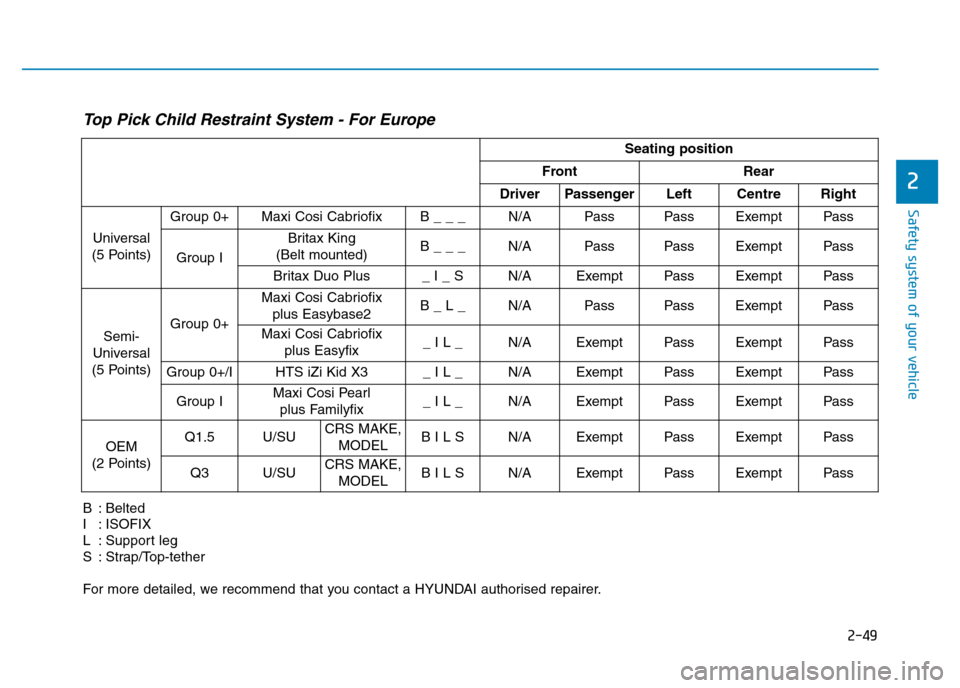
Top Pick Child Restraint System - For Europe
B : Belted
I : ISOFIX
L : Support leg
S : Strap/Top-tether
For more detailed, we recommend that you contact a HYUNDAI authorised repairer.Seating position
Front Rear
Driver Passenger Left Centre Right
Universal
(5 Points)Group 0+ Maxi Cosi Cabriofix B _ _ _ N/A Pass Pass Exempt Pass
Group IBritax King
(Belt mounted)B _ _ _ N/A Pass Pass Exempt Pass
Britax Duo Plus _ I _ S N/A Exempt Pass Exempt Pass
Semi-
Universal
(5 Points)Group 0+Maxi Cosi Cabriofix
plus Easybase2 B _ L _ N/A Pass Pass Exempt Pass
Maxi Cosi Cabriofix
plus Easyfix _ I L _ N/A Exempt Pass Exempt Pass
Group 0+/I HTS iZi Kid X3 _ I L _ N/A Exempt Pass Exempt Pass
Group IMaxi Cosi Pearl
plus Familyfix_ I L _ N/A Exempt Pass Exempt Pass
OEM
(2 Points)Q1.5 U/SUCRS MAKE,
MODELB I L S N/A Exempt Pass Exempt Pass
Q3 U/SUCRS MAKE,
MODELB I L S N/A Exempt Pass Exempt Pass
Page 69 of 502
2-51
Safety system of your vehicle
2
Vehicles are equipped with a
Supplemental Air Bag System for the
driver’s seat, front passenger’s seats
and/or rear seats.
The front air bags are designed to
supplement the three-point seat
belts. For these air bags to provide
protection, the seat belts must be
worn at all times when driving.
You can be severely injured or killed
in an accident if you are not wearing
a seat belt. Air bags are designed to
supplement seat belts, but do not
replace them. Also, air bags are not
designed to deploy in every collision.
In some accidents, the seat belts are
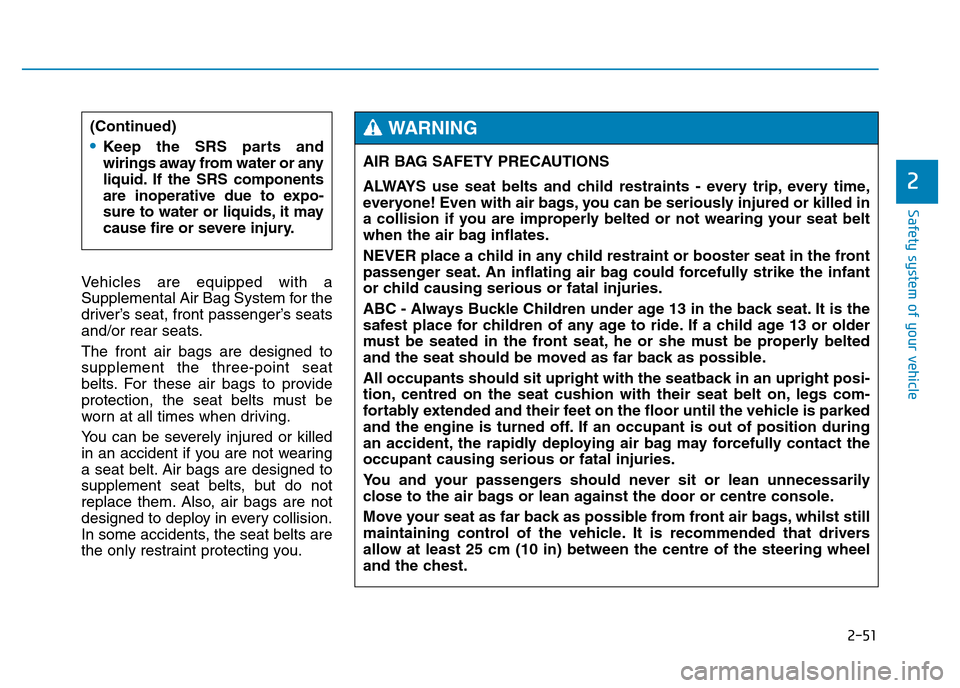
the only restraint protecting you.AIR BAG SAFETY PRECAUTIONS
ALWAYS use seat belts and child restraints - every trip, every time,
everyone! Even with air bags, you can be seriously injured or killed in
a collision if you are improperly belted or not wearing your seat belt
when the air bag inflates.
NEVER place a child in any child restraint or booster seat in the front
passenger seat. An inflating air bag could forcefully strike the infant
or child causing serious or fatal injuries.
ABC - Always Buckle Children under age 13 in the back seat. It is the
safest place for children of any age to ride. If a child age 13 or older
must be seated in the front seat, he or she must be properly belted
and the seat should be moved as far back as possible.
All occupants should sit upright with the seatback in an upright posi-
tion, centred on the seat cushion with their seat belt on, legs com-
fortably extended and their feet on the floor until the vehicle is parked
and the engine is turned off. If an occupant is out of position during
an accident, the rapidly deploying air bag may forcefully contact the
occupant causing serious or fatal injuries.
You and your passengers should never sit or lean unnecessarily
close to the air bags or lean against the door or centre console.
Move your seat as far back as possible from front air bags, whilst still
maintaining control of the vehicle. It is recommended that drivers
allow at least 25 cm (10 in) between the centre of the steering wheel
and the chest.
WARNING (Continued)
•Keep the SRS parts and
wirings away from water or any
liquid. If the SRS components
are inoperative due to expo-
sure to water or liquids, it may
cause fire or severe injury.
Page 73 of 502
2-55
Safety system of your vehicle
2
Safety system of your vehicle
They are designed to help protect the
heads of the front seat occupants
and the rear outboard seat occupants
in certain side impact collisions.
The curtain air bags are designed to
deploy only during certain side
impact collisions, depending on the
crash severity, angle, speed and
impact.
For vehicles equipped with a rollover
sensor the side and/or curtain air
bags on both sides of the vehicle
may deploy if a rollover or possible
rollover is detected.
The curtain air bags are not designed
to deploy in all side impact or rollover
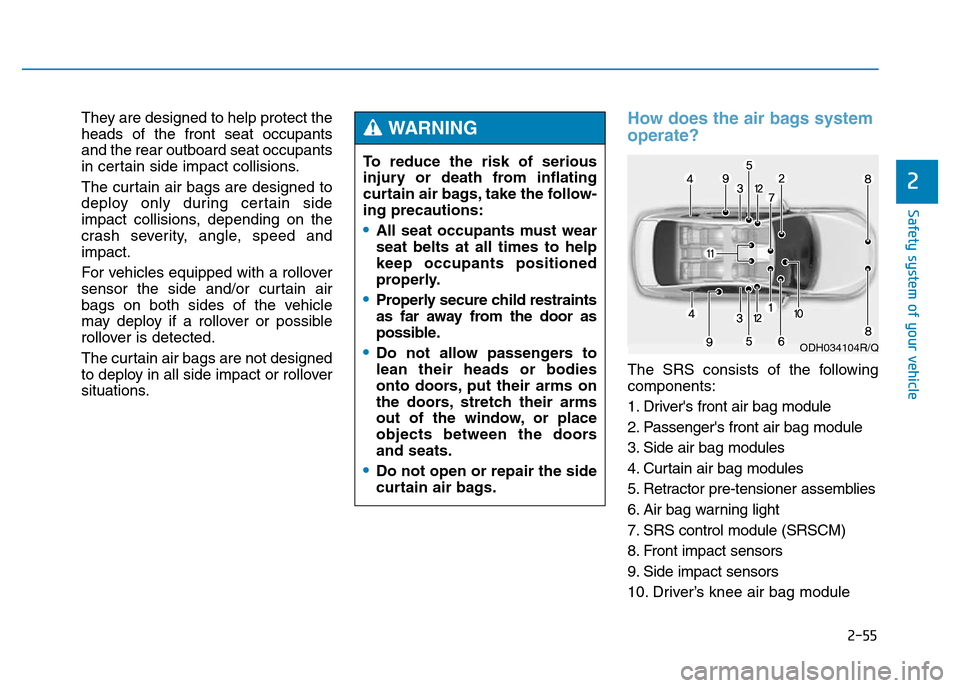
situations.How does the air bags system
operate?
The SRS consists of the following
components:
1. Driver's front air bag module
2. Passenger's front air bag module
3. Side air bag modules
4. Curtain air bag modules
5. Retractor pre-tensioner assemblies
6. Air bag warning light
7. SRS control module (SRSCM)
8. Front impact sensors
9. Side impact sensors
10. Driver’s knee air bag module To reduce the risk of serious
injury or death from inflating
curtain air bags, take the follow-
ing precautions:
•All seat occupants must wear
seat belts at all times to help
keep occupants positioned
properly.
•Properly secure child restraints
as far away from the door as
possible.
•Do not allow passengers to
lean their heads or bodies
onto doors, put their arms on
the doors, stretch their arms
out of the window, or place
objects between the doors
and seats.
•Do not open or repair the side
curtain air bags.
WARNING
ODH034104R/Q
Page 80 of 502
2-62
Safety system of your vehicle
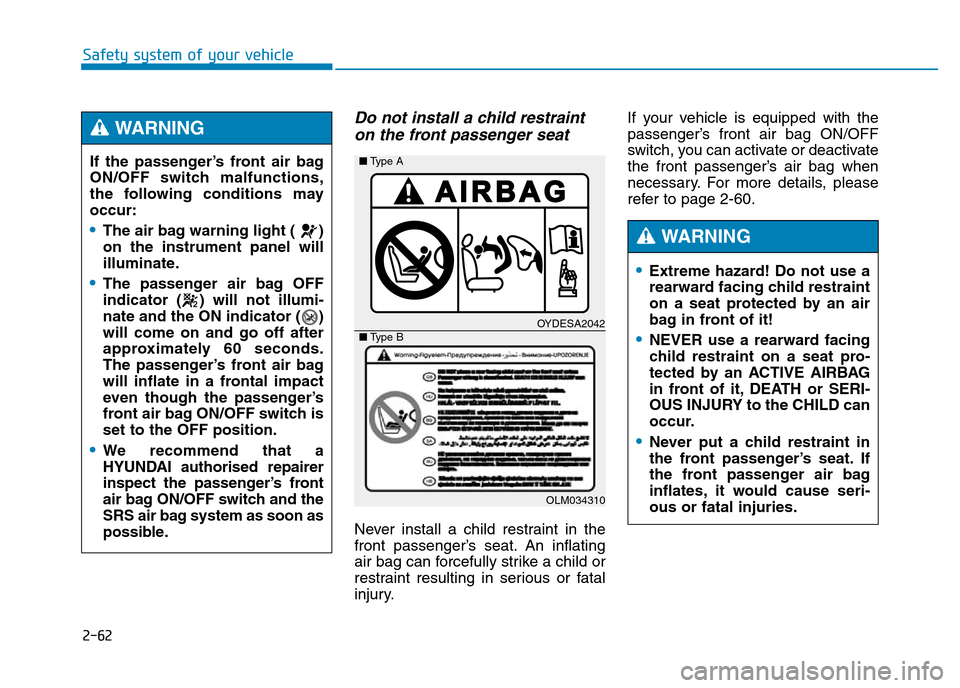
Do not install a child restraint
on the front passenger seat
Never install a child restraint in the
front passenger’s seat. An inflating
air bag can forcefully strike a child or
restraint resulting in serious or fatal
injury.If your vehicle is equipped with the
passenger’s front air bag ON/OFF
switch, you can activate or deactivate
the front passenger’s air bag when
necessary. For more details, please
refer to page 2-60.
OYDESA2042
OLM034310 ■Type A
■Type B
•Extreme hazard! Do not use a
rearward facing child restraint
on a seat protected by an air
bag in front of it!
•NEVER use a rearward facing
child restraint on a seat pro-
tected by an ACTIVE AIRBAG
in front of it, DEATH or SERI-
OUS INJURY to the CHILD can
occur.
•Never put a child restraint in
the front passenger’s seat. If
the front passenger air bag
inflates, it would cause seri-
ous or fatal injuries.
WARNING
If the passenger’s front air bag
ON/OFF switch malfunctions,
the following conditions may
occur:
•The air bag warning light ( )
on the instrument panel will
illuminate.
•The passenger air bag OFF
indicator ( ) will not illumi-
nate and the ON indicator ( )
will come on and go off after
approximately 60 seconds.
The passenger’s front air bag
will inflate in a frontal impact
even though the passenger’s
front air bag ON/OFF switch is
set to the OFF position.
•We recommend that a
HYUNDAI authorised repairer
inspect the passenger’s front
air bag ON/OFF switch and the
SRS air bag system as soon as
possible.
WARNING
Page 105 of 502
3-14
Auto door lock/unlock features
Impact sensing door unlock
system
All doors will be automatically
unlocked when an impact causes the
air bags to deploy.
Speed sensing door lock system
All doors will be automatically locked
when vehicle speed exceeds 9 mph
(15 km/h).
All of the doors will be automatically
unlocked after the engine is turned off.
You can activate or deactivate the
Auto Door Lock/Unlock features from
the User Settings Mode on the LCD
display. For more details, refer to
"LCD Display" in this chapter.
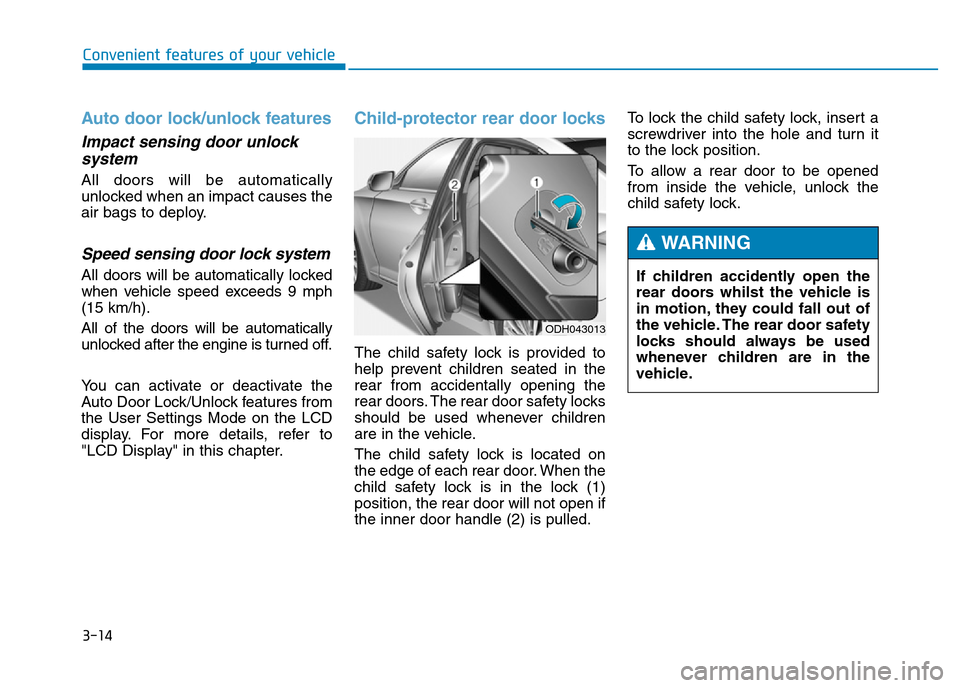
Child-protector rear door locks
The child safety lock is provided to
help prevent children seated in the
rear from accidentally opening the
rear doors. The rear door safety locks
should be used whenever children
are in the vehicle.
The child safety lock is located on
the edge of each rear door. When the
child safety lock is in the lock (1)
position, the rear door will not open if
the inner door handle (2) is pulled.To lock the child safety lock, insert a
screwdriver into the hole and turn it
to the lock position.
To allow a rear door to be opened
from inside the vehicle, unlock the
child safety lock.
Convenient features of your vehicle
ODH043013
If children accidently open the
rear doors whilst the vehicle is
in motion, they could fall out of
the vehicle. The rear door safety
locks should always be used
whenever children are in the
vehicle.
WARNING
Page 285 of 502
5-12
Driving your vehicle
The indicator in the instrument clus-
ter displays the shift lever position
when the Engine Start/Stop button is
in the ON position.
P (Park)
Always come to a complete stop
before shifting into P (Park).
To shift from P (Park), you must
depress firmly on the brake pedal
and make sure your foot is off the
accelerator pedal.
If you have done all of the above and
still cannot shift the lever out of P
(Park), see “Shift-Lock Release” on
page 5-16.
The shift lever must be in P (Park)
before turning the engine off. To reduce the risk of serious
injury or death:
•ALWAYS check the surround-
ing areas near your vehicle for
people, especially children,
before shifting a vehicle into
D (Drive) or R (Reverse).
•Before leaving the driver’s
seat, always make sure the
shift lever is in the P (Park)
position, then set the parking
brake, and place the Engine
Start/Stop button in the OFF
position. Unexpected and
sudden vehicle movement
can occur if these precautions
are not followed.
•Do not use engine braking
(shifting from a high gear to
lower gear) rapidly on slip-
pery roads. The vehicle may
slip causing an accident.
WARNING
•Shifting into P (Park) whilst
the vehicle is in motion may
cause you to lose control of
the vehicle.
•After the vehicle has stopped,
always make sure the shift
lever is in P (Park), apply the
parking brake, and turn the
engine off.
•Do not use the P (Park) posi-
tion in place of the parking
brake.
WARNING