warning light Hyundai Genesis 2016 Owner's Manual
[x] Cancel search | Manufacturer: HYUNDAI, Model Year: 2016, Model line: Genesis, Model: Hyundai Genesis 2016Pages: 503, PDF Size: 12.94 MB
Page 7 of 503
F7
Introduction
Gasoline containing alcohol andmethanol
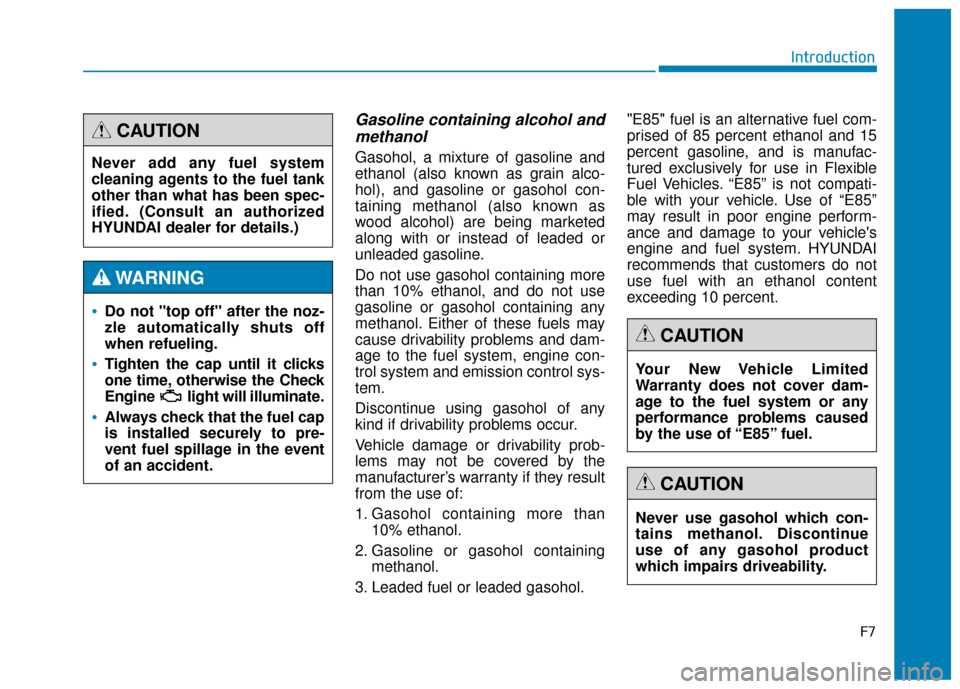
Gasohol, a mixture of gasoline and
ethanol (also known as grain alco-
hol), and gasoline or gasohol con-
taining methanol (also known as
wood alcohol) are being marketed
along with or instead of leaded or
unleaded gasoline.
Do not use gasohol containing more
than 10% ethanol, and do not use
gasoline or gasohol containing any
methanol. Either of these fuels may
cause drivability problems and dam-
age to the fuel system, engine con-
trol system and emission control sys-
tem.
Discontinue using gasohol of any
kind if drivability problems occur.
Vehicle damage or drivability prob-
lems may not be covered by the
manufacturer’s warranty if they result
from the use of:
1. Gasohol containing more than
10% ethanol.
2. Gasoline or gasohol containing methanol.
3. Leaded fuel or leaded gasohol. "E85" fuel is an alternative fuel com-
prised of 85 percent ethanol and 15
percent gasoline, and is manufac-
tured exclusively for use in Flexible
Fuel Vehicles. “E85” is not compati-
ble with your vehicle. Use of “E85”
may result in poor engine perform-
ance and damage to your vehicle's
engine and fuel system. HYUNDAI
recommends that customers do not
use fuel with an ethanol content
exceeding 10 percent.
•Do not "top off" after the noz-
zle automatically shuts off
when refueling.
Tighten the cap until it clicks
one time, otherwise the Check
Engine light will illuminate.
Always check that the fuel cap
is installed securely to pre-
vent fuel spillage in the event
of an accident.
WARNING
Never add any fuel system
cleaning agents to the fuel tank
other than what has been spec-
ified. (Consult an authorized
HYUNDAI dealer for details.)
CAUTION
Your New Vehicle Limited
Warranty does not cover dam-
age to the fuel system or any
performance problems caused
by the use of “E85” fuel.
CAUTION
Never use gasohol which con-
tains methanol. Discontinue
use of any gasohol product
which impairs driveability.
CAUTION
Page 12 of 503
F12
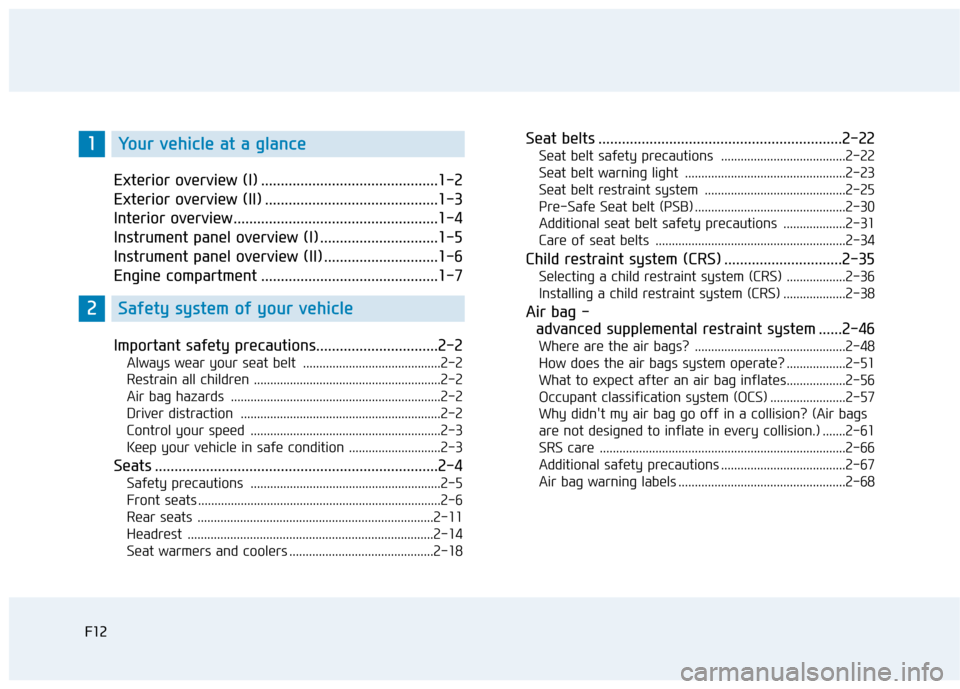
Exterior overview (I) .............................................1-2
Exterior overview (II) ............................................1-3
Interior overview ....................................................1-4
Instrument panel overview (I) ..............................1-5
Instrument panel overview (II) .............................1-6
Engine compartment .............................................1-7
Important safety precautions...............................2-2
Always wear your seat belt ..........................................2-2
Restrain all children .........................................................2-2
Air bag hazards ................................................................2-2
Driver distraction .............................................................2-2
Control your speed ..........................................................2-3
Keep your vehicle in safe condition ............................2-3
Seats ........................................................................\
2-4
Safety precautions ..........................................................2-5
Front seats ........................................................................\
..2-6
Rear seats ........................................................................\
2-11
Headrest ....................................................................\
.......2-14
Seat warmers and coolers ............................................2-18
Seat belts ..............................................................2-22
Seat belt safety precautions ......................................2-22
Seat belt warning light .................................................2-23
Seat belt restraint system ...........................................2-25
Pre-Safe Seat belt (PSB) ..............................................2-30
Additional seat belt safety precautions ...................2-31
Care of seat belts ..........................................................2-34
Child restraint system (CRS) ..............................2-35
Selecting a child restraint system (CRS) ..................2-36
Installing a child restraint system (CRS) ...................2-38
Air bag - advanced supplemental restraint system ......2-46
Where are the air bags? ..............................................2-48
How does the air bags system operate? ..................2-51
What to expect after an air bag inflates..................2-56
Occupant classification system (OCS) .......................2-57
Why didn't my air bag go off in a collision? (Air bags
are not designed to inflate in every collision.) .......2-61
SRS care ........................................................................\
...2-66
Additional safety precautions ......................................2-67
Air bag warning labels ...................................................2-68
F12
1Your vehicle at a glance
2Safety system of your vehicle
Page 14 of 503

F14
LCD display ...........................................................3-68
LCD Modes ........................................................................\
3-68
Trip Computer Mode.......................................................3-69
Turn By Turn (TBT) Mode ............................................3-70
ASCC/LKAS Mode ...........................................................3-70
A/V Mode........................................................................\
..3-70
Information Mode ...........................................................3-71
User Settings Mode ........................................................3-73
Warning Messages..........................................................3-80
Trip computer .......................................................3-90
Overview........................................................................\
....3-90
Trip A/B ........................................................................\
.....3-91
Fuel Economy...................................................................3-92
Digital Speedometer .......................................................3-94
Warning and indicator lights ..............................3-95
Warning lights ..................................................................3-95
Indicator Lights ..............................................................3-103
Head Up Display (HUD).....................................3-107
Description ......................................................................3-\
107
Head Up Display ON/OFF ...........................................3-108
Head Up Display Information .....................................3-108
Head Up Display Setting .............................................3-109
Light .....................................................................3-1\
10
Exterior lights ................................................................3-110
Smart High Beam ..........................................................3-112
Welcome system ...........................................................3-117
Interior lights..................................................................3-118
Wipers and washers ..........................................3-123
Windshield wipers ........................................................3-123
Windshield washers ....................................................3-125
Driver assist system ..........................................3-126
Rear view camera .........................................................3-126
Parking Guide System ..................................................3-127
Parking Assist System .................................................3-128
Defroster .............................................................3-132
Rear window defroster ...............................................3-132
Automatic climate control system ...................3-134
Automatic heating and air conditioning ..................3-135
Manual heating and air conditioning .......................3-136
System operation ..........................................................3-144
Climate control air filter ............................................3-146
Air conditioner refrigerant and compressor
lubricant ........................................................................\
..3-147
Air Conditioning refrigerant label .............................3-147
Windshield defrosting and defogging ............3-148
Auto defogging system ON/OFF...............................3-150
F14
Page 16 of 503
F16
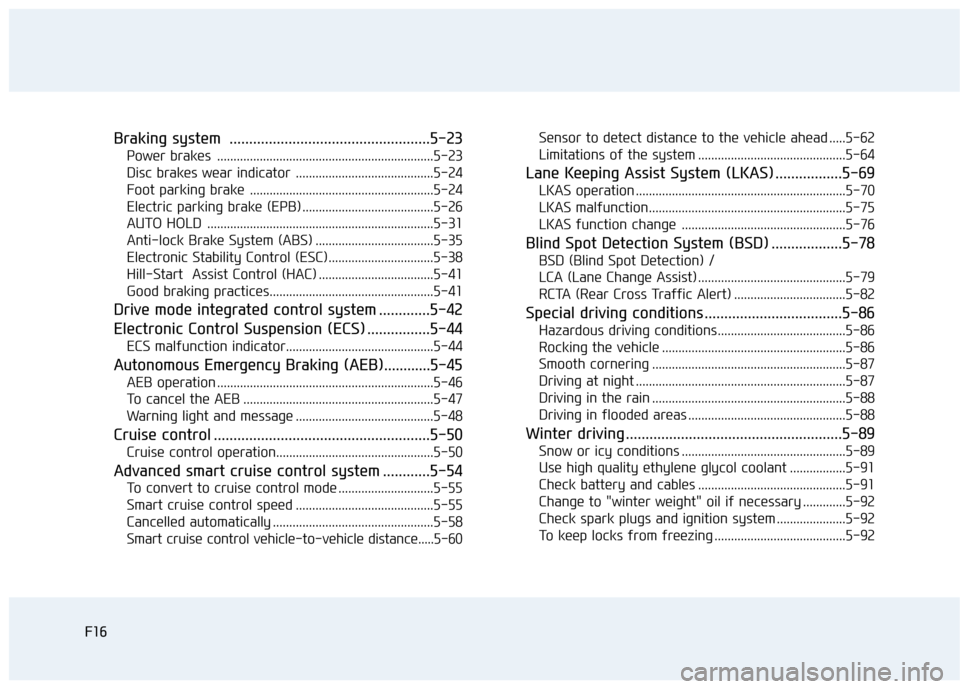
Braking system ...................................................5-23
Power brakes ..................................................................5-23
Disc brakes wear indicator ..........................................5-24
Foot parking brake ........................................................5-24
Electric parking brake (EPB) ........................................5-26
AUTO HOLD .....................................................................5-3\
1
Anti-lock Brake System (ABS) ....................................5-35
Electronic Stability Control (ESC)................................5-38
Hill-Start Assist Control (HAC) ...................................5-41
Good braking practices..................................................5-41
Drive mode integrated control system .............5-42
Electronic Control Suspension (ECS) ................5-44
ECS malfunction indicator.............................................5-44
Autonomous Emergency Braking (AEB)............5-45
AEB operation ..................................................................5-46
To cancel the AEB ..........................................................5-47
Warning light and message ..........................................5-48
Cruise control .......................................................5-50
Cruise control operation................................................5-50
Advanced smart cruise control system ............5-54
To convert to cruise control mode .............................5-55
Smart cruise control speed ..........................................5-55
Cancelled automatically .................................................5-58
Smart cruise control vehicle-to-vehicle distance.....5-60Sensor to detect distance to the vehicle ahead .....5-62
Limitations of the system .............................................5-64
Lane Keeping Assist System (LKAS) .................5-69
LKAS operation ................................................................5-70
LKAS malfunction............................................................5-75
LKAS function change ..................................................5-76
Blind Spot Detection System (BSD) ..................5-78
BSD (Blind Spot Detection) /
LCA (Lane Change Assist) .............................................5-79
RCTA (Rear Cross Traffic Alert) ..................................5-82
Special driving conditions ...................................5-86
Hazardous driving conditions.......................................5-86
Rocking the vehicle ........................................................5-86
Smooth cornering ...........................................................5-87
Driving at night ................................................................5-87
Driving in the rain ...........................................................5-88
Driving in flooded areas ................................................5-88
Winter driving .......................................................5-89
Snow or icy conditions ..................................................5-89
Use high quality ethylene glycol coolant .................5-91
Check battery and cables .............................................5-91
Change to "winter weight" oil if necessary .............5-92
Check spark plugs and ignition system .....................5-92
To keep locks from freezing ........................................5-92
F16
Page 27 of 503

Safety system of your vehicle
2
Important safety precautions...............................2-2
Always wear your seat belt ..........................................2-2
Restrain all children .........................................................2-2
Air bag hazards ................................................................2-2
Driver distraction .............................................................2-2
Control your speed ..........................................................2-3
Keep your vehicle in safe condition ............................2-3
Seats ........................................................................\
2-4
Safety precautions ..........................................................2-5
Front seats ........................................................................\
..2-6
Rear seats ........................................................................\
2-11
Headrest ....................................................................\
.......2-14
Seat warmers and coolers ............................................2-18
Seat belts ..............................................................2-22
Seat belt safety precautions ......................................2-22
Seat belt warning light .................................................2-23
Seat belt restraint system ...........................................2-25
Pre-Safe Seat belt (PSB) ..............................................2-30
Additional seat belt safety precautions ...................2-31
Care of seat belts ..........................................................2-34
Child restraint system (CRS) ..............................2-35
Selecting a child restraint system (CRS) ..................2-36
Installing a child restraint system (CRS) ...................2-38
Air bag - advanced supplemental restraint system ......2-46
Where are the air bags? ..............................................2-48
How does the air bags system operate? ..................2-51
What to expect after an air bag inflates..................2-56
Occupant classification system (OCS) .......................2-57
Why didn't my air bag go off in a collision? (Air bags
are not designed to inflate in every collision.) .......2-61
SRS care ........................................................................\
...2-66
Additional safety precautions ......................................2-67
Air bag warning labels ...................................................2-68
Page 32 of 503

2-6
Safety system of your vehicle
Front seats
Take the following precautions
when adjusting your seat belt:
NEVER use one seat belt for
more than one occupant.
Always position the seatback
upright with the lap portion of
the seat belt snug and low
across the hips.
NEVER allow children or small
infants to ride in a passenger’s
lap.
Do not route the seat belt
across your neck, across sharp
edges, or reroute the shoulder
strap away from your body.
Do not allow the seat belt to
become caught or jammed.
WARNING
Take the following precautions
when adjusting your seat:
NEVER attempt to adjust the
seat while the vehicle is mov-
ing. The seat could respond
with unexpected movement
and may cause loss of vehicle
control resulting in an acci-
dent.
Do not place anything under
the front seats. Loose objects
in the driver’s foot area could
interfere with the operation of
the foot pedals, causing an
accident.
Do not allow anything to inter-
fere with the normal position
and proper locking of the seat-
back.
Do not place a cigarette lighter
on the floor or seat. When you
operate the seat, gas may exit
out of the lighter causing a fire.(Continued)
WARNING
To prevent injury:
Do not adjust your seat while
wearing your seat belt.
Moving the seat cushion for-
ward may cause strong pres-
sure on your abdomen.
Do not allow your hands or
fingers to get caught in the
seat mechanisms while the
seat is moving.
(Continued)
Use extreme caution when
picking small objects trapped
under the seats or between the
seat and the center console.
Your hands might be cut or
injured by the sharp edges of
the seat mechanism.
WARNING
Page 49 of 503

2-23
Safety system of your vehicle
2
Seat belt warning light
Seat belt warning light (for driver’s seat)
The driver’s seat belt warning light
and chime will come on according to
the following table when the Engine
Start/Stop button is in the ON posi-
tion.
*1: The Warning Pattern repeats 11 times
with an interval of 24 seconds. If the
driver's seat belt is buckled, the light
will stop within 6 seconds and chime
will stop immediately.
*
2: The light will stop within 6 seconds and chime will stop immediately.
Damaged seat belts and seat
belt assemblies will not operate
properly. Always replace:
Frayed, contaminated, or dam-
aged webbing
Damaged hardware
The entire seat belt assembly
after it has been worn in an
accident, even if damage to
webbing or assembly is not
apparent
WARNING
OLMB033022
ConditionsWarning Pattern
Seat BeltVehicle
SpeedLight (Blink)Chime
Unbuckled6 seconds
Buckled6 secondsNone
Buckled →
Unbuckled
Below 3 mph (5 km/h)6 secondsNone
3 mph~6 mph6 seconds
Above 6 mph (10 km/h)6 sec. ON / 24 sec. OFF (11 times)
Unbuckled
Above 6 mph(10 km/h)
↓
Below 3 mph
(5 km/h)6 seconds *1
↓
Stop *
2
Page 50 of 503
2-24
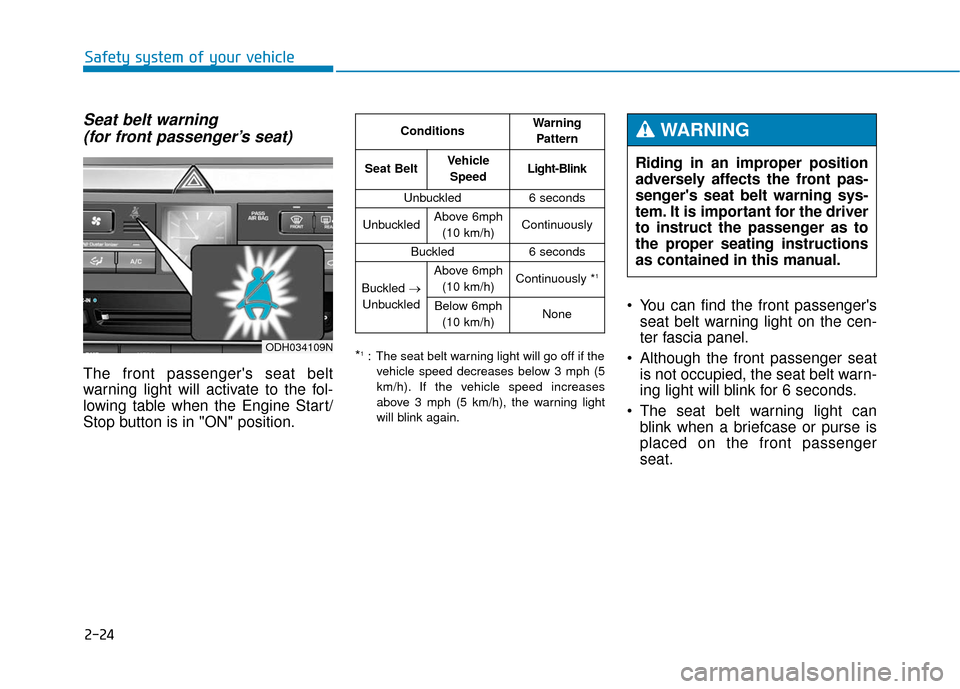
Seat belt warning (for front passenger’s seat)
The front passenger's seat belt
warning light will activate to the fol-
lowing table when the Engine Start/
Stop button is in "ON" position.
*1: The seat belt warning light will go off if the
vehicle speed decreases below 3 mph (5
km/h). If the vehicle speed increases
above 3 mph (5 km/h), the warning light
will blink again.
You can find the front passenger's seat belt warning light on the cen-
ter fascia panel.
Although the front passenger seat is not occupied, the seat belt warn-
ing light will blink for 6 seconds.
The seat belt warning light can blink when a briefcase or purse is
placed on the front passenger
seat.
Safety system of your vehicle
ODH034109N
ConditionsWarning
Pattern
Seat BeltVehicleSpeedLight-Blink
Unbuckled6 seconds
UnbuckledAbove 6mph (10 km/h)Continuously
Buckled6 seconds
Buckled →
Unbuckled
Above 6mph (10 km/h)Continuously *1
Below 6mph(10 km/h)None
Riding in an improper position
adversely affects the front pas-
senger's seat belt warning sys-
tem. It is important for the driver
to instruct the passenger as to
the proper seating instructions
as contained in this manual.
WARNING
Page 55 of 503

2-29
Safety system of your vehicle
2
The Pre-Tensioner Seat Belt System
consists mainly of the following com-
ponents. Their locations are shown in
the illustration above:
1. SRS air bag warning light
2. Retractor pre-tensioner assembly
3. SRS control module
4. Emergency fastening device (EFD)
✽ ✽NOTICE
The sensor that activates the SRS air
bag is connected with the pre–ten-
sioner seat belts. The SRS air bag
warning light on the instrument panel
will illuminate for approximately 6
seconds after the Engine Start/Stop
button is pressed to the ON position,
and then it should turn off.
If the pre-tensioner is not working
properly, the warning light will illu-
minate even if the SRS air bag is not
malfunctioning. If the warning light
does not illuminate, stays illuminated
or illuminates when the vehicle is
being driven, have an authorized
HYUNDAI dealer inspect the pre-
tensioner seat belts and SRS air bags
as soon as possible.
1LDE3100/Q
Do not touch the pre-tensioner
seat belt (Retractor pre-tension-
er seat belt and emergency fas-
tening device) assemblies for
several minutes after they have
been activated. When the pre-
tensioner seat belt (Retractor
pre-tensioner seat belt and
emergency fastening device)
mechanism deploy during a col-
lision, the pre-tensioner
becomes hot and can burn you.
WARNING
Body work on the front area of
the vehicle may damage the pre-
tensioner seat belt (Retractor
pre-tensioner seat belt and
emergency fastening device)
system. Therefore, we recom-
mend that the system be serv-
iced by an authorized HYUNDAI
dealer.
CAUTION
Page 59 of 503
2-33
Safety system of your vehicle
2
Larger children
Children under age 13 and who are
too large for a booster seat must
always occupy the rear seat and use
the available lap/shoulder belts. A
seat belt should lie across the upper
thighs and be snug across the shoul-
der and chest to restrain the child
safely. Check belt fit periodically. A
child's squirming could put the belt
out of position. Always have the
LATCH system inspected by your
authorized HYUNDAI dealer after an
accident. An accident can damage
the LATCH system and may not
properly secure the child restraint.
If a larger child over age 13 must be
seated in the front seat, the child
must be securely restrained by the
available lap/shoulder belt and the
seat should be placed in the rear-
most position.
If the shoulder belt portion slightly
touches the child’s neck or face, try
placing the child closer to the center
of the vehicle. If the shoulder belt still
touches their face or neck, they need
to be returned to an appropriate
booster seat in the rear seat.
Transporting an injured person
A seat belt should be used when an
injured person is being transported.
Consult a physician for specific rec-
ommendations.
One person per belt
Two people (including children) should
never attempt to use a single seat belt.
This could increase the severity of
injuries in case of an accident.
Do not lie down
Sitting in a reclined position when
the vehicle is in motion can be dan-
gerous. Even when buckled up, the
protections of your restraint system
(seat belts and air bags) is greatly
reduced by reclining your seatback.
To reduce the chance of injuries in
the event of an accident and to
achieve the maximum effectiveness
of the restraint system, all passen-
gers should be sitting up and the
front and rear seats should be in an
upright position when the car is mov-
ing. A seat belt cannot provide prop-
er protection if the person is lying
down in the rear seat or if the front or
rear seats are in a reclined position.
Always make sure children
are wearing their seat belts
and that they are properly
adjusted before driving.
NEVER allow the shoulder
belt to contact the child’s
neck or face.
Do not allow more than one
child to use a single seat belt.
WARNING