3.8 Hyundai Genesis Coupe 2010 Owner's Manual
[x] Cancel search | Manufacturer: HYUNDAI, Model Year: 2010, Model line: Genesis Coupe, Model: Hyundai Genesis Coupe 2010Pages: 322, PDF Size: 25.93 MB
Page 17 of 322
25
Your vehicle at a glance
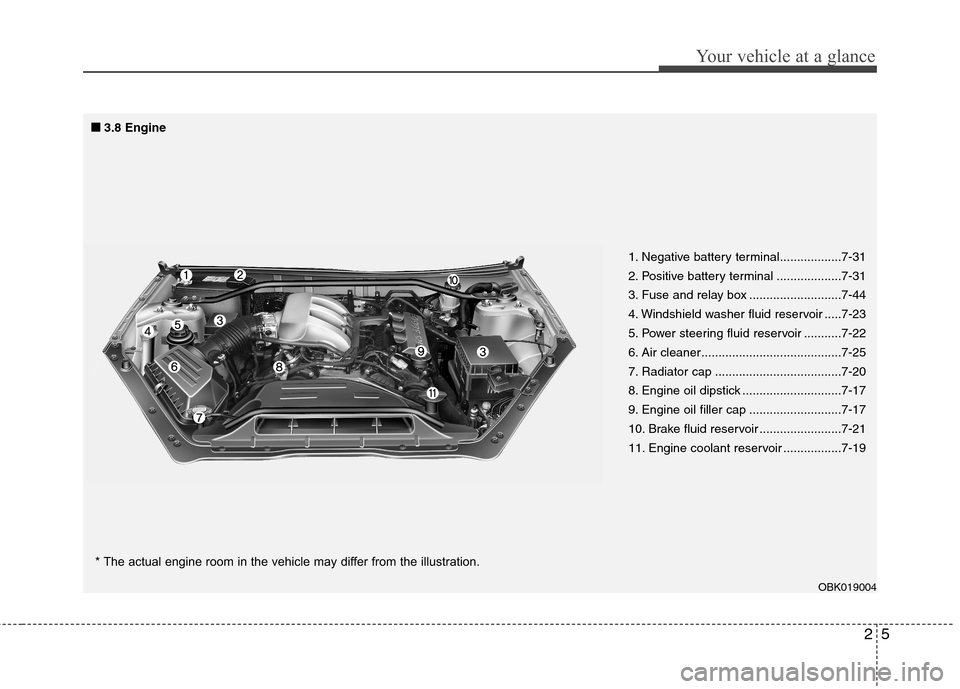
1. Negative battery terminal..................7-31
2. Positive battery terminal ...................7-31
3. Fuse and relay box ...........................7-44
4. Windshield washer fluid reservoir .....7-23
5. Power steering fluid reservoir ...........7-22
6. Air cleaner.........................................7-25
7. Radiator cap .....................................7-20
8. Engine oil dipstick .............................7-17
9. Engine oil filler cap ...........................7-17
10. Brake fluid reservoir ........................7-21
11. Engine coolant reservoir .................7-19
■
■
3.8 Engine
* The actual engine room in the vehicle may differ from the i llustration.
OBK019004
Page 246 of 322
73
Maintenance
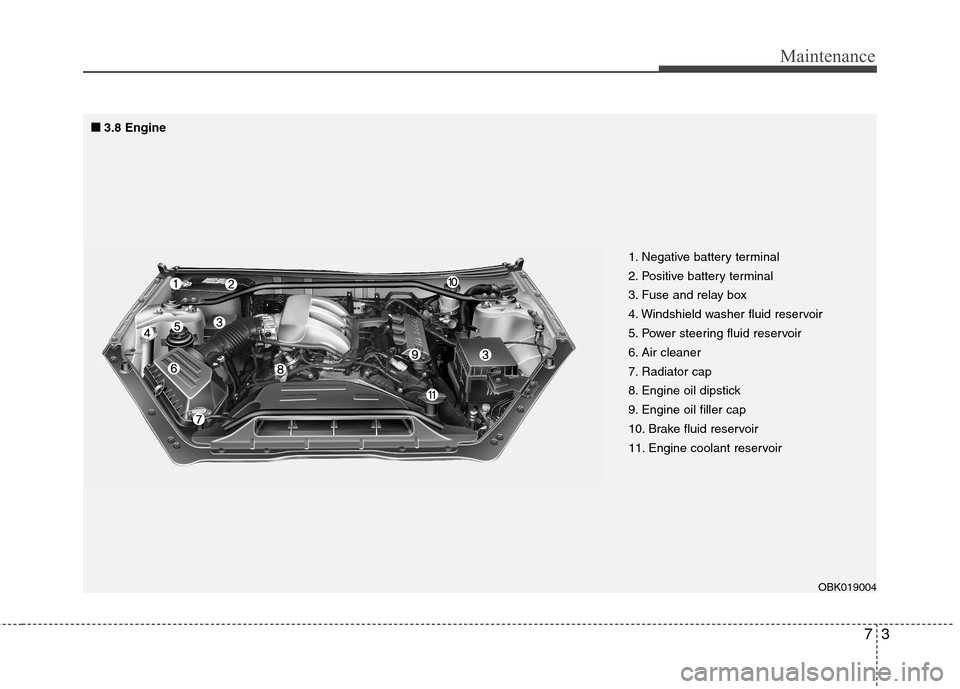
1. Negative battery terminal
2. Positive battery terminal
3. Fuse and relay box
4. Windshield washer fluid reservoir
5. Power steering fluid reservoir
6. Air cleaner
7. Radiator cap
8. Engine oil dipstick
9. Engine oil filler cap
10. Brake fluid reservoir
11. Engine coolant reservoir
■
■
3.8 Engine
OBK019004
Page 251 of 322
Maintenance
8
7
G040100ABK
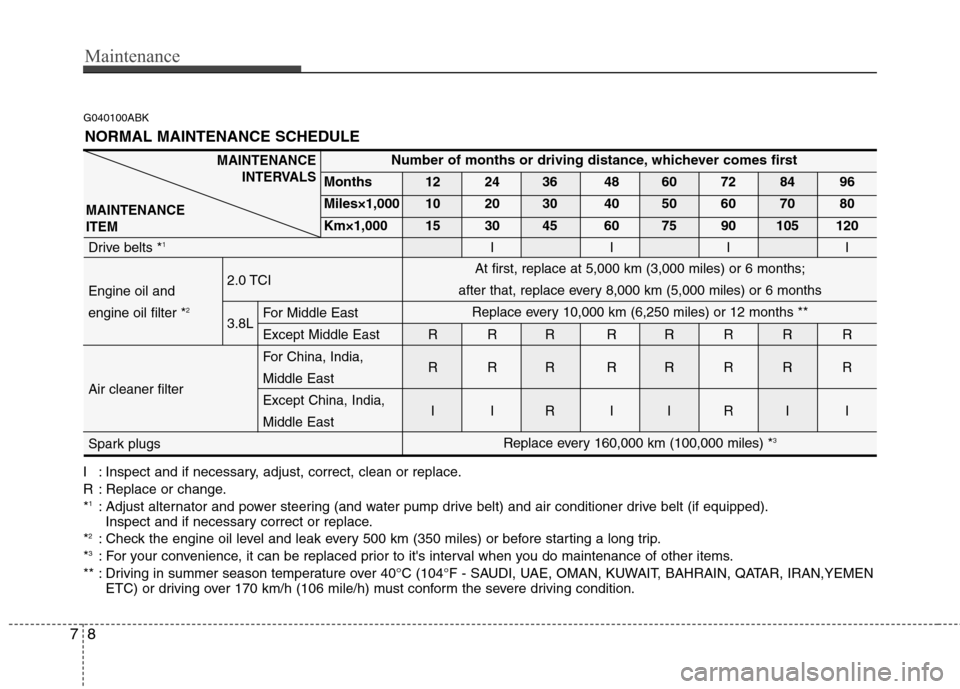
NORMAL MAINTENANCE SCHEDULE
I : Inspect and if necessary, adjust, correct, clean or replace.
R : Replace or change.* 1
: Adjust alternator and power steering (and water pump drive belt) and air conditioner drive belt (if equipped).
Inspect and if necessary correct or replace.
* 2
: Check the engine oil level and leak every 500 km (350 miles) or before starting a long trip.
* 3
: For your convenience, it can be replaced prior to it's interval when you do maintenance of other items.
** : Driving in summer season temperature over 40°C (104°F - SAUDI, UAE, OMAN, KUWAIT, BAHRAIN, QATAR, IRAN,YEMEN ETC) or driving over 170 km/h (106 mile/h) must conform the severe driving condition.
MAINTENANCE
INTERVALS
MAINTENANCE ITEMNumber of months or driving distance, whichever comes first
Months 12 24 36 48 60 72 84 96
Miles×1,000 10 20 30 40 50 60 70 80
Km×1,000 15 30 45 60 75 90 105 120
Drive belts * 1
IIII
Engine oil and 2.0 TCI
engine oil filter * 2
3.8LFor Middle East
Except Middle East R R R R R R R R
For China, India,
RRR RRRRR
Air cleaner filter Middle EastExcept China, India,
IIRIIRII
Middle East
Spark plugs
Replace every 160,000 km (100,000 miles) * 3
Replace every 10,000 km (6,250 miles) or 12 months **
At first, replace at 5,000 km (3,000 miles) or 6 months;
after that, replace every 8,000 km (5,000 miles) or 6 months
Page 255 of 322

Maintenance
12
7
G040200ABK
MAINTENANCE UNDER SEVERE USAGE CONDITIONS
The following items must be serviced more frequently on cars mainly used under severe driving conditions.
Refer to the chart below for the appropriate maintenance intervals.
R : Replace I : Inspect and if necessary, adjust, correct, clean or replace
Engine oil and 2.0 TCI R Every 5,000 km (3,000 miles) or 3 months
A, B, C, D, E, F,
engine oil filter 3.8L For Middle East R Every 5,000 km (3,000 miles) or 6 months
G, H, I, K, L
Except Middle East R Every 7,500 km (4,500 miles) or 6 months
Air cleaner element R C, E
Spark plugs R B, H
Manual transmission fluid R Every 120,000 km (80,000 miles) C, D, E, G, H, I, K
Automatic transmission fluid R Every 100,000 km (60,000 miles) A, C, F, G, I
Steering gear rack, linkage and boots I C, D, E, F, G
Rear axle oil R Every 120,000 km (75,000 miles) C, E, G, H, I, K
MAINTENANCE ITEMMaintenance
operation Maintenance intervals
Driving condition
Replace more frequently
depending on the condition
Inspect more frequently
depending on the condition Replace more frequently
depending on the condition
Page 260 of 322
717
Maintenance
ENGINE OIL
G060100AEN
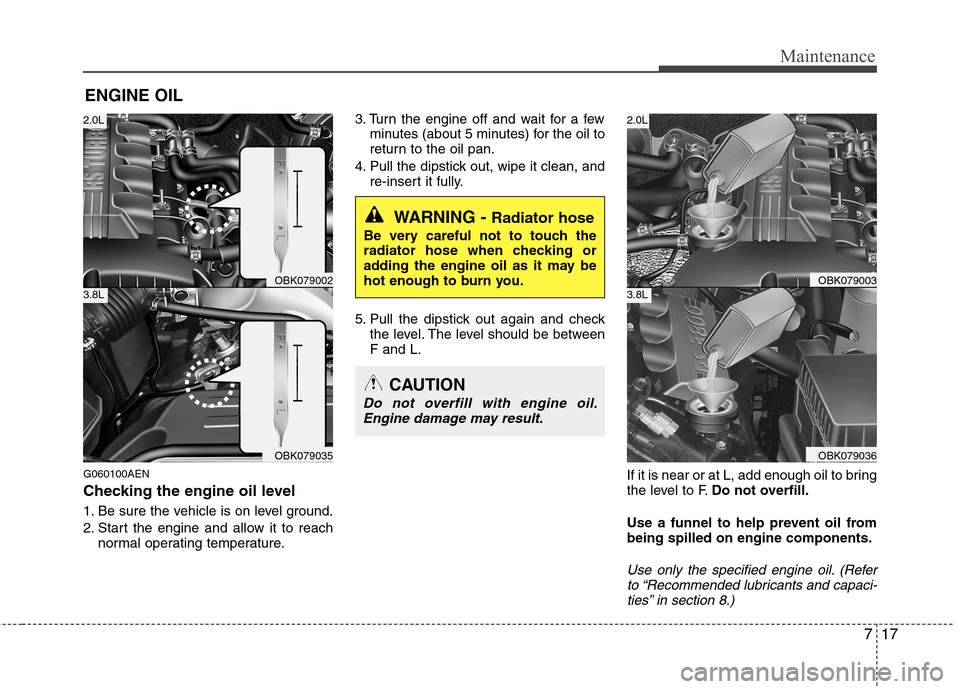
Checking the engine oil level
1. Be sure the vehicle is on level ground.
2. Start the engine and allow it to reach normal operating temperature. 3. Turn the engine off and wait for a few
minutes (about 5 minutes) for the oil to
return to the oil pan.
4. Pull the dipstick out, wipe it clean, and re-insert it fully.
5. Pull the dipstick out again and check the level. The level should be betweenF and L.
If it is near or at L, add enough oil to bring
the level to F.Do not overfill.
Use a funnel to help prevent oil frombeing spilled on engine components.
Use only the specified engine oil. (Refer to “Recommended lubricants and capaci- ties” in section 8.)
WARNING - Radiator hose
Be very careful not to touch the
radiator hose when checking or
adding the engine oil as it may be
hot enough to burn you.
OBK079002
OBK079035
CAUTION
Do not overfill with engine oil. Engine damage may result.
2.0L
3.8LOBK079003
OBK079036
2.0L
3.8L
Page 262 of 322
719
Maintenance
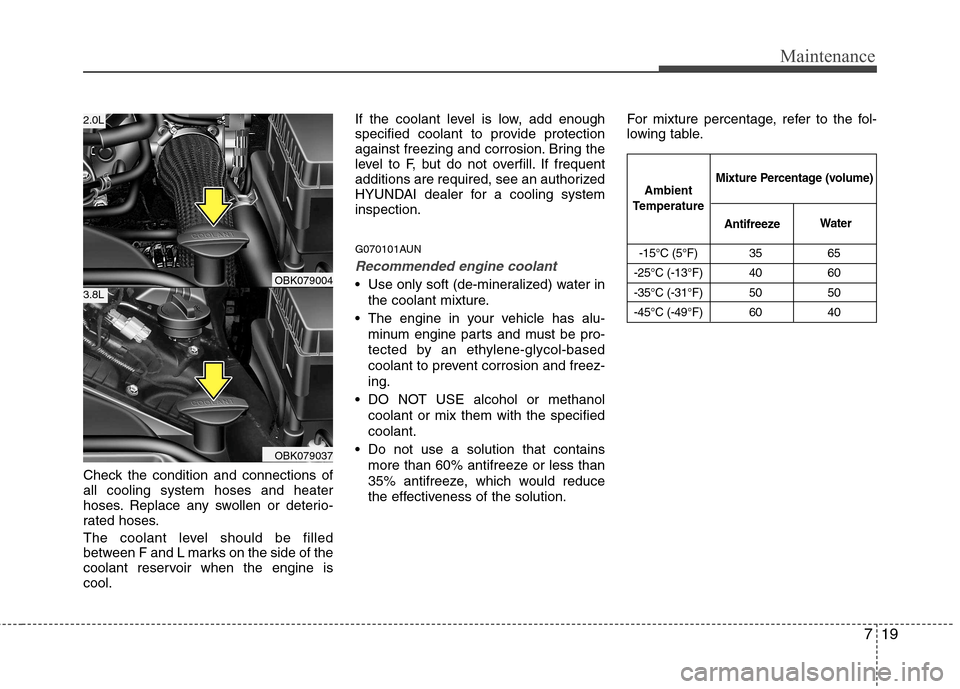
Check the condition and connections of all cooling system hoses and heater
hoses. Replace any swollen or deterio-
rated hoses.
The coolant level should be filled
between F and L marks on the side of the
coolant reservoir when the engine iscool.If the coolant level is low, add enough
specified coolant to provide protection
against freezing and corrosion. Bring the
level to F, but do not overfill. If frequent
additions are required, see an authorized
HYUNDAI dealer for a cooling systeminspection.
G070101AUN
Recommended engine coolant
Use only soft (de-mineralized) water in
the coolant mixture.
The engine in your vehicle has alu- minum engine parts and must be pro-
tected by an ethylene-glycol-based
coolant to prevent corrosion and freez-ing.
DO NOT USE alcohol or methanol coolant or mix them with the specifiedcoolant.
Do not use a solution that contains more than 60% antifreeze or less than
35% antifreeze, which would reduce
the effectiveness of the solution. For mixture percentage, refer to the fol-
lowing table.
-15°C (5°F) 35 65
-25°C (-13°F) 40 60
-35°C (-31°F) 50 50
-45°C (-49°F) 60 40
Ambient
Temperature Mixture Percentage (volume)
Antifreeze Water
OBK079004
OBK079037
2.0L
3.8L
Page 315 of 322
Specifications & Consumer information
4
8
RECOMMENDED LUBRICANTS AND CAPACITIES
I040000ABK
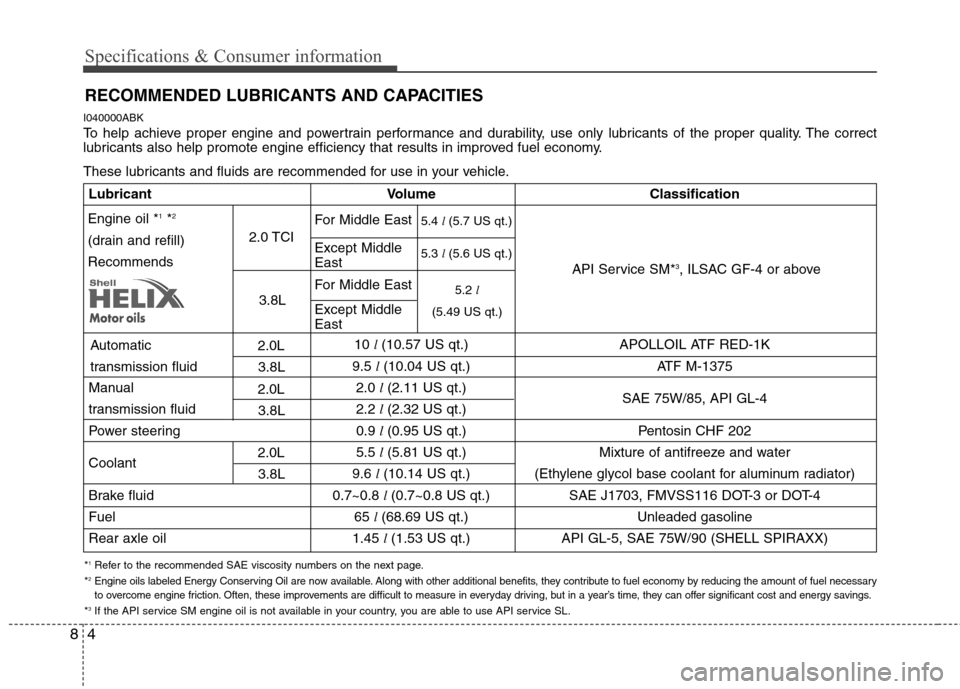
To help achieve proper engine and powertrain performance and durability, use only lubricants of the proper quality. The correct
lubricants also help promote engine efficiency that results in improved fuel economy.
These lubricants and fluids are recommended for use in your vehicle.
* 1
Refer to the recommended SAE viscosity numbers on the next page.
* 2
Engine oils labeled Energy Conserving Oil are now available. Along with other additional benefits, they contribute to fuel economy by reducing the amount of fuel necessary
to overcome engine friction. Often, these improvements are difficult to measure in everyday driving, but in a year’s time, they can offer significant cost and energy savings.
*3
If the API service SM engine oil is not available in your country, you are able to use API service SL.
Lubricant Volume Classification
10 l (10.57 US qt.) APOLLOIL ATF RED-1K
9.5 l (10.04 US qt.) ATF M-1375
Manual 2.0 l (2.11 US qt.)
SAE 75W/85, API GL-4
transmission fluid 2.2 l (2.32 US qt.)
Power steering 0.9 l (0.95 US qt.) Pentosin CHF 202
Coolant 5.5
l (5.81 US qt.) Mixture of antifreeze and water
9.6 l (10.14 US qt.) (Ethylene glycol base coolant for aluminum radiator)
Brake fluid 0.7~0.8 l (0.7~0.8 US qt.) SAE J1703, FMVSS116 DOT-3 or DOT-4
Fuel 65 l (68.69 US qt.) Unleaded gasoline
Rear axle oil 1.45 l (1.53 US qt.) API GL-5, SAE 75W/90 (SHELL SPIRAXX)
Engine oil * 1
*2
(drain and refill) Recommends 2.0 TCI
3.8L
Automatic
transmission fluid
2.0L3.8L
2.0L
3.8L
2.0L
3.8L API Service SM*
3
, ILSAC GF-4 or above5.4 l (5.7 US qt.)
5.3 l (5.6 US qt.)
5.2 l
(5.49 US qt.)
Except Middle East
For Middle East
Except MiddleEast
For Middle East
Page 316 of 322
85
Specifications & Consumer information
I040100AUN Recommended SAE viscosity
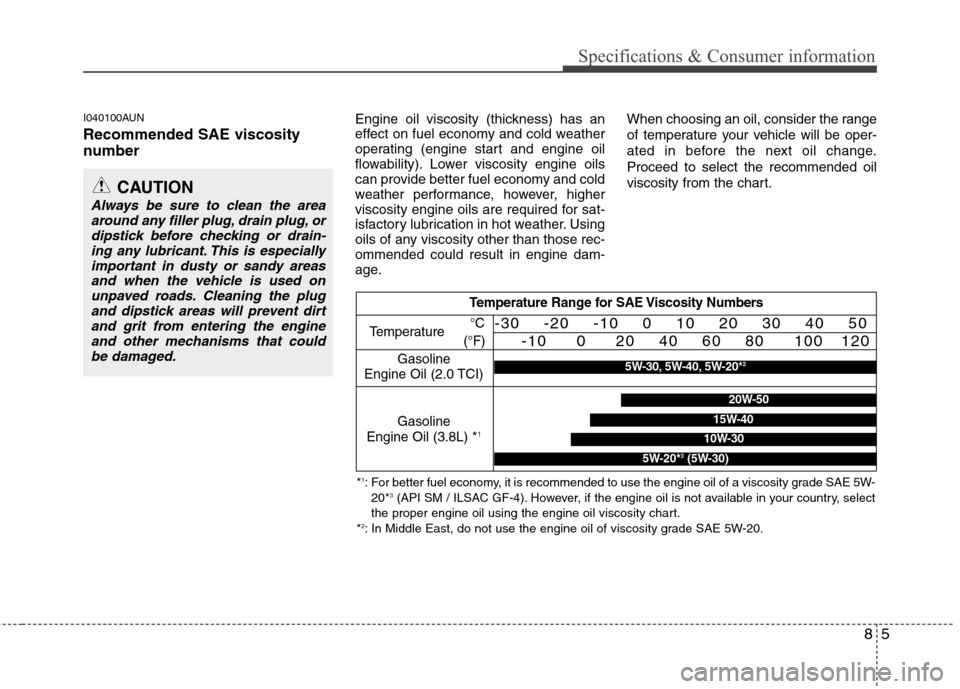
number Engine oil viscosity (thickness) has an
effect on fuel economy and cold weather
operating (engine start and engine oil
flowability). Lower viscosity engine oils
can provide better fuel economy and cold
weather performance, however, higher
viscosity engine oils are required for sat-
isfactory lubrication in hot weather. Using
oils of any viscosity other than those rec-ommended could result in engine dam-
age.When choosing an oil, consider the range
of temperature your vehicle will be oper-
ated in before the next oil change.Proceed to select the recommended oil
viscosity from the chart.
CAUTION
Always be sure to clean the area
around any filler plug, drain plug, or
dipstick before checking or drain-ing any lubricant. This is especiallyimportant in dusty or sandy areas
and when the vehicle is used on unpaved roads. Cleaning the plugand dipstick areas will prevent dirt and grit from entering the engine and other mechanisms that could
be damaged.
Temperature Range for SAE Viscosity Numbers
Temperature
Gasoline
Engine Oil (3.8L) * 1
Gasoline
Engine Oil (2.0 TCI) °C
(°F)-30 -20 -10 0 10 20 30 40 50 -10 0 20 40 60 80 100 120
*1
: For better fuel economy, it is recommended to use the engine oil of a viscosity grade SAE 5W-
20* 3
(API SM / ILSAC GF-4). However, if the engine oil is not available in your country, select
the proper engine oil using the engine oil viscosity chart.
* 2
: In Middle East, do not use the engine oil of viscosity grade SAE 5W-20.
20W-50
10W-30
15W-40
5W-20* 3
(5W-30)
5W-30, 5W-40, 5W-20* 2
Page 318 of 322
87
Specifications & Consumer information
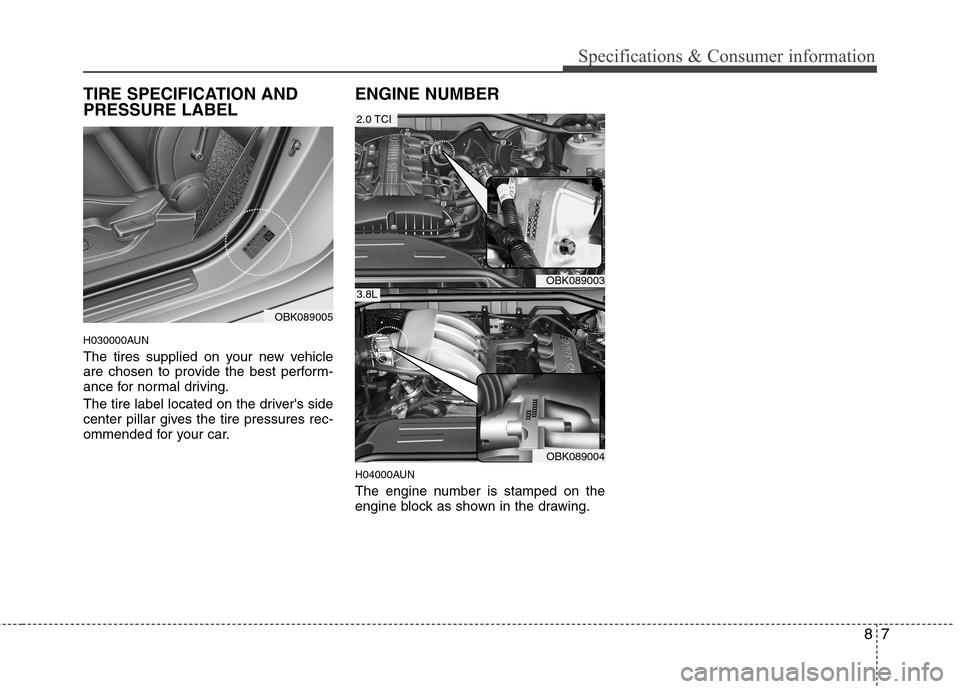
TIRE SPECIFICATION AND PRESSURE LABEL
H030000AUN
The tires supplied on your new vehicle
are chosen to provide the best perform-
ance for normal driving.
The tire label located on the driver's side
center pillar gives the tire pressures rec-
ommended for your car.ENGINE NUMBER
H04000AUN
The engine number is stamped on the
engine block as shown in the drawing.
OBK089003
OBK089004
3.8L
2.0 TCI
OBK089005