start stop button Hyundai Genesis Coupe 2011 User Guide
[x] Cancel search | Manufacturer: HYUNDAI, Model Year: 2011, Model line: Genesis Coupe, Model: Hyundai Genesis Coupe 2011Pages: 343, PDF Size: 34.28 MB
Page 202 of 343
59
Driving your vehicle
E030205ABHStarting the engine E040000ABH
WARNING
Never press the ENGINE START/STOP button while the
vehicle is in motion. This wouldresult in loss of directional con-
trol and braking function, whichcould cause an accident.
The anti-theft steering column lock is not a substitute for the
parking brake. Before leaving the
driver’s seat, always make sure
the shift lever is engaged in P
(Park),set the parking brake fully
and shut the engine off.
Unexpected and sudden vehicle
movement may occur if theseprecautions are not taken.
(Continued)
(Continued)
Never reach for the enginestart/stop button, or any other
controls through the steering
wheel while the vehicle is in
motion. The presence of yourhand or arm in this area could
cause a loss of vehicle control,
an accident and serious bodily
injury or death.
Do not place any movable objects around the driver’s seat as they
may move while driving, interferewith the driver and lead to anaccident.
WARNING
Always wear appropriate shoes
when operating your vehicle.
Unsuitable shoes (high heels, ski
boots, etc.) may interfere with yourability to use the brake and acceler-ator pedal.
Page 203 of 343
Driving your vehicle
10
5
E040100ABK
1. Carry the smart key or leave it inside
the vehicle.
2. Make sure the parking brake is firmly applied.
3. Manual Transmission - Depress the
clutch pedal fully and shift the trans-
mission into Neutral. Depress the
brake and clutch pedal fully.
Automatic Transmission - Place the
transmission shift lever in P (Park).
Depress the brake pedal fully.
You can also start the engine when
the shift lever is in the N (Neutral) position.
4. Press the engine start/stop button.
5. In extremely cold weather (below -
18°C / 0°F) or after the vehicle has not
been operated for several days, let the
engine warm up without depressing
the accelerator.
Whether the engine is cold or warm, itshould be started without depressing
the accelerator.
Even if the smart key is in the vehicle,
if it is far away from you, the engine
may not start.
When the engine start/stop button is in
the ACC or ON position, if any door is
open, the system checks for the smart
key. If the smart key is not in the vehi-
cle, and if all doors are closed, the
chime will sound for about 5 seconds.
Keep the smart key in the vehicle,
when using the ACC position or if the
vehicle engine is on.
WARNING
The engine will start by pressing
the engine start/stop button, only
when the smart key is in the vehi-
cle. Never allow children or any per-son who is unfamiliar with the vehi-
cle to touch the engine start/stop
button or related parts.CAUTION
If the engine stalls while you are in motion, do not attempt to move the
shift lever to the P (Park) position. Iftraffic and road conditions permit,you may put the shift lever in the N(Neutral) position while the vehi-
cle is still moving and press theengine start/stop button in anattempt to restart the engine.
Page 204 of 343
511
Driving your vehicle
✽✽NOTICE
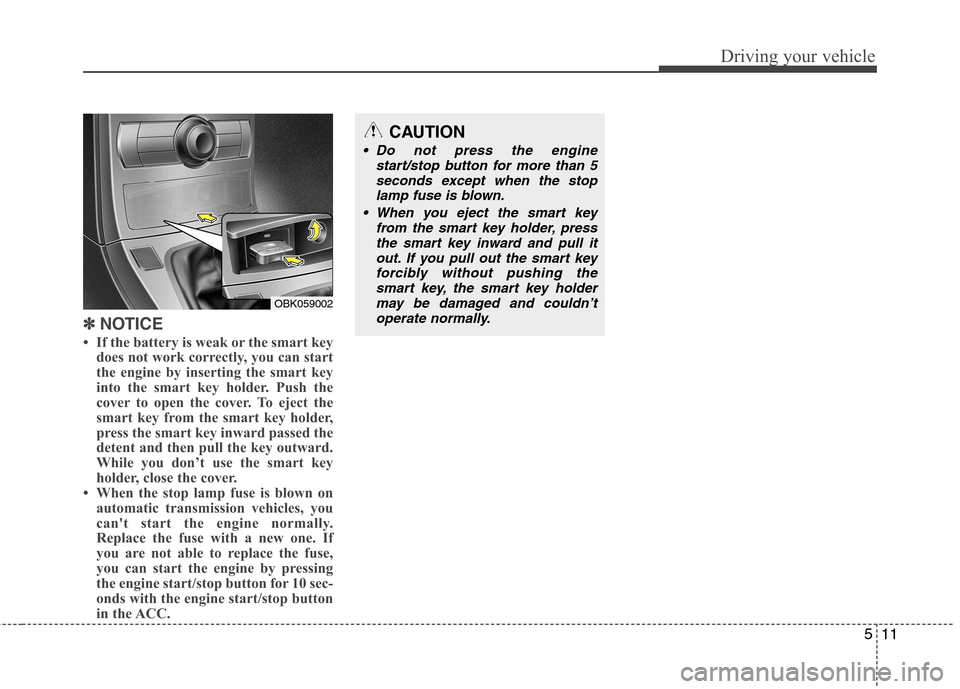
If the battery is weak or the smart key does not work correctly, you can start
the engine by inserting the smart key
into the smart key holder. Push the
cover to open the cover. To eject the
smart key from the smart key holder,
press the smart key inward passed the
detent and then pull the key outward.
While you don’t use the smart key
holder, close the cover.
When the stop lamp fuse is blown on
automatic transmission vehicles, you
can't start the engine normally.
Replace the fuse with a new one. If
you are not able to replace the fuse,
you can start the engine by pressing
the engine start/stop button for 10 sec-
onds with the engine start/stop button
in the ACC.
CAUTION
Do not press the engine
start/stop button for more than 5
seconds except when the stoplamp fuse is blown.
When you eject the smart key from the smart key holder, press
the smart key inward and pull it out. If you pull out the smart keyforcibly without pushing thesmart key, the smart key holder
may be damaged and couldn’t operate normally.
OBK059002
Page 212 of 343
519
Driving your vehicle
✽✽NOTICE
In sports mode, the driver must exe- cute upshifts in accordance with road
conditions, taking care to keep the
engine speed below the red zone.
In sports mode, only the 5 (or 6) for-
ward gears can be selected. To reverse
or park the vehicle, move the shift
lever to the R (Reverse) or P (Park)
position as required.
In sports mode, downshifts are made automatically when the vehicle slows
down. When the vehicle stops, 1st gear
is automatically selected.
In sports mode, when the engine rpm approaches the red zone shift points
are varied to upshift automatically.
To maintain the required levels of
vehicle performance and safety, the
system may not execute certain
gearshifts when the shift lever is oper-
ated.
When driving on a slippery road, push the shift lever forward into the
+(up) position. This causes the trans-
mission to shift into the 2nd (or 3rd)
gear which is better for smooth driv-
ing on a slippery road. Push the shift
lever to the -(down) side to shift back
to the 1st gear.E060102ABH
Shift lock system (if equipped)
For your safety, the automatic transmis-
sion has a shift lock system which pre-
vents shifting the transmission from P
(Park) or N (Neutral) into R (Reverse)
unless the brake pedal is depressed.
To shift the transmission from P (Park) or
N (Neutral) into R (Reverse):
1. Depress and hold the brake pedal.
2. Start the engine or turn the ignition switch to the ON position.
3. Move the shift lever.
If the brake pedal is repeatedly depressed and released with the shift
lever in the P (Park) position, a chattering
noise near the shift lever may be heard.
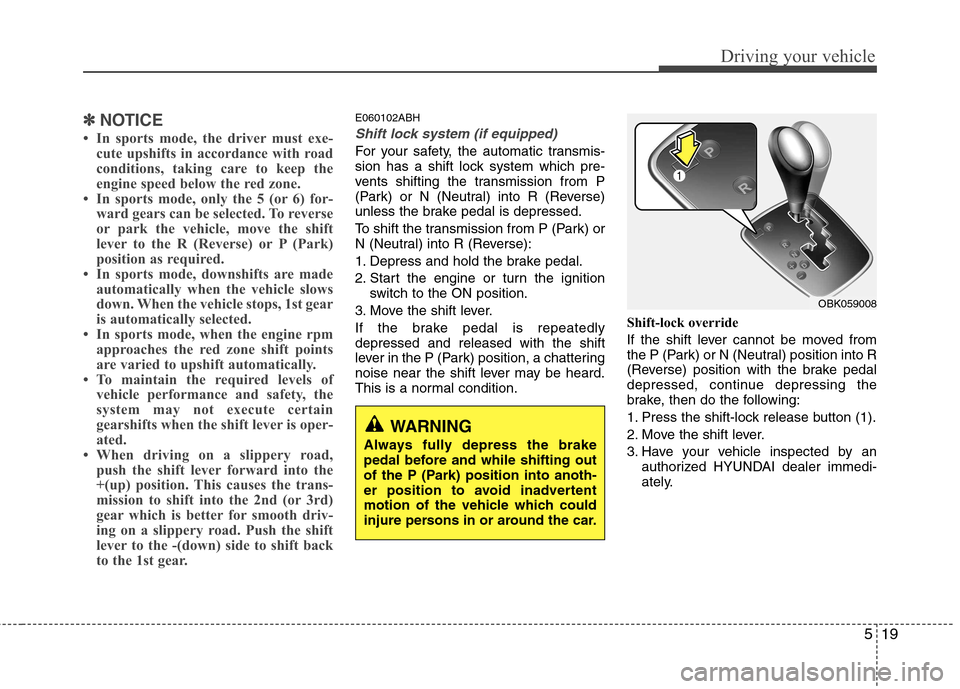
This is a normal condition. Shift-lock override
If the shift lever cannot be moved from
the P (Park) or N (Neutral) position into R
(Reverse) position with the brake pedal
depressed, continue depressing the
brake, then do the following:
1. Press the shift-lock release button (1).
2. Move the shift lever.
3. Have your vehicle inspected by an
authorized HYUNDAI dealer immedi-
ately.
WARNING
Always fully depress the brake
pedal before and while shifting out
of the P (Park) position into anoth-
er position to avoid inadvertent
motion of the vehicle which could
injure persons in or around the car.
OBK059008
Page 217 of 343
Driving your vehicle
24
5
E070202AFD
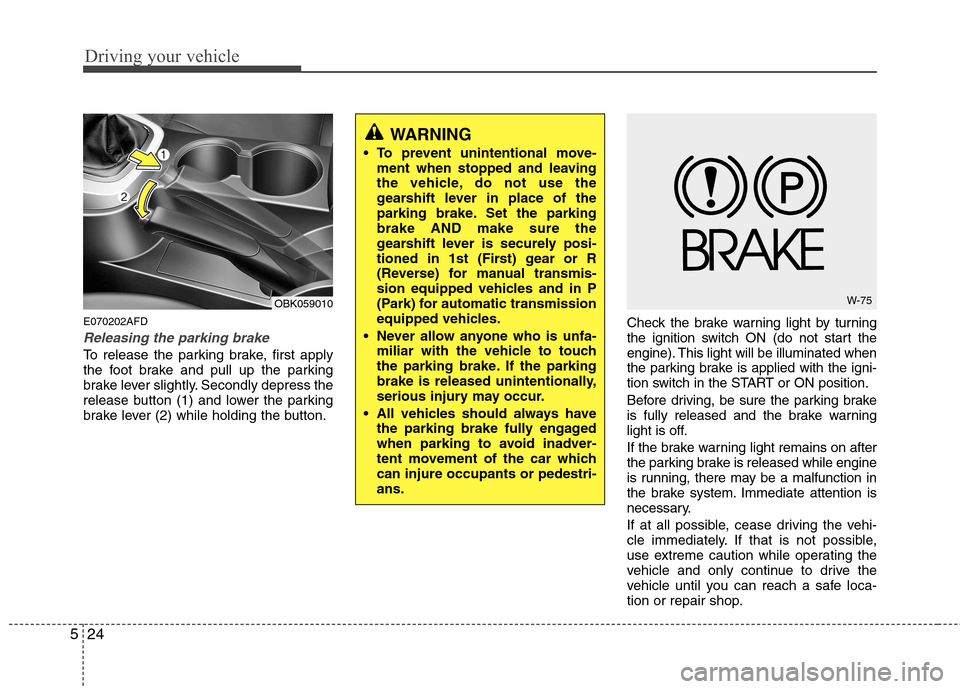
Releasing the parking brake
To release the parking brake, first apply
the foot brake and pull up the parking
brake lever slightly. Secondly depress the
release button (1) and lower the parking
brake lever (2) while holding the button. Check the brake warning light by turning
the ignition switch ON (do not start the
engine). This light will be illuminated when
the parking brake is applied with the igni-
tion switch in the START or ON position.
Before driving, be sure the parking brake
is fully released and the brake warning
light is off.
If the brake warning light remains on after
the parking brake is released while engine
is running, there may be a malfunction in
the brake system. Immediate attention is
necessary.
If at all possible, cease driving the vehi-
cle immediately. If that is not possible,
use extreme caution while operating the
vehicle and only continue to drive the
vehicle until you can reach a safe loca-
tion or repair shop.
WARNING
To prevent unintentional move- ment when stopped and leaving
the vehicle, do not use the
gearshift lever in place of the
parking brake. Set the parkingbrake AND make sure the
gearshift lever is securely posi-
tioned in 1st (First) gear or R
(Reverse) for manual transmis-
sion equipped vehicles and in P
(Park) for automatic transmission
equipped vehicles.
Never allow anyone who is unfa- miliar with the vehicle to touch
the parking brake. If the parking
brake is released unintentionally,
serious injury may occur.
All vehicles should always have the parking brake fully engaged
when parking to avoid inadver-
tent movement of the car whichcan injure occupants or pedestri-ans.
OBK059010W-75
Page 308 of 343
749
Maintenance
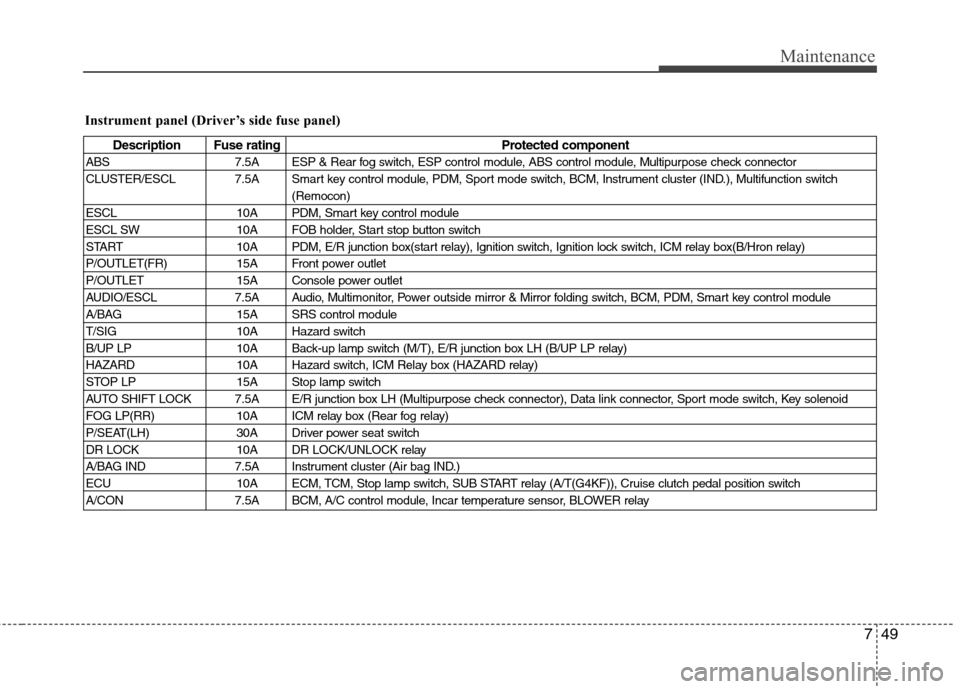
Instrument panel (Driver’s side fuse panel)
Description Fuse ratingProtected component
ABS 7.5A ESP & Rear fog switch, ESP control module, ABS control module, Multipurpose check connector
CLUSTER/ESCL 7.5A Smart key control module, PDM, Sport mode switch, BCM, Instrument cluster (IND.), Multifunction switch (Remocon)
ESCL 10A PDM, Smart key control module
ESCL SW 10A FOB holder, Start stop button switch
START 10A PDM, E/R junction box(start relay), Ignition switch, Ignition lock switch, ICM relay box(B/Hron relay)
P/OUTLET(FR) 15A Front power outlet
P/OUTLET 15A Console power outlet
AUDIO/ESCL 7.5A Audio, Multimonitor, Power outside mirror & Mirror folding switch, BCM, PDM, Smart key control module
A/BAG 15A SRS control module
T/SIG 10A Hazard switch
B/UP LP 10A Back-up lamp switch (M/T), E/R junction box LH (B/UP LP relay)
HAZARD 10A Hazard switch, ICM Relay box (HAZARD relay)
STOP LP 15A Stop lamp switch
AUTO SHIFT LOCK 7.5A E/R junction box LH (Multipurpose check connector), Data link connector, Sport mode switch, Key solenoid
FOG LP(RR) 10A ICM relay box (Rear fog relay)
P/SEAT(LH) 30A Driver power seat switch
DR LOCK 10A DR LOCK/UNLOCK relay
A/BAG IND 7.5A Instrument cluster (Air bag IND.)
ECU 10A ECM, TCM, Stop lamp switch, SUB START relay (A/T(G4KF)), Cruise clutch pedal position switch
A/CON 7.5A BCM, A/C control module, Incar temperature sensor, BLOWER relay
Page 336 of 343
Index
2
I
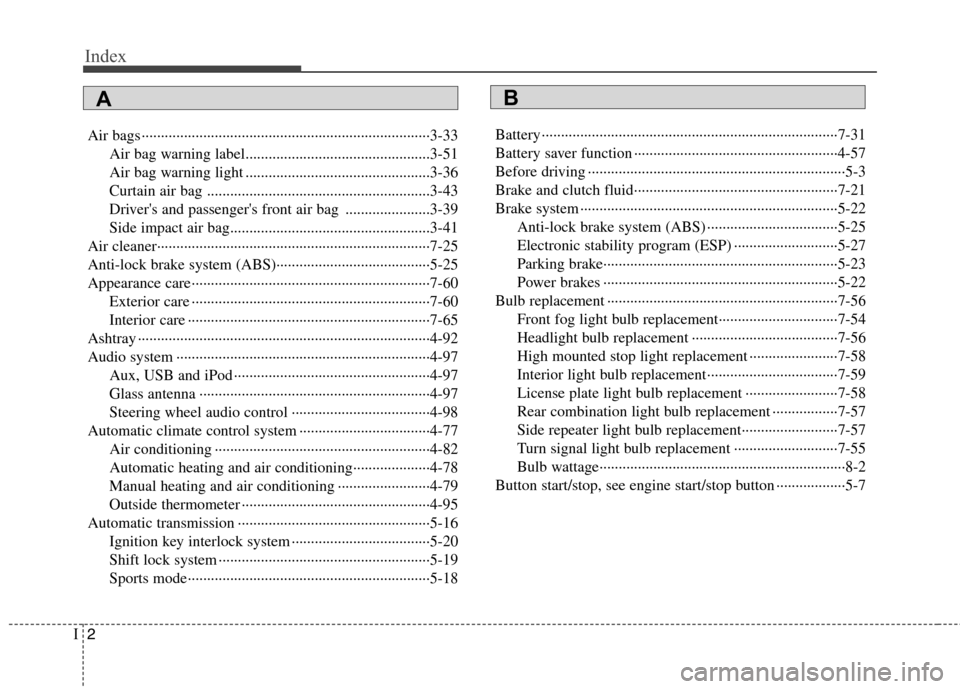
Air bags ···········································································3-33
Air bag warning label................................................3-51
Air bag warning light ................................................3-36
Curtain air bag ..........................................................3-43
Driver's and passenger's front air bag ......................3-39
Side impact air bag....................................................3-41
Air cleaner·······································································7-25
Anti-lock brake system (ABS)········································5-25
Appearance care······························································7-60 Exterior care ······························································7-60
Interior care ·······························································7-65
Ashtray ············································································4-92
Audio system ··································································4-97 Aux, USB and iPod ···················································4-97
Glass antenna ····························································4-97
Steering wheel audio control ····································4-98
Automatic climate control system ··································4-77 Air conditioning ························································4-82
Automatic heating and air conditioning····················4-78
Manual heating and air conditioning ························4-79
Outside thermometer ·················································4-95
Automatic transmission ··················································5-16 Ignition key interlock system ····································5-20
Shift lock system ·······················································5-19
Sports mode·······························································5-18 Battery ·············································································7-31
Battery saver function ·····················································4-57
Before driving ···································································5-3
Brake and clutch fluid·····················································7-21
Brake system ···································································5-22
Anti-lock brake system (ABS) ··································5-25
Electronic stability program (ESP) ···························5-27
Parking brake·····························································5-23
Power brakes ·····························································5-22
Bulb replacement ····························································7-56 Front fog light bulb replacement·······························7-54
Headlight bulb replacement ······································7-56
High mounted stop light replacement ·······················7-58
Interior light bulb replacement··································7-59
License plate light bulb replacement ························7-58
Rear combination light bulb replacement ·················7-57
Side repeater light bulb replacement·························7-57
Turn signal light bulb replacement ···························7-55
Bulb wattage································································8-2
Button start/stop, see engine start/stop button ··················5-7
AB
Page 338 of 343
Index
4
I
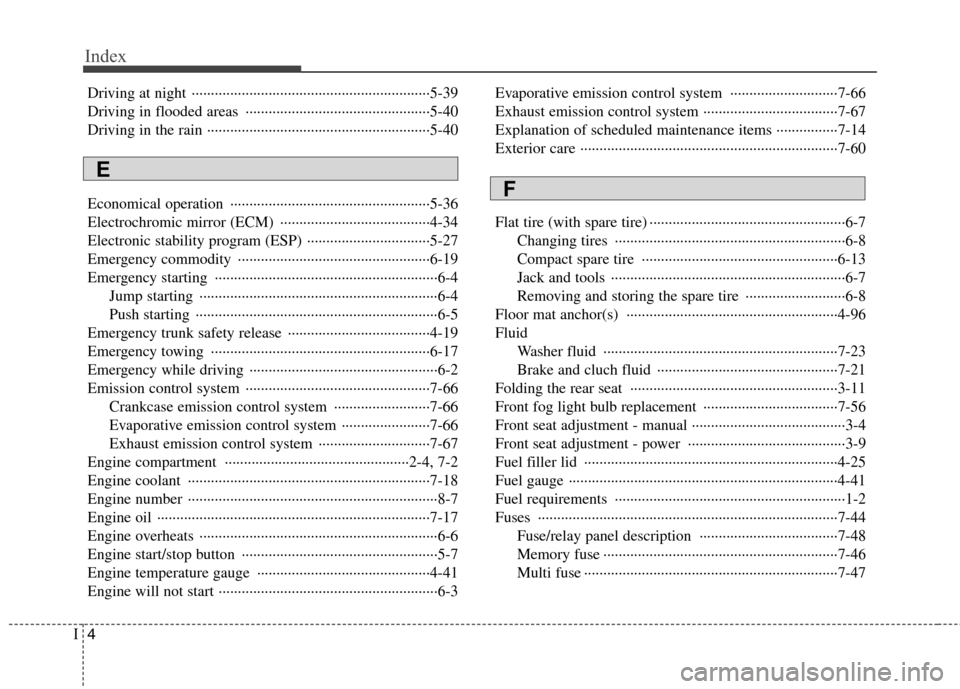
Driving at night ······························································5-39
Driving in flooded areas ················································5-40
Driving in the rain ··························································5-40
Economical operation ····················································5-36
Electrochromic mirror (ECM) ·······································4-34
Electronic stability program (ESP) ································5-27
Emergency commodity ··················································6-19
Emergency starting ··························································6-4
Jump starting ······························································6-4
Push starting ·······························································6-5
Emergency trunk safety release ·····································4-19
Emergency towing ·························································6-17
Emergency while driving ·················································6-2
Emission control system ················································7-66 Crankcase emission control system ·························7-66
Evaporative emission control system ·······················7-66
Exhaust emission control system ·····························7-67
Engine compartment ················································2-4, 7-2
Engine coolant ·······························································7-18
Engine number ·································································8-7
Engine oil ·······································································7-17
Engine overheats ······························································6-6
Engine start/stop button ···················································5-7
Engine temperature gauge ·············································4-41
Engine will not start ·························································6-3 Evaporative emission control system ····························7-66
Exhaust emission control system ···································7-67Explanation of scheduled maintenance items ················7-14
Exterior care ···································································7-60
Flat tire (with spare tire) ···················································6-7
Changing tires ····························································6-8
Compact spare tire ···················································6-13
Jack and tools ·····························································6-7
Removing and storing the spare tire ··························6-8
Floor mat anchor(s) ·······················································4-96Fluid Washer fluid ·····························································7-23
Brake and cluch fluid ···············································7-21
Folding the rear seat ······················································3-11
Front fog light bulb replacement ···································7-56Front seat adjustment - manual ········································3-4
Front seat adjustment - power ·········································3-9
Fuel filler lid ··································································4-25
Fuel gauge ······································································4-41
Fuel requirements ····························································1-2Fuses ··············································································7-44 Fuse/relay panel description ····································7-48
Memory fuse ·····························································7-46
Multi fuse ··································································7-47
E
F