climate control Hyundai Genesis Coupe 2012 User Guide
[x] Cancel search | Manufacturer: HYUNDAI, Model Year: 2012, Model line: Genesis Coupe, Model: Hyundai Genesis Coupe 2012Pages: 391, PDF Size: 6.59 MB
Page 166 of 391
489
Features of your vehicle
D250000AEN For maximum defrosting, set the tem-perature control to the full right/hot
position and the fan speed control to
the highest speed.
If warm air to the floor is desired while defrosting or defogging, set the mode
to the floor-defrost position.
Before driving, clear all snow and ice from the windshield, rear window, out-
side rear view mirrors, and all side win-
dows.
Clear all snow and ice from the hood and air inlet in the cowl grill to improve
heater and defroster efficiency and to
reduce the probability of fogging up the
inside of the windshield.
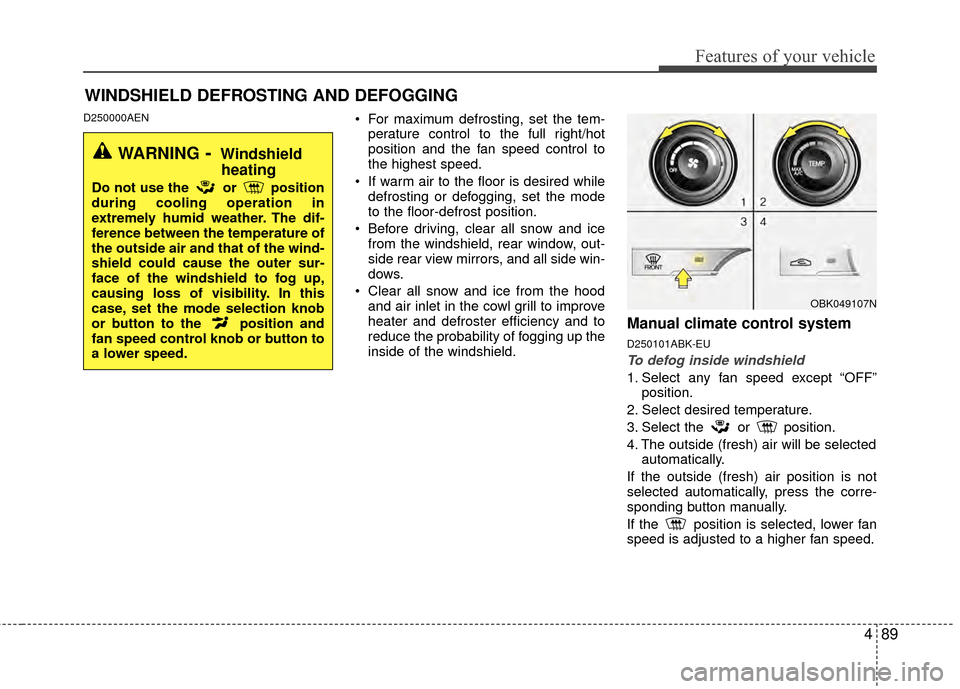
Manual climate control system
D250101ABK-EU
To defog inside windshield
1. Select any fan speed except “OFF” position.
2. Select desired temperature.
3. Select the or position.
4. The outside (fresh) air will be selected automatically.
If the outside (fresh) air position is not
selected automatically, press the corre-
sponding button manually.
If the position is selected, lower fan
speed is adjusted to a higher fan speed.
WINDSHIELD DEFROSTING AND DEFOGGING
OBK049107N
WARNING- Windshield heating
Do not use the or position
during cooling operation in
extremely humid weather. The dif-
ference between the temperature of
the outside air and that of the wind-
shield could cause the outer sur-
face of the windshield to fog up,
causing loss of visibility. In this
case, set the mode selection knob
or button to the position and
fan speed control knob or button to
a lower speed.
Page 167 of 391

Features of your vehicle
90
4
D250102ABK-EU
To defrost outside windshield
1. Set the fan speed to the highest (fully
right) position.
2. Set the temperature to the extreme hot position.
3. Select the position.
4. The outside (fresh) air will be selected automatically.
If the position is selected, lower fan
speed is adjusted to a higher fan speed.
Automatic climate control system
D250201ABK-EU
To defog inside windshield
1. Set the fan speed to the desired posi- tion.
2. Select desired temperature.
3. Press the defrost button ( ).
4. The outside (fresh) air position will be selected automatically.
If the outside (fresh) air position is not
selected automatically, adjust the corre-
sponding button manually.
If the position is selected, lower fan
speed is adjusted to a higher fan speed.
D250202ABK-EU
To defrost outside windshield
1. Set the fan speed to the highest posi- tion.
2. Set the temperature to the hot (HI) position.
3. Press the defrost button ( ).
4. The outside (fresh) air position will be selected automatically.
If the position is selected, lower fan
speed is adjusted to a higher fan speed.
OBK049108NOBK049073N/Q
Type A
Type B
Type A
Type BOBK049072N/Q
Page 168 of 391
491
Features of your vehicle
D250300AUN-EU
Defogging logic
To reduce the possibility of fogging up
the inside of the windshield, the air intake
is controlled automatically according to
certain conditions such as or
position. To cancel or return the defog-
ging logic, perform the following steps:
D250301ABK
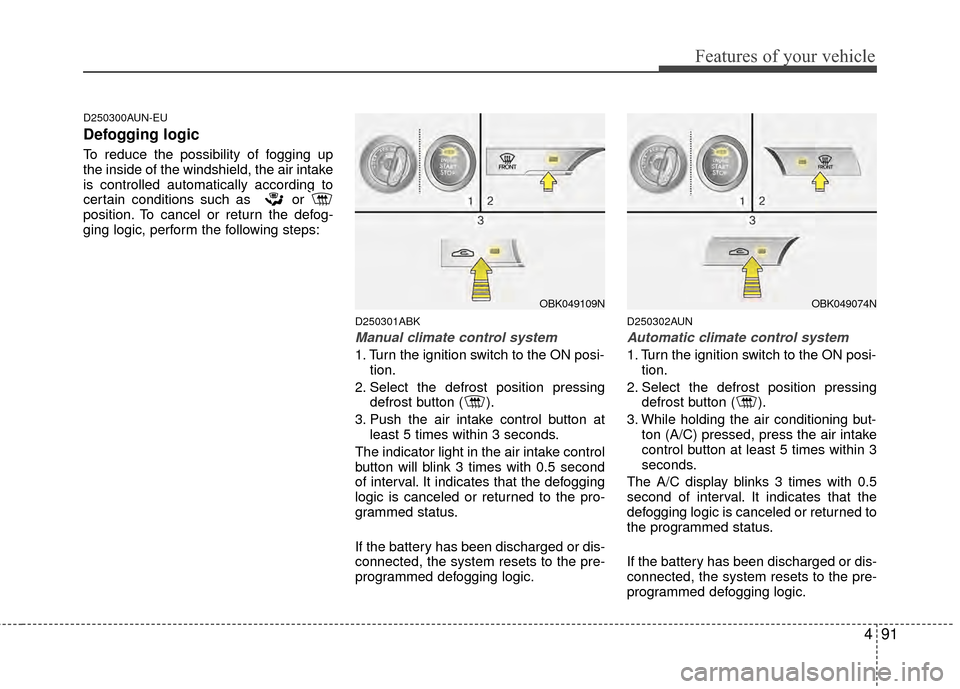
Manual climate control system
1. Turn the ignition switch to the ON posi-tion.
2. Select the defrost position pressing defrost button ( ).
3. Push the air intake control button at least 5 times within 3 seconds.
The indicator light in the air intake control
button will blink 3 times with 0.5 second
of interval. It indicates that the defogging
logic is canceled or returned to the pro-
grammed status.
If the battery has been discharged or dis-
connected, the system resets to the pre-
programmed defogging logic.
D250302AUN
Automatic climate control system
1. Turn the ignition switch to the ON posi- tion.
2. Select the defrost position pressing defrost button ( ).
3. While holding the air conditioning but- ton (A/C) pressed, press the air intake
control button at least 5 times within 3
seconds.
The A/C display blinks 3 times with 0.5
second of interval. It indicates that the
defogging logic is canceled or returned to
the programmed status.
If the battery has been discharged or dis-
connected, the system resets to the pre-
programmed defogging logic.
OBK049109NOBK049074N
Page 303 of 391
7
Engine compartment / 7-2
Maintenance services / 7-4
Owner maintenance / 7-5
Scheduled maintenance service / 7-7
Explanation of scheduled maintenance items / 7-13
Engine oil / 7-16
Engine coolant / 7-17
Brake and clutch fluid / 7-20
Power steering fluid / 7-21
Automatic transmission fluid / 7-22
Manual transmission fluid / 7-22
Washer fluid / 7-22
Parking brake / 7-23
Air cleaner / 7-24
Climate control air filter / 7-25
Wiper blades / 7-27
Battery / 7-30
Tires and wheels / 7-33
Fuses / 7-47
Light bulbs / 7-56
Appearance care / 7-61
Emission control system / 7-67
Califonia perchlorate notice / 7-70
Maintenance
Page 309 of 391
77
Maintenance
SCHEDULED MAINTENANCE SERVICE
G030105AHM
At least once a year:
Clean the body and door drain holes.
Lubricate the door hinges and checks,and hood hinges.
Lubricate the door and hood locks and latches.
Lubricate the door rubber weather- strips.
Check the air conditioning system.
Check the power steering fluid level.
Inspect and lubricate the automatic transmission linkage and controls.
Clean the battery and terminals.
Check the brake fluid level.
G040000AUN-EU
Follow Normal Maintenance Schedule if
the vehicle is usually operated where
none of the following conditions apply. If
any of the following conditions apply, fol-
low Maintenance Under Severe Usage
Conditions.
Repeated short distance driving.
Driving in dusty conditions or sandy areas.
Extensive use of brakes.
Driving in areas where salt or other corrosive materials are being used.
Driving on rough or muddy roads.
Driving in mountainous areas.
Extended periods of idling or low speed operation.
Driving for a prolonged period in cold temperatures and/or extremely humid
climates.
More than 50% driving in heavy city traffic during hot weather above 90°F
(32°C).If your vehicle is operated under theabove conditions, you should inspect, replace or refill more frequently than thefollowing Normal Maintenance Schedule. After 120 months or 150,000 miles(240,000 km) continue to follow the pre-scribed maintenance intervals.
Page 313 of 391

R : Replace I : Inspect and, after Inspection, clean, adjust, repair or replace if neces\
sary.
DESCRIPTION
7.5 15 22.5 30 37.5 45 52.5 60 67.5 75 8")
711
Maintenance
NORMAL MAINTENANCE SCHEDULE (CONT.)
R : Replace I : Inspect and, after Inspection, clean, adjust, repair or replace if neces\
sary.
DESCRIPTION
7.5 15 22.5 30 37.5 45 52.5 60 67.5 75 82.5 90 97.5 105 112.5 120 127.5 135 142.5 150
12 24 36 48 60 72 84 96 108 120 132 144 156 168 180 192 204 216 228 240 6 121824303642485460667278849096102108114120
IIIIIIIIII
IIIIIIIIIIIIIIIIII II IIIIIIIIII
IIIIIIIIII
IIIIIIIIII
RRRRRRRRRR IIIII
IIIIIIIIII
GENERAL ITEMS
STEERING GEAR BOX, LINKAGE & BOOTS
/LOWER ARM BALL JOINT, UPPER ARM BALL
JOINT
POWER STEERING FLUID
POWER STEERING PUMP, BELT AND HOSES
DRIVE SHAFTS AND BOOTS
AIR CONDITIONING REFRIGERANT
CLIMATE CONTROL AIR FILTER
(FOR EVAPORATOR AND BLOWER UNIT)
REAR AXLE OIL *
7
PROPELLER SHAFT MILES X 1000
KILOMETERS X 1000
MONTHS
No.
12
13
14
15
16
17
18
19
*7: Rear axle oil should be changed anytime the differential has been submerged in water
Page 314 of 391
Maintenance
12
7
G040200ABK-EU
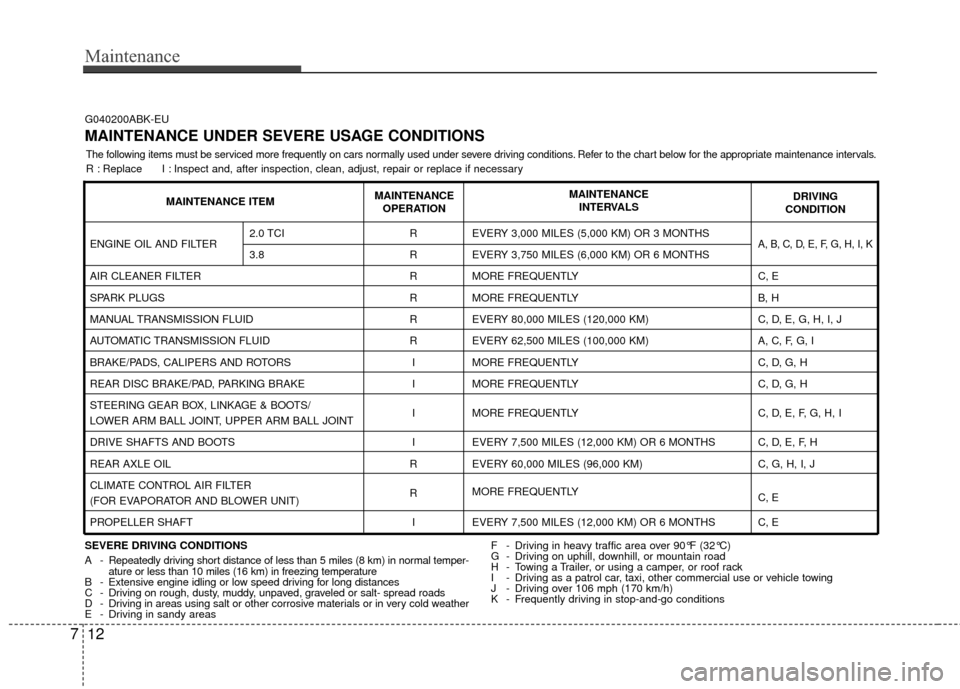
MAINTENANCE UNDER SEVERE USAGE CONDITIONS
ENGINE OIL AND FILTER
AIR CLEANER FILTER
SPARK PLUGS
MANUAL TRANSMISSION FLUID
AUTOMATIC TRANSMISSION FLUID
BRAKE/PADS, CALIPERS AND ROTORS
REAR DISC BRAKE/PAD, PARKING BRAKE
STEERING GEAR BOX, LINKAGE & BOOTS/
LOWER ARM BALL JOINT, UPPER ARM BALL JOINT
DRIVE SHAFTS AND BOOTS
REAR AXLE OIL
CLIMATE CONTROL AIR FILTER
(FOR EVAPORATOR AND BLOWER UNIT)
PROPELLER SHAFT 2.0 TCI
3.8
R
R
R
R
R
R
I
I
I
I
R
R
I EVERY 3,000 MILES (5,000 KM) OR 3 MONTHS
EVERY 3,750 MILES (6,000 KM) OR 6 MONTHS
MORE FREQUENTLY
MORE FREQUENTLY
EVERY 80,000 MILES (120,000 KM)
EVERY 62,500 MILES (100,000 KM)
MORE FREQUENTLY
MORE FREQUENTLY
MORE FREQUENTLY
EVERY 7,500 MILES (12,000 KM) OR 6 MONTHS
EVERY 60,000 MILES (96,000 KM)
MORE FREQUENTLY
EVERY 7,500 MILES (12,000 KM) OR 6 MONTHSA, B, C, D, E, F, G, H, I, K
C, E
B, H
C, D, E, G, H, I, J
A, C, F, G, I
C, D, G, H
C, D, G, H
C, D, E, F, G, H, I
C, D, E, F, H
C, G, H, I, J
C, E
C, E
MAINTENANCE ITEM
MAINTENANCE
OPERATION MAINTENANCE
INTERVALS DRIVING
CONDITION
The following items must be serviced more frequently on cars normally used under severe driving conditions. Refer to the chart below for the appropriate maintenance intervals.R : Replace I : Inspect and, after inspection, clean, adjust, repair or replace if neces\
sary
SEVERE DRIVING CONDITIONS
A - Repeatedly driving short distance of less than 5 miles (8 km) in normal temper- ature or less than 10 miles (16 km) in freezing temperature
B - Extensive engine idling or low speed driving for long distances
C - Driving on rough, dusty, muddy, unpaved, graveled or salt- spread roads
D - Driving in areas using salt or other corrosive materials or in very cold weather
E - Driving in sandy areas F - Driving in heavy traffic area over 90°F (32°C)
G - Driving on uphill, downhill, or mountain road
H - Towing a Trailer, or using a camper, or roof rack
I - Driving as a patrol car, taxi, other commercial use or vehicle towing
J - Driving over 106 mph (170 km/h)
K - Frequently driving in stop-and-go conditions
Page 327 of 391
725
Maintenance
G170100AEN
Filter inspection
The climate control air filter should be
replaced according to the Maintenance
Schedule. If the vehicle is operated in
severely air-polluted cities or on dusty
rough roads for a long period, it should
be inspected more frequently and
replaced earlier. When you replace the
climate control air filter, replace it per-
forming the following procedure, and be
careful to avoid damaging other compo-
nents.
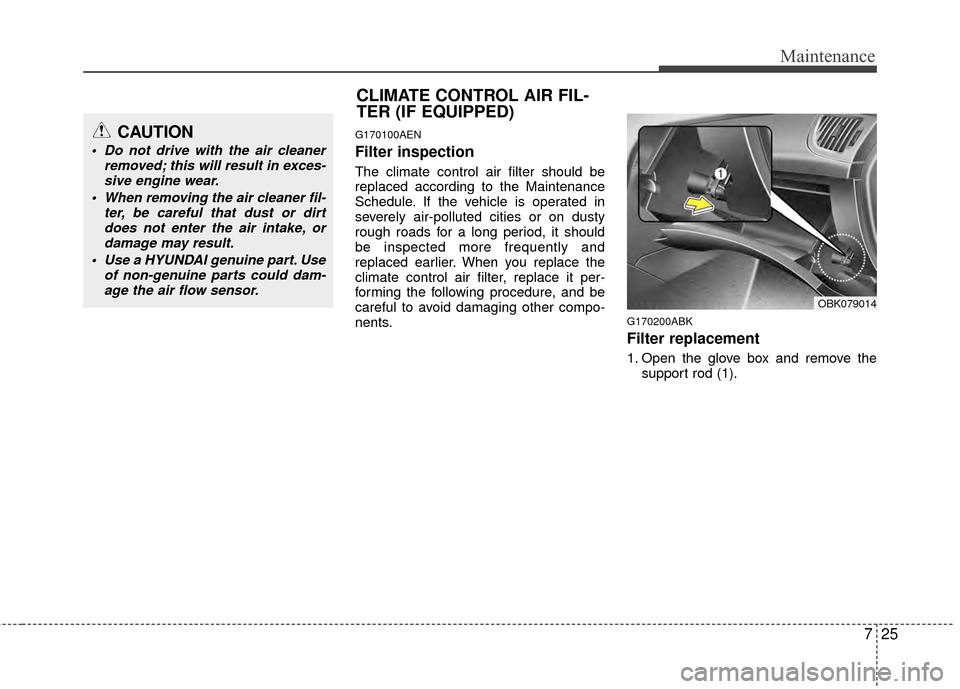
G170200ABK
Filter replacement
1. Open the glove box and remove thesupport rod (1).
CAUTION
Do not drive with the air cleaner removed; this will result in exces-sive engine wear.
When removing the air cleaner fil- ter, be careful that dust or dirtdoes not enter the air intake, ordamage may result.
Use a HYUNDAI genuine part. Use of non-genuine parts could dam-age the air flow sensor.
CLIMATE CONTROL AIR FIL-
TER (IF EQUIPPED)
OBK079014
Page 328 of 391
Maintenance
26
7
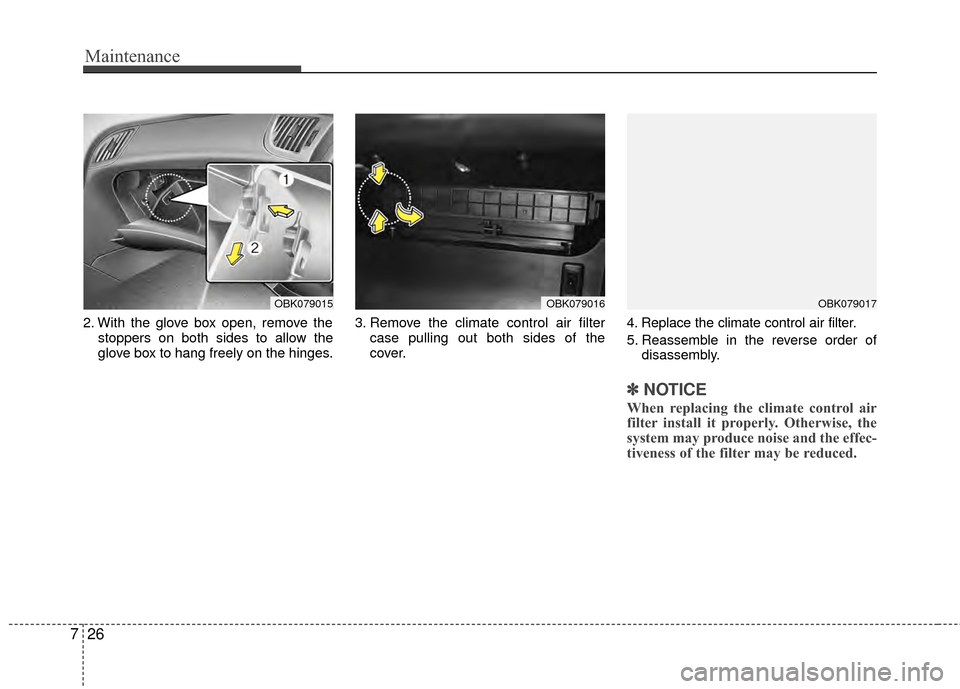
2. With the glove box open, remove the
stoppers on both sides to allow the
glove box to hang freely on the hinges. 3. Remove the climate control air filter
case pulling out both sides of the
cover. 4. Replace the climate control air filter.
5. Reassemble in the reverse order of
disassembly.
✽ ✽NOTICE
When replacing the climate control air
filter install it properly. Otherwise, the
system may produce noise and the effec-
tiveness of the filter may be reduced.
OBK079016OBK079017OBK079015
Page 334 of 391
Maintenance
32
7
G190300ABK
Reset items
Items should be reset after the battery
has been discharged or the battery has
been disconnected.
Sunroof (See section 4)
Trip computer (See section 4)
Climate control system
(See section 4)
Clock (See section 4)
Audio (See section 4)
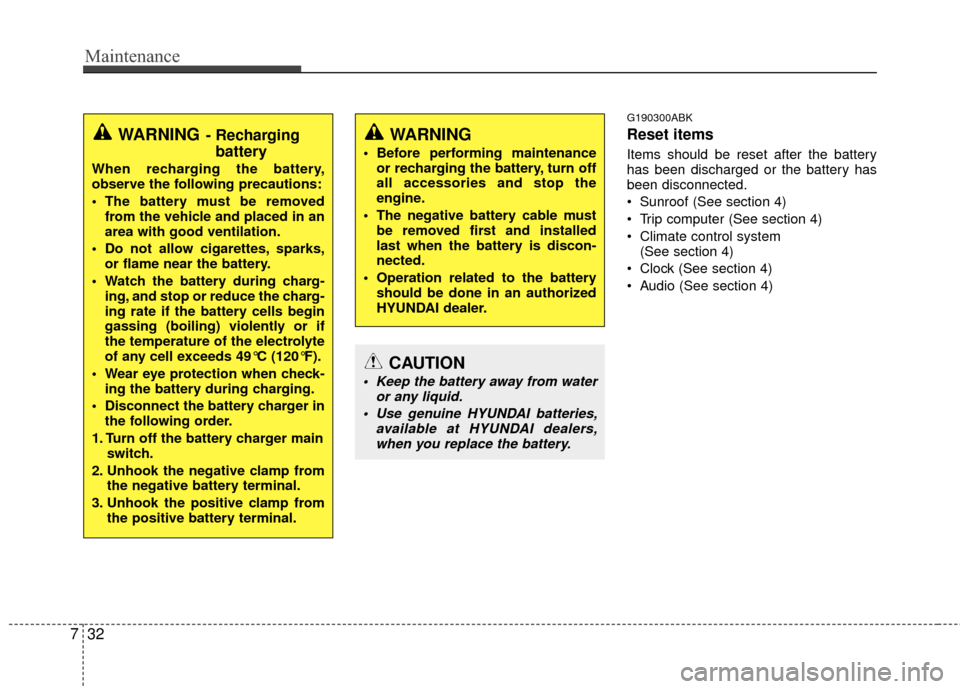
WARNING
Before performing maintenance or recharging the battery, turn off
all accessories and stop the
engine.
The negative battery cable must be removed first and installed
last when the battery is discon-
nected.
Operation related to the battery should be done in an authorized
HYUNDAI dealer.
CAUTION
Keep the battery away from water or any liquid.
Use genuine HYUNDAI batteries, available at HYUNDAI dealers,when you replace the battery.
WARNING- Recharging battery
When recharging the battery,
observe the following precautions:
The battery must be removed
from the vehicle and placed in an
area with good ventilation.
Do not allow cigarettes, sparks, or flame near the battery.
Watch the battery during charg- ing, and stop or reduce the charg-
ing rate if the battery cells begin
gassing (boiling) violently or if
the temperature of the electrolyte
of any cell exceeds 49°C (120°F).
Wear eye protection when check- ing the battery during charging.
Disconnect the battery charger in the following order.
1. Turn off the battery charger main switch.
2. Unhook the negative clamp from the negative battery terminal.
3. Unhook the positive clamp from the positive battery terminal.