fuel HYUNDAI GENESIS COUPE 2014 Owner's Manual
[x] Cancel search | Manufacturer: HYUNDAI, Model Year: 2014, Model line: GENESIS COUPE, Model: HYUNDAI GENESIS COUPE 2014Pages: 438, PDF Size: 40.35 MB
Page 145 of 438
461
Features of your vehicle
Warnings and indicators
All warning lights are checked by
turning the ignition switch ON (do not
start the engine). Any light that does
not illuminate should be checked by
an authorized HYUNDAI dealer.
After starting the engine, check to
make sure that all warning lights are
off. If any are still on, this indicates a
situation that needs attention. When
releasing the parking brake, the
brake system warning light should go
off. The fuel warning light will stay on
if the fuel level is low.
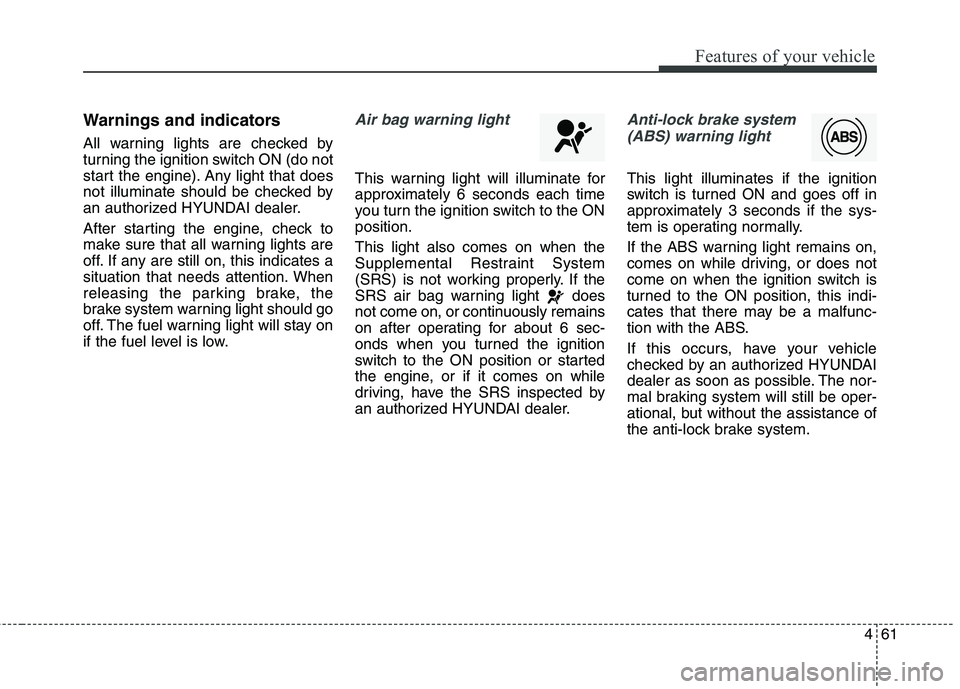
Air bag warning light
This warning light will illuminate for
approximately 6 seconds each time
you turn the ignition switch to the ON
position.
This light also comes on when the
Supplemental Restraint System
(SRS) is not working properly. If the
SRS air bag warning light does
not come on, or continuously remains
on after operating for about 6 sec-
onds when you turned the ignition
switch to the ON position or started
the engine, or if it comes on while
driving, have the SRS inspected by
an authorized HYUNDAI dealer.
Anti-lock brake system
(ABS) warning light
This light illuminates if the ignition
switch is turned ON and goes off in
approximately 3 seconds if the sys-
tem is operating normally.
If the ABS warning light remains on,
comes on while driving, or does not
come on when the ignition switch is
turned to the ON position, this indi-
cates that there may be a malfunc-
tion with the ABS.
If this occurs, have your vehicle
checked by an authorized HYUNDAI
dealer as soon as possible. The nor-
mal braking system will still be oper-
ational, but without the assistance of
the anti-lock brake system.
Page 151 of 438
467
Features of your vehicle
When the smart key is in the vehi-
cle, if the engine start/stop button
is turned to the ON position, the
indicator will illuminate until the
engine is started. However, when
the smart key is not in the vehicle,
if the engine start/stop button is
depressed, the indicator will blink
for a few minutes to indicate that
you will not be able to start the
engine.
When the ignition switch is turned
to the ON position and the indica-
tor turns off after 2 seconds, the
system may have a problem. Have
the vehicle checked by an author-
ized HYUNDAI dealer.
When the battery is weak, if the
engine start/stop button is
depressed, the indicator will blink
and you will not be able to start the
engine. However, you may still be
able to start the engine by inserting
the smart key in the smart key
holder. If smart key system related
parts have a problem, the indicator
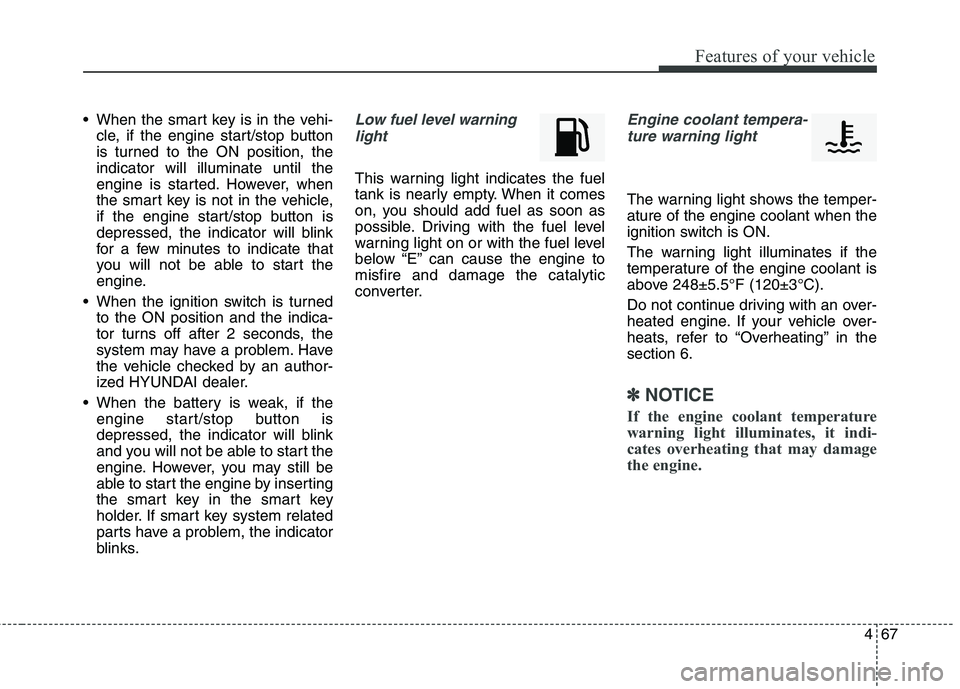
blinks.Low fuel level warning
light
This warning light indicates the fuel
tank is nearly empty. When it comes
on, you should add fuel as soon as
possible. Driving with the fuel level
warning light on or with the fuel level
below “E” can cause the engine to
misfire and damage the catalytic
converter.
Engine coolant tempera-
ture warning light
The warning light shows the temper-
ature of the engine coolant when the
ignition switch is ON.
The warning light illuminates if the
temperature of the engine coolant is
above 248±5.5°F (120±3°C).
Do not continue driving with an over-
heated engine. If your vehicle over-
heats, refer to “Overheating” in the
section 6.
✽ ✽
NOTICE
If the engine coolant temperature
warning light illuminates, it indi-
cates overheating that may damage
the engine.
Page 152 of 438
Features of your vehicle
68 4
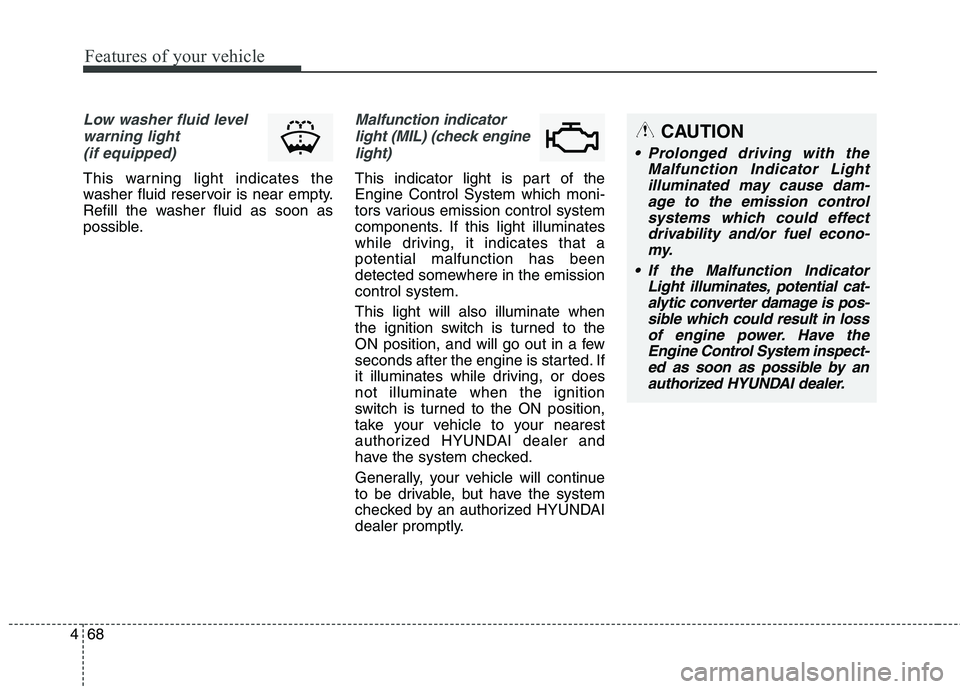
Low washer fluid level
warning light
(if equipped)
This warning light indicates the
washer fluid reservoir is near empty.
Refill the washer fluid as soon as
possible.
Malfunction indicator
light (MIL) (check engine
light)
This indicator light is part of the
Engine Control System which moni-
tors various emission control system
components. If this light illuminates
while driving, it indicates that a
potential malfunction has been
detected somewhere in the emission
control system.
This light will also illuminate when
the ignition switch is turned to the
ON position, and will go out in a few
seconds after the engine is started. If
it illuminates while driving, or does
not illuminate when the ignition
switch is turned to the ON position,
take your vehicle to your nearest
authorized HYUNDAI dealer and
have the system checked.
Generally, your vehicle will continue
to be drivable, but have the system
checked by an authorized HYUNDAI
dealer promptly.
CAUTION
Prolonged driving with the
Malfunction Indicator Light
illuminated may cause dam-
age to the emission control
systems which could effect
drivability and/or fuel econo-
my.
If the Malfunction Indicator
Light illuminates, potential cat-
alytic converter damage is pos-
sible which could result in loss
of engine power. Have the
Engine Control System inspect-
ed as soon as possible by an
authorized HYUNDAI dealer.
Page 155 of 438
471
Features of your vehicle
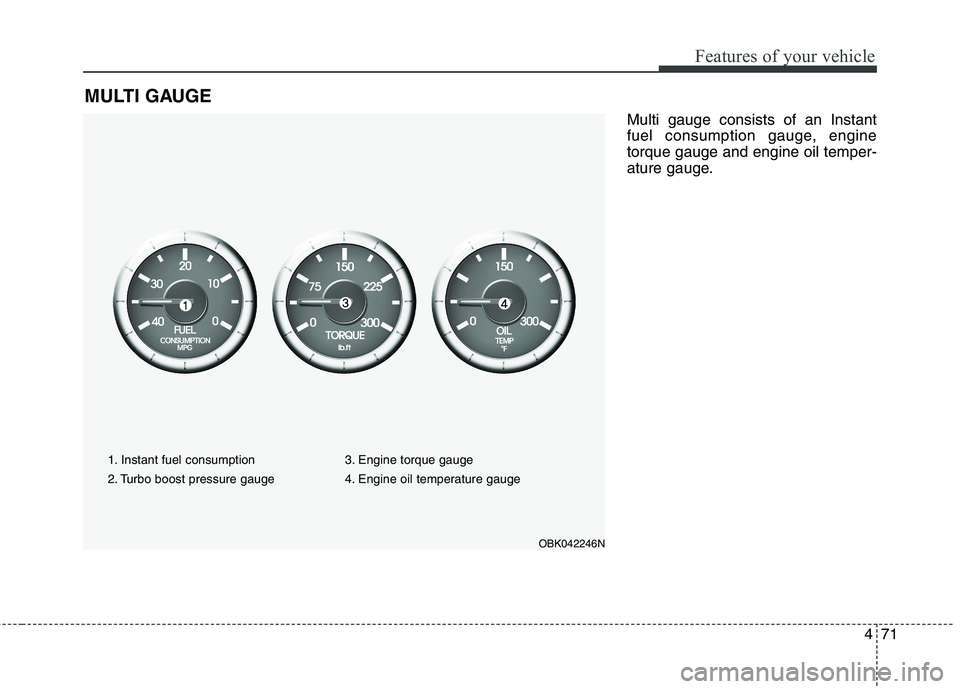
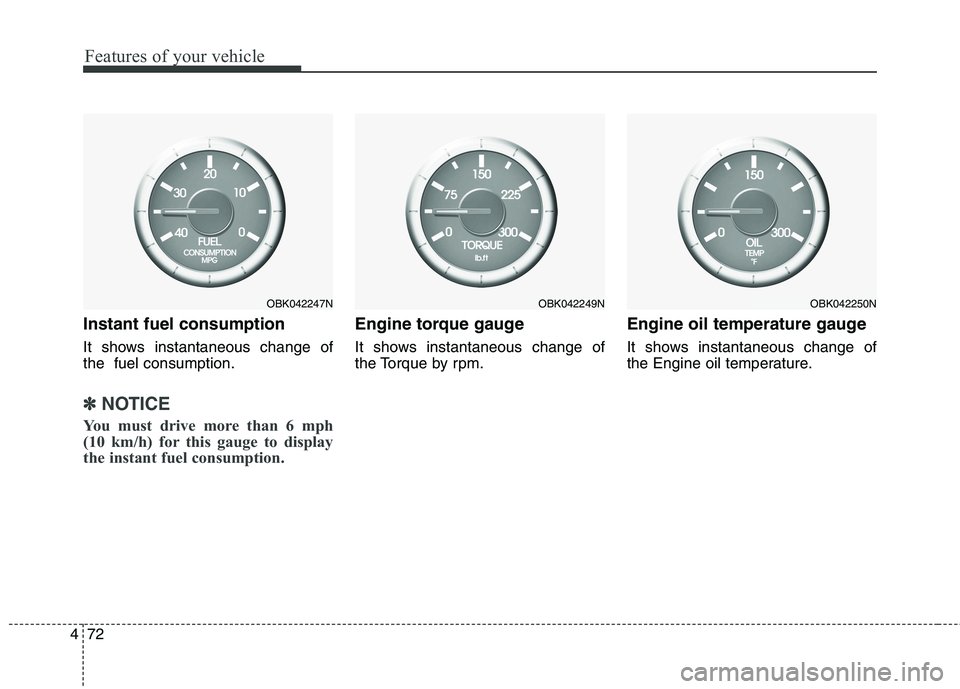
Multi gauge consists of an Instant
fuel consumption gauge, engine
torque gauge and engine oil temper-
ature gauge.
MULTI GAUGE
1. Instant fuel consumption
2. Turbo boost pressure gauge3. Engine torque gauge
4. Engine oil temperature gauge
OBK042246N
Page 156 of 438
Features of your vehicle
72 4
Instant fuel consumption
It shows instantaneous change of
the fuel consumption.
✽ ✽
NOTICE
You must drive more than 6 mph
(10 km/h) for this gauge to display
the instant fuel consumption.
Engine torque gauge
It shows instantaneous change of
the Torque by rpm.
Engine oil temperature gauge
It shows instantaneous change of
the Engine oil temperature.
OBK042247NOBK042249NOBK042250N
Page 265 of 438
515
Driving your vehicle
Shifting to R (Reverse)
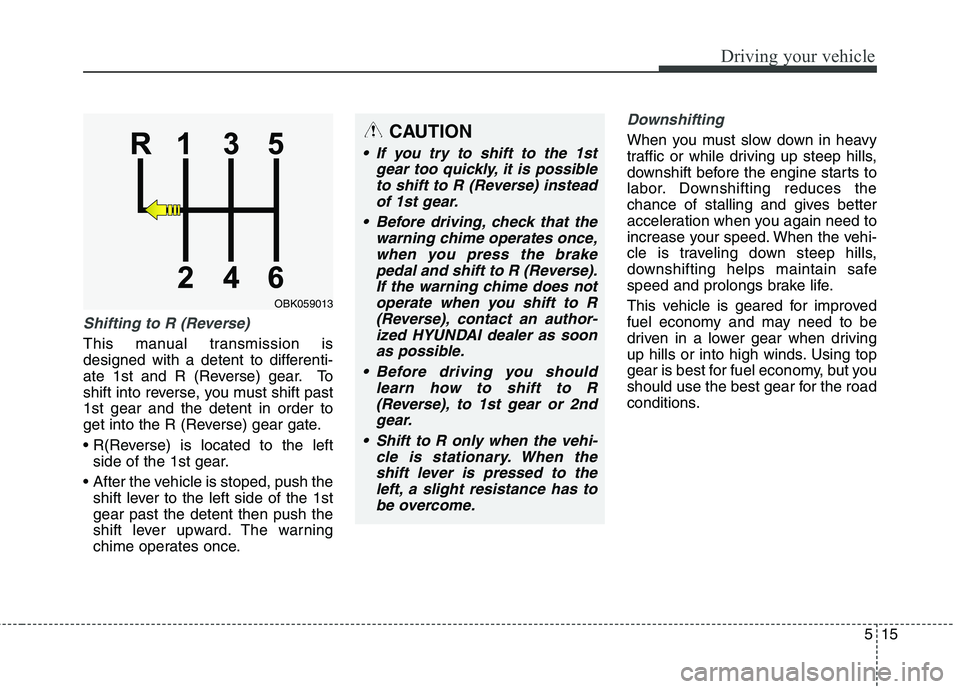
This manual transmission is
designed with a detent to differenti-
ate 1st and R (Reverse) gear. To
shift into reverse, you must shift past
1st gear and the detent in order to
get into the R (Reverse) gear gate.
side of the 1st gear.
After the vehicle is stoped, push the
shift lever to the left side of the 1st
gear past the detent then push the
shift lever upward. The warning
chime operates once.
Downshifting
When you must slow down in heavy
traffic or while driving up steep hills,
downshift before the engine starts to
labor. Downshifting reduces the
chance of stalling and gives better
acceleration when you again need to
increase your speed. When the vehi-
cle is traveling down steep hills,
downshifting helps maintain safe
speed and prolongs brake life.
This vehicle is geared for improved
fuel economy and may need to be
driven in a lower gear when driving
up hills or into high winds. Using top
gear is best for fuel economy, but you
should use the best gear for the road
conditions.CAUTION
If you try to shift to the 1st
gear too quickly, it is possible
to shift to R (Reverse) instead
of 1st gear.
Before driving, check that the
warning chime operates once,
when you press the brake
pedal and shift to R (Reverse).
If the warning chime does not
operate when you shift to R
(Reverse), contact an author-
ized HYUNDAI dealer as soon
as possible.
Before driving you should
learn how to shift to R
(Reverse), to 1st gear or 2nd
gear.
Shift to R only when the vehi-
cle is stationary. When the
shift lever is pressed to the
left, a slight resistance has to
be overcome.
OBK059013
Page 270 of 438
Driving your vehicle
20 5
D (Drive)
This is the normal forward driving
position. The transmission will auto-
matically shift through a 8-gear
sequence, providing the best fuel
economy and power.
For extra power when passing anoth-
er vehicle or climbing grades,
depress the accelerator fully, at
which time the transmission will
automatically downshift to the next
lower gear (or gears, as appropri-
ate).
✽ ✽
NOTICE
Always come to a complete stop
before shifting into D (Drive).
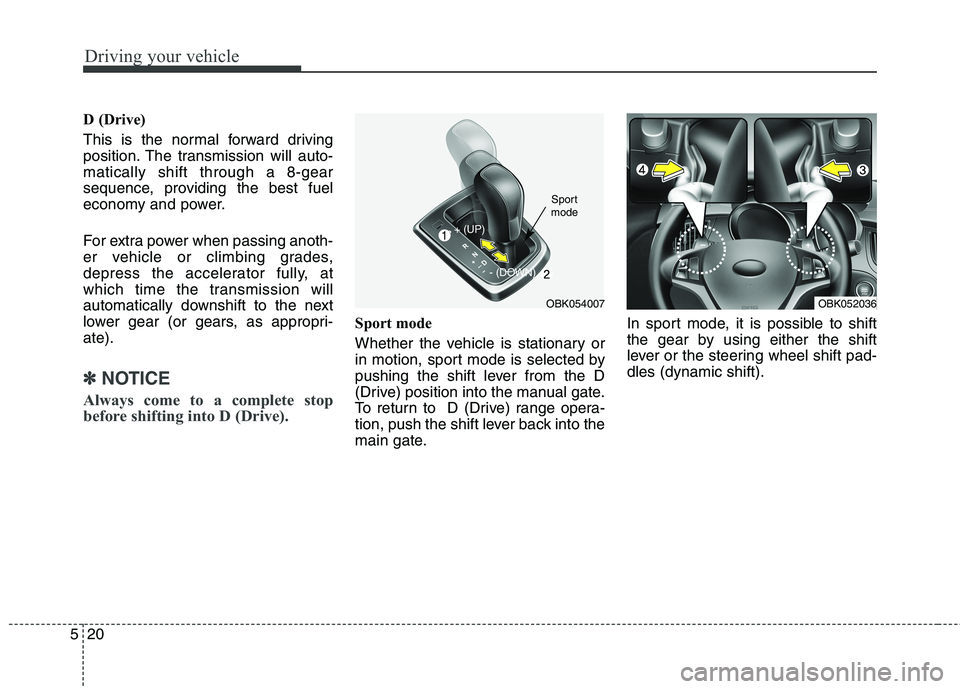
Sport mode
Whether the vehicle is stationary or
in motion, sport mode is selected by
pushing the shift lever from the D
(Drive) position into the manual gate.
To return to D (Drive) range opera-
tion, push the shift lever back into the
main gate.In sport mode, it is possible to shift
the gear by using either the shift
lever or the steering wheel shift pad-
dles (dynamic shift).
OBK054007
+ (UP)
- (DOWN)
Sport
mode
OBK052036
Page 291 of 438
541
Driving your vehicle
Your vehicle's fuel economy depends
mainly on your style of driving, where
you drive and when you drive.
Each of these factors affects how
many miles (kilometers) you can get
from a gallon (liter) of fuel. To operate
your vehicle as economically as possi-
ble, use the following driving sugges-
tions to help save money in both fuel
and repairs:
Drive smoothly. Accelerate at a mod-
erate rate. Don't make "jack-rabbit"
starts or full-throttle shifts and main-
tain a steady cruising speed. Don't
race between stoplights. Try to adjust
your speed to that of the other traffic
so you don't have to change speeds
unnecessarily. Avoid heavy traffic
whenever possible. Always maintain
a safe distance from other vehicles
so you can avoid unnecessary brak-
ing. This also reduces brake wear.
Drive at a moderate speed. The
faster you drive the more fuel your
vehicle uses. Driving at a moderate
speed, in the highest gear appropri-
ate for the conditions, especially on
the highway, is one of the most effec-
tive ways to reduce fuel consump-
tion. Don't "ride" the brake or clutch
pedal. This can increase fuel con-
sumption and also increase wear
on these components. In addition,
driving with your foot resting on the
brake pedal may cause the brakes
to overheat, which reduces their
effectiveness and may lead to
more serious consequences.
Take care of your tires. Keep them
inflated to the recommended pres-
sure. Incorrect inflation, either too
much or too little, results in unnec-
essary tire wear. Check the tire
pressures at least once a month.
Be sure that the wheels are
aligned correctly. Improper align-
ment can result from hitting curbs
or driving too fast over irregular
surfaces. Poor alignment causes
faster tire wear and may also result
in other problems as well as
greater fuel consumption. Keep your car in good condition.
For better fuel economy and
reduced maintenance costs, main-
tain your car in accordance with
the maintenance schedule in sec-
tion 7. If you drive your car in
severe conditions, more frequent
maintenance is required (see sec-
tion 7 for details).
Keep your car clean. For maximum
service, your vehicle should be
kept clean and free of corrosive
materials. It is especially important
that mud, dirt, ice, etc. not be
allowed to accumulate on the
underside of the car. This extra
weight can result in increased fuel
consumption and also contribute to
corrosion.
Travel lightly. Don't carry unneces-
sary weight in your car. Weight
reduces fuel economy.
Don't let the engine idle longer
than necessary. If you are waiting
(and not in traffic), turn off your
engine and restart only when
you're ready to go.
ECONOMICAL OPERATION
Page 292 of 438
Driving your vehicle
42 5
Remember, your vehicle does not
require extended warm-up. After
the engine has started, allow the
engine to run for 10 to 20 seconds
prior to placing the vehicle in gear.
In very cold weather, however, give
your engine a slightly longer warm-
up period.
Don't "lug" or "over-rev" the engine.
Lugging is driving too slowly in too
high a gear resulting in the engine
bucking. If this happens, shift to a
lower gear. Over-revving is racing
the engine beyond its safe limit.
This can be avoided by shifting at
the recommended speeds. Use your air conditioning sparingly.
The air conditioning system is
operated by engine power so your
fuel economy is reduced when you
use it.
Open windows at high speeds can
reduce fuel economy.
Fuel economy is less in crosswinds
and headwinds. To help offset
some of this loss, slow down when
driving in these conditions.
Keeping a vehicle in good operating
condition is important both for econ-
omy and safety. Therefore, have an
authorized HYUNDAI dealer perform
scheduled inspections and mainte-
nance.
WARNING - Engine off
during motion
Never turn the engine off to
coast down hills or anytime the
vehicle is in motion. The power
steering and power brakes will
not function properly without
the engine running. Instead,
keep the engine on and down-
shift to an appropriate gear for
engine braking effect. In addi-
tion, turning off the ignition
while driving could engage the
steering wheel lock resulting in
loss of vehicle steering which
could cause serious injury or
death.
Page 297 of 438
547
Driving your vehicle
Fuel, engine coolant and engine
oil
High speed travel consumes more
fuel than urban motoring. Do not for-
get to check both engine coolant and
engine oil.
Drive belt
A loose or damaged drive belt may
result in overheating of the engine.
WARNING
Underinflated or overinflated
tires can cause poor handling,
loss of vehicle control, and
sudden tire failure leading to
accidents, injuries, and even
death. Always check tires for
proper inflation before driv-
ing. For proper tire pressures,
refer to “Tires and wheels” in
section 8.
Driving on tires with no or
insufficient tread is danger-
ous. Worn-out tires can result
in loss of vehicle control, col-
lisions, injury, and even death.
Worn-out tires should be
replaced as soon as possible
and should never be used for
driving. Always check the tire
tread before driving your car.
For further information and
tread limits, refer to “Tires and
wheels” in section 7.