belt HYUNDAI GENESIS COUPE 2014 Repair Manual
[x] Cancel search | Manufacturer: HYUNDAI, Model Year: 2014, Model line: GENESIS COUPE, Model: HYUNDAI GENESIS COUPE 2014Pages: 438, PDF Size: 40.35 MB
Page 345 of 438
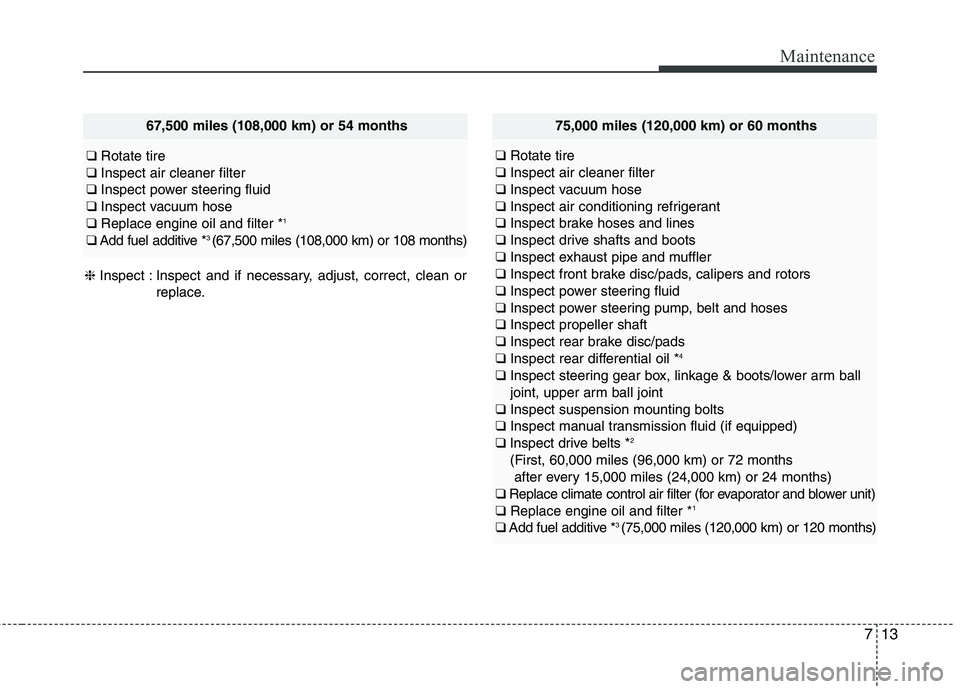
713
Maintenance
67,500 miles (108,000 km) or 54 months
❑Rotate tire
❑Inspect air cleaner filter
❑Inspect power steering fluid
❑Inspect vacuum hose
❑Replace engine oil and filter *
1
❑Add fuel additive *3 (67,500 miles (108,000 km) or 108 months)
75,000 miles (120,000 km) or 60 months
❑Rotate tire
❑Inspect air cleaner filter
❑Inspect vacuum hose
❑Inspect air conditioning refrigerant
❑Inspect brake hoses and lines
❑Inspect drive shafts and boots
❑Inspect exhaust pipe and muffler
❑Inspect front brake disc/pads, calipers and rotors
❑Inspect power steering fluid
❑Inspect power steering pump, belt and hoses
❑Inspect propeller shaft
❑Inspect rear brake disc/pads
❑Inspect rear differential oil *
4
❑Inspect steering gear box, linkage & boots/lower arm ball
joint, upper arm ball joint
❑Inspect suspension mounting bolts
❑Inspect manual transmission fluid (if equipped)
❑Inspect drive belts *
2
(First, 60,000 miles (96,000 km) or 72 months
after every 15,000 miles (24,000 km) or 24 months)
❑Replace climate control air filter (for evaporator and blower unit)
❑Replace engine oil and filter *
1
❑Add fuel additive *3 (75,000 miles (120,000 km) or 120 months)
❈Inspect : Inspect and if necessary, adjust, correct, clean or
replace.
Page 346 of 438
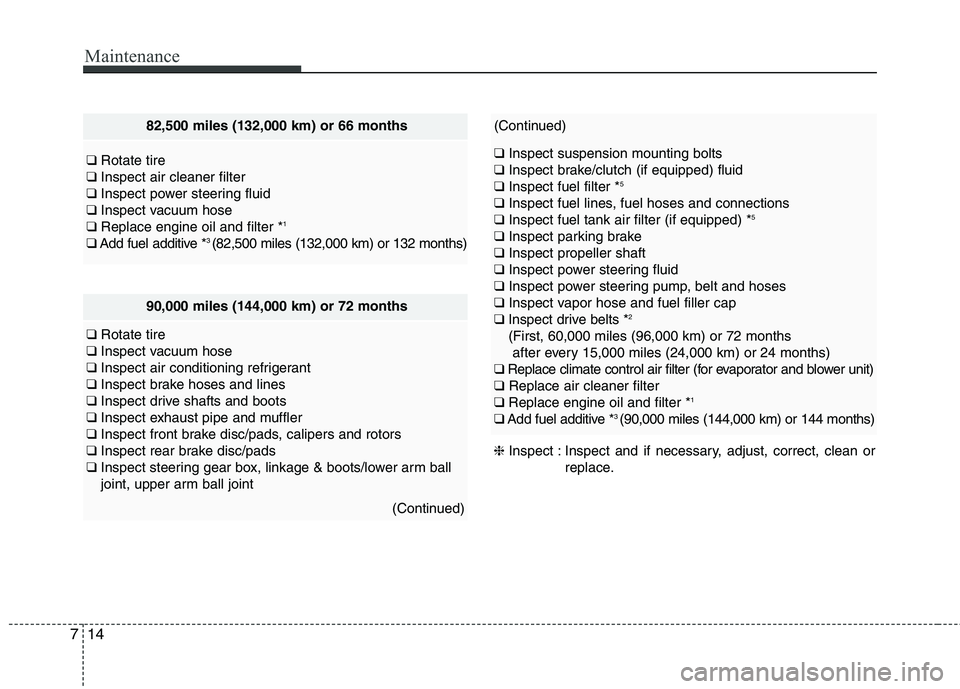
Maintenance
14 7
90,000 miles (144,000 km) or 72 months
❑Rotate tire
❑Inspect vacuum hose
❑Inspect air conditioning refrigerant
❑Inspect brake hoses and lines
❑Inspect drive shafts and boots
❑Inspect exhaust pipe and muffler
❑Inspect front brake disc/pads, calipers and rotors
❑Inspect rear brake disc/pads
❑Inspect steering gear box, linkage & boots/lower arm ball
joint, upper arm ball joint
(Continued)
(Continued)
❑Inspect suspension mounting bolts
❑Inspect brake/clutch (if equipped) fluid
❑Inspect fuel filter *
5
❑Inspect fuel lines, fuel hoses and connections
❑Inspect fuel tank air filter (if equipped) *5
❑Inspect parking brake
❑Inspect propeller shaft
❑Inspect power steering fluid
❑Inspect power steering pump, belt and hoses
❑Inspect vapor hose and fuel filler cap
❑Inspect drive belts *
2
(First, 60,000 miles (96,000 km) or 72 months
after every 15,000 miles (24,000 km) or 24 months)
❑Replace climate control air filter (for evaporator and blower unit)
❑Replace air cleaner filter
❑Replace engine oil and filter *
1
❑Add fuel additive *3 (90,000 miles (144,000 km) or 144 months)
82,500 miles (132,000 km) or 66 months
❑Rotate tire
❑Inspect air cleaner filter
❑Inspect power steering fluid
❑Inspect vacuum hose
❑Replace engine oil and filter *
1
❑Add fuel additive *3 (82,500 miles (132,000 km) or 132 months)
❈Inspect : Inspect and if necessary, adjust, correct, clean or
replace.
Page 347 of 438
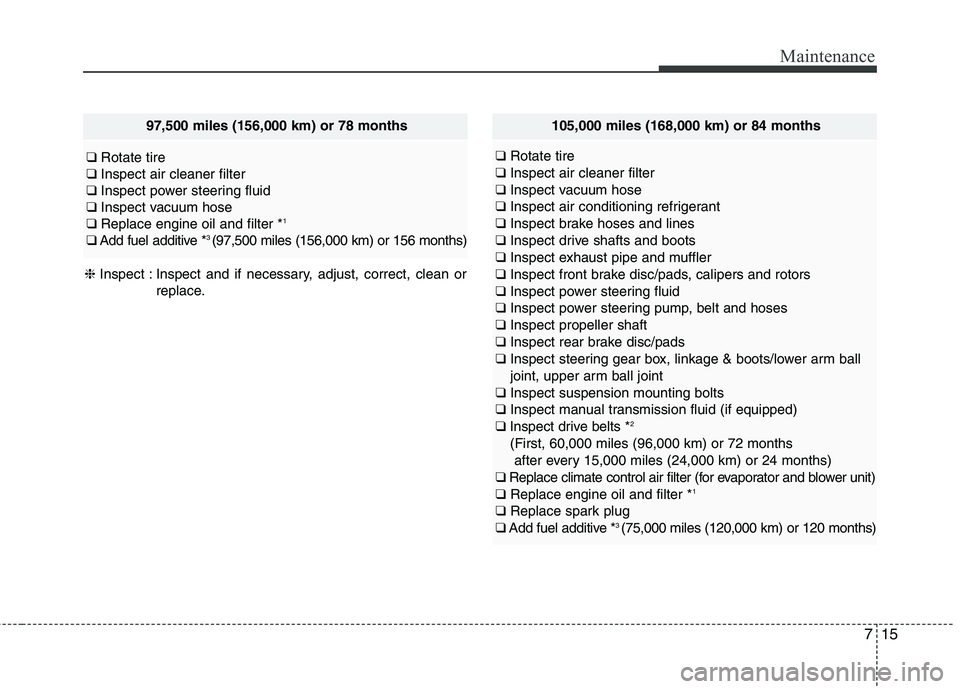
715
Maintenance
97,500 miles (156,000 km) or 78 months
❑Rotate tire
❑Inspect air cleaner filter
❑Inspect power steering fluid
❑Inspect vacuum hose
❑Replace engine oil and filter *
1
❑Add fuel additive *3 (97,500 miles (156,000 km) or 156 months)
105,000 miles (168,000 km) or 84 months
❑Rotate tire
❑Inspect air cleaner filter
❑Inspect vacuum hose
❑Inspect air conditioning refrigerant
❑Inspect brake hoses and lines
❑Inspect drive shafts and boots
❑Inspect exhaust pipe and muffler
❑Inspect front brake disc/pads, calipers and rotors
❑Inspect power steering fluid
❑Inspect power steering pump, belt and hoses
❑Inspect propeller shaft
❑Inspect rear brake disc/pads
❑Inspect steering gear box, linkage & boots/lower arm ball
joint, upper arm ball joint
❑Inspect suspension mounting bolts
❑Inspect manual transmission fluid (if equipped)
❑Inspect drive belts *
2
(First, 60,000 miles (96,000 km) or 72 months
after every 15,000 miles (24,000 km) or 24 months)
❑Replace climate control air filter (for evaporator and blower unit)
❑Replace engine oil and filter *
1
❑Replace spark plug
❑Add fuel additive *3 (75,000 miles (120,000 km) or 120 months)
❈Inspect : Inspect and if necessary, adjust, correct, clean or
replace.
Page 348 of 438
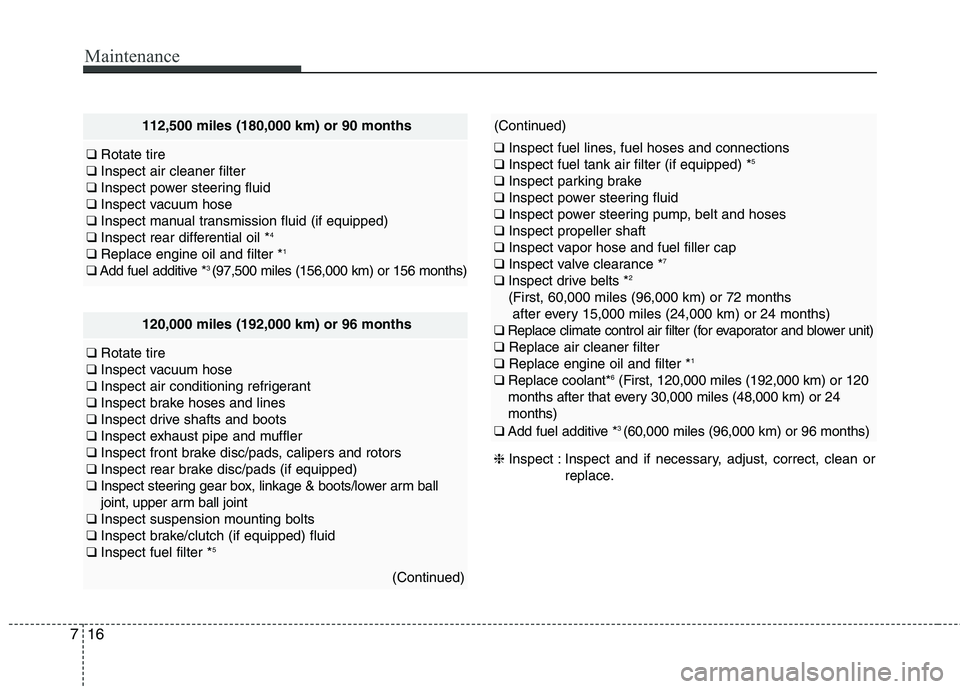
Maintenance
16 7
120,000 miles (192,000 km) or 96 months
❑Rotate tire
❑Inspect vacuum hose
❑Inspect air conditioning refrigerant
❑Inspect brake hoses and lines
❑Inspect drive shafts and boots
❑Inspect exhaust pipe and muffler
❑Inspect front brake disc/pads, calipers and rotors
❑Inspect rear brake disc/pads (if equipped)
❑Inspect steering gear box, linkage & boots/lower arm ball
joint, upper arm ball joint
❑Inspect suspension mounting bolts
❑Inspect brake/clutch (if equipped) fluid
❑Inspect fuel filter *
5
(Continued)
112,500 miles (180,000 km) or 90 months
❑Rotate tire
❑Inspect air cleaner filter
❑Inspect power steering fluid
❑Inspect vacuum hose
❑Inspect manual transmission fluid (if equipped)
❑Inspect rear differential oil *
4
❑Replace engine oil and filter *1
❑Add fuel additive *3 (97,500 miles (156,000 km) or 156 months)
❈Inspect : Inspect and if necessary, adjust, correct, clean or
replace.
(Continued)
❑Inspect fuel lines, fuel hoses and connections
❑Inspect fuel tank air filter (if equipped) *5
❑Inspect parking brake
❑Inspect power steering fluid
❑Inspect power steering pump, belt and hoses
❑Inspect propeller shaft
❑Inspect vapor hose and fuel filler cap
❑Inspect valve clearance *
7
❑Inspect drive belts *2
(First, 60,000 miles (96,000 km) or 72 months
after every 15,000 miles (24,000 km) or 24 months)
❑Replace climate control air filter (for evaporator and blower unit)
❑Replace air cleaner filter
❑Replace engine oil and filter *
1
❑Replace coolant*6(First, 120,000 miles (192,000 km) or 120
months after that every 30,000 miles (48,000 km) or 24
months)
❑Add fuel additive *
3 (60,000 miles (96,000 km) or 96 months)
Page 349 of 438
717
Maintenance
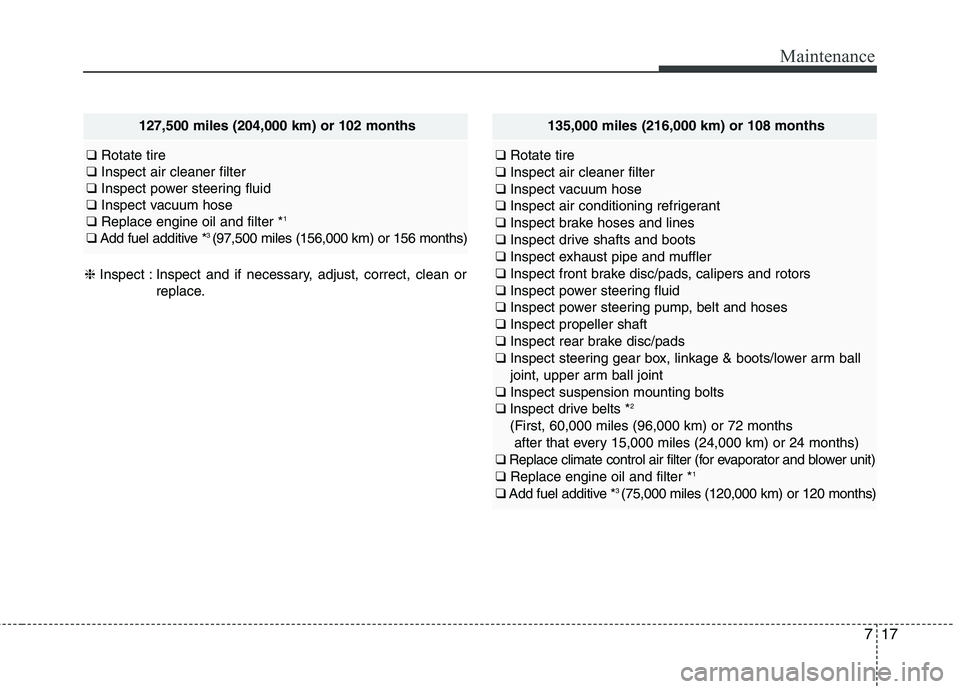
135,000 miles (216,000 km) or 108 months
❑Rotate tire
❑Inspect air cleaner filter
❑Inspect vacuum hose
❑Inspect air conditioning refrigerant
❑Inspect brake hoses and lines
❑Inspect drive shafts and boots
❑Inspect exhaust pipe and muffler
❑Inspect front brake disc/pads, calipers and rotors
❑Inspect power steering fluid
❑Inspect power steering pump, belt and hoses
❑Inspect propeller shaft
❑Inspect rear brake disc/pads
❑Inspect steering gear box, linkage & boots/lower arm ball
joint, upper arm ball joint
❑Inspect suspension mounting bolts
❑Inspect drive belts *
2
(First, 60,000 miles (96,000 km) or 72 months
after that every 15,000 miles (24,000 km) or 24 months)
❑Replace climate control air filter (for evaporator and blower unit)
❑Replace engine oil and filter *
1
❑Add fuel additive *3 (75,000 miles (120,000 km) or 120 months)
127,500 miles (204,000 km) or 102 months
❑Rotate tire
❑Inspect air cleaner filter
❑Inspect power steering fluid
❑Inspect vacuum hose
❑Replace engine oil and filter *
1
❑Add fuel additive *3 (97,500 miles (156,000 km) or 156 months)
❈Inspect : Inspect and if necessary, adjust, correct, clean or
replace.
Page 350 of 438
Maintenance
18 7
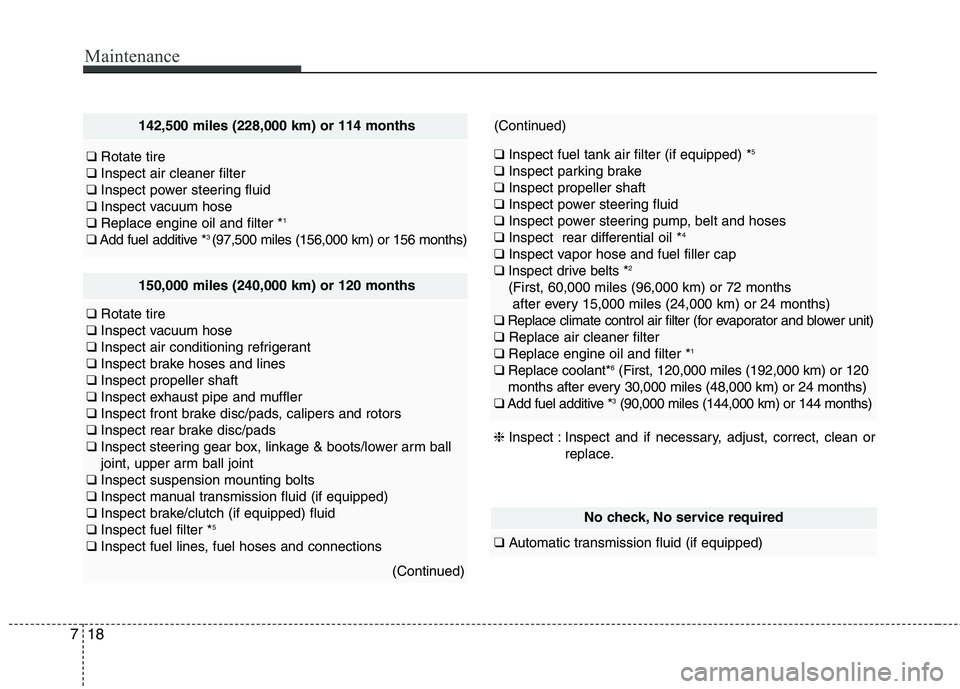
142,500 miles (228,000 km) or 114 months
❑Rotate tire
❑Inspect air cleaner filter
❑Inspect power steering fluid
❑Inspect vacuum hose
❑Replace engine oil and filter *
1
❑Add fuel additive *3 (97,500 miles (156,000 km) or 156 months)
(Continued)
❑Inspect fuel tank air filter (if equipped) *5
❑Inspect parking brake
❑Inspect propeller shaft
❑Inspect power steering fluid
❑Inspect power steering pump, belt and hoses
❑Inspect rear differential oil *
4
❑Inspect vapor hose and fuel filler cap
❑Inspect drive belts *2
(First, 60,000 miles (96,000 km) or 72 months
after every 15,000 miles (24,000 km) or 24 months)
❑Replace climate control air filter (for evaporator and blower unit)
❑Replace air cleaner filter
❑Replace engine oil and filter *
1
❑Replace coolant*6(First, 120,000 miles (192,000 km) or 120
months after every 30,000 miles (48,000 km) or 24 months)
❑Add fuel additive *
3 (90,000 miles (144,000 km) or 144 months)
150,000 miles (240,000 km) or 120 months
❑Rotate tire
❑Inspect vacuum hose
❑Inspect air conditioning refrigerant
❑Inspect brake hoses and lines
❑Inspect propeller shaft
❑Inspect exhaust pipe and muffler
❑Inspect front brake disc/pads, calipers and rotors
❑Inspect rear brake disc/pads
❑Inspect steering gear box, linkage & boots/lower arm ball
joint, upper arm ball joint
❑Inspect suspension mounting bolts
❑Inspect manual transmission fluid (if equipped)
❑Inspect brake/clutch (if equipped) fluid
❑Inspect fuel filter *
5
❑Inspect fuel lines, fuel hoses and connections
(Continued)
No check, No service required
❑Automatic transmission fluid (if equipped)
❈Inspect : Inspect and if necessary, adjust, correct, clean or
replace.
Page 352 of 438
Maintenance
20 7
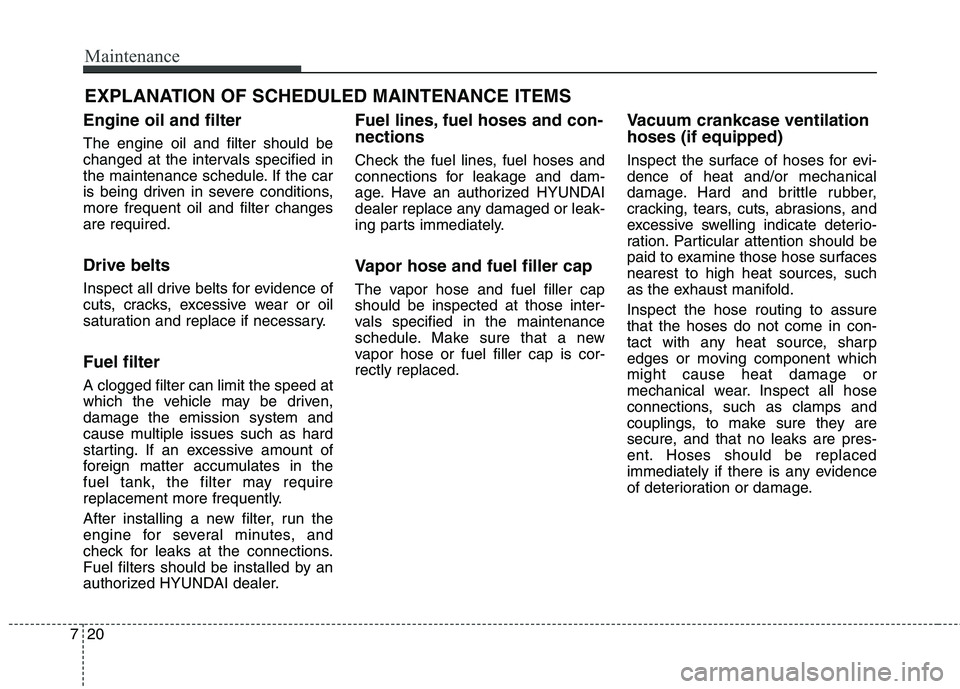
EXPLANATION OF SCHEDULED MAINTENANCE ITEMS
Engine oil and filter
The engine oil and filter should be
changed at the intervals specified in
the maintenance schedule. If the car
is being driven in severe conditions,
more frequent oil and filter changes
are required.
Drive belts
Inspect all drive belts for evidence of
cuts, cracks, excessive wear or oil
saturation and replace if necessary.
Fuel filter
A clogged filter can limit the speed at
which the vehicle may be driven,
damage the emission system and
cause multiple issues such as hard
starting. If an excessive amount of
foreign matter accumulates in the
fuel tank, the filter may require
replacement more frequently.
After installing a new filter, run the
engine for several minutes, and
check for leaks at the connections.
Fuel filters should be installed by an
authorized HYUNDAI dealer.
Fuel lines, fuel hoses and con-
nections
Check the fuel lines, fuel hoses and
connections for leakage and dam-
age. Have an authorized HYUNDAI
dealer replace any damaged or leak-
ing parts immediately.
Vapor hose and fuel filler cap
The vapor hose and fuel filler cap
should be inspected at those inter-
vals specified in the maintenance
schedule. Make sure that a new
vapor hose or fuel filler cap is cor-
rectly replaced.
Vacuum crankcase ventilation
hoses (if equipped)
Inspect the surface of hoses for evi-
dence of heat and/or mechanical
damage. Hard and brittle rubber,
cracking, tears, cuts, abrasions, and
excessive swelling indicate deterio-
ration. Particular attention should be
paid to examine those hose surfaces
nearest to high heat sources, such
as the exhaust manifold.
Inspect the hose routing to assure
that the hoses do not come in con-
tact with any heat source, sharp
edges or moving component which
might cause heat damage or
mechanical wear. Inspect all hose
connections, such as clamps and
couplings, to make sure they are
secure, and that no leaks are pres-
ent. Hoses should be replaced
immediately if there is any evidence
of deterioration or damage.
Page 354 of 438
Maintenance
22 7
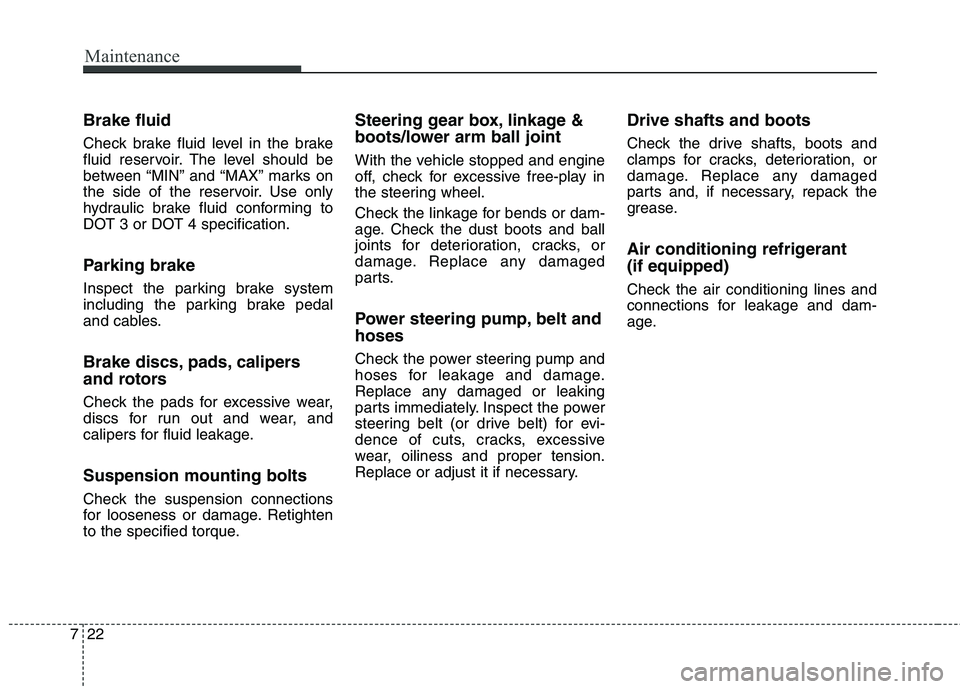
Brake fluid
Check brake fluid level in the brake
fluid reservoir. The level should be
between “MIN” and “MAX” marks on
the side of the reservoir. Use only
hydraulic brake fluid conforming to
DOT 3 or DOT 4 specification.
Parking brake
Inspect the parking brake system
including the parking brake pedal
and cables.
Brake discs, pads, calipers
and rotors
Check the pads for excessive wear,
discs for run out and wear, and
calipers for fluid leakage.
Suspension mounting bolts
Check the suspension connections
for looseness or damage. Retighten
to the specified torque.
Steering gear box, linkage &
boots/lower arm ball joint
With the vehicle stopped and engine
off, check for excessive free-play in
the steering wheel.
Check the linkage for bends or dam-
age. Check the dust boots and ball
joints for deterioration, cracks, or
damage. Replace any damaged
parts.
Power steering pump, belt and
hoses
Check the power steering pump and
hoses for leakage and damage.
Replace any damaged or leaking
parts immediately. Inspect the power
steering belt (or drive belt) for evi-
dence of cuts, cracks, excessive
wear, oiliness and proper tension.
Replace or adjust it if necessary.
Drive shafts and boots
Check the drive shafts, boots and
clamps for cracks, deterioration, or
damage. Replace any damaged
parts and, if necessary, repack the
grease.
Air conditioning refrigerant
(if equipped)
Check the air conditioning lines and
connections for leakage and dam-
age.
Page 381 of 438
749
Maintenance
4. Tire ply composition and mate-
rial
The number of layers or plies of rub-
ber-coated fabric in the tire. Tire manu-
facturers also must indicate the materi-
als in the tire, which include steel,
nylon, polyester, and others. The letter
"R" means radial ply construction; the
letter "D" means diagonal or bias ply
construction; and the letter "B" means
belted-bias ply construction.
5. Maximum permissible inflation
pressure
This number is the greatest amount
of air pressure that should be put in
the tire. Do not exceed the maximum
permissible inflation pressure. Refer
to the Tire and Loading Information
label for recommended inflation
pressure.
6. Maximum load rating
This number indicates the maximum
load in kilograms and pounds that
can be carried by the tire. When
replacing the tires on the vehicle,
always use a tire that has the same
load rating as the factory installed
tire.
7. Uniform tire quality grading
Quality grades can be found where
applicable on the tire sidewall
between tread shoulder and maxi-
mum section width.
For example:
TREAD wear 200
TRACTION AA
TEMPERATURE A
Tread wear
The tread wear grade is a compara-
tive rating based on the wear rate of
the tire when tested under controlled
conditions on a specified govern-
ment test course. For example, a tire
graded 150 would wear one-and-a-
half times (1½) as well on the gov-
ernment course as a tire graded 100.
The relative performance of tires
depends upon the actual conditions
of their use, however, and may
depart significantly from the norm
due to variations in driving habits,
service practices and differences in
road characteristics and climate.WARNING - Tire age
Tires degrade over time, even
when they are not being used.
Regardless of the remaining
tread, it is recommended that
tires generally be replaced after
six (6) years of normal service.
Heat caused by hot climates or
frequent high loading condi-
tions can accelerate the aging
process. Failure to follow this
warning can result in sudden
tire failure, which could lead to
a loss of control and an acci-
dent involving serious injury or
death.
Page 383 of 438
751
Maintenance
Tire terminology and definitions
Air Pressure: The amount of air
inside the tire pressing outward on
the tire. Air pressure is expressed in
pounds per square inch (psi) or kilo-
pascal (kPa).
Accessory Weight: This means the
combined weight of optional acces-
sories. Some examples of optional
accessories are, automatic transmis-
sion, power seats, and air condition-
ing.
Aspect Ratio: The relationship of a
tire's height to its width.
Belt:A rubber coated layer of cords
that is located between the plies and
the tread. Cords may be made from
steel or other reinforcing materials.
Bead: The tire bead contains steel
wires wrapped by steel cords that
hold the tire onto the rim.
Bias Ply Tire: A pneumatic tire in
which the plies are laid at alternate
angles less than 90 degrees to the
centerline of the tread.Cold Tire Pressure: The amount of
air pressure in a tire, measured in
pounds per square inch (psi) or kilo-
pascals (kPa) before a tire has built
up heat from driving.
Curb Weight: This means the weight
of a motor vehicle with standard and
optional equipment including the
maximum capacity of fuel, oil and
coolant, but without passengers and
cargo.
DOT Markings: A code molded into
the sidewall of a tire signifying that
the tire is in compliance with the U.S.
Department of Transportation motor
vehicle safety standards. The DOT
code includes the Tire Identification
Number (TIN), an alphanumeric des-
ignator which can also identify the
tire manufacturer, production plant,
brand and date of production.
GVWR: Gross Vehicle Weight Rating
GAWR FRT: Gross Axle Weight
Rating for the Front Axle.
GAWR RR: Gross Axle Weight
Rating for the Rear axle.Intended Outboard Sidewall: The
side of an asymmetrical tire, that
must always face outward when
mounted on a vehicle.
Kilopascal (kPa): The metric unit for
air pressure.
Load Index: An assigned number
ranging from 1 to 279 that corre-
sponds to the load carrying capacity
of a tire.
Maximum Inflation Pressure: The
maximum air pressure to which a
cold tire may be inflated. The maxi-
mum air pressure is molded onto the
sidewall.
Maximum Load Rating: The load
rating for a tire at the maximum per-
missible inflation pressure for that
tire.
Maximum Loaded Vehicle Weight:
The sum of curb weight; accessory
weight; vehicle capacity weight; and
production options weight.
Normal Occupant Weight: The
number of occupants a vehicle is
designed to seat multiplied by 150
pounds (68 kg).