ECU Hyundai Genesis Coupe 2015 User Guide
[x] Cancel search | Manufacturer: HYUNDAI, Model Year: 2015, Model line: Genesis Coupe, Model: Hyundai Genesis Coupe 2015Pages: 438, PDF Size: 40.35 MB
Page 53 of 438
Safety features of your vehicle
32 3
To remove the child restraint, press
the release button on the buckle and
then pull the lap/shoulder belt out of
the restraint and allow the seat belt
to retract fully.
When the seat belt is allowed to
retract to its fully stowed position,
the retractor will automatically
switch from the “Automatic
Locking” mode to the emergency
locking mode for normal adult
usage.
Securing a child restraint seat
with “Tether Anchor” system
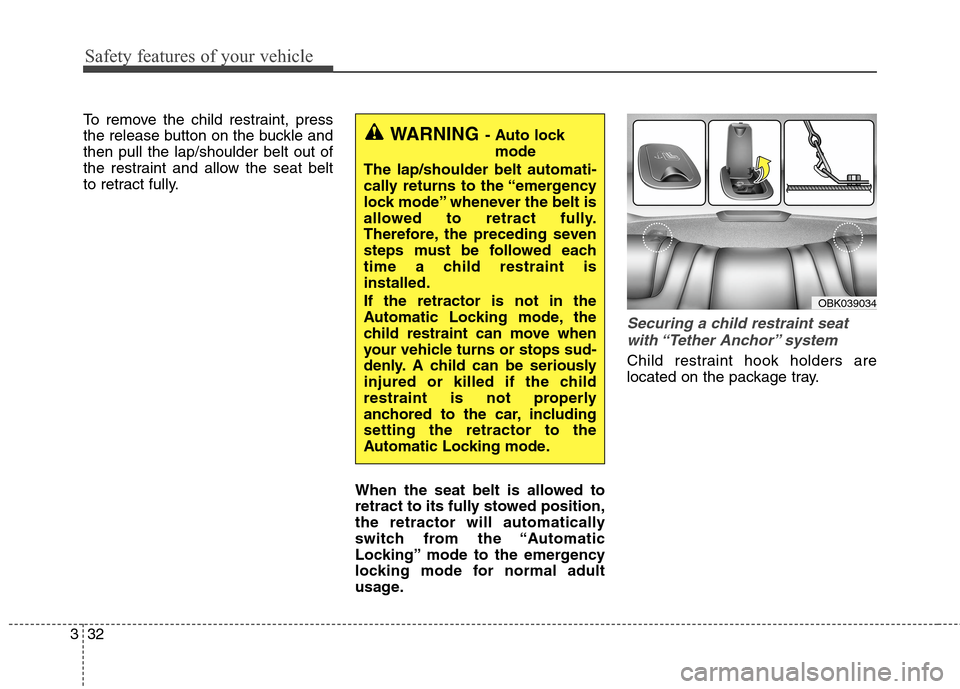
Child restraint hook holders are
located on the package tray.
OBK039034
WARNING- Auto lock
mode
The lap/shoulder belt automati-
cally returns to the “emergency
lock mode” whenever the belt is
allowed to retract fully.
Therefore, the preceding seven
steps must be followed each
time a child restraint is
installed.
If the retractor is not in the
Automatic Locking mode, the
child restraint can move when
your vehicle turns or stops sud-
denly. A child can be seriously
injured or killed if the child
restraint is not properly
anchored to the car, including
setting the retractor to the
Automatic Locking mode.
Page 54 of 438
333
Safety features of your vehicle
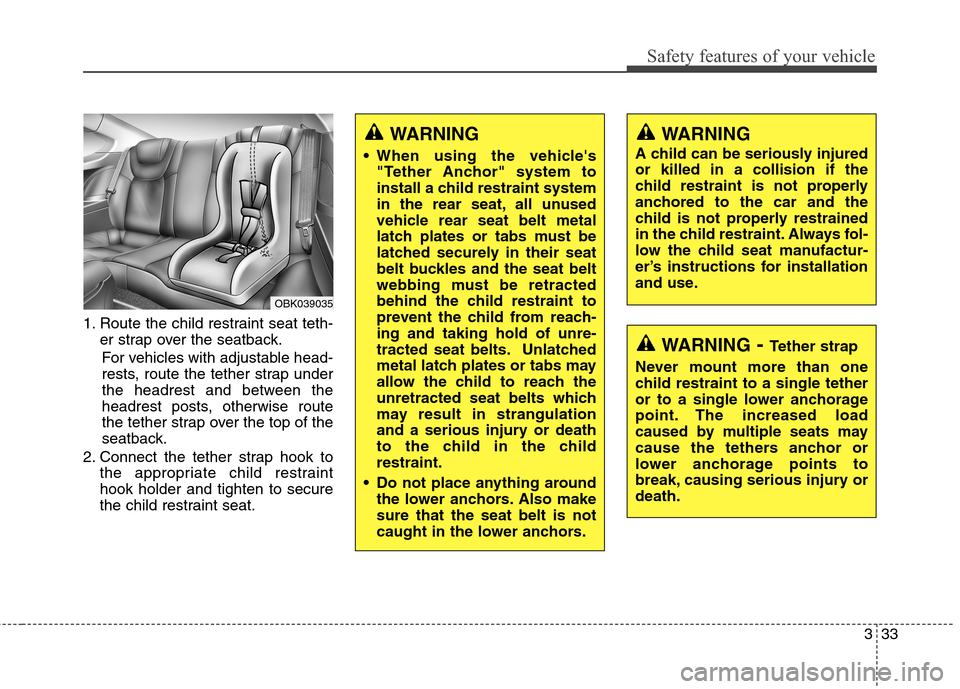
1. Route the child restraint seat teth-
er strap over the seatback.
For vehicles with adjustable head-
rests, route the tether strap under
the headrest and between the
headrest posts, otherwise route
the tether strap over the top of the
seatback.
2. Connect the tether strap hook to
the appropriate child restraint
hook holder and tighten to secure
the child restraint seat.
WARNING
When using the vehicle's
"Tether Anchor" system to
install a child restraint system
in the rear seat, all unused
vehicle rear seat belt metal
latch plates or tabs must be
latched securely in their seat
belt buckles and the seat belt
webbing must be retracted
behind the child restraint to
prevent the child from reach-
ing and taking hold of unre-
tracted seat belts. Unlatched
metal latch plates or tabs may
allow the child to reach the
unretracted seat belts which
may result in strangulation
and a serious injury or death
to the child in the child
restraint.
Do not place anything around
the lower anchors. Also make
sure that the seat belt is not
caught in the lower anchors.
WARNING- Tether strap
Never mount more than one
child restraint to a single tether
or to a single lower anchorage
point. The increased load
caused by multiple seats may
cause the tethers anchor or
lower anchorage points to
break, causing serious injury or
death.
WARNING
A child can be seriously injured
or killed in a collision if the
child restraint is not properly
anchored to the car and the
child is not properly restrained
in the child restraint. Always fol-
low the child seat manufactur-
er’s instructions for installation
and use.
OBK039035
Page 55 of 438
Safety features of your vehicle
34 3
Securing a child restraint seat
with child seat lower anchor sys-
tem
Some child seat manufacturers
make child restraint seats that are
labeled as LATCH or LATCH-com-
patible child restraint seats. LATCH
stands for "Lower Anchors and
Tethers for Children". These seats
include two rigid or webbing mount-
ed attachments that connect to two
LATCH anchors at specific seating
positions in your vehicle. This type of
child restraint seat eliminates the
need to use seat belts to attach the
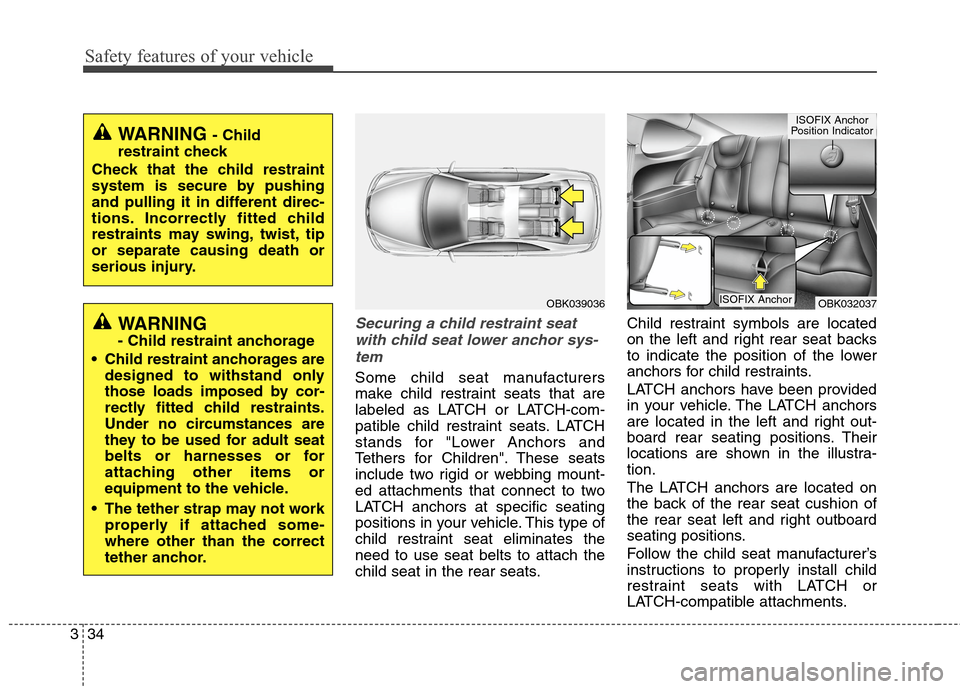
child seat in the rear seats.Child restraint symbols are located
on the left and right rear seat backs
to indicate the position of the lower
anchors for child restraints.
LATCH anchors have been provided
in your vehicle. The LATCH anchors
are located in the left and right out-
board rear seating positions. Their
locations are shown in the illustra-
tion.
The LATCH anchors are located on
the back of the rear seat cushion of
the rear seat left and right outboard
seating positions.
Follow the child seat manufacturer’s
instructions to properly install child
restraint seats with LATCH or
LATCH-compatible attachments.
OBK039036OBK032037ISOFIX Anchor
ISOFIX Anchor
Position Indicator
WARNING
- Child restraint anchorage
Child restraint anchorages are
designed to withstand only
those loads imposed by cor-
rectly fitted child restraints.
Under no circumstances are
they to be used for adult seat
belts or harnesses or for
attaching other items or
equipment to the vehicle.
The tether strap may not work
properly if attached some-
where other than the correct
tether anchor.
WARNING - Child
restraint check
Check that the child restraint
system is secure by pushing
and pulling it in different direc-
tions. Incorrectly fitted child
restraints may swing, twist, tip
or separate causing death or
serious injury.
Page 56 of 438
335
Safety features of your vehicle
Once you have installed the LATCH
child restraint, assure that the seat is
properly attached to the LATCH and
tether anchors.
Also, test the child restraint seat
before you place the child in it. Tilt
the seat from side to side. Also try to
tug the seat forward. Check to see if
the anchors hold the seat in place.
✽ ✽
NOTICE
The recommended weight for the
LATCH system is under 65 lbs (30
kg).
How to calculate the child restraint
weight :
Child restraint weight =
65 lbs (30 kg) - Child weight
WARNING
If the child restraint is not
anchored properly, the risk of a
child being seriously injured or
killed in a collision greatly
increases.
WARNING - LATCH lower
anchors
LATCH lower anchors are only
to be used with the left and right
rear outboard seating positions.
WARNING
When using the vehicle's
"LATCH" system to install a
child restraint system in the
rear seat, all unused vehicle
rear seat belt metal latch plates
or tabs must be latched secure-
ly in their seat belt buckles and
the seat belt webbing must be
retracted behind the child
restraint to prevent the child
from reaching and taking hold
of unretracted seat belts.
Unlatched metal latch plates or
tabs may allow the child to
reach the unretracted seat belts
which may result in strangula-
tion and a serious injury or
death to the child in the child
restraint.
CAUTION
Do not allow the rear seat belt
webbing to get scratched or
pinched by the child-seat latch
and LATCH anchor during the
installation.
Page 68 of 438
347
Safety features of your vehicle
(Continued)
Air bags can only be used
once – have an authorized
HYUNDAI dealer replace the
air bag immediately after
deployment.
A smaller-stature adult who is
not seated correctly (for exam-
ple: seat excessively reclined,
leaning on the door or center
console, or hips shifted for-
ward in the seat) can cause a
condition where the advanced
frontal air bag system senses
less weight than if the occu-
pant were seated properly (sit-
ting upright with the seatback
in an upright position, cen-
tered on the seat cushion with
their seat belt on, legs com-
fortably extended and their
feet on the floor).
This condition can result in an
adult potentially being mis-
classified and illumination of
the PASSENGER AIR BAG
"OFF" indicator.(Continued)
Do not modify or replace the
front passenger seat. Don't
place anything on or attach
anything such as a blanket or
seat heater to the front passen-
ger seat. This can adversely
affect the occupant classifica-
tion system.
Do not sit on sharp objects
such as tools when occupying
the front passenger seat. This
can adversely affect the occu-
pant classification system.
Do not use accessory seat cov-
ers on the front seats.
Accident statistics show that
children are safer if they are
restrained in the rear, as
opposed to the front seat. It is
recommended that child
restraints be secured in a rear
seat, including an infant riding
in a rear-facing infant seat, a
child riding in a forward-facing
child seat and an older child
riding in a booster seat.
(Continued)WARNING
Even though your vehicle is
equipped with the occupant
classification system, never
install a child restraint system
in the front passenger's seat.
A deploying air bag can force-
fully strike a child resulting in
serious injuries or death. Any
child age 12 and under should
ride in the rear seat. Children
too large for child restraints
should use the available
lap/shoulder belts. No matter
what type of crash, children of
all ages are safer when
restrained in the rear seat.
If the PASSENGER AIR BAG
"OFF" indicator is illuminated
when the front passenger's
seat is occupied by an adult
and he/she sits properly (sit-
ting upright with the seatback
in an upright position, centered
on the seat cushion with their
seat belt on, legs comfortably
extended and their feet on the
floor), have that person sit in
the rear seat.
(Continued)
Page 100 of 438
Features of your vehicle
16 4
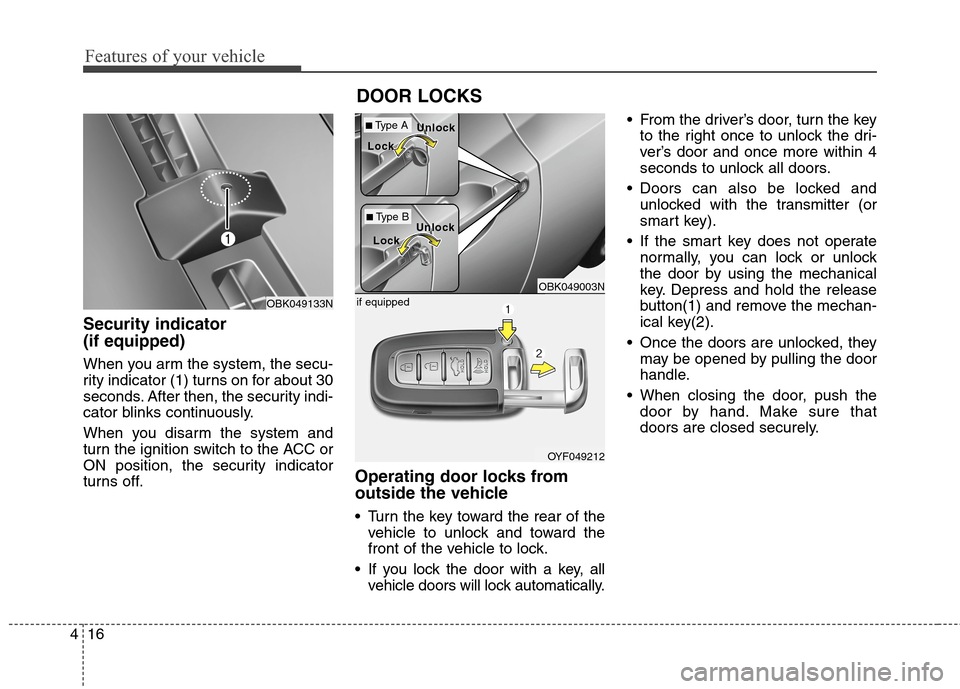
Security indicator
(if equipped)
When you arm the system, the secu-
rity indicator (1) turns on for about 30
seconds. After then, the security indi-
cator blinks continuously.
When you disarm the system and
turn the ignition switch to the ACC or
ON position, the security indicator
turns off.
Operating door locks from
outside the vehicle
Turn the key toward the rear of the
vehicle to unlock and toward the
front of the vehicle to lock.
If you lock the door with a key, all
vehicle doors will lock automatically. From the driver’s door, turn the key
to the right once to unlock the dri-
ver’s door and once more within 4
seconds to unlock all doors.
Doors can also be locked and
unlocked with the transmitter (or
smart key).
If the smart key does not operate
normally, you can lock or unlock
the door by using the mechanical
key. Depress and hold the release
button(1) and remove the mechan-
ical key(2).
Once the doors are unlocked, they
may be opened by pulling the door
handle.
When closing the door, push the
door by hand. Make sure that
doors are closed securely.
DOOR LOCKS
OBK049133N
OBK049003N
OYF049212
if equipped
■Type A
■Type B
Loc Loc
k k
Loc Loc
k kUnloc Unloc
k k
Unloc Unloc
k k
Page 101 of 438
417
Features of your vehicle
✽ ✽
NOTICE
• In cold and wet climates, door
locks and door mechanisms may
not work properly due to freezing
conditions.
• If the door is locked/unlocked
multiple times in rapid succession
with either the vehicle key or door
lock switch, the system may stop
operating temporarily in order to
protect the circuit and prevent
damage to system components.
• If you open the door when the win-
dow is closed completely, the win-
dow will go down slightly. If you
close the door when the window is
closed completely, the window will
go up slightly.
It is to reduce the airflow noise
and prevent water leakage by clos-
ing the door completely.
Mechanical noise may be heard
when you close and open the door,
but this condition is normal.
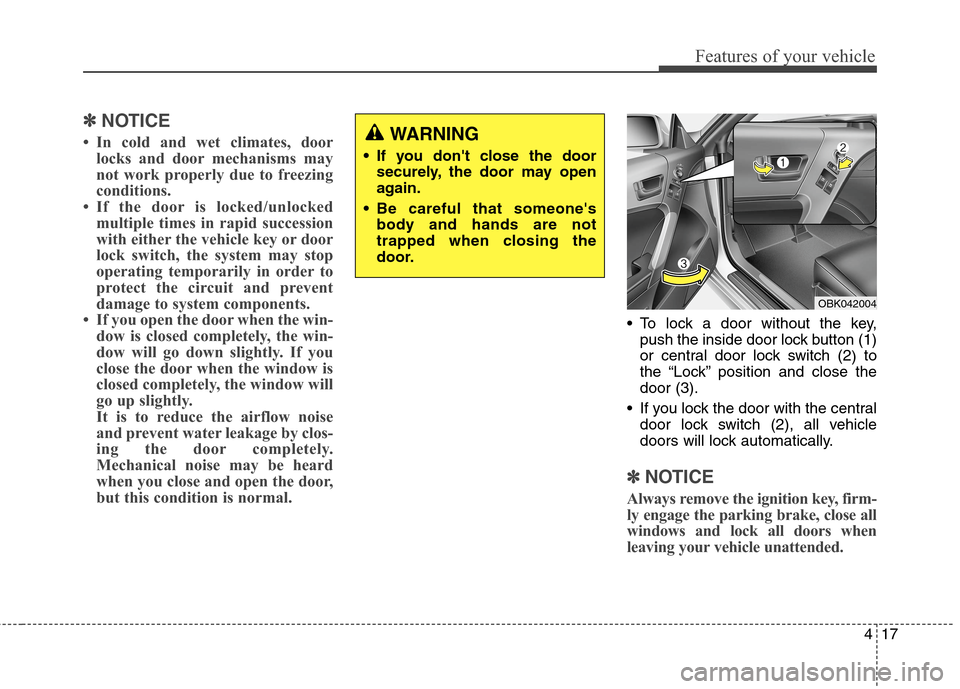
To lock a door without the key,
push the inside door lock button (1)
or central door lock switch (2
) to
the “Lock” position and close the
door (3).
If you lock the door with the central
door lock switch (2), all vehicle
doors will lock automatically.
✽ ✽
NOTICE
Always remove the ignition key, firm-
ly engage the parking brake, close all
windows and lock all doors when
leaving your vehicle unattended.
OBK042004
WARNING
If you don't close the door
securely, the door may open
again.
Be careful that someone's
body and hands are not
trapped when closing the
door.
Page 104 of 438
Features of your vehicle
20 4
TRUNK
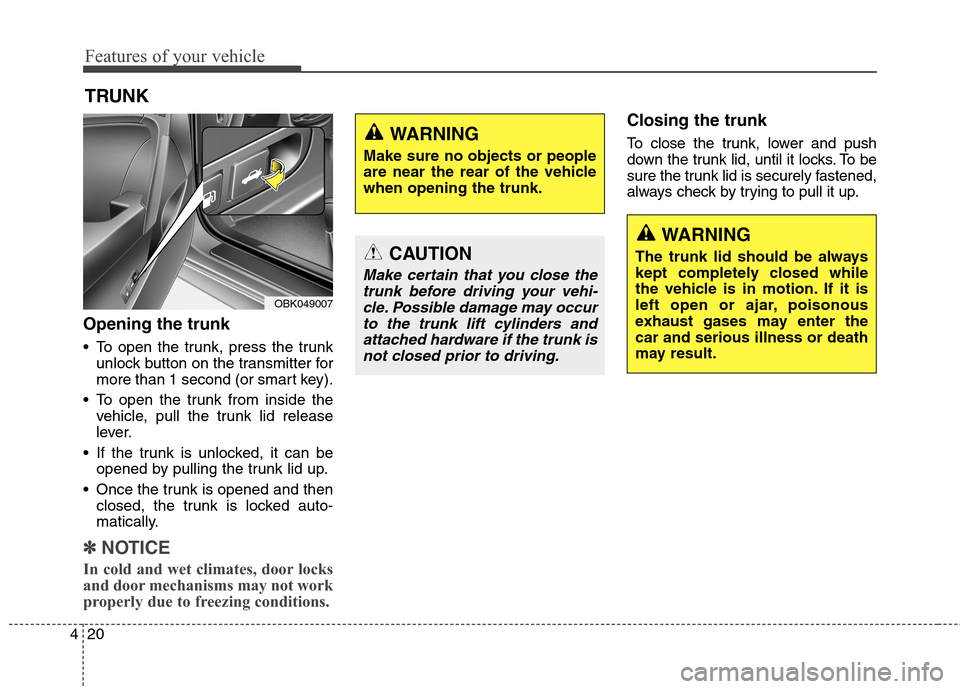
Opening the trunk
To open the trunk, press the trunk
unlock button on the transmitter for
more than 1 second (or smart key).
To open the trunk from inside the
vehicle, pull the trunk lid release
lever.
If the trunk is unlocked, it can be
opened by pulling the trunk lid up.
Once the trunk is opened and then
closed, the trunk is locked auto-
matically.
✽ ✽
NOTICE
In cold and wet climates, door locks
and door mechanisms may not work
properly due to freezing conditions.
Closing the trunk
To close the trunk, lower and push
down the trunk lid, until it locks. To be
sure the trunk lid is securely fastened,
always check by trying to pull it up.
OBK049007
CAUTION
Make certain that you close the
trunk before driving your vehi-
cle. Possible damage may occur
to the trunk lift cylinders and
attached hardware if the trunk is
not closed prior to driving.
WARNING
Make sure no objects or people
are near the rear of the vehicle
when opening the trunk.
WARNING
The trunk lid should be always
kept completely closed while
the vehicle is in motion. If it is
left open or ajar, poisonous
exhaust gases may enter the
car and serious illness or death
may result.
Page 110 of 438
Features of your vehicle
26 4
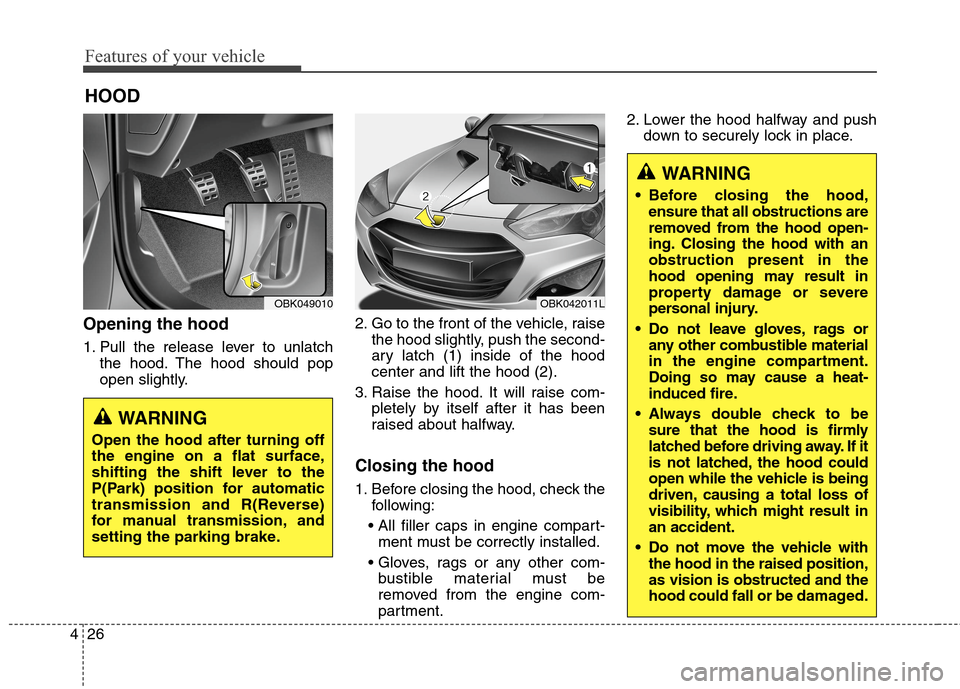
Opening the hood
1. Pull the release lever to unlatch
the hood. The hood should pop
open slightly.2. Go to the front of the vehicle, raise
the hood slightly, push the second-
ary latch (1) inside of the hood
center and lift the hood (2).
3. Raise the hood. It will raise com-
pletely by itself after it has been
raised about halfway.
Closing the hood
1. Before closing the hood, check the
following:
ment must be correctly installed.
bustible material must be
removed from the engine com-
partment.2. Lower the hood halfway and push
down to securely lock in place.
HOOD
WARNING
Before closing the hood,
ensure that all obstructions are
removed from the hood open-
ing. Closing the hood with an
obstruction present in the
hood opening may result in
property damage or severe
personal injury.
Do not leave gloves, rags or
any other combustible material
in the engine compartment.
Doing so may cause a heat-
induced fire.
Always double check to be
sure that the hood is firmly
latched before driving away. If it
is not latched, the hood could
open while the vehicle is being
driven, causing a total loss of
visibility, which might result in
an accident.
Do not move the vehicle with
the hood in the raised position,
as vision is obstructed and the
hood could fall or be damaged.
OBK049010OBK042011L
WARNING
Open the hood after turning off
the engine on a flat surface,
shifting the shift lever to the
P(Park) position for automatic
transmission and R(Reverse)
for manual transmission, and
setting the parking brake.
Page 111 of 438
427
Features of your vehicle
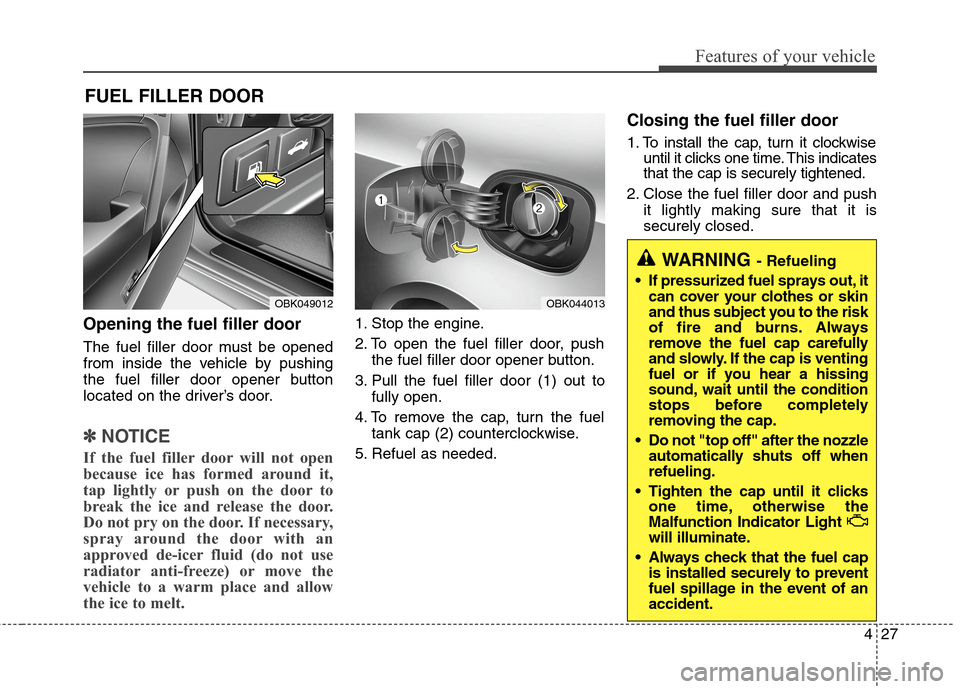
Opening the fuel filler door
The fuel filler door must be opened
from inside the vehicle by pushing
the fuel filler door opener button
located on the driver’s door.
✽ ✽
NOTICE
If the fuel filler door will not open
because ice has formed around it,
tap lightly or push on the door to
break the ice and release the door.
Do not pry on the door. If necessary,
spray around the door with an
approved de-icer fluid (do not use
radiator anti-freeze) or move the
vehicle to a warm place and allow
the ice to melt.
1. Stop the engine.
2. To open the fuel filler door, push
the fuel filler door opener button.
3. Pull the fuel filler door (1) out to
fully open.
4. To remove the cap, turn the fuel
tank cap (2) counterclockwise.
5. Refuel as needed.
Closing the fuel filler door
1. To install the cap, turn it clockwise
until it clicks one time. This indicates
that the cap is securely tightened.
2. Close the fuel filler door and push
it lightly making sure that it is
securely closed.
FUEL FILLER DOOR
WARNING - Refueling
If pressurized fuel sprays out, it
can cover your clothes or skin
and thus subject you to the risk
of fire and burns. Always
remove the fuel cap carefully
and slowly. If the cap is venting
fuel or if you hear a hissing
sound, wait until the condition
stops before completely
removing the cap.
Do not "top off" after the nozzle
automatically shuts off when
refueling.
Tighten the cap until it clicks
one time, otherwise the
Malfunction Indicator Light
will illuminate.
Always check that the fuel cap
is installed securely to prevent
fuel spillage in the event of an
accident.
OBK049012OBK044013