parking gear Hyundai Genesis Coupe 2015 User Guide
[x] Cancel search | Manufacturer: HYUNDAI, Model Year: 2015, Model line: Genesis Coupe, Model: Hyundai Genesis Coupe 2015Pages: 438, PDF Size: 40.35 MB
Page 278 of 438
Driving your vehicle
28 5
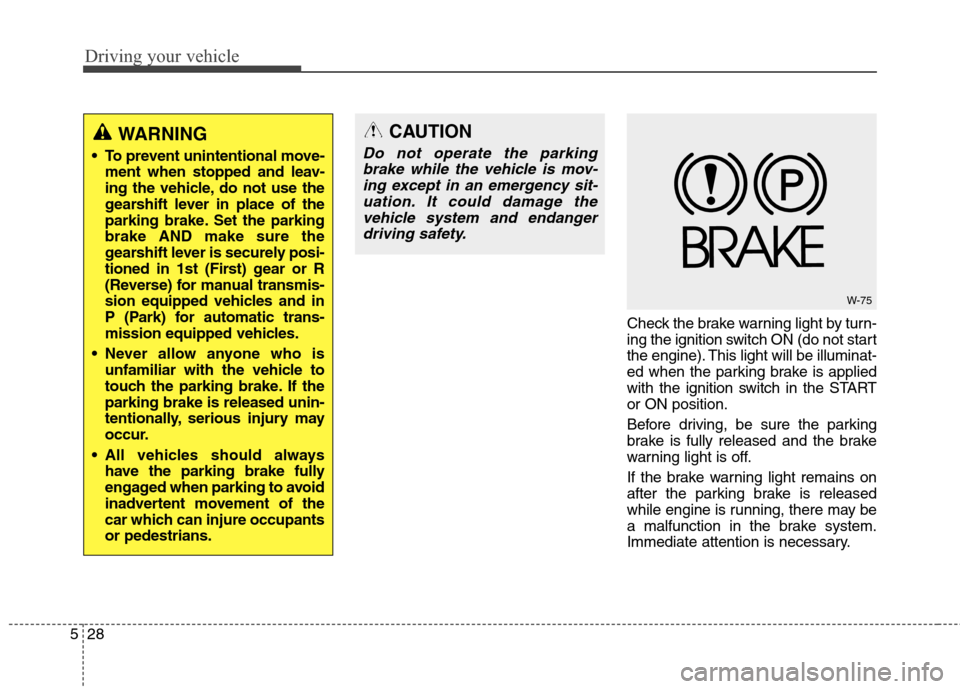
Check the brake warning light by turn-
ing the ignition switch ON (do not start
the engine). This light will be illuminat-
ed when the parking brake is applied
with the ignition switch in the START
or ON position.
Before driving, be sure the parking
brake is fully released and the brake
warning light is off.
If the brake warning light remains on
after the parking brake is released
while engine is running, there may be
a malfunction in the brake system.
Immediate attention is necessary.
WARNING
To prevent unintentional move-
ment when stopped and leav-
ing the vehicle, do not use the
gearshift lever in place of the
parking brake. Set the parking
brake AND make sure the
gearshift lever is securely posi-
tioned in 1st (First) gear or R
(Reverse) for manual transmis-
sion equipped vehicles and in
P (Park) for automatic trans-
mission equipped vehicles.
Never allow anyone who is
unfamiliar with the vehicle to
touch the parking brake. If the
parking brake is released unin-
tentionally, serious injury may
occur.
All vehicles should always
have the parking brake fully
engaged when parking to avoid
inadvertent movement of the
car which can injure occupants
or pedestrians.
W-75
CAUTION
Do not operate the parking
brake while the vehicle is mov-
ing except in an emergency sit-
uation. It could damage the
vehicle system and endanger
driving safety.
Page 286 of 438
Driving your vehicle
36 5
After parking the vehicle, check to
be sure the parking brake is not
engaged and that the parking
brake indicator light is out before
driving away.
Driving through water may get the
brakes wet. They can also get wet
when the car is washed. Wet
brakes can be dangerous! Your car
will not stop as quickly if the brakes
are wet. Wet brakes may cause the
car to pull to one side.
To dry the brakes, apply the brakes
lightly until the braking action
returns to normal, taking care to
keep the car under control at all
times. If the braking action does
not return to normal, stop as soon
as it is safe to do so and call an
authorized HYUNDAI dealer for
assistance.
Don't coast down hills with the car
out of gear. This is extremely haz-
ardous. Keep the car in gear at all
times, use the brakes to slow
down, then shift to a lower gear so
that engine braking will help you
maintain a safe speed. Don't "ride" the brake pedal.
Resting your foot on the brake
pedal while driving can be danger-
ous because it can result in the
brakes overheating and losing their
effectiveness. It also increases the
wear of the brake components.
If a tire goes flat while you are driv-
ing, apply the brakes gently and
keep the car pointed straight
ahead while you slow down. When
you are moving slowly enough for it
to be safe to do so, pull off the road
and stop in a safe place.
If your car is equipped with an
automatic transmission, don't let
your car creep forward. To avoid
creeping forward, keep your foot
firmly on the brake pedal when the
car is stopped. Use caution when parking on a hill.
Firmly engage the parking brake
and place the shift lever in P. If your
car is facing downhill, turn the front
wheels into the curb to help keep
the car from rolling. If your car is
facing uphill, turn the front wheels
away from the curb to help keep
the car from rolling. If there is no
curb or if it is required by other con-
ditions to keep the car from rolling,
block the wheels.
Under some conditions your park-
ing brake can freeze in the
engaged position. This is most like-
ly to happen when there is an
accumulation of snow or ice
around or near the rear brakes or if
the brakes are wet. If there is a risk
that the parking brake may freeze,
apply it only temporarily while you
put the shift lever in P (automatic
transmission) and block the rear
wheels so the car cannot roll. Then
release the parking brake.
Do not hold the vehicle on an uphill
with the accelerator pedal. This can
cause the transmission to over-
heat. Always use the brake pedal
or parking brake.
Page 301 of 438

551
Driving your vehicle
To keep locks from freezing
To keep the locks from freezing,
squirt an approved de-icer fluid or
glycerine into the key opening. If a
lock is covered with ice, squirt it with
an approved de-icing fluid to remove
the ice. If the lock is frozen internally,
you may be able to thaw it out by
using a heated key. Handle the heat-
ed key with care to avoid injury.
Use approved window washer
anti-freeze in system
To keep the water in the window
washer system from freezing, add an
approved window washer anti-freeze
solution in accordance with instruc-
tions on the container. Window wash-
er anti-freeze is available from an
authorized HYUNDAI dealer and
most auto parts outlets. Do not use
engine coolant or other types of anti-
freeze as these may damage the
paint finish.
Don't let your parking brake
freeze
Under some conditions your parking
brake can freeze in the engaged
position. This is most likely to hap-
pen when there is an accumulation
of snow or ice around or near the
rear brakes or if the brakes are wet.
If there is a risk the parking brake
may freeze, apply it only temporarily
while you put the gear shift lever in P
and block the rear wheels so the car
cannot roll. Then release the parking
brake.
Don't let ice and snow accu-
mulate underneath
Under some conditions, snow and
ice can build up under the fenders
and interfere with the steering. When
driving in severe winter conditions
where this may happen, you should
periodically check underneath the
car to be sure the movement of the
front wheels and the steering com-
ponents is not obstructed.
Carry emergency equipment
Depending on the severity of the
weather where you drive your car,
you should carry appropriate emer-
gency equipment. Some of the items
you may want to carry include tire
chains, tow straps or chains, flash-
light, emergency flares, sand, a
shovel, jumper cables, a window
scraper, gloves, ground cloth, cover-
alls, a blanket, etc.
Don't place foreign objects or
materials in the engine com-
partment
Placement of foreign object or mate-
rials which prevent cooling of the
engine, in the engine compartment,
may cause a failure or combustion.
The manufacturer is not responsible
for the damage caused by such
placement.
Page 311 of 438
63
What to do in an emergency
2.When the car is stopped, turn on
your emergency hazard flashers,
set the parking brake and put the
transmission in P (automatic trans-
mission) or reverse (manual trans-
mission).
3.Have all passengers get out of the
car. Be sure they all get out on the
side of the car that is away from
traffic.
4.When changing a flat tire, follow
the instruction provided later in this
section.
If engine stalls while driving
1. Reduce your speed gradually,
keeping a straight line. Move cau-
tiously off the road to a safe place.
2. Turn on your emergency flashers.
3. Try to start the engine again. If
your vehicle will not start, contact
an authorized HYUNDAI dealer or
seek other qualified assistance.
If engine doesn't turn over or
turns over slowly
1. If your vehicle has an automatic
transmission, be sure the gear
selector lever is in N(Neutral) or
P(Park) and the emergency brake
is set.
2. Check the battery connections to
be sure they are clean and tight.
3. Turn on the interior light. If the light
dims or goes out when you oper-
ate the starter, the battery is dis-
charged.
4. Check the starter connections to
be sure they are securely tight-
ened.
5. Do not push or pull the vehicle to
start it. See instructions for "Jump
starting".
If the engine turns over nor-
mally but does not start
1. Check fuel level.
2. With the ignition switch in the
LOCK position, check all connec-
tors at the ignition coils and spark
plugs. Reconnect any that may be
disconnected or loose.
3. If the engine still does not start,
call an authorized HYUNDAI deal-
er or seek other qualified assis-
tance.
IF THE ENGINE WILL NOT START
WARNING
If the engine will not start, do
not push or pull the car to start
it. This could result in a collision
or cause other damage.
Page 328 of 438

What to do in an emergency
20 6
Jack label
1. Model Name
2. Maximum allowable load
3. When using the jack, set your
parking brake.
4. When using the jack, stop the
engine.
5. Do not get under a vehicle that is
supported by a jack.
6. The designated locations under
the frame
7. When supporting the vehicle, the
base plate of jack must be vertical
under the lifting point.
8. Shift into Reverse gear on vehicles
with manual transaxle or move the
shift lever to the P position on
vehicles with automatic transaxle.
9. The jack should be used on firm
level ground.
10. Jack manufacture
11. Production date
OHYK064001
OHYK064002
■ Type A■Example
■ Type B
❈The actual Jack label in the vehicle may differ from the illustration.
For more detailed specifications, refer to the label attached to the jack.
Page 342 of 438

Maintenance
10 7
22,500 miles (36,000 km) or 18 months
❑ Rotate tire
❑Inspect air cleaner filter
❑Inspect power steering fluid
❑Inspect vacuum hose
❑Replace engine oil and filter *
1
❑Add fuel additive *3
(22,500 miles (36,000 km) or 36 months)
30,000 miles (48,000 km) or 24 months
❑Rotate tire
❑Inspect vacuum hose
❑Inspect air conditioning refrigerant
❑Inspect brake hoses and lines
❑Inspect drive shafts and boots
❑Inspect exhaust pipe and muffler
❑Inspect front brake disc/pads, calipers and rotors
❑Inspect rear brake disc/pads
❑Inspect steering gear box, linkage & boots/lower arm ball
joint, upper arm ball joint
(Continued)
(Continued)
❑Inspect suspension mounting bolts
❑Inspect brake/clutch (if equipped) fluid
❑Inspect fuel filter *
5
❑Inspect fuel lines, fuel hoses and connections
❑Inspect fuel tank air filter (if equipped) *5
❑Inspect parking brake
❑Inspect propeller shaft
❑Inspect power steering fluid
❑Inspect power steering pump, belt and hoses
❑Inspect vapor hose and fuel filler cap
❑Replace climate control air filter (for evaporator and blower unit)
❑Replace air cleaner filter
❑Replace engine oil and filter *
1
❑Add fuel additive *3 (30,000 miles (48,000 km) or 48 months)
❈Inspect : Inspect and if necessary, adjust, correct, clean or
replace.
Page 344 of 438

Maintenance
12 7
60,000 miles (96,000 km) or 48 months
❑Rotate tire
❑Inspect vacuum hose
❑Inspect air conditioning refrigerant
❑Inspect brake hoses and lines
❑Inspect drive shafts and boots
❑Inspect exhaust pipe and muffler
❑Inspect front brake disc/pads, calipers and rotors
❑Inspect rear brake disc/pads
❑Inspect steering gear box, linkage & boots/lower arm ball
joint, upper arm ball joint
❑Inspect suspension mounting bolts
(Continued)
(Continued)
❑Inspect brake/clutch (if equipped) fluid
❑Inspect fuel filter *5
❑Inspect fuel lines, fuel hoses and connections
❑Inspect fuel tank air filter (if equipped) *5
❑Inspect parking brake
❑Inspect propeller shaft
❑Inspect power steering fluid
❑Inspect power steering pump, belt and hoses
❑Inspect vapor hose and fuel filler cap
❑Inspect valve clearance *
7 (60,000 miles (96,000 km) or 72
months)
❑Inspect drive belts *
2
(First, 60,000 miles (96,000 km) or 72 months
after every 15,000 miles (24,000 km) or 24 months)
❑Replace climate control air filter (for evaporator and blower unit)
❑Replace air cleaner filter
❑Replace engine oil and filter *
1
❑Add fuel additive *3 (60,000 miles (96,000 km) or 96 months)
52,500 miles (84,000 km) or 42 months
❑Rotate tire
❑Inspect air cleaner filter
❑Inspect power steering fluid
❑Inspect vacuum hose
❑Replace engine oil and filter *
1
❑Add fuel additive *3 (52,500 miles (84,000 km) or 84 months)
❈Inspect : Inspect and if necessary, adjust, correct, clean or
replace.
Page 346 of 438

Maintenance
14 7
90,000 miles (144,000 km) or 72 months
❑Rotate tire
❑Inspect vacuum hose
❑Inspect air conditioning refrigerant
❑Inspect brake hoses and lines
❑Inspect drive shafts and boots
❑Inspect exhaust pipe and muffler
❑Inspect front brake disc/pads, calipers and rotors
❑Inspect rear brake disc/pads
❑Inspect steering gear box, linkage & boots/lower arm ball
joint, upper arm ball joint
(Continued)
(Continued)
❑Inspect suspension mounting bolts
❑Inspect brake/clutch (if equipped) fluid
❑Inspect fuel filter *
5
❑Inspect fuel lines, fuel hoses and connections
❑Inspect fuel tank air filter (if equipped) *5
❑Inspect parking brake
❑Inspect propeller shaft
❑Inspect power steering fluid
❑Inspect power steering pump, belt and hoses
❑Inspect vapor hose and fuel filler cap
❑Inspect drive belts *
2
(First, 60,000 miles (96,000 km) or 72 months
after every 15,000 miles (24,000 km) or 24 months)
❑Replace climate control air filter (for evaporator and blower unit)
❑Replace air cleaner filter
❑Replace engine oil and filter *
1
❑Add fuel additive *3 (90,000 miles (144,000 km) or 144 months)
82,500 miles (132,000 km) or 66 months
❑Rotate tire
❑Inspect air cleaner filter
❑Inspect power steering fluid
❑Inspect vacuum hose
❑Replace engine oil and filter *
1
❑Add fuel additive *3 (82,500 miles (132,000 km) or 132 months)
❈Inspect : Inspect and if necessary, adjust, correct, clean or
replace.
Page 348 of 438

Maintenance
16 7
120,000 miles (192,000 km) or 96 months
❑Rotate tire
❑Inspect vacuum hose
❑Inspect air conditioning refrigerant
❑Inspect brake hoses and lines
❑Inspect drive shafts and boots
❑Inspect exhaust pipe and muffler
❑Inspect front brake disc/pads, calipers and rotors
❑Inspect rear brake disc/pads (if equipped)
❑Inspect steering gear box, linkage & boots/lower arm ball
joint, upper arm ball joint
❑Inspect suspension mounting bolts
❑Inspect brake/clutch (if equipped) fluid
❑Inspect fuel filter *
5
(Continued)
112,500 miles (180,000 km) or 90 months
❑Rotate tire
❑Inspect air cleaner filter
❑Inspect power steering fluid
❑Inspect vacuum hose
❑Inspect manual transmission fluid (if equipped)
❑Inspect rear differential oil *
4
❑Replace engine oil and filter *1
❑Add fuel additive *3 (97,500 miles (156,000 km) or 156 months)
❈Inspect : Inspect and if necessary, adjust, correct, clean or
replace.
(Continued)
❑Inspect fuel lines, fuel hoses and connections
❑Inspect fuel tank air filter (if equipped) *5
❑Inspect parking brake
❑Inspect power steering fluid
❑Inspect power steering pump, belt and hoses
❑Inspect propeller shaft
❑Inspect vapor hose and fuel filler cap
❑Inspect valve clearance *
7
❑Inspect drive belts *2
(First, 60,000 miles (96,000 km) or 72 months
after every 15,000 miles (24,000 km) or 24 months)
❑Replace climate control air filter (for evaporator and blower unit)
❑Replace air cleaner filter
❑Replace engine oil and filter *
1
❑Replace coolant*6(First, 120,000 miles (192,000 km) or 120
months after that every 30,000 miles (48,000 km) or 24
months)
❑Add fuel additive *
3 (60,000 miles (96,000 km) or 96 months)
Page 350 of 438
Maintenance
18 7
142,500 miles (228,000 km) or 114 months
❑Rotate tire
❑Inspect air cleaner filter
❑Inspect power steering fluid
❑Inspect vacuum hose
❑Replace engine oil and filter *
1
❑Add fuel additive *3 (97,500 miles (156,000 km) or 156 months)
(Continued)
❑Inspect fuel tank air filter (if equipped) *5
❑Inspect parking brake
❑Inspect propeller shaft
❑Inspect power steering fluid
❑Inspect power steering pump, belt and hoses
❑Inspect rear differential oil *
4
❑Inspect vapor hose and fuel filler cap
❑Inspect drive belts *2
(First, 60,000 miles (96,000 km) or 72 months
after every 15,000 miles (24,000 km) or 24 months)
❑Replace climate control air filter (for evaporator and blower unit)
❑Replace air cleaner filter
❑Replace engine oil and filter *
1
❑Replace coolant*6(First, 120,000 miles (192,000 km) or 120
months after every 30,000 miles (48,000 km) or 24 months)
❑Add fuel additive *
3 (90,000 miles (144,000 km) or 144 months)
150,000 miles (240,000 km) or 120 months
❑Rotate tire
❑Inspect vacuum hose
❑Inspect air conditioning refrigerant
❑Inspect brake hoses and lines
❑Inspect propeller shaft
❑Inspect exhaust pipe and muffler
❑Inspect front brake disc/pads, calipers and rotors
❑Inspect rear brake disc/pads
❑Inspect steering gear box, linkage & boots/lower arm ball
joint, upper arm ball joint
❑Inspect suspension mounting bolts
❑Inspect manual transmission fluid (if equipped)
❑Inspect brake/clutch (if equipped) fluid
❑Inspect fuel filter *
5
❑Inspect fuel lines, fuel hoses and connections
(Continued)
No check, No service required
❑Automatic transmission fluid (if equipped)
❈Inspect : Inspect and if necessary, adjust, correct, clean or
replace.