cooling Hyundai Genesis Coupe 2016 s User Guide
[x] Cancel search | Manufacturer: HYUNDAI, Model Year: 2016, Model line: Genesis Coupe, Model: Hyundai Genesis Coupe 2016Pages: 475, PDF Size: 15.71 MB
Page 351 of 475
What to do in an emergency
66
IF THE ENGINE OVERHEATS
If your temperature gauge indicates
overheating, you experience a loss
of power, or hear loud pinging or
knocking, the engine is probably too
hot. If this happens, you should:
1. Pull off the road and stop as soonas it is safe to do so.
2. Place the shift lever in P (automat- ic transmission) or neutral (manual
transmission) and set the parking
brake. If the air conditioning is on,
turn it off.
3. If engine coolant is running out under the car or steam is coming
out from underneath the hood,
stop the engine. Do not open the
hood until the coolant has flow
stopped. If there is no visible loss
of engine coolant and no steam,
leave the engine running and
check to be sure the engine cool-
ing fan is operating. If the fan is
not running, turn the engine off.
4. Check to see if the water pump drive belt is missing. If it is not
missing, check to see that it is
tight. If the drive belt seems to be
satisfactory, check for coolant
leaking from the radiator, hoses or
under the car. (If the air condition-
ing had been in use, it is normal
for cold water to be draining from it
when you stop). 5. If the water pump drive belt is bro-
ken or engine coolant is leaking
out, stop the engine immediately
and call the nearest authorized
HYUNDAI dealer for assistance.
6.If you cannot find the cause of the overheating, wait until the engine
temperature has returned to nor-
mal. Then, if coolant has been lost,
carefully add coolant to the reser-
voir to bring the fluid level in the
reservoir up to the halfway mark. 7.Proceed with caution, keeping
alert for further signs of overheat-
ing. If overheating happens again,
call an authorized HYUNDAI deal-
er for assistance.
WARNING
While the engine is running,
keep hair, hands and clothing
away from moving parts such
as the fan and drive belts to pre-
vent injury.
WARNING
Do not remove the radiator cap
when the engine is hot. This
may result in coolant to be
blown out of the opening and
cause serious burns.
CAUTION
Serious loss of coolant indicatesthere is a leak in the cooling sys-tem and this should be checkedas soon as possible by anauthorized HYUNDAI dealer.
Page 390 of 475
721
Maintenance
Air cleaner filter
A Genuine HYUNDAI air cleaner fil-
ter is recommended when the filter is
replaced.
Spark plugs
Make sure to install new spark plugs
of the correct heat range.
Valve clearance
Inspect excessive valve noise and/or
engine vibration and adjust if neces-
sary. An authorized HYUNDAI dealer
should perform the operation.
Cooling system
Check cooling system components,
such as radiator, coolant reservoir,
hoses and connections for leakage
and damage. Replace any damaged
parts.
Coolant
The coolant should be changed at
the intervals specified in the mainte-
nance schedule.
Manual transmission fluid
(if equipped)
Inspect the manual transmission
fluid according to the maintenance
schedule.
Automatic transmission fluid
Automatic transmission fluid should
not be checked under normal usage
conditions.
But in severe conditions, the fluid
should be changed at an authorized
HYUNDAI dealer in accordance to
the scheduled maintenance at the
beginning of this chapter.
Brake hoses and lines
Visually check for proper installation,
chafing, cracks, deterioration and
any leakage. Replace any deteriorat-
ed or damaged parts immediately.
CAUTION
The use of a non-specified fluidcould result in transmissionmalfunction and failure.
Use only specified automatictransmission fluid. (Refer to“Recommended lubricants andcapacities” in section 8.)
Page 394 of 475
725
Maintenance
The high-pressure cooling system
has a reservoir filled with year-round
antifreeze coolant. The reservoir is
filled at the factory.
Check the antifreeze protection and
coolant level at least once a year, at
the beginning of the winter season,
and before traveling to a colder cli-
mate.Checking the coolant level
ENGINE COOLANT
(Continued)
Even if the engine is not oper-ating, do not remove the radi-
ator cap or the drain plug
while the engine and radiator
are hot. Hot coolant and
steam may still blow out
under pressure, causing seri-
ous injury.
WARNING
Removing radiator
cap
Never attempt to remove the radiator cap while the engine
is operating or hot. Doing so
might lead to cooling system
and engine damage and could
result in serious personal
injury from escaping hot
coolant or steam.
Turn the engine off and wait until it cools down. Use
extreme care when removing
the radiator cap. Wrap a thick
towel around it, and turn it
counterclockwise slowly to the
first stop. Step back while the
pressure is released from the
cooling system. When you are
sure all the pressure has been
released, press down on the
cap, using a thick towel, and
continue turning counterclock-
wise to remove it.
(Continued)
Page 395 of 475
Maintenance
26
7
Check the condition and connections
of all cooling system hoses and
heater hoses. Replace any swollen
or deteriorated hoses.
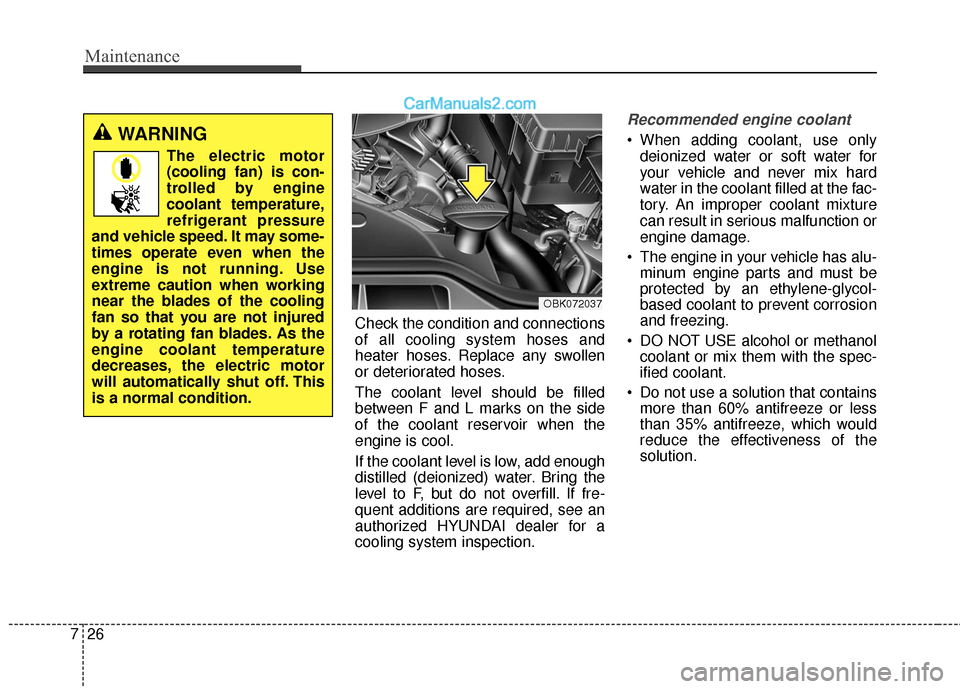
The coolant level should be filled
between F and L marks on the side
of the coolant reservoir when the
engine is cool.
If the coolant level is low, add enough
distilled (deionized) water. Bring the
level to F, but do not overfill. If fre-
quent additions are required, see an
authorized HYUNDAI dealer for a
cooling system inspection.
Recommended engine coolant
When adding coolant, use only
deionized water or soft water for
your vehicle and never mix hard
water in the coolant filled at the fac-
tory. An improper coolant mixture
can result in serious malfunction or
engine damage.
The engine in your vehicle has alu- minum engine parts and must be
protected by an ethylene-glycol-
based coolant to prevent corrosion
and freezing.
DO NOT USE alcohol or methanol coolant or mix them with the spec-
ified coolant.
Do not use a solution that contains more than 60% antifreeze or less
than 35% antifreeze, which would
reduce the effectiveness of the
solution.WARNING
The electric motor
(cooling fan) is con-
trolled by engine
coolant temperature,
refrigerant pressure
and vehicle speed. It may some-
times operate even when the
engine is not running. Use
extreme caution when working
near the blades of the cooling
fan so that you are not injured
by a rotating fan blades. As the
engine coolant temperature
decreases, the electric motor
will automatically shut off. This
is a normal condition.
OBK072037
Page 432 of 475
763
Maintenance
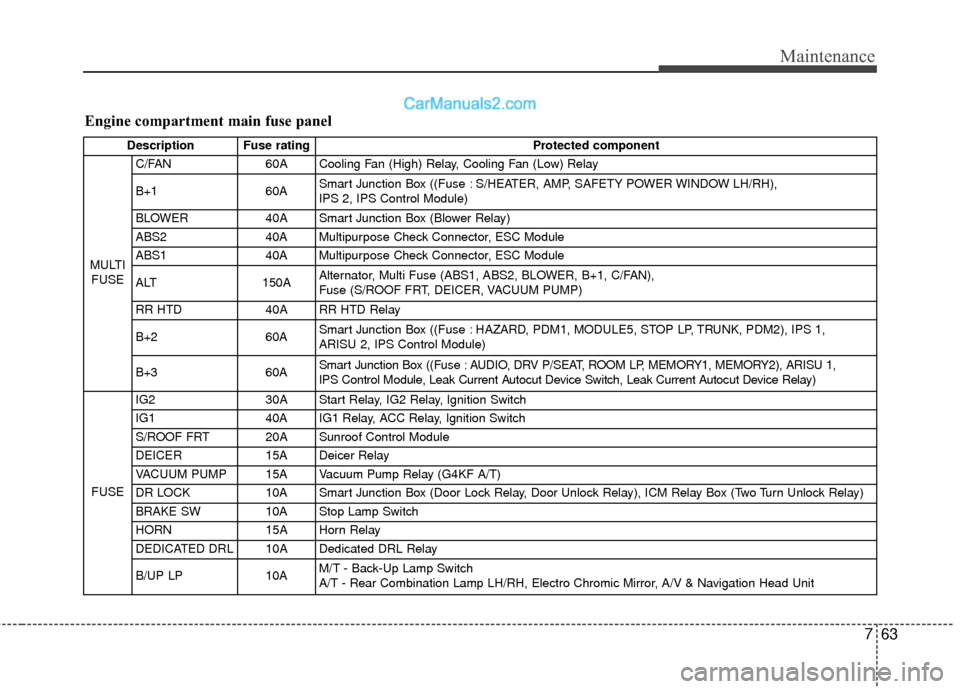
Engine compartment main fuse panel
Description Fuse ratingProtected component
MULTI FUSE C/FAN
60A Cooling Fan (High) Relay, Cooling Fan (Low) Relay
B+1 60ASmart Junction Box ((Fuse : S/HEATER, AMP, SAFETY POWER WINDOW LH/RH),
IPS 2, IPS Control Module)
BLOWER 40A Smart Junction Box (Blower Relay)
ABS2 40A Multipurpose Check Connector, ESC Module
ABS1 40A Multipurpose Check Connector, ESC Module
ALT 150AAlternator, Multi Fuse (ABS1, ABS2, BLOWER, B+1, C/FAN),
Fuse (S/ROOF FRT, DEICER, VACUUM PUMP)
RR HTD 40A RR HTD Relay
B+260ASmart Junction Box ((Fuse : HAZARD, PDM1, MODULE5, STOP LP, TRUNK, PDM2), IPS 1,
ARISU 2, IPS Control Module)
B+360ASmart Junction Box ((Fuse : AUDIO, DRV P/SEAT, ROOM LP, MEMORY1, MEMORY2), ARISU 1,
IPS Control Module, Leak Current Autocut Device Switch, Leak Current Autocut Device Relay)
FUSE IG2
30A Start Relay, IG2 Relay, Ignition Switch
IG140AIG1 Relay, ACC Relay, Ignition Switch
S/ROOF FRT 20A Sunroof Control Module
DEICER 15A Deicer Relay
VACUUM PUMP 15A Vacuum Pump Relay (G4KF A/T)
DR LOCK 10A Smart Junction Box (Door Lock Relay, Door Unlock Relay), ICM Relay Box (Two Turn Unlock Relay)
BRAKE SW 10A Stop Lamp Switch
HORN 15A Horn Relay
DEDICATED DRL 10A Dedicated DRL Relay
B/UP LP 10AM/T - Back-Up Lamp Switch
A/T - Rear Combination Lamp LH/RH, Electro Chromic Mirror, A/V & Navigation Head Unit
Page 434 of 475
765
Maintenance
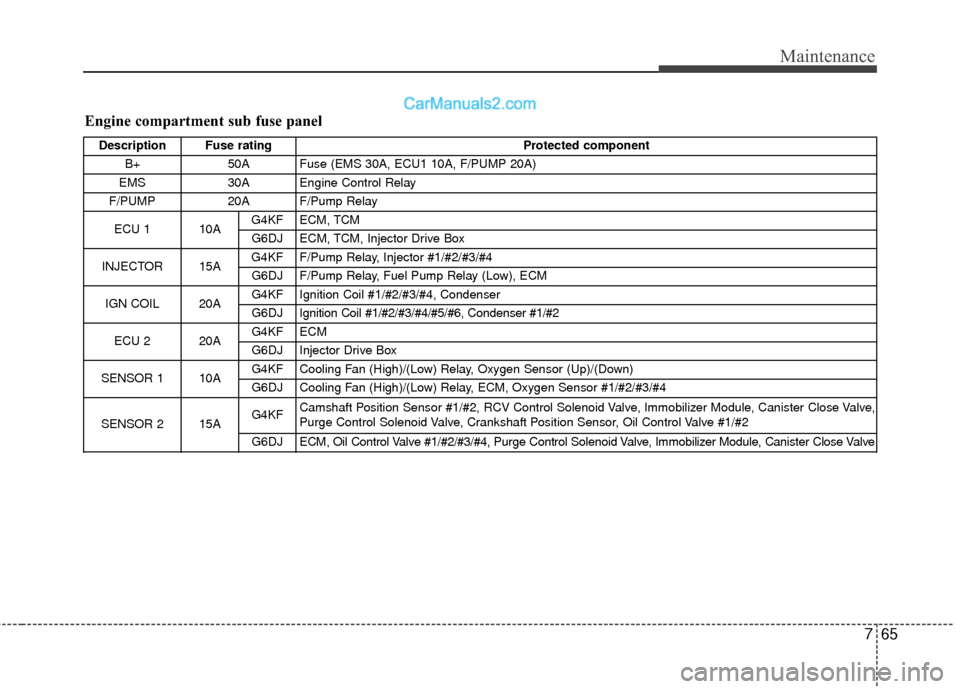
Engine compartment sub fuse panel
Description Fuse ratingProtected component
B+ 50A Fuse (EMS 30A, ECU1 10A, F/PUMP 20A)
EMS 30A Engine Control Relay
F/PUMP 20A F/Pump Relay
ECU 1 10A G4KF ECM, TCM
G6DJ ECM, TCM, Injector Drive Box
INJECTOR 15A G4KF F/Pump Relay, Injector #1/#2/#3/#4
G6DJ F/Pump Relay, Fuel Pump Relay (Low), ECM
IGN COIL20AG4KFIgnition Coil #1/#2/#3/#4, Condenser
G6DJIgnition Coil #1/#2/#3/#4/#5/#6, Condenser #1/#2
ECU 2 20A G4KF ECM
G6DJInjector Drive Box
SENSOR 1 10A G4KF Cooling Fan (High)/(Low) Relay, Oxygen Sensor (Up)/(Down)
G6DJ Cooling Fan (High)/(Low) Relay, ECM, Oxygen Sensor #1/#2/#3/#4
SENSOR 2 15A G4KF
Camshaft Position Sensor #1/#2, RCV Control Solenoid Valve, Immobilizer Module, Canister Close Valve,
Purge Control Solenoid Valve, Crankshaft Position Sensor, Oil Control Valve #1/#2
G6DJ ECM, Oil Control Valve #1/#2/#3/#4, Purge Control Solenoid Valve, Immobilizer Module, Canister Close Valve
Page 467 of 475
 ··················\
··")
I3
Index
Brake system··················\
··················\
············ ·5-25
Anti-lock brake system (ABS) ··················\
·······5-29
Electronic stability program (ESC) ··················\
··5-31
Parking brake ··················\
··················\
·········5-27
Power brakes ··················\
··················\
········· ·5-25
Brakes/clutch fluid ··················\
··················\
····· ·7-28
Bulb replacement ··················\
··················\
······· ·7-67
Bulb wattage ··················\
··················\
···············8-2
California perchlorate notice ··················\
·············7-86
Capacities (Lubricants) ··················\
··················\
···8-4
Care Exterior care ··················\
··················\
········· ·7-76
Interior care ··················\
··················\
·········· ·7-82
Tire care ··················\
··················\
·············· ·7-41
Cargo capacity ··················\
··················\
·········· ·5-53
Cargo weight ··················\
··················\
············ ·5-57
Center console storage ··················\
················· ·4-120
Central door lock switch ··················\
················· ·4-18
Certification label ··················\
··················\
······· ·5-55
Certification label ··················\
··················\
·········8-6
Chains Tire chains ··················\
··················\
············ ·5-49
Changing tires ··················\
··················\
··········· ·6-13
Checking tire inflation pressure ··················\
·········7-43 Child restraint system
··················\
··················\
·· ·3-27
Lower anchor ··················\
··················\
·········3-34
Passerger's seat ··················\
··················\
······ ·3-38
Seat belt ··················\
··················\
··············· ·3-30
Tether anchor system ··················\
················· ·3-32
Cigarette lighter ··················\
··················\
······· ·4-121
Climate control air filter ··················\
···········4-100, 112
Climate control air filter replacement ··················\
···7-33
Clock (Digital) ··················\
··················\
········· ·4-124
Collision sensors ··················\
··················\
·········3-55
Combined instrument, see instrument cluster ···········4-45
Compact spare tire replacement ··················\
·········7-46
Compass ··················\
··················\
················· ·4-37
Consumer information ··················\
··················\
··· ·8-8
Coolant ··················\
··················\
··················\
· ·7-25
Cooling fluid, see engine coolant ··················\
·······7-25
Crankcase emission control system ··················\
·····7-83
Cruise control system ··················\
··················\
·· ·5-37
Cup holder ··················\
··················\
··············4-120
Curtain air bag ··················\
··················\
·········· ·3-54
Dashboard illumination, see instrument panel illumination· ·4-46
Dashboard, see instrument cluster··················\
·······4-45
Daytime running light (DRL) ··················\
············4-83
Defogging (Windshield) ··················\
················ ·4-114
D
C