automatic transmission HYUNDAI GENESIS COUPE ULTIMATE 2016 Owner's Manual
[x] Cancel search | Manufacturer: HYUNDAI, Model Year: 2016, Model line: GENESIS COUPE ULTIMATE, Model: HYUNDAI GENESIS COUPE ULTIMATE 2016Pages: 475, PDF Size: 14.35 MB
Page 326 of 475
539
Driving your vehicle
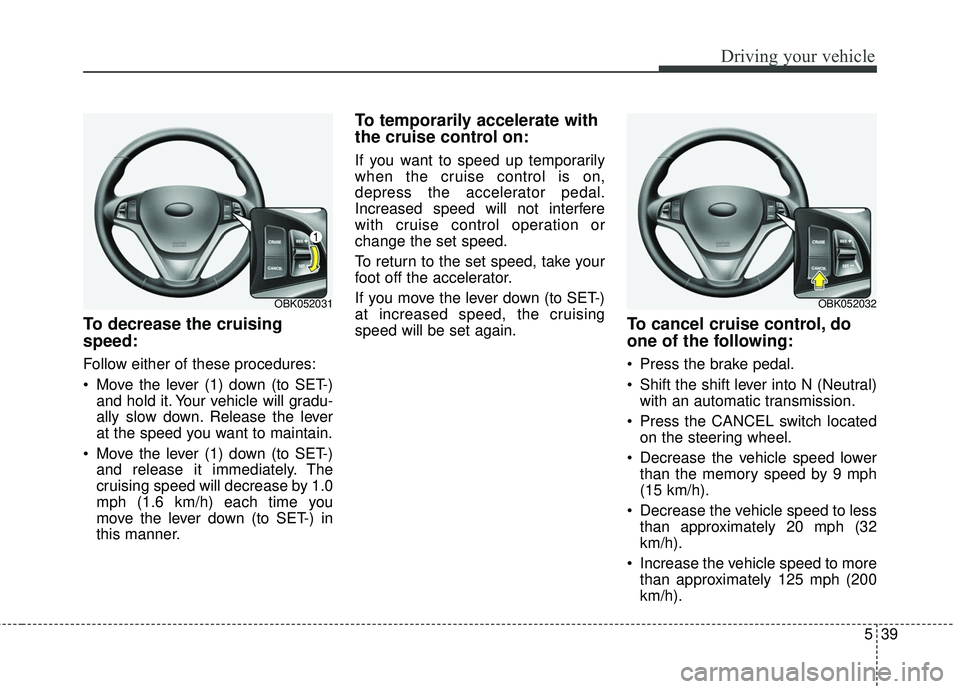
To decrease the cruising
speed:
Follow either of these procedures:
Move the lever (1) down (to SET-)and hold it. Your vehicle will gradu-
ally slow down. Release the lever
at the speed you want to maintain.
Move the lever (1) down (to SET-) and release it immediately. The
cruising speed will decrease by 1.0
mph (1.6 km/h) each time you
move the lever down (to SET-) in
this manner.
To temporarily accelerate with
the cruise control on:
If you want to speed up temporarily
when the cruise control is on,
depress the accelerator pedal.
Increased speed will not interfere
with cruise control operation or
change the set speed.
To return to the set speed, take your
foot off the accelerator.
If you move the lever down (to SET-)
at increased speed, the cruising
speed will be set again.
To cancel cruise control, do
one of the following:
Press the brake pedal.
Shift the shift lever into N (Neutral)with an automatic transmission.
Press the CANCEL switch located on the steering wheel.
Decrease the vehicle speed lower than the memory speed by 9 mph
(15 km/h).
Decrease the vehicle speed to less than approximately 20 mph (32
km/h).
Increase the vehicle speed to more than approximately 125 mph (200
km/h).
OBK052032OBK052031
Page 330 of 475
543
Driving your vehicle
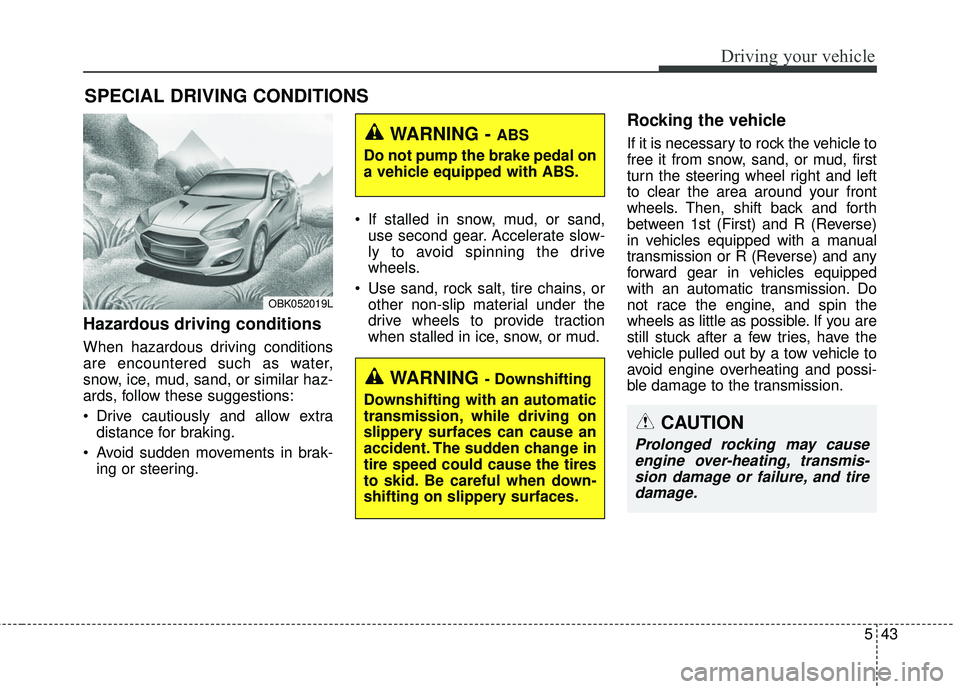
Hazardous driving conditions
When hazardous driving conditions
are encountered such as water,
snow, ice, mud, sand, or similar haz-
ards, follow these suggestions:
Drive cautiously and allow extradistance for braking.
Avoid sudden movements in brak- ing or steering. If stalled in snow, mud, or sand,
use second gear. Accelerate slow-
ly to avoid spinning the drive
wheels.
Use sand, rock salt, tire chains, or other non-slip material under the
drive wheels to provide traction
when stalled in ice, snow, or mud.
Rocking the vehicle
If it is necessary to rock the vehicle to
free it from snow, sand, or mud, first
turn the steering wheel right and left
to clear the area around your front
wheels. Then, shift back and forth
between 1st (First) and R (Reverse)
in vehicles equipped with a manual
transmission or R (Reverse) and any
forward gear in vehicles equipped
with an automatic transmission. Do
not race the engine, and spin the
wheels as little as possible. If you are
still stuck after a few tries, have the
vehicle pulled out by a tow vehicle to
avoid engine overheating and possi-
ble damage to the transmission.
SPECIAL DRIVING CONDITIONS
WARNING - ABS
Do not pump the brake pedal on
a vehicle equipped with ABS.
WARNING - Downshifting
Downshifting with an automatic
transmission, while driving on
slippery surfaces can cause an
accident. The sudden change in
tire speed could cause the tires
to skid. Be careful when down-
shifting on slippery surfaces.
CAUTION
Prolonged rocking may cause engine over-heating, transmis-sion damage or failure, and tiredamage.
OBK052019L
Page 348 of 475
63
What to do in an emergency
2.When the car is stopped, turn onyour emergency hazard flashers,
set the parking brake and put the
transmission in P (automatic trans-
mission) or reverse (manual trans-
mission).
3.Have all passengers get out of the car. Be sure they all get out on the
side of the car that is away from
traffic.
4.When changing a flat tire, follow the instruction provided later in this
section.
If engine stalls while driving
1. Reduce your speed gradually, keeping a straight line. Move cau-
tiously off the road to a safe place.
2. Turn on your emergency flashers.
3. Try to start the engine again. If your vehicle will not start, contact
an authorized HYUNDAI dealer or
seek other qualified assistance.
If engine doesn't turn over or
turns over slowly
1. If your vehicle has an automatictransmission, be sure the gear
selector lever is in N(Neutral) or
P(Park) and the emergency brake
is set.
2. Check the battery connections to be sure they are clean and tight.
3. Turn on the interior light. If the light dims or goes out when you oper-
ate the starter, the battery is dis-
charged.
4. Check the starter connections to be sure they are securely tight-
ened.
5. Do not push or pull the vehicle to start it. See instructions for "Jump
starting".
If the engine turns over nor-
mally but does not start
1. Check fuel level.
2. With the ignition switch in theLOCK position, check all connec-
tors at the ignition coils and spark
plugs. Reconnect any that may be
disconnected or loose.
3. If the engine still does not start, call an authorized HYUNDAI deal-
er or seek other qualified assis-
tance.
IF THE ENGINE WILL NOT START
WARNING
If the engine will not start, do
not push or pull the car to start
it. This could result in a collision
or cause other damage.
Page 350 of 475
65
What to do in an emergency
Jump starting procedure
1. Make sure the booster battery is12-volt and that its negative termi-
nal is grounded.
2. If the booster battery is in another vehicle, do not allow the vehicles
to touch.
3. Turn off all unnecessary electrical loads.
4. Connect the jumper cables in the exact sequence shown in the illus-
tration. First connect one end of a
jumper cable to the positive termi-
nal of the discharged battery (1),
then connect the other end to the
positive terminal on the booster
battery (2).
Proceed to connect one end of the
other jumper cable to the negative
terminal of the booster battery (3),
then the other end to a solid, sta-
tionary, metallic point (for example,
the engine lifting bracket) away
from the battery (4). Do not con-
nect it to or near any part that
moves when the engine is cranked.
Do not allow the jumper cables to
contact anything except the correct
battery terminals or the correct
ground. Do not lean over the bat-
tery when making connections. 5. Start the engine of the vehicle with
the booster battery and let it run at
2,000 rpm, then start the engine of
the vehicle with the discharged
battery.
6. After jump start of your vehicle run the vehicle for at least 15 minutes
either at idle or driving the vehicle
before turning off the engine. This
will assure the vehicle can be
started next time after the engine
is shut off.
If the cause of your battery discharg-
ing is not apparent, you should have
your vehicle checked by an author-
ized HYUNDAI dealer.
Push-starting
Your manual transmission-equipped
vehicle should not be push-started
because it might damage the emis-
sion control system.
Vehicles equipped with automatic
transmission cannot be push-started.
Follow the directions in this section
for jump-starting.
WARNING
Never tow a vehicle to start it
because the sudden surge for-
ward when the engine starts
could cause a collision with the
tow vehicle.
CAUTION - Battery cables
Do not connect the jumper cable from the negative terminalof the booster battery to thenegative terminal of the dis-charged battery. This can causethe discharged battery to over-heat and crack, releasing bat-tery acid.
Page 358 of 475
613
What to do in an emergency
Removing and storing the
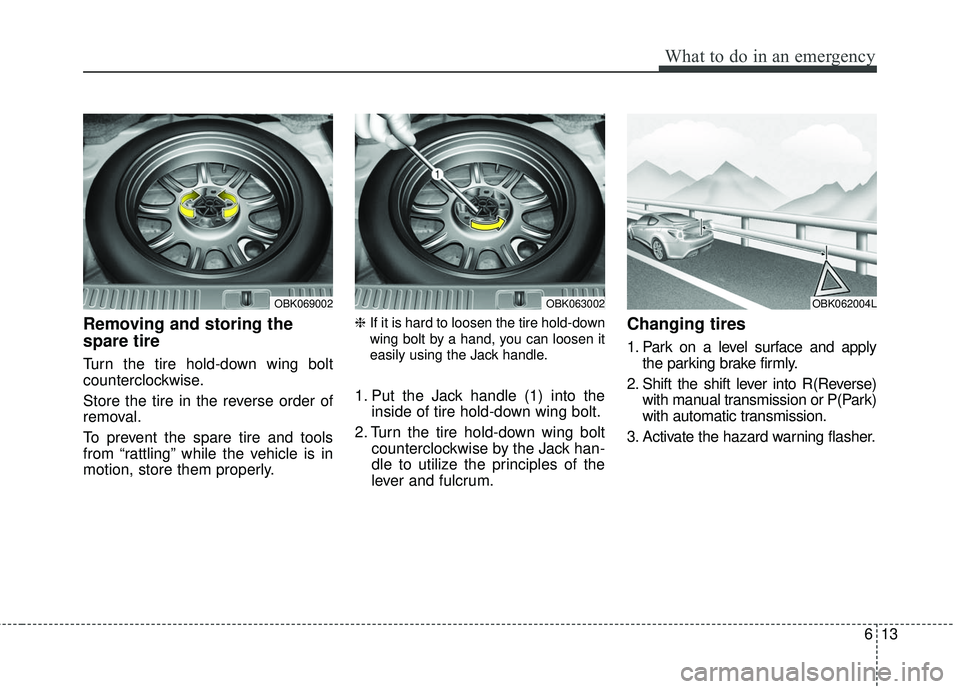
spare tire
Turn the tire hold-down wing bolt
counterclockwise.
Store the tire in the reverse order of
removal.
To prevent the spare tire and tools
from “rattling” while the vehicle is in
motion, store them properly.
❈If it is hard to loosen the tire hold-down
wing bolt by a hand, you can loosen it
easily using the Jack handle.
1. Put the Jack handle (1) into the
inside of tire hold-down wing bolt.
2. Turn the tire hold-down wing bolt counterclockwise by the Jack han-
dle to utilize the principles of the
lever and fulcrum.
Changing tires
1. Park on a level surface and applythe parking brake firmly.
2. Shift the shift lever into R(Reverse) with manual transmission or P(Park)
with automatic transmission.
3. Activate the hazard warning flasher.
OBK069002OBK063002OBK062004L
Page 369 of 475
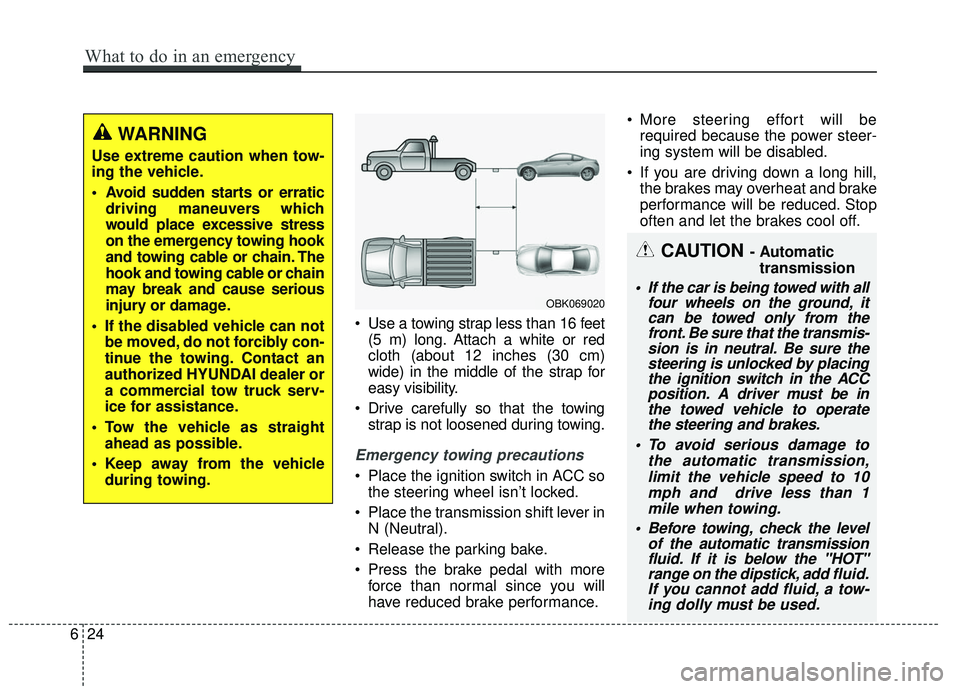
Use a towing strap less than 16 feet(5 m) long. Attach a white or red
cloth (about 12 inches (30 cm)
wide) in the middle of the strap for
easy visibility.
Drive carefully so that the towing strap is not loosened during towing.
Emergency towing precautions
Place the ignition switch in ACC sothe steering wheel isn’t locked.
Place the transmission shift lever in N (Neutral).
Release the parking bake.
Press the brake pedal with more force than normal since you will
have reduced brake performance. More steering effort will be
required because the power steer-
ing system will be disabled.
If you are driving down a long hill, the brakes may overheat and brake
performance will be reduced. Stop
often and let the brakes cool off.
WARNING
Use extreme caution when tow-
ing the vehicle.
driving maneuvers which
would place excessive stress
on the emergency towing hook
and towing cable or chain. The
hook and towing cable or chain
may break and cause serious
injury or damage.
If the disabled vehicle can not be moved, do not forcibly con-
tinue the towing. Contact an
authorized HYUNDAI dealer or
a commercial tow truck serv-
ice for assistance.
Tow the vehicle as straight ahead as possible.
Keep away from the vehicle during towing.
OBK069020
CAUTION - Automatictransmission
If the car is being towed with all four wheels on the ground, itcan be towed only from thefront. Be sure that the transmis-sion is in neutral. Be sure thesteering is unlocked by placingthe ignition switch in the ACCposition. A driver must be inthe towed vehicle to operatethe steering and brakes.
To avoid serious damage to the automatic transmission,limit the vehicle speed to 10mph and drive less than 1mile when towing.
Before towing, check the level of the automatic transmissionfluid. If it is below the "HOT"range on the dipstick, add fluid.
If you cannot add fluid, a tow- ing dolly must be used.
624
What to do in an emergency
Page 370 of 475
Maintenance
Engine compartment . . . . . . . . . . . . . . . . . . . . . . . . 7-2
Maintenance services . . . . . . . . . . . . . . . . . . . . . . . . 7-4
• Owner’s responsibility. . . . . . . . . . . . . . . . . . . . . . 7-4
. . . . . . . . . . . . . . . 7-4
Owner maintenance . . . . . . . . . . . . . . . . . . . . . . . . . 7-5
. . . . . . . . . . . . . . . . . 7-5
Scheduled maintenance service . . . . . . . . . . . . . . . 7-7
. . . . . . . . . . . . . . . . 7-8
. . . . . . 7-19
Explanation of scheduled maintenance items . . . . 7-20
Engine oil . . . . . . . . . . . . . . . . . . . . . . . . . . . . . . . . . 7-23
Engine coolant . . . . . . . . . . . . . . . . . . . . . . . . . . . . . 7-25
Brake and clutch fluid . . . . . . . . . . . . . . . . . . . . . . . 7-28
Power steering fluid . . . . . . . . . . . . . . . . . . . . . . . . . 7-29
Automatic transmission fluid . . . . . . . . . . . . . . . . . 7-30
Manual transmission fluid . . . . . . . . . . . . . . . . . . . 7-30
Washer fluid . . . . . . . . . . . . . . . . . . . . . . . . . . . . . . . 7-30
Parking brake . . . . . . . . . . . . . . . . . . . . . . . . . . . . . . 7-31
Air cleaner . . . . . . . . . . . . . . . . . . . . . . . . . . . . . . . . 7-32
Climate control air filter . . . . . . . . . . . . . . . . . . . . . 7-33
Wiper blades . . . . . . . . . . . . . . . . . . . . . . . . . . . . . . . 7-35
Battery. . . . . . . . . . . . . . . . . . . . . . . . . . . . . . . . . . . . \
7-38 Tires and wheels . . . . . . . . . . . . . . . . . . . . . . . . . . . . 7-41
. . . . . . . . . . . . . . . . . . . . . . . . . . . . . . . . . 7-41
. . . . . . . 7-41
. . . . . . . . . . . . . . . 7-42
. . . . . . . . . . . . . . . . . . . . . . . . . . . . . . 7-43
. . . . . . . . . . . . . . 7-44
. . . . . . . . . . . . . . . . . . . . . . . . . . . 7-45
. . . . . . . . . . . . . . . . . . . . . . . . . 7-46
. . . . . . . . . . . . . . . . . . . . . . . . . . . . . . 7-47
. . . . . . . . . . . . . . . . . . . . . . . . . . 7-47
. . . . . . . . . . . . . . . . . . . . . . . 7-47
. . . . . . . . . . . . . . . 7-51
. . . . . . . . . . . . . . . . . . . . . . . . . . . . 7-52
. . . . . . . . . . . . . . . . . . . . . . . . . . . . . 7-53
. . . . . . . . . . . . . . . . . . . . . . . . . . . . . . . . 7-53
. . . . . . . . . . . . . . . . . . . . . . . . . . . . . . . 7-53
. . . . . . . . . . . . . . . . . . . . . . . . . . . . 7-54
Fuses . . . . . . . . . . . . . . . . . . . . . . . . . . . . . . . . . . . . \
. 7-55
. . . . . . . . . . . . . 7-56
. . . . . . . . . . 7-57
. . . . . . . . . . . . . . . . . . . . 7-587
Page 375 of 475
Maintenance
67
While operating your vehicle:
Note any changes in the sound ofthe exhaust or any smell of
exhaust fumes in the vehicle.
Check for vibrations in the steering wheel. Notice any increased steer-
ing effort or looseness in the steer-
ing wheel, or change in its straight-
ahead position.
Notice if your vehicle constantly turns slightly or “pulls” to one side
when traveling on smooth, level
road.
When stopping, listen and check for unusual sounds, pulling to one
side, increased brake pedal travel
or “hard-to-push” brake pedal.
If any slipping or changes in the operation of your transmission
occurs, check the transmission
fluid level.
Check automatic transmission P (Park) function.
Check parking brake.
Check for fluid leaks under your vehicle (water dripping from the air
conditioning system during or after
use is normal).
At least monthly:
Check the coolant level in theengine coolant reservoir.
Check the operation of all exterior lights, including the stoplights, turn
signals and hazard warning flash-
ers.
Check the inflation pressures of all tires including the spare.
At least twice a year
(i.e., every Spring and Fall):
Check the radiator, heater and air conditioning hoses for leaks or
damage.
Check the windshield washer spray and wiper operation. Clean
the wiper blades with clean cloth
dampened with washer fluid.
Check the headlight alignment.
Check the muffler, exhaust pipes, shields and clamps.
Check the lap/shoulder belts for wear and function.
Check for worn tires and loose wheel lug nuts.
Page 387 of 475
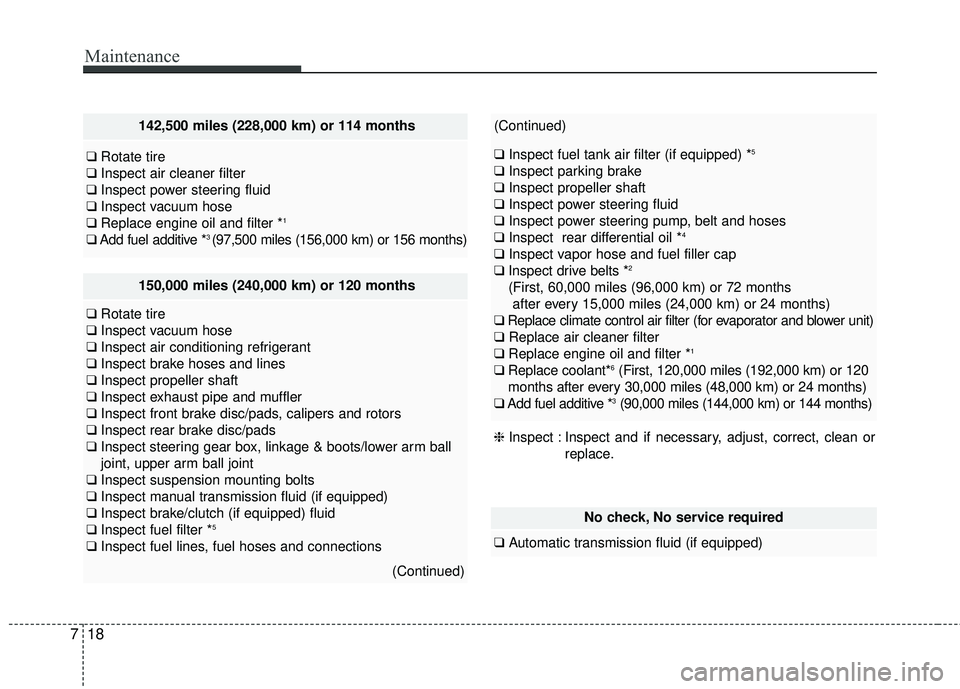
Maintenance
18
7
142,500 miles (228,000 km) or 114 months
❑ Rotate tire
❑ Inspect air cleaner filter
❑ Inspect power steering fluid
❑ Inspect vacuum hose
❑ Replace engine oil and filter *
1
❑Add fuel additive *3 (97,500 miles (156,000 km) or 156 months)
(Continued)
❑ Inspect fuel tank air filter (if equipped) *5
❑Inspect parking brake
❑ Inspect propeller shaft
❑ Inspect power steering fluid
❑ Inspect power steering pump, belt and hoses
❑ Inspect rear differential oil *
4
❑Inspect vapor hose and fuel filler cap
❑ Inspect drive belts *2
(First, 60,000 miles (96,000 km) or 72 months
after every 15,000 miles (24,000 km) or 24 months)
❑ Replace climate control air filter (for evaporator and blower unit)
❑ Replace air cleaner filter
❑ Replace engine oil and filter *
1
❑Replace coolant*6(First, 120,000 miles (192,000 km) or 120
months after every 30,000 miles (48,000 km) or 24 months)
❑ Add fuel additive *
3 (90,000 miles (144,000 km) or 144 months)
150,000 miles (240,000 km) or 120 months
❑ Rotate tire
❑ Inspect vacuum hose
❑ Inspect air conditioning refrigerant
❑ Inspect brake hoses and lines
❑ Inspect propeller shaft
❑ Inspect exhaust pipe and muffler
❑ Inspect front brake disc/pads, calipers and rotors
❑ Inspect rear brake disc/pads
❑ Inspect steering gear box, linkage & boots/lower arm ball
joint, upper arm ball joint
❑ Inspect suspension mounting bolts
❑ Inspect manual transmission fluid (if equipped)
❑ Inspect brake/clutch (if equipped) fluid
❑ Inspect fuel filter *
5
❑Inspect fuel lines, fuel hoses and connections
(Continued)
No check, No service required
❑Automatic transmission fluid (if equipped)
❈ Inspect : Inspect and if necessary, adjust, correct, clean or
replace.
Page 388 of 475
719
Maintenance
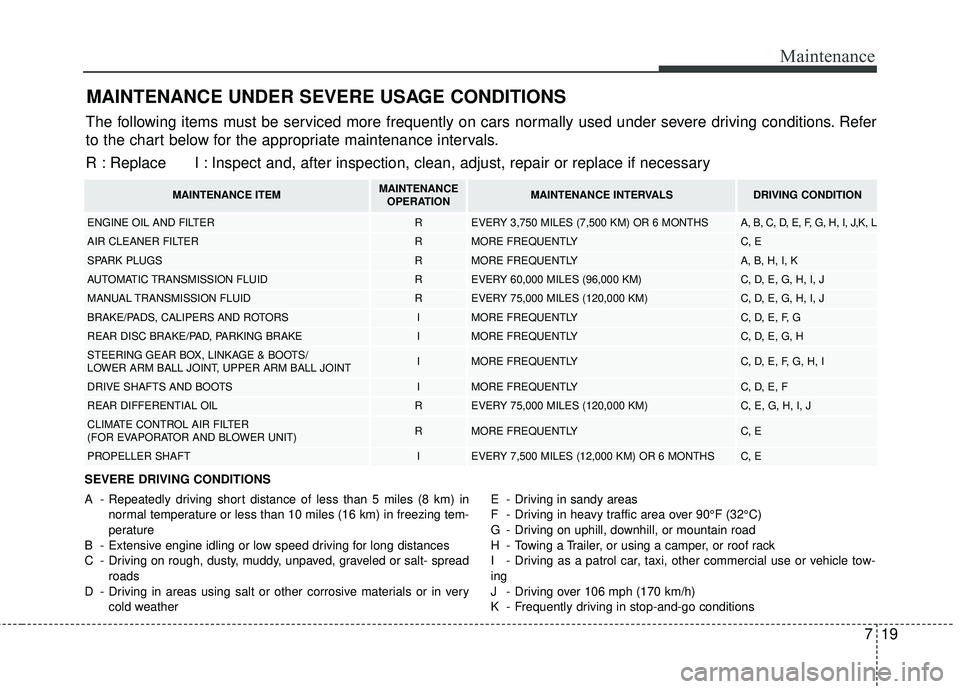
MAINTENANCE UNDER SEVERE USAGE CONDITIONS
SEVERE DRIVING CONDITIONS
A - Repeatedly driving short distance of less than 5 miles (8 km) innormal temperature or less than 10 miles (16 km) in freezing tem-
perature
B - Extensive engine idling or low speed driving for long distances
C - Driving on rough, dusty, muddy, unpaved, graveled or salt- spread roads
D - Driving in areas using salt or other corrosive materials or in very cold weather E - Driving in sandy areas
F - Driving in heavy traffic area over 90°F (32°C)
G - Driving on uphill, downhill, or mountain road
H - Towing a Trailer, or using a camper, or roof rack
I - Driving as a patrol car, taxi, other commercial use or vehicle tow-
ing
J - Driving over 106 mph (170 km/h)
K - Frequently driving in stop-and-go conditions
The following items must be serviced more frequently on cars normally used under severe driving conditions. Refer
to the chart below for the appropriate maintenance intervals.
R : Replace I : Inspect and, after inspection, clean, adjust, repair or replace if neces\
sary
MAINTENANCE ITEMMAINTENANCE
OPERATIONMAINTENANCE INTERVALSDRIVING CONDITION
ENGINE OIL AND FILTERREVERY 3,750 MILES (7,500 KM) OR 6 MONTHSA, B, C, D, E, F, G, H, I, J,K, L
AIR CLEANER FILTERRMORE FREQUENTLYC, E
SPARK PLUGSRMORE FREQUENTLYA, B, H, I, K
AUTOMATIC TRANSMISSION FLUIDREVERY 60,000 MILES (96,000 KM)C, D, E, G, H, I, J
MANUAL TRANSMISSION FLUIDREVERY 75,000 MILES (120,000 KM)C, D, E, G, H, I, J
BRAKE/PADS, CALIPERS AND ROTORSIMORE FREQUENTLYC, D, E, F, G
REAR DISC BRAKE/PAD, PARKING BRAKEIMORE FREQUENTLYC, D, E, G, H
STEERING GEAR BOX, LINKAGE & BOOTS/
LOWER ARM BALL JOINT, UPPER ARM BALL JOINTIMORE FREQUENTLYC, D, E, F, G, H, I
DRIVE SHAFTS AND BOOTSIMORE FREQUENTLYC, D, E, F
REAR DIFFERENTIAL OIL REVERY 75,000 MILES (120,000 KM)C, E, G, H, I, J
CLIMATE CONTROL AIR FILTER
(FOR EVAPORATOR AND BLOWER UNIT)RMORE FREQUENTLYC, E
PROPELLER SHAFTIEVERY 7,500 MILES (12,000 KM) OR 6 MONTHSC, E