engine oil HYUNDAI GENESIS G80 2013 Owner's Manual
[x] Cancel search | Manufacturer: HYUNDAI, Model Year: 2013, Model line: GENESIS G80, Model: HYUNDAI GENESIS G80 2013Pages: 432, PDF Size: 29.24 MB
Page 355 of 432
721
Maintenance
POWER STEERING FLUID
G090100ABH
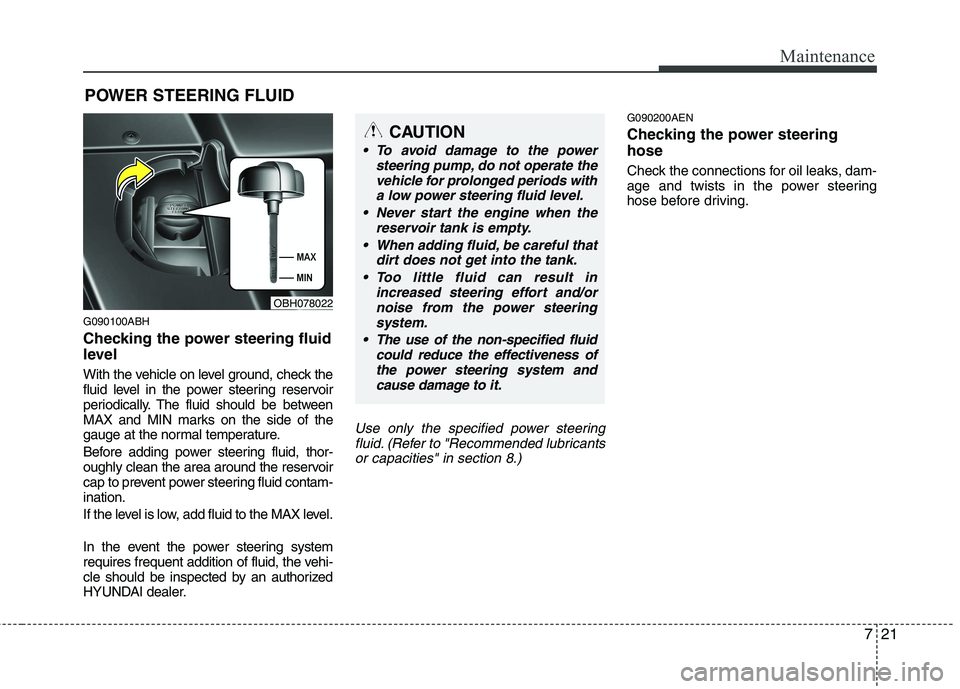
Checking the power steering fluid
level
With the vehicle on level ground, check the
fluid level in the power steering reservoir
periodically. The fluid should be between
MAX and MIN marks on the side of the
gauge at the normal temperature.
Before adding power steering fluid, thor-
oughly clean the area around the reservoir
cap to prevent power steering fluid contam-
ination.
If the level is low, add fluid to the MAX level.
In the event the power steering system
requires frequent addition of fluid, the vehi-
cle should be inspected by an authorized
HYUNDAI dealer.
Use only the specified power steeringfluid. (Refer to "Recommended lubricantsor capacities" in section 8.)
G090200AEN
Checking the power steering
hose
Check the connections for oil leaks, dam-
age and twists in the power steering
hose before driving.
CAUTION
• To avoid damage to the power steering pump, do not operate thevehicle for prolonged periods witha low power steering fluid level.
Never start the engine when the reservoir tank is empty.
When adding fluid, be careful that dirt does not get into the tank.
Too little fluid can result in increased steering effort and/ornoise from the power steeringsystem.
The use of the non-specified fluid could reduce the effectiveness ofthe power steering system andcause damage to it.
OBH078022
Page 367 of 432
733
Maintenance
G190300ABH
Reset items
Items should be reset after the battery
has been discharged or the battery has
been disconnected.
Auto up/down window (See section 4)
Sunroof (See section 4)
Driver position memory system
(See section 4)
Trip computer (See section 4)
Climate control system
(See section 4)
Clock (See section 4)
Audio (See section 4)
WARNING
Before performing maintenance
or recharging the battery, turn off
all accessories and stop the
engine.
The negative battery cable must
be removed first and installed
last when the battery is discon-
nected.
Operation related to the battery
should be done at an authorized
HYUNDAI dealer.
CAUTION
Keep the battery away from water
or any liquid.
The battery is in the trunk, so you
should be careful when you load
a container filled with liquid into
the trunk.
For your safety, use a genuine
HYUNDAI approved battery when
you replace the battery.
WARNING- Recharging
battery
When recharging the battery,
observe the following precautions:
The battery must be removed
from the vehicle and placed in an
area with good ventilation.
Do not allow cigarettes, sparks,
or flame near the battery.
Watch the battery during charg-
ing, and stop or reduce the charg-
ing rate if the battery cells begin
gassing (boiling) violently or if
the temperature of the electrolyte
of any cell exceeds 120°F (49°C).
Wear eye protection when check-
ing the battery during charging.
Disconnect the battery charger in
the following order.
1. Turn off the battery charger main
switch.
2. Unhook the negative clamp from
the negative battery terminal.
3. Unhook the positive clamp from
the positive battery terminal.
Page 382 of 432
Maintenance
48 7
FUSES
G210000ABH-EU
A vehicle’s electrical system is protected
from electrical overload damage by
fuses.This vehicle has 4 fuse panels, two locat-
ed in the driver’s side and passenger’s
side panel bolster, the others are in the
engine compartment.
If any of your vehicle’s lights, acces-
sories, or controls do not work, check the
appropriate circuit fuse. If a fuse has
blown, the element inside the fuse will be
melted.
If the electrical system does not work,
first check the driver’s side fuse panel.
Before replacing a blown fuse, discon-
nect the negative battery cable.
Always replace a blown fuse with one of
the same rating.
If the replacement fuse blows, this indi-
cates an electrical problem. Avoid using
the system involved and immediately
consult an authorized HYUNDAI dealer.
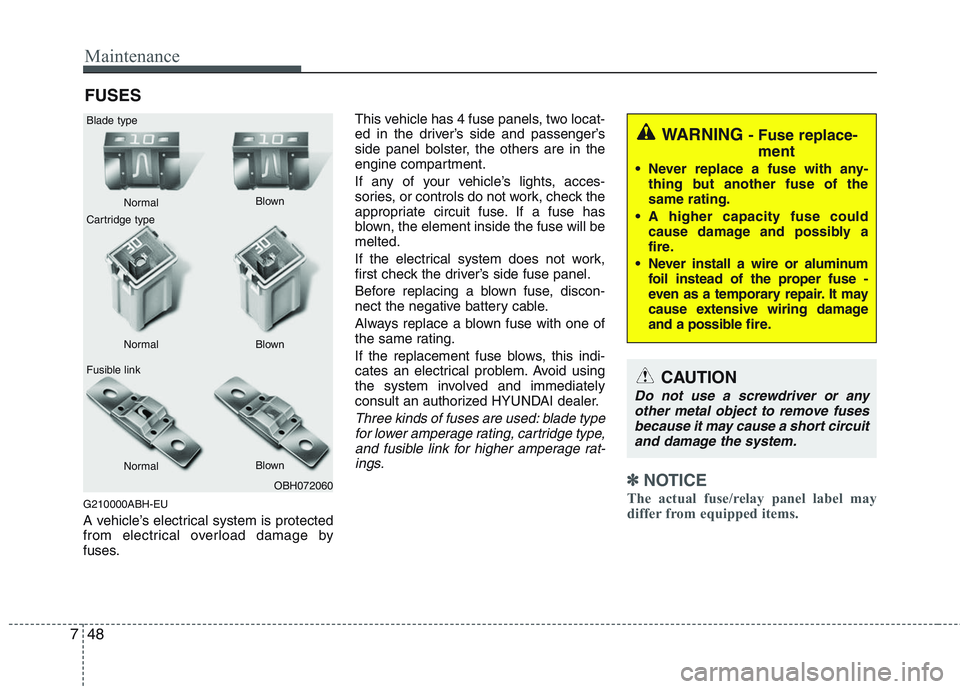
Three kinds of fuses are used: blade type
for lower amperage rating, cartridge type,
and fusible link for higher amperage rat-
ings.
✽ ✽
NOTICE
The actual fuse/relay panel label may
differ from equipped items.OBH072060 Normal Normal Blade type
Cartridge type
Fusible linkBlown
Blown
NormalBlown
WARNING - Fuse replace-
ment
Never replace a fuse with any-
thing but another fuse of the
same rating.
A higher capacity fuse could
cause damage and possibly a
fire.
Never install a wire or aluminum
foil instead of the proper fuse -
even as a temporary repair. It may
cause extensive wiring damage
and a possible fire.
CAUTION
Do not use a screwdriver or any
other metal object to remove fuses
because it may cause a short circuit
and damage the system.
Page 394 of 432
Maintenance
60 7
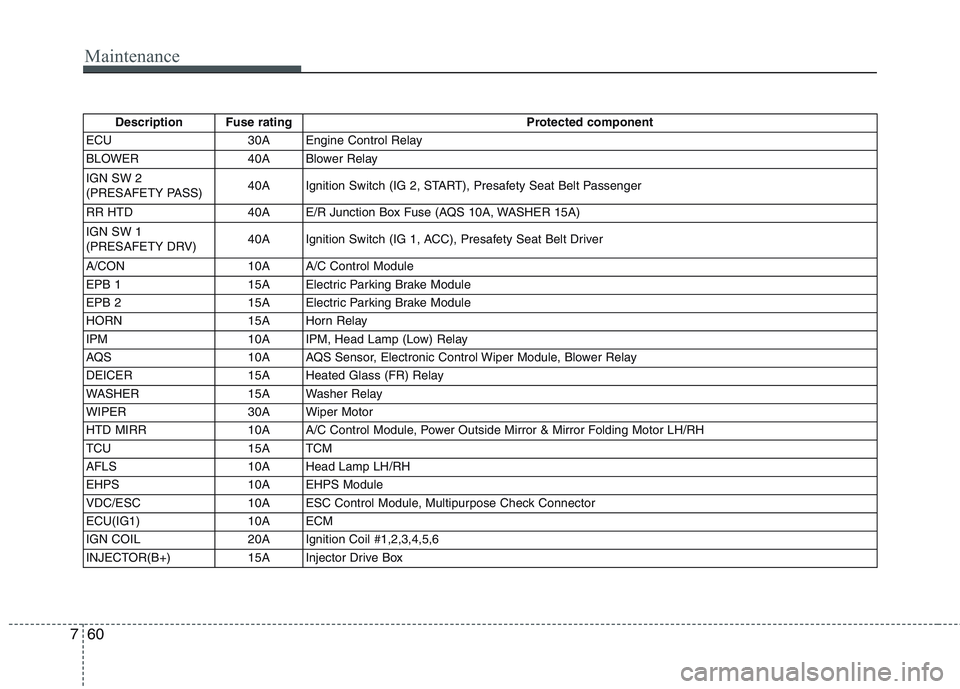
Description Fuse rating Protected component
ECU 30A Engine Control Relay
BLOWER 40A Blower Relay
IGN SW 2
(PRESAFETY PASS)40A Ignition Switch (IG 2, START), Presafety Seat Belt Passenger
RR HTD 40A E/R Junction Box Fuse (AQS 10A, WASHER 15A)
IGN SW 1
(PRESAFETY DRV)40A Ignition Switch (IG 1, ACC), Presafety Seat Belt Driver
A/CON 10A A/C Control Module
EPB 1 15A Electric Parking Brake Module
EPB 2 15A Electric Parking Brake Module
HORN 15A Horn Relay
IPM 10A IPM, Head Lamp (Low) Relay
AQS 10A AQS Sensor, Electronic Control Wiper Module, Blower Relay
DEICER 15A Heated Glass (FR) Relay
WASHER 15A Washer Relay
WIPER 30A Wiper Motor
HTD MIRR 10A A/C Control Module, Power Outside Mirror & Mirror Folding Motor LH/RH
TCU 15A TCM
AFLS 10A Head Lamp LH/RH
EHPS 10A EHPS Module
VDC/ESC 10A ESC Control Module, Multipurpose Check Connector
ECU(IG1) 10A ECM
IGN COIL 20A Ignition Coil #1,2,3,4,5,6
INJECTOR(B+) 15A Injector Drive Box
Page 406 of 432
Maintenance
72 7
Waxing
A good coat of wax is a barrier between
your paint and contaminate. Keeping a
good coat of wax on your vehicle will help
protect it.
Wax the vehicle when water will no
longer bead on the paint.
Always wash and dry the vehicle before
waxing. Use a good quality liquid or
paste wax, and follow the manufacturer’s
instructions. Wax all metal trim to protect
it and to maintain its luster.
Removing oil, tar, and similar materials
with a spot remover will usually strip the
wax from the finish. Be sure to re-wax
these areas even if the rest of the vehicle
does not yet need waxing.G230103AUN
Finish damage repair
Deep scratches or stone chips in the
painted surface must be repaired
promptly. Exposed metal will quickly rust
and may develop into a major repair
expense.
✽ ✽
NOTICE
If your vehicle is damaged and requires
any metal repair or replacement, be sure
the body shop applies anti-corrosion
materials to the parts repaired or
replaced.
CAUTION
Wiping dust or dirt off the body
with a dry cloth will scratch the
finish.
Do not use steel wool, abrasive
cleaners, or strong detergents
containing highly alkaline or
caustic agents on chrome-plated
or anodized aluminum parts. This
may result in damage to the pro-
tective coating and cause discol-
oration or paint deterioration.
CAUTION
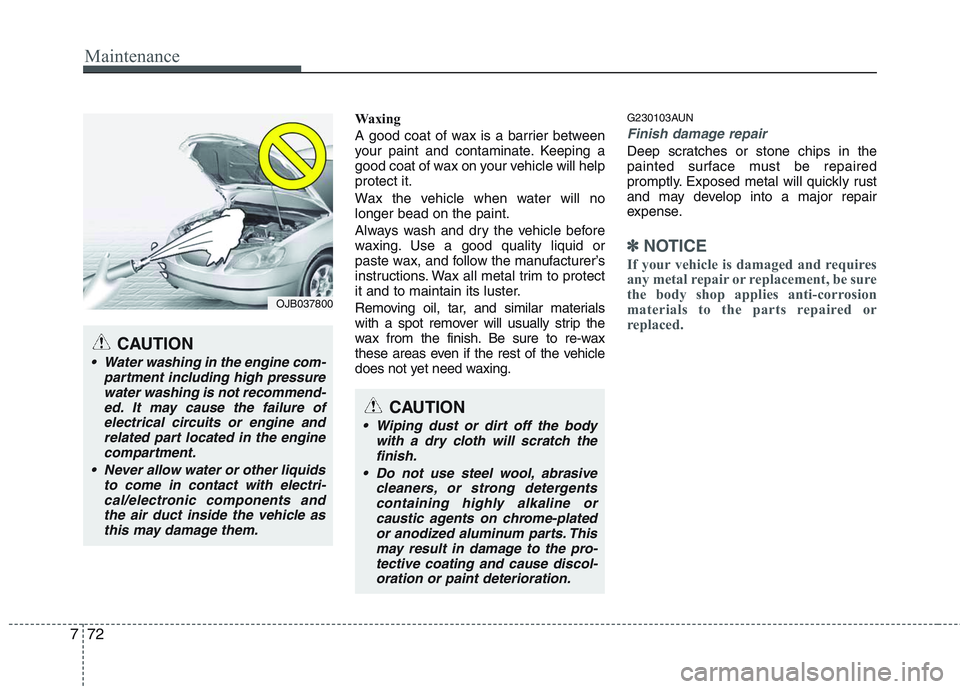
Water washing in the engine com-
partment including high pressure
water washing is not recommend-
ed. It may cause the failure of
electrical circuits or engine and
related part located in the engine
compartment.
Never allow water or other liquids
to come in contact with electri-
cal/electronic components and
the air duct inside the vehicle as
this may damage them.
OJB037800
Page 415 of 432
Maintenance
8 7
G040100ABH-EU
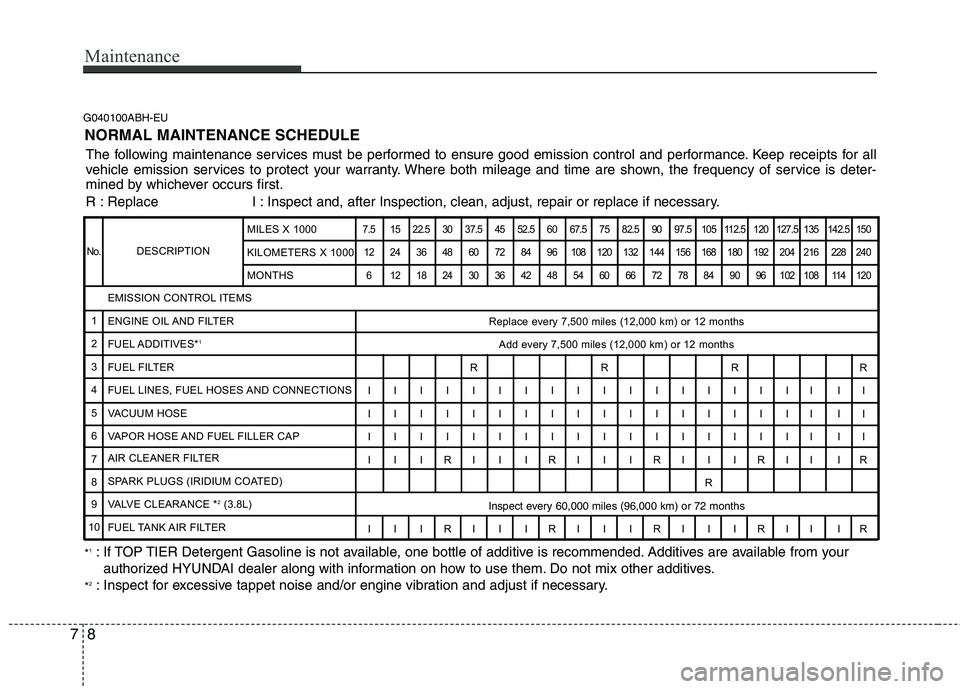
The following maintenance services must be performed to ensure good emission control and performance. Keep receipts for all
vehicle emission services to protect your warranty. Where both mileage and time are shown, the frequency of service is deter-
mined by whichever occurs first.
R : Replace I : Inspect and, after Inspection, clean, adjust, repair or replace if necessary.
NORMAL MAINTENANCE SCHEDULE
*1: If TOP TIER Detergent Gasoline is not available, one bottle of additive is recommended. Additives are available from your
authorized HYUNDAI dealer along with information on how to use them. Do not mix other additives.
*2: Inspect for excessive tappet noise and/or engine vibration and adjust if necessary.
DESCRIPTION
7.5 15 22.5 30 37.5 45 52.5 60 67.5 75 82.5 90 97.5 105 112.5 120 127.5 135 142.5 150
12 24 36 48 60 72 84 96 108 120 132 144 156 168 180 192 204 216 228 240
6 121824303642485460667278849096102108114120
Replace every 7,500 miles (12,000 km) or 12 months
Add every 7,500 miles (12,000 km) or 12 months
RRRR
IIIIIIIIIIIIIIIIII II
IIIIIIIIIIIIIIIIII II
IIIIIIIIIIIIIIIIII II
I I IRI I IRI I IRI I IRII IR
R
Inspect every 60,000 miles (96,000 km) or 72 months
I I IRI I IRI I IRI I IRII IR EMISSION CONTROL ITEMS
ENGINE OIL AND FILTER
FUEL ADDITIVES*
1
FUEL FILTER
FUEL LINES, FUEL HOSES AND CONNECTIONS
VACUUM HOSE
VAPOR HOSE AND FUEL FILLER CAP
AIR CLEANER FILTER
SPARK PLUGS (IRIDIUM COATED)
VALVE CLEARANCE *
2(3.8L)
FUEL TANK AIR FILTER
No.
1
2
3
4
5
6
7
8
9
10MILES X 1000
KILOMETERS X 1000
MONTHS
Page 419 of 432
Specifications, Consumer information, Reporting safety defects
4 8
RECOMMENDED LUBRICANTS AND CAPACITIES
I040000BBH-EU
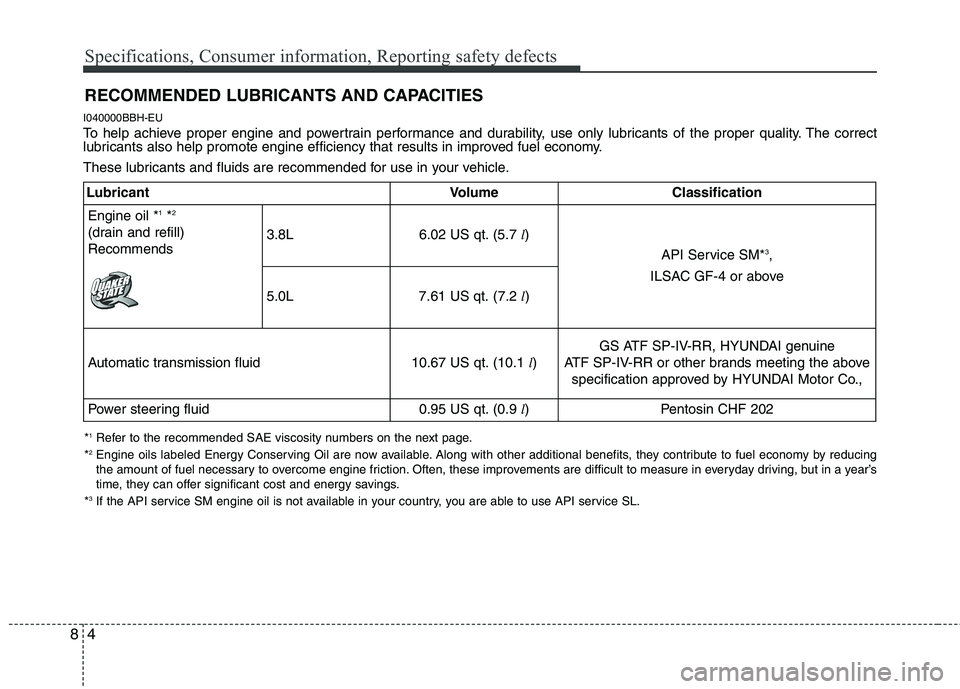
To help achieve proper engine and powertrain performance and durability, use only lubricants of the proper quality. The correct
lubricants also help promote engine efficiency that results in improved fuel economy.
These lubricants and fluids are recommended for use in your vehicle.
*1Refer to the recommended SAE viscosity numbers on the next page.
*2Engine oils labeled Energy Conserving Oil are now available. Along with other additional benefits, they contribute to fuel economy by reducing
the amount of fuel necessary to overcome engine friction. Often, these improvements are difficult to measure in everyday driving, but in a year’s
time, they can offer significant cost and energy savings.
*
3If the API service SM engine oil is not available in your country, you are able to use API service SL.
LubricantVolumeClassification
Engine oil *1*2
(drain and refill)
Recommends3.8L6.02 US qt. (5.7 l)
API Service SM*3,
ILSAC GF-4 or above
5.0L7.61 US qt. (7.2 l)
Automatic transmission fluid10.67 US qt. (10.1 l)
GS ATF SP-IV-RR, HYUNDAI genuine
ATF SP-IV-RR or other brands meeting the above
specification approved by HYUNDAI Motor Co.,
Power steering fluid0.95 US qt. (0.9 l)Pentosin CHF 202
Page 421 of 432
Specifications, Consumer information, Reporting safety defects
6 8
I040100ABH-EU
Recommended SAE viscosity
number
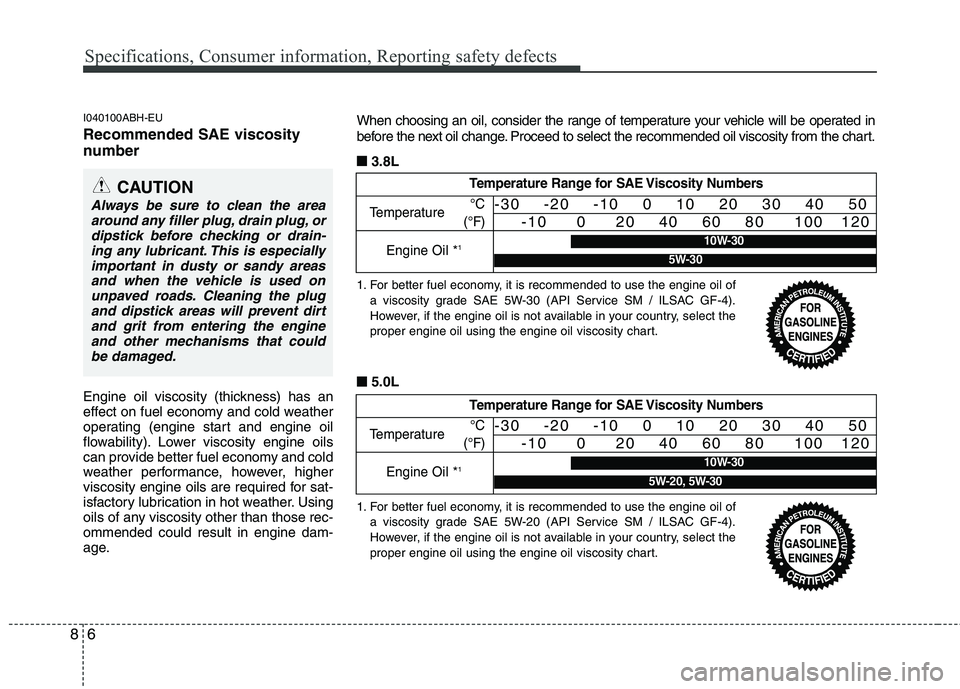
Engine oil viscosity (thickness) has an
effect on fuel economy and cold weather
operating (engine start and engine oil
flowability). Lower viscosity engine oils
can provide better fuel economy and cold
weather performance, however, higher
viscosity engine oils are required for sat-
isfactory lubrication in hot weather. Using
oils of any viscosity other than those rec-
ommended could result in engine dam-
age.
CAUTION
Always be sure to clean the area
around any filler plug, drain plug, or
dipstick before checking or drain-
ing any lubricant. This is especially
important in dusty or sandy areas
and when the vehicle is used on
unpaved roads. Cleaning the plug
and dipstick areas will prevent dirt
and grit from entering the engine
and other mechanisms that could
be damaged.
Temperature Range for SAE Viscosity Numbers
Temperature
Engine Oil *
1
°C
(°F)-30 -20 -10 0 10 20 30 40 50
-10 0 20 40 60 80 100 120
1. For better fuel economy, it is recommended to use the engine oil of
a viscosity grade SAE 5W-30 (API Service SM / ILSAC GF-4).
However, if the engine oil is not available in your country, select the
proper engine oil using the engine oil viscosity chart.
10W-30
5W-30
Temperature Range for SAE Viscosity Numbers
Temperature
Engine Oil *
1
°C
(°F)-30 -20 -10 0 10 20 30 40 50
-10 0 20 40 60 80 100 120
1. For better fuel economy, it is recommended to use the engine oil of
a viscosity grade SAE 5W-20 (API Service SM / ILSAC GF-4).
However, if the engine oil is not available in your country, select the
proper engine oil using the engine oil viscosity chart.
10W-30
5W-20, 5W-30
When choosing an oil, consider the range of temperature your vehicle will be operated in
before the next oil change. Proceed to select the recommended oil viscosity from the chart.
■ ■
3.8L
■ ■
5.0L
Page 428 of 432
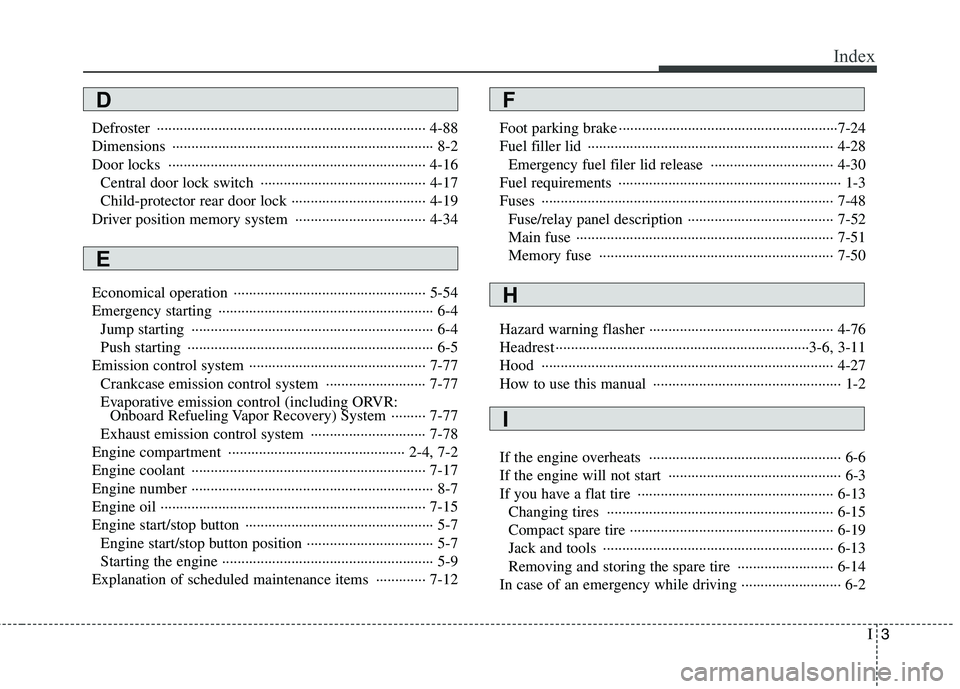
I3
Index
Defroster ······································································ 4-88
Dimensions ···································································· 8-2
Door locks ··································································· 4-16
Central door lock switch ··········································· 4-17
Child-protector rear door lock ··································· 4-19
Driver position memory system ·································· 4-34
Economical operation ·················································· 5-54
Emergency starting ························································ 6-4
Jump starting ······························································· 6-4
Push starting ································································ 6-5
Emission control system ·············································· 7-77
Crankcase emission control system ·························· 7-77
Evaporative emission control (including ORVR:
Onboard Refueling Vapor Recovery) System ········· 7-77
Exhaust emission control system ······························ 7-78
Engine compartment ·············································· 2-4, 7-2
Engine coolant ····························································· 7-17
Engine number ······························································· 8-7
Engine oil ····································································· 7-15
Engine start/stop button ················································· 5-7
Engine start/stop button position ································· 5-7
Starting the engine ······················································· 5-9
Explanation of scheduled maintenance items ············· 7-12Foot parking brake ·························································7-24
Fuel filler lid ································································ 4-28
Emergency fuel filer lid release ································ 4-30
Fuel requirements ·························································· 1-3
Fuses ············································································ 7-48
Fuse/relay panel description ······································ 7-52
Main fuse ··································································· 7-51
Memory fuse ····························································· 7-50
Hazard warning flasher ················································ 4-76
Headrest ··································································3-6, 3-11
Hood ············································································ 4-27
How to use this manual ················································· 1-2
If the engine overheats ·················································· 6-6
If the engine will not start ············································· 6-3
If you have a flat tire ··················································· 6-13
Changing tires ··························································· 6-15
Compact spare tire ····················································· 6-19
Jack and tools ···························································· 6-13
Removing and storing the spare tire ························· 6-14
In case of an emergency while driving ·························· 6-2
D
E
F
H
I