service HYUNDAI GENESIS G80 2014 Owner's Guide
[x] Cancel search | Manufacturer: HYUNDAI, Model Year: 2014, Model line: GENESIS G80, Model: HYUNDAI GENESIS G80 2014Pages: 432, PDF Size: 29.24 MB
Page 375 of 432

741
Maintenance
Tire speed ratings
The chart below lists many of the dif-
ferent speed ratings currently being
used for passenger car tires. The
speed rating is part of the tire size
designation on the sidewall of the
tire. This symbol corresponds to that
tire's designed maximum safe oper-
ating speed.
G201003AEN
3. Checking tire life (TIN : Tire
Identification Number)
Any tires that are over 6 years old,
based on the manufacturing date,
(including the spare tire) should be
replaced by new ones. You can find
the manufacturing date on the tire
sidewall (possibly on the inside of the
wheel), displaying the DOT Code.
The DOT Code is a series of num-
bers on a tire consisting of numbers
and English letters. The manufactur-
ing date is designated by the last four
digits (characters) of the DOT code.
DOT : XXXX XXXX OOOO
The front part of the DOT means a
plant code number, tire size and
tread pattern and the last four num-
bers indicate week and year manu-
factured.
For example:
DOT XXXX XXXX 1613 represents
that the tire was produced in the 16th
week of 2013.
S 112 mph (180 km/h)
T 118 mph (190 km/h)
H 130 mph (210 km/h)
V 149 mph (240 km/h)
Z Above 149 mph (240 km/h)
Maximum Speed Speed
Rating
Symbol
WARNING - Tire age
Tires degrade over time, even
when they are not being used.
Regardless of the remaining
tread, it is recommended that
tires generally be replaced after
six (6) years of normal service.
Heat caused by hot climates or
frequent high loading conditions
can accelerate the aging
process. Failure to follow this
warning can result in sudden tire
failure, which could lead to a
loss of control and an accident
involving serious injury or death.
Page 376 of 432
Maintenance
42 7
G201004AEN
4. Tire ply composition and material
The number of layers or plies of rub-
ber-coated fabric in the tire. Tire
manufacturers also must indicate the
materials in the tire, which include
steel, nylon, polyester, and others.
The letter "R" means radial ply con-
struction; the letter "D" means diago-
nal or bias ply construction; and the
letter "B" means belted-bias ply con-
struction.
G201005AUN
5. Maximum permissible inflation
pressure
This number is the greatest amount
of air pressure that should be put in
the tire. Do not exceed the maximum
permissible inflation pressure. Refer
to the Tire and Loading Information
label for recommended inflation
pressure.
G201006AUN
6. Maximum load rating
This number indicates the maximum
load in kilograms and pounds that
can be carried by the tire. When
replacing the tires on the vehicle,
always use a tire that has the same
load rating as the factory installed
tire.
G2010007AEN-EU
7. Uniform tire quality grading
Quality grades can be found where
applicable on the tire sidewall
between tread shoulder and maxi-
mum section width.
For example: TREAD wear 200
TRACTION AA
TEMPERATURE A
Tread wear
The tread wear grade is a compara-
tive rating based on the wear rate of
the tire when tested under controlled
conditions on a specified govern-
ment test course. For example, a tire
graded 150 would wear one-and-a-
half times (1½) as well on the gov-
ernment course as a tire graded 100.
The relative performance of tires
depends upon the actual conditions
of their use, however, and may
depart significantly from the norm
due to variations in driving habits,
service practices and differences in
road characteristics and climate.
These grades are molded on the
side-walls of passenger vehicle tires.
The tires available as standard or
optional equipment on your vehicle
may vary with respect to grade.
Page 399 of 432
765
Maintenance
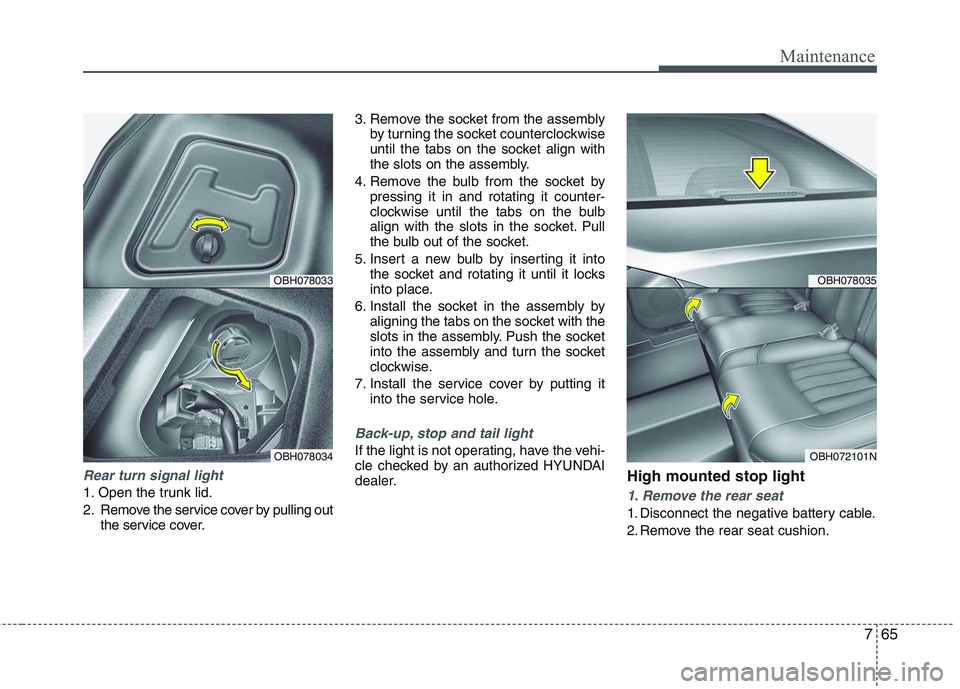
Rear turn signal light
1. Open the trunk lid.
2. Remove the service cover by pulling out
the service cover.3. Remove the socket from the assembly
by turning the socket counterclockwise
until the tabs on the socket align with
the slots on the assembly.
4. Remove the bulb from the socket by
pressing it in and rotating it counter-
clockwise until the tabs on the bulb
align with the slots in the socket. Pull
the bulb out of the socket.
5. Insert a new bulb by inserting it into
the socket and rotating it until it locks
into place.
6. Install the socket in the assembly by
aligning the tabs on the socket with the
slots in the assembly. Push the socket
into the assembly and turn the socket
clockwise.
7. Install the service cover by putting it
into the service hole.
Back-up, stop and tail light
If the light is not operating, have the vehi-
cle checked by an authorized HYUNDAI
dealer.
High mounted stop light
1. Remove the rear seat
1. Disconnect the negative battery cable.
2. Remove the rear seat cushion.
OBH078033
OBH078034
OBH078035
OBH072101N
Page 415 of 432
Maintenance
8 7
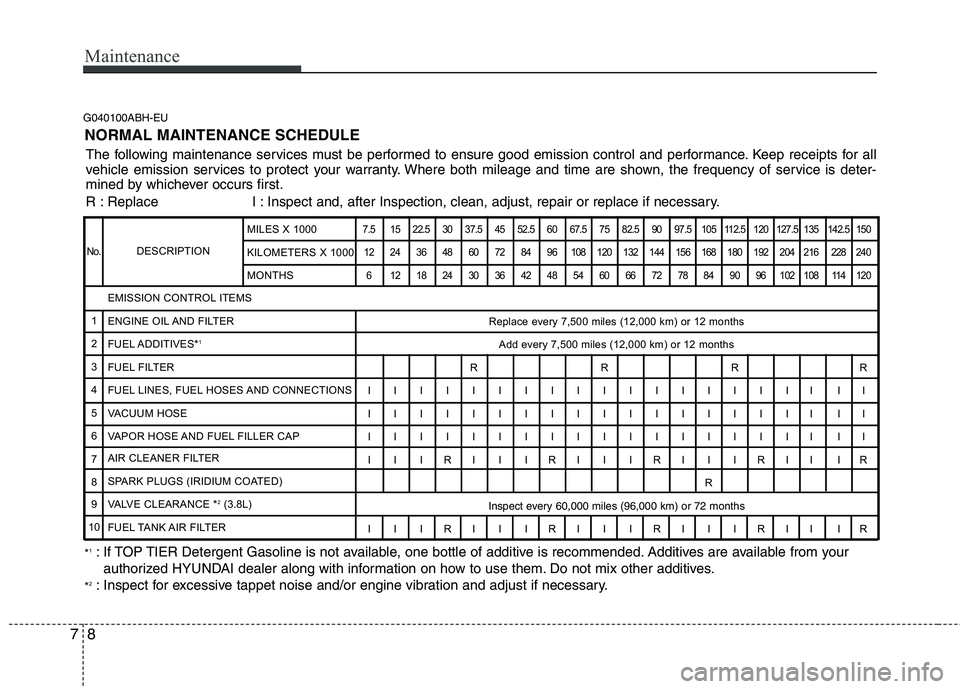
G040100ABH-EU
The following maintenance services must be performed to ensure good emission control and performance. Keep receipts for all
vehicle emission services to protect your warranty. Where both mileage and time are shown, the frequency of service is deter-
mined by whichever occurs first.
R : Replace I : Inspect and, after Inspection, clean, adjust, repair or replace if necessary.
NORMAL MAINTENANCE SCHEDULE
*1: If TOP TIER Detergent Gasoline is not available, one bottle of additive is recommended. Additives are available from your
authorized HYUNDAI dealer along with information on how to use them. Do not mix other additives.
*2: Inspect for excessive tappet noise and/or engine vibration and adjust if necessary.
DESCRIPTION
7.5 15 22.5 30 37.5 45 52.5 60 67.5 75 82.5 90 97.5 105 112.5 120 127.5 135 142.5 150
12 24 36 48 60 72 84 96 108 120 132 144 156 168 180 192 204 216 228 240
6 121824303642485460667278849096102108114120
Replace every 7,500 miles (12,000 km) or 12 months
Add every 7,500 miles (12,000 km) or 12 months
RRRR
IIIIIIIIIIIIIIIIII II
IIIIIIIIIIIIIIIIII II
IIIIIIIIIIIIIIIIII II
I I IRI I IRI I IRI I IRII IR
R
Inspect every 60,000 miles (96,000 km) or 72 months
I I IRI I IRI I IRI I IRII IR EMISSION CONTROL ITEMS
ENGINE OIL AND FILTER
FUEL ADDITIVES*
1
FUEL FILTER
FUEL LINES, FUEL HOSES AND CONNECTIONS
VACUUM HOSE
VAPOR HOSE AND FUEL FILLER CAP
AIR CLEANER FILTER
SPARK PLUGS (IRIDIUM COATED)
VALVE CLEARANCE *
2(3.8L)
FUEL TANK AIR FILTER
No.
1
2
3
4
5
6
7
8
9
10MILES X 1000
KILOMETERS X 1000
MONTHS
Page 419 of 432
Specifications, Consumer information, Reporting safety defects
4 8
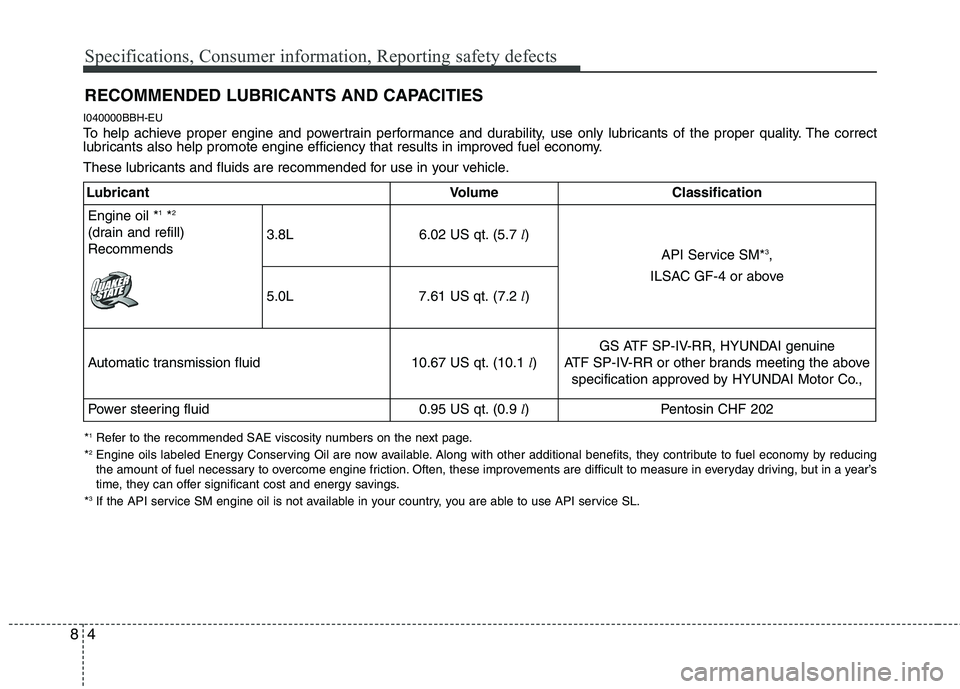
RECOMMENDED LUBRICANTS AND CAPACITIES
I040000BBH-EU
To help achieve proper engine and powertrain performance and durability, use only lubricants of the proper quality. The correct
lubricants also help promote engine efficiency that results in improved fuel economy.
These lubricants and fluids are recommended for use in your vehicle.
*1Refer to the recommended SAE viscosity numbers on the next page.
*2Engine oils labeled Energy Conserving Oil are now available. Along with other additional benefits, they contribute to fuel economy by reducing
the amount of fuel necessary to overcome engine friction. Often, these improvements are difficult to measure in everyday driving, but in a year’s
time, they can offer significant cost and energy savings.
*
3If the API service SM engine oil is not available in your country, you are able to use API service SL.
LubricantVolumeClassification
Engine oil *1*2
(drain and refill)
Recommends3.8L6.02 US qt. (5.7 l)
API Service SM*3,
ILSAC GF-4 or above
5.0L7.61 US qt. (7.2 l)
Automatic transmission fluid10.67 US qt. (10.1 l)
GS ATF SP-IV-RR, HYUNDAI genuine
ATF SP-IV-RR or other brands meeting the above
specification approved by HYUNDAI Motor Co.,
Power steering fluid0.95 US qt. (0.9 l)Pentosin CHF 202
Page 421 of 432
Specifications, Consumer information, Reporting safety defects
6 8
I040100ABH-EU
Recommended SAE viscosity
number
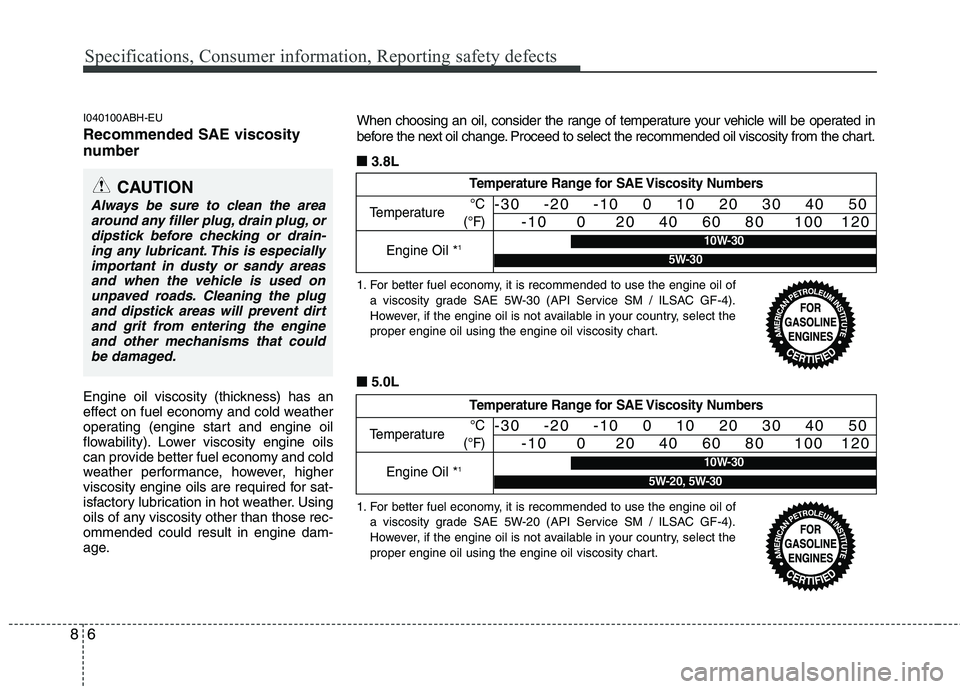
Engine oil viscosity (thickness) has an
effect on fuel economy and cold weather
operating (engine start and engine oil
flowability). Lower viscosity engine oils
can provide better fuel economy and cold
weather performance, however, higher
viscosity engine oils are required for sat-
isfactory lubrication in hot weather. Using
oils of any viscosity other than those rec-
ommended could result in engine dam-
age.
CAUTION
Always be sure to clean the area
around any filler plug, drain plug, or
dipstick before checking or drain-
ing any lubricant. This is especially
important in dusty or sandy areas
and when the vehicle is used on
unpaved roads. Cleaning the plug
and dipstick areas will prevent dirt
and grit from entering the engine
and other mechanisms that could
be damaged.
Temperature Range for SAE Viscosity Numbers
Temperature
Engine Oil *
1
°C
(°F)-30 -20 -10 0 10 20 30 40 50
-10 0 20 40 60 80 100 120
1. For better fuel economy, it is recommended to use the engine oil of
a viscosity grade SAE 5W-30 (API Service SM / ILSAC GF-4).
However, if the engine oil is not available in your country, select the
proper engine oil using the engine oil viscosity chart.
10W-30
5W-30
Temperature Range for SAE Viscosity Numbers
Temperature
Engine Oil *
1
°C
(°F)-30 -20 -10 0 10 20 30 40 50
-10 0 20 40 60 80 100 120
1. For better fuel economy, it is recommended to use the engine oil of
a viscosity grade SAE 5W-20 (API Service SM / ILSAC GF-4).
However, if the engine oil is not available in your country, select the
proper engine oil using the engine oil viscosity chart.
10W-30
5W-20, 5W-30
When choosing an oil, consider the range of temperature your vehicle will be operated in
before the next oil change. Proceed to select the recommended oil viscosity from the chart.
■ ■
3.8L
■ ■
5.0L
Page 430 of 432
I5
Index
Maintenance services ····················································· 7-4
Mirrors ········································································· 4-39
Electric chromic mirror (ECM) with compass and
HomeLink® system ················································ 4-39
Inside rearview mirror ··············································· 4-39
Outside rearview mirror ············································ 4-45
Owner maintenance ······················································· 7-5
Parking assist system ··················································· 4-72
Power steering fluid ····················································· 7-21
Rear view camera ························································ 4-76
Recommended lubricants and capacities ······················· 8-4
Remote keyless entry ··················································· 4-11
Reporting safety defects ················································ 8-9
Road warning ································································· 6-2Scheduled maintenance service ····································· 7-7
Normal maintenance schedule ···································· 7-8
Maintenance under severe usage conditions ············· 7-11
Seat belts ······································································ 3-16
Pre-tensioner seat belt ··············································· 3-21
Seat belt - Driver's 3-point system
with emergency locking retractor ··························· 3-18
Seat belts - Front passenger and rear seat
3-point system with combination locking retractor ··3-20
Seat warmer ····························································3-8, 3-14
Seats ··············································································· 3-2
Armrest ······································································ 3-13
Smart cruise control system···········································5-40
Smart key ······································································· 4-7
Special driving conditions ··········································· 5-56
Driving at night ························································· 5-57
Driving in flooded areas ············································ 5-58
Driving in the rain ····················································· 5-58
Hazardous driving conditions ···································· 5-56
Highway driving ························································ 5-59
Rocking the vehicle ··················································· 5-56
Smooth cornering ······················································ 5-57
Steering wheel ····························································· 4-37
Horn ··········································································· 4-38
Power steering ··························································· 4-37
Tilt steering ································································ 4-37
MS
O
P
R