trailer HYUNDAI GENESIS GV70 2021 Owner's Manual
[x] Cancel search | Manufacturer: HYUNDAI, Model Year: 2021, Model line: GENESIS GV70, Model: HYUNDAI GENESIS GV70 2021Pages: 647, PDF Size: 49.91 MB
Page 504 of 647
07
7-155
• The pedestrian is near the rear edge of
the vehicle
• The pedestrian is not standing upright
• The pedestrian is either very short or
very tall for Reverse Parking Collision-
Avoidance Assist to detect
• The pedestrian or cyclist is wearing
clothing that easily blends into the
background, making it difficult to
detect
• The pedestrian is wearing clothing
that does not reflect ultrasonic waves
well
• Size, thickness, height, or shape of
the object does not reflect ultrasonic
waves well (e.g., pole, bush, curbs,
carts, edge of a wall, etc.)
• The pedestrian or the object is moving
• The pedestrian or the object is very
close to the rear of the vehicle
• A wall is behind the pedestrian or the
object
• The object is not located at the rear
center of your vehicle
• The object is not parallel to the rear
bumper
• The road is slippery or inclined
• The driver backs up the vehicle
immediately after shifting to R
(Reverse)
• The driver accelerates or circles the
vehicleReverse Parking Collision-Avoidance
Assist may unnecessarily warn the driver
or assist with braking even if there are
no pedestrians or objects under the
following circumstances:
• Any non-factory equipment or
accessory is installed
• Your vehicle is unstable due to an
accident or other causes
• Bumper height or rear ultrasonic
sensor installation has been modified
• Your vehicle height is low or high
due to heavy loads, abnormal tire
pressure, etc.
• Rear view camera or the rear
ultrasonic sensor(s) is stained with
foreign material, such as snow, dirt,
etc.
• The pattern on the road is mistaken
for a pedestrian
• There is shadow or light reflecting on
the ground
• Pedestrians or objects are around the
path of the vehicle
• Objects generating excessive
noise, such as vehicle horns, loud
motorcycle engines or truck air
brakes, are near your vehicle
• Your vehicle is backing towards a
narrow passage or parking space
• Your vehicle is backing towards an
uneven road surface, such as an
unpaved road, gravel, bump, gradient,
etc.
• A trailer or carrier is installed on the
rear of your vehicle
• An ultrasonic sensor with similar
frequency is near your vehicle
Page 528 of 647
07
7-179
Limitations of Remote Smart Parking
Assist
In the following circumstances, Remote
Smart Parking Assist performance to
park or exit the vehicle may be limited,
there may be a risk of collision, or
Remote Smart Parking Assist may turn
off. Park or exit the vehicle manually if
necessary.
• An object is attached to the steering
wheel
• The vehicle is installed with a snow
chain, spare tire or different size
wheel
• Tire pressure is lower or higher than
the standard tire pressure
• Your vehicle is loaded with cargo
longer or wider than your vehicle or a
trailer is connected to your vehicle
• There is a problem with the wheel
alignment
• Your vehicle is leaned severely to one
side
• Your vehicle is equipped with a trailer
hitch
• The license plate is installed
differently from the original location
• There is a person, animal or object
above or below the ultrasonic sensor
when Remote Smart Parking Assist is
activated
• The parking space is curved or
diagonal
• There is an obstacle such as a person,
animal or object (trash can, bicycle,
motorcycle, shopping cart, narrow
pillar etc.) near the parking space • There is a circular pillar or narrow
pillar, or a pillar surrounded by objects
such as fire extinguisher, etc. near the
parking space
• The road surface is bumpy (curbstone,
speed bump, etc.)
• The road is slippery
• The parking space is near a vehicle
with higher ground clearance or big,
such as a truck, etc.
• The parking space is Inclined
• There is heavy wind
• Operating Remote Smart Parking
Assist on uneven roads, gravel roads,
bushes, etc.
• The performance of the ultrasonic
sensor is affected by extremely hot or
cold weather
• The ultrasonic sensor is covered with
snow or water
• An object that generates ultrasonic
waves is nearby
• A wireless device with a transmission
function operates near the ultrasonic
sensors
• Your vehicle is affected by another
vehicle’s Parking Distance Warning
• The sensor is mounted or positioned
incorrectly by an impact to the
bumper
• When the ultrasonic sensor cannot
detect the following objects:
- Sharp or slim objects, such as ropes,
chains or small poles
- Objects smaller than 40 in. (100 cm)
in length and narrower than 6 in. (14
cm) in diameter
- Objects which tend to absorb
sensor frequency, such as clothes,
spongy material or snow
- A narrow object such as a corner of
a square pillar
- Person, animal or object near the
ultrasonic sensor
Page 551 of 647
Emergency Situations
8-18
WARNING
To prevent compact spare tire failure and loss of control possibly resulting in an accident:
• Use the compact spare tire only in an emergency.
• NEVER operate your vehicle over 50 mph (80 km/h).
• Do not exceed the vehicle’s maximum load rating or the load carrying capacity shown on the sidewall of the compact spare tire.
• Do not use the compact spare tire continuously. Repair or replace the original tire as soon as possible to avoid failure of the compact spare tire.
When driving with the compact spare tire mounted to your vehicle:
• Check the tire pressure after installing the compact spare tire. The compact spare tire should be inflated to 60 psi (420 kPa).
• Do not take this vehicle through an automatic car wash while the compact spare tire is installed.
• Do not use the compact spare tire on any other vehicle because this tire has been designed especially for your vehicle.
• The compact spare tire’s tread life is shorter than a regular tire. Inspect your compact spare tire regularly and replace worn compact spare tires with the same size and design, mounted on the same wheel.
• Do not use more than one compact spare tire at a time.
• Do not tow a trailer while the compact spare tire is installed.
Information
When the original tire and wheel are repaired and reinstalled on the vehicle, the wheel bolt torque must be set correctly. The correct wheel bolt tightening torque is 101~116 lbf.ft (14~16 kgf.m).
NOTICE
To prevent damaging the compact spare tire and your vehicle:
• Drive slowly enough for the road conditions to avoid all hazards, such as a potholes or debris.
• Avoid driving over obstacles. The compact spare tire diameter is smaller than the diameter of a conventional tire and reduces the ground clearance approximately 1 inch (25 mm).
• Do not use tire chains on the compact spare tire. Because of the smaller size, a tire chain will not fit properly.
• Do not use the compact spare tire on any other wheels, nor should standard tires, snow tires, wheel covers or trim rings be used with the compact spare wheel.
Page 564 of 647
09
9-7
Follow Normal Maintenance Schedule if the vehicle is usually operated where none of
the following conditions apply. If any of the following conditions apply, you must follow
the Maintenance Under Severe Usage Conditions.
• Repeated driving short distance of less than 5 miles (8 km) in normal temperature or
less than 10 miles (16 km) in freezing temperature
• Extensive engine idling or low speed driving for long distances
• Driving on rough, dusty, muddy, unpaved, graveled or salt-spread roads
• Driving in areas using salt or other corrosive materials or in very cold weather
• Driving in heavy dust conditions
• Driving in heavy traffic area
• Driving on uphill, downhill, or mountain road repeatedly
• Towing a trailer or using a camper, or driving with loads on the roof
• Driving as a patrol car, taxi, other commercial use of vehicle towing
• Frequently driving under high speed or rapid acceleration/deceleration
• Frequently driving in stop-and-go condition
• Engine oil usage which is not recommended (Mineral type, Semi-synthetic, Lower
grade spec, etc.)
If your vehicle is operated under the above conditions, you should inspect, replace or
refill more frequently than the following Normal Maintenance Schedule. After the periods
or distance shown in the chart, continue to follow the prescribed maintenance intervals.
NOTICE
After 10 years or 100,000 miles, we recommend to use severe maintenance schedule.
Information
• As it is normal for engine oil to be consumed during driving, the engine oil level should be
checked on regular basis.
• The engine oil change interval for normal operating conditions is based on the use of the
recommended engine specification. If the recommended engine oil specification is not used, then
replace the engine oil according to the maintenance schedule under severe operating conditions.
• The vehicle may be equipped with the Engine Oil Change Reminder that predicts engine oil life
based on the driver’s driving history and alerts the driver to change engine oil.
-If the deterioration of the engine oil increases depending on the driver’s driving severity,
the remaining oil life alert appears on the instrument cluster before the normal engine oil
replacement interval. Have the engine oil and filter changed by an authorized retailer of
Genesis Branded product.
-Engine Oil Change Reminder works when the recommended engine oil is used. So, if
recommended engine oil is not used, replace the engine oil according to the maintenance
schedule under severe usage condition.
Also, check the amount of engine oil regularly as this system assumes that the engine oil is
being filled normally.
-Always reset the remaining engine oil life whenever the engine oil is changed. Otherwise, the
Engine Oil Change Reminder will not be correct.
To reset the Engine Oil Change Reminder, select ‘RESET’ from the infotainment system
screen. Then, select ‘Yes’ when the message “Changed engine oil? Press [Yes] to reset the oil
life.” appears on the screen.
-If there is no alert until the maximum maintenance interval, have the vehicle checked by an
authorized retailer of Genesis Branded product.
SCHEDULED MAINTENANCE SERVICES
Page 569 of 647
Maintenance
9-12
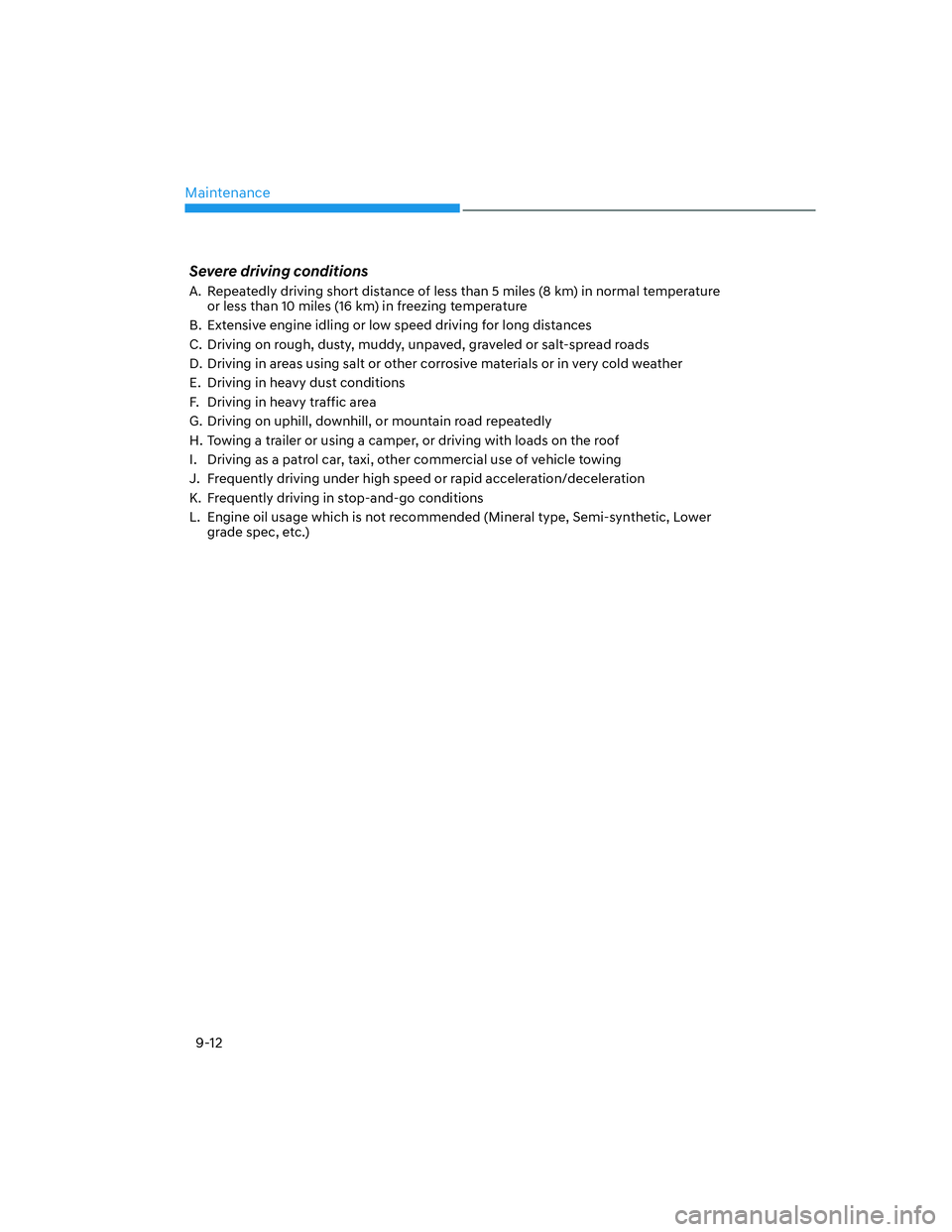
Severe driving conditions
A. Repeatedly driving short distance of less than 5 miles (8 km) in normal temperature
or less than 10 miles (16 km) in freezing temperature
B. Extensive engine idling or low speed driving for long distances
C. Driving on rough, dusty, muddy, unpaved, graveled or salt-spread roads
D. Driving in areas using salt or other corrosive materials or in very cold weather
E. Driving in heavy dust conditions
F. Driving in heavy traffic area
G. Driving on uphill, downhill, or mountain road repeatedly
H. Towing a trailer or using a camper, or driving with loads on the roof
I. Driving as a patrol car, taxi, other commercial use of vehicle towing
J. Frequently driving under high speed or rapid acceleration/deceleration
K. Frequently driving in stop-and-go conditions
L. Engine oil usage which is not recommended (Mineral type, Semi-synthetic, Lower
grade spec, etc.)
Page 605 of 647
Maintenance
9-48
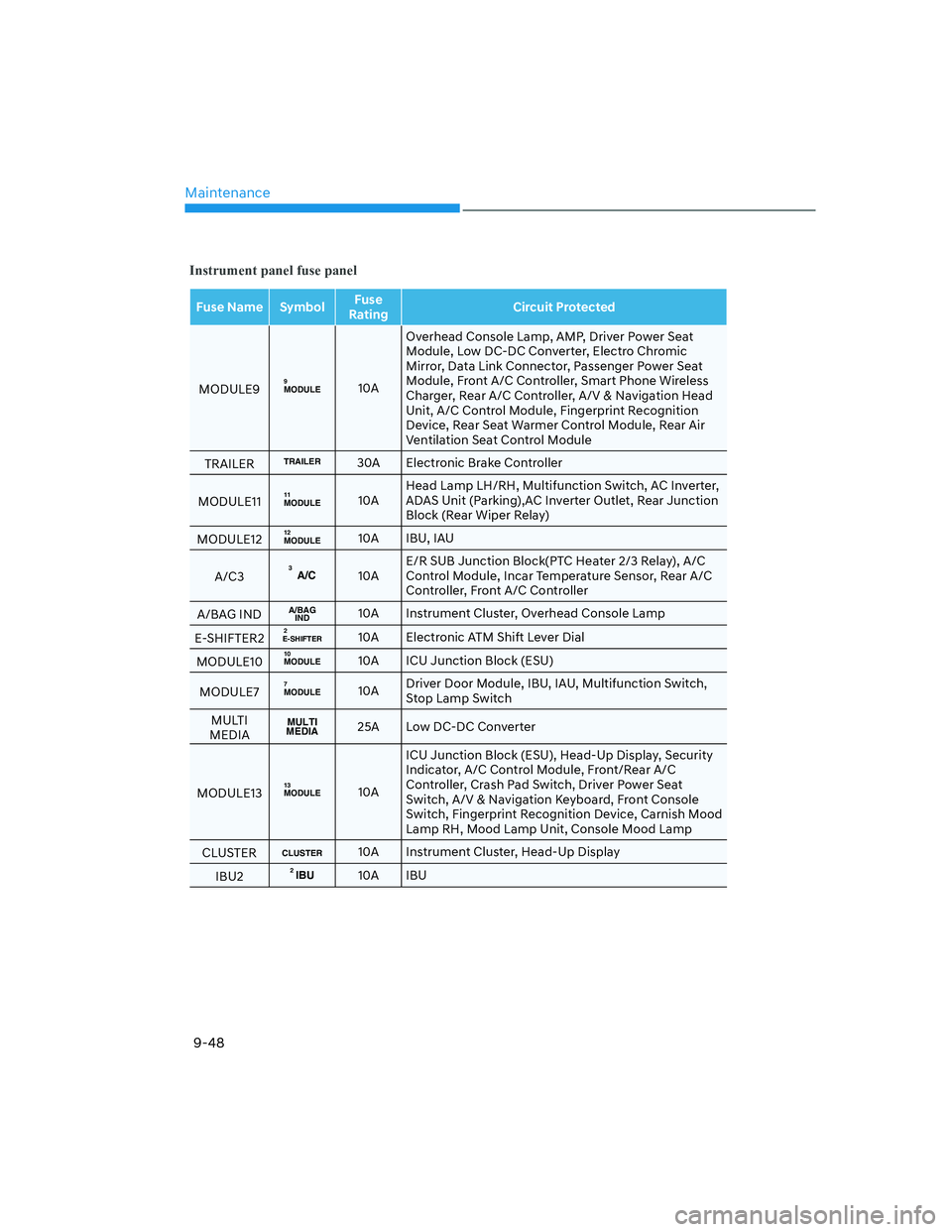
Instrument panel fuse panel
Fuse Name SymbolFuse
RatingCircuit Protected
MODULE9MODULE910AOverhead Console Lamp, AMP, Driver Power Seat
Module, Low DC-DC Converter, Electro Chromic
Mirror, Data Link Connector, Passenger Power Seat
Module, Front A/C Controller, Smart Phone Wireless
Charger, Rear A/C Controller, A/V & Navigation Head
Unit, A/C Control Module, Fingerprint Recognition
Device, Rear Seat Warmer Control Module, Rear Air
Ventilation Seat Control Module
TRAILER
TRAILER30A Electronic Brake Controller
MODULE11
MODULE1110AHead Lamp LH/RH, Multifunction Switch, AC Inverter,
ADAS Unit (Parking),AC Inverter Outlet, Rear Junction
Block (Rear Wiper Relay)
MODULE12
MODULE1210A IBU, IAU
A/C3
A/C310AE/R SUB Junction Block(PTC Heater 2/3 Relay), A/C
Control Module, Incar Temperature Sensor, Rear A/C
Controller, Front A/C Controller
A/BAG IND
A/BAG
IND10A Instrument Cluster, Overhead Console Lamp
E-SHIFTER2
E-SHIFTER210A Electronic ATM Shift Lever Dial
MODULE10
MODULE1010A ICU Junction Block (ESU)
MODULE7
MODULE710ADriver Door Module, IBU, IAU, Multifunction Switch,
Stop Lamp Switch
MULTI
MEDIA
MULTI
MEDIA25A Low DC-DC Converter
MODULE13
MODULE1310AICU Junction Block (ESU), Head-Up Display, Security
Indicator, A/C Control Module, Front/Rear A/C
Controller, Crash Pad Switch, Driver Power Seat
Switch, A/V & Navigation Keyboard, Front Console
Switch, Fingerprint Recognition Device, Carnish Mood
Lamp RH, Mood Lamp Unit, Console Mood Lamp
CLUSTER
CLUSTER10A Instrument Cluster, Head-Up Display
IBU2
IBU210A IBU
Page 616 of 647
09
9-59
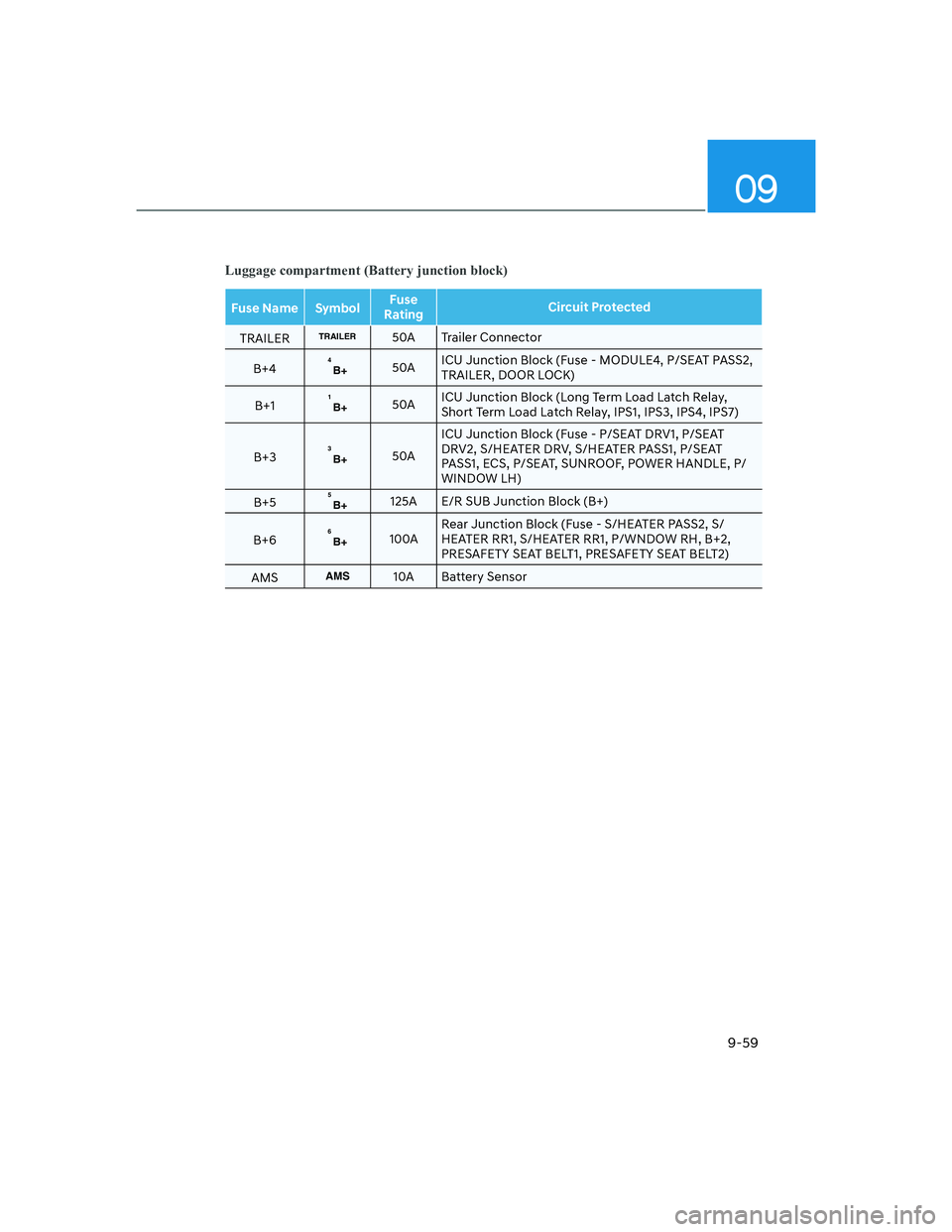
Luggage compartment (Battery junction block)
Fuse Name SymbolFuse
RatingCircuit Protected
TRAILERTRAILER50A Trailer Connector
B+4
B+450AICU Junction Block (Fuse - MODULE4, P/SEAT PASS2,
TRAILER, DOOR LOCK)
B+1
1B+50AICU Junction Block (Long Term Load Latch Relay,
Short Term Load Latch Relay, IPS1, IPS3, IPS4, IPS7)
B+3
B+350AICU Junction Block (Fuse - P/SEAT DRV1, P/SEAT
DRV2, S/HEATER DRV, S/HEATER PASS1, P/SEAT
PASS1, ECS, P/SEAT, SUNROOF, POWER HANDLE, P/
WINDOW LH)
B+5
B+5125A E/R SUB Junction Block (B+)
B+6
B+6100ARear Junction Block (Fuse - S/HEATER PASS2, S/
HEATER RR1, S/HEATER RR1, P/WNDOW RH, B+2,
PRESAFETY SEAT BELT1, PRESAFETY SEAT BELT2)
AMS
AMS10A Battery Sensor
Page 646 of 647

Index
I-14
Tires and Wheels ........................................................................\
.........................2-10
Tires and Wheels ........................................................................\
.........................9-30
All Season Tires ........................................................................\
......................9-41
Check Tire Inflation Pressure ........................................................................\
..9-31
Low Aspect Ratio Tires ........................................................................\
...........9-43
Radial-Ply Tires ........................................................................\
.......................9-42
Recommended Cold Tire Inflation Pressures ..................................................9-30
Snow Tires ........................................................................\
...............................9-42
Summer Tires ........................................................................\
..........................9-41
Tire Care ........................................................................\
..................................9-30
Tire Maintenance ........................................................................\
.....................9-34
Tire Replacement ........................................................................\
....................9-33
Tire Rotation ........................................................................\
...........................9-32
Tire Sidewall Labeling ........................................................................\
............9-35
Tire Terminology and Definitions ...................................................................9-38
Tire Traction ........................................................................\
............................9-34
Wheel Alignment and Tire Balance ................................................................9-33
Wheel Replacement ........................................................................\
................9-34
Tire Specification and Pressure Label .................................................................2-14
Towing ........................................................................\
.........................................8-20
Emergency Towing........................................................................\
..................8-22
Removable Towing Hook........................................................................\
........8-21
Towing Service ........................................................................\
........................8-20
Trailer Towing ........................................................................\
.............................6-64
Driving with a Trailer ........................................................................\
..............6-67
If You Decide to Pull a Trailer? .......................................................................6-64
Maintenance When Towing a Trailer ..............................................................6-70
Trailer Towing Equipment ........................................................................\
......6-66
V
Vehicle Auto-Shut Off ........................................................................\
.................5-38
Deactivating Conditions ........................................................................\
..........5-38
Operating Conditions ........................................................................\
..............5-38
System Operation ........................................................................\
....................5-38
Vehicle Certification Label ........................................................................\
..........2-14
Vehicle Identification Number (VIN) ..................................................................2-14