drive HYUNDAI GENESIS GV70 2022 Owners Manual
[x] Cancel search | Manufacturer: HYUNDAI, Model Year: 2022, Model line: GENESIS GV70, Model: HYUNDAI GENESIS GV70 2022Pages: 647, PDF Size: 49.91 MB
Page 5 of 647
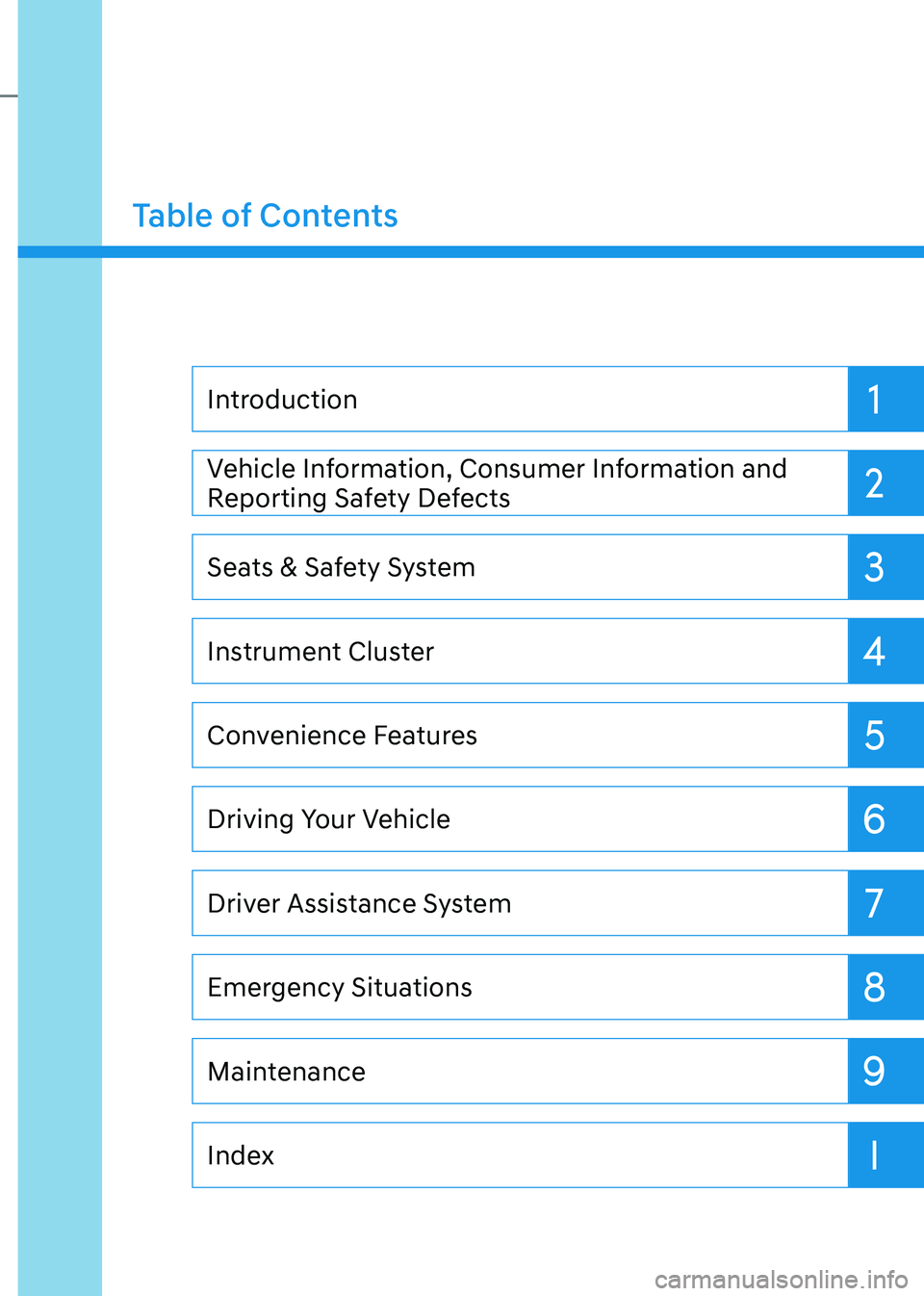
Maintenance
Index
Emergency Situations
Driver Assistance System
Driving Your Vehicle
Convenience Features
Instrument Cluster
Seats & Safety System
Vehicle Information, Consumer Information and
Reporting Safety Defects
Introduction
Table of Contents
1
2
3
4
5
6
7
9
I
8
Page 6 of 647
Introduction
1-2
INTRODUCTION
Congratulations, and thank you for choosing this Genesis Branded Vehicle. We are pleased to welcome you to the growing number of discerning people who drive the Genesis Branded Vehicle. We are very proud of the advanced engineering and high-quality construction of each Genesis Branded Vehicle we build.
Your Owner’s Manual will introduce you to the features and operation of your new Genesis Branded Vehicle. To become familiar with your new Genesis Branded Vehicle, so that you can fully enjoy it, read this Owner’s Manual carefully before driving your new vehicle.
This manual contains important safety information and instructions intended to familiarize you with your vehicle’s controls and safety features so you can safely operate your vehicle.
This manual also contains information on maintenance designed to enhance safe operation of the vehicle. It is recommended that all service and maintenance on your car be performed by an authorized retailer of Genesis Branded products. Retailers of Genesis Branded products are prepared to provide high-quality service, maintenance and any other assistance that may be required.
This Owner’s Manual should be considered a permanent part of your vehicle, and should be kept in the vehicle so you can refer to it at any time. The manual should stay with the vehicle if you sell it to provide the next owner with important operating, safety and maintenance information.
GENESIS CUSTOMER CARE
CAUTION
Severe engine and transmission damage may result from the use of poor quality fuels and lubricants that do not meet Genesis Branded Vehicle specifications. You must always use high quality fuels and lubricants that meet the specifications listed on Page 2-12 in the Vehicle Specifications section of the Owner’s Manual.
Copyright 2021 Genesis Customer Care. All rights reserved. No part of this publication may be reproduced, stored in any retrieval system or transmitted in any form or by any means without the prior written permission of Genesis Customer Care.
Page 10 of 647
Introduction
1-6
Using Fuel Additives (except Detergent Fuel Additives)
Using fuel additives such as:
-Silicone fuel additive
-Ferrocene (iron-based) fuel additive
-Other metallic-based fuel additives
may result in cylinder misfire, poor acceleration, engine stalling, damage to the catalyst, or abnormal corrosion, and may cause damage to the engine resulting in a reduction in the overall life of the powertrain.
The Malfunction Indicator Lamp (MIL) may illuminate.
NOTICE
Damage to the fuel system or performance problem caused by the use of these fuels or fuel additives may not be covered by your New Vehicle Limited Warranty.
Gasoline containing MMT
Some gasoline contains harmful manganese-based fuel additives such as MMT (Methylcyclopentadienyl Manganese Tricarbonyl).
Genesis Branded Vehicle does not recommend the use of gasoline containing MMT.
This type of fuel can reduce vehicle performance and affect your emission control system.
The malfunction indicator lamp on the cluster may come on.
Detergent Fuel Additives
Genesis Branded Vehicle recommends that you use good quality gasolines treated with detergent additives such as TOP TIER Detergent Gasoline, which help prevent deposit formation in the engine. These gasolines will help the engine run cleaner and enhance performance of the Emission Control System. For more information on TOP TIER Detergent Gasoline, please go to the website (www.toptiergas.com).
For customers who do not use TOP Tier Detergent Gasoline regularly, and have problems starting or the engine does not run smoothly, detergent-based fuel additives that you can purchase separately may be added to the gasoline. If TOP TIER Detergent Gasoline is not available, one bottle of additive added to the fuel tank at every 8,000 miles or 12 months is recommended.
Additives are available from your authorized retailer of Genesis Branded products along with information on how to use them. Do not mix other additives.
Operation in foreign countries
If you are going to drive your vehicle in another country, be sure to:
• Observe all regulations regarding registration and insurance.
• Determine that acceptable fuel is available.
Page 12 of 647
Introduction
1-8
VEHICLE DATA COLLECTION AND EVENT DATA RECORDERS
This vehicle is equipped with an event data recorder (EDR). The main purpose of an EDR is to record, in certain crash or near crash-like situations, such as an air bag deployment or hitting a road obstacle, data that will assist in understanding how a vehicle’s systems performed. The EDR is designed to record data related to vehicle dynamics and safety systems for a short period of time, typically 30 seconds or less.The EDR in this vehicle is designed to record such data as:
• How various systems in your vehicle were operating;
• Whether or not the driver and passenger safety belts were buckled/fastened;
• How far (if at all) the driver was depressing the accelerator and/or brake pedal; and,
• How fast the vehicle was traveling.
These data can help provide a better understanding of the circumstances in which crashes and injuries occur. NOTE: EDR data are recorded by your vehicle only if a non-trivial crash situation occurs; no data are recorded by the EDR under normal driving conditions and no personal data (e.g., name, gender, age, and crash location) are recorded. However, other parties, such as law enforcement, could combine the EDR data with the type of personally identifying data routinely acquired during a crash investigation.
To read data recorded by an EDR, special equipment is required, and access to the vehicle or the EDR is needed. In addition to the vehicle manufacturer, other parties, such as law enforcement, that have the special equipment, can read the information if they have access to the vehicle or the EDR.
Page 17 of 647
2-5
02
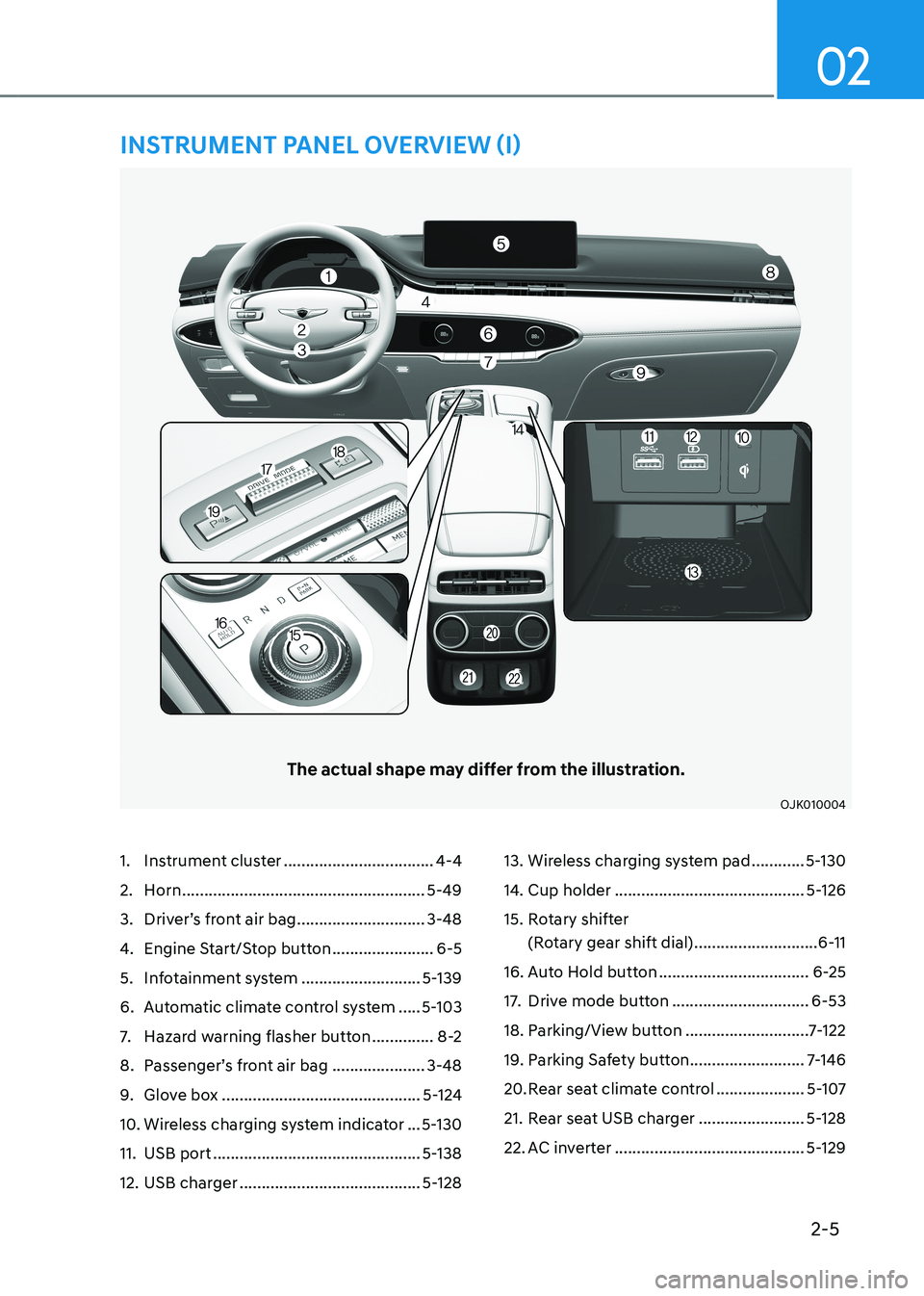
1. Instrument cluster ..................................4-4
2. Horn .......................................................5-49
3. Driver’s front air bag .............................3-48
4. Engine Start/Stop button .......................6-5
5. Infotainment system ...........................5-139
6. Automatic climate control system .....5-103
7. Hazard warning flasher button ..............8-2
8. Passenger’s front air bag .....................3-48
9. Glove box .............................................5-124
10. Wireless charging system indicator ...5-130
11. USB port ...............................................5-138
12. USB charger .........................................5-128
13. Wireless charging system pad ............5-130
14. Cup holder ...........................................5-126
15. Rotary shifter
(Rotary gear shift dial) ............................6-11
16. Auto Hold button ..................................6-25
17. Drive mode button ...............................6-53
18. Parking/View button ............................7-122
19. Parking Safety button ..........................7-146
20. Rear seat climate control ....................5-107
21. Rear seat USB charger ........................5-128
22. AC inverter ...........................................5-129
The actual shape may differ from the illustration.
OJK010004OJK010004
INSTRUMENT PANEL OVERVIEW (I)
Page 29 of 647
3
3. Seats & Safety System
Important Safety Precautions ...........................................................................3-2Always Wear Your Seat Belt ......................................................................................... 3-2
Restrain All Children ..................................................................................................... 3-2
Air Bag Hazards ............................................................................................................ 3-2
Driver Distraction ......................................................................................................... 3-2
Control Your Speed ...................................................................................................... 3-2
Keep Your Vehicle in Safe Condition ........................................................................... 3-2
Seats .................................................................................................................. 3-3Safety Precautions .......................................................................................................3-6
Front Seats ....................................................................................................................3-7
Rear Seats ....................................................................................................................3-12
Head Restraint ............................................................................................................ 3-16
Seat Warmers .............................................................................................................3-20
Air Ventilation Seats ................................................................................................... 3-23
Seat Belts ......................................................................................................... 3-25Seat Belt Safety Precautions ..................................................................................... 3-25
Seat Belt Warning Light ............................................................................................. 3-26
Seat Belt Restraint System ........................................................................................ 3-27
Pre-Active Seat Belt (PSB) ......................................................................................... 3-33
Additional Seat Belt Safety Precautions ...................................................................3-34
Care of Seat Belts .......................................................................................................3-36
Child Restraint System (CRS) ..........................................................................3-37
Children Always in the Rear ....................................................................................... 3-37
Selecting a Child Restraint System (CRS) .................................................................3-38
Installing a Child Restraint System (CRS) .................................................................3-39
Air Bag - Supplemental Restraint System ..................................................... 3-46Where Are the Air Bags? ........................................................................................... 3-48
How Does the Air Bags System Operate? ................................................................ 3-52
What to Expect After an Air Bag Inflates ..................................................................3-56
Occupant Classification System (OCS) .....................................................................3-56
Why Didn’t My Air Bag Go Off in a Collision? ...........................................................3-62
SRS Care ..................................................................................................................... 3-67
Additional Safety Precautions .................................................................................. 3-68
Air Bag Warning Labels ............................................................................................. 3-68
Page 30 of 647
Seats & Safety System
3-2
You will find many safety precautions
and recommendations throughout this
section, and throughout this manual.
The safety precautions in this section are
among the most important.
Always Wear Your Seat Belt
A seat belt is your best protection in all
types of accidents. Air bags are designed
to supplement seat belts, not to replace
them. So even though your vehicle is
equipped with air bags, ALWAYS make
sure you and your passengers wear your
seat belts, and wear them properly.
Restrain All Children
All children under age 13 should ride
in your vehicle properly restrained in a
rear seat, not the front seat. Infants and
small children should be restrained in
an appropriate Child Restraint System.
Larger children should use a booster
seat with the lap/shoulder belt until they
can use the seat belt properly without a
booster seat.
Air Bag Hazards
While air bags can save lives, they can
also cause serious or fatal injuries to
occupants who sit too close to them, or
who are not properly restrained. Infants,
young children, and short adults are at
the greatest risk of being injured by an
inflating air bag. Follow all instructions
and warnings in this manual.
Driver Distraction
Driver distraction presents a serious and
potentially deadly danger, especially for
inexperienced drivers. Safety should be
the first concern when behind the wheel
and drivers need to be aware of the wide
array of potential distractions, such as
drowsiness, reaching for objects, eating,
personal grooming, other passengers,
and using mobile phones.Drivers can become distracted when
they take their eyes and attention off
the road or their hands off the wheel to
focus on activities other than driving.
To reduce your risk of distraction and an
accident:
• Set up your mobile devices (i.e., MP3
players, phones, navigation units, etc.)
ONLY when your vehicle is parked or
safely stopped.
• ONLY use your mobile device when
allowed by laws and conditions permit
safe use. NEVER text or email while
driving. Most countries have laws
prohibiting drivers from texting. Some
countries and cities also prohibit
drivers from using handheld phones.
• NEVER let the use of a mobile device
distract you from driving. You have a
responsibility to your passengers and
others on the road to always drive
safely, with your hands on the wheel
as well as your eyes and attention on
the road.
Control Your Speed
Excessive speed is a major factor in crash
injuries and deaths. Generally, the higher
the speed, the greater the risk, but
serious injuries can also occur at lower
speeds. Never drive faster than is safe
for current conditions, regardless of the
maximum speed posted.
Keep Your Vehicle in Safe
Condition
Having a tire blowout or a mechanical
failure can be extremely hazardous. To
reduce the possibility of such problems,
check your tire pressures and condition
frequently, and perform all regularly
scheduled maintenance.
IMPORTANT SAFETY PRECAUTIONS
Page 31 of 647
3-3
03
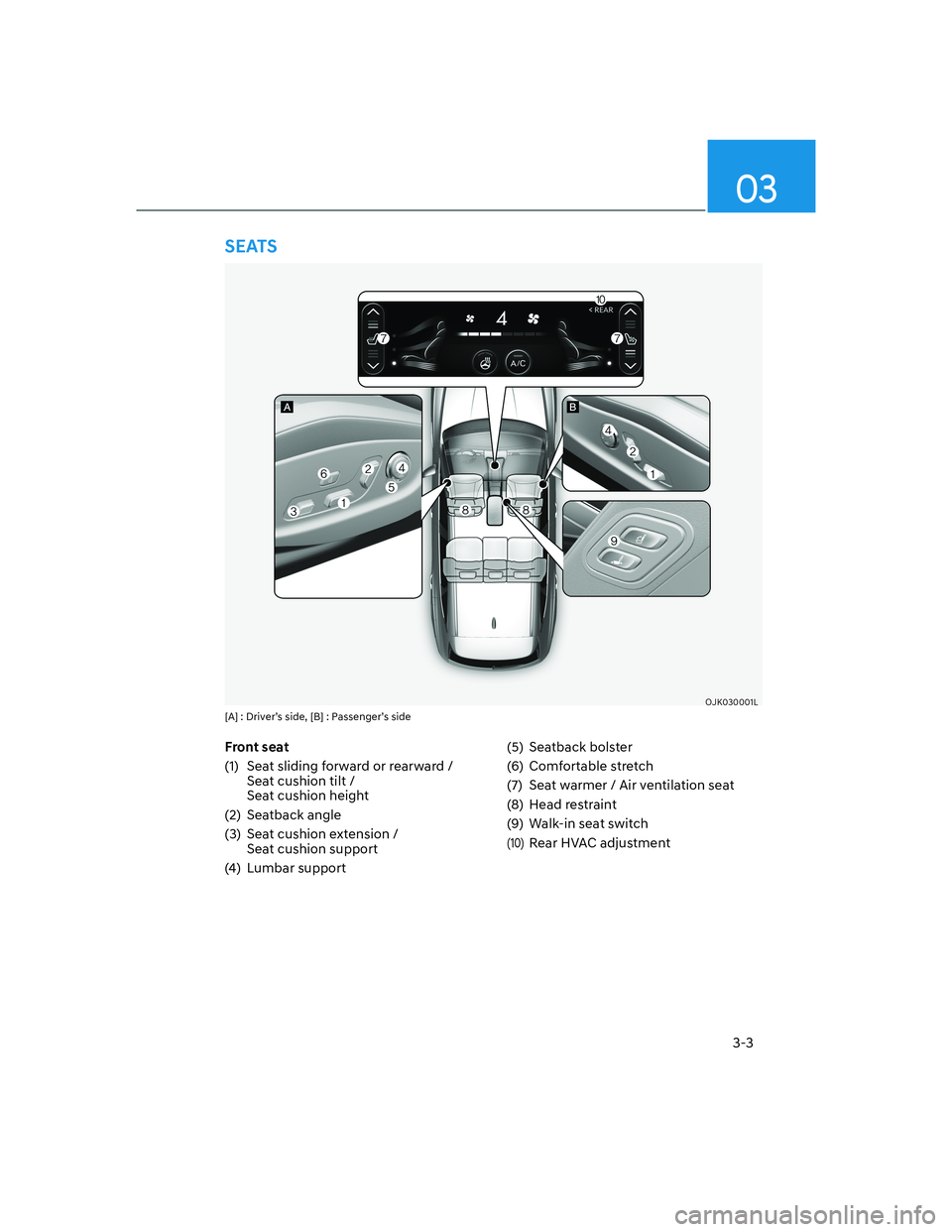
Front seat
(1) Seat sliding forward or rearward /
Seat cushion tilt /
Seat cushion height
(2) Seatback angle
(3) Seat cushion extension /
Seat cushion support
(4) Lumbar support(5) Seatback bolster
(6) Comfortable stretch
(7) Seat warmer / Air ventilation seat
(8) Head restraint
(9) Walk-in seat switch
(10) Rear HVAC adjustment
SEATS
OJK030001LOJK030001L[A] : Driver’s side, [B] : Passenger’s side
Page 34 of 647
Seats & Safety System
3-6
Information
The information provided may differ
depending on which functions are
applicable to your vehicle.
Safety Precautions
Adjusting the seats so that you are sitting
in a safe and comfortable position plays
an important role for the safety of the
driver and passengers, as much as seat
belts and air bags when in an accident.
WARNING
Do not use a cushion that reduces
friction between the seat and the
passenger. The passenger’s hips may
slide under the lap portion of the seat
belt during an accident or a sudden
stop.
Serious or fatal internal injuries could
result because the seat belt cannot
operate properly.
Air bags
You can take steps to reduce the risk
of being injured by an inflating air bag.
Sitting too close to an air bag greatly
increases the risk of injury in the event
the air bag inflates. The National
Highway Traffic Safety Administration
(NHTSA) recommends that drivers allow
at least 10 inches (25 cm) between the
center of the steering wheel and their
chest.
WARNING
To reduce the risk of serious injury or
death from an inflating air bag, take the
following precautions:
• Adjust the driver’s seat as far to the
rear as possible maintaining the
ability to control the vehicle.
• Adjust the front passenger seat as far
to the rear as possible.
• Hold the steering wheel by the rim
with hands at the 9 o’clock and 3
o’clock positions to minimize the risk
of injuries to your hands and arms.
• NEVER place anything or anyone
between you and the air bag.
• Do not allow the front passenger to
place feet or legs on the dashboard
to minimize the risk of leg injuries.
Seat belts
Always fasten your seat belt before
starting any trip. At all times, passengers
should sit upright and be properly
restrained. Infants and small children
must be restrained in appropriate Child
Restraint Systems. Children who have
outgrown a booster seat and adults must
be restrained using the seat belts.
WARNING
Take the following precautions when
adjusting your seat belt:
• NEVER use one seat belt for more
than one occupant.
• Always position the seatback upright
with the lap portion of the seat belt
snug and low across the hips.
• NEVER allow children or small infants
to ride on a passenger’s lap.
• Do not route the seat belt across your
neck, across sharp edges, or reroute
the shoulder strap away from your
body.
• Do not allow the seat belt to become
caught or jammed.
Page 35 of 647
03
3-7
Front Seats
The front seat can be adjusted by using
the control switches located on the
outside of the seat cushion. Before
driving, adjust the seat to the proper
position so that you can easily control
the steering wheel, foot pedals and
controls on the instrument panel.
WARNING
Take the following precautions when
adjusting your seat:
• NEVER attempt to adjust the seat
while the vehicle is moving. The seat
could respond with unexpected
movement and may cause loss
of vehicle control resulting in an
accident.
• Do not place anything under the
front seats. Loose objects in the
driver’s foot area could interfere
with the operation of the foot pedals,
causing an accident.
• Do not allow anything to interfere
with the normal position and proper
locking of the seatback.
• Do not place a cigarette lighter on
the floor or seat. When you operate
the seat, gas may exit out of the
lighter causing a fire.
• Use extreme caution when picking
up small objects trapped under the
seats or between the seat and the
center console. Your hands might be
cut or injured by the sharp edges of
the seat mechanism.
• If there are occupants in the rear
seats, be careful while adjusting the
front seat position.
• Make sure that the seat is locked in
place after the adjustment. If not,
the seat might move unexpectedly
resulting in an accident.
CAUTION
To prevent injury:
• Do not adjust your seat while
wearing your seat belt. Moving the
seat cushion forward may cause
strong pressure on your abdomen.
• Do not allow your hands or fingers to
get caught in the seat mechanisms
while the seat is moving.
WARNING
NEVER allow children in the vehicle
unattended. The power seats are
operable when the vehicle is turned off.
NOTICE
To prevent damage to the seats:
• Always stop adjusting the seats when
the seat has been adjusted as far
forward or rearward as possible.
• Do not adjust the seats longer than
necessary when the vehicle is turned
off. This may result in unnecessary
battery drain.
• Do not operate two or more seats at
the same time. This may result in an
electrical malfunction.