warning Hyundai Getz 2002 Owner's Manual
[x] Cancel search | Manufacturer: HYUNDAI, Model Year: 2002, Model line: Getz, Model: Hyundai Getz 2002Pages: 428, PDF Size: 6.13 MB
Page 262 of 428
1- 18 FEATURES OF YOUR HYUNDAI
SB090P1-E SEAT BELTS (3-Point Type) To Fasten The Seat Belt
B180A01L-D
The seat belts are fastened by pulling the belt buckle towards the seat beltstalk and inserting the metal tongue of the buckle into the stalk. The buckle should be firmly pressed into the stalkuntil locked which will be indicated byan audible "click".The length of the seat belt webbing willbe automatically adjusted by the seat belt mechanism to allow the wearer maximum freedom of movement whilstthe belt is being worn. However, in theevent of rapid deceleration or impact,the belt mechanism will automaticallylock.
B170A01L
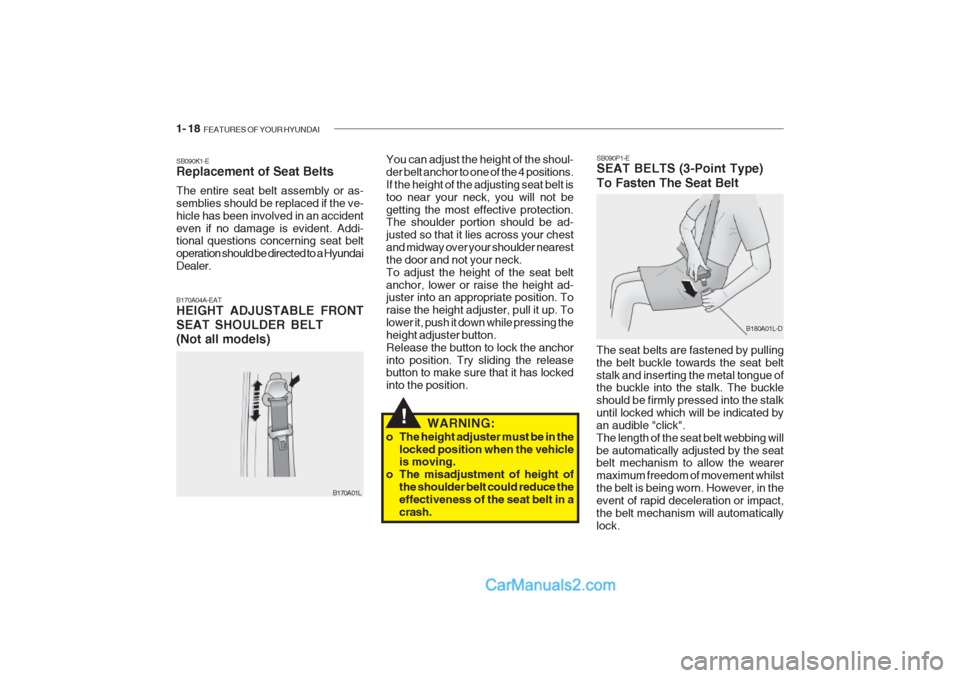
SB090K1-E Replacement of Seat Belts The entire seat belt assembly or as- semblies should be replaced if the ve-hicle has been involved in an accidenteven if no damage is evident. Addi- tional questions concerning seat belt operation should be directed to a HyundaiDealer. B170A04A-EAT HEIGHT ADJUSTABLE FRONT SEAT SHOULDER BELT(Not all models)
You can adjust the height of the shoul- der belt anchor to one of the 4 positions.If the height of the adjusting seat belt istoo near your neck, you will not begetting the most effective protection. The shoulder portion should be ad- justed so that it lies across your chestand midway over your shoulder nearestthe door and not your neck.To adjust the height of the seat beltanchor, lower or raise the height ad- juster into an appropriate position. To raise the height adjuster, pull it up. Tolower it, push it down while pressing theheight adjuster button.Release the button to lock the anchorinto position. Try sliding the release button to make sure that it has locked into the position.
WARNING:
o The height adjuster must be in the locked position when the vehicle is moving.
o The misadjustment of height of
the shoulder belt could reduce the effectiveness of the seat belt in acrash.
!
Page 264 of 428
1- 20 FEATURES OF YOUR HYUNDAI
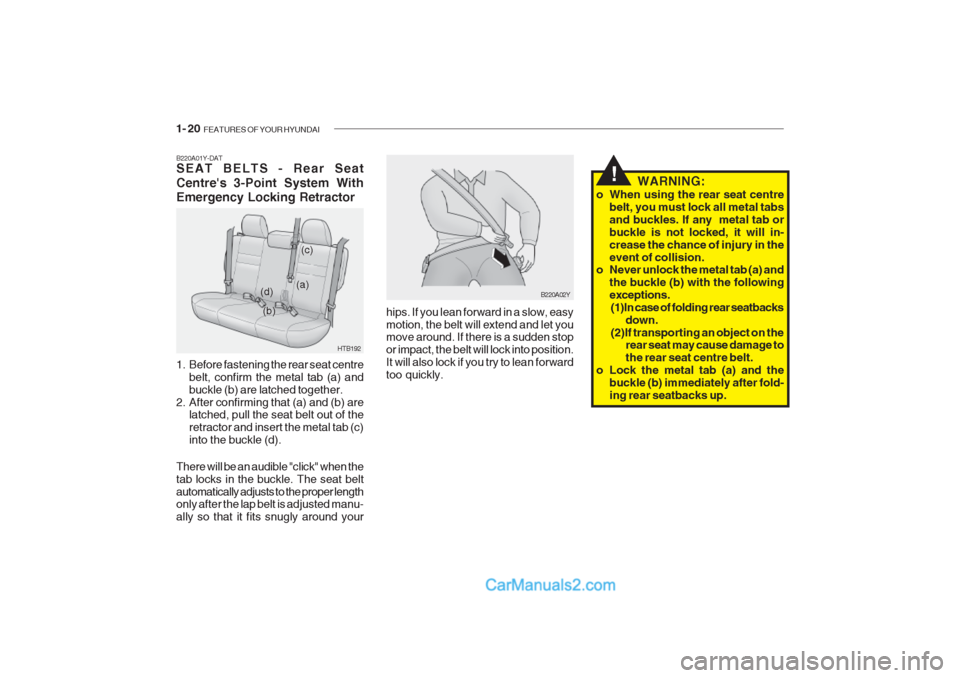
B220A01Y-DAT SEAT BELTS - Rear Seat Centre's 3-Point System With Emergency Locking Retractor
1. Before fastening the rear seat centre
belt, confirm the metal tab (a) and buckle (b) are latched together.
2. After confirming that (a) and (b) are latched, pull the seat belt out of theretractor and insert the metal tab (c)into the buckle (d).
There will be an audible "click" when thetab locks in the buckle. The seat beltautomatically adjusts to the proper length only after the lap belt is adjusted manu- ally so that it fits snugly around your HTB192
hips. If you lean forward in a slow, easymotion, the belt will extend and let you move around. If there is a sudden stop or impact, the belt will lock into position.It will also lock if you try to lean forwardtoo quickly. WARNING:
o When using the rear seat centre belt, you must lock all metal tabsand buckles. If any metal tab orbuckle is not locked, it will in-crease the chance of injury in theevent of collision.
o Never unlock the metal tab (a) and
the buckle (b) with the followingexceptions.(1)In case of folding rear seatbacks
down.
(2)If transporting an object on the rear seat may cause damage tothe rear seat centre belt.
o Lock the metal tab (a) and the buckle (b) immediately after fold-ing rear seatbacks up.
!
(a)
(b) (c)
(d) B220A02Y
Page 265 of 428
FEATURES OF YOUR HYUNDAI 1- 21
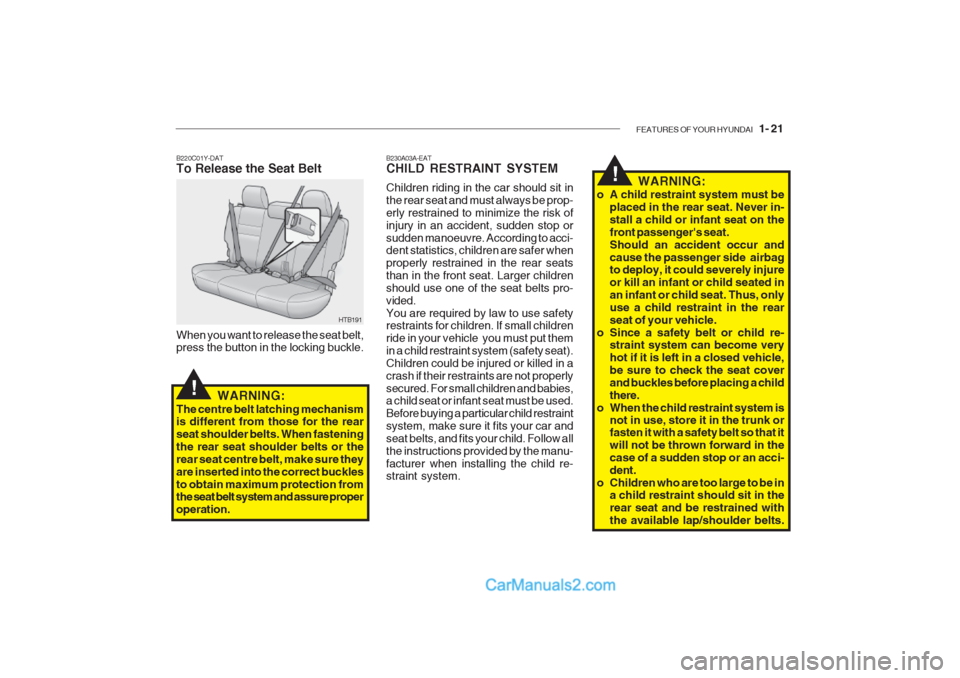
B220C01Y-DAT To Release the Seat Belt When you want to release the seat belt, press the button in the locking buckle. HTB191
WARNING:
The centre belt latching mechanismis different from those for the rear seat shoulder belts. When fasteningthe rear seat shoulder belts or therear seat centre belt, make sure theyare inserted into the correct bucklesto obtain maximum protection from the seat belt system and assure proper operation.
!
B230A03A-EAT CHILD RESTRAINT SYSTEM Children riding in the car should sit in the rear seat and must always be prop-erly restrained to minimize the risk ofinjury in an accident, sudden stop orsudden manoeuvre. According to acci- dent statistics, children are safer when properly restrained in the rear seatsthan in the front seat. Larger childrenshould use one of the seat belts pro-vided.You are required by law to use safety restraints for children. If small children ride in your vehicle you must put themin a child restraint system (safety seat).Children could be injured or killed in acrash if their restraints are not properlysecured. For small children and babies, a child seat or infant seat must be used. Before buying a particular child restraintsystem, make sure it fits your car andseat belts, and fits your child. Follow allthe instructions provided by the manu-facturer when installing the child re- straint system. WARNING:
o A child restraint system must be placed in the rear seat. Never in- stall a child or infant seat on thefront passenger's seat.Should an accident occur andcause the passenger side airbag to deploy, it could severely injure or kill an infant or child seated inan infant or child seat. Thus, onlyuse a child restraint in the rearseat of your vehicle.
o Since a safety belt or child re- straint system can become veryhot if it is left in a closed vehicle,be sure to check the seat coverand buckles before placing a childthere.
o When the child restraint system is not in use, store it in the trunk orfasten it with a safety belt so that itwill not be thrown forward in thecase of a sudden stop or an acci-dent.
o Children who are too large to be in a child restraint should sit in therear seat and be restrained withthe available lap/shoulder belts.
!
Page 267 of 428

FEATURES OF YOUR HYUNDAI 1- 23
WARNING:
Do not install any child restraint sys- tem in the front passenger seat. Should an accident occur and cause the passenger side airbag to deploy,it could severely injure or kill aninfant or child seated in an infant orchild seat. Therefore, only use a childrestraint system in the rear seat of your vehicle.
If you need to tighten the belt, pull more webbing toward the retractor. When youunbuckle the seat belt and allow it toretract, the retractor will automaticallyrevert back to its normal seated pas- senger emergency locking usage con- dition. NOTE:
o Before installing the child restraint
system, read the instructions sup- plied by the child restraint systemmanufacturer.
o If the seat belt does not operate as
described, have the systemchecked immediately by your au-thorized Hyundai dealer.!
B230B01TB
B230B02A-GAT Using a Child Restraint System with "Tether Anchorage" Sys- tem For small children and babies, the use of a child seat or infant seat is strongly recommended. This child seat or infant seat should be of appropriate size forthe child and should be installed inaccordance with the manufacturer's in-structions. It is further recommendedthat the seat be placed in the vehicle's rear seat since this can make an impor- tant contribution to safety. Your vehicleis provided with three child restrainthook holders for installing the child seator infant seat. Spacer (10mm), Child Restraint Hook Holder
Holder Bolt (5/16"-30 mm) Washer, Conical Spring Holder, Child Restraint Hook
Retainer Washer B230E02FC-GAT Securing a Child Restraint Sys- tem with "Tether Anchorage" System Three child restraint hook holders are located on the vertical back panel.(behind rear bumper bar)
1. Route the child restraint seat strap
over the seatback. For vehicles with adjustable head- rests, route the tether strap underthe headrest and between the head-rest posts, otherwise route the tetherstrap over the top of the seatback.
Page 268 of 428
1- 24 FEATURES OF YOUR HYUNDAI
!
B230E01TB
Back panel
Front of Vehicle
Attaching clip
Covering shelf
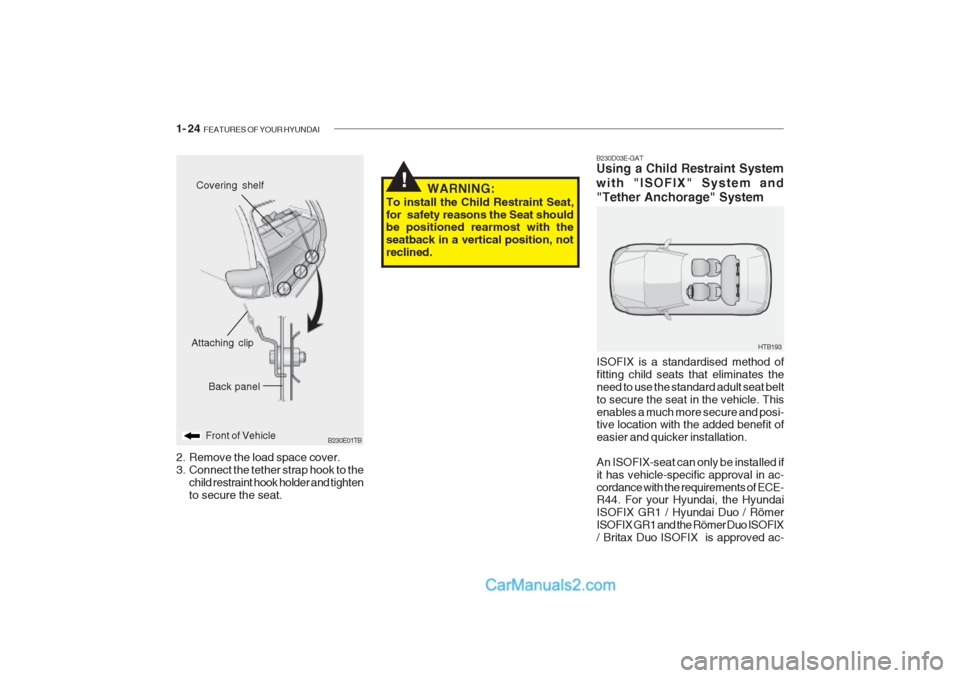
2. Remove the load space cover.
3. Connect the tether strap hook to the child restraint hook holder and tightento secure the seat. B230D03E-GAT Using a Child Restraint System with "ISOFIX" System and "Tether Anchorage" System
ISOFIX is a standardised method of fitting child seats that eliminates theneed to use the standard adult seat beltto secure the seat in the vehicle. Thisenables a much more secure and posi- tive location with the added benefit of easier and quicker installation. An ISOFIX-seat can only be installed if it has vehicle-specific approval in ac-cordance with the requirements of ECE- R44. For your Hyundai, the Hyundai ISOFIX GR1 / Hyundai Duo / RömerISOFIX GR1 and the Römer Duo ISOFIX/ Britax Duo ISOFIX is approved ac-
HTB193
WARNING:
To install the Child Restraint Seat, for safety reasons the Seat should be positioned rearmost with the seatback in a vertical position, notreclined.
Page 270 of 428
1- 26 FEATURES OF YOUR HYUNDAI
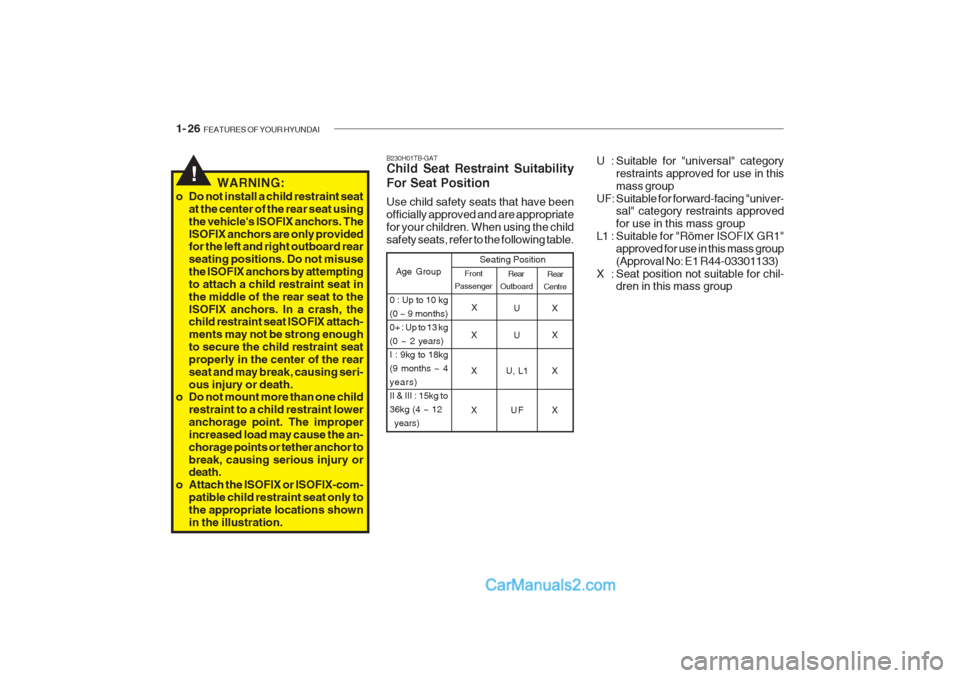
B230H01TB-GAT Child Seat Restraint Suitability For Seat Position Use child safety seats that have been officially approved and are appropriatefor your children. When using the childsafety seats, refer to the following table.
Rear
Centre
Age Group Seating Position
UX
X UX
Rear
Outboard
Front
Passenger
0 : Up to 10 kg (0 ~ 9 months)0+ : Up to 13 kg(0 ~ 2 years)I : 9kg to 18kg(9 months ~ 4years)II & III : 15kg to36kg (4 ~ 12 years) X
X U, L1 X XU
FX
U : Suitable for "universal" category
restraints approved for use in this mass group
UF: Suitable for forward-facing "univer- sal" category restraints approvedfor use in this mass group
L1 : Suitable for "Römer ISOFIX GR1" approved for use in this mass group(Approval No: E1 R44-03301133)
X : Seat position not suitable for chil- dren in this mass group
WARNING:
o Do not install a child restraint seat at the center of the rear seat using the vehicle's ISOFIX anchors. TheISOFIX anchors are only provided for the left and right outboard rear seating positions. Do not misusethe ISOFIX anchors by attemptingto attach a child restraint seat inthe middle of the rear seat to theISOFIX anchors. In a crash, the child restraint seat ISOFIX attach- ments may not be strong enoughto secure the child restraint seatproperly in the center of the rearseat and may break, causing seri-ous injury or death.
o Do not mount more than one child
restraint to a child restraint loweranchorage point. The improperincreased load may cause the an-chorage points or tether anchor tobreak, causing serious injury or death.
o Attach the ISOFIX or ISOFIX-com- patible child restraint seat only to the appropriate locations shownin the illustration.!
Page 271 of 428
FEATURES OF YOUR HYUNDAI 1- 27
B180B01A-EAT Pre-Tensioner Seat Belt
B180B01S-D
Your Hyundai vehicle is equipped with driver's and front passenger's pre-tensioner seat belts. The purpose of the pre-tensioner is to make sure that the seat belts fit tightly against theoccupant's body in certain frontal colli-sions. The pre-tensioner seat belts canbe activated with the airbags. The pre-tensioner seat belt operates in the same way as an Emergency Lock-ing Retractor (ELR) type of seat belt.When the vehicle stops suddenly, or ifthe occupant tries to lean forward tooquickly, the seat belt retractor will lock into position. However, in certain frontal
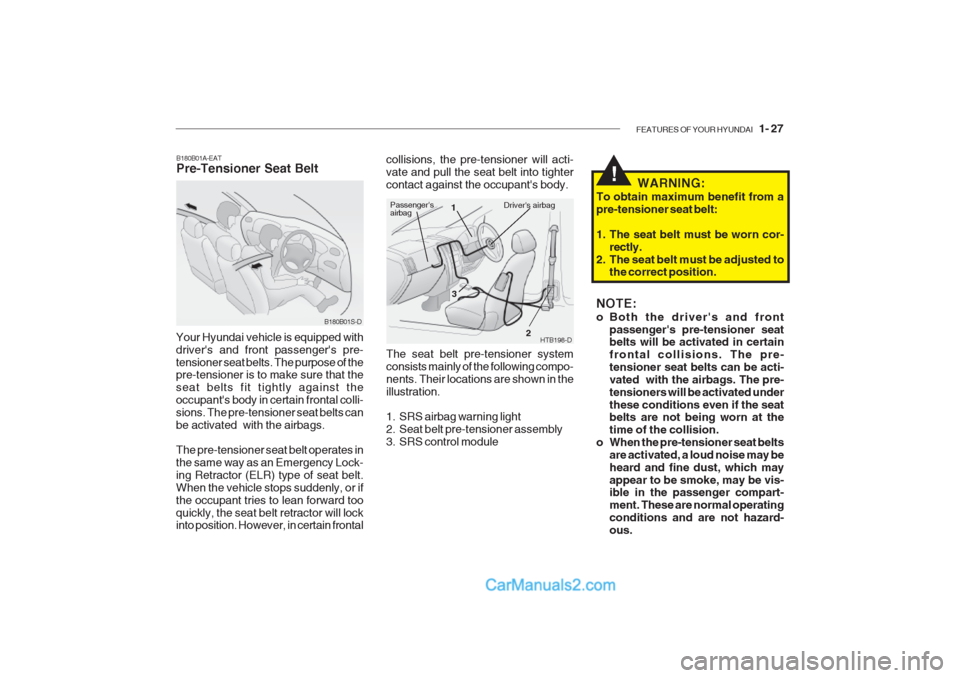
collisions, the pre-tensioner will acti- vate and pull the seat belt into tightercontact against the occupant's body. The seat belt pre-tensioner system consists mainly of the following compo-nents. Their locations are shown in theillustration.
1. SRS airbag warning light
2. Seat belt pre-tensioner assembly
3. SRS control module HTB198-D
Driver's airbag1
2
3Passenger's airbag
WARNING:
To obtain maximum benefit from a pre-tensioner seat belt:
1. The seat belt must be worn cor- rectly.
2. The seat belt must be adjusted to the correct position.
!
NOTE:
o Both the driver's and front
passenger's pre-tensioner seat belts will be activated in certain frontal collisions. The pre-tensioner seat belts can be acti-vated with the airbags. The pre-tensioners will be activated underthese conditions even if the seat belts are not being worn at the time of the collision.
o When the pre-tensioner seat belts
are activated, a loud noise may beheard and fine dust, which mayappear to be smoke, may be vis- ible in the passenger compart- ment. These are normal operatingconditions and are not hazard-ous.
Page 272 of 428
1- 28 FEATURES OF YOUR HYUNDAI
o Although it is harmless, the fine
dust may cause skin irritation and should not be breathed for pro-longed periods. Wash your handsand face thoroughly after an acci- dent in which the pre-tensioner seat belts were activated. it illuminates whilst the vehicle isbeing driven, please have an au-thorized Hyundai dealer inspectthe pre-tensioner seat belt or SRSairbag system as soon as pos- sible.
o Do not attempt to service or repair
the pre-tensioner seat belt systemin any manner.
o Improper handling of the pre- tensioner seat belt assemblies, and failure to heed the warnings to notstrike, modify, inspect, replace,service or repair the pre-tensioner seat belt assemblies may lead to improper operation or inadvertentactivation and serious injury.
o Always wear the seat belts when driving or travelling in a motorvehicle.
CAUTION:
o Because the sensor that activates the SRS airbag is connected withthe pre-tensioner seat belt, the SRSairbag warning light on theinstrument panel will blink forapproximately 6 seconds after the ignition key has been turned to the "ON" position and then it shouldturn off.
o If the pre-tensioner seat belt is not
working properly, this warninglight will illuminate even if there is no malfunction of the SRS airbag system.If the SRS airbag warning lightdoes not illuminate when the igni-tion key is turned to "ON", or if itremains illuminated after blinking for approximately 6 seconds, or if WARNING:
o Pre-tensioners are designed to op- erate only one time. After activa- tion, pre-tensioner seat belts must be replaced. All seat belts, of any type, should always be replacedafter they have been worn during acollision.
o The pre-tensioner seat belt assem-
bly mechanisms become hot dur- ing activation. Do not touch the pre-tensioner seat belt assembliesfor several minutes after they havebeen activated.
o Do not attempt to inspect or re-
place the pre-tensioner seat belts yourself. This must be done by an authorized Hyundai dealer.
o Do not strike the pre-tensioner seat
belt assemblies.
!!
Page 273 of 428
FEATURES OF YOUR HYUNDAI 1- 29
HTB201
Driver's Airbag
Your Hyundai is equipped with a Supple- mental Restraint (Airbag) System. Theindications of the system's presence are the letters "SRS AIR BAG" em- bossed on the airbag pad cover in thesteering wheel and printed on thepassenger's side front panel pad abovethe glove box. The Hyundai SRS consists of airbags installed under the pad covers in thecentre of the steering wheel and thepassenger's side front panel above theglove box. The purpose of the SRS is toprovide the vehicle's driver and/or the front passenger with additional protec- B240A01TB-EAT SUPPLEMENTAL RESTRAINT (AIRBAG) SYSTEM
HTB203
Rear impact
Side Impact Rollover
tion than that offered by the seat belt system alone, in case of a frontal im-pact of sufficient severity. NOTE: Be sure to read information about the SRS on the labels provided onthe back of the sun visor and in the glove box.
!WARNING:
o As its name implies, the SRS is designed to work with, and be supplemental to, the driver's and the passenger's three point seat belt systems and is not a substi-tute for them. Therefore your seatbelts must be worn at all timeswhile the vehicle is in motion. Inaddition, the airbags deploy only in certain frontal impact condi- tions severe enough to likely causesignificant injury to the vehicleoccupants. o The SRS is designed to deploy the
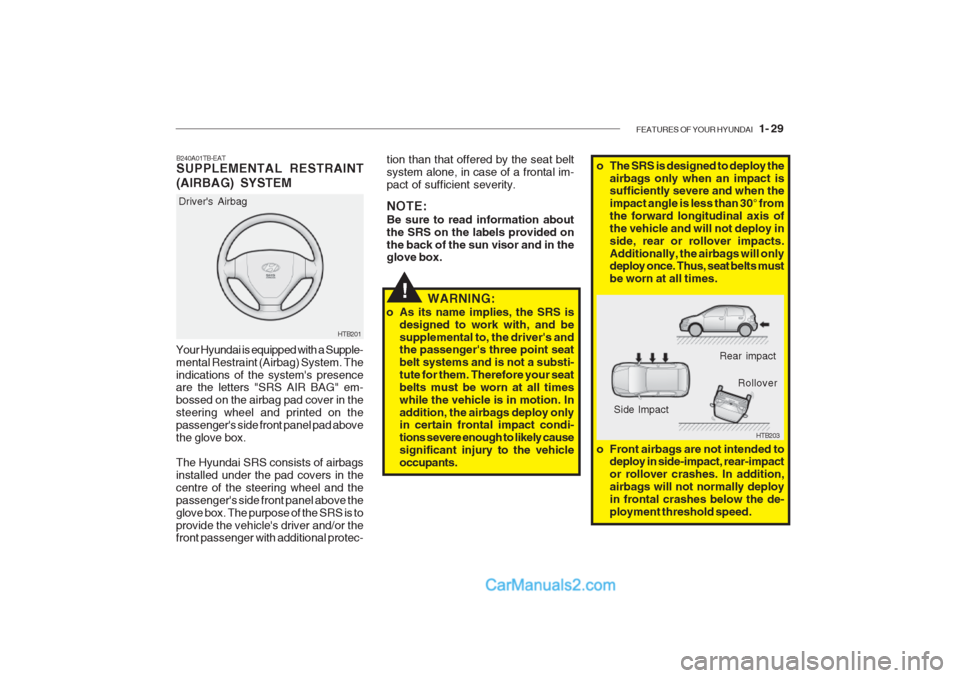
airbags only when an impact is sufficiently severe and when the impact angle is less than 30° fromthe forward longitudinal axis ofthe vehicle and will not deploy inside, rear or rollover impacts.Additionally, the airbags will only deploy once. Thus, seat belts must be worn at all times.
o Front airbags are not intended to deploy in side-impact, rear-impactor rollover crashes. In addition,airbags will not normally deployin frontal crashes below the de-ployment threshold speed.
Page 276 of 428
1- 32 FEATURES OF YOUR HYUNDAI
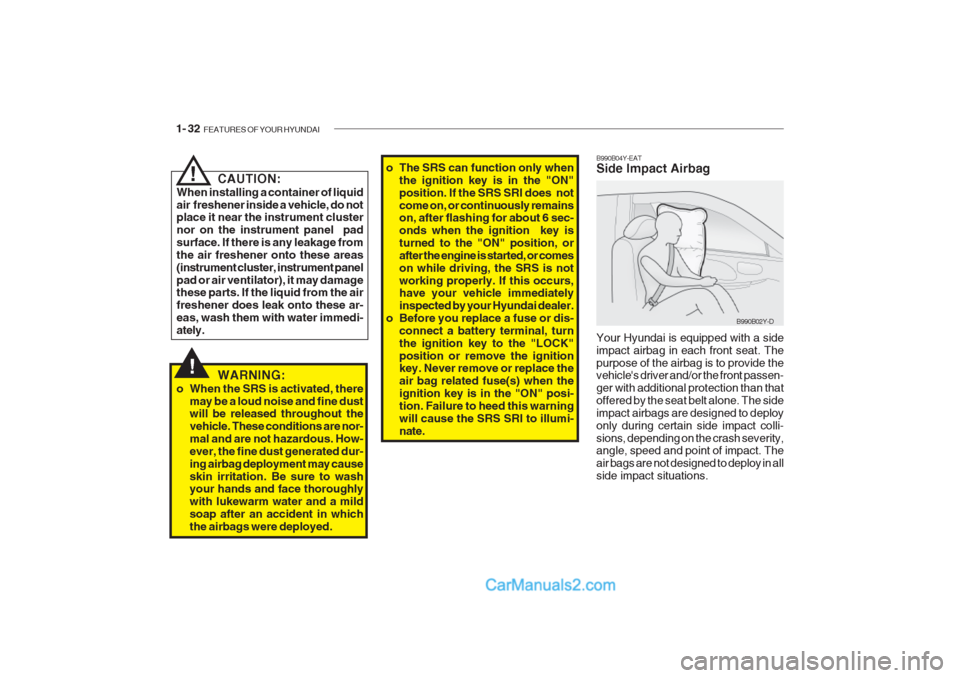
B990B04Y-EAT Side Impact Airbag Your Hyundai is equipped with a side impact airbag in each front seat. Thepurpose of the airbag is to provide the vehicle's driver and/or the front passen- ger with additional protection than thatoffered by the seat belt alone. The sideimpact airbags are designed to deployonly during certain side impact colli-sions, depending on the crash severity, angle, speed and point of impact. The air bags are not designed to deploy in allside impact situations.
B990B02Y-D
!
!
CAUTION:
When installing a container of liquid air freshener inside a vehicle, do not place it near the instrument cluster nor on the instrument panel padsurface. If there is any leakage fromthe air freshener onto these areas(instrument cluster, instrument panelpad or air ventilator), it may damage these parts. If the liquid from the air freshener does leak onto these ar-eas, wash them with water immedi-ately.
WARNING:
o When the SRS is activated, there may be a loud noise and fine dust will be released throughout the vehicle. These conditions are nor-mal and are not hazardous. How-ever, the fine dust generated dur-ing airbag deployment may causeskin irritation. Be sure to wash your hands and face thoroughly with lukewarm water and a mildsoap after an accident in whichthe airbags were deployed. o The SRS can function only when
the ignition key is in the "ON"position. If the SRS SRI does notcome on, or continuously remains on, after flashing for about 6 sec- onds when the ignition key isturned to the "ON" position, orafter the engine is started, or comeson while driving, the SRS is notworking properly. If this occurs, have your vehicle immediately inspected by your Hyundai dealer.
o Before you replace a fuse or dis- connect a battery terminal, turnthe ignition key to the "LOCK"position or remove the ignition key. Never remove or replace the air bag related fuse(s) when theignition key is in the "ON" posi-tion. Failure to heed this warningwill cause the SRS SRI to illumi-nate.