ECU Hyundai Getz 2002 Owner's Guide
[x] Cancel search | Manufacturer: HYUNDAI, Model Year: 2002, Model line: Getz, Model: Hyundai Getz 2002Pages: 428, PDF Size: 6.13 MB
Page 267 of 428

FEATURES OF YOUR HYUNDAI 1- 23
WARNING:
Do not install any child restraint sys- tem in the front passenger seat. Should an accident occur and cause the passenger side airbag to deploy,it could severely injure or kill aninfant or child seated in an infant orchild seat. Therefore, only use a childrestraint system in the rear seat of your vehicle.
If you need to tighten the belt, pull more webbing toward the retractor. When youunbuckle the seat belt and allow it toretract, the retractor will automaticallyrevert back to its normal seated pas- senger emergency locking usage con- dition. NOTE:
o Before installing the child restraint
system, read the instructions sup- plied by the child restraint systemmanufacturer.
o If the seat belt does not operate as
described, have the systemchecked immediately by your au-thorized Hyundai dealer.!
B230B01TB
B230B02A-GAT Using a Child Restraint System with "Tether Anchorage" Sys- tem For small children and babies, the use of a child seat or infant seat is strongly recommended. This child seat or infant seat should be of appropriate size forthe child and should be installed inaccordance with the manufacturer's in-structions. It is further recommendedthat the seat be placed in the vehicle's rear seat since this can make an impor- tant contribution to safety. Your vehicleis provided with three child restrainthook holders for installing the child seator infant seat. Spacer (10mm), Child Restraint Hook Holder
Holder Bolt (5/16"-30 mm) Washer, Conical Spring Holder, Child Restraint Hook
Retainer Washer B230E02FC-GAT Securing a Child Restraint Sys- tem with "Tether Anchorage" System Three child restraint hook holders are located on the vertical back panel.(behind rear bumper bar)
1. Route the child restraint seat strap
over the seatback. For vehicles with adjustable head- rests, route the tether strap underthe headrest and between the head-rest posts, otherwise route the tetherstrap over the top of the seatback.
Page 268 of 428
1- 24 FEATURES OF YOUR HYUNDAI
!
B230E01TB
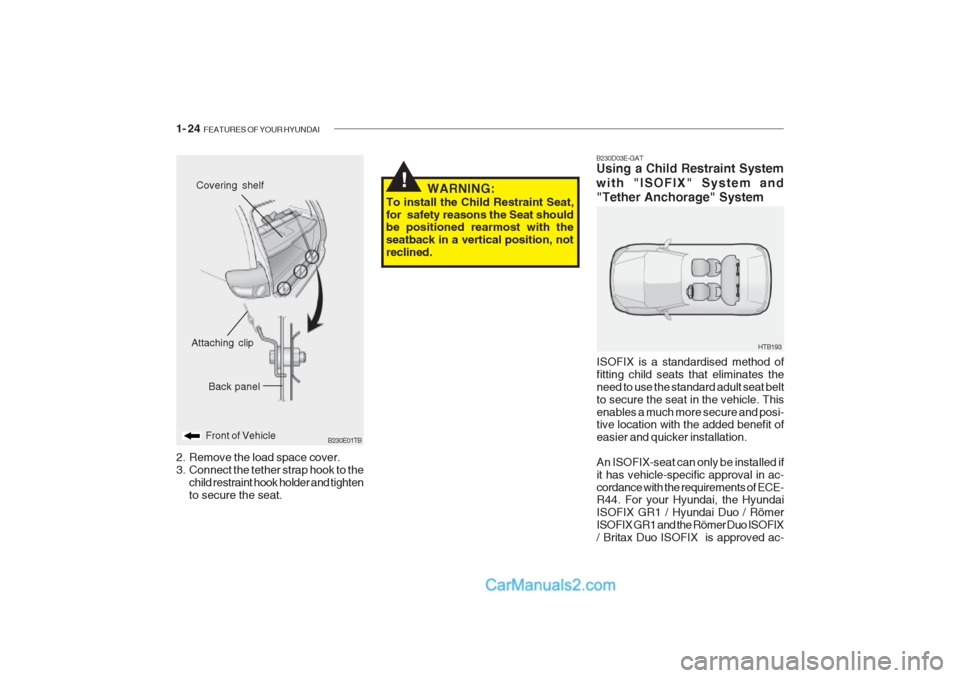
Back panel
Front of Vehicle
Attaching clip
Covering shelf
2. Remove the load space cover.
3. Connect the tether strap hook to the child restraint hook holder and tightento secure the seat. B230D03E-GAT Using a Child Restraint System with "ISOFIX" System and "Tether Anchorage" System
ISOFIX is a standardised method of fitting child seats that eliminates theneed to use the standard adult seat beltto secure the seat in the vehicle. Thisenables a much more secure and posi- tive location with the added benefit of easier and quicker installation. An ISOFIX-seat can only be installed if it has vehicle-specific approval in ac-cordance with the requirements of ECE- R44. For your Hyundai, the Hyundai ISOFIX GR1 / Hyundai Duo / RömerISOFIX GR1 and the Römer Duo ISOFIX/ Britax Duo ISOFIX is approved ac-
HTB193
WARNING:
To install the Child Restraint Seat, for safety reasons the Seat should be positioned rearmost with the seatback in a vertical position, notreclined.
Page 269 of 428
FEATURES OF YOUR HYUNDAI 1- 25
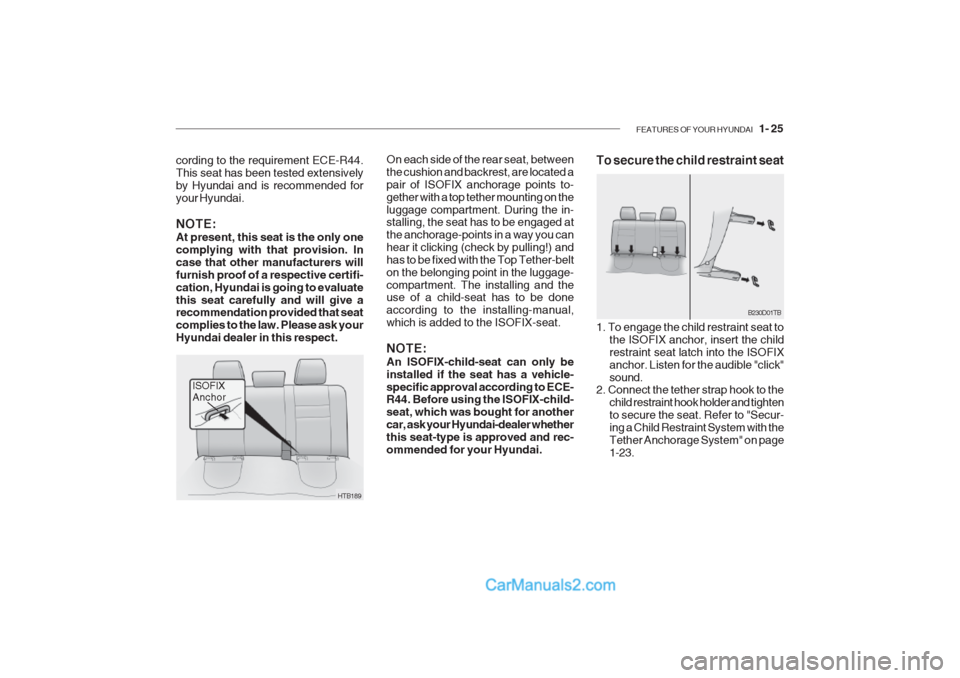
On each side of the rear seat, between the cushion and backrest, are located apair of ISOFIX anchorage points to-gether with a top tether mounting on theluggage compartment. During the in- stalling, the seat has to be engaged at the anchorage-points in a way you canhear it clicking (check by pulling!) andhas to be fixed with the Top Tether-belton the belonging point in the luggage-compartment. The installing and the use of a child-seat has to be done according to the installing-manual,which is added to the ISOFIX-seat. NOTE: An ISOFIX-child-seat can only be installed if the seat has a vehicle-specific approval according to ECE- R44. Before using the ISOFIX-child- seat, which was bought for anothercar, ask your Hyundai-dealer whetherthis seat-type is approved and rec-ommended for your Hyundai. B230D01TB
1. To engage the child restraint seat to the ISOFIX anchor, insert the childrestraint seat latch into the ISOFIXanchor. Listen for the audible "click"sound.
2. Connect the tether strap hook to the
child restraint hook holder and tightento secure the seat. Refer to "Secur-ing a Child Restraint System with theTether Anchorage System" on page1-23.
To secure the child restraint seatcording to the requirement ECE-R44. This seat has been tested extensivelyby Hyundai and is recommended foryour Hyundai. NOTE: At present, this seat is the only one complying with that provision. Incase that other manufacturers willfurnish proof of a respective certifi-cation, Hyundai is going to evaluatethis seat carefully and will give a recommendation provided that seat complies to the law. Please ask yourHyundai dealer in this respect.
HTB189
ISOFIX Anchor
Page 270 of 428
1- 26 FEATURES OF YOUR HYUNDAI
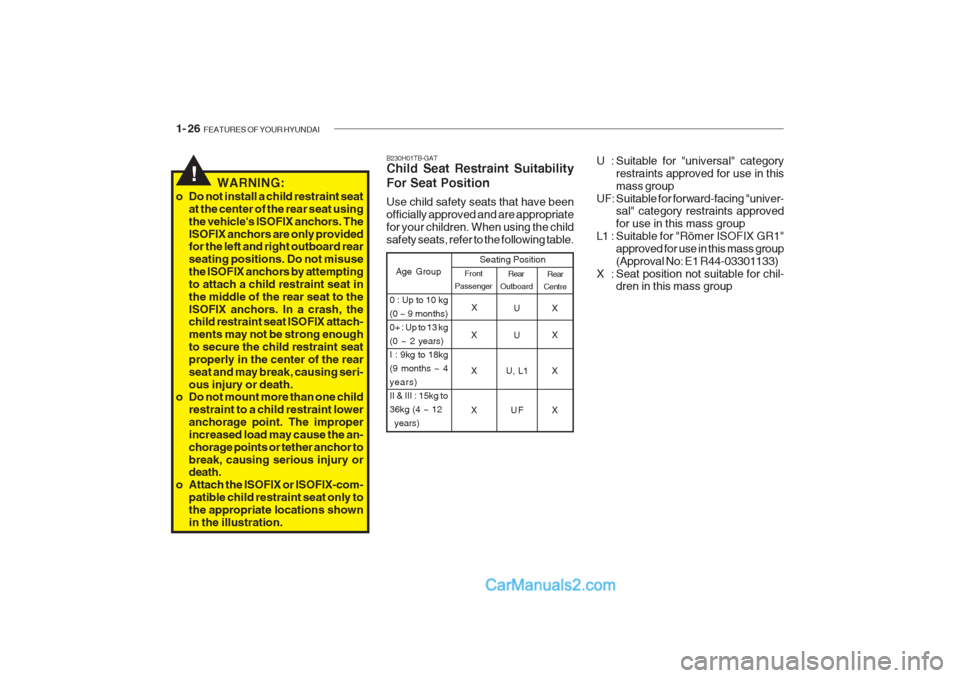
B230H01TB-GAT Child Seat Restraint Suitability For Seat Position Use child safety seats that have been officially approved and are appropriatefor your children. When using the childsafety seats, refer to the following table.
Rear
Centre
Age Group Seating Position
UX
X UX
Rear
Outboard
Front
Passenger
0 : Up to 10 kg (0 ~ 9 months)0+ : Up to 13 kg(0 ~ 2 years)I : 9kg to 18kg(9 months ~ 4years)II & III : 15kg to36kg (4 ~ 12 years) X
X U, L1 X XU
FX
U : Suitable for "universal" category
restraints approved for use in this mass group
UF: Suitable for forward-facing "univer- sal" category restraints approvedfor use in this mass group
L1 : Suitable for "Römer ISOFIX GR1" approved for use in this mass group(Approval No: E1 R44-03301133)
X : Seat position not suitable for chil- dren in this mass group
WARNING:
o Do not install a child restraint seat at the center of the rear seat using the vehicle's ISOFIX anchors. TheISOFIX anchors are only provided for the left and right outboard rear seating positions. Do not misusethe ISOFIX anchors by attemptingto attach a child restraint seat inthe middle of the rear seat to theISOFIX anchors. In a crash, the child restraint seat ISOFIX attach- ments may not be strong enoughto secure the child restraint seatproperly in the center of the rearseat and may break, causing seri-ous injury or death.
o Do not mount more than one child
restraint to a child restraint loweranchorage point. The improperincreased load may cause the an-chorage points or tether anchor tobreak, causing serious injury or death.
o Attach the ISOFIX or ISOFIX-com- patible child restraint seat only to the appropriate locations shownin the illustration.!
Page 311 of 428
FEATURES OF YOUR HYUNDAI 1- 67
B610B01A-DAT HORN
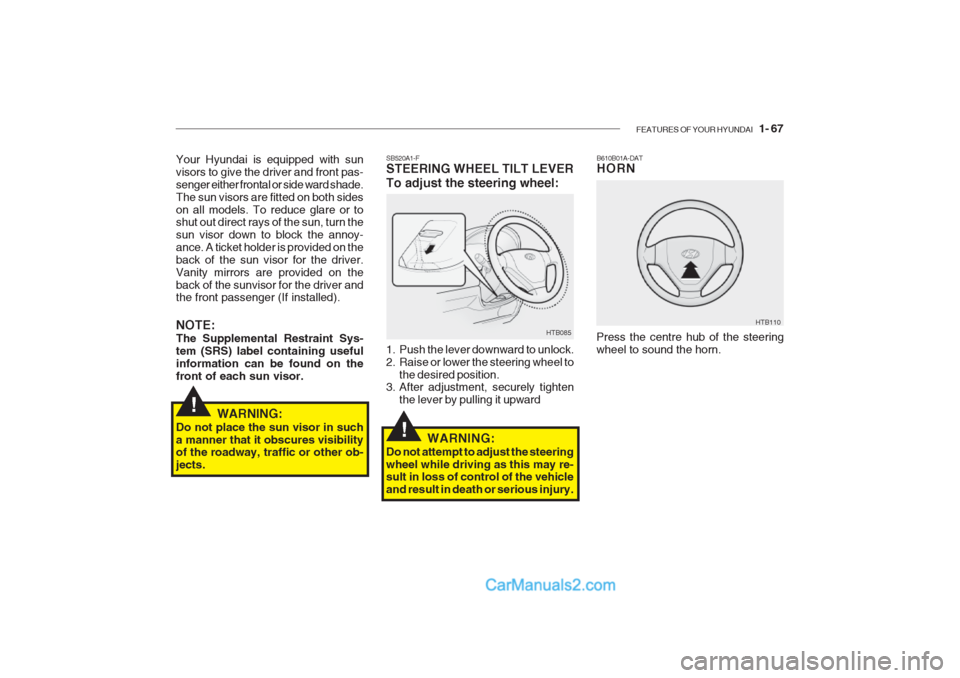
Press the centre hub of the steering wheel to sound the horn. HTB110SB520A1-F STEERING WHEEL TILT LEVER To adjust the steering wheel:
HTB085
1. Push the lever downward to unlock.
2. Raise or lower the steering wheel to the desired position.
3. After adjustment, securely tighten
the lever by pulling it upward
!WARNING:
Do not attempt to adjust the steering wheel while driving as this may re- sult in loss of control of the vehicle and result in death or serious injury.
Your Hyundai is equipped with sunvisors to give the driver and front pas-senger either frontal or side ward shade.The sun visors are fitted on both sideson all models. To reduce glare or to shut out direct rays of the sun, turn the sun visor down to block the annoy-ance. A ticket holder is provided on theback of the sun visor for the driver.Vanity mirrors are provided on theback of the sunvisor for the driver and the front passenger (If installed). NOTE: The Supplemental Restraint Sys- tem (SRS) label containing usefulinformation can be found on thefront of each sun visor.
WARNING:
Do not place the sun visor in sucha manner that it obscures visibility of the roadway, traffic or other ob- jects.
!
Page 345 of 428

DRIVING YOUR HYUNDAI 2- 19
Coupling point
Tongue
97
(44)
Without Brake Type Trailer
1,543 (700)
2,204 (1,000) 2,425 (1,100) 2,425(1,100) 1,984 (900)
2,425 (1,100) 992(450)
MANUAL
TRANSAXLE
AUTO
TRANSAXLE
1.1L 1.3L1.6L
Diesel 1.3L1.6L
With
Brake Type Lbs (kg.)
Maximum Towable
Weight
Type
NOTE:
o The total gross vehicle weight with trailer must not exceed the Gross Vehicle Weight Rating(GVWR) shown on the vehicle identification plate (see page 8- 1). The total gross vehicle weightis the combined weight of the vehicle, driver, all passengers and their luggage, cargo, hitch,trailer tongue load and other op- tional equipment. o The front or rear axle weight must
not exceed the Gross Axle Weight Rating (GAWR) shown on the ve-hicle identification plate (see page 8-1). it is possible that your towing package does not exceedthe GVWR but exceeds the GAWR. Improper trailer loading and/or too much luggage in thetrunk can overload the rear axle. Redistribute the load and check the axle weight again.
o The maximum permissible static vertical load on the coupling de-vice : 44kg
o The maximum permissible over-
hang of the coupling point : 690mm. YC200E2-E Trailer or Vehicle Towing Tips
1. Before towing, check hitch and
safety chain connections as well as proper operation of the trailer run- ning lights, brake lights, and turn signals.
2. Always drive your vehicle at a mod- erate speed (Less than 62 MPH)
3. Trailer towing requires more fuel than normal conditions.
4. To maintain engine braking effi-
ciency and electrical charging per-formance, do not use fifth gear (manual transaxle) or overdrive (au- tomatic transaxle).
5. Always secure items in the trailer to prevent load shift while driving.
6. Check the condition and air pres- sure of all tyres on the trailer and your car. Low tyre pressure can seriously affect the handling. Alsocheck the spare tyre.
7. The vehicle/trailer combination is
more affected by crosswind andbuffeting.
HTB312
Page 346 of 428

2- 20 DRIVING YOUR HYUNDAI
When being passed by a large ve- hicle, keep a constant speed and steer straight ahead. If there is toomuch wind buffeting slow down to get out of the other vehicle's air turbulence.
8. When parking your car and trailer, especially on a hill, be sure to followall the normal precautions. Turn yourfront wheel into the curb, set the parking brake firmly, and put the transaxle in 1st or Reverse (manual)or Park (automatic). In addition, place wheel chocks at each of the trailer's tyres.
9. If the trailer has electric brakes, start your vehicle and trailer mov-ing, and then apply the trailer brakecontroller by hand to be sure the brakes are working. This lets you check your electrical connection atthe same time.
10. During your trip, check occasion-
ally to be sure that the load issecure, and that the lights and any trailer brakes are still working.
11. Avoid jerky starts, sudden accel- eration or sudden stops.
12. Avoid sharp turns and rapid lane
changes. 13. Avoid holding the brake pedal
down too long or too frequently. This could cause the brakes tooverheat, resulting in reduced brak- ing efficiency.
14. When going down a hill, shift into a lower gear and use the enginebraking effect.When ascending a long grade,
downshift the transaxle to a lowergear and reduce speed to reduce chances of engine overloading and/or overheating.
15. If you have to stop while going
uphill, do not hold the vehicle inplace by pressing on the accelera- tor. This can cause the automatic transaxle to overheat. Use the park-ing brake or footbrake.
NOTE: When towing check transaxle fluid more frequently. CAUTION:
If overheating should occur when towing, (temperature gauge reads near red zone), taking the followingaction may reduce or eliminate the problem.
1. Turn off the air conditioner.
2. Reduce highway speed.
3. Select a lower gear when going uphill.
4. While in stop and go traffic, place
the gear selection in park or neutraland idle the engine at a higher speed.
!
Page 350 of 428

3- 4 WHAT TO DO IN AN EMERGENCY
D030A01TB-EAT IF THE ENGINE OVERHEATS If the temperature gauge indicates overheating:
1. Pull off the road and stop as soon as
it is safe to do so.
2. Place the gear selector lever in "P" (automatic), or neutral (manual transaxle) and set the parking brake. If the air conditioning is on, turn it off. 3. If coolant is running out under the
car or steam is coming out fromunder the bonnet stop the engine.Do not open the bonnet until the coolant has stopped running or the steaming has stopped. If there is novisible loss of coolant and no steam, leave the engine running and check to be sure the engine cooling fan isoperating. If the fan is not running, turn the engine off.
4. Check to see if the water pump drive belt is missing. If it is not missing,check to see that it is tight. If thedrive belt seems to be satisfactory, check for coolant leaking from the radiator, hoses or under the car. (Ifthe air conditioning had been in use, it is normal for cold water to be draining from it).
WARNING:
Whilst the engine is running, keephands and clothing away from mov-ing parts such as the fan and drive belts to prevent injury.
!
7. Remove jump cables in the reverse order of installation (black cable first).
CAUTION:
If the jump cable is incorrectly in- stalled, damage to the vehicle elec-trical system may occur, in particu- lar the electronic components such as the Fuel Injection system com-puter and the Automatic transaxle computer. The battery must never be disconnected whilst the engineis running.
!
!WARNING (Diesel only):
Never work on injection system with engine running or within 30 sec- onds after shutting off engine. Highpressure pump, rail, injectors and high pressure pipes are subject to high pressure even after the enginestopped. The fuel jet produced by fuel leaks may cause serious in- jury, if it touch the body. Peopleusing pacemakers should not move than 30cm closer to the ECU or wiring harness within the engineroom while engine is running, since the high currents in the Common Rail system produce considerablemagnetic fields.
5. If the water pump drive belt is bro- ken or coolant is leaking out, stop the engine immediately and call thenearest Hyundai dealer for assis- tance.
Page 356 of 428
3- 10 WHAT TO DO IN AN EMERGENCY
HTB150
SD070J1-E 8. Lower Vehicle and Tighten
Nuts
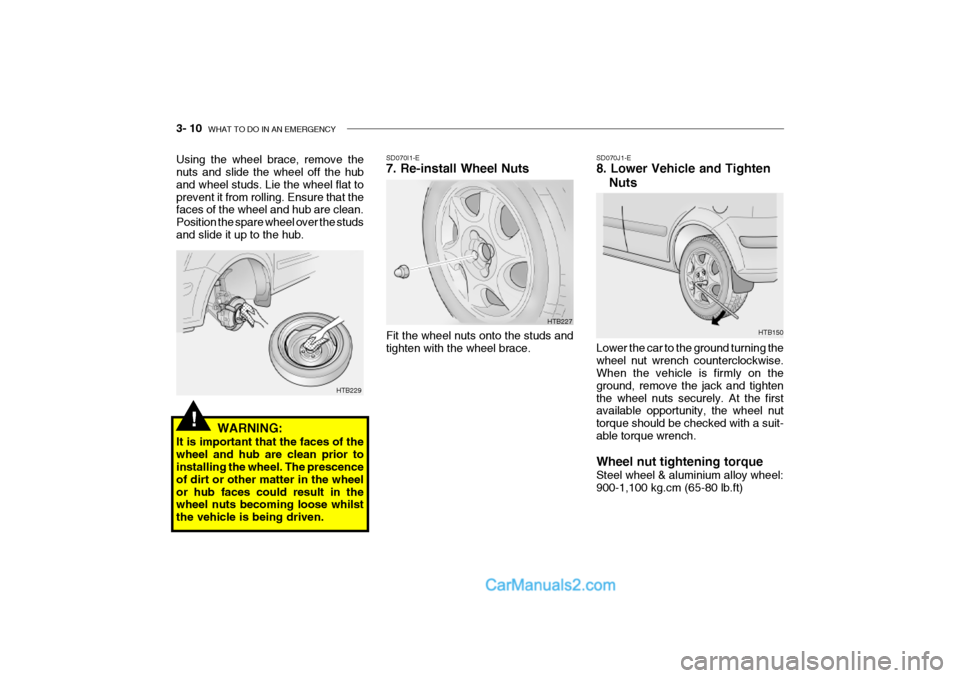
Lower the car to the ground turning the wheel nut wrench counterclockwise. When the vehicle is firmly on the ground, remove the jack and tightenthe wheel nuts securely. At the first available opportunity, the wheel nut torque should be checked with a suit-able torque wrench. Wheel nut tightening torque Steel wheel & aluminium alloy wheel: 900-1,100 kg.cm (65-80 lb.ft)
SD070I1-E 7. Re-install Wheel NutsFit the wheel nuts onto the studs and tighten with the wheel brace.
HTB227
Using the wheel brace, remove the nuts and slide the wheel off the hub and wheel studs. Lie the wheel flat toprevent it from rolling. Ensure that the faces of the wheel and hub are clean. Position the spare wheel over the studsand slide it up to the hub.
!
HTB229
WARNING:
It is important that the faces of the wheel and hub are clean prior to installing the wheel. The prescence of dirt or other matter in the wheelor hub faces could result in the wheel nuts becoming loose whilst the vehicle is being driven.
Page 371 of 428

VEHICLE MAINTENANCE REQUIREMENTS 5- 7
6ZF060A1-A
EXPLANATION OF SCHEDULED MAINTENANCE ITEMS
6ZF060M1-A
o Engine oil and filter
The engine oil and filter should be changed at the intervals specified inthe maintenance schedule. If the car is being driven in severe conditions, more frequent oil and filter changesare required. 6ZF060B1-A
o Drive belts
Inspect all drive belts for evidence of cuts, cracks, excessive wear or oilsaturation and replace if necessary. Drive belts should be checked peri- odically for proper tension and ad-justed as necessary. 6ZF060C1-A
o Fuel filter
A clogged filter can limit the speed at
which the vehicle may be driven, dam- age the emission system and cause hard starting. If an excessive amountof foreign matter accumulates in the fuel tank, the filter may require re- placement more frequently.
After installing a new filter, run the
engine for several minutes, and checkfor leaks at the connections.
F060D01TB-EAT
o Fuel lines, fuel hoses and con- nections
Check the fuel lines, fuel hoses and
connections for leakage and damage. Replace any damaged or leaking parts immediately.
6ZF060E1-A o Timing belt Replace timimg belt and inspect all associated parts related for damageand deformation. Replace any dam- aged parts immediately.
!WARNING (Diesel only):
Never work on injection system with engine running or within 30 seconds after shutting off engine. High pressure pump, rail, injectorsand high pressure pipes are sub- jected to high pressure even after the engine has been switched off.The fuel jet produced by fuel leaks may cause serious injury, if it con- tacts with the body. People usingpacemakers should not move closer than 30cm to the ECU or wiring harness within the engine room with the engine running, since the high currents in the CommonRail system produce considerable magnetic fields.