warning light Hyundai Getz 2002 Repair Manual
[x] Cancel search | Manufacturer: HYUNDAI, Model Year: 2002, Model line: Getz, Model: Hyundai Getz 2002Pages: 428, PDF Size: 6.13 MB
Page 348 of 428

3- 2 WHAT TO DO IN AN EMERGENCY
HTB165
SD020B1-E IF THE ENGINE CANNOT BE CRANKED
1. If the vehicle is fitted with manual
transaxle, ensure that the clutch pedal is depressed whilst cranking the engine. If the vehicle is fitted with automatic transaxle, ensurethat the transaxle selector is at the "P" or"N" position.
2. Check the battery terminals and
connections to ensure that theseare clean and also tight.
3. If the ignition warning lights dim
when the engine is cranked and thebattery terminals have been checked, a discharged battery isindicated. SD020C1-F If Engine Turns Over Normally but Does Not Start
SD020A1-E IF THE ENGINE WILL NOT START Seek assistance from the nearest Hyundai dealer with regard to the method of ignition and fuel systemdiagnosis.
!
HTB221
CAUTION:
If the engine refuses to start, no attempt should be made to push or tow start the vehicle. Vehicles withautomatic transaxle or fuel injec- tion will not be able to be started in this manner since no drive is trans-mitted through the automatic transaxle whilst the engine is not running, and in the case of fuelinjected derivatives, the fuel pump will not operate under tow start conditions. In addition, if the ve-hicle is equipped with an exhaust catalyst, damage to the catalyst may result if the vehicle is tow started. 4. Do not attempt to push or tow start
the vehicle, refer to "Jump Starting"for information regarding enginestarting when the battery is dis- charged.
1. Check fuel Level
2. Check all connectors at ignition coil and spark plugs. Replace any that may be discon- nected or loose.
3. Check fuel line in the engine room.
4. If engine still refuses to start, call a Hyundai dealer or seek other quali-fied assistance.
Page 349 of 428
WHAT TO DO IN AN EMERGENCY 3- 3
HTB218
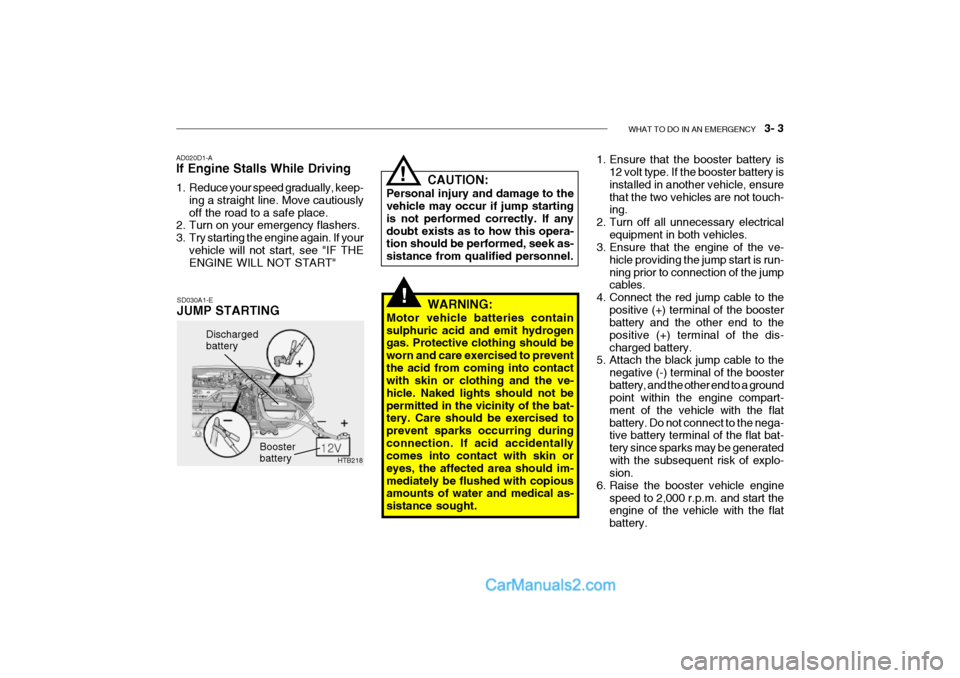
Discharged battery
Booster battery
CAUTION:
Personal injury and damage to the vehicle may occur if jump starting is not performed correctly. If anydoubt exists as to how this opera- tion should be performed, seek as- sistance from qualified personnel.
SD030A1-E JUMP STARTING
AD020D1-AIf Engine Stalls While Driving
1. Reduce your speed gradually, keep-
ing a straight line. Move cautiously off the road to a safe place.
2. Turn on your emergency flashers.
3. Try starting the engine again. If your
vehicle will not start, see "IF THE ENGINE WILL NOT START"!
WARNING:
Motor vehicle batteries contain sulphuric acid and emit hydrogen gas. Protective clothing should be worn and care exercised to preventthe acid from coming into contact with skin or clothing and the ve- hicle. Naked lights should not bepermitted in the vicinity of the bat- tery. Care should be exercised to prevent sparks occurring duringconnection. If acid accidentally comes into contact with skin or eyes, the affected area should im-mediately be flushed with copious amounts of water and medical as- sistance sought. 1. Ensure that the booster battery is
12 volt type. If the booster battery isinstalled in another vehicle, ensurethat the two vehicles are not touch- ing.
2. Turn off all unnecessary electrical equipment in both vehicles.
3. Ensure that the engine of the ve-
hicle providing the jump start is run- ning prior to connection of the jump cables.
4. Connect the red jump cable to the positive (+) terminal of the boosterbattery and the other end to the positive (+) terminal of the dis-charged battery.
5. Attach the black jump cable to the
negative (-) terminal of the boosterbattery, and the other end to a ground point within the engine compart- ment of the vehicle with the flatbattery. Do not connect to the nega- tive battery terminal of the flat bat- tery since sparks may be generatedwith the subsequent risk of explo- sion.
6. Raise the booster vehicle engine speed to 2,000 r.p.m. and start theengine of the vehicle with the flat battery.
!
Page 380 of 428

6- 6 DO-IT-YOURSELF MAINTENANCE
SG020B1-E DAILY OPERATING CHECKS The following items should be checked on a daily basis or whenever the vehicleis refuelled, whichever occurs sooner.
o Engine oil level.
o Engine coolant level.
o Power steering fluid level.
o Brake fluid level.
o Windscreen washer fluid level.
o Battery condition.
o Tyre condition and pressures.
o Operation and cleanliness of all light-
ing equipment.
o Windscreen wiper and washer opera- tion.
o Horn operation.
o Warning light operation.
o Adjustment and cleanliness of mir- rors.
o Seat and seat belt adjustment and operation.
o Fluid leakage. The vehicle must not be driven if the daily operating checks indicate that any item of equipment related to thesafety or roadworthiness of the vehicle is not functioning correctly. G030B02A-EAT Recommended Oil
1. Petrol engine A multi grade oil having a specification which meets A.P.I. specification of SGor above is recommended. The oil vis- cosity should be selected according to the operating environment of the engineby means of the table shown in the illustration. The engine oil recommen- dations are complete in themselvesand the use of additives is neither required nor recommended. The use of engine oil additives may result in invali-dation of the vehicle warranty.
G030A01FC-EAT ENGINE OIL The correct engine oil level is of para- mount importance. An excessively highor low oil level may result in irreparable damage being sustained by the engine. The engine oil level must be checkedon a daily basis, whenever the vehicle is refuelled or before starting a long trip, whichever occurs sooner.In addition, it is imperative that only an approved grade and specification of oil is used to avoid the possibility of seri-ous engine damage and premature wear. The use of "budget price" oil is a false economy that must be avoided if themaximum reliability and useful life is to be obtained from the vehicle.
G030B01L
Page 398 of 428

6- 24 DO-IT-YOURSELF MAINTENANCE
SG200A1-E FUSIBLE LINKS The fusible link prevents damage to the wiring harness in the event of an elec-trical system malfunction. Failure of a fusiblelink is indicative of a serious overload condition having occurred andtherefore the electrical system should be checked by a Hyundai dealer before a replacement link is fitted.
WARNING:
Under no circumstances should a fusible link be replaced with any- thing other than a new link of thesame rating. The use of higher rated links or other means of connecting the circuit will create a potential firehazard.
!
G200B01E-EAT INDIVIDUAL CIRCUIT FUSES The fuse box containing the individual circuit fuses will be found in the back-side of multi box located in the right side of driver. The multi box is removed by pulling lightly and then releasing the lid.A fuse rating grid will be found on the reverse side of the cover. In the event of fuse failure, the fuse should be re-placed with one of equivalent rating. A fuse removal tool is provided within the fuse box to facilitate replacement.In the event of a replacement fuse failing shortly after installation a mal- function within the circuit protected bythat fuse is indicated. The circuit should be checked by a Hyundai dealer at the first available opportunity. HTB180-D
HTB223
WARNING:
The use of replacement fuses having a higher rating than specified or other means of connecting the circuit willcreate a potential fire hazard.
!
Page 399 of 428
DO-IT-YOURSELF MAINTENANCE 6- 25
o If battery electrolyte is spilled onto
skin or into eyes, the effected area must be flushed with copiousamounts of water and medical assis- tance sought.
o If battery electrolyte is ingested, copious amounts of water or milkfollowed by an ant-acid (raw egg or milk of magnesia) must be drunk.Vomiting should not be induced and medical assistance must be sought.
o Batteries must only be charged in well venti-lated areas from whichnaked lights or sources of sparks are excluded.
o Ensure that children, pets or other unauthorized persons are kept awayfrom batteries.
o Do not allow anything to bridge the positive (+) and negative (-) termi-nals of the battery.
o Never invert the battery. The battery fitted during production is of the "Maintenance Free" type.
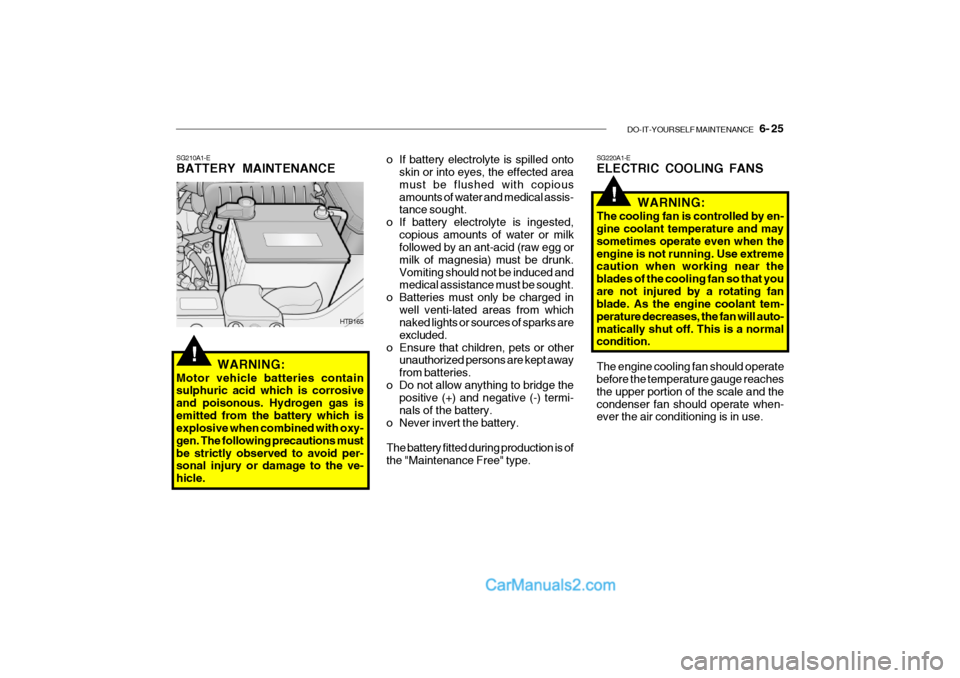
SG210A1-E BATTERY MAINTENANCE
WARNING:
Motor vehicle batteries contain sulphuric acid which is corrosive and poisonous. Hydrogen gas isemitted from the battery which is explosive when combined with oxy- gen. The following precautions mustbe strictly observed to avoid per- sonal injury or damage to the ve- hicle.
!
HTB165 SG220A1-E ELECTRIC COOLING FANS
WARNING:
The cooling fan is controlled by en- gine coolant temperature and may sometimes operate even when theengine is not running. Use extreme caution when working near the blades of the cooling fan so that youare not injured by a rotating fan blade. As the engine coolant tem- perature decreases, the fan will auto-matically shut off. This is a normal condition. The engine cooling fan should operate before the temperature gauge reaches the upper portion of the scale and thecondenser fan should operate when- ever the air conditioning is in use.
!
Page 401 of 428

DO-IT-YOURSELF MAINTENANCE 6- 27
5. Open the hood.
6. Draw the vertical line (through the
center of each headlight beam pat-tern) and the horizontal line (throughthe center of each headlight beam pattern) on the aiming screen. And then, draw the horizontal paral- lel line at 1.18 in. (30 mm ) under the horizontal line.
7. Adjust each cut-off line of the low beam to the parallel line with a phillipsscrewdriver - VERTICAL AIMING.
8. Adjust each cut-off line of the low
beam to each vertical line with aphillips screwdriver - HORIZONTAL AIMING. HTB269
Horizontal Aiming
Vertical Aiming
G290A01FC-EAT HEADLIGHT AIMING ADJUST- MENT Before performing aiming adjustment, make sure of the following.
1. Keep all tires inflated to the correct pressure.
2. Place the vehicle on level ground
and press the front bumper and rear bumper down several times. Place the vehicle at a distance of 118 in. (3,000 mm) from the test wall.
3. See that the vehicle is unloaded (except for full levels of coolant,engine oil and fuel, and spare tire,jack, and tools).
4. Clean the head lights lens and turn
on the headlight (low beam). WARNING:
Be sure to carefully wipe away anywater drained out in this manner,because the fuel mixed in the water might be ignited and result in a fire.!
1. Remove the engine cover.
2. Disconnect the air intake hose from air cleaner cover.
3. Loosen the drain plug at the bottom
of the fuel filter.
4. Tighten the drain plug when water no longer comes out.
5. Check to be sure that the warning
lamp illuminates when the ignition key is turned to "ON", and that it goes off when the engine is started.If in doubt, consult your nearest au- thorized HYUNDAI dealer.
G300B01FC
Page 403 of 428
DO-IT-YOURSELF MAINTENANCE 6- 29
!
HTB183
HTB268HTB184
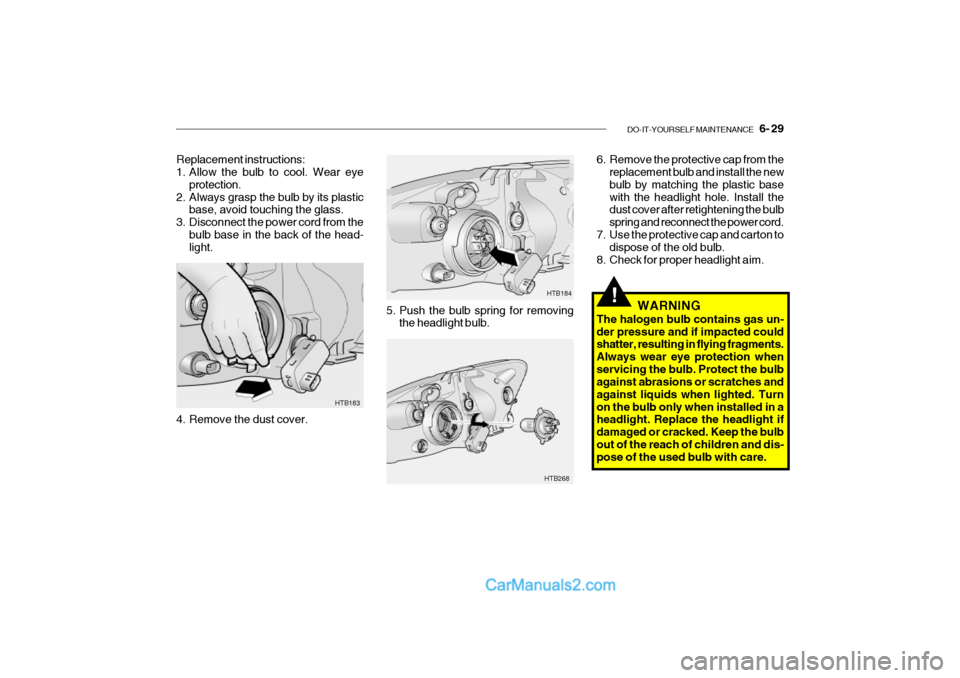
Replacement instructions:
1. Allow the bulb to cool. Wear eye
protection.
2. Always grasp the bulb by its plastic base, avoid touching the glass.
3. Disconnect the power cord from the bulb base in the back of the head-light.
4. Remove the dust cover. 5. Push the bulb spring for removing
the headlight bulb. 6. Remove the protective cap from the
replacement bulb and install the new bulb by matching the plastic basewith the headlight hole. Install the dust cover after retightening the bulb spring and reconnect the power cord.
7. Use the protective cap and carton to dispose of the old bulb.
8. Check for proper headlight aim.
WARNING
The halogen bulb contains gas un-der pressure and if impacted could shatter, resulting in flying fragments. Always wear eye protection whenservicing the bulb. Protect the bulb against abrasions or scratches and against liquids when lighted. Turnon the bulb only when installed in a headlight. Replace the headlight if damaged or cracked. Keep the bulbout of the reach of children and dis- pose of the used bulb with care.
Page 409 of 428

DO-IT-YOURSELF MAINTENANCE 6- 35
G200E01TB-GAT Inner Panel
HTB260-DFUSE RATING10A 10A10A10A10A10A 10A 15A10A10A20A15A 10A 20A10A15A15A15A 20A 10A10A10A30A15A 10A 15A15APROTECTED COMPONENTS
Air conditioner
Stop/Tail Light (LH) A/Bag IndicatorAudio, Electronic Outside Mirror
Turn signal Light, Back-up Light
Stop/Tail Light (RH)Cluster Cigarette Lighter PCM, ABS controlAir BagDoor Lock System, SunroofRear Wiper Motor
Start Relay, 9oTheft alarm system Seat Warmer Rear window DefrosterECM
Stop Light, Power Window
Hazard Warning Light, ETACMFront Wiper Motor Rear Fog Light
Fog light, ETACM, Power Window, Headlight leveling Device
Blower, SunroofRear window DefrosterHeadlight (RH)Front Fog Light
High Beam Light Indicator, Headlight (LH) Room Lamp, Audio, Cluster
DESCRIPTION
A/C SW
TAIL LH
A/BAG IND
AUDIO
T/SIG
TAIL RH
CLUSTER C/LIGHT ECU 1
A/BAG
D/LOCK
RR/WPR STARTS/HTD
HTD MIR ECU2
STOP
HAZARD
FRT WPR R/FOG
IGNITION BLOWER PR/HTD
H/LP RH F/FOG
H/LP LH
POWER CONN & R/LP
Page 426 of 428

INDEX 10- 3
ENGINE OIL REPLENISHMENT ................................ 6-8
ENGINE OIL ............................................................... 6-6 F FRONT ASHTRAY .................................................... 1-52
FRONT SEAT ........................................................... 1-11
FRONT FOG LIGHT SWITCH .................................. 1-50
FUEL ECONOMY ....................................................... 2-7
FUEL GAUGE ........................................................... 1-41
FUEL RECOMMENDATIONS ..................................... 1-1
FUSE PANEL DESCRIPTION ..................................6-34
FUSIBLE LINKS ........................................................ 6-24
GGLOVE BOX ............................................................. 1-57
HHAZARD WARNING SYSTEM................................. 1-49
HEADLIGHT AIMING ADJUSTEMENT ....................6-27
HEADLIGHT BULB ................................................... 6-28
HEADLIGHT LEVELING DEVICE SYSTEM .............1-53
HEAD RESTRAINT ADJ USTMENT .......................... 1-12
HEATED REAR WINDOW ............. ...........................1-50
HEATING AND COOLING CONTROL .....................1-68
HEIGHT ADJUSTABLE FRONT SEAT SHOULDER BELT ................................................ 1-18
HORN ........................................................................ 1-67
HOW TO USE LUGGAGE ROOM ............................1-63I
IF THE ENGINE CANNOT BE CRANKED
................. 3-2
IF THE ENGINE OVERHEATS ................................... 3-4
IF THE ENGINE WILL NOT START ........................... 3-2
IF THE EVENT OF A PUNCTURE ............................. 3-6
IMMOBILIZER SYSTEM ............................................. 1-4
INDIVIDUAL CIRCUIT FUSES .................................6-24
INSTRUMENT CLUSTER AND INDICATO RS .........1-35
INTERIOR LIGHT ..................................................... 1-56
INTERIOR REAR VIEW MIRROR ............................ 1-59
JJUMP STARTING ....................................................... 3-3
KKEY POSITI ONS ........................................................ 2-3
LLIGHTING SW ITCH .................................................. 1-47
LUGGAGE BOARD ................................................... 1-65
LUGGAGE NET ........................................................ 1-65
LUGGAGE ROOM .................................................... 1-63
LUGGAGE UNDER TRAY .............................. .......... 1-64
LUMBAR SUPPORT ADJUSTMENT ........................1-12
Page 427 of 428

10- 4 INDEX
M MAINTENANCE AND SERVICING
REQUIREMENTS ................................................... 5-2
MAINTENANCE UNDER SEVERE USAGE CONDITIONS .......................................................... 5-6
MANUAL TRANSAXLE ............................................... 2-8
MANUAL TRANSAXLE LUBRICANT ........................6-15
MIRROR .................................................................... 1-57
MULTI FUNCTION SWITCH ....................................1-46
OODOMETER ............................................................. 1-43
OUTSIDE REAR VIEW MIRROR .................. 1-57 ~ 1-58
OUTSIDE REAR VIEW MIRROR HEAT ...................1-59
OVERDRIVE SWI TCH .............................................. 2-12
PPARKING BRAKE ..................................................... 1-59
POLISHING ................................................................. 4-3POLLEN FILTER .............................................. 1-76, 6-20
POWER STEERING FLUID LEVEL ..........................6-26
POWER STEERING HOSES ...................................6-26
POWER W INDOW .................................................... 1-10
PROTECTING YOUR HYUNDAI FROM CORROSION .......................................................... 4-2 RREAR FOG LIGHT
SWITCH .................................... 1-51
REAR SE AT .............................................................. 1-13
REAR SEAT WARNING .... .......................................1-16
RECOMMENDED SHIFT SPEEDS ............................ 2-9
REMOTE FUEL FILLER LID RELEASE ...................1-61
REMOVAL OF WATER FROM THE FUEL FI LTER ............................................... 6-26
REPLACING LIGHT BULBS .....................................6-28
RUNNING IN ............................................................... 1-3
SSCHEDULED MAIN TENANCE................................... 5-3
SEAT ADJUSTMENT ................................................ 1-11
SEATBACK HOLDER ............................................... 1-63
SEAT BELT PRE CAUTIONS.................................... 1-16
SEAT BELTS ............................................................ 1-18
SEAT POCKET ......................................................... 1-63
SERVICE HISTORY ................................................... 5-2
SMOOTH CORNERING ........ ...................................2-15
SNOW TYRES ............................................................ 8-1
SPARE TYRE ............................................................. 3-5
SPARE WHEEL .......................................................... 3-6
SPARKING PLUG REPLACEMENT .........................6-13
SPECTACLE CASE .................................................. 1-56
SPEEDOMETER ....................................................... 1-42