change time Hyundai Getz 2002 Owner's Manual
[x] Cancel search | Manufacturer: HYUNDAI, Model Year: 2002, Model line: Getz, Model: Hyundai Getz 2002Pages: 428, PDF Size: 6.13 MB
Page 2 of 428
OWNER'S MANUAL A030A01TB-GAT Operation MaintenanceSpecifications All information in the Owner's Manual is current at the time of publication. Hyundai reserves the right to make changes at any time as part of our policy of continual product improvement may be carried out. This manual applies to all Hyundai models and includes descriptions and explanations of optional as well as standard equipment. As a result, you may find material in this manual that does not apply to yourspecific vehicle. Please note that some models are equipped with Right-Hand Drive (RHD). The explanations and illustrations for some operations in RHD models are opposite of those written in this manual.HTB089
Page 66 of 428
FEATURES OF YOUR HYUNDAI 1- 53
HTB018A
HTB015
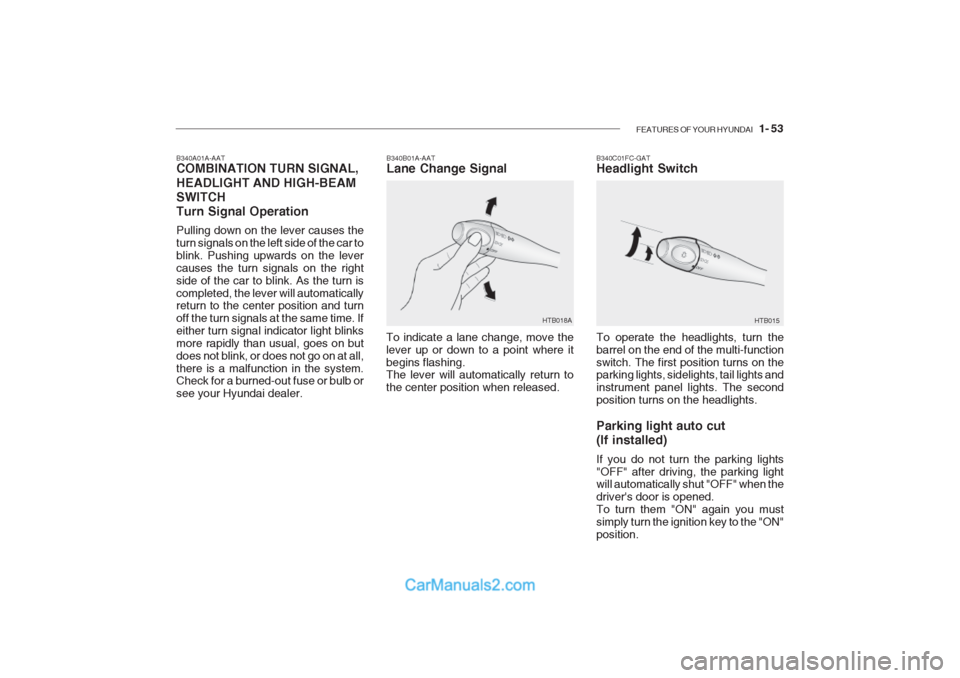
B340B01A-AAT Lane Change Signal
B340C01FC-GATHeadlight Switch
To indicate a lane change, move the lever up or down to a point where itbegins flashing. The lever will automatically return to the center position when released. To operate the headlights, turn thebarrel on the end of the multi-functionswitch. The first position turns on the parking lights, sidelights, tail lights and instrument panel lights. The secondposition turns on the headlights. Parking light auto cut (If installed) If you do not turn the parking lights "OFF" after driving, the parking light will automatically shut "OFF" when the driver's door is opened.To turn them "ON" again you mustsimply turn the ignition key to the "ON"position.
B340A01A-AAT COMBINATION TURN SIGNAL, HEADLIGHT AND HIGH-BEAM SWITCHTurn Signal Operation Pulling down on the lever causes the turn signals on the left side of the car toblink. Pushing upwards on the levercauses the turn signals on the rightside of the car to blink. As the turn iscompleted, the lever will automatically return to the center position and turn off the turn signals at the same time. Ifeither turn signal indicator light blinksmore rapidly than usual, goes on butdoes not blink, or does not go on at all,there is a malfunction in the system. Check for a burned-out fuse or bulb or see your Hyundai dealer.
Page 123 of 428

2- 2 DRIVING YOUR HYUNDAI
C010A01O-AAT
WARNING: ENGINE EXHAUST CAN BE DANGEROUS!
Engine exhaust fumes can be extremely dangerous. If, at any time, you smell exhaust fumes inside the vehicle, open the windows immediately. o Do not inhale exhaust fumes. Exhaust fumes contain carbon monoxide, a colorless, odorless gas that can cause unconsciousness and death by asphyxiation. o Be sure the exhaust system does not leak. The exhaust system should be checked whenever the vehicle is raised to change the oil or for any other purpose. If you hear a change in the sound of the exhaust or if you drive over something that strikes the underneath side of the car, have the exhaust system checked as soon as possible by your Hyundai dealer. o Do not run the engine in an enclosed area. Letting the engine idle in your garage, even with the garage door open, is a hazardous practice. Never run the engine in your garage any longer than it takes to start the engine and back the car out. o Avoid idling the engine for prolonged periods with people inside the car. If it is necessary to idle the engine for a prolonged period with people inside the car, be sure to do so only in an open area with the air intake set at "Fresh" and fan operating at one of the higher speeds so fresh air is drawn into the interior. If you must drive with the tail gate open because you are carrying objects that make this necessary: 1. Close all windows. 2. Open side vents. 3. Set the air intake control at "Fresh", the air flow control at "Floor" or "Face" and the fan at one of the higher speeds.
To assure proper operation of the ventilation system, be sure the ventilation air intakes located just in front ofthe windshield are kept clear of snow, ice, leaves or other obstructions.
!
Page 142 of 428

DRIVING YOUR HYUNDAI 2- 21
6. Check the condition and air pres-
sure of all tires on the trailer and your car. Low tire pressure canseriously affect the handling. Also check the spare tire.
7. The vehicle/trailer combination is more affected by crosswind andbuffeting. When being passed by a largevehicle, keep a constant speed and steer straight ahead. If there is too much wind buffeting slow downto get out of the other vehicle's air turbulence.
8. When parking your car and trailer, especially on a hill, be sure to fol-low all the normal precautions. Turn your front wheel into the curb, setthe parking brake firmly, and put the transaxle in 1st or Reverse (manual) or Park (automatic). Inaddition, place wheel chocks at each of the trailer's tires.
9. If the trailer has electric brakes, start your vehicle and trailer mov-ing, and then apply the trailer brake controller by hand to be sure thebrakes are working. This lets you check your electrical connection at the same time. 10. During your trip, check occasion-
ally to be sure that the load issecure, and that the lights andany trailer brakes are still working.
11. Avoid jerky starts, sudden accel-
eration or sudden stops.
12. Avoid sharp turns and rapid lane changes.
13. Avoid holding the brake pedal down
too long or too frequently. This could cause the brakes to over- heat, resulting in reduced brakingefficiency.
14. When going down a hill, shift into a
lower gear and use the engine brak-ing effect. When ascending a long grade, downshift the transaxle to a lowergear and reduce speed to reduce chances of engine overloading and/ or overheating.
15. If you have to stop while going uphill, do not hold the vehicle inplace by pressing on the accelera-tor. This can cause the automatic transaxle to overheat. Use the park- ing brake or footbrake.
NOTE: When towing check transaxle fluid more frequently. CAUTION:
If overheating should occur whentowing, (temperature gauge readsnear red zone), taking the following action may reduce or eliminate the problem.
1. Turn off the air conditioner.
2. Reduce highway speed.
3. Select a lower gear when going uphill.
4. While in stop and go traffic, place the gear selection in park or neutral and idle the engine at a higher speed.
!
Page 184 of 428
DO-IT-YOURSELF MAINTENANCE 6- 11
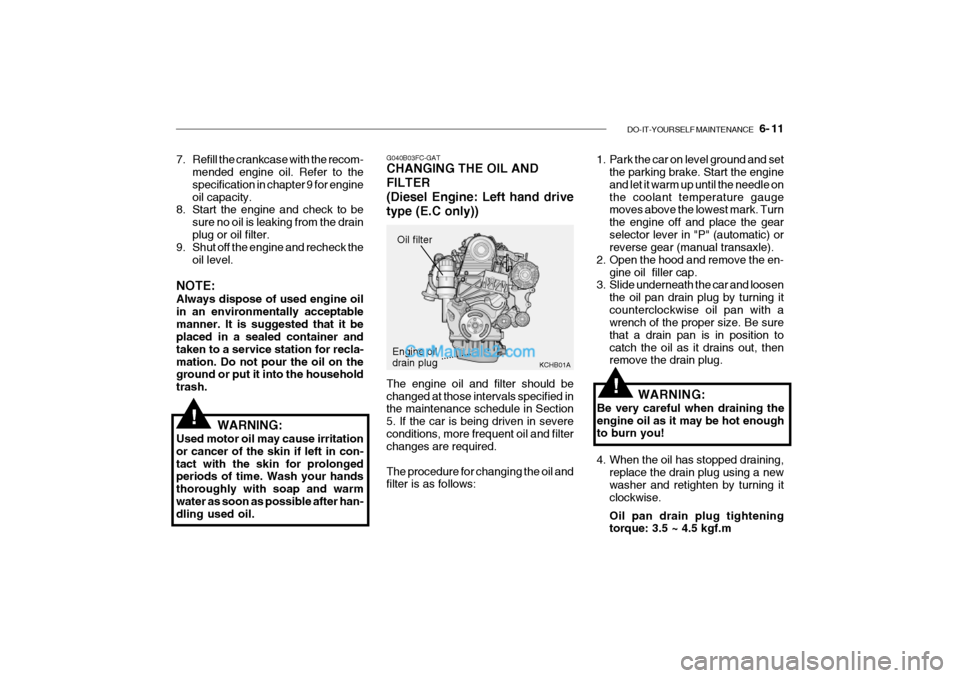
G040B03FC-GAT CHANGING THE OIL AND FILTER
(Diesel Engine: Left hand drivetype (E.C only)) The engine oil and filter should be changed at those intervals specified in the maintenance schedule in Section 5. If the car is being driven in severeconditions, more frequent oil and filter changes are required. The procedure for changing the oil and filter is as follows: 1. Park the car on level ground and set
the parking brake. Start the engine and let it warm up until the needle onthe coolant temperature gauge moves above the lowest mark. Turn the engine off and place the gearselector lever in "P" (automatic) or reverse gear (manual transaxle).
2. Open the hood and remove the en- gine oil filler cap.
3. Slide underneath the car and loosen
the oil pan drain plug by turning it counterclockwise oil pan with a wrench of the proper size. Be sure that a drain pan is in position tocatch the oil as it drains out, then remove the drain plug.
7. Refill the crankcase with the recom-
mended engine oil. Refer to the specification in chapter 9 for engineoil capacity.
8. Start the engine and check to be
sure no oil is leaking from the drainplug or oil filter.
9. Shut off the engine and recheck the
oil level.
NOTE: Always dispose of used engine oil in an environmentally acceptablemanner. It is suggested that it be placed in a sealed container and taken to a service station for recla-mation. Do not pour the oil on the ground or put it into the household trash.
WARNING:
Used motor oil may cause irritationor cancer of the skin if left in con-tact with the skin for prolonged periods of time. Wash your hands thoroughly with soap and warmwater as soon as possible after han- dling used oil.
!
Engine oil drain plug Oil filter
KCHB01A
WARNING:
Be very careful when draining the engine oil as it may be hot enough to burn you!!
4. When the oil has stopped draining, replace the drain plug using a new washer and retighten by turning it clockwise. Oil pan drain plug tightening torque: 3.5 ~ 4.5 kgf.m
............
Page 185 of 428

6- 12 DO-IT-YOURSELF MAINTENANCE
5. Loosen the oil filter drain plug by
turning it counterclockwise with a wrench of the proper size and drain out some oil in the oil filter. Be sure that a drain pan is in position tocatch the oil.
6. Loosen the oil filter upper cap with a
proper tool from the lower case untilan O-ring is seen. Then, drain the oil completely.
7. Pull out the oil filter upper cap with element from the lower case.Using a clean cloth, remove any dirt or oil accumulated around the lowercase.
8. Install a new copper washer of the
oil filter drain plug by the side oflower case and retighten by turning it clockwise. Tightening torque : 0.8 ~ 1.0 kgf.m
9. After mounting a new oil filter ele- ment and new O-ring to upper cap,install the upper cap to lower case and retighten by turning it clock-wise. Do not over-tighten. Tightening torque : 2.3 ~ 2.5 kgf.m
10.Refill the crankcase with the rec- ommended engine oil. Refer to the specification in chapter 9 for engine oil capacity.
11.Start the engine and check to be sure no oil is leaking from the drainplug or oil filter.
12.Shut off the engine and recheck the oil level.
NOTE: It is recommended that the engine oil and filter should be changed by an authorized Hyundai dealer.
G040B01FC
Oil filter drain plug O-ring
Oil filter element
Washer
Upper cap
Lower case NOTE: Always dispose of used engine oil in an environmentally acceptable manner. It is suggested that it beplaced in a sealed container and taken to a service station for maybe reclaimation. Do not pour the oil onthe ground or put it into the house- hold trash.
WARNING:
Used motor oil may cause irritation or cancer of the skin if left in con- tact with the skin for prolonged periods of time. Wash your handsthoroughly with soap and warm water as soon as possible after han- dling used oil.
!
Page 188 of 428

DO-IT-YOURSELF MAINTENANCE 6- 15
HTB172
5. Start the engine, top off the radiator with water and then add engine coolant to the reservoir until the level is between "LOW" and "FULL".
6. Replace the radiator and reservoir caps and check to be sure the draincocks are fully closed and not leak-ing.
WARNING:
The cooling fan is controlled byengine coolant temperature and may sometimes operate even when the engine is not running. Use ex-treme caution when working near the blades of the cooling fan so that you are not injured by a rotating fan blade. As the engine coolant tem-perature decreases, the fan will au- tomatically shut off. This is a nor- mal condition.
!
G060B02S-GAT REPLACING THE SPARK PLUGS
CHAMPION NGK
RC10YC BKR5ES
Unleaded
engine Leaded
engine
RC10YC4 BKR5ES-11
G060A01L
Unleaded: 1.0 ~ 1.1 mm (0.039 ~ 0.043 in.) Leaded: 0.7 ~ 0.8 mm(0.028 ~ 0.032 in.)
The spark plugs should be changed at the intervals specified in the vehicle maintenances schedule in Section 5 or whenever engine performance indi-cates they should be changed. Symp- toms that suggest poor spark plug performance include engine misfiringunder load, loss of fuel economy, poor acceleration, etc. When spark plugs are replaced, always use spark plugs recommended by Hyundai. The use ofother spark plugs can result in loss of performance, radio interference or engine damage. NOTE: When replacing the spark plugs, always use genuine parts recom-mended. Recommended Spark Plugs:
Page 189 of 428

6- 16 DO-IT-YOURSELF MAINTENANCE
WARNING:
It is recommended that the engine be cool or cold when changing the spark plugs. If the engine is hot, you couldburn yourself on the insulated con- nector, the spark plug or the engine itself.
4. When preparing to remove the old spark plug, guide the socket down over the spark plug, being careful not to damage the ceramic insulator.
5. To remove the spark plug, turn the
wrench handle in a counterclockwisedirection.
G060C01S-GAT Changing the Spark Plugs You will find it easier to change spark plugs if the engine is cold. Always change one spark plug at a time. Thishelps avoid getting the wires mixed up.
1. Remove the center cover on the
engine rocker cover. (1.6L only)
2. Using a clean cloth, remove any dirt that has accumulated around the spark plug so it cannot fall into thecylinder when the spark plug is re- moved.
3. To remove the spark plug cable, pull straight up on the insulated connec-tor, not the cable. Pulling on the cable may damage the carbon coreconductor. HTB174
HTB175
HTB176!
6. To install the new spark plug, guidethe socket down over the spark plug, being careful not to damage the ce-ramic insulator.
NOTE: Spark plugs should be tightened firmly. Over-tightening can damagethe threads in the aluminum cylinder head. Leaving them too loose can cause the spark plugs to get very hotand possibly result in damage to the engine.
7. Replace the cable by pushing the insulated connector directly down onto the electrode. Check to be sure it has snapped into place and can'tfall off.
Page 198 of 428

DO-IT-YOURSELF MAINTENANCE 6- 25
Water Pump Pulley
Alternator Pulley
Crankshaft Pulley 5.1~6 mm(0.2~0.24 in.)
G190A01A-GAT CHECKING DRIVE BELTS (Gasoline)
G180A01A-GAT CHECKING BRAKE PEDAL CLEARANCE
G180A01L
45.1 mm (1.78 in.)
You need a helper to check the brake pedal clearance. With the engine run- ning, have your helper press down on the brake pedal several times and thenhold it down with a force of about 490 N (50 Kg, 110 lbs). The brake pedal clearance is the distance from the topsurface of the brake pedal to the as- phalt sheeting under the floor mat. If the brake pedal clearance is notwithin the limits specified in the illustra- tion, have it inspected by your Hyundai dealer and adjusted or repaired if nec-essary. HTB186
1.1L
1.3L/1.6L Crankshaft pulley
Alternator
HTB220
Water Pump Pulley
9.5 ~11.0 mm (0.37 ~ 0.43 in.)
G170A01A-GAT CHECKING BRAKE PEDAL FREEPLAY
HXGS508
3 ~ 8 mm (0.12 ~ 0.31 in.)
With the engine off, press down on the brake pedal several times to reduce the vacuum in the brake booster.Then, using your hand, press down slowly on the brake pedal until you feel a change in resistance. This is thebrake pedal freeplay. The freeplay should be within the limits specified in the illustration. If it is not,have it inspected by your Hyundai dealer and adjusted or repaired if nec- essary.
Page 334 of 428
2- 8 DRIVING YOUR HYUNDAI
HTB206 CAUTION:
o Do not attempt to engage reverse gear when the car is in motion.
o To avoid damaging the selector mechanism, do not use the gear shift lever as a hand rest. Releasethe lever immediately the shift is completed.
o To avoid premature clutch wear, do not use the clutch pedal as afoot rest, and do not hold the vehicle on a gradient using theclutch.
o Ensure that the engine is not
over-revved by upshifting beforethe tachometer needle enters the red zone.
o Do not coast with the shift lever at the neutral position.
o When descending long gradi-
ents, make use of the engine brak- ing to assist the footbrake to avoid brake fade or over-heating.
o When slippery conditions are en- countered, increased cautionshould be exercised when gear changing, braking or accelerat-
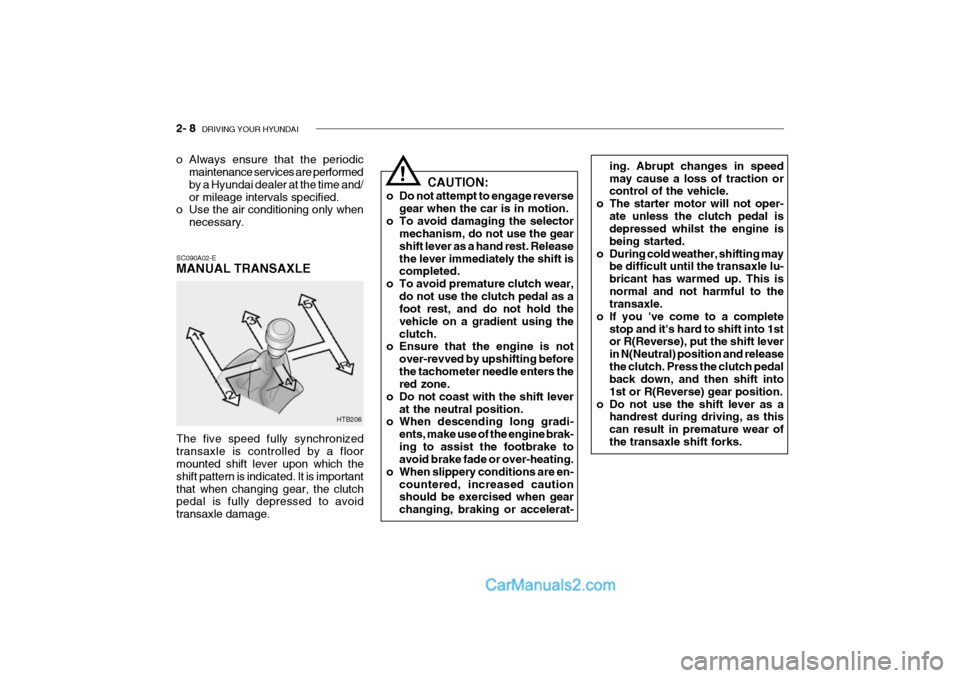
SC090A02-E MANUAL TRANSAXLE The five speed fully synchronized transaxle is controlled by a floor mounted shift lever upon which the shift pattern is indicated. It is importantthat when changing gear, the clutch pedal is fully depressed to avoid transaxle damage. ing. Abrupt changes in speedmay cause a loss of traction or control of the vehicle.
o The starter motor will not oper-
ate unless the clutch pedal isdepressed whilst the engine is being started.
o During cold weather, shifting may be difficult until the transaxle lu-bricant has warmed up. This isnormal and not harmful to the transaxle.
o If you 've come to a complete stop and it's hard to shift into 1stor R(Reverse), put the shift lever in N(Neutral) position and releasethe clutch. Press the clutch pedal back down, and then shift into 1st or R(Reverse) gear position.
o Do not use the shift lever as a handrest during driving, as thiscan result in premature wear ofthe transaxle shift forks.
o Always ensure that the periodic
maintenance services are performedby a Hyundai dealer at the time and/or mileage intervals specified.
o Use the air conditioning only when
necessary.
!