ESP Hyundai Getz 2003 User Guide
[x] Cancel search | Manufacturer: HYUNDAI, Model Year: 2003, Model line: Getz, Model: Hyundai Getz 2003Pages: 444, PDF Size: 13.82 MB
Page 151 of 444
DRIVING YOUR HYUNDAI 2- 15
C150A01A-AAT SMOOTH CORNERING Avoid braking or gear changing in cor- ners, especially when roads are wet.Ideally, corners should always be taken under gentle acceleration. If you follow these suggestions, tire wear will beheld to a minimum.
o Keep your car in good condition. For
better fuel economy and reducedmaintenance costs, maintain yourcar in accordance with the mainte- nance schedule in Section 5. If you drive your car in severe conditions,more frequent maintenance is re- quired (see Section 5 for details).
o Keep your car clean. For maximum service, your Hyundai should bekept clean and free of corrosive materials. It is especially importantthat mud, dirt, ice, etc. not be al- lowed to accumulate on the under- side of the car. This extra weightcan result in increased fuel con- sumption and also contribute to cor- rosion.
o Travel lightly. Don't carry unneces- sary weight in your car. Weight re-duces fuel economy.
o Don't let the engine idle longer than necessary. If you are waiting (andnot in traffic), turn off your engineand restart only when you're ready to go.
o Remember, your Hyundai does not require extended warm-up. As soonas the engine is running smoothly, you can drive away. In very cold weather, however, give your engine a slightly longer warm-up period.
o Don't "lug" or "over-rev" the engine. Lugging is driving too slowly in toohigh a gear resulting in the engine bucking. If this happens, shift to alower gear. Over-revving is racing the engine beyond its safe limit. This can be avoided by shifting atthe recommended speeds.
o Use your air conditioning sparingly.
The air conditioning system is oper-ated by engine power so your fuel economy is reduced when you use it. C160A01A-AAT WINTER DRIVING The more severe weather conditions of winter result in greater wear andother problems. To minimize the prob- lems of winter driving, you should fol- low these suggestions: C160B01A-GAT Snowy or Icy Conditions To drive your vehicle in deep snow, it may be necessary to use snow tires or to install tire chains on your tires. If snow tires are needed, it is necessary to select tires equivalent in size and type to the original equipment tires.Failure to do so may adversely affect the safety and handling of your car. Speeding, rapid acceleration, suddenbrake applications, and sharp turns are potentially very hazardous prac- tices. During deceleration, use enginebraking to the fullest extent. Sudden brake applications on snowy or icy roads may cause skids to occur. Youneed to keep sufficient distance be- tween the vehicle in front and your vehicle. Also, apply the brake gently. Itshould be noted that installing tire
Page 157 of 444
DRIVING YOUR HYUNDAI 2- 21
6. Check the condition and air pres-
sure of all tires on the trailer and your car. Low tire pressure canseriously affect the handling. Also check the spare tire.
7. The vehicle/trailer combination is more affected by crosswind andbuffeting. When being passed by a largevehicle, keep a constant speed and steer straight ahead. If there is too much wind buffeting slow downto get out of the other vehicle's air turbulence.
8. When parking your car and trailer, especially on a hill, be sure to fol-low all the normal precautions. Turn your front wheel into the curb, setthe parking brake firmly, and put the transaxle in 1st or Reverse (manual) or Park (automatic). Inaddition, place wheel chocks at each of the trailer's tires.
9. If the trailer has electric brakes, start your vehicle and trailer mov-ing, and then apply the trailer brake controller by hand to be sure thebrakes are working. This lets you check your electrical connection at the same time. 10. During your trip, check occasion-
ally to be sure that the load issecure, and that the lights andany trailer brakes are still working.
11. Avoid jerky starts, sudden accel-
eration or sudden stops.
12. Avoid sharp turns and rapid lane changes.
13. Avoid holding the brake pedal down too long or too frequently. This could cause the brakes to over- heat, resulting in reduced brakingefficiency.
14. When going down a hill, shift into a
lower gear and use the engine brak-ing effect. When ascending a long grade, downshift the transaxle to a lowergear and reduce speed to reduce chances of engine overloading and/ or overheating.
15. If you have to stop while going uphill, do not hold the vehicle inplace by pressing on the accelera-tor. This can cause the automatic transaxle to overheat. Use the park- ing brake or footbrake.
NOTE: When towing check transaxle fluid more frequently. CAUTION:
If overheating should occur whentowing, (temperature gauge readsnear red zone), taking the following action may reduce or eliminate the problem.
1. Turn off the air conditioner.
2. Reduce highway speed.
3. Select a lower gear when going uphill.
4. While in stop and go traffic, place the gear selection in park or neutral and idle the engine at a higher speed.
!
Page 179 of 444
5- 2 VEHICLE MAINTENANCE REQUIREMENTS
F010C01A-GAT
Specified Scheduled Procedures
These are the procedures such as
inspections, adjustments and replace- ments that are listed in the mainte- nance charts starting on page 5-4.These procedures must be performed at the intervals shown in the mainte- nance schedule to assure that yourwarranty remains in effect. Although it is strongly recommended that they be performed by the factory-trained ordistributor-trained technicians at your Hyundai dealer, these procedures may be performed at any qualified servicefacility. It is suggested that genuine Hyundai F010D01A-GAT
General Checks
These are the regular checks youshould perform when you drive your Hyundai or you fill the fuel tank. A list of these items will be found on page6-6.
F010A01A-GAT MAINTENANCE INTERVALS Service Requirements To assure that you receive the great- est number of kilometers of satisfyingoperation from your Hyundai, certain maintenance procedures must be performed. Although careful designand engineering have reduced these to a minimum, those that are required are of the utmost importance.It is your responsibility to have thesemaintenance procedures performedto comply with the terms of the war- ranties covering your new Hyundai. The Service Passport supplied withyour new vehicle provides further in- formation about these warranties.
F010B01A-AAT
Maintenance Requirements
The maintenance required for your
Hyundai can be divided into threemain areas:
o Specified scheduled procedures
o General checks
o Do-it-yourself maintenance service parts be used for any required repairs or replacements. Other parts of equivalent quality such as engineoil, engine coolant, manual or auto transaxle oil, brake fluid and so on which are not supplied by HyundaiMotor Company or its distributor may be used without affecting your war- ranty coverage but you should alwaysbe sure these are equivalent to the quality of the original Hyundai parts. Your Service Passport provides fur-ther information about your warranty coverage.
Page 180 of 444
VEHICLE MAINTENANCE REQUIREMENTS 5- 3
F010E01A-AAT
Do-It-Yourself Maintenance
If you are mechanically inclined, own a few tools that are required and want to take the time to do so, you can inspect and service a number of items.For more information about doing it yourself, see Section 6. F010F01A-AAT
A Few Tips
o Whenever you have your Hyundai
serviced, keep copies of the ser- vice records in your glovebox. This will help ensure that you can docu-ment that the required procedures have been performed to keep your warranties in effect. This is espe-cially important when service is not performed by an authorized Hyundai dealer.
o If you choose to do your own main-
tenance and repairs, you may findit helpful to have an official Hyundai Shop Manual. A copy of this pub- lication may be purchased at yourHyundai dealer's parts department. F020A01Y-GAT
SCHEDULED MAINTENANCE REQUIREMENTS
Inspection should be performed any time a malfunction is experienced orsuspected. Receipts for all emission control system services should be retained to demonstrate compliancewith conditions of the emissions sys- tem warranty. For severe usage maintenance re-
quirements, see page 5-7 of this sec- tion.
Page 195 of 444

DO-IT-YOURSELF MAINTENANCE 6- 7
G030A01FC-GAT CHECKING THE ENGINE OIL Gasoline EngineRecommended Oil Engine oil is essential to the perfor- mance and service of the engine. It is suggested that you check the oil levelat least once a week in normal use and more often if you are on a trip or driving in severe conditions. SH, SG or SG/CD (API) multi-grade and fuel efficient oil is recommended. NOTE: SAE 5W-20 is not recommended for sustained high speed vehicle op-eration.
G030B01L G030B01TB
G030B02TB-GAT CHECKING THE ENGINE OIL Diesel EngineRecommended Oil Engine oil is essential to the perfor- mance and service of the engine. It is suggested that you check the oil level every 500km or before starting a longtrip and more often if you are driving in severe conditions. The engine oil quality should meet the following classification: API class: CF-4 or ABOVE ACEA class: B4 or ABOVE NOTE: SAE 0W-30 oil is for extra cold zone and to be restricted by driving con- dition and dealing area. (Especially,not recommended for sustained high loaded and high speed opera- tion.)
Page 226 of 444
6- 38 DO-IT-YOURSELF MAINTENANCE
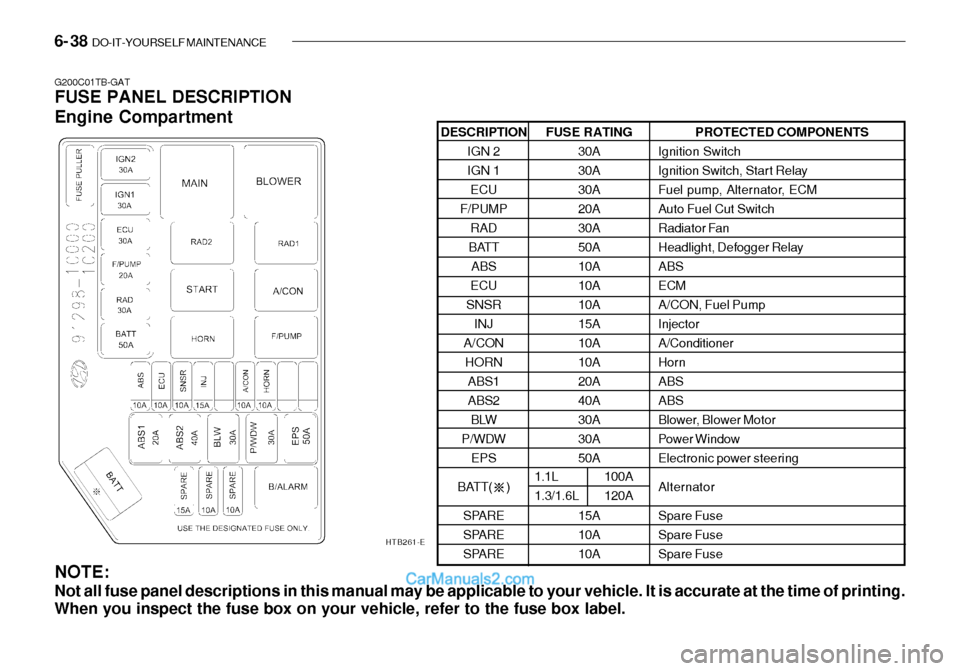
G200C01TB-GAT FUSE PANEL DESCRIPTION Engine Compartment
HTB261-EPROTECTED COMPONENTS
Ignition Switch
Ignition Switch, Start Relay
Fuel pump, Alternator, ECM
Auto Fuel Cut Switch
Radiator Fan
Headlight, Defogger RelayABSECMA/CON, Fuel PumpInjectorA/Conditioner
HornABSABS
Blower, Blower Motor
Power Window
Electronic power steering AlternatorSpare Fuse Spare FuseSpare Fuse
FUSE RATING
30A30A30A20A30A50A10A10A10A15A10A10A20A40A30A30A50A 15A 10A10A
DESCRIPTION
IGN 2IGN 1ECU
F/PUMP RAD
BATT ABS
ECU
SNSR INJ
A/CON HORN ABS1ABS2 BLW
P/WDW EPS
BATT( ) SPARE
SPARE
SPARE
NOTE:
Not all fuse panel descriptions in this manual may be applicable to your vehicle. It is accurate at the time of printing. When you inspect the fuse box on your vehicle, refer to the fuse box label.
1.1L 1.3/1.6L 100A120A
Page 251 of 444
Responsibilty For Maintenance
It is the responsibility of the vehicle owner/driver to ensure that all routine mainte- nance services are undertaken in line with the recommendations specified in Section 5 of this manual. In addition, in order to ensure continued validity of the new vehiclewarranty and safe operation of the vehicle, non scheduled maintenance/running repairs should be undertaken at the earliest available opportunity. Under severe operating conditions, more frequent maintenance is required. Detailsof the maintenance schedule for such conditions are also given in section 5. It is recommended that all maintenance operations and repairs are entrusted to a franchised Hyundai dealer to ensure that the latest repair methods, specializedtooling and genuine Hyundai parts are used to ensure the continued reliability and safety of the vehicle.
SA020A1-E
Page 252 of 444
The information in this Owner's Manual is current at the time of publication. However, the right to amend specifications without
notice or obligation to incorporate such amendments into vehicles already produced is reserved. This manual applies to all markets and includes descriptions and explanations of optional as well as standard equipment. As a result, some of the equipment operating descriptions referred to may not apply to the particular vehicle with which this manual is supplied. Please refer to the nearest franchised Hyundai dealer for information regarding current standard and optional equipment levels. HTB089
SA010A1-E OWNER'S MANUAL Operation MaintenanceSpecifications
Page 285 of 444
FEATURES OF YOUR HYUNDAI 1- 25
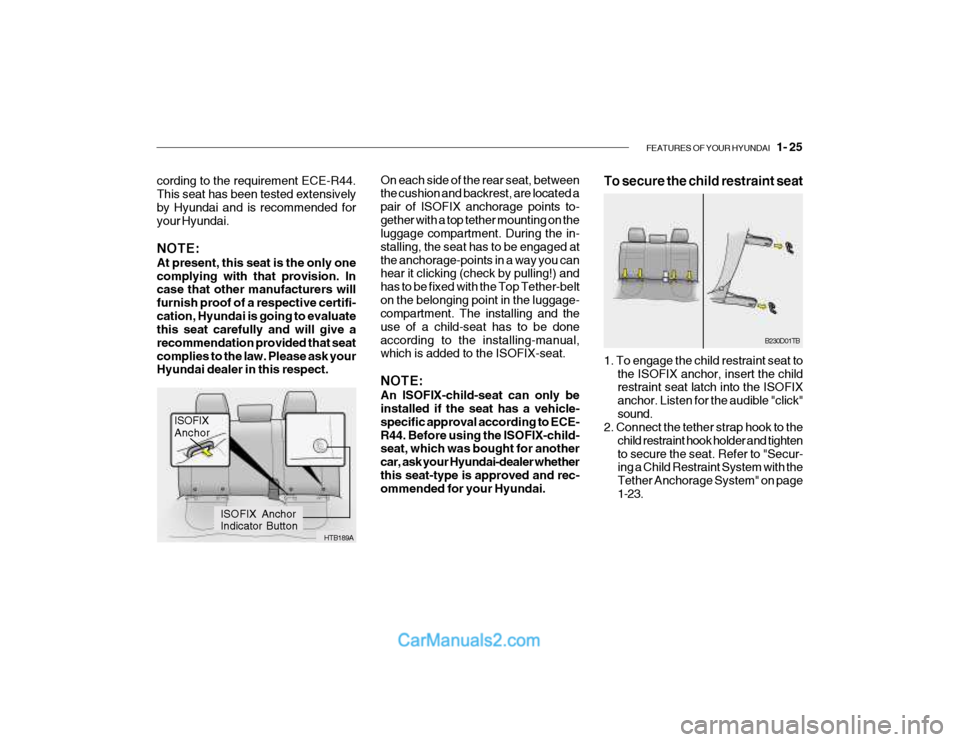
On each side of the rear seat, between the cushion and backrest, are located a pair of ISOFIX anchorage points to-gether with a top tether mounting on the luggage compartment. During the in- stalling, the seat has to be engaged atthe anchorage-points in a way you can hear it clicking (check by pulling!) and has to be fixed with the Top Tether-belton the belonging point in the luggage- compartment. The installing and the use of a child-seat has to be doneaccording to the installing-manual, which is added to the ISOFIX-seat. NOTE: An ISOFIX-child-seat can only be installed if the seat has a vehicle- specific approval according to ECE-R44. Before using the ISOFIX-child- seat, which was bought for another car, ask your Hyundai-dealer whetherthis seat-type is approved and rec- ommended for your Hyundai. B230D01TB
1. To engage the child restraint seat to the ISOFIX anchor, insert the childrestraint seat latch into the ISOFIX anchor. Listen for the audible "click"sound.
2. Connect the tether strap hook to the
child restraint hook holder and tightento secure the seat. Refer to "Secur- ing a Child Restraint System with the Tether Anchorage System" on page1-23.
To secure the child restraint seatcording to the requirement ECE-R44. This seat has been tested extensivelyby Hyundai and is recommended for your Hyundai. NOTE: At present, this seat is the only one complying with that provision. In case that other manufacturers will furnish proof of a respective certifi-cation, Hyundai is going to evaluate this seat carefully and will give a recommendation provided that seatcomplies to the law. Please ask your Hyundai dealer in this respect.
HTB189A
ISOFIX Anchor
ISOFIX Anchor Indicator Button
Page 298 of 444

1- 38 FEATURES OF YOUR HYUNDAI
!
SB210J1-E
HIGH BEAM INDICATOR LIGHT
The high beam indicator light will illumi- nate whenever the headlights are switched to high beam of flash position.
B260H03A-EATPARKING BRAKE/
BRAKE FLUID LEVEL WARNING LIGHT
SB210K1-E
OIL PRESSURE WARNING LIGHT
!CAUTION:
If the oil pressure light illuminates when the engine is running, an in- sufficient oil pressure level for con- tinued safe operation of the engineexists. Continued operation of the engine in this condition may result in serious engine damage. Under normal circumstances, the light will illuminate when the igni-tion is turned "on" and will be extin- guished when the engine is started. If the oil pressure warning light illu-minates whilst the engine is run- ning, stop the engine immediately and check the engine oil level. If thelevel is insufficient, add the required amount of oil as indicated by theengine oil dipstick. If the light fails to extinguish when the engine is re- started, do not continue to operatethe vehicle. If the oil pressure light illuminates during normal operation and thecause is not an insufficient oil level, or the light fails to illuminate when the ignition is turned "on", contactthe nearest Hyundai dealer before further operating the vehicle.
Warning light operation The parking brake/brake fluid level warn- ing light will be illuminated wheneverthe ignition switch is turned to the "ON" position irrespective of whether or not the parking brake is applied and mustbe extinguished when the engine starts and the parking brake released. If the warning light fails to extinguish orilluminates at any other time, the ve- hicle must be brought to rest in a safe location and the level of brake fluid inthe reservoir checked. If the fluid level is incorrect, fluid conforming to DOT 3 or DOT 4 specifications should be added.If, after correcting the brake fluid level, the warning light continues to be illumi- nated, the advice of the nearest Hyundaidealer must be sought before the ve- hicle is driven again. Your Hyundai is equipped with a diago-nally split dual braking system which will ensure that in the event of one of the brake circuits becoming defective, ap-proximately fifty per cent of the normal braking performance will be available. If failure of one of the circuits occurs,the required amount of pedal effort, pedal travel and stopping distance will be increased. Use of the gearbox is
WARNING:
In the event of problems being sus-pected with the braking system, theadvice of the nearest Hyundai dealer must be sought before the vehicle is driven. Driving the vehicle with ei-ther an electrical or hydraulic brak- ing system defect may be danger- ous, resulting in accident or per-sonal injury.