engine overheat Hyundai Getz 2003 User Guide
[x] Cancel search | Manufacturer: HYUNDAI, Model Year: 2003, Model line: Getz, Model: Hyundai Getz 2003Pages: 444, PDF Size: 13.82 MB
Page 231 of 444
EMISSION CONTROL SYSTEMS 7- 3
H020A01A-GAT
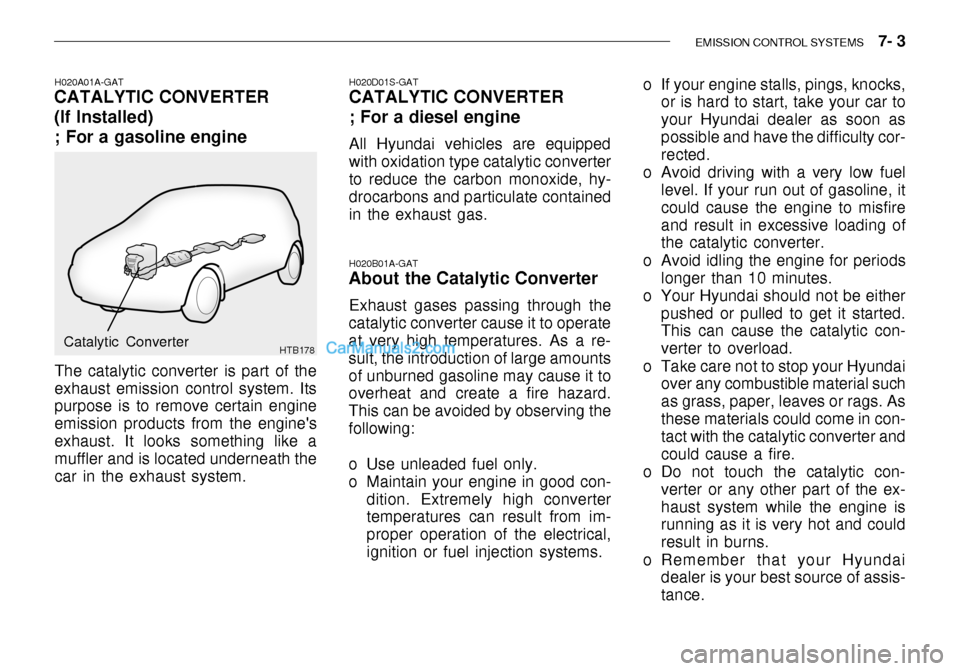
CATALYTIC CONVERTER (If Installed) ; For a gasoline engine
HTB178
The catalytic converter is part of the exhaust emission control system. Its purpose is to remove certain engine emission products from the engine'sexhaust. It looks something like a muffler and is located underneath the car in the exhaust system.
Catalytic Converter H020B01A-GAT
About the Catalytic Converter
Exhaust gases passing through the
catalytic converter cause it to operate at very high temperatures. As a re- sult, the introduction of large amountsof unburned gasoline may cause it to overheat and create a fire hazard. This can be avoided by observing thefollowing:
o Use unleaded fuel only.
o Maintain your engine in good con-
dition. Extremely high converter temperatures can result from im- proper operation of the electrical,ignition or fuel injection systems.
H020D01S-GAT CATALYTIC CONVERTER ; For a diesel engine All Hyundai vehicles are equipped with oxidation type catalytic converterto reduce the carbon monoxide, hy- drocarbons and particulate contained in the exhaust gas.
o If your engine stalls, pings, knocks,
or is hard to start, take your car toyour Hyundai dealer as soon aspossible and have the difficulty cor- rected.
o Avoid driving with a very low fuel level. If your run out of gasoline, it could cause the engine to misfireand result in excessive loading of the catalytic converter.
o Avoid idling the engine for periods longer than 10 minutes.
o Your Hyundai should not be either pushed or pulled to get it started.This can cause the catalytic con- verter to overload.
o Take care not to stop your Hyundai over any combustible material suchas grass, paper, leaves or rags. Asthese materials could come in con- tact with the catalytic converter and could cause a fire.
o Do not touch the catalytic con-
verter or any other part of the ex-haust system while the engine is running as it is very hot and could result in burns.
o Remember that your Hyundai dealer is your best source of assis-tance.
Page 245 of 444
INDEX 10- 3
D
Defrosting / Defogging .............................................. 1-80 Door
Door locks ................................................................ 1-7
Locking, unlocking front doors with a key ............... 1-7
Drink Holder .............................................................. 1-59
Drive Belts ................................................................ 6-25 Driving
Economical driving ................................................. 2-14
Smooth cornering ................................................... 2-15
Winter driving ......................................................... 2-15
E
Emission Control System ........................................... 7-2 Engine Before starting the engine ....................................... 2-3
Compartment ........................................................... 6-2
Coolant ................................................................... 6-13
Coolant temperature gauge ................................... 1-49
If the engine overheats ............................................ 3-4
Number .................................................................... 8-2
Oil ............................................................................. 6-7
Starting ..................................................................... 2-3
Engine Exhaust Can Be Dangerous ........................... 2-2 F Fog Light
Front ....................................................................... 1-57
Rear ....................................................................... 1-57
Front Seats Adjustable front seats ............................................ 1-13
Adjustable headrests .............................................. 1-14
Adjusting seat forward and rearward ..................... 1-13
Adjusting seatback angle ....................................... 1-13
Lumbar support control .......................................... 1-14
Seat cushion height adjustment ............................ 1-15
Seat warmer ........................................................... 1-19
Fuel Capacity ................................................................... 9-2
Gauge .................................................................... 1-48
recommendations ..................................................... 1-2
Fuel Filler Lid Remote release ...................................................... 1-68
Fuses ........................................................................ 6-26
Fuse Panel description ............................................. 6-38 G
General Checks .......................................................... 6-6
Glove Box ................................................................. 1-63
Page 299 of 444

FEATURES OF YOUR HYUNDAI 1- 39
SB210M1-E
CHARGING SYSTEM WARNING LIGHT
The charging system warning light should illuminate when the ignitionswitch is turned to the "ON" position and should be extinguished when the engine is started. If the light fails toilluminate when the ignition is turned "ON" or fails to extinguish after starting the engine, the nearest Hyundai dealershould be contacted. If the light illumi- nates whilst the vehicle is being driven, stop the vehicle as soon as it is safe todo so and check the condition of the generator drive belt. If the belt is in SB2100I-E
DOOR AJAR WARNING LIGHT
The door ajar warning light indicates that a door is not correctly closed. Ensure that the light is extinguishedprior to driving the vehicle.
B260B01FC-EAT
TAIL GATE OPEN WARNING LIGHT
The tail gate warning light indicates when the tail gate is open or is not fullyclosed. Ensure that the light has extin- guished prior to driving the vehicle. SB210P1-E
LOW FUEL LEVEL WARNING LIGHT
The low fuel warning light serves to warn the driver that the remaining fuel quantity is approximately 9 litres and that the vehicle should be refuelled. Ifthe vehicle is driven for an extended period with the low fuel warning light illuminated there exists a possibilitythat misfiring due to fuel shortage may occur. This situation must be avoided to prevent damage to the catalyst oc-curring.
recommended to assist in bringing the vehicle to rest. The vehicle must not be driven once brake failure has occurreduntil the system has been repaired and is functioning normally. The braking system employs a vacuumservo in order that the pedal efforts are reduced. Power for the servo is derived from the engine and therefore, in theevent of the engine stopping or the vehicle being towed, pedal efforts will be substantially increased.
place and the tension is satisfactory, the advice of a Hyundai dealer should be sought.
CAUTION:
If the drive belt (generator belt) is loose, broken, or missing while the vehicle is driving, there may be aserious malfunction, engine could overheat because this belt also drives the water pump.
!
B260N02FC-EAT MALFUNCTION INDICA- TOR LIGHT
This light illuminates when there is a malfunction of an exhaust gas related component, and the system is not func-tioning properly so that the exhaust gas regulation values are not satisfied. This light will illuminate when the ignition keyis tuned to the "ON" position, and will go out after the engine start. If it illumi- nates while driving, or does not illumi-nate when the ignition key is turned to the "ON" position, take your car to your
Page 302 of 444

1- 42 FEATURES OF YOUR HYUNDAI
!
SB215B1-E ENGINE COOLANT TEMPERA- TURE GAUGE
The engine coolant temperature gauge indicates the engine coolant tempera- ture and will, under normal circum-stances, give an indication in the "Nor- mal" or centre portion of the scale. Should the indication move into theupper or "Hot" portion of the scale, engine overheating is indicated. Under these circumstances, the vehicle shouldbe brought to rest as soon as is safe to do so and the engine turned off. Once the engine has cooled somewhat, thecoolant level and the condition of the generator/water pump drive belt should be checked. If the cause of the over- SB215C1-E SPEEDOMETER
HTB007A
heating cannot be readily established, the assistance of a Hyundai dealer should be sought.
HTB004A
The speedometer indicates the vehicle speed in both miles and kilometres per hour.
WARNING:
The engine cooling system is pres- surized and removal of the radiator cap when the engine is hot maycause hot water and steam to be ejected from the radiator resulting in burns and scalding. The radiator capmust only be removed when the en- gine has cooled. Do not add cold water to a hot engine to avoid thepossibility of engine damage. The use of plain water in the cooling system is not recommended sincethe aluminium components of the cooling system require the use of a corrosion inhibitor found in the rec-ommended Ethylene Glycol type anti freeze solutions.
A Type B Type
Page 355 of 444
DRIVING YOUR HYUNDAI 2- 13
SC140B1-E ANTI-LOCK BRAKE SYSTEM (Not all models) The Anti-Lock Brake System (ABS) is designed to prevent wheel lock-up during sudden braking or on hazard-ous road surfaces. The ABS control module monitors the wheel speed and controls the pressure applied to eachbrake. Thus, in emergency situations or on slick roads, ABS will increase vehicle control during braking. NOTE: During ABS operation, a slight pul- sation may be felt in the brake pedalwhen the brakes are applied. Also, a noise may be heard in the engine compartment whilst braking. Theseconditions are normal and indicate that the anti-lock brake system is functioning properly.
located in the instrument cluster will be illuminated. When the overdrive switch is turned "ON", the transaxle functionsas a fully automatic four speed unit with the maximum fuel economy po- tential of the vehicle being realized.
SC140A1-E EFFECTIVE BRAKING Braking system performance and fric- tion material life are greatly affected bythe driving style adopted. The follow- ing suggestions are made to assist in achieving the best results from the braking system.
o Anticipate the road and conditions ahead in order that heavy braking may be avoided.
o When descending long gradients, use the engine to assist in retardingthe vehicle to minimize the possibil-ity of brake fade occurring.
o When trailer towing, ensure that the
trailer brakes function correctly anduse engine braking to assist the vehicle braking system. o Use only genuine Hyundai replace-
ment brake pads and shoes to en- sure consistent friction characteris-tics and wear rates.
o After driving through deep water
(e.g. fording), the brakes may be-come wet and performance reduced. Always check brake efficiency after emerging from the water and dry thebrakes by lightly depressing the brake pedal several times whilst driving slowly.
o Apply the parking brake only when the vehicle is at rest.
o Since the power assistance pro- vided by the brake servo is derived from the engine, coasting with the engine turned off or towing of thevehicle with the engine turned off will result in greatly increased pedal pressures being required to stop thevehicle.
o Do not hold the vehicle on the up-
grade with the accelerator pedal.This can cause the transmission to overheat. Always use the brake pedal or parking brake.
Page 362 of 444

2- 20 DRIVING YOUR HYUNDAI
When being passed by a large ve- hicle, keep a constant speed and steer straight ahead. If there is toomuch wind buffeting slow down to get out of the other vehicle's air turbulence.
8. When parking your car and trailer, especially on a hill, be sure to followall the normal precautions. Turn yourfront wheel into the curb, set the parking brake firmly, and put the transaxle in 1st or Reverse (manual)or Park (automatic). In addition, place wheel chocks at each of the trailer's tyres.
9. If the trailer has electric brakes, start your vehicle and trailer mov-ing, and then apply the trailer brakecontroller by hand to be sure the brakes are working. This lets you check your electrical connection atthe same time.
10. During your trip, check occasion-
ally to be sure that the load issecure, and that the lights and any trailer brakes are still working.
11. Avoid jerky starts, sudden accel- eration or sudden stops.
12. Avoid sharp turns and rapid lane
changes. 13. Avoid holding the brake pedal
down too long or too frequently. This could cause the brakes tooverheat, resulting in reduced brak- ing efficiency.
14. When going down a hill, shift into a lower gear and use the enginebraking effect.When ascending a long grade,
downshift the transaxle to a lowergear and reduce speed to reduce chances of engine overloading and/or overheating.
15. If you have to stop while going
uphill, do not hold the vehicle inplace by pressing on the accelera- tor. This can cause the automatic transaxle to overheat. Use the park-ing brake or footbrake.
NOTE: When towing check transaxle fluid more frequently. CAUTION:
If overheating should occur when towing, (temperature gauge reads near red zone), taking the followingaction may reduce or eliminate the problem.
1. Turn off the air conditioner.
2. Reduce highway speed.
3. Select a lower gear when going uphill.
4. While in stop and go traffic, place
the gear selection in park or neu- tral and idle the engine at a higher speed.
!
Page 363 of 444
3. WHAT TO DO IN AN EMERGENCY
If the engine will not start ................................................................ 3-2
Jump starting .................................................................................. 3-3
If the engine overheats ................................................................... 3-4
Spare tyre ....................................................................................... 3-5
In the event of a puncture ............................................................... 3-6
Vehicle Towing or Recovery .........................................................3-11
Emergency towing ........................................................................ 3-13
If you lose your keys ..................................................................... 3-13
3
Page 366 of 444

3- 4 WHAT TO DO IN AN EMERGENCY
!
!
D030A01TB-EAT IF THE ENGINE OVERHEATS If the temperature gauge indicates overheating:
1. Pull off the road and stop as soon as
it is safe to do so.
2. Place the gear selector lever in "P" (automatic), or neutral (manual transaxle) and set the parking brake.If the air conditioning is on, turn it off.
3. If coolant is running out under the car
or steam is coming out from underthe bonnet stop the engine. Do not open the bonnet until the coolant has stopped running or the steaming hasstopped. If there is no visible loss of coolant and no steam, leave the engine running and check to be surethe engine cooling fan is operating. If the fan is not running, turn the engine off.
4. Check to see if the water pump drive belt is missing. If it is not missing,check to see that it is tight. If thedrive belt seems to be satisfactory, check for coolant leaking from the radiator, hoses or under the car. (Ifthe air conditioning had been in use, it is normal for cold water to be draining from it). WARNING:
Whilst the engine is running, keep hands and clothing away from mov- ing parts such as the fan and drivebelts to prevent injury.
7. Switch ON the main beam
headlamps before carefully remov-ing the jumper cables in the reverseorder of attachment. Once the jumper cables have been removed, switch "OFF" the main beamheadlamps.
CAUTION:
If the jump cable is incorrectly in-stalled, damage to the vehicle elec- trical system may occur, in particu- lar the electronic components suchas the Fuel Injection system com- puter and the Automatic transaxle computer. The battery must neverbe disconnected whilst the engine is running.
!
WARNING (Diesel only):
Never work on injection system with engine running or within 30 sec- onds after shutting off engine. Highpressure pump, rail, injectors and high pressure pipes are subject to high pressure even after the enginestopped. The fuel jet produced by fuel leaks may cause serious in- jury, if it touch the body. Peopleusing pacemakers should not move than 30cm closer to the ECU or wiring harness within the engineroom while engine is running, since the high currents in the Common Rail system produce considerablemagnetic fields.
Page 367 of 444

WHAT TO DO IN AN EMERGENCY 3- 5
!
D040A01TB-EAT TEMPORARY SPARE TYRE (Not all models) The following instructions for the tem- porary spare tyre should be observed:
1. Check inflation pressure as soon as
practical after installing the spare tyre, and adjust to the specifiedpressure. The tyre pressure should be periodically checked and main- tained at the specified pressurewhile the tyre is stored.
6. If the cause of the overheating can- not be found, wait until the enginetemperature has returned to nor- mal. Then, if coolant has been lost, carefully remove the radiator capand add water to bring the fluid level in the reservoir up to the base of the radiator fill opening. Fill the coolantexpansion tank to the halfway mark.
7. Proceed with caution until it is es-
tablished that the engine is operat-ing normally. If the engine over- heats repeatedly, the advice of a Hyundai dealer should be sought. WARNING:
Do not remove the radiator cap when the engine is hot since steam and boiling water may be ejected fromthe radiator resulting in burns or scalding.
Inflation Pressure
Tyre Size
T105/70D14 420 kPa (60 psi)
2. The spare tyre should only be used temporarily and should be returned to the luggage compartment as soonas the original tyre can be repaired or replaced.
3. Continuous use at speeds of over 50 mph(80 km/h) is not recom-mended.
4. As the temporary spare tyre is spe- cifically designed for your car, itshould not be used on any other vehicle.
Spare Tyre Pressure
YD050A1-E SPARE TYRE For Full Size (Not all models) The following instructions for the FULL SIZE spare tyre should be observed: Check inflation pressure as soon aspossible after installing the spare tyre, and adjust to the specified pressure. The tyre pressure should be periodi-cally checked and maintained at the specified pressure while the tyre is stored. Spare Tyre Pressure
Tyre Size Inflation Pressure
FULL SIZE 30 psi (210 kPa)
5. If the water pump drive belt is bro-
ken or coolant is leaking out, stop the engine immediately and call thenearest Hyundai dealer for assis- tance.
! CAUTION:
Serious loss of coolant indicates there is a leak in the cooling systemand this should be checked as soon as possible by a Hyundai dealer.
Page 401 of 444

DO-IT-YOURSELF MAINTENANCE 6- 11
HTB170A
Diesel engine Only ethylene glycol based coolant with a corrosion inhibitor suited to aluminium alloy engine components should be used in the cooling system. No further additives or inhibitors should be used.The coolant specific gravity should be checked as prescribed in the mainte- nance schedule to ensure adequatefrost and corrosion protection. In addi- tion, the engine coolant must be re- placed at the specified interval sincethe corrosion inhibitor properties dete- riorate with time. It is important to note that whilst anincrease in the concentration of anti freeze gives an increase in the level offrost protection, a solution which is in excess of 65% anti freeze will result in reduced frost protection and engineoverheating. Therefore the recom- mended concentration of 50% should not be exceeded for general use.The use of methanol based anti freeze compounds may result in engine over- heating and will invalidate the vehiclewarranty. NOTE: It is imperative that vehicles fitted with an air conditioning system have a coolant concentration of the rec- ommended strength at all times. Theuse of the air conditioning system when the cooling system is filled with water only will result in theheater matrix freezing and subse- quently bursting.
SG050C1-E Engine Coolant Level The engine coolant level may be ob- served through the side of the plasticcoolant reservoir (expansion tank) when the engine is cold. If the level is below the "LOW" mark, add coolant of thecorrect concentration until the level is between the "LOW" and "Full" marks. If the level falls below the "LOW" mark ona regular basis despite being topped up, consult a Hyundai dealer. SG050D1-E To Change the engine Coolant The engine coolant should be changed at those intervals specified in the ve- hicle maintenance schedule in Section5. NOTE: Care should be taken to ensure that coolant is not allowed to spill ontothe paintwork since the finish may become damaged. If coolant spill- age occurs, the affected area shouldbe rinsed thoroughly with water.