Panel Hyundai Getz 2003 Owner's Guide
[x] Cancel search | Manufacturer: HYUNDAI, Model Year: 2003, Model line: Getz, Model: Hyundai Getz 2003Pages: 444, PDF Size: 13.82 MB
Page 228 of 444
6- 40 DO-IT-YOURSELF MAINTENANCE
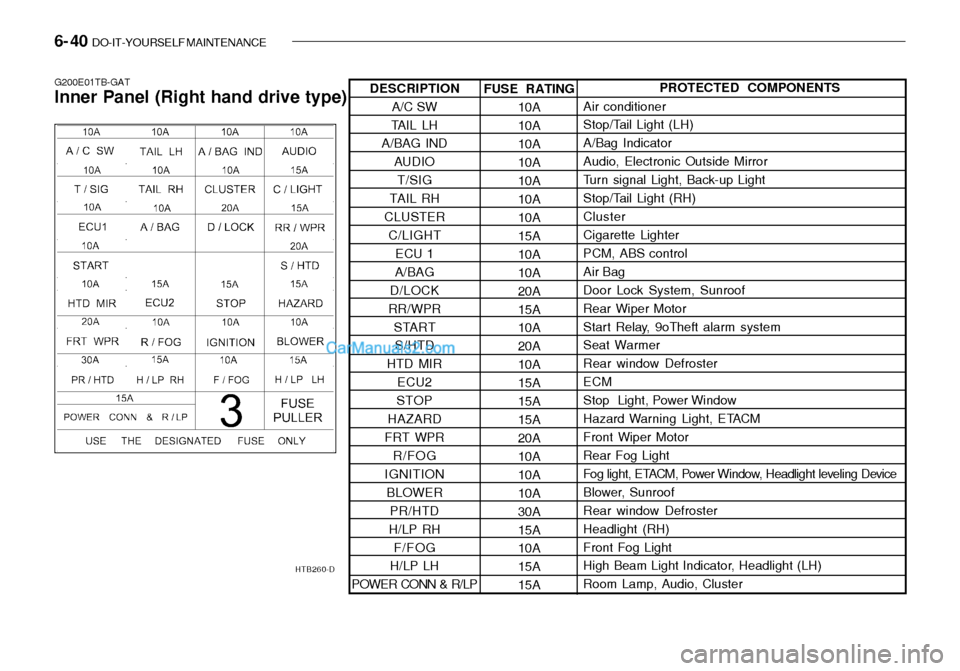
G200E01TB-GAT Inner Panel (Right hand drive type)
HTB260-DFUSE RATING10A 10A10A10A10A10A 10A 15A10A10A20A15A 10A 20A10A15A15A15A 20A 10A10A10A30A15A 10A 15A15APROTECTED COMPONENTS
Air conditioner
Stop/Tail Light (LH) A/Bag IndicatorAudio, Electronic Outside Mirror
Turn signal Light, Back-up Light
Stop/Tail Light (RH)Cluster Cigarette Lighter PCM, ABS controlAir BagDoor Lock System, SunroofRear Wiper Motor
Start Relay, 9oTheft alarm system Seat Warmer Rear window DefrosterECM
Stop Light, Power Window
Hazard Warning Light, ETACMFront Wiper Motor Rear Fog Light
Fog light, ETACM, Power Window, Headlight leveling Device
Blower, SunroofRear window DefrosterHeadlight (RH)Front Fog Light
High Beam Light Indicator, Headlight (LH) Room Lamp, Audio, Cluster
DESCRIPTION
A/C SW
TAIL LH
A/BAG IND
AUDIOT/SIG
TAIL RH
CLUSTER C/LIGHT ECU 1
A/BAG
D/LOCK
RR/WPR STARTS/HTD
HTD MIR
ECU2
STOP
HAZARD
FRT WPR R/FOG
IGNITION
BLOWER PR/HTD
H/LP RH F/FOG
H/LP LH
POWER CONN & R/LP
Page 245 of 444
INDEX 10- 3
D
Defrosting / Defogging .............................................. 1-80 Door
Door locks ................................................................ 1-7
Locking, unlocking front doors with a key ............... 1-7
Drink Holder .............................................................. 1-59
Drive Belts ................................................................ 6-25 Driving
Economical driving ................................................. 2-14
Smooth cornering ................................................... 2-15
Winter driving ......................................................... 2-15
E
Emission Control System ........................................... 7-2 Engine Before starting the engine ....................................... 2-3
Compartment ........................................................... 6-2
Coolant ................................................................... 6-13
Coolant temperature gauge ................................... 1-49
If the engine overheats ............................................ 3-4
Number .................................................................... 8-2
Oil ............................................................................. 6-7
Starting ..................................................................... 2-3
Engine Exhaust Can Be Dangerous ........................... 2-2 F Fog Light
Front ....................................................................... 1-57
Rear ....................................................................... 1-57
Front Seats Adjustable front seats ............................................ 1-13
Adjustable headrests .............................................. 1-14
Adjusting seat forward and rearward ..................... 1-13
Adjusting seatback angle ....................................... 1-13
Lumbar support control .......................................... 1-14
Seat cushion height adjustment ............................ 1-15
Seat warmer ........................................................... 1-19
Fuel Capacity ................................................................... 9-2
Gauge .................................................................... 1-48
recommendations ..................................................... 1-2
Fuel Filler Lid Remote release ...................................................... 1-68
Fuses ........................................................................ 6-26
Fuse Panel description ............................................. 6-38 G
General Checks .......................................................... 6-6
Glove Box ................................................................. 1-63
Page 259 of 444

YOUR VEHICLE AT A GLANCE
1. Glove Box
2. Passenger's Airbag (Not all models)
3. Heating/Air Conditioning Control Panel(Not all models)
4. Rear Fog Light Switch
5. Front Fog Light Switch (Not all models)
6. Hazard Warning Light
7. Windshield Wiper/Washer Switch
8. Horn and Driver's Airbag (Not all models)
9. Instrument Cluster
10. Multi-Function Light Switch
CAUTION:
When installing a container of liquid air freshener inside a vehicle, do not place it near the instrument cluster nor on the instrument panel pad surface. If there is any leakage from the air freshener onto these areas (instrument cluster, instrument panel pad or air ventilator), it may damage these parts. If the liquid from the air freshener does leak onto these areas, wash them with water immediately. 11. Headlight Leveling Switch (Not all models)
12. Rear Drink Holder
13. Cigarette Lighter
14. Parking Brake Lever
15. Shift Lever (Not all models)
16. Front Drink Holder
17. Ashtray
18. Fuse Box
19. Hood Release Lever
!
Page 260 of 444
YOUR VEHICLE AT A GLANCE
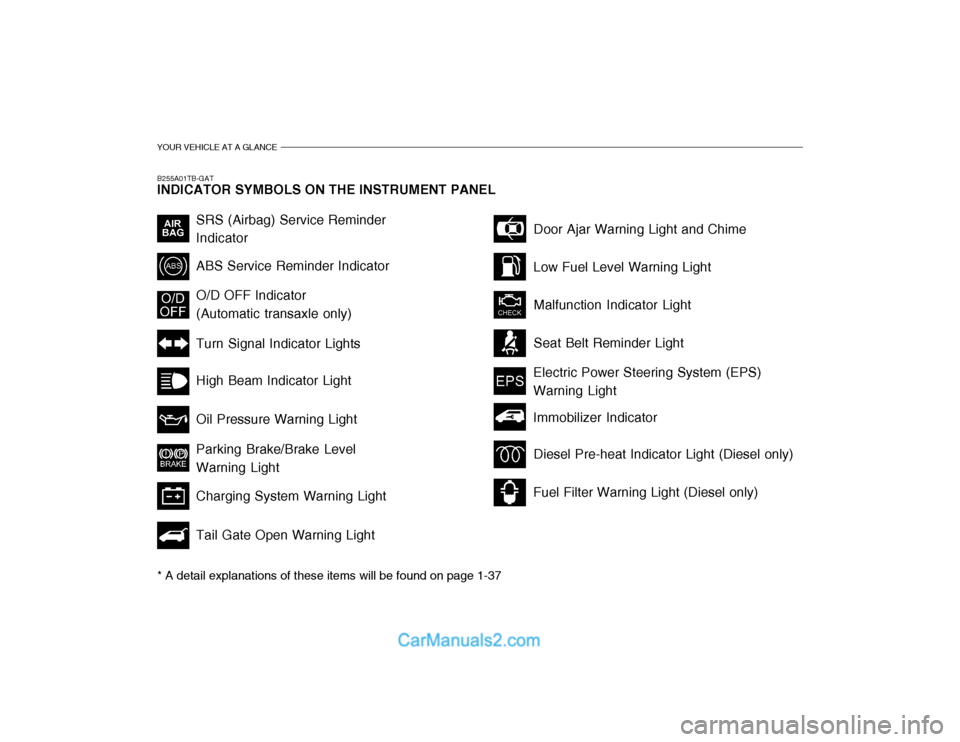
B255A01TB-GAT INDICATOR SYMBOLS ON THE INSTRUMENT PANEL * A detail explanations of these items will be found on page 1-37
SRS (Airbag) Service Reminder Indicator ABS Service Reminder Indicator Turn Signal Indicator Lights High Beam Indicator Light Oil Pressure Warning Light Parking Brake/Brake Level Warning Light Charging System Warning Light Tail Gate Open Warning LightDoor Ajar Warning Light and Chime
Low Fuel Level Warning Light Malfunction Indicator Light Seat Belt Reminder Light
O/D OFF Indicator (Automatic transaxle only)
Electric Power Steering System (EPS)Warning Light
Diesel Pre-heat Indicator Light (Diesel only)
Fuel Filter Warning Light (Diesel only)
Immobilizer Indicator
Page 283 of 444
FEATURES OF YOUR HYUNDAI 1- 23
!WARNING:
Do not install any child restraint sys- tem in the front passenger seat. Should an accident occur and cause the passenger side airbag to deploy,it could severely injure or kill an infant or child seated in an infant or child seat. Therefore, only use a childrestraint system in the rear seat of your vehicle.
If you need to tighten the belt, pull morewebbing toward the retractor. When you unbuckle the seat belt and allow it toretract, the retractor will automatically revert back to its normal seated pas- senger emergency locking usage con-dition. NOTE:
o Before installing the child restraint
system, read the instructions sup- plied by the child restraint system manufacturer.
o If the seat belt does not operate as described, have the systemchecked immediately by your au-thorized Hyundai dealer.
B230B01TB
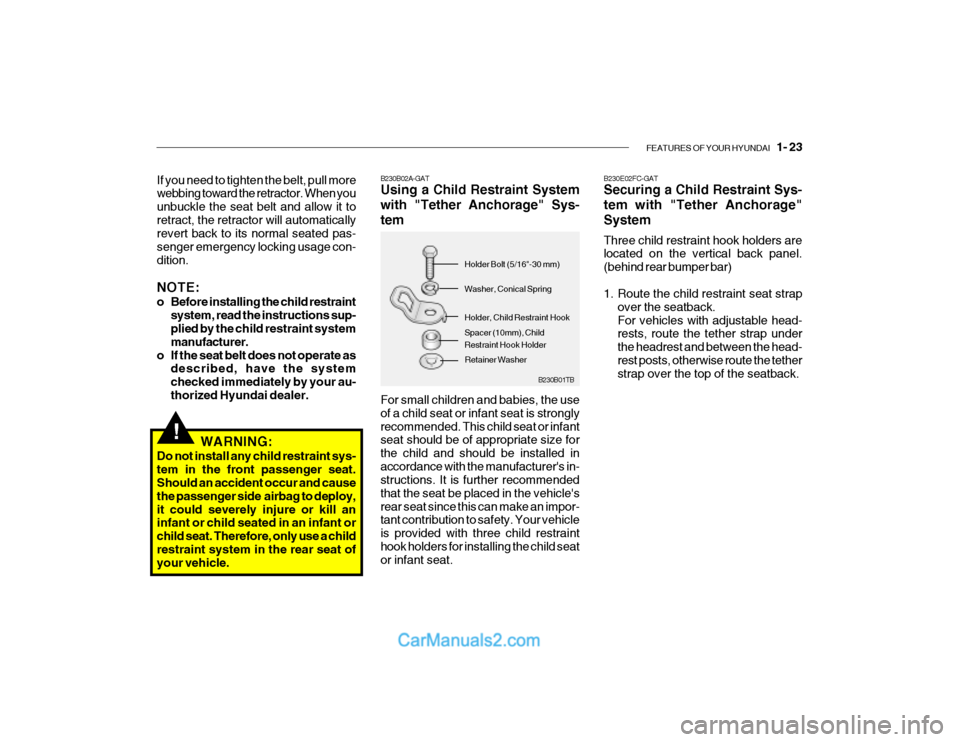
B230B02A-GAT Using a Child Restraint System with "Tether Anchorage" Sys-tem For small children and babies, the use of a child seat or infant seat is stronglyrecommended. This child seat or infant seat should be of appropriate size for the child and should be installed inaccordance with the manufacturer's in- structions. It is further recommended that the seat be placed in the vehicle'srear seat since this can make an impor- tant contribution to safety. Your vehicle is provided with three child restrainthook holders for installing the child seat or infant seat. Spacer (10mm), Child Restraint Hook Holder
Holder Bolt (5/16"-30 mm) Washer, Conical Spring Holder, Child Restraint Hook
Retainer Washer B230E02FC-GAT Securing a Child Restraint Sys- tem with "Tether Anchorage"System Three child restraint hook holders are located on the vertical back panel. (behind rear bumper bar)
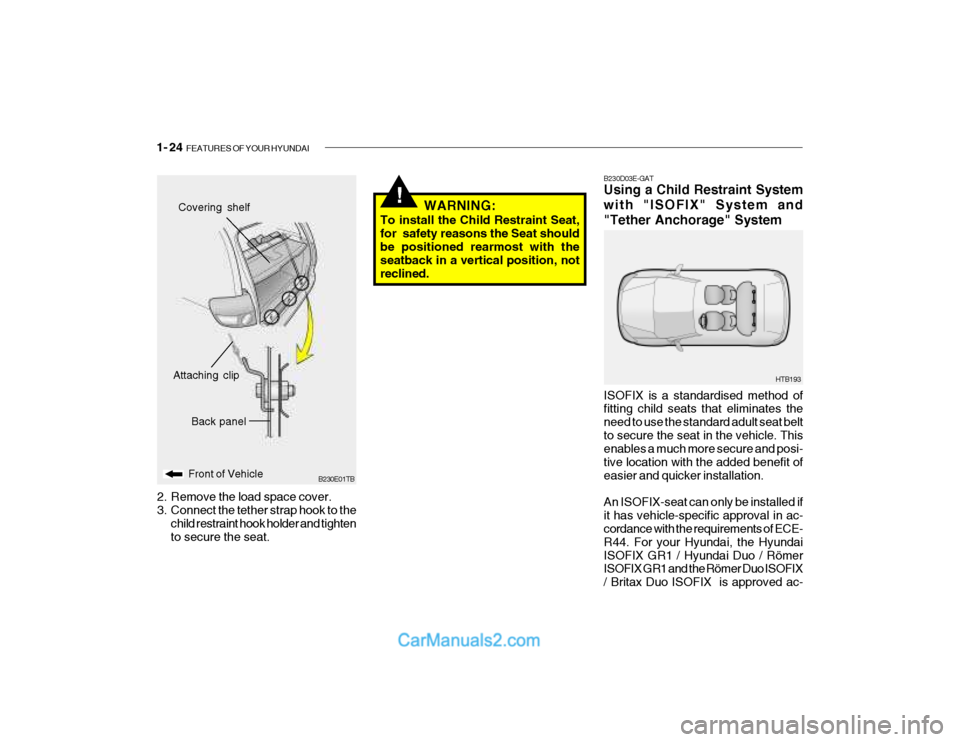
1. Route the child restraint seat strap
over the seatback. For vehicles with adjustable head- rests, route the tether strap under the headrest and between the head-rest posts, otherwise route the tether strap over the top of the seatback.
Page 284 of 444
1- 24 FEATURES OF YOUR HYUNDAI
!
B230E01TB
Back panel
Front of Vehicle
Attaching clip
Covering shelf
2. Remove the load space cover.
3. Connect the tether strap hook to the child restraint hook holder and tighten to secure the seat. B230D03E-GAT Using a Child Restraint System with "ISOFIX" System and"Tether Anchorage" System ISOFIX is a standardised method of fitting child seats that eliminates the need to use the standard adult seat beltto secure the seat in the vehicle. This enables a much more secure and posi- tive location with the added benefit ofeasier and quicker installation. An ISOFIX-seat can only be installed if it has vehicle-specific approval in ac- cordance with the requirements of ECE- R44. For your Hyundai, the HyundaiISOFIX GR1 / Hyundai Duo / Römer ISOFIX GR1 and the Römer Duo ISOFIX / Britax Duo ISOFIX is approved ac-
HTB193
WARNING:
To install the Child Restraint Seat, for safety reasons the Seat should be positioned rearmost with the seatback in a vertical position, notreclined.
Page 288 of 444
1- 28 FEATURES OF YOUR HYUNDAI
!
o Although it is harmless, the fine
dust may cause skin irritation and should not be breathed for pro-longed periods. Wash your hands and face thoroughly after an acci- dent in which the pre-tensionerseat belts were activated. it illuminates whilst the vehicle is being driven, please have an au- thorized Hyundai dealer inspectthe pre-tensioner seat belt or SRS airbag system as soon as pos- sible.
o Do not attempt to service or repair
the pre-tensioner seat belt systemin any manner.
o Improper handling of the pre-
tensioner seat belt assemblies, andfailure to heed the warnings to not strike, modify, inspect, replace, service or repair the pre-tensionerseat belt assemblies may lead to improper operation or inadvertent activation and serious injury.
o Always wear the seat belts when driving or travelling in a motorvehicle.
CAUTION:
o Because the sensor that activates the SRS airbag is connected with the pre-tensioner seat belt, the SRS airbag warning light on theinstrument panel will blink for approximately 6 seconds after the ignition key has been turned to the "ON" position and then it should turn off.
o If the pre-tensioner seat belt is not working properly, this warninglight will illuminate even if there isno function of the SRS airbag sys- tem. If the SRS airbag warning lightdoes not illuminate when the igni- tion key is turned to "ON", or if it remains illuminated after blinkingfor approximately 6 seconds, or if WARNING:
o Pre-tensioners are designed to op- erate only one time. After activa-tion, pre-tensioner seat belts mustbe replaced. All seat belts, of any type, should always be replaced after they have been worn during acollision.
o The pre-tensioner seat belt assem-
bly mechanisms become hot dur-ing activation. Do not touch the pre-tensioner seat belt assemblies for several minutes after they havebeen activated.
o Do not attempt to inspect or re-
place the pre-tensioner seat beltsyourself. This must be done by an authorized Hyundai dealer.
o Do not strike the pre-tensioner seat belt assemblies.
!
Page 289 of 444
FEATURES OF YOUR HYUNDAI 1- 29
!
HTB201
Driver's Airbag
Your Hyundai is equipped with a Supple- mental Restraint (Airbag) System. The indications of the system's presenceare the letters "SRS AIR BAG" em- bossed on the airbag pad cover in the steering wheel and printed on thepassenger's side front panel pad above the glove box. The Hyundai SRS consists of airbags installed under the pad covers in the centre of the steering wheel and thepassenger's side front panel above the glove box. The purpose of the SRS is to provide the vehicle's driver and/or thefront passenger with additional protec- B240A01TB-EAT SUPPLEMENTAL RESTRAINT (AIRBAG) SYSTEM
HTB203
Rear impact
Side Impact Rollover
tion than that offered by the seat belt system alone, in case of a frontal im- pact of sufficient severity. NOTE: Be sure to read information about the SRS on the labels provided on the back of the sun visor and in theglove box.
WARNING:
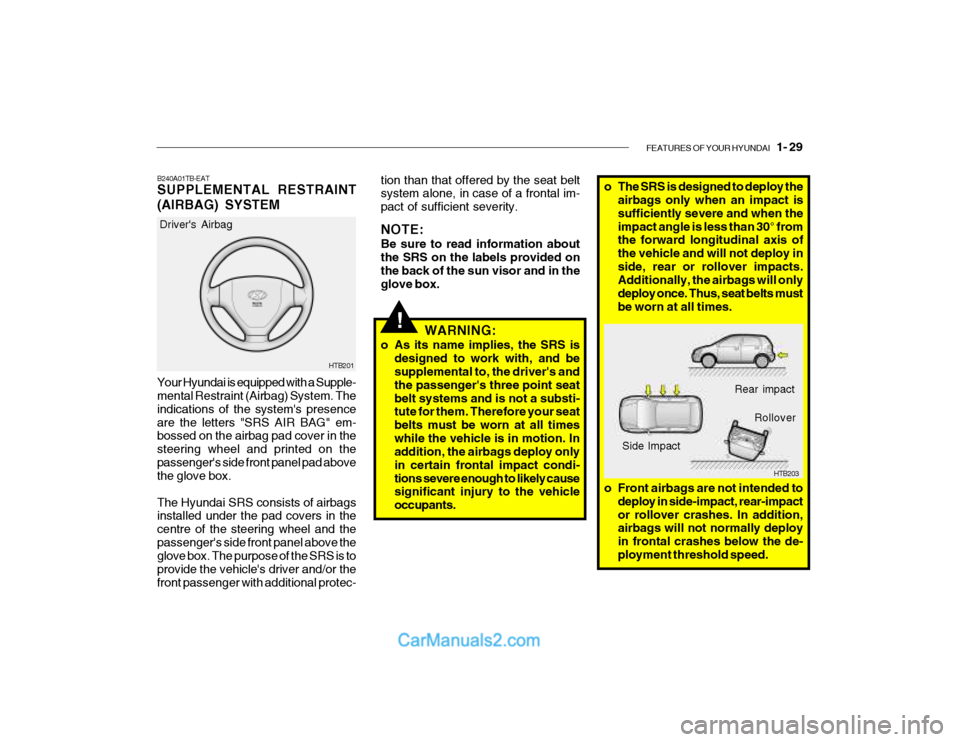
o As its name implies, the SRS is designed to work with, and be supplemental to, the driver's and the passenger's three point seatbelt systems and is not a substi- tute for them. Therefore your seat belts must be worn at all timeswhile the vehicle is in motion. In addition, the airbags deploy only in certain frontal impact condi-tions severe enough to likely cause significant injury to the vehicle occupants. o The SRS is designed to deploy the
airbags only when an impact issufficiently severe and when theimpact angle is less than 30° from the forward longitudinal axis of the vehicle and will not deploy inside, rear or rollover impacts. Additionally, the airbags will only deploy once. Thus, seat belts mustbe worn at all times.
o Front airbags are not intended to deploy in side-impact, rear-impactor rollover crashes. In addition, airbags will not normally deploy in frontal crashes below the de-ployment threshold speed.
Page 290 of 444
1- 30 FEATURES OF YOUR HYUNDAI
o For maximum safety protection in
all types of crashes, all occupants including the driver should always wear their seat belts whether ornot an airbag is also provided at their seating position to minimize the risk of severe injury or death inthe event of a crash. Do not sit or lean unnecessarily close to the airbag while the vehicle is in mo-tion.
o The SRS airbag system must de-
ploy very rapidly to provide pro-tection in a crash. If an occupant is out of position because of not wearing a seat belt, the airbag mayforcefully contact the occupant causing serious or fatal injuries.
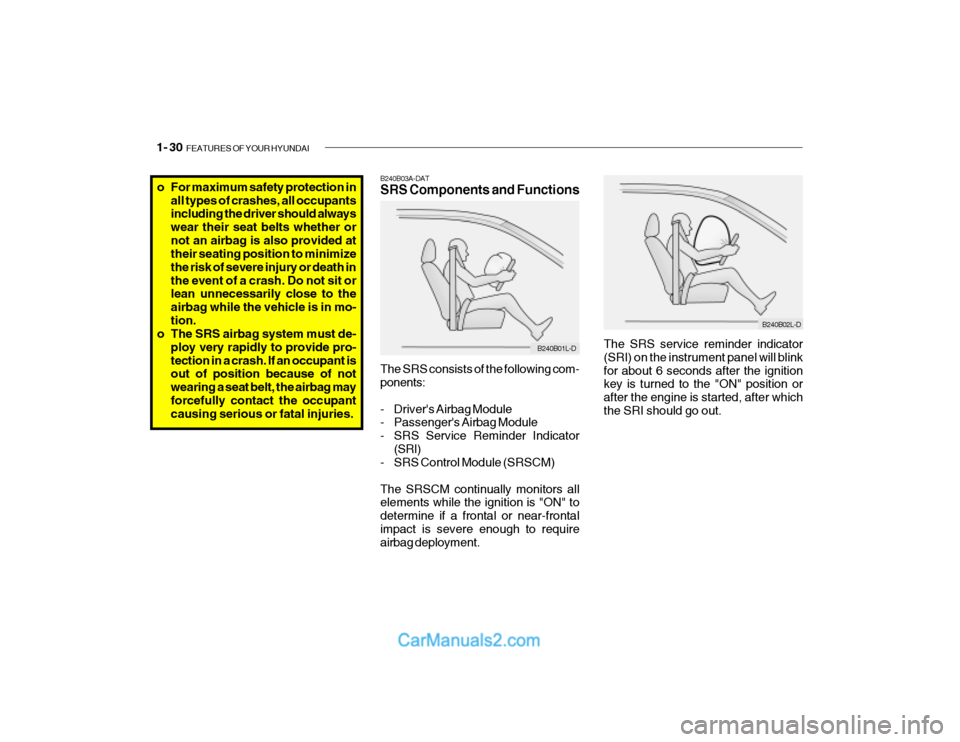
The SRS consists of the following com- ponents:
- Driver's Airbag Module
- Passenger's Airbag Module
- SRS Service Reminder Indicator(SRI)
- SRS Control Module (SRSCM) The SRSCM continually monitors all elements while the ignition is "ON" to determine if a frontal or near-frontalimpact is severe enough to require airbag deployment. B240B03A-DAT SRS Components and Functions
The SRS service reminder indicator (SRI) on the instrument panel will blinkfor about 6 seconds after the ignition key is turned to the "ON" position or after the engine is started, after whichthe SRI should go out.
B240B01L-D
B240B02L-D
Page 291 of 444
FEATURES OF YOUR HYUNDAI 1- 31
B240B03L-D
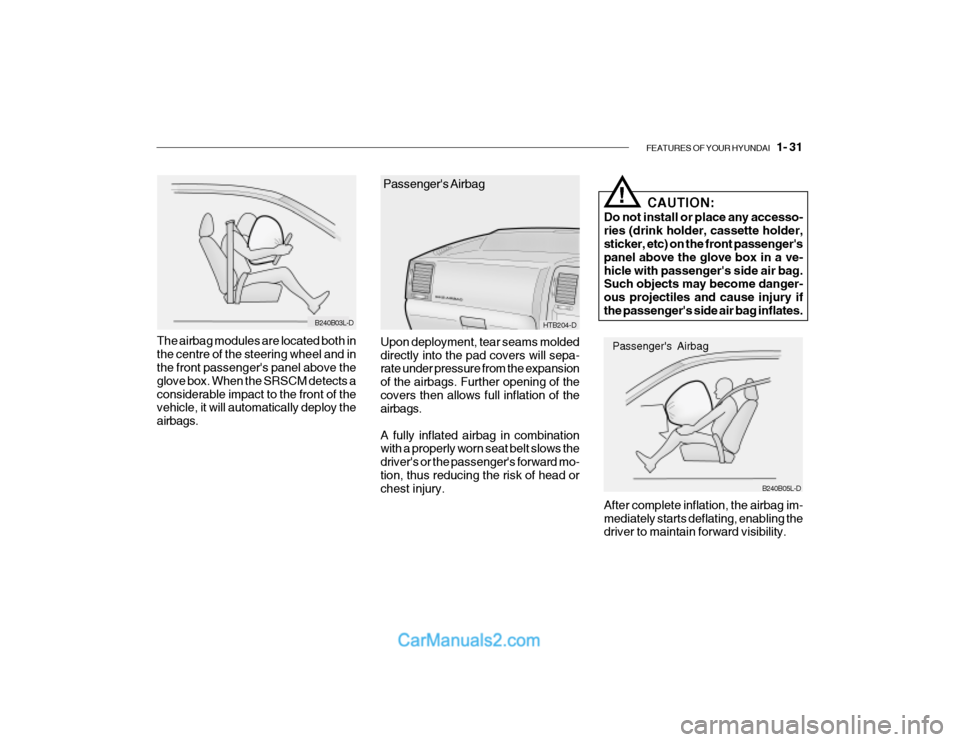
The airbag modules are located both in the centre of the steering wheel and in the front passenger's panel above the glove box. When the SRSCM detects aconsiderable impact to the front of the vehicle, it will automatically deploy the airbags.
Passenger's Airbag
HTB204-D
Upon deployment, tear seams molded directly into the pad covers will sepa- rate under pressure from the expansion of the airbags. Further opening of thecovers then allows full inflation of the airbags. A fully inflated airbag in combination with a properly worn seat belt slows the driver's or the passenger's forward mo-tion, thus reducing the risk of head or chest injury.
B240B05L-D
Passenger's Airbag
!
CAUTION:
Do not install or place any accesso- ries (drink holder, cassette holder, sticker, etc) on the front passenger's panel above the glove box in a ve-hicle with passenger's side air bag. Such objects may become danger- ous projectiles and cause injury ifthe passenger's side air bag inflates. After complete inflation, the airbag im- mediately starts deflating, enabling the driver to maintain forward visibility.