engine coolant Hyundai Getz 2003 Owner's Guide
[x] Cancel search | Manufacturer: HYUNDAI, Model Year: 2003, Model line: Getz, Model: Hyundai Getz 2003Pages: 444, PDF Size: 13.82 MB
Page 219 of 444

DO-IT-YOURSELF MAINTENANCE 6- 31
1. Remove the engine cover.
2. Disconnect the air intake hose from
air cleaner cover.
3. Loosen the drain plug at the bottom of the fuel filter.
4. Tighten the drain plug when water
no longer comes out.
5. Check to be sure that the warning
lamp illuminates when the ignition key is turned to "ON", and that it goes off when the engine is started. If in doubt, consult your nearestauthorized HYUNDAI dealer.
NOTE: It is recommended that water accu- mulated in the fuel filter should beremoved by an authorized Hyundai dealer. G300B01FC
WARNING:
Be sure to carefully wipe away anywater drained out in this manner, because the fuel mixed in the watermight be ignited and result in a fire.
!
5. Open the hood.
6. Draw the vertical line (through the center of each headlight beam pat-tern) and the horizontal line (throughthe center of each headlight beam pattern) on the aiming screen. And then, draw the horizontal paral- lel line at 30 mm (1.18 in.) under the horizontal line.
7. Adjust each cut-off line of the low beam to the parallel line with a phillipsscrewdriver - VERTICAL AIMING.
8. Adjust each cut-off line of the low
beam to each vertical line with aphillips screwdriver - HORIZONTAL AIMING. HTB269
Horizontal Aiming
Vertical Aiming
G290A01FC-GAT HEADLIGHT AIMING ADJUST- MENT Before performing aiming adjustment, make sure of the following.
1. Keep all tires inflated to the correct pressure.
2. Place the vehicle on level ground
and press the front bumper and rear bumper down several times. Place the vehicle at a distance of 3,000 mm (118 in.) from the test wall.
3. See that the vehicle is unloaded (except for full levels of coolant,engine oil and fuel, and spare tire,jack, and tools).
4. Clean the head lights lens and turn
on the headlight (low beam).
Page 230 of 444
7- 2 EMISSION CONTROL SYSTEMS
H010A01A-GAT
EMISSION CONTROL SYSTEM (If Installed)
Your Hyundai is equipped with an
emission control system to meet all requirements of the Emission prohibi- tion rules of your province.
There are three emission control sys-
tems which are as follows.
1) Crankcase emission control sys-
tem
2) Evaporative emission control sys- tem
3) Exhaust emission control system
In order to assure the proper function
of the emission control systems, it is recommended that you have your carinspected and maintained by an au- thorized Hyundai dealer in accordance with the maintenance schedule in thismanual. H010B01A-AAT
1. Crankcase Emission Control
System
The positive crankcase ventilation
system is employed to prevent airpollution caused by blow-by gases being emitted from the crankcase. This system supplies fresh air to thecrankcase through the air intake hose. Inside the crankcase, the fresh air mixes with blow-by gases, which thenpass through the PCV valve and into the induction system.
H010C01E-GAT
2. Evaporative Emission Con- trol System
The Evaporative Emission Control
System is designed to prevent fuel vapors from escaping into the atmo-sphere. Canister
While the engine is inoperative, fuel
vapors generated inside the fuel tank are absorbed and stored in the canis- ter. When the engine is running, the fuel vapors absorbed in the canister are drawn into the induction system through
the purge control solenoid valve.
Purge Control Solenoid Valve (PCSV) The purge control solenoid valve is
controlled by the Engine Control Mod- ule (ECM); when the engine coolanttemperature is low during idling, the PCSV closes so that evaporated fuel is not taken into the engine. After theengine warms-up during ordinary driv- ing, the PCSV opens so as to intro- duce evaporated fuel to the engine. H010D01A-AAT
3. Exhaust Emission Control
System
The exhaust emission control system is a highly effective system whichcontrols exhaust emission while main- taining good vehicle performance.
Page 242 of 444
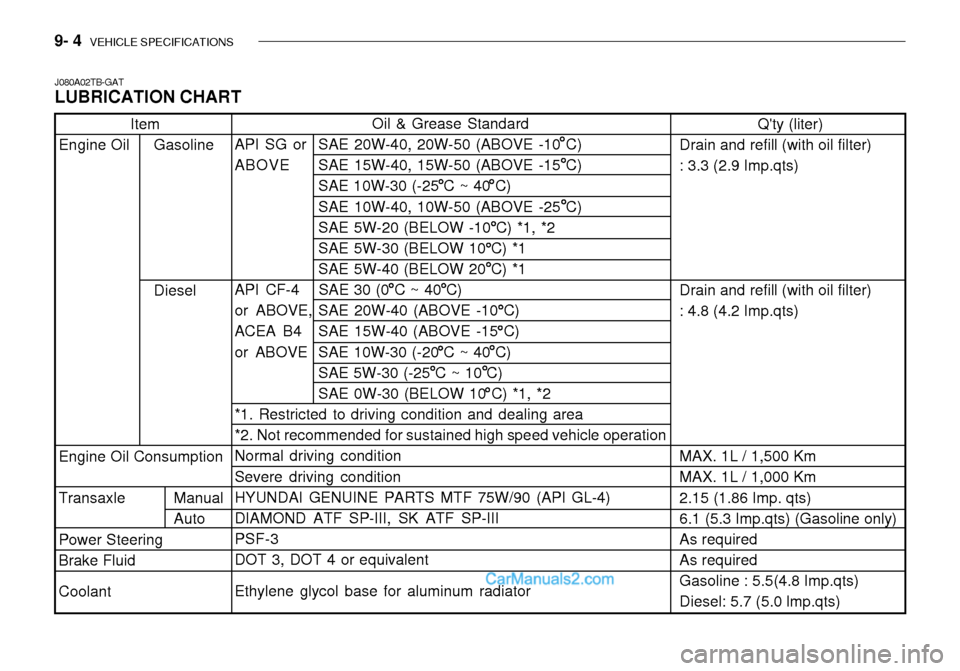
9- 4 VEHICLE SPECIFICATIONS
Oil & Grease Standard
API SG or SAE 20W-40, 20W-50 (ABOVE -10 C) ABOVE SAE 15W-40, 15W-50 (ABOVE -15 C)SAE 10W-30 (-25 C ~ 40 C) SAE 10W-40, 10W-50 (ABOVE -25 C) SAE 5W-20 (BELOW -10 C) *1, *2SAE 5W-30 (BELOW 10 C) *1 SAE 5W-40 (BELOW 20 C) *1
API CF-4 SAE 30 (0 C ~ 40 C)
or ABOVE, SAE 20W-40 (ABOVE -10 C)
ACEA B4 SAE 15W-40 (ABOVE -15 C)
or ABOVE SAE 10W-30 (-20 C ~ 40 C) SAE 5W-30 (-25 C ~ 10 C) SAE 0W-30 (BELOW 10 C) *1, *2
*1. Restricted to driving condition and dealing area*2. Not recommended for sustained high speed vehicle operationNormal driving condition Severe driving condition HYUNDAI GENUINE PARTS MTF 75W/90 (API GL-4)DIAMOND ATF SP-III, SK ATF SP-III PSF-3 DOT 3, DOT 4 or equivalent Ethylene glycol base for aluminum radiator
Item
Engine Oil Gasoline
Diesel
Engine Oil Consumption
Transaxle Manual Auto
Power Steering
Brake Fluid Coolant
J080A02TB-GAT LUBRICATION CHARTQ'ty (liter)
Drain and refill (with oil filter) : 3.3 (2.9 Imp.qts) Drain and refill (with oil filter) : 4.8 (4.2 Imp.qts) MAX. 1L / 1,500 Km MAX. 1L / 1,000 Km 2.15 (1.86 Imp. qts) 6.1 (5.3 Imp.qts) (Gasoline only)As required As required Gasoline : 5.5(4.8 Imp.qts)Diesel: 5.7 (5.0 lmp.qts)
Page 245 of 444
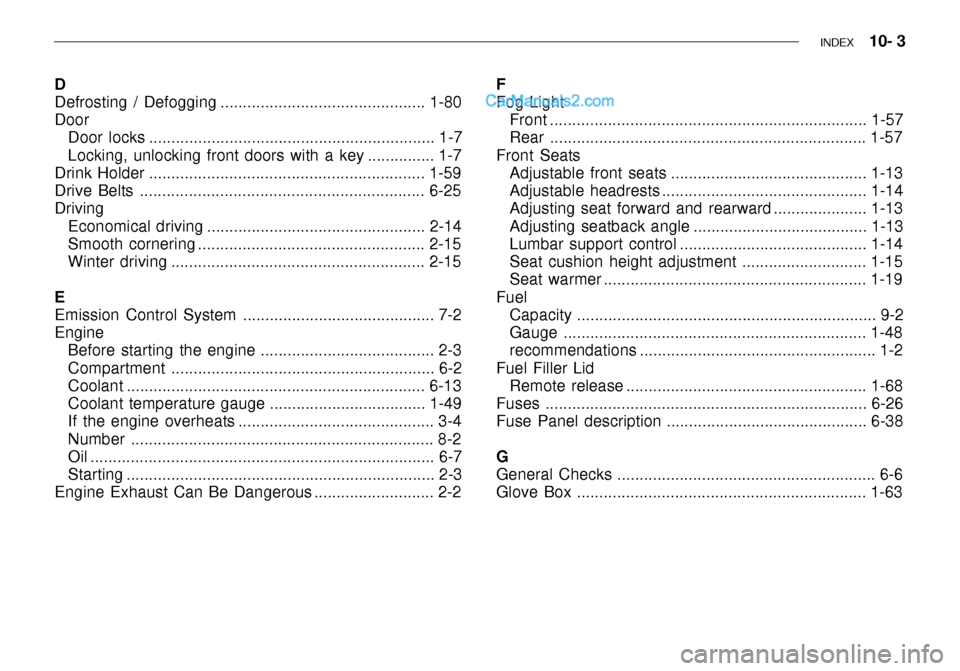
INDEX 10- 3
D
Defrosting / Defogging .............................................. 1-80 Door
Door locks ................................................................ 1-7
Locking, unlocking front doors with a key ............... 1-7
Drink Holder .............................................................. 1-59
Drive Belts ................................................................ 6-25 Driving
Economical driving ................................................. 2-14
Smooth cornering ................................................... 2-15
Winter driving ......................................................... 2-15
E
Emission Control System ........................................... 7-2 Engine Before starting the engine ....................................... 2-3
Compartment ........................................................... 6-2
Coolant ................................................................... 6-13
Coolant temperature gauge ................................... 1-49
If the engine overheats ............................................ 3-4
Number .................................................................... 8-2
Oil ............................................................................. 6-7
Starting ..................................................................... 2-3
Engine Exhaust Can Be Dangerous ........................... 2-2 F Fog Light
Front ....................................................................... 1-57
Rear ....................................................................... 1-57
Front Seats Adjustable front seats ............................................ 1-13
Adjustable headrests .............................................. 1-14
Adjusting seat forward and rearward ..................... 1-13
Adjusting seatback angle ....................................... 1-13
Lumbar support control .......................................... 1-14
Seat cushion height adjustment ............................ 1-15
Seat warmer ........................................................... 1-19
Fuel Capacity ................................................................... 9-2
Gauge .................................................................... 1-48
recommendations ..................................................... 1-2
Fuel Filler Lid Remote release ...................................................... 1-68
Fuses ........................................................................ 6-26
Fuse Panel description ............................................. 6-38 G
General Checks .......................................................... 6-6
Glove Box ................................................................. 1-63
Page 302 of 444

1- 42 FEATURES OF YOUR HYUNDAI
!
SB215B1-E ENGINE COOLANT TEMPERA- TURE GAUGE
The engine coolant temperature gauge indicates the engine coolant tempera- ture and will, under normal circum-stances, give an indication in the "Nor- mal" or centre portion of the scale. Should the indication move into theupper or "Hot" portion of the scale, engine overheating is indicated. Under these circumstances, the vehicle shouldbe brought to rest as soon as is safe to do so and the engine turned off. Once the engine has cooled somewhat, thecoolant level and the condition of the generator/water pump drive belt should be checked. If the cause of the over- SB215C1-E SPEEDOMETER
HTB007A
heating cannot be readily established, the assistance of a Hyundai dealer should be sought.
HTB004A
The speedometer indicates the vehicle speed in both miles and kilometres per hour.
WARNING:
The engine cooling system is pres- surized and removal of the radiator cap when the engine is hot maycause hot water and steam to be ejected from the radiator resulting in burns and scalding. The radiator capmust only be removed when the en- gine has cooled. Do not add cold water to a hot engine to avoid thepossibility of engine damage. The use of plain water in the cooling system is not recommended sincethe aluminium components of the cooling system require the use of a corrosion inhibitor found in the rec-ommended Ethylene Glycol type anti freeze solutions.
A Type B Type
Page 366 of 444

3- 4 WHAT TO DO IN AN EMERGENCY
!
!
D030A01TB-EAT IF THE ENGINE OVERHEATS If the temperature gauge indicates overheating:
1. Pull off the road and stop as soon as
it is safe to do so.
2. Place the gear selector lever in "P" (automatic), or neutral (manual transaxle) and set the parking brake.If the air conditioning is on, turn it off.
3. If coolant is running out under the car
or steam is coming out from underthe bonnet stop the engine. Do not open the bonnet until the coolant has stopped running or the steaming hasstopped. If there is no visible loss of coolant and no steam, leave the engine running and check to be surethe engine cooling fan is operating. If the fan is not running, turn the engine off.
4. Check to see if the water pump drive belt is missing. If it is not missing,check to see that it is tight. If thedrive belt seems to be satisfactory, check for coolant leaking from the radiator, hoses or under the car. (Ifthe air conditioning had been in use, it is normal for cold water to be draining from it). WARNING:
Whilst the engine is running, keep hands and clothing away from mov- ing parts such as the fan and drivebelts to prevent injury.
7. Switch ON the main beam
headlamps before carefully remov-ing the jumper cables in the reverseorder of attachment. Once the jumper cables have been removed, switch "OFF" the main beamheadlamps.
CAUTION:
If the jump cable is incorrectly in-stalled, damage to the vehicle elec- trical system may occur, in particu- lar the electronic components suchas the Fuel Injection system com- puter and the Automatic transaxle computer. The battery must neverbe disconnected whilst the engine is running.
!
WARNING (Diesel only):
Never work on injection system with engine running or within 30 sec- onds after shutting off engine. Highpressure pump, rail, injectors and high pressure pipes are subject to high pressure even after the enginestopped. The fuel jet produced by fuel leaks may cause serious in- jury, if it touch the body. Peopleusing pacemakers should not move than 30cm closer to the ECU or wiring harness within the engineroom while engine is running, since the high currents in the Common Rail system produce considerablemagnetic fields.
Page 367 of 444

WHAT TO DO IN AN EMERGENCY 3- 5
!
D040A01TB-EAT TEMPORARY SPARE TYRE (Not all models) The following instructions for the tem- porary spare tyre should be observed:
1. Check inflation pressure as soon as
practical after installing the spare tyre, and adjust to the specifiedpressure. The tyre pressure should be periodically checked and main- tained at the specified pressurewhile the tyre is stored.
6. If the cause of the overheating can- not be found, wait until the enginetemperature has returned to nor- mal. Then, if coolant has been lost, carefully remove the radiator capand add water to bring the fluid level in the reservoir up to the base of the radiator fill opening. Fill the coolantexpansion tank to the halfway mark.
7. Proceed with caution until it is es-
tablished that the engine is operat-ing normally. If the engine over- heats repeatedly, the advice of a Hyundai dealer should be sought. WARNING:
Do not remove the radiator cap when the engine is hot since steam and boiling water may be ejected fromthe radiator resulting in burns or scalding.
Inflation Pressure
Tyre Size
T105/70D14 420 kPa (60 psi)
2. The spare tyre should only be used temporarily and should be returned to the luggage compartment as soonas the original tyre can be repaired or replaced.
3. Continuous use at speeds of over 50 mph(80 km/h) is not recom-mended.
4. As the temporary spare tyre is spe- cifically designed for your car, itshould not be used on any other vehicle.
Spare Tyre Pressure
YD050A1-E SPARE TYRE For Full Size (Not all models) The following instructions for the FULL SIZE spare tyre should be observed: Check inflation pressure as soon aspossible after installing the spare tyre, and adjust to the specified pressure. The tyre pressure should be periodi-cally checked and maintained at the specified pressure while the tyre is stored. Spare Tyre Pressure
Tyre Size Inflation Pressure
FULL SIZE 30 psi (210 kPa)
5. If the water pump drive belt is bro-
ken or coolant is leaking out, stop the engine immediately and call thenearest Hyundai dealer for assis- tance.
! CAUTION:
Serious loss of coolant indicates there is a leak in the cooling systemand this should be checked as soon as possible by a Hyundai dealer.
Page 388 of 444
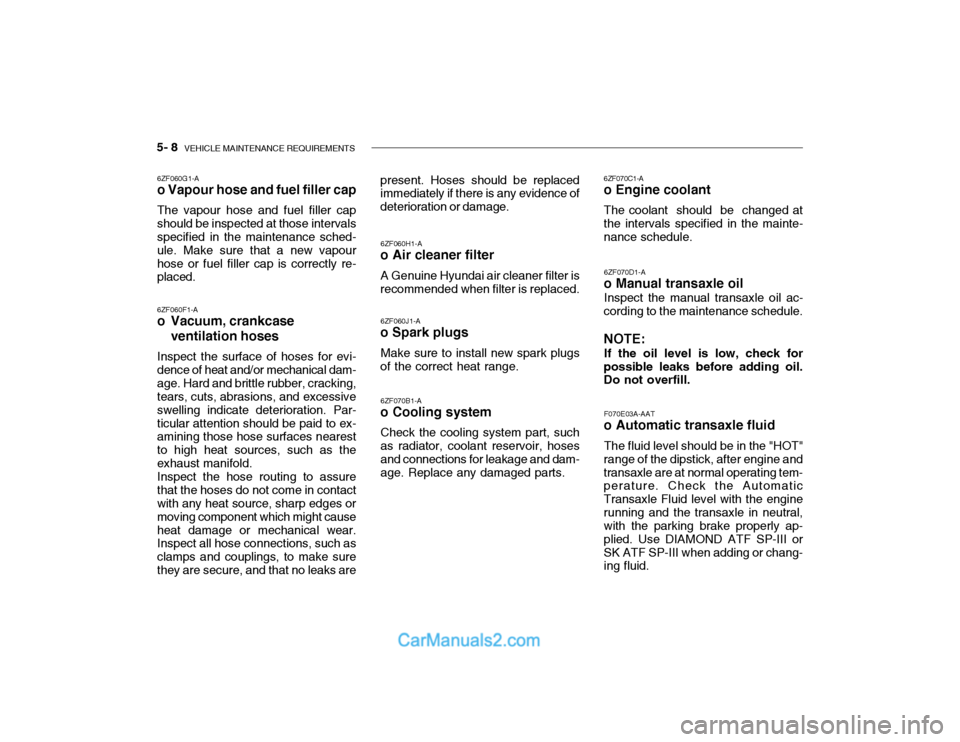
5- 8 VEHICLE MAINTENANCE REQUIREMENTS
6ZF070C1-A
o Engine coolant
The coolant should be changed at the intervals specified in the mainte- nance schedule.
6ZF060H1-A
o Air cleaner filter
A Genuine Hyundai air cleaner filter is
recommended when filter is replaced.
6ZF060J1-A
o Spark plugs
Make sure to install new spark plugs
of the correct heat range.
6ZF070B1-A
o Cooling system
Check the cooling system part, such as radiator, coolant reservoir, hoses and connections for leakage and dam- age. Replace any damaged parts. 6ZF070D1-A
o Manual transaxle oil
Inspect the manual transaxle oil ac-
cording to the maintenance schedule. NOTE:
If the oil level is low, check for
possible leaks before adding oil. Do not overfill.
F070E03A-AAT
o Automatic transaxle fluid
The fluid level should be in the "HOT"
range of the dipstick, after engine and transaxle are at normal operating tem- perature. Check the Automatic Transaxle Fluid level with the enginerunning and the transaxle in neutral, with the parking brake properly ap- plied. Use DIAMOND ATF SP-III orSK ATF SP-III when adding or chang- ing fluid.
6ZF060G1-A o Vapour hose and fuel filler cap The vapour hose and fuel filler cap should be inspected at those intervals specified in the maintenance sched- ule. Make sure that a new vapourhose or fuel filler cap is correctly re- placed. 6ZF060F1-A
o Vacuum, crankcase
ventilation hoses
Inspect the surface of hoses for evi- dence of heat and/or mechanical dam-age. Hard and brittle rubber, cracking, tears, cuts, abrasions, and excessive swelling indicate deterioration. Par-ticular attention should be paid to ex- amining those hose surfaces nearest to high heat sources, such as theexhaust manifold.Inspect the hose routing to assurethat the hoses do not come in contact with any heat source, sharp edges or moving component which might causeheat damage or mechanical wear. Inspect all hose connections, such as clamps and couplings, to make surethey are secure, and that no leaks are present. Hoses should be replaced immediately if there is any evidence of deterioration or damage.
Page 391 of 444

6. Do-It-Yourself Maintenance
Engine compartment ........................................................................ 6-2
Daily operating checks ..................................................................... 6-6
Engine oil .......................................................................................... 6-6
Engine and filter Replacement ......................................................... 6-9
Engine coolant Checking and Replacing .......................................6-10
Spark plug Replacement ................................................................ 6-13
Changing the air cleaner filter ......................................................... 6-14
Manual Transaxle Lubricant........................................................... 6-15
Automatic Transaxle fluid ............................................................... 6-16
Brake System Checking ................................................................ 6-18
Air conditioning System .................................................................. 6-19
Drive belts ...................................................................................... 6-23
Individual Circuit Fuses .................................................................. 6-24
Power steering fluid level ............................................................... 6-26
Replacing Light Bulbs .................................................................... 6-28
Fuse panel description ................................................................... 6-34
6
Page 392 of 444
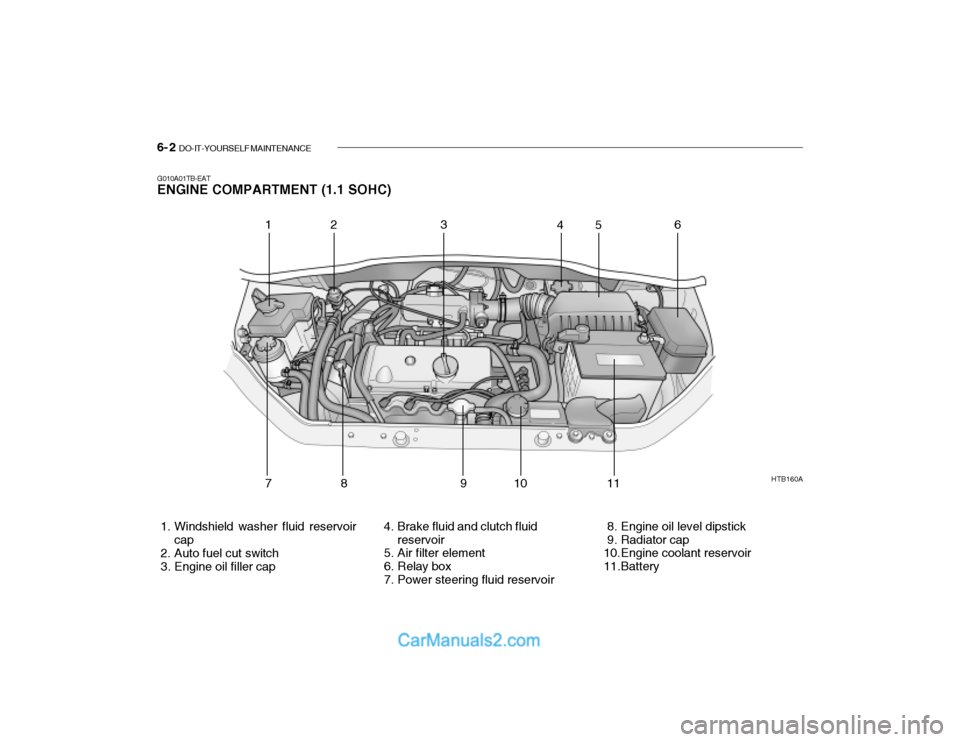
6- 2 DO-IT-YOURSELF MAINTENANCE
HTB160A
1. Windshield washer fluid reservoir cap
2. Auto fuel cut switch
3. Engine oil filler cap 4. Brake fluid and clutch fluid
reservoir
5. Air filter element
6. Relay box
7. Power steering fluid reservoir 8. Engine oil level dipstick
9. Radiator cap
10.Engine coolant reservoir
11.Battery
G010A01TB-EAT ENGINE COMPARTMENT (1.1 SOHC)
12 3
456
78 9 10 1 1