Engin size Hyundai Getz 2003 Owner's Manual
[x] Cancel search | Manufacturer: HYUNDAI, Model Year: 2003, Model line: Getz, Model: Hyundai Getz 2003Pages: 444, PDF Size: 13.82 MB
Page 151 of 444
DRIVING YOUR HYUNDAI 2- 15
C150A01A-AAT SMOOTH CORNERING Avoid braking or gear changing in cor- ners, especially when roads are wet.Ideally, corners should always be taken under gentle acceleration. If you follow these suggestions, tire wear will beheld to a minimum.
o Keep your car in good condition. For
better fuel economy and reducedmaintenance costs, maintain yourcar in accordance with the mainte- nance schedule in Section 5. If you drive your car in severe conditions,more frequent maintenance is re- quired (see Section 5 for details).
o Keep your car clean. For maximum service, your Hyundai should bekept clean and free of corrosive materials. It is especially importantthat mud, dirt, ice, etc. not be al- lowed to accumulate on the under- side of the car. This extra weightcan result in increased fuel con- sumption and also contribute to cor- rosion.
o Travel lightly. Don't carry unneces- sary weight in your car. Weight re-duces fuel economy.
o Don't let the engine idle longer than necessary. If you are waiting (andnot in traffic), turn off your engineand restart only when you're ready to go.
o Remember, your Hyundai does not require extended warm-up. As soonas the engine is running smoothly, you can drive away. In very cold weather, however, give your engine a slightly longer warm-up period.
o Don't "lug" or "over-rev" the engine. Lugging is driving too slowly in toohigh a gear resulting in the engine bucking. If this happens, shift to alower gear. Over-revving is racing the engine beyond its safe limit. This can be avoided by shifting atthe recommended speeds.
o Use your air conditioning sparingly.
The air conditioning system is oper-ated by engine power so your fuel economy is reduced when you use it. C160A01A-AAT WINTER DRIVING The more severe weather conditions of winter result in greater wear andother problems. To minimize the prob- lems of winter driving, you should fol- low these suggestions: C160B01A-GAT Snowy or Icy Conditions To drive your vehicle in deep snow, it may be necessary to use snow tires or to install tire chains on your tires. If snow tires are needed, it is necessary to select tires equivalent in size and type to the original equipment tires.Failure to do so may adversely affect the safety and handling of your car. Speeding, rapid acceleration, suddenbrake applications, and sharp turns are potentially very hazardous prac- tices. During deceleration, use enginebraking to the fullest extent. Sudden brake applications on snowy or icy roads may cause skids to occur. Youneed to keep sufficient distance be- tween the vehicle in front and your vehicle. Also, apply the brake gently. Itshould be noted that installing tire
Page 162 of 444
WHAT TO DO IN AN EMERGENCY 3- 5
Inflation Pressure
Tire Size
T105/70D14 420 kPa (60 psi)
2. The spare tire should only be used temporarily and should be returned to the luggage compartment as soonas the original tire can be repaired or replaced.
3. Continuous use at speeds of over 80 km/h (50 mph) is not recom-mended.
4. As the temporary spare tire is spe- cifically designed for your car, itshould not be used on any other vehicle.
D040A01TB-GAT TEMPORARY SPARE TIRE The following instructions for the tem- porary spare tire should be observed:
1. Check inflation pressure as soon as
practical after installing the spare tire, and adjust to the specified pres- sure. The tire pressure should be periodically checked and maintainedat the specified pressure while the tire is stored.
Spare Tire Pressure
WARNING:
Do not remove the radiator cap whenthe engine is hot. This can allow coolant to be blown out of the open-ing and cause serious burns.
6. If you cannot find the cause of the overheating, wait until the engine temperature has returned to nor- mal. Then, if the engine coolant hasbeen lost, carefully remove the ra- diator cap and add engine coolant to bring the fluid level in the reservoir up to the halfway mark.
7. Proceed with caution, keeping alert for further signs of overheating. Ifoverheating happens again, call a Hyundai dealer for assistance.
!
!
!
CAUTION:
Serious loss of engine coolant indi- cates there is a leak in the cooling system and this should be checked as soon as possible by a Hyundaidealer. 5. The temporary spare tire should not
be used on any other wheels, norshould standard tires, snow tires,wheel covers or trim rings be used with the temporary spare wheel. If such use is attempted, damage tothese items or other car compo- nents may occur.
6. The temporary spare tire pressure should be checked once a monthwhile the tire is stored.
CAUTION:
o Do not use snow chains with your temporary spare tire.
o Do not use more than one tempo-
rary spare tire at a time.
Page 198 of 444
6- 10 DO-IT-YOURSELF MAINTENANCE
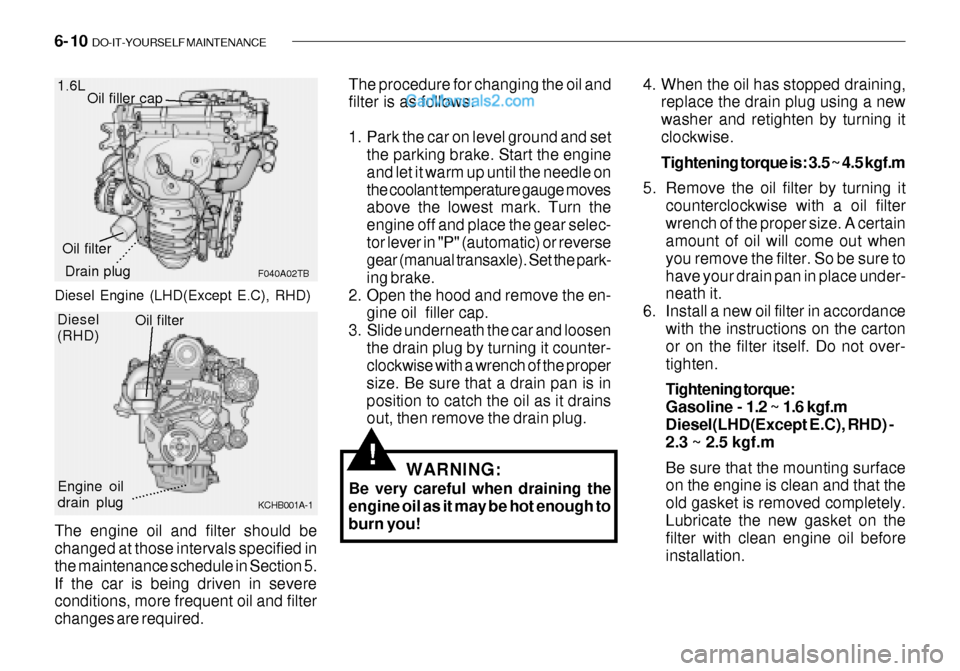
The engine oil and filter should be changed at those intervals specified in the maintenance schedule in Section 5.If the car is being driven in severe conditions, more frequent oil and filter changes are required.1.6L
F040A02TB
Oil filler cap
Drain plug
Oil filter The procedure for changing the oil and filter is as follows:
1. Park the car on level ground and set
the parking brake. Start the engine and let it warm up until the needle onthe coolant temperature gauge moves above the lowest mark. Turn the engine off and place the gear selec-tor lever in "P" (automatic) or reverse gear (manual transaxle). Set the park- ing brake.
2. Open the hood and remove the en- gine oil filler cap.
3. Slide underneath the car and loosen the drain plug by turning it counter- clockwise with a wrench of the proper size. Be sure that a drain pan is inposition to catch the oil as it drains out, then remove the drain plug.
WARNING:
Be very careful when draining theengine oil as it may be hot enough to burn you!
!
4. When the oil has stopped draining, replace the drain plug using a new washer and retighten by turning itclockwise. Tightening torque is: 3.5 ~ 4.5 kgf.m
5. Remove the oil filter by turning it counterclockwise with a oil filter wrench of the proper size. A certain amount of oil will come out when you remove the filter. So be sure tohave your drain pan in place under- neath it.
6. Install a new oil filter in accordance with the instructions on the cartonor on the filter itself. Do not over- tighten. Tightening torque: Gasoline - 1.2 ~ 1.6 kgf.m
Diesel(LHD(Except E.C), RHD) - 2.3 ~ 2.5 kgf.m Be sure that the mounting surface on the engine is clean and that the old gasket is removed completely.Lubricate the new gasket on the filter with clean engine oil before installation.
.........
Diesel (RHD)
KCHB001A-1
Engine oil drain plugOil filter................
Diesel Engine (LHD(Except E.C), RHD)
Page 199 of 444

DO-IT-YOURSELF MAINTENANCE 6- 11
G040B03FC-GAT CHANGING THE OIL AND FILTER
(Diesel Engine: Left hand drivetype (E.C only)) The engine oil and filter should be changed at those intervals specified in the maintenance schedule in Section 5. If the car is being driven in severeconditions, more frequent oil and filter changes are required. The procedure for changing the oil and filter is as follows: 1. Park the car on level ground and set
the parking brake. Start the engine and let it warm up until the needle onthe coolant temperature gauge moves above the lowest mark. Turn the engine off and place the gearselector lever in "P" (automatic) or reverse gear (manual transaxle).
2. Open the hood and remove the en- gine oil filler cap.
3. Slide underneath the car and loosen
the oil pan drain plug by turning it counterclockwise oil pan with a wrench of the proper size. Be sure that a drain pan is in position tocatch the oil as it drains out, then remove the drain plug.
7. Refill the crankcase with the recom-
mended engine oil. Refer to the specification in chapter 9 for engineoil capacity.
8. Start the engine and check to be
sure no oil is leaking from the drainplug or oil filter.
9. Shut off the engine and recheck the
oil level.
NOTE: Always dispose of used engine oil in an environmentally acceptablemanner. It is suggested that it be placed in a sealed container and taken to a service station for recla-mation. Do not pour the oil on the ground or put it into the household trash.
WARNING:
Used motor oil may cause irritationor cancer of the skin if left in con-tact with the skin for prolonged periods of time. Wash your hands thoroughly with soap and warmwater as soon as possible after han- dling used oil.
!
Engine oil drain plug Oil filter
KCHB01A
WARNING:
Be very careful when draining the engine oil as it may be hot enough to burn you!!
4. When the oil has stopped draining, replace the drain plug using a new washer and retighten by turning it clockwise. Oil pan drain plug tightening torque: 3.5 ~ 4.5 kgf.m
............
Page 200 of 444
6- 12 DO-IT-YOURSELF MAINTENANCE
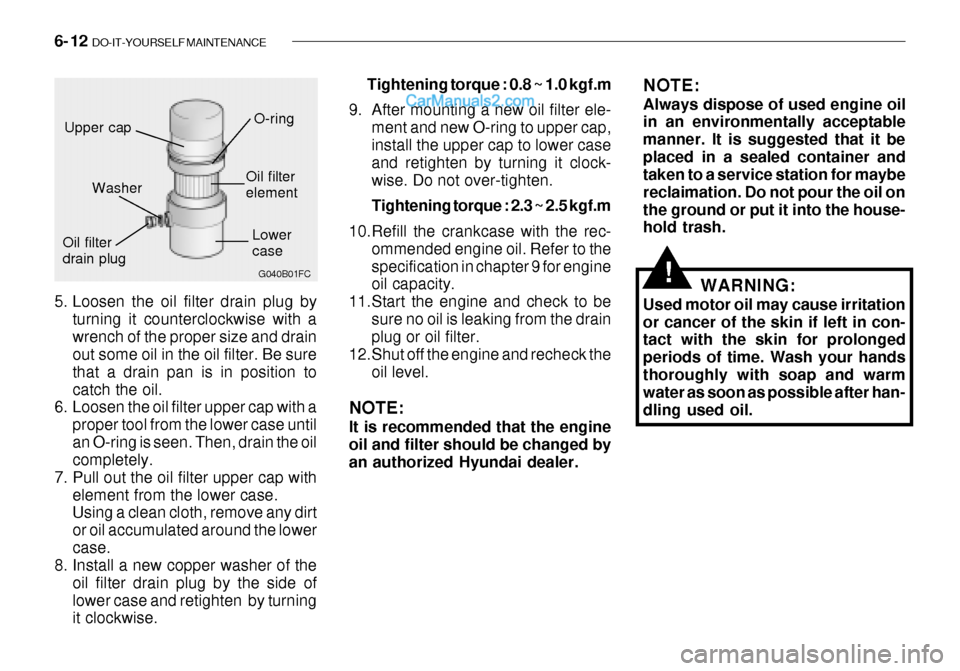
5. Loosen the oil filter drain plug by
turning it counterclockwise with a wrench of the proper size and drain out some oil in the oil filter. Be sure that a drain pan is in position tocatch the oil.
6. Loosen the oil filter upper cap with a
proper tool from the lower case untilan O-ring is seen. Then, drain the oil completely.
7. Pull out the oil filter upper cap with element from the lower case.Using a clean cloth, remove any dirt or oil accumulated around the lowercase.
8. Install a new copper washer of the
oil filter drain plug by the side oflower case and retighten by turning it clockwise. Tightening torque : 0.8 ~ 1.0 kgf.m
9. After mounting a new oil filter ele- ment and new O-ring to upper cap,install the upper cap to lower case and retighten by turning it clock-wise. Do not over-tighten. Tightening torque : 2.3 ~ 2.5 kgf.m
10.Refill the crankcase with the rec- ommended engine oil. Refer to the specification in chapter 9 for engine oil capacity.
11.Start the engine and check to be sure no oil is leaking from the drainplug or oil filter.
12.Shut off the engine and recheck the oil level.
NOTE: It is recommended that the engine oil and filter should be changed by an authorized Hyundai dealer.
G040B01FC
Oil filter drain plug O-ring
Oil filter element
Washer
Upper cap
Lower case NOTE: Always dispose of used engine oil in an environmentally acceptable manner. It is suggested that it beplaced in a sealed container and taken to a service station for maybe reclaimation. Do not pour the oil onthe ground or put it into the house- hold trash.
WARNING:
Used motor oil may cause irritation or cancer of the skin if left in con- tact with the skin for prolonged periods of time. Wash your handsthoroughly with soap and warm water as soon as possible after han- dling used oil.
!
Page 207 of 444
DO-IT-YOURSELF MAINTENANCE 6- 19
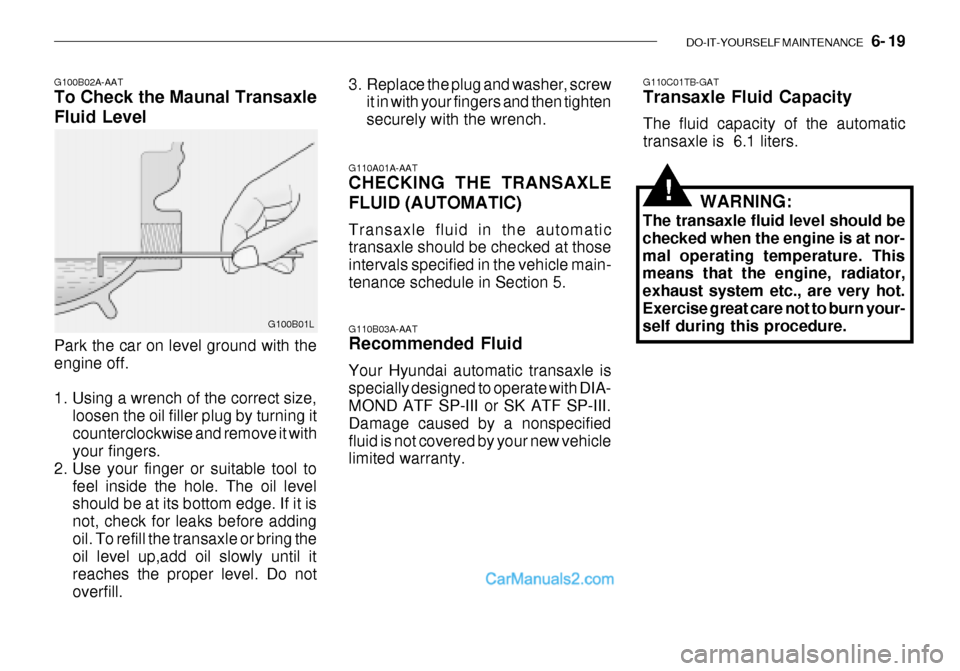
G100B02A-AAT To Check the Maunal Transaxle Fluid Level
G110A01A-AAT CHECKING THE TRANSAXLE FLUID (AUTOMATIC) Transaxle fluid in the automatic transaxle should be checked at those intervals specified in the vehicle main-tenance schedule in Section 5. G110B03A-AAT Recommended Fluid Your Hyundai automatic transaxle is specially designed to operate with DIA-
MOND ATF SP-III or SK ATF SP-III. Damage caused by a nonspecifiedfluid is not covered by your new vehicle limited warranty.G110C01TB-GAT Transaxle Fluid Capacity The fluid capacity of the automatic transaxle is 6.1 liters.
G100B01L
Park the car on level ground with the engine off.
1. Using a wrench of the correct size, loosen the oil filler plug by turning it counterclockwise and remove it with your fingers.
2. Use your finger or suitable tool to feel inside the hole. The oil levelshould be at its bottom edge. If it is not, check for leaks before addingoil. To refill the transaxle or bring the oil level up,add oil slowly until it reaches the proper level. Do notoverfill. 3. Replace the plug and washer, screw
it in with your fingers and then tightensecurely with the wrench.
WARNING:
The transaxle fluid level should bechecked when the engine is at nor-mal operating temperature. This means that the engine, radiator, exhaust system etc., are very hot.Exercise great care not to burn your- self during this procedure.
!
Page 235 of 444

CONSUMER INFORMATION 8- 3
4.5Jx13 5.0Jx13 5.0Jx14 5.5Jx145.5Jx15
4.0Tx14 TIRE
SIZE
RIM
SIZE PRESSURE, kPa (PSI)
155/80R13165/65R14 175/65R14
185/55R15
T105/70D14 REAR
210(30) 420(60) FRONT
230(33) 420(60)
UP TO 2
PERSONS UP TO
MAX. LOAD
REAR
230(33)420(60)
FRONT 210(30) 420(60)
The engine number is stamped on the engine block as shown in the drawing. I020A01A-AAT TIRE INFORMATION The tires supplied on your new Hyundai are chosen to provide the best perfor-mance for normal driving. I030A03TB-GAT RECOMMENDED INFLATION PRESSURES The tire label located in the glove box gives the tire pressures recommended for your car.These pressures were chosen to pro- vide the most satisfactory combinationof ride comfort, tire wear and stability under normal conditions. Tire pres- sures should be checked at leastmonthly. Proper tire inflation pressures should be maintained for these rea- sons:
o Lower-than-recommended tire pres-
sures cause uneven tread wear and poor handling.
o Higher-than-recommended tire
pressures increase the chance ofdamage from impacts and cause uneven tread wear.
I010B01B
HTB263
Diesel Engine
Page 367 of 444

WHAT TO DO IN AN EMERGENCY 3- 5
!
D040A01TB-EAT TEMPORARY SPARE TYRE (Not all models) The following instructions for the tem- porary spare tyre should be observed:
1. Check inflation pressure as soon as
practical after installing the spare tyre, and adjust to the specifiedpressure. The tyre pressure should be periodically checked and main- tained at the specified pressurewhile the tyre is stored.
6. If the cause of the overheating can- not be found, wait until the enginetemperature has returned to nor- mal. Then, if coolant has been lost, carefully remove the radiator capand add water to bring the fluid level in the reservoir up to the base of the radiator fill opening. Fill the coolantexpansion tank to the halfway mark.
7. Proceed with caution until it is es-
tablished that the engine is operat-ing normally. If the engine over- heats repeatedly, the advice of a Hyundai dealer should be sought. WARNING:
Do not remove the radiator cap when the engine is hot since steam and boiling water may be ejected fromthe radiator resulting in burns or scalding.
Inflation Pressure
Tyre Size
T105/70D14 420 kPa (60 psi)
2. The spare tyre should only be used temporarily and should be returned to the luggage compartment as soonas the original tyre can be repaired or replaced.
3. Continuous use at speeds of over 50 mph(80 km/h) is not recom-mended.
4. As the temporary spare tyre is spe- cifically designed for your car, itshould not be used on any other vehicle.
Spare Tyre Pressure
YD050A1-E SPARE TYRE For Full Size (Not all models) The following instructions for the FULL SIZE spare tyre should be observed: Check inflation pressure as soon aspossible after installing the spare tyre, and adjust to the specified pressure. The tyre pressure should be periodi-cally checked and maintained at the specified pressure while the tyre is stored. Spare Tyre Pressure
Tyre Size Inflation Pressure
FULL SIZE 30 psi (210 kPa)
5. If the water pump drive belt is bro-
ken or coolant is leaking out, stop the engine immediately and call thenearest Hyundai dealer for assis- tance.
! CAUTION:
Serious loss of coolant indicates there is a leak in the cooling systemand this should be checked as soon as possible by a Hyundai dealer.
Page 432 of 444
CONSUMER INFORMATION 8- 3
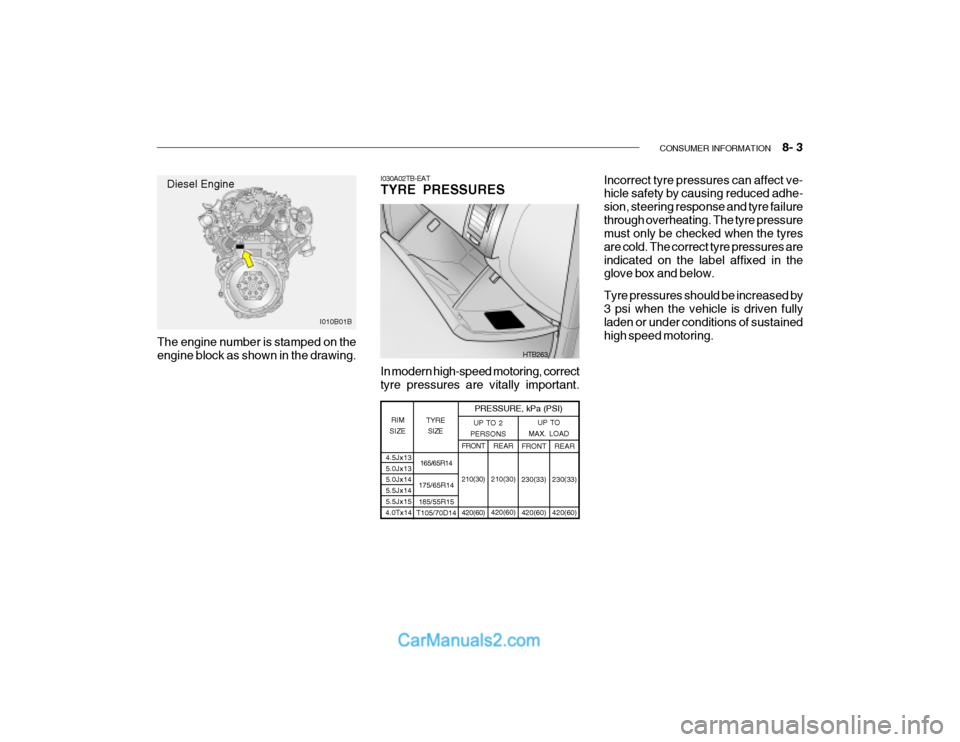
4.5Jx13 5.0Jx13 5.0Jx14 5.5Jx145.5Jx15
4.0Tx14 TYRE
SIZE
RIM
SIZE PRESSURE, kPa (PSI)
165/65R14
175/65R14 185/55R15
T105/70D14 REAR
210(30) 420(60) FRONT
230(33) 420(60)
UP TO 2
PERSONS UP TO
MAX. LOAD
REAR
230(33)420(60)
FRONT 210(30) 420(60)
The engine number is stamped on the engine block as shown in the drawing. I030A02TB-EAT TYRE PRESSURES In modern high-speed motoring, correct tyre pressures are vitally important.
I010B01B
HTB263
Diesel EngineIncorrect tyre pressures can affect ve- hicle safety by causing reduced adhe- sion, steering response and tyre failurethrough overheating. The tyre pressure must only be checked when the tyres are cold. The correct tyre pressures areindicated on the label affixed in the glove box and below. Tyre pressures should be increased by 3 psi when the vehicle is driven fully laden or under conditions of sustained high speed motoring.