warning Hyundai Getz 2004 Owner's Manual
[x] Cancel search | Manufacturer: HYUNDAI, Model Year: 2004, Model line: Getz, Model: Hyundai Getz 2004Pages: 445, PDF Size: 12.16 MB
Page 274 of 445
1- 16 FEATURES OF YOUR HYUNDAI
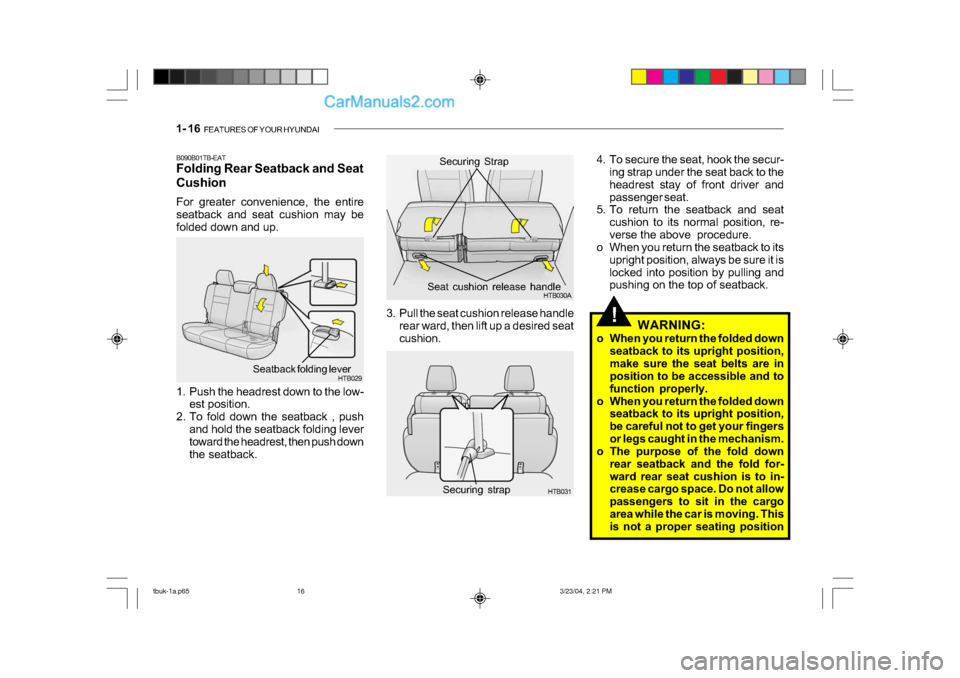
3. Pull the seat cushion release handle
rear ward, then lift up a desired seat
cushion.!WARNING:
o When you return the folded down seatback to its upright position,
make sure the seat belts are in
position to be accessible and to
function properly.
o When you return the folded down seatback to its upright position,
be careful not to get your fingers
or legs caught in the mechanism.
o The purpose of the fold down
rear seatback and the fold for-
ward rear seat cushion is to in-
crease cargo space. Do not allow
passengers to sit in the cargo
area while the car is moving. This
is not a proper seating position
4. To secure the seat, hook the secur-
ing strap under the seat back to the
headrest stay of front driver and
passenger seat.
5. To return the seatback and seat
cushion to its normal position, re-
verse the above procedure.
o When you return the seatback to its
upright position, always be sure it is
locked into position by pulling and
pushing on the top of seatback.
HTB030A
Seat cushion release handle
HTB031Securing strap
Securing Strap
B090B01TB-EAT
Folding Rear Seatback and Seat
Cushion
For greater convenience, the entire
seatback and seat cushion may be
folded down and up.
1. Push the headrest down to the low-
est position.
2. To fold down the seatback , push and hold the seatback folding lever
toward the headrest, then push down
the seatback. HTB029
Seatback folding lever
tbuk-1a.p65
3/23/04, 2:21 PM
16
Page 275 of 445
FEATURES OF YOUR HYUNDAI 1- 17
HTB195
B140A01B-GAT
REAR SEAT WARNING
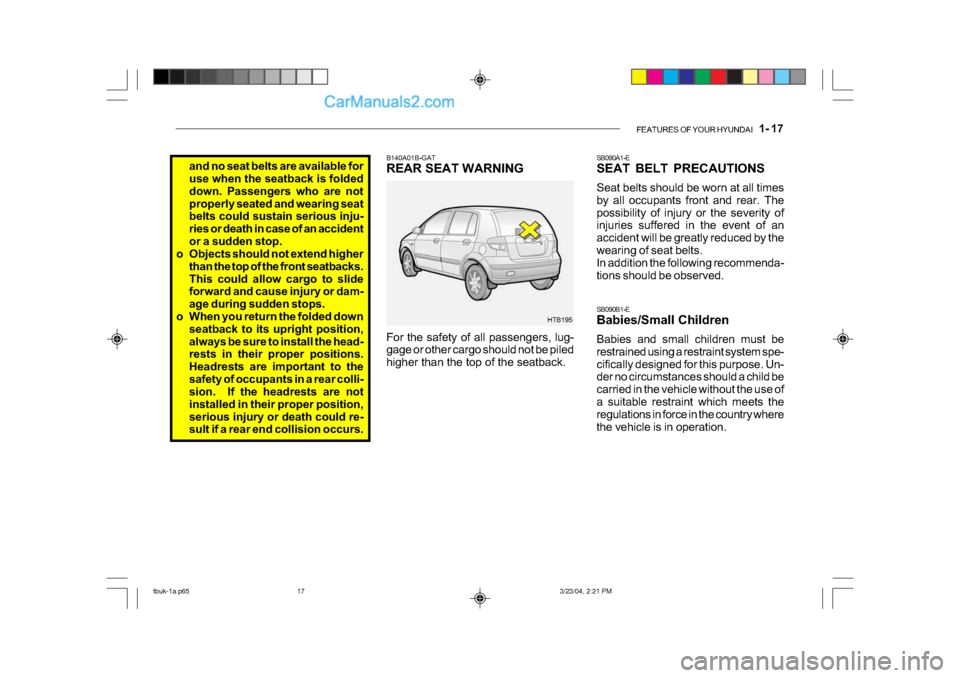
For the safety of all passengers, lug-
gage or other cargo should not be piled
higher than the top of the seatback.
and no seat belts are available for
use when the seatback is folded
down. Passengers who are not
properly seated and wearing seat
belts could sustain serious inju-
ries or death in case of an accident
or a sudden stop.
o Objects should not extend higher
than the top of the front seatbacks.
This could allow cargo to slide
forward and cause injury or dam-
age during sudden stops.
o When you return the folded down seatback to its upright position,
always be sure to install the head-
rests in their proper positions.
Headrests are important to the
safety of occupants in a rear colli-
sion. If the headrests are not
installed in their proper position,
serious injury or death could re-
sult if a rear end collision occurs. SB090A1-E
SEAT BELT PRECAUTIONS
Seat belts should be worn at all times
by all occupants front and rear. The
possibility of injury or the severity of
injuries suffered in the event of an
accident will be greatly reduced by the
wearing of seat belts.
In addition the following recommenda-
tions should be observed.
SB090B1-E
Babies/Small Children
Babies and small children must be
restrained using a restraint system spe-
cifically designed for this purpose. Un-
der no circumstances should a child be
carried in the vehicle without the use of
a suitable restraint which meets the
regulations in force in the country where
the vehicle is in operation.
tbuk-1a.p65
3/23/04, 2:21 PM
17
Page 276 of 445
1- 18 FEATURES OF YOUR HYUNDAI
SB090C1-E
Larger Children
Larger children should occupy the rear
seat and be restrained at all times. The
restraint may take the form of a special
safety belt or the original factory fitted
seat belt used in conjunction with an
approved booster cushion depending
upon the size and weight of the child.
Under no circumstances should chil-
dren be allowed to travel standing, kneel-
ing or lying on the seat.
Never allow children to ride in the front
passenger seat.
SB090O1-E
Pregnant Women
The use of a seat belt is recommended
for pregnant women. The seat belt should
be worn as low and snugly as possible
across the hips, not across the abdo-
men. A qualified Medical Practitioner
should be consulted for further informa-
tion. SB090E1-E
Injured Persons
A seat belt should be used when an
injured person is being transported. For
specific recommendations, the advice
of a qualified Medical Practioner should
be sought.
SB090F1-E
Seat Belt Occupancy
The seat belts are designed to be used
by one seat occupant only. The use of
a seat belt by more than one person
increases the levels of injury which
may be sustained in the event of an
accident.
SE090G1-E
Do Not Lie Down
To ensure that the maximum level of
protection may be afforded by the seat
belt system, all passengers should be
sitting in an upright position throughout
the journey. The seat belt will be unable
to afford maximum protection if the
front seats are at or near the fully
reclined position.
!WARNING:
Sitting in a reclined position or lying
down when your vehicle is in motion
can be dangerous. Even if you buckle
up, your seat belts can't do their job
when you're reclined.
The shoulder belt can't do its job
because it won't be against your
body. Instead, it will be in front of
you. In a crash you could go into it
with great force, receiving serious
neck or other injuries.
The lap belt can't do its job either. In
a crash the belt could go up over
your abdomen. The belt forces would
be applied there, not at your strong
pelvic bones. This could cause seri-
ous internal injuries.
For proper protection when the ve-
hicle is in motion, have the seatback
upright. Then sit back in the seat and
wear your seat belt properly. See
page 1-20.
tbuk-1a.p65 3/23/04, 2:21 PM
18
Page 277 of 445
FEATURES OF YOUR HYUNDAI 1- 19
!
B170A01L
SB090K1-E
Replacement of Seat Belts
The entire seat belt assembly or as-
semblies should be replaced if the ve-
hicle has been involved in an accident
even if no damage is evident. Addi-
tional questions concerning seat belt
operation should be directed to a Hyundai
Dealer.
B170A04A-EAT
HEIGHT ADJUSTABLE FRONT
SEAT SHOULDER BELT
(Not all models)
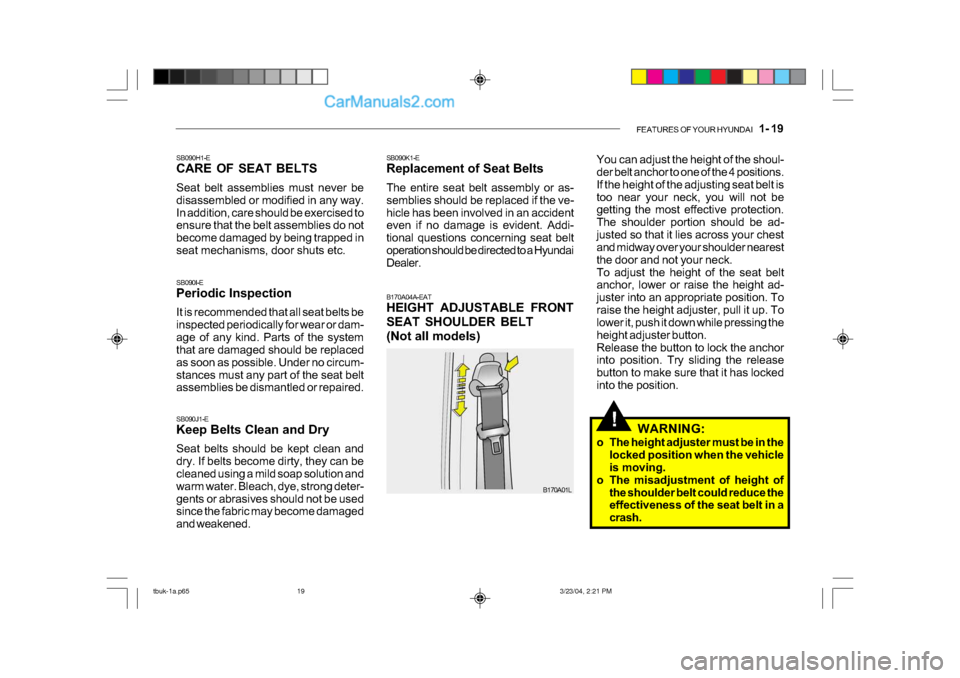
You can adjust the height of the shoul-
der belt anchor to one of the 4 positions.
If the height of the adjusting seat belt is
too near your neck, you will not be
getting the most effective protection.
The shoulder portion should be ad-
justed so that it lies across your chest
and midway over your shoulder nearest
the door and not your neck.
To adjust the height of the seat belt
anchor, lower or raise the height ad-
juster into an appropriate position. To
raise the height adjuster, pull it up. To
lower it, push it down while pressing the
height adjuster button.
Release the button to lock the anchor
into position. Try sliding the release
button to make sure that it has locked
into the position.
WARNING:
o The height adjuster must be in the locked position when the vehicle
is moving.
o The misadjustment of height of the shoulder belt could reduce the
effectiveness of the seat belt in a
crash.
SB090H1-E
CARE OF SEAT BELTS
Seat belt assemblies must never be
disassembled or modified in any way.
In addition, care should be exercised to
ensure that the belt assemblies do not
become damaged by being trapped in
seat mechanisms, door shuts etc.
SB090I-E
Periodic Inspection
It is recommended that all seat belts be
inspected periodically for wear or dam-
age of any kind. Parts of the system
that are damaged should be replaced
as soon as possible. Under no circum-
stances must any part of the seat belt
assemblies be dismantled or repaired.
SB090J1-E
Keep Belts Clean and Dry
Seat belts should be kept clean and
dry. If belts become dirty, they can be
cleaned using a mild soap solution and
warm water. Bleach, dye, strong deter-
gents or abrasives should not be used
since the fabric may become damaged
and weakened.
tbuk-1a.p65
3/23/04, 2:21 PM
19
Page 280 of 445
1- 22 FEATURES OF YOUR HYUNDAI
!
B220C01Y-DAT
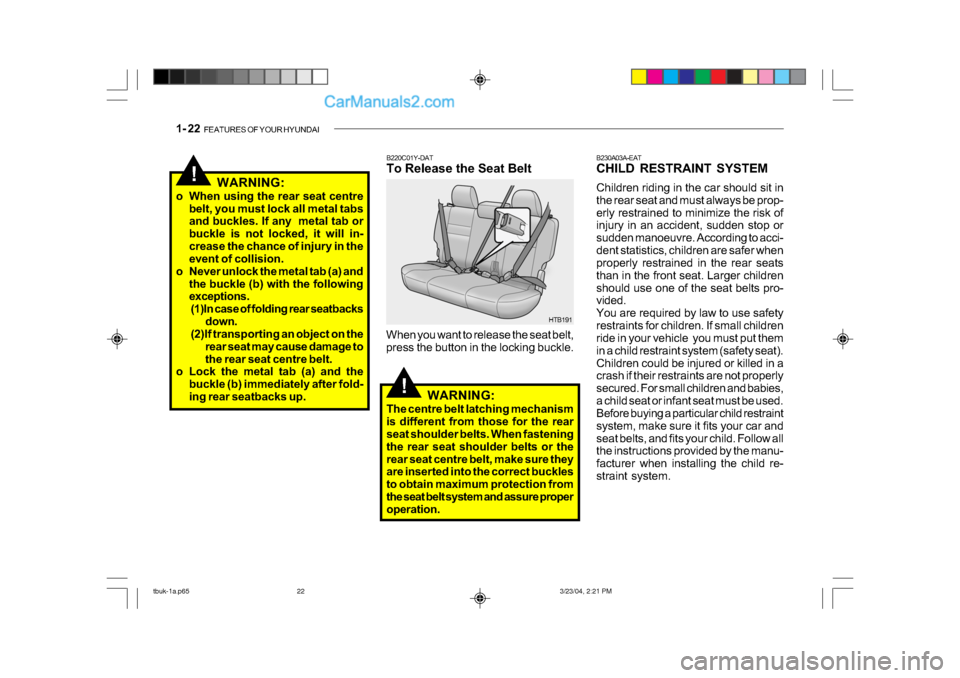
To Release the Seat Belt
When you want to release the seat belt,
press the button in the locking buckle. HTB191
WARNING:
The centre belt latching mechanism
is different from those for the rear
seat shoulder belts. When fastening
the rear seat shoulder belts or the
rear seat centre belt, make sure they
are inserted into the correct buckles
to obtain maximum protection from
the seat belt system and assure proper
operation. B230A03A-EAT
CHILD RESTRAINT SYSTEM
Children riding in the car should sit in
the rear seat and must always be prop-
erly restrained to minimize the risk of
injury in an accident, sudden stop or
sudden manoeuvre. According to acci-
dent statistics, children are safer when
properly restrained in the rear seats
than in the front seat. Larger children
should use one of the seat belts pro-
vided.
You are required by law to use safety
restraints for children. If small children
ride in your vehicle you must put them
in a child restraint system (safety seat).
Children could be injured or killed in a
crash if their restraints are not properly
secured. For small children and babies,
a child seat or infant seat must be used.
Before buying a particular child restraint
system, make sure it fits your car and
seat belts, and fits your child. Follow all
the instructions provided by the manu-
facturer when installing the child re-
straint system.
!WARNING:
o When using the rear seat centre belt, you must lock all metal tabs
and buckles. If any metal tab or
buckle is not locked, it will in-
crease the chance of injury in the
event of collision.
o Never unlock the metal tab (a) and
the buckle (b) with the following
exceptions.(1)In case of folding rear seatbacks down.
(2)If transporting an object on the
rear seat may cause damage to
the rear seat centre belt.
o Lock the metal tab (a) and the
buckle (b) immediately after fold-
ing rear seatbacks up.
tbuk-1a.p65 3/23/04, 2:21 PM
22
Page 281 of 445
FEATURES OF YOUR HYUNDAI 1- 23
Never allow children to ride in the
front passenger seat.
o Always make sure that the shoul-
der belt portion of the outboard
lap/shoulder belt is positioned
midway over the shoulder, never
across the neck or behind the
back. Moving the child closer to
the centre of the vehicle may help
provide a good shoulder belt fit.
The lap belt portion of the lap/
shoulder belt or the centre seat lap
belt must always be positioned as
low as possible on the child's hips
and as snug as possible.
o If the seat belt will not properly fit the child, Hyundai recommends
the use of an approved booster
seat in the rear seat in order to
raise the child's seating height so
that the seat belt will properly fit
the child.
o Never allow a child to stand up or kneel on the seat. o Never use an infant carrier or child
safety seat that "hooks" over a
seatback; it may not provide ad-
equate security in an accident.
o Never allow a child to be held in a person's arms while they are in a
moving vehicle, as this could re-
sult in serious injury to the child
in the event of an accident or a
sudden stop. Holding a child in a
moving vehicle does not provide
the child with any means of pro-
tection during an accident, even if
the person holding the child is
wearing a seat belt.
o If the child restraint seat is not
anchored properly, the risk of a
child being seriously injured or
killed in a collision greatly in-
creases.
WARNING:
o A child restraint system must be placed in the rear seat. Never in-
stall a child or infant seat on the
front passenger's seat.
Should an accident occur and
cause the passenger side airbag
to deploy, it could severely injure
or kill an infant or child seated in
an infant or child seat. Thus, only
use a child restraint in the rear
seat of your vehicle.
o Since a safety belt or child re-
straint system can become very
hot if it is left in a closed vehicle,
be sure to check the seat cover
and buckles before placing a child
there.
o When the child restraint system is
not in use, store it in the trunk or
fasten it with a safety belt so that it
will not be thrown forward in the
case of a sudden stop or an acci-
dent.
o Children who are too large to be in
a child restraint should sit in the
rear seat and be restrained with
the available lap/shoulder belts.!
tbuk-1a.p65 3/23/04, 2:21 PM
23
Page 282 of 445
1- 24 FEATURES OF YOUR HYUNDAI
!WARNING:
Do not install any child restraint sys-
tem in the front passenger seat.
Should an accident occur and cause
the passenger side airbag to deploy,
it could severely injure or kill an
infant or child seated in an infant or
child seat. Therefore, only use a child
restraint system in the rear seat of
your vehicle.
If you need to tighten the belt, pull more
webbing toward the retractor. When you
unbuckle the seat belt and allow it to
retract, the retractor will automatically
revert back to its normal seated pas-
senger emergency locking usage con-
dition.
NOTE:
o Before installing the child restraint
system, read the instructions sup-
plied by the child restraint system
manufacturer.
o If the seat belt does not operate as described, have the system
checked immediately by your au-
thorized Hyundai dealer.
B230B01TB
B230B02A-GAT
Using a Child Restraint System
with "Tether Anchorage" Sys-
tem
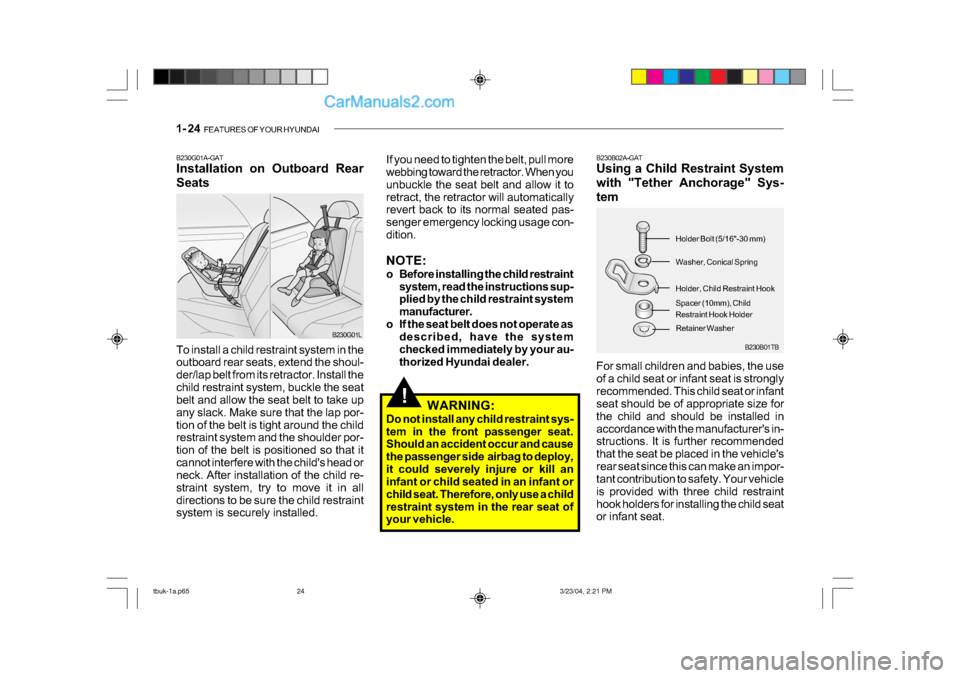
For small children and babies, the use
of a child seat or infant seat is strongly
recommended. This child seat or infant
seat should be of appropriate size for
the child and should be installed in
accordance with the manufacturer's in-
structions. It is further recommended
that the seat be placed in the vehicle's
rear seat since this can make an impor-
tant contribution to safety. Your vehicle
is provided with three child restraint
hook holders for installing the child seat
or infant seat. Spacer (10mm), Child
Restraint Hook Holder
Holder Bolt (5/16"-30 mm)
Washer, Conical Spring
Holder, Child Restraint Hook
Retainer Washer
To install a child restraint system in the
outboard rear seats, extend the shoul-
der/lap belt from its retractor. Install the
child restraint system, buckle the seat
belt and allow the seat belt to take up
any slack. Make sure that the lap por-
tion of the belt is tight around the child
restraint system and the shoulder por-
tion of the belt is positioned so that it
cannot interfere with the child's head or
neck. After installation of the child re-
straint system, try to move it in all
directions to be sure the child restraint
system is securely installed.B230G01A-GAT
Installation on Outboard Rear
Seats
B230G01L
tbuk-1a.p65
3/23/04, 2:21 PM
24
Page 283 of 445
FEATURES OF YOUR HYUNDAI 1- 25
!
B230E01TB
Back panel
Front of Vehicle
Attaching clip
Covering shelf
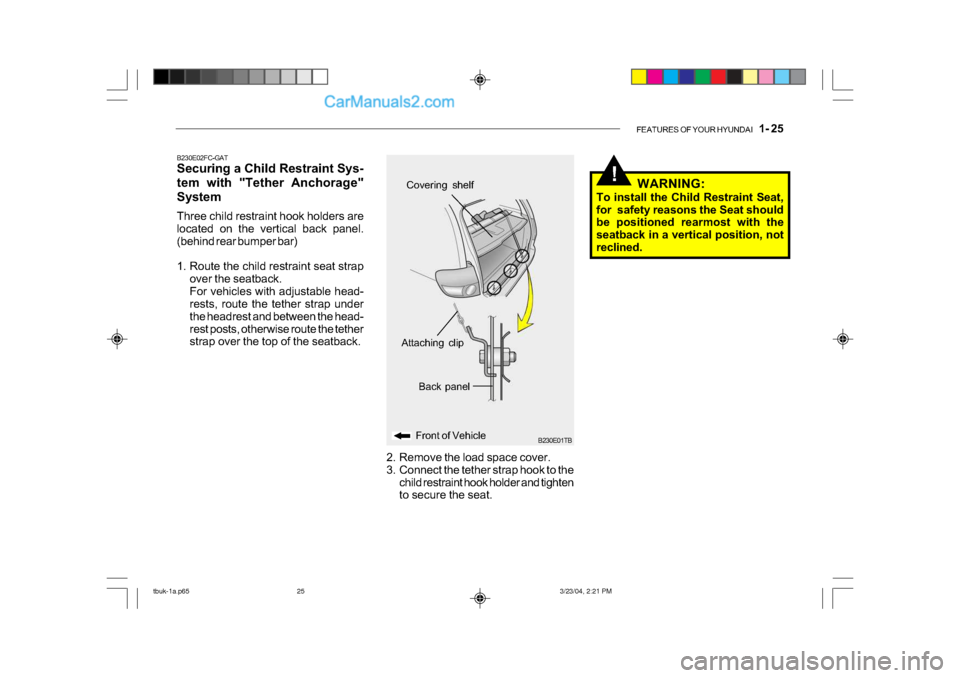
2. Remove the load space cover.
3. Connect the tether strap hook to the child restraint hook holder and tighten
to secure the seat. WARNING:
To install the Child Restraint Seat,
for safety reasons the Seat should
be positioned rearmost with the
seatback in a vertical position, not
reclined.
B230E02FC-GAT
Securing a Child Restraint Sys-
tem with "Tether Anchorage"
System
Three child restraint hook holders are
located on the vertical back panel.
(behind rear bumper bar)
1. Route the child restraint seat strap
over the seatback.
For vehicles with adjustable head-
rests, route the tether strap under
the headrest and between the head-
rest posts, otherwise route the tether
strap over the top of the seatback.
tbuk-1a.p65 3/23/04, 2:21 PM
25
Page 285 of 445
FEATURES OF YOUR HYUNDAI 1- 27
!
B230H01TB-GAT
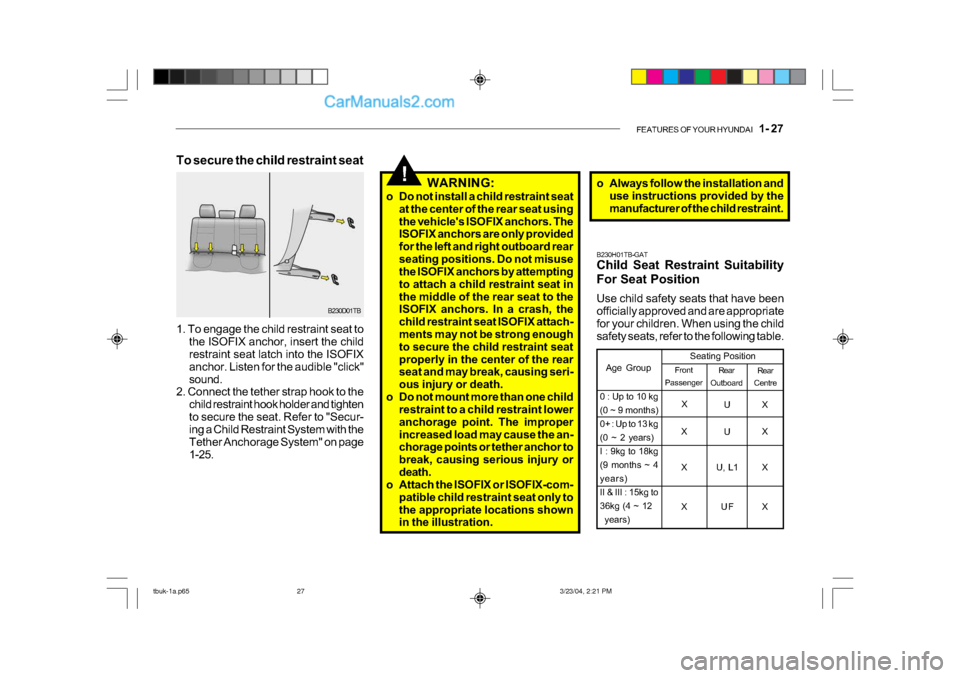
Child Seat Restraint Suitability
For Seat Position
Use child safety seats that have been
officially approved and are appropriate
for your children. When using the child
safety seats, refer to the following table.
Rear
Centre
Age Group Seating Position
UX
X UX
Rear
Outboard
Front
Passenger
0 : Up to 10 kg
(0 ~ 9 months)
0+ : Up to 13 kg
(0 ~ 2 years)
I : 9kg to 18kg
(9 months ~ 4
years)
II & III : 15kg to
36kg (4 ~ 12
years) X
XU
, L 1X
XU FX
WARNING:
o Do not install a child restraint seat at the center of the rear seat using
the vehicle's ISOFIX anchors. The
ISOFIX anchors are only provided
for the left and right outboard rear
seating positions. Do not misuse
the ISOFIX anchors by attempting
to attach a child restraint seat in
the middle of the rear seat to the
ISOFIX anchors. In a crash, the
child restraint seat ISOFIX attach-
ments may not be strong enough
to secure the child restraint seat
properly in the center of the rear
seat and may break, causing seri-
ous injury or death.
o Do not mount more than one child restraint to a child restraint lower
anchorage point. The improper
increased load may cause the an-
chorage points or tether anchor to
break, causing serious injury or
death.
o Attach the ISOFIX or ISOFIX-com-
patible child restraint seat only to
the appropriate locations shown
in the illustration.
B230D01TB
1. To engage the child restraint seat to the ISOFIX anchor, insert the child
restraint seat latch into the ISOFIX
anchor. Listen for the audible "click"
sound.
2. Connect the tether strap hook to the
child restraint hook holder and tighten
to secure the seat. Refer to "Secur-
ing a Child Restraint System with the
Tether Anchorage System" on page
1-25.
To secure the child restraint seat
o Always follow the installation and
use instructions provided by the
manufacturer of the child restraint.
tbuk-1a.p65 3/23/04, 2:21 PM
27
Page 286 of 445
1- 28 FEATURES OF YOUR HYUNDAI
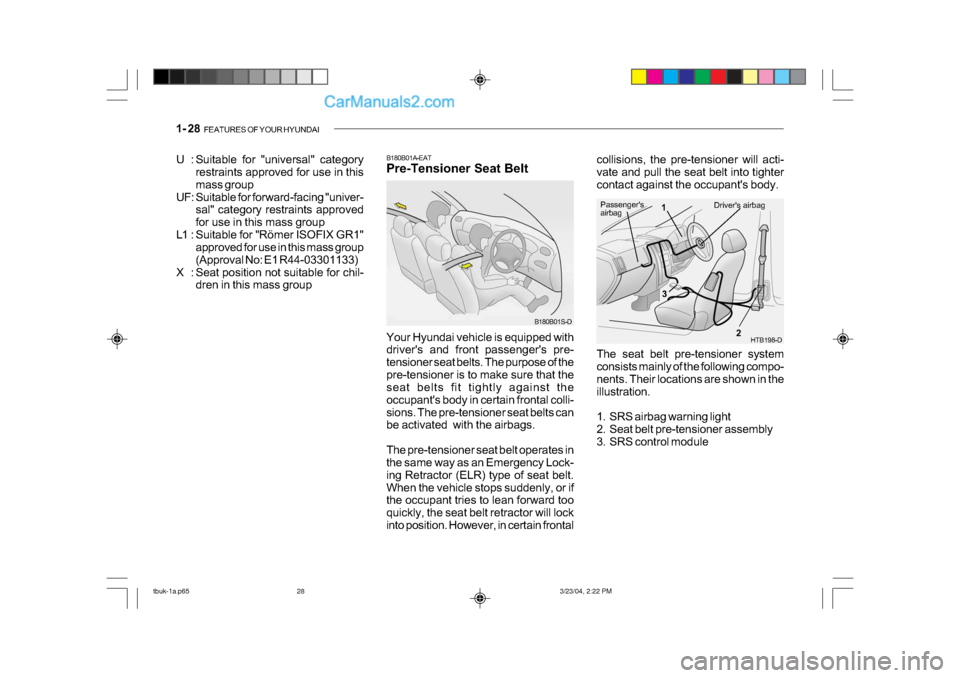
B180B01A-EAT
Pre-Tensioner Seat Belt
B180B01S-D
Your Hyundai vehicle is equipped with
driver's and front passenger's pre-
tensioner seat belts. The purpose of the
pre-tensioner is to make sure that the
seat belts fit tightly against the
occupant's body in certain frontal colli-
sions. The pre-tensioner seat belts can
be activated with the airbags.
The pre-tensioner seat belt operates in
the same way as an Emergency Lock-
ing Retractor (ELR) type of seat belt.
When the vehicle stops suddenly, or if
the occupant tries to lean forward too
quickly, the seat belt retractor will lock
into position. However, in certain frontal
collisions, the pre-tensioner will acti-
vate and pull the seat belt into tighter
contact against the occupant's body.
The seat belt pre-tensioner system
consists mainly of the following compo-
nents. Their locations are shown in the
illustration.
1. SRS airbag warning light
2. Seat belt pre-tensioner assembly
3. SRS control module HTB198-D
Driver's airbag1
2
3Passenger's
airbag
U : Suitable for "universal" category
restraints approved for use in this
mass group
UF: Suitable for forward-facing "univer- sal" category restraints approved
for use in this mass group
L1 : Suitable for "R