Tyre Hyundai Getz 2004 User Guide
[x] Cancel search | Manufacturer: HYUNDAI, Model Year: 2004, Model line: Getz, Model: Hyundai Getz 2004Pages: 445, PDF Size: 12.16 MB
Page 369 of 445
3- 6 WHAT TO DO IN AN EMERGENCY
SD060A1-E
IN THE EVENT OF A PUNCTURE
If a puncture occurs whilst driving the
vehicle:
1. Bring the car to rest as soon as it is
safe to do so and with the minimum
amount of braking required which
will assist in maintaining the maxi-
mum amount of control. The vehicle
should be parked wherever pos-
sible upon firm level ground to facili-
tate wheel changing.
2. If the vehicle is creating a hazard and the road conditions do not per-
mit the wheel to be changed safely,
assistance should be sought.
3. Passengers must not be allowed to
remain inside the vehicle during
wheel changing. If a puncture oc-
curs whilst the vehicle is on a
motorway, the passengers should
take refuge on the motorway em-
bankment to avoid the possibility of
injury occurring should the vehicle
be struck by other motorway traffic.
4. Wheel changing should be per-
formed according to the following
instructions.
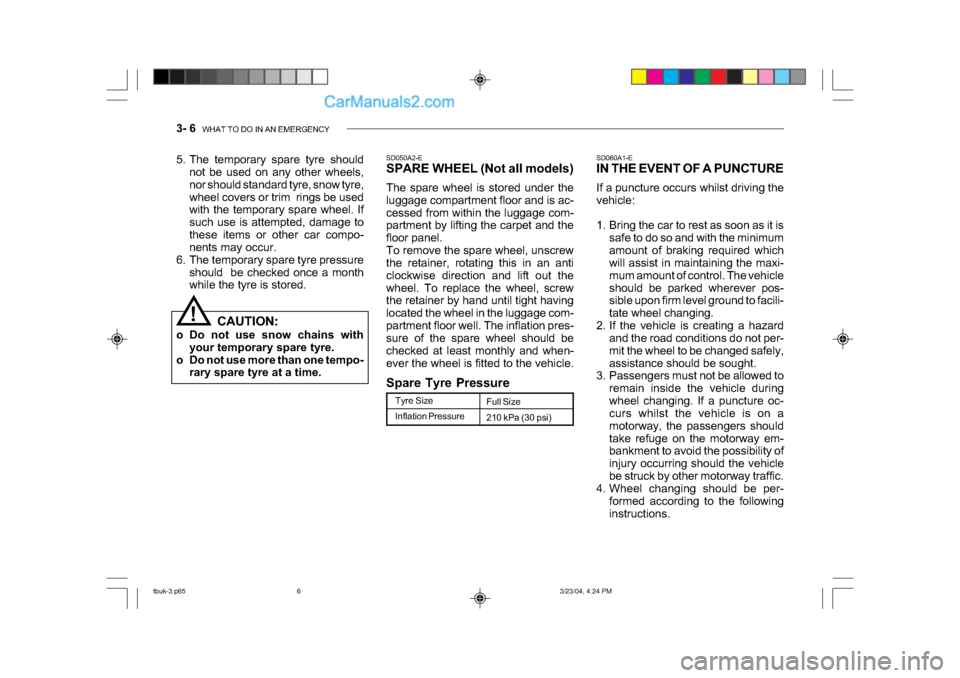
SD050A2-E
SPARE WHEEL (Not all models)
The spare wheel is stored under the
luggage compartment floor and is ac-
cessed from within the luggage com-
partment by lifting the carpet and the
floor panel.
To remove the spare wheel, unscrew
the retainer, rotating this in an anti
clockwise direction and lift out the
wheel. To replace the wheel, screw
the retainer by hand until tight having
located the wheel in the luggage com-
partment floor well. The inflation pres-
sure of the spare wheel should be
checked at least monthly and when-
ever the wheel is fitted to the vehicle.
Inflation Pressure
Tyre Size
Spare Tyre Pressure
Full Size
210 kPa (30 psi)
CAUTION:
o Do not use snow chains with your temporary spare tyre.
o Do not use more than one tempo- rary spare tyre at a time.
!
5. The temporary spare tyre should
not be used on any other wheels,
nor should standard tyre, snow tyre,
wheel covers or trim rings be used
with the temporary spare wheel. If
such use is attempted, damage to
these items or other car compo-
nents may occur.
6. The temporary spare tyre pressure should be checked once a month
while the tyre is stored.
tbuk-3.p65 3/23/04, 4:24 PM
6
Page 370 of 445
WHAT TO DO IN AN EMERGENCY 3- 7
HTB153
HTB152
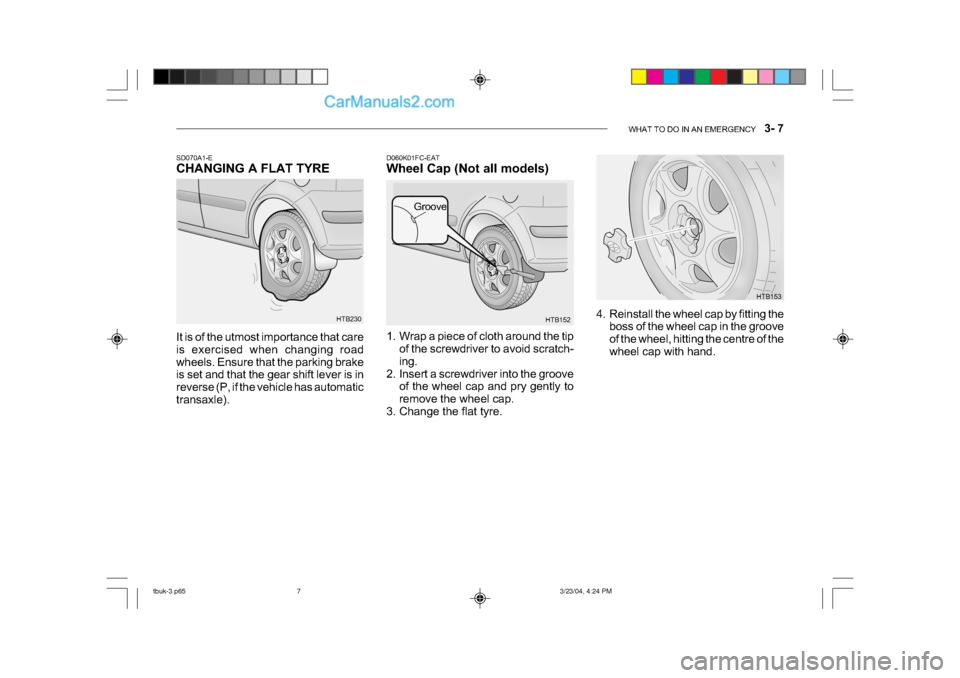
Groove
D060K01FC-EAT
Wheel Cap (Not all models)
1. Wrap a piece of cloth around the tip
of the screwdriver to avoid scratch-
ing.
2. Insert a screwdriver into the groove of the wheel cap and pry gently to
remove the wheel cap.
3. Change the flat tyre. 4. Reinstall the wheel cap by fitting the
boss of the wheel cap in the groove
of the wheel, hitting the centre of the
wheel cap with hand.
HTB230
SD070A1-E
CHANGING A FLAT TYRE
It is of the utmost importance that care
is exercised when changing road
wheels. Ensure that the parking brake
is set and that the gear shift lever is in
reverse (P, if the vehicle has automatic
transaxle).
tbuk-3.p65
3/23/04, 4:24 PM
7
Page 371 of 445
3- 8 WHAT TO DO IN AN EMERGENCY
HTB149
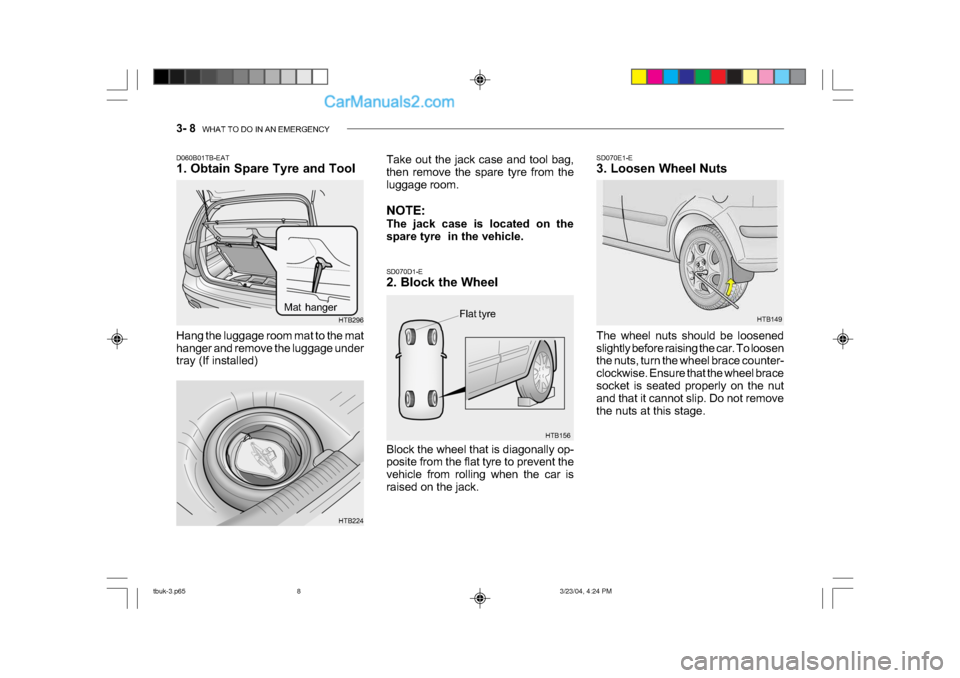
SD070E1-E
3. Loosen Wheel Nuts
The wheel nuts should be loosened
slightly before raising the car. To loosen
the nuts, turn the wheel brace counter-
clockwise. Ensure that the wheel brace
socket is seated properly on the nut
and that it cannot slip. Do not remove
the nuts at this stage.Flat tyre
HTB156
SD070D1-E
2. Block the Wheel
Block the wheel that is diagonally op-
posite from the flat tyre to prevent the
vehicle from rolling when the car is
raised on the jack.
Take out the jack case and tool bag,
then remove the spare tyre from the
luggage room.
NOTE:
The jack case is located on the
spare tyre in the vehicle.
Hang the luggage room mat to the mat
hanger and remove the luggage under
tray (If installed)
D060B01TB-EAT
1. Obtain Spare Tyre and Tool
HTB224
HTB296
Mat hanger
tbuk-3.p65
3/23/04, 4:24 PM
8
Page 374 of 445
WHAT TO DO IN AN EMERGENCY 3- 11
o OK FOR AUTOMATIC OR MANUAL
TRANSAXLE EQUIPPED VEHICLE
WITH NO DAMAGE HTB208
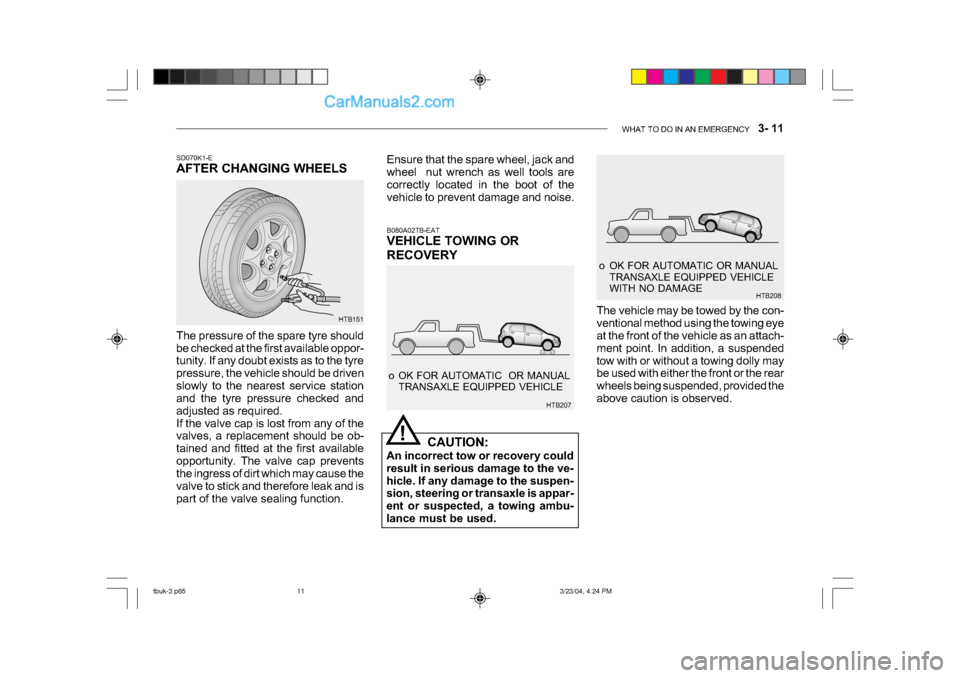
HTB151B080A02TB-EAT
VEHICLE TOWING OR
RECOVERY
CAUTION:
An incorrect tow or recovery could
result in serious damage to the ve-
hicle. If any damage to the suspen-
sion, steering or transaxle is appar-
ent or suspected, a towing ambu-
lance must be used. o OK FOR AUTOMATIC OR MANUAL
TRANSAXLE EQUIPPED VEHICLE
HTB207
!
SD070K1-E
AFTER CHANGING WHEELS
The pressure of the spare tyre should
be checked at the first available oppor-
tunity. If any doubt exists as to the tyre
pressure, the vehicle should be driven
slowly to the nearest service station
and the tyre pressure checked and
adjusted as required.
If the valve cap is lost from any of the
valves, a replacement should be ob-
tained and fitted at the first available
opportunity. The valve cap prevents
the ingress of dirt which may cause the
valve to stick and therefore leak and is
part of the valve sealing function. Ensure that the spare wheel, jack and
wheel nut wrench as well tools are
correctly located in the boot of the
vehicle to prevent damage and noise.
The vehicle may be towed by the con-
ventional method using the towing eye
at the front of the vehicle as an attach-
ment point. In addition, a suspended
tow with or without a towing dolly may
be used with either the front or the rear
wheels being suspended, provided the
above caution is observed.
tbuk-3.p65 3/23/04, 4:24 PM
11
Page 376 of 445
WHAT TO DO IN AN EMERGENCY 3- 13
D120A01A-EAT
IF YOU LOSE YOUR KEYS
Information about the key of immobi-
lizer system will be found on page 1-4.CAUTION:
If the car is being towed with all
four wheels on the ground, it can
be towed only from the front. Be
sure that the transaxle is in neu-
tral. Do not tow at speeds greater
than 30 mph (50 km/h) and for more
than 15 miles(25 km).
Be sure the steering is unlocked by
placing the key in the "ACC" posi-
tion. A driver must be in the towed
vehicle to operate the steering and
brakes.
!
(3)Attach a tow cable, chain or strap to
the towing hook on the front bumper.
D080D02TB-AAT
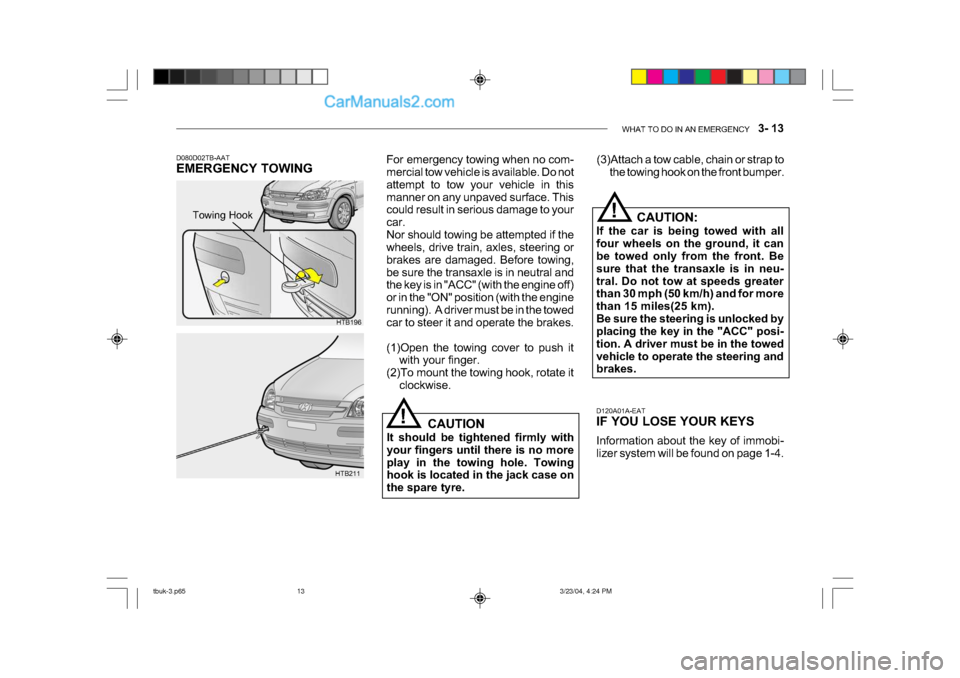
EMERGENCY TOWING For emergency towing when no com-
mercial tow vehicle is available. Do not
attempt to tow your vehicle in this
manner on any unpaved surface. This
could result in serious damage to your
car.
Nor should towing be attempted if the
wheels, drive train, axles, steering or
brakes are damaged. Before towing,
be sure the transaxle is in neutral and
the key is in "ACC" (with the engine off)
or in the "ON" position (with the engine
running). A driver must be in the towed
car to steer it and operate the brakes.
(1)Open the towing cover to push it
with your finger.
(2)To mount the towing hook, rotate it clockwise.
HTB196
HTB211 CAUTION
It should be tightened firmly with
your fingers until there is no more
play in the towing hole. Towing
hook is located in the jack case on
the spare tyre.
!
Towing Hook
tbuk-3.p65
3/23/04, 4:24 PM
13
Page 386 of 445
VEHICLE MAINTENANCE REQUIREMENTS 5- 5
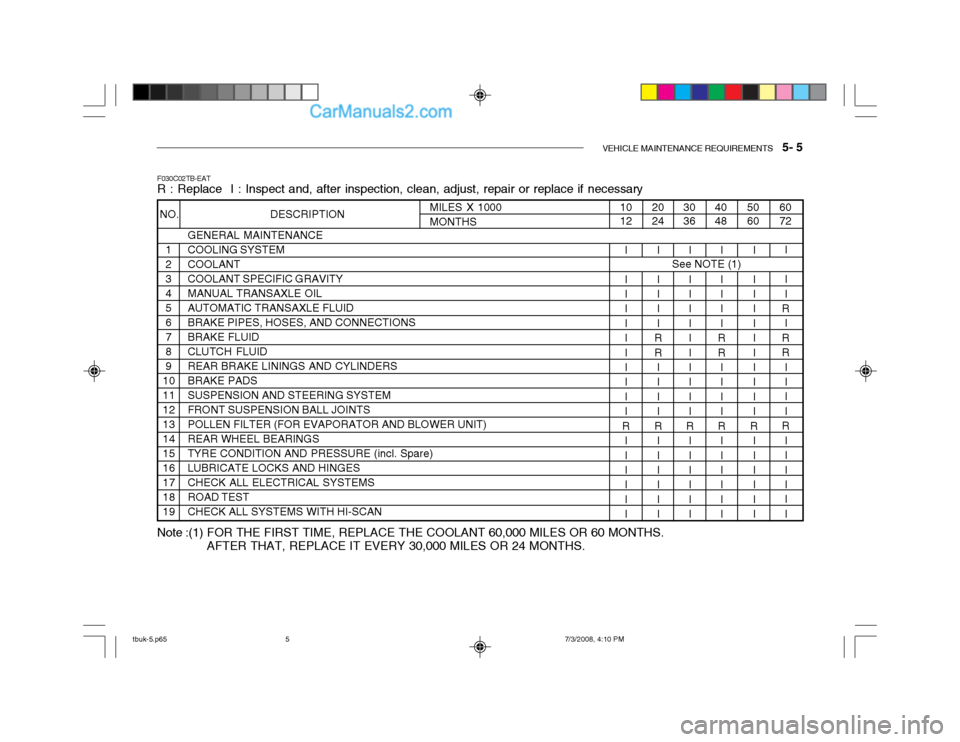
F030C02TB-EAT R : Replace I : Inspect and, after inspection, clean, adjust, repair or replace if necessary
GENERAL MAINTENANCE COOLING SYSTEMCOOLANTCOOLANT SPECIFIC GRAVITYMANUAL TRANSAXLE OILAUTOMATIC TRANSAXLE FLUIDBRAKE PIPES, HOSES, AND CONNECTIONSBRAKE FLUIDCLUTCH FLUIDREAR BRAKE LININGS AND CYLINDERSBRAKE PADSSUSPENSION AND STEERING SYSTEMFRONT SUSPENSION BALL JOINTSPOLLEN FILTER (FOR EVAPORATOR AND BLOWER UNIT)REAR WHEEL BEARINGSTYRE CONDITION AND PRESSURE (incl. Spare)LUBRICATE LOCKS AND HINGESCHECK ALL ELECTRICAL SYSTEMSROAD TESTCHECK ALL SYSTEMS WITH HI-SCAN
60 72
5060
4048
I I I
R
I
RR II I I
R III I II
I I I IIIII I II
R II I III
I I I II
RR I I II
R II I III
30 36
2024
I I I IIIII I II
R II I III
I I I II
RR I I II
R II I III
10 12
I I I IIIII I II
R II I III
MILES X 1000MONTHS
NO. DESCRIPTION
1 23456789
10111213141516171819
See NOTE (1)
Note :(1) FOR THE FIRST TIME, REPLACE THE COOLANT 60,000 MILES OR 60 MONTHS. AFTER THAT, REPLACE IT EVERY 30,000 MILES OR 24 MONTHS.
tbuk-5.p65 7/3/2008, 4:10 PM
5
Page 397 of 445
6- 6 DO-IT-YOURSELF MAINTENANCE
SG020B1-E
DAILY OPERATING CHECKS
The following items should be checked
on a daily basis or whenever the vehicle
is refuelled, whichever occurs sooner.
o Engine oil level.
o Engine coolant level.
o Power steering fluid level.
o Brake fluid level.
o Windscreen washer fluid level.
o Battery condition.
o Tyre condition and pressures.
o Operation and cleanliness of all light-
ing equipment.
o Windscreen wiper and washer opera- tion.
o Horn operation.
o Warning light operation.
o Adjustment and cleanliness of mir- rors.
o Seat and seat belt adjustment and operation.
o Fluid leakage.
The vehicle must not be driven if the
daily operating checks indicate that
any item of equipment related to the
safety or roadworthiness of the vehicle
is not functioning correctly. G030B02A-EAT
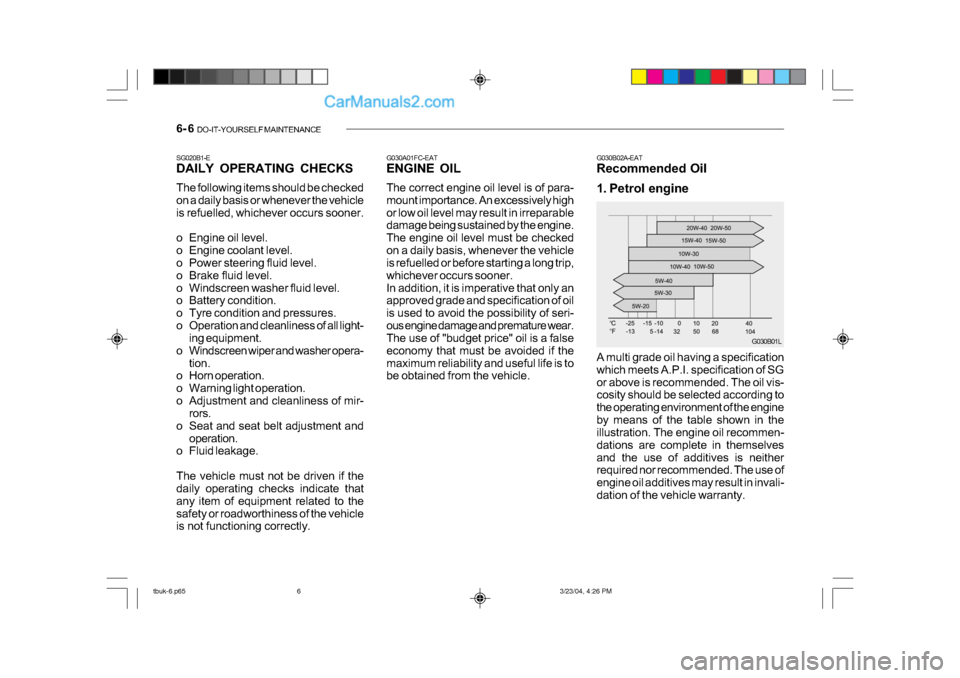
Recommended Oil
1. Petrol engine
A multi grade oil having a specification
which meets A.P.I. specification of SG
or above is recommended. The oil vis-
cosity should be selected according to
the operating environment of the engine
by means of the table shown in the
illustration. The engine oil recommen-
dations are complete in themselves
and the use of additives is neither
required nor recommended. The use of
engine oil additives may result in invali-
dation of the vehicle warranty.
G030A01FC-EAT
ENGINE OIL
The correct engine oil level is of para-
mount importance. An excessively high
or low oil level may result in irreparable
damage being sustained by the engine.
The engine oil level must be checked
on a daily basis, whenever the vehicle
is refuelled or before starting a long trip,
whichever occurs sooner.
In addition, it is imperative that only an
approved grade and specification of oil
is used to avoid the possibility of seri-
ous engine damage and premature wear.
The use of "budget price" oil is a false
economy that must be avoided if the
maximum reliability and useful life is to
be obtained from the vehicle.
G030B01L
tbuk-6.p65
3/23/04, 4:26 PM
6
Page 431 of 445
8. CONSUMER INFORMATIONVehicle Identification Number (VIN) .............................................. . 8-2
Engine num ber ................................................ ................................. 8-2
Tyre pressures ................................................... .............................. 8-3
Snow tyres ................................................... .................................... 8-4
Tyre chains ................................................... ................................... 8-4
Tyre rotation ................................................... .................................. 8-4
Tyre balancing ..................................... ............................................. 8-5
Tyre Replacem ent ................................................ ............................ 8-5
Wheel Replacement ................................................... ...................... 8-5
Spare tyre and t ools ............................................... .......................... 8-6
8
tbuk-8.p65 3/23/04, 4:27 PM
1
Page 433 of 445
CONSUMER INFORMATION 8- 3
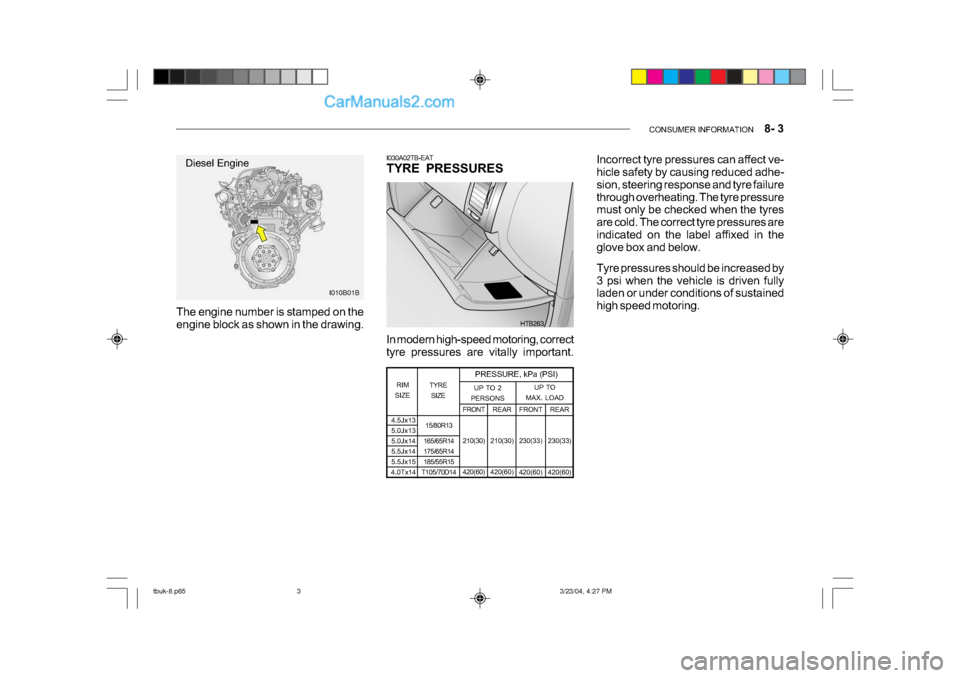
4.5Jx13
5.0Jx13
5.0Jx14
5.5Jx14
5.5Jx15
4.0Tx14 TYRE
SIZE
RIM
SIZE PRESSURE, kPa (PSI)
15/80R13
165/65R14
175/65R14
185/55R15
T105/70D14 REAR
210(30)
420(60) FRONT
230(33)
420(60)
UP TO 2
PERSONS UP TO
MAX. LOAD
REAR
230(33)
420(60)
FRONT
210(30)
420(60)
The engine number is stamped on the
engine block as shown in the drawing. I030A02TB-EAT
TYRE PRESSURES
In modern high-speed motoring, correct
tyre pressures are vitally important.
I010B01B
HTB263
Diesel EngineIncorrect tyre pressures can affect ve-
hicle safety by causing reduced adhe-
sion, steering response and tyre failure
through overheating. The tyre pressure
must only be checked when the tyres
are cold. The correct tyre pressures are
indicated on the label affixed in the
glove box and below.
Tyre pressures should be increased by
3 psi when the vehicle is driven fully
laden or under conditions of sustained
high speed motoring.
tbuk-8.p65 3/23/04, 4:27 PM
3
Page 434 of 445
8- 4 CONSUMER INFORMATION
!
I050A01TB-EAT
TYRE CHAINS
Tyre chains, if necessary, should be
installed on the front wheels. Be sure
that the chains are the proper size and
that they are installed in accordance
with the manufacturer's instructions.
To minimize tyre and chain wear, do not
continue to use tyre chains when they
are no longer needed.
SI030A2-E
SNOW TYRES
If it is desired to fit snow tyres to the
vehicle, it must be ascertained that the
original size and load carrying capacity
are met by the replacement tyres. When
using snow tyres, the vehicle should
not be driven at speeds in excess of 60
MPH.
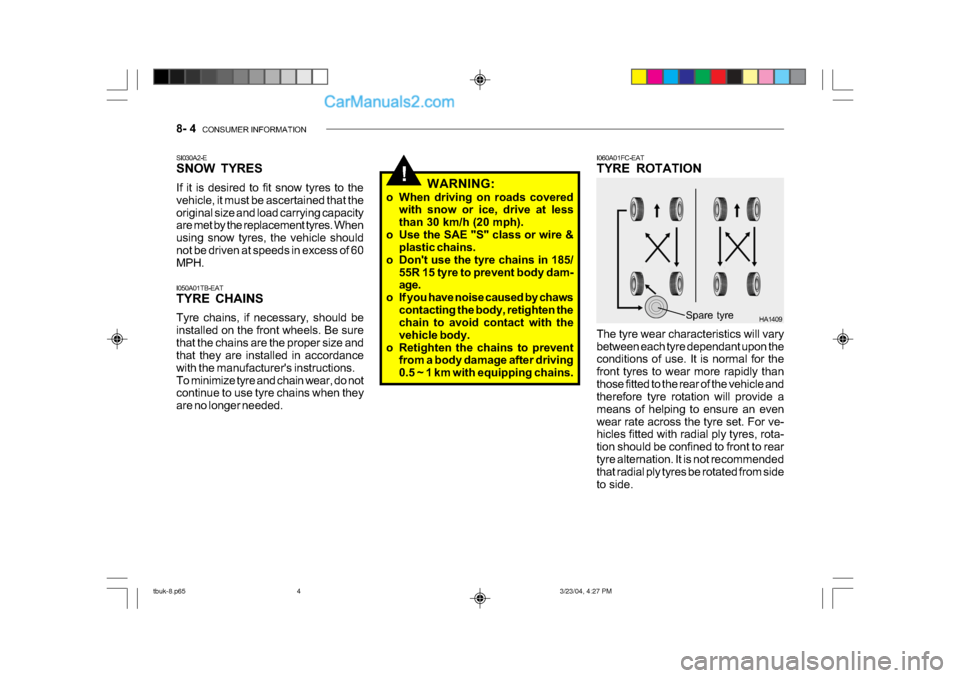
I060A01FC-EAT
TYRE ROTATION
The tyre wear characteristics will vary
between each tyre dependant upon the
conditions of use. It is normal for the
front tyres to wear more rapidly than
those fitted to the rear of the vehicle and
therefore tyre rotation will provide a
means of helping to ensure an even
wear rate across the tyre set. For ve-
hicles fitted with radial ply tyres, rota-
tion should be confined to front to rear
tyre alternation. It is not recommended
that radial ply tyres be rotated from side
to side.
WARNING:
o When driving on roads covered with snow or ice, drive at less
than 30 km/h (20 mph).
o Use the SAE "S" class or wire & plastic chains.
o Don't use the tyre chains in 185/ 55R 15 tyre to prevent body dam-
age.
o If you have noise caused by chaws contacting the body, retighten the
chain to avoid contact with the
vehicle body.
o Retighten the chains to prevent from a body damage after driving
0.5 ~ 1 km with equipping chains.
HA1409Spare tyre
tbuk-8.p65 3/23/04, 4:27 PM
4