ESP Hyundai Getz 2004 Owner's Guide
[x] Cancel search | Manufacturer: HYUNDAI, Model Year: 2004, Model line: Getz, Model: Hyundai Getz 2004Pages: 445, PDF Size: 12.16 MB
Page 298 of 445
1- 40 FEATURES OF YOUR HYUNDAI
!
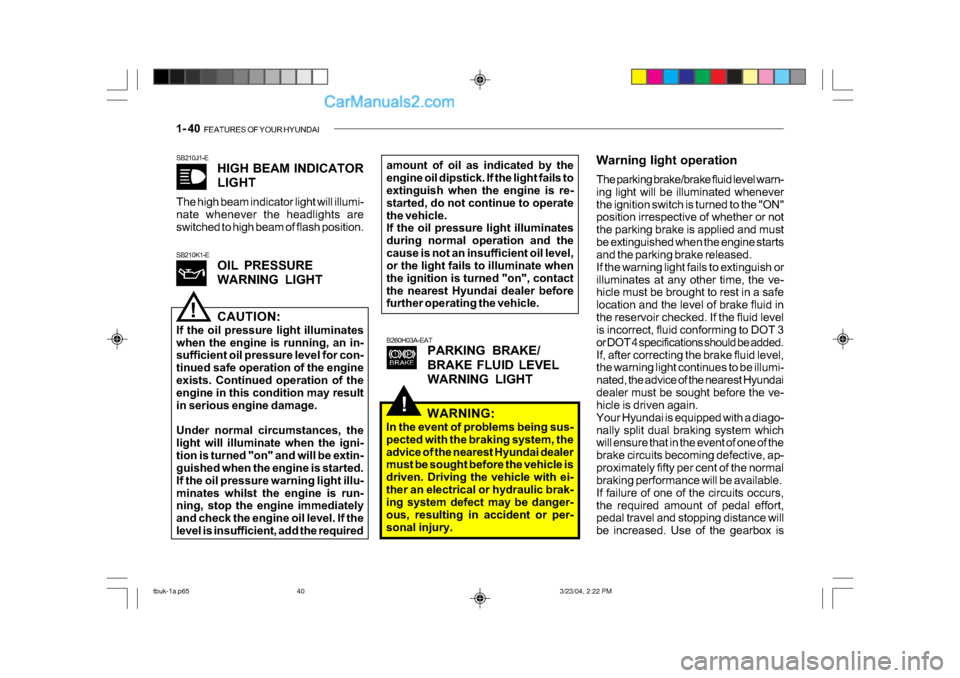
SB210J1-E
HIGH BEAM INDICATOR
LIGHT
The high beam indicator light will illumi-
nate whenever the headlights are
switched to high beam of flash position.
B260H03A-EATPARKING BRAKE/
BRAKE FLUID LEVEL
WARNING LIGHT
SB210K1-E
OIL PRESSURE
WARNING LIGHT
!CAUTION:
If the oil pressure light illuminates
when the engine is running, an in-
sufficient oil pressure level for con-
tinued safe operation of the engine
exists. Continued operation of the
engine in this condition may result
in serious engine damage.
Under normal circumstances, the
light will illuminate when the igni-
tion is turned "on" and will be extin-
guished when the engine is started.
If the oil pressure warning light illu-
minates whilst the engine is run-
ning, stop the engine immediately
and check the engine oil level. If the
level is insufficient, add the required amount of oil as indicated by the
engine oil dipstick. If the light fails to
extinguish when the engine is re-
started, do not continue to operate
the vehicle.
If the oil pressure light illuminates
during normal operation and the
cause is not an insufficient oil level,
or the light fails to illuminate when
the ignition is turned "on", contact
the nearest Hyundai dealer before
further operating the vehicle.
Warning light operation
The parking brake/brake fluid level warn-
ing light will be illuminated whenever
the ignition switch is turned to the "ON"
position irrespective of whether or not
the parking brake is applied and must
be extinguished when the engine starts
and the parking brake released.
If the warning light fails to extinguish or
illuminates at any other time, the ve-
hicle must be brought to rest in a safe
location and the level of brake fluid in
the reservoir checked. If the fluid level
is incorrect, fluid conforming to DOT 3
or DOT 4 specifications should be added.
If, after correcting the brake fluid level,
the warning light continues to be illumi-
nated, the advice of the nearest Hyundai
dealer must be sought before the ve-
hicle is driven again.
Your Hyundai is equipped with a diago-
nally split dual braking system which
will ensure that in the event of one of the
brake circuits becoming defective, ap-
proximately fifty per cent of the normal
braking performance will be available.
If failure of one of the circuits occurs,
the required amount of pedal effort,
pedal travel and stopping distance will
be increased. Use of the gearbox is
WARNING:
In the event of problems being sus-
pected with the braking system, the
advice of the nearest Hyundai dealer
must be sought before the vehicle is
driven. Driving the vehicle with ei-
ther an electrical or hydraulic brak-
ing system defect may be danger-
ous, resulting in accident or per-
sonal injury.
tbuk-1a.p65 3/23/04, 2:22 PM
40
Page 349 of 445
2- 6 DRIVING YOUR HYUNDAI
C050B01HP
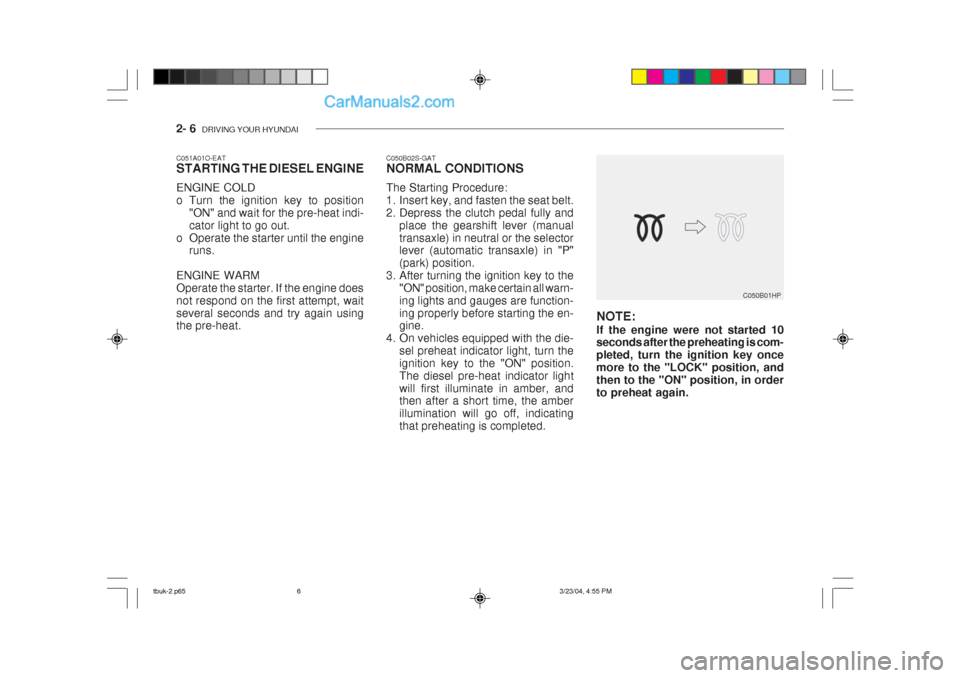
NOTE: If the engine were not started 10 seconds after the preheating is com- pleted, turn the ignition key oncemore to the "LOCK" position, andthen to the "ON" position, in orderto preheat again.
C051A01O-EAT STARTING THE DIESEL ENGINE ENGINE COLD
o Turn the ignition key to position
"ON" and wait for the pre-heat indi-cator light to go out.
o Operate the starter until the engine runs.
ENGINE WARMOperate the starter. If the engine doesnot respond on the first attempt, waitseveral seconds and try again using the pre-heat. C050B02S-GAT NORMAL CONDITIONS The Starting Procedure:
1. Insert key, and fasten the seat belt.
2. Depress the clutch pedal fully and
place the gearshift lever (manualtransaxle) in neutral or the selector lever (automatic transaxle) in "P" (park) position.
3. After turning the ignition key to the
"ON" position, make certain all warn-ing lights and gauges are function-ing properly before starting the en- gine.
4. On vehicles equipped with the die-
sel preheat indicator light, turn the ignition key to the "ON" position.The diesel pre-heat indicator lightwill first illuminate in amber, and then after a short time, the amber illumination will go off, indicatingthat preheating is completed.
tbuk-2.p65 3/23/04, 4:55 PM
6
Page 353 of 445
2- 10 DRIVING YOUR HYUNDAI
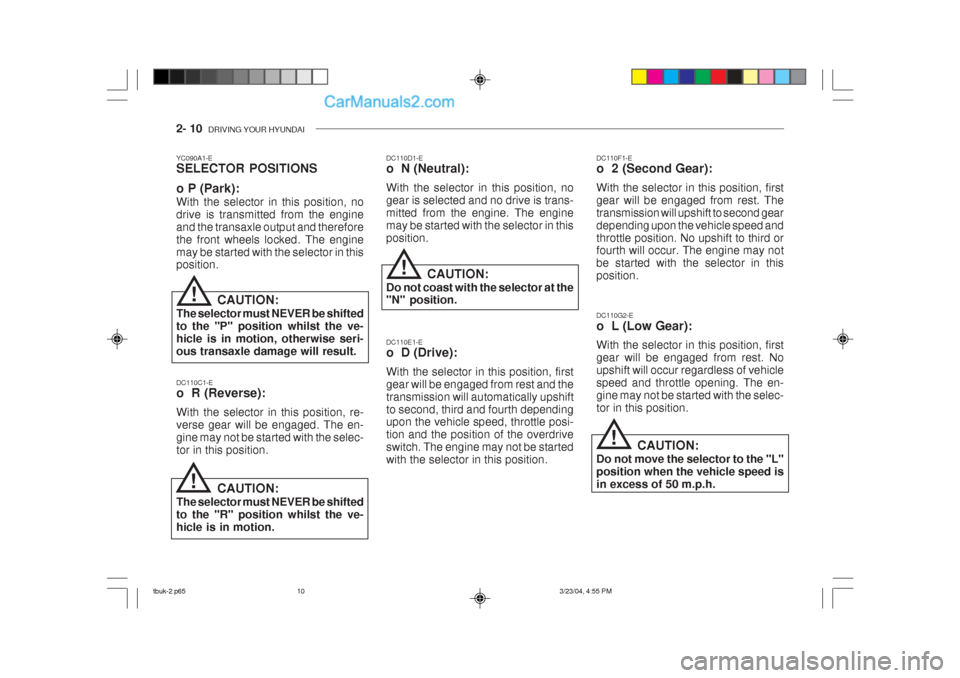
YC090A1-E SELECTOR POSITIONS o P (Park): With the selector in this position, no drive is transmitted from the engineand the transaxle output and thereforethe front wheels locked. The enginemay be started with the selector in this position.
!
CAUTION:
The selector must NEVER be shifted to the "P" position whilst the ve-hicle is in motion, otherwise seri-ous transaxle damage will result. DC110C1-E o R (Reverse): With the selector in this position, re- verse gear will be engaged. The en-gine may not be started with the selec-tor in this position.
CAUTION:
The selector must NEVER be shiftedto the "R" position whilst the ve-hicle is in motion.
! DC110D1-E o N (Neutral): With the selector in this position, no gear is selected and no drive is trans-mitted from the engine. The enginemay be started with the selector in thisposition.
!
CAUTION:
Do not coast with the selector at the "N" position. DC110E1-E o D (Drive): With the selector in this position, first gear will be engaged from rest and thetransmission will automatically upshiftto second, third and fourth depending upon the vehicle speed, throttle posi- tion and the position of the overdriveswitch. The engine may not be startedwith the selector in this position. DC110F1-E o 2 (Second Gear): With the selector in this position, first gear will be engaged from rest. Thetransmission will upshift to second geardepending upon the vehicle speed andthrottle position. No upshift to third or fourth will occur. The engine may not be started with the selector in thisposition. DC110G2-E o L (Low Gear): With the selector in this position, first gear will be engaged from rest. Noupshift will occur regardless of vehiclespeed and throttle opening. The en-gine may not be started with the selec-tor in this position.
!
CAUTION:
Do not move the selector to the "L" position when the vehicle speed isin excess of 50 m.p.h.
tbuk-2.p65 3/23/04, 4:55 PM
10
Page 357 of 445
2- 14 DRIVING YOUR HYUNDAI
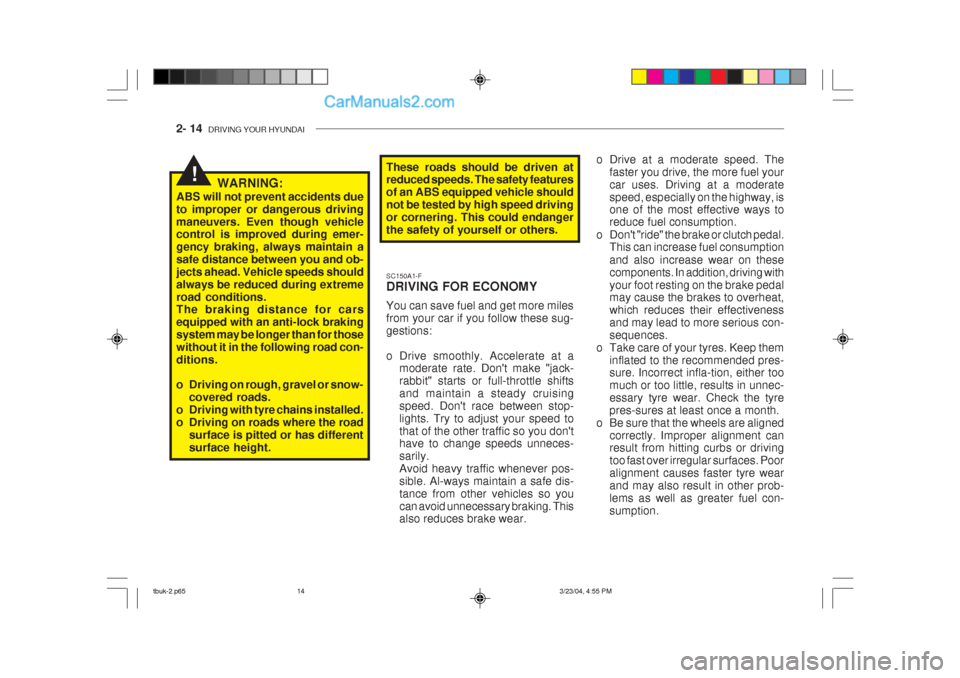
!WARNING:
ABS will not prevent accidents due to improper or dangerous drivingmaneuvers. Even though vehicle control is improved during emer- gency braking, always maintain asafe distance between you and ob-jects ahead. Vehicle speeds shouldalways be reduced during extremeroad conditions. The braking distance for cars equipped with an anti-lock brakingsystem may be longer than for thosewithout it in the following road con-ditions.
o Driving on rough, gravel or snow- covered roads.
o Driving with tyre chains installed.
o Driving on roads where the road
surface is pitted or has differentsurface height. These roads should be driven at reduced speeds. The safety features of an ABS equipped vehicle shouldnot be tested by high speed drivingor cornering. This could endangerthe safety of yourself or others. SC150A1-F DRIVING FOR ECONOMY You can save fuel and get more miles from your car if you follow these sug-gestions:
o Drive smoothly. Accelerate at a
moderate rate. Don't make "jack- rabbit" starts or full-throttle shiftsand maintain a steady cruisingspeed. Don't race between stop-lights. Try to adjust your speed tothat of the other traffic so you don't have to change speeds unneces- sarily.Avoid heavy traffic whenever pos-sible. Al-ways maintain a safe dis-tance from other vehicles so youcan avoid unnecessary braking. This also reduces brake wear. o Drive at a moderate speed. The
faster you drive, the more fuel your car uses. Driving at a moderatespeed, especially on the highway, isone of the most effective ways to reduce fuel consumption.
o Don't "ride" the brake or clutch pedal. This can increase fuel consumption and also increase wear on thesecomponents. In addition, driving withyour foot resting on the brake pedal may cause the brakes to overheat, which reduces their effectivenessand may lead to more serious con-sequences.
o Take care of your tyres. Keep them inflated to the recommended pres- sure. Incorrect infla-tion, either too much or too little, results in unnec-essary tyre wear. Check the tyrepres-sures at least once a month.
o Be sure that the wheels are aligned correctly. Improper alignment can result from hitting curbs or driving too fast over irregular surfaces. Pooralignment causes faster tyre wearand may also result in other prob-lems as well as greater fuel con-sumption.
tbuk-2.p65 3/23/04, 4:55 PM
14
Page 358 of 445
DRIVING YOUR HYUNDAI 2- 15
o Keep your car in good condition. For
better fuel economy and reduced maintenance costs, maintain yourcar in accordance with the mainte-nance schedule in Section 5. If you drive your car in severe conditions, more frequent maintenance is re-quired (see Section 5 for details).
o Keep your car clean. For maximum service, your car should be keptclean and free of corrosive materi- als. It is especially important that mud, dirt, ice, etc. not be allowed toaccumulate on the underside of thecar. This extra weight can result inincreased fuel consumption and alsocontribute to corrosion.
o Travel lightly. Don't carry unneces-
sary weight in your car. Weight is anenemy of good fuel economy.
o Don't let the engine idle longer than necessary. If you are waiting (andnot in traffic), turn off your engine and restart only when you're ready to go.
o Remember, your car does not re-
quire extended warm-up. As soonas the engine is running smoothly,you can drive away. In very cold weather, however, give your engine a slightly longer warm-up period. o Don't "lug" or "over-rev" the engine.
Lugging is driving too slowly in toohigh a gear resulting in the enginebucking. If this happens to you, shiftto a lower gear. Over-revving is racing the engine beyond its safe limit. This can beavoided by shifting at the recom-mended speeds.
o Use your air conditioning sparingly.
The air conditioning system is oper- ated by the engine power so your fuel economy is reduced when youuse it.
SC160A1-F SMOOTH CORNERING Avoid braking or gear changing in cor- ners, especially when roads are wet.Ideally, corners should always be takenunder gentle acceleration. If you followthese suggestions, tyre wear will beheld to a minimum. SC170A1-E WINTER MOTORING The onset of winter conditions subject motor vehicles to greater operatingdemands. Therefore, the followingsuggestions will assist in maintainingpeak performance and reliability dur- ing these periods: ZC170B1-E Electrical System Winter conditions impose severe de- mands upon vehicle electrical systems, particularly the charging circuit. The battery condition and performancealong with the alternator performanceand drive belt condition should bechecked prior to the onset of winter.
tbuk-2.p65
3/23/04, 4:55 PM
15
Page 363 of 445
2- 20 DRIVING YOUR HYUNDAI
When being passed by a large ve- hicle, keep a constant speed andsteer straight ahead. If there is toomuch wind buffeting slow down toget out of the other vehicle's air turbulence.
8. When parking your car and trailer, especially on a hill, be sure to follow all the normal precautions. Turn yourfront wheel into the curb, set theparking brake firmly, and put the transaxle in 1st or Reverse (manual) or Park (automatic). In addition,place wheel chocks at each of thetrailer's tyres.
9. If the trailer has electric brakes,
start your vehicle and trailer mov- ing, and then apply the trailer brake controller by hand to be sure thebrakes are working. This lets youcheck your electrical connection atthe same time.
10. During your trip, check occasion- ally to be sure that the load issecure, and that the lights andany trailer brakes are still working.
11. Avoid jerky starts, sudden accel- eration or sudden stops.
12. Avoid sharp turns and rapid lane changes. 13. Avoid holding the brake pedal
down too long or too frequently.This could cause the brakes tooverheat, resulting in reduced brak-ing efficiency.
14. When going down a hill, shift into
a lower gear and use the enginebraking effect.When ascending a long grade,
downshift the transaxle to a lowergear and reduce speed to reduce chances of engine overloading and/ or overheating.
15. If you have to stop while going
uphill, do not hold the vehicle inplace by pressing on the accelera-tor. This can cause the automatic transaxle to overheat. Use the park- ing brake or footbrake.
NOTE: When towing check transaxle fluid more frequently. CAUTION:
If overheating should occur whentowing, (temperature gauge reads near red zone), taking the following action may reduce or eliminate theproblem.
1. Turn off the air conditioner.
2. Reduce highway speed.
3. Select a lower gear when going uphill.
4. While in stop and go traffic, place the gear selection in park or neu- tral and idle the engine at a higherspeed.
!
tbuk-2.p65 3/23/04, 4:55 PM
20
Page 383 of 445
5- 2 VEHICLE MAINTENANCE REQUIREMENTS
SF020A1-E MAINTENANCE AND SERVICING REQUIREMENTS To ensure the continued reliability and safety of the vehicle, certain routinemaintenance operations are required at specific mileage or time intervals. It is the responsibility of the vehicle owner to ensure that the maintenance schedules shown in both this OwnersManual and the Warranty and Service Passport are adhered to. The new vehicle warranty may be invalidated if the routine maintenance operations are not performed in line with the recommendations outlinedand the safety and durability of the vehicle adversely affected. It is recommended that all mainte- nance operations with the exception of the daily operating checks are en-trusted to a Hyundai dealer to ensure that the latest repair and maintenance procedures and specialized servicingtools are employed. In addition, the use of genuine Hyundai replacement parts will ensure that the vehicle safetyand performance will not be compro- mised. NOTE:
The inspection and testing of cer-
tain electronic fuel injection/engine management and automatic trans- mission control systems require specialised electronic equipmentspecifically designed for Hyundai vehicles. The use of general pur- pose electrical test equipment mayresult in damage to the control unit microprocessors.
SF020C1-E
Specified Scheduled Procedures
The Specified scheduled procedures
are listed in the maintenance charts beginning at page 5-3. The opera- tions specified must be performed at the time or mileage intervals shownirrespective of whether the mileage interval has been reached before the specified time interval. Certain lubricants and components
degrade with both time and mileage(e.g. engine oil and brake fluid) and therefore it is not permissable to base the maintenance schedule upon mile-age alone. It is strongly recommended that the maintenance operations are performed by the factory-trained ordistributor-trained technicians at your Hyundai dealer because of the needfor specialized knowledge and tooling and to ensure that no possibility of invalidating the manufacturers war-ranty exists.
The maintenance schedules relate to
vehicles operated under normal con- ditions, vehicles which are operated under adverse conditions will requiremore frequent maintenance which is described at page 5-6.
SF030B1-E
SERVICE HISTORY
It is important that all scheduled main-
tenance services are recorded in thewarranty and service passport to en- sure that proof of maintenance is avail-able when warranty service is required.
tbuk-5.p65 7/3/2008, 4:10 PM
2
Page 398 of 445
DO-IT-YOURSELF MAINTENANCE 6- 7
G030B01TB
NOTE:
The use of a 5W-20 multi grade oil is
not recommended for sustained high
speed use.
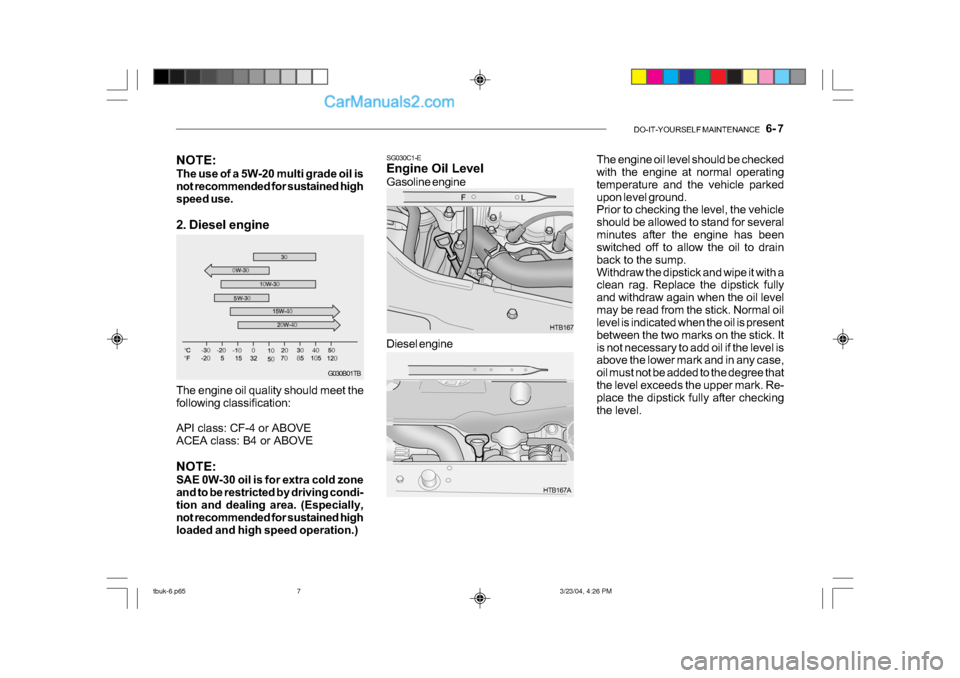
2. Diesel engine
The engine oil quality should meet the
following classification:
API class: CF-4 or ABOVE
ACEA class: B4 or ABOVE
NOTE:
SAE 0W-30 oil is for extra cold zone
and to be restricted by driving condi-
tion and dealing area. (Especially,
not recommended for sustained high
loaded and high speed operation.) SG030C1-E
Engine Oil Level
Gasoline engine
HTB167
HTB167A
Diesel engine The engine oil level should be checked
with the engine at normal operating
temperature and the vehicle parked
upon level ground.
Prior to checking the level, the vehicle
should be allowed to stand for several
minutes after the engine has been
switched off to allow the oil to drain
back to the sump.
Withdraw the dipstick and wipe it with a
clean rag. Replace the dipstick fully
and withdraw again when the oil level
may be read from the stick. Normal oil
level is indicated when the oil is present
between the two marks on the stick. It
is not necessary to add oil if the level is
above the lower mark and in any case,
oil must not be added to the degree that
the level exceeds the upper mark. Re-
place the dipstick fully after checking
the level.
tbuk-6.p65
3/23/04, 4:26 PM
7
Page 402 of 445
DO-IT-YOURSELF MAINTENANCE 6- 11
HTB170A
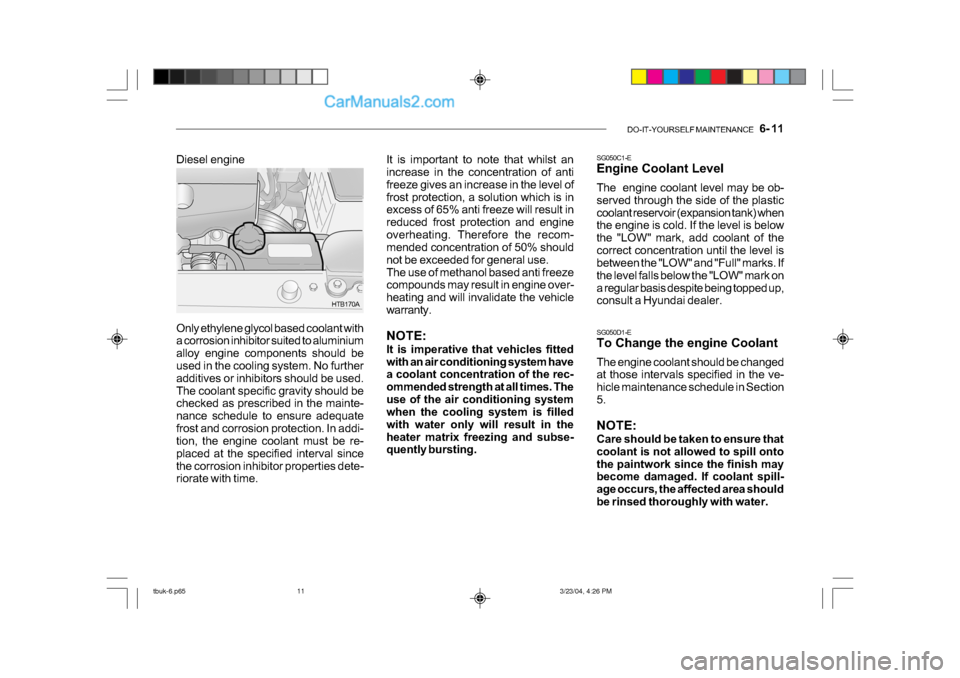
Diesel engine
Only ethylene glycol based coolant with
a corrosion inhibitor suited to aluminium
alloy engine components should be
used in the cooling system. No further
additives or inhibitors should be used.
The coolant specific gravity should be
checked as prescribed in the mainte-
nance schedule to ensure adequate
frost and corrosion protection. In addi-
tion, the engine coolant must be re-
placed at the specified interval since
the corrosion inhibitor properties dete-
riorate with time. It is important to note that whilst an
increase in the concentration of anti
freeze gives an increase in the level of
frost protection, a solution which is in
excess of 65% anti freeze will result in
reduced frost protection and engine
overheating. Therefore the recom-
mended concentration of 50% should
not be exceeded for general use.
The use of methanol based anti freeze
compounds may result in engine over-
heating and will invalidate the vehicle
warranty.
NOTE:
It is imperative that vehicles fitted
with an air conditioning system have
a coolant concentration of the rec-
ommended strength at all times. The
use of the air conditioning system
when the cooling system is filled
with water only will result in the
heater matrix freezing and subse-
quently bursting.
SG050C1-E
Engine Coolant Level
The engine coolant level may be ob-
served through the side of the plastic
coolant reservoir (expansion tank) when
the engine is cold. If the level is below
the "LOW" mark, add coolant of the
correct concentration until the level is
between the "LOW" and "Full" marks. If
the level falls below the "LOW" mark on
a regular basis despite being topped up,
consult a Hyundai dealer.
SG050D1-E
To Change the engine Coolant
The engine coolant should be changed
at those intervals specified in the ve-
hicle maintenance schedule in Section
5.
NOTE:
Care should be taken to ensure that
coolant is not allowed to spill onto
the paintwork since the finish may
become damaged. If coolant spill-
age occurs, the affected area should
be rinsed thoroughly with water.
tbuk-6.p65
3/23/04, 4:26 PM
11
Page 433 of 445
CONSUMER INFORMATION 8- 3
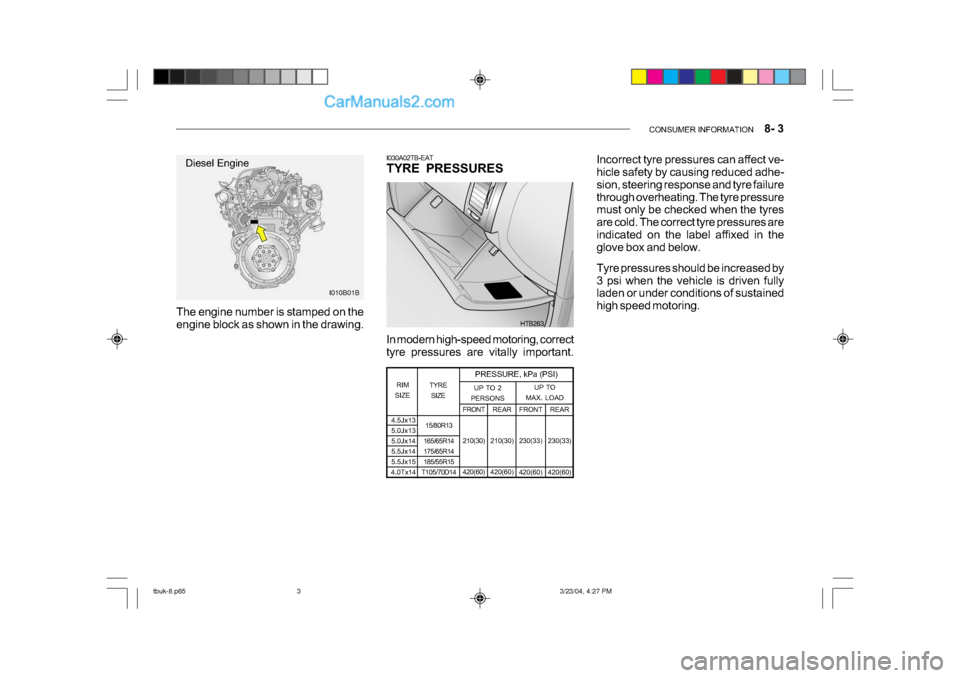
4.5Jx13
5.0Jx13
5.0Jx14
5.5Jx14
5.5Jx15
4.0Tx14 TYRE
SIZE
RIM
SIZE PRESSURE, kPa (PSI)
15/80R13
165/65R14
175/65R14
185/55R15
T105/70D14 REAR
210(30)
420(60) FRONT
230(33)
420(60)
UP TO 2
PERSONS UP TO
MAX. LOAD
REAR
230(33)
420(60)
FRONT
210(30)
420(60)
The engine number is stamped on the
engine block as shown in the drawing. I030A02TB-EAT
TYRE PRESSURES
In modern high-speed motoring, correct
tyre pressures are vitally important.
I010B01B
HTB263
Diesel EngineIncorrect tyre pressures can affect ve-
hicle safety by causing reduced adhe-
sion, steering response and tyre failure
through overheating. The tyre pressure
must only be checked when the tyres
are cold. The correct tyre pressures are
indicated on the label affixed in the
glove box and below.
Tyre pressures should be increased by
3 psi when the vehicle is driven fully
laden or under conditions of sustained
high speed motoring.
tbuk-8.p65 3/23/04, 4:27 PM
3