warning lights Hyundai Getz 2004 Owner's Guide
[x] Cancel search | Manufacturer: HYUNDAI, Model Year: 2004, Model line: Getz, Model: Hyundai Getz 2004Pages: 445, PDF Size: 12.16 MB
Page 306 of 445
1- 48 FEATURES OF YOUR HYUNDAI
HTB014B
MPG = Total Cruise Distance(Miles)
Total Fuel Consumption (G)
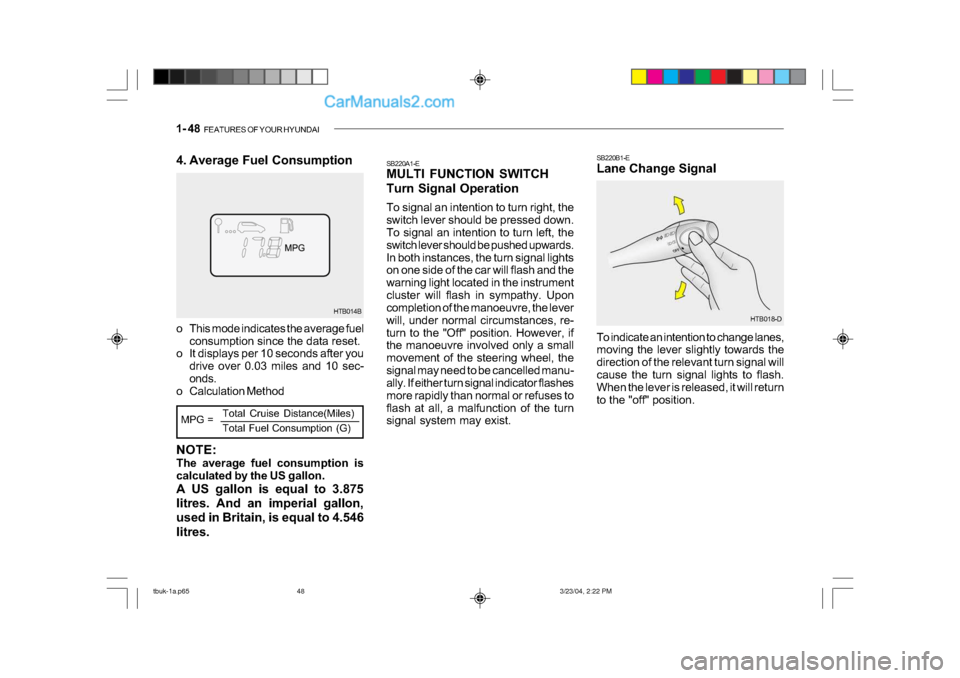
4. Average Fuel Consumption
o This mode indicates the average fuel
consumption since the data reset.
o It displays per 10 seconds after you
drive over 0.03 miles and 10 sec-
onds.
o Calculation Method SB220A1-E
MULTI FUNCTION SWITCH
Turn Signal Operation
To signal an intention to turn right, the
switch lever should be pressed down.
To signal an intention to turn left, the
switch lever should be pushed upwards.
In both instances, the turn signal lights
on one side of the car will flash and the
warning light located in the instrument
cluster will flash in sympathy. Upon
completion of the manoeuvre, the lever
will, under normal circumstances, re-
turn to the "Off" position. However, if
the manoeuvre involved only a small
movement of the steering wheel, the
signal may need to be cancelled manu-
ally. If either turn signal indicator flashes
more rapidly than normal or refuses to
flash at all, a malfunction of the turn
signal system may exist. SB220B1-E
Lane Change Signal
To indicate an intention to change lanes,
moving the lever slightly towards the
direction of the relevant turn signal will
cause the turn signal lights to flash.
When the lever is released, it will return
to the "off" position.
HTB018-D
NOTE:
The average fuel consumption is
calculated by the US gallon.
A US gallon is equal to 3.875
litres. And an imperial gallon,
used in Britain, is equal to 4.546
litres.
tbuk-1a.p65 3/23/04, 2:22 PM
48
Page 309 of 445
FEATURES OF YOUR HYUNDAI 1- 51
SB240A1-E
HAZARD WARNING SYSTEM
The hazard warning system should be
used whenever it becomes necessary
to stop the car in a hazardous location.
The hazard warning system is operated
by depressing the switch at which time
all turn signal lights will flash simulta-
neously and the turn signal warning
lights located within the instrument clus-
ter will flash simultaneously.
The hazard warning system may be
turned off by depressing the switch
again. HTB093B350A01TB-AAT
Tail Gate Wiper And Washer
Switch (Not all models)
HTB023-D
1. : The washer fluid will be sprayed onto the rear window and the
wiper operates while the rear win-
dow wiper barrel is placed in this
position.
2.ON : When the point indicates "ON", the rear window wiper oper-
ates continuously.
3.OFF
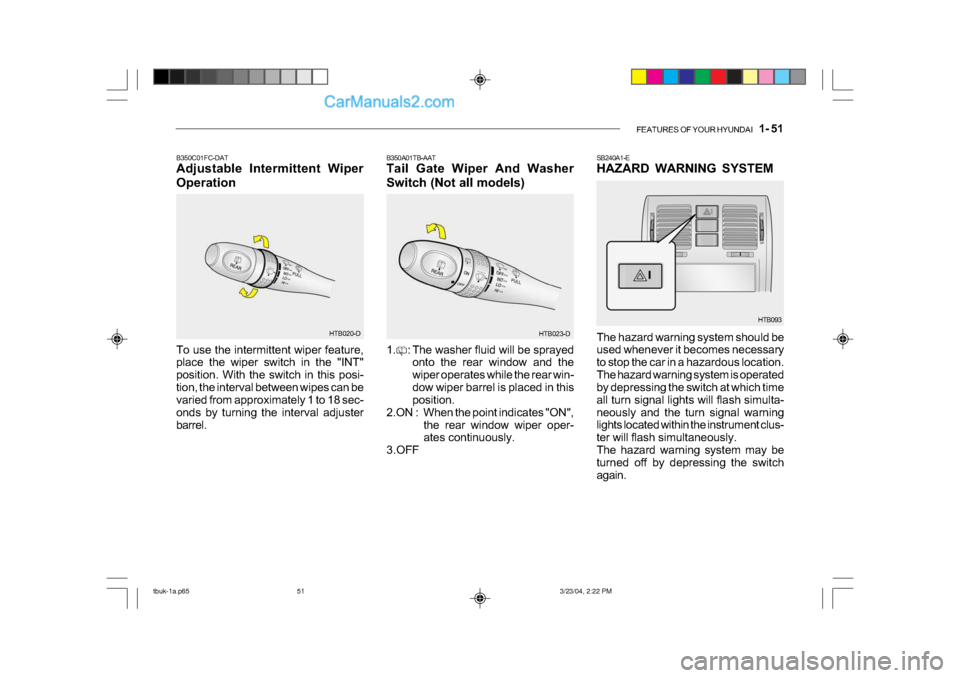
B350C01FC-DAT
Adjustable Intermittent Wiper
Operation
To use the intermittent wiper feature,
place the wiper switch in the "INT"
position. With the switch in this posi-
tion, the interval between wipes can be
varied from approximately 1 to 18 sec-
onds by turning the interval adjuster
barrel.
HTB020-D
tbuk-1a.p65
3/23/04, 2:22 PM
51
Page 313 of 445

FEATURES OF YOUR HYUNDAI 1- 55
!
B460A01Y-AAT
SUNROOF (Not all models)
Sun Shade
Your HYUNDAI is equipped with a
sliding sunshade which you can manu-
ally adjust to let in light with the sunroof
closed, or to block sunlight.
Loading condition Switch
position
Driver only
Driver + front passenger
Full passengers
(including driver)
Full passengers
(including driver) + full trunk
loading (or light trailer loading)
Driver + full trunk loading
(or maximum trailer loading) 0
1
2
3 0
B470A01FC
WARNING:
Never adjust the sunshade while
driving.
B340G01S-EAT
HEADLIGHT LEVELING DEVICE
SYSTEM
To adjust the headlight beam level ac-
cording to the number of the passen-
gers and the loading weight in the lug-
gage area, turn the beam leveling switch.
The higher the number of the switch
position, the lower the headlight beam
level. Always keep the headlight beam
at the proper leveling position, or head-
lights may dazzle other road users.
Listed below are the examples of rec-
ommended switch settings. For loading
conditions other than those listed be-
low, adjust the switch position so that
the beam level may be the nearest as
the condition obtained according to the
list.
HTB181-D
tbuk-1a.p65
3/23/04, 2:22 PM
55
Page 319 of 445
FEATURES OF YOUR HYUNDAI 1- 61
!
SB370A1-E
INTERIOR REAR VIEW MIRROR
The interior mirror is of the day/night
type to enable the glare of headlights
from following vehicles to be eliminated
during night time driving.
The tab located at the bottom of the
mirror should be set to the position
nearest the windscreen for normal day
time driving, and flipped towards the
rear of the vehicle to eliminate glare
during night time driving. To adjust the
field of vision, the mirror may be moved
by hand upon the mounting.
NOTE:
The mirror should always be ad-
justed prior to setting the vehicle in
motion. HTB103B510D01HP-EAT
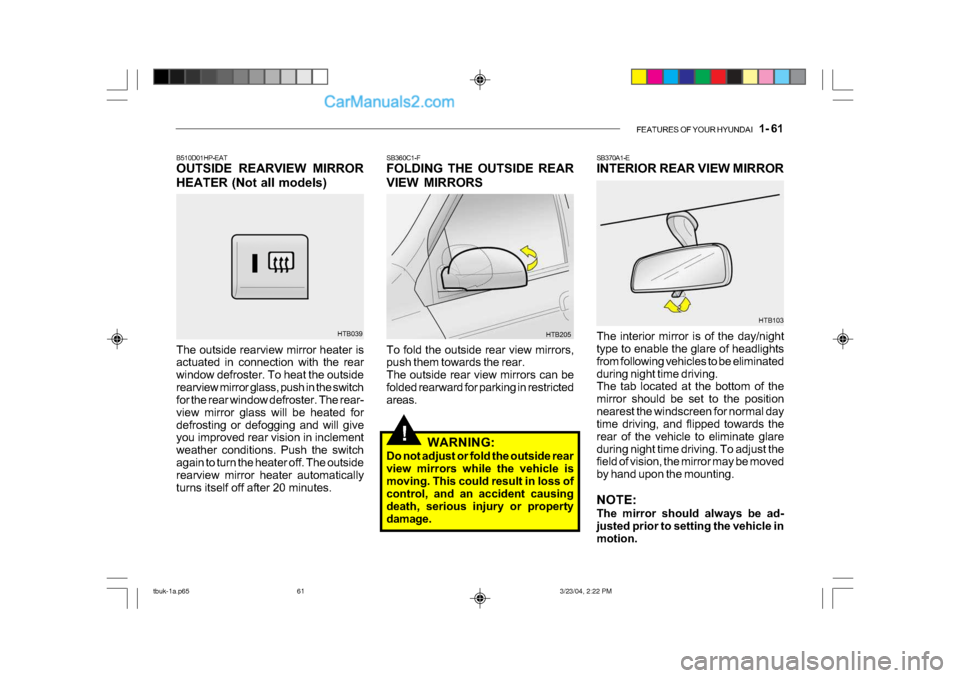
OUTSIDE REARVIEW MIRROR
HEATER (Not all models)
The outside rearview mirror heater is
actuated in connection with the rear
window defroster. To heat the outside
rearview mirror glass, push in the switch
for the rear window defroster. The rear-
view mirror glass will be heated for
defrosting or defogging and will give
you improved rear vision in inclement
weather conditions. Push the switch
again to turn the heater off. The outside
rearview mirror heater automatically
turns itself off after 20 minutes. SB360C1-F
FOLDING THE OUTSIDE REAR
VIEW MIRRORS
To fold the outside rear view mirrors,
push them towards the rear.
The outside rear view mirrors can be
folded rearward for parking in restricted
areas.
HTB039
HTB205
WARNING:
Do not adjust or fold the outside rear
view mirrors while the vehicle is
moving. This could result in loss of
control, and an accident causing
death, serious injury or property
damage.
tbuk-1a.p65 3/23/04, 2:22 PM
61
Page 320 of 445
1- 62 FEATURES OF YOUR HYUNDAI
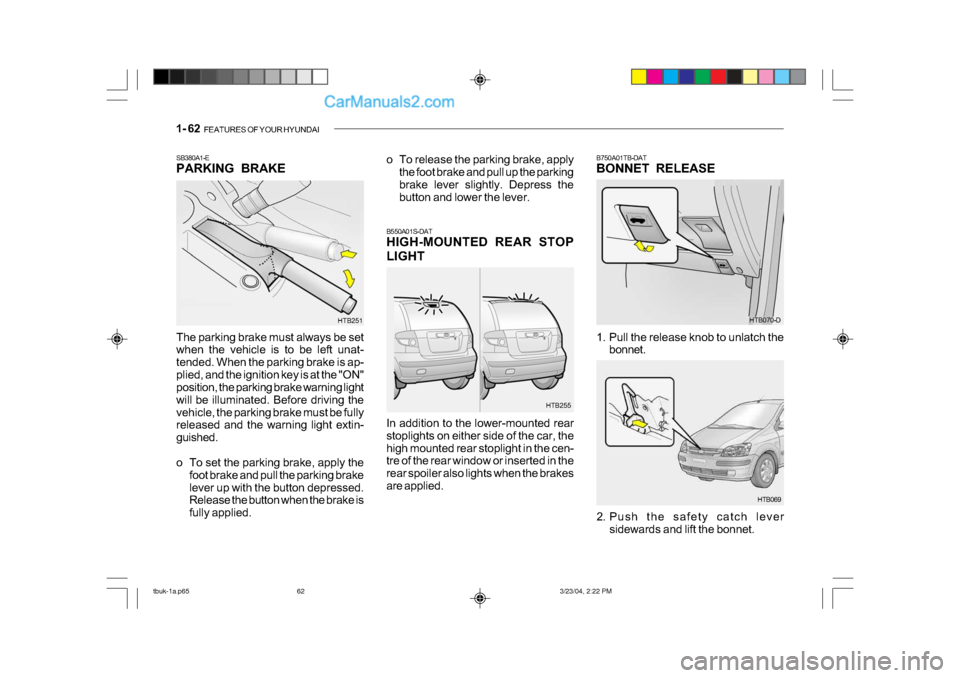
The parking brake must always be set
when the vehicle is to be left unat-
tended. When the parking brake is ap-
plied, and the ignition key is at the "ON"
position, the parking brake warning light
will be illuminated. Before driving the
vehicle, the parking brake must be fully
released and the warning light extin-
guished.
o To set the parking brake, apply the
foot brake and pull the parking brake
lever up with the button depressed.
Release the button when the brake is
fully applied.
SB380A1-E
PARKING BRAKE
B550A01S-DAT
HIGH-MOUNTED REAR STOP
LIGHT
In addition to the lower-mounted rear
stoplights on either side of the car, the
high mounted rear stoplight in the cen-
tre of the rear window or inserted in the
rear spoiler also lights when the brakes
are applied.
HTB251
HTB255
o To release the parking brake, apply
the foot brake and pull up the parking
brake lever slightly. Depress the
button and lower the lever.
B750A01TB-DAT
BONNET RELEASE
HTB070-D
1. Pull the release knob to unlatch the bonnet.
HTB069
2. Push the safety catch lever sidewards and lift the bonnet.
tbuk-1a.p65 3/23/04, 2:22 PM
62
Page 346 of 445
DRIVING YOUR HYUNDAI 2- 3
!
C020A01O-EAT BEFORE STARTING THE EN- GINE Before you start the engine, you should always:
1. Look around the vehicle to be sure
there are no flat tyres, puddles of oil or water or other indications of pos- sible trouble.
2. After entering the car, check to be
sure the parking brake is engaged.
3. Check that all windows, and lights are clean.
4. Check that the interior and exterior
mirrors are clean and in position.
5. Check your seat, seatback and
headrestraint to be sure they are intheir proper positions.
6. Close all the doors.
7. Fasten your seat belt and be sure
that all other occupants have fas- tened theirs.
8. Turn off all lights and accessories that are not needed.
9. When you turn the ignition switch to "ON" check that all appropriate warn-ing lights are operating and that youhave sufficient fuel. 10.Check the operation of warning
lights and all bulbs when key is inthe "ON" position.
WARNING: (DIESEL ENGINE)
To ensure that sufficient vacuum exists within the brake system dur-ing cold weather start-up condi-tions, it is necessary to run theengine at idle for several seconds after starting the engine. SC040A1-F COMBINATION IGNITION SWITCH AND STEERING LOCK To Start the Engine
o If your Hyundai is equipped with a
manual transaxle, place the shift lever in neutral and depress theclutch pedal fully.
o If your Hyundai has an automatic
transaxle, place the shift lever in "P" (park).
o To start the engine, insert the igni-
tion key and turn it to the "START" position. Release it as soon as theengine starts. Do not hold the key inthe "START" position for more that 15 seconds.
NOTE: For safety, the engine will not start if the shift lever is not in "P" or "N"Position (automatic transaxle).
tbuk-2.p65 3/23/04, 4:55 PM
3
Page 357 of 445
2- 14 DRIVING YOUR HYUNDAI
!WARNING:
ABS will not prevent accidents due to improper or dangerous drivingmaneuvers. Even though vehicle control is improved during emer- gency braking, always maintain asafe distance between you and ob-jects ahead. Vehicle speeds shouldalways be reduced during extremeroad conditions. The braking distance for cars equipped with an anti-lock brakingsystem may be longer than for thosewithout it in the following road con-ditions.
o Driving on rough, gravel or snow- covered roads.
o Driving with tyre chains installed.
o Driving on roads where the road
surface is pitted or has differentsurface height. These roads should be driven at reduced speeds. The safety features of an ABS equipped vehicle shouldnot be tested by high speed drivingor cornering. This could endangerthe safety of yourself or others. SC150A1-F DRIVING FOR ECONOMY You can save fuel and get more miles from your car if you follow these sug-gestions:
o Drive smoothly. Accelerate at a
moderate rate. Don't make "jack- rabbit" starts or full-throttle shiftsand maintain a steady cruisingspeed. Don't race between stop-lights. Try to adjust your speed tothat of the other traffic so you don't have to change speeds unneces- sarily.Avoid heavy traffic whenever pos-sible. Al-ways maintain a safe dis-tance from other vehicles so youcan avoid unnecessary braking. This also reduces brake wear. o Drive at a moderate speed. The
faster you drive, the more fuel your car uses. Driving at a moderatespeed, especially on the highway, isone of the most effective ways to reduce fuel consumption.
o Don't "ride" the brake or clutch pedal. This can increase fuel consumption and also increase wear on thesecomponents. In addition, driving withyour foot resting on the brake pedal may cause the brakes to overheat, which reduces their effectivenessand may lead to more serious con-sequences.
o Take care of your tyres. Keep them inflated to the recommended pres- sure. Incorrect infla-tion, either too much or too little, results in unnec-essary tyre wear. Check the tyrepres-sures at least once a month.
o Be sure that the wheels are aligned correctly. Improper alignment can result from hitting curbs or driving too fast over irregular surfaces. Pooralignment causes faster tyre wearand may also result in other prob-lems as well as greater fuel con-sumption.
tbuk-2.p65 3/23/04, 4:55 PM
14
Page 365 of 445
3- 2 WHAT TO DO IN AN EMERGENCY
HTB165
SD020B1-E
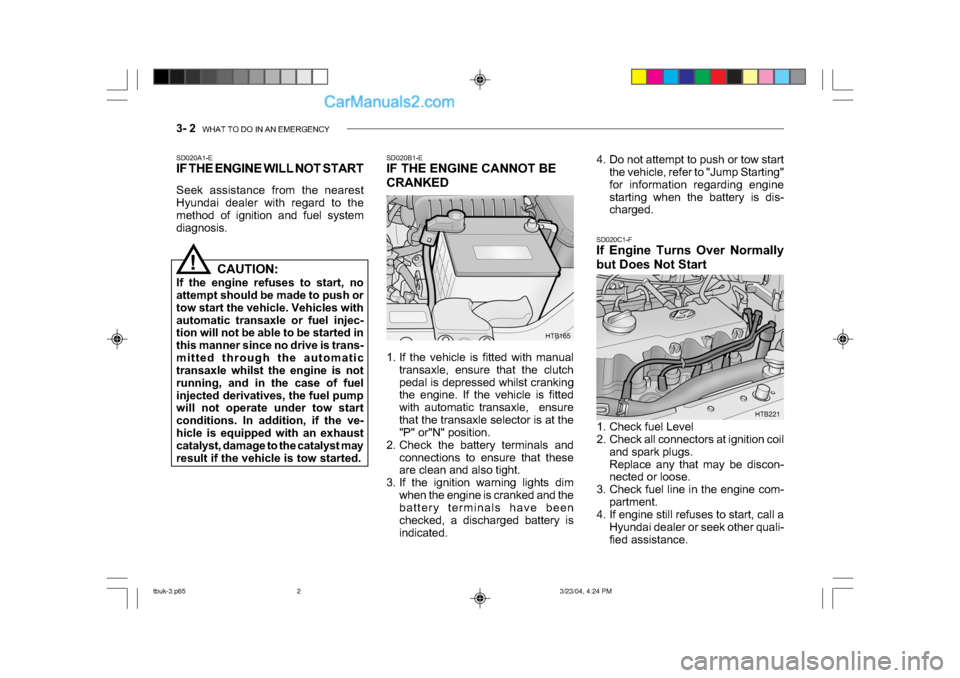
IF THE ENGINE CANNOT BE
CRANKED
1. If the vehicle is fitted with manual
transaxle, ensure that the clutch
pedal is depressed whilst cranking
the engine. If the vehicle is fitted
with automatic transaxle, ensure
that the transaxle selector is at the
"P" or"N" position.
2. Check the battery terminals and
connections to ensure that these
are clean and also tight.
3. If the ignition warning lights dim
when the engine is cranked and the
battery terminals have been
checked, a discharged battery is
indicated. SD020C1-F
If Engine Turns Over Normally
but Does Not Start
SD020A1-E
IF THE ENGINE WILL NOT START
Seek assistance from the nearest
Hyundai dealer with regard to the
method of ignition and fuel system
diagnosis.
!
HTB221
CAUTION:
If the engine refuses to start, no
attempt should be made to push or
tow start the vehicle. Vehicles with
automatic transaxle or fuel injec-
tion will not be able to be started in
this manner since no drive is trans-
mitted through the automatic
transaxle whilst the engine is not
running, and in the case of fuel
injected derivatives, the fuel pump
will not operate under tow start
conditions. In addition, if the ve-
hicle is equipped with an exhaust
catalyst, damage to the catalyst may
result if the vehicle is tow started. 4. Do not attempt to push or tow start
the vehicle, refer to "Jump Starting"
for information regarding engine
starting when the battery is dis-
charged.
1. Check fuel Level
2. Check all connectors at ignition coil and spark plugs.
Replace any that may be discon-
nected or loose.
3. Check fuel line in the engine com- partment.
4. If engine still refuses to start, call a
Hyundai dealer or seek other quali-
fied assistance.
tbuk-3.p65 3/23/04, 4:24 PM
2
Page 366 of 445
WHAT TO DO IN AN EMERGENCY 3- 3
!
HTB218
Discharged
battery
Booster
battery
CAUTION:
Personal injury and damage to the
vehicle may occur if jump starting
is not performed correctly. If any
doubt exists as to how this opera-
tion should be performed, seek as-
sistance from qualified personnel.
SD030A1-E
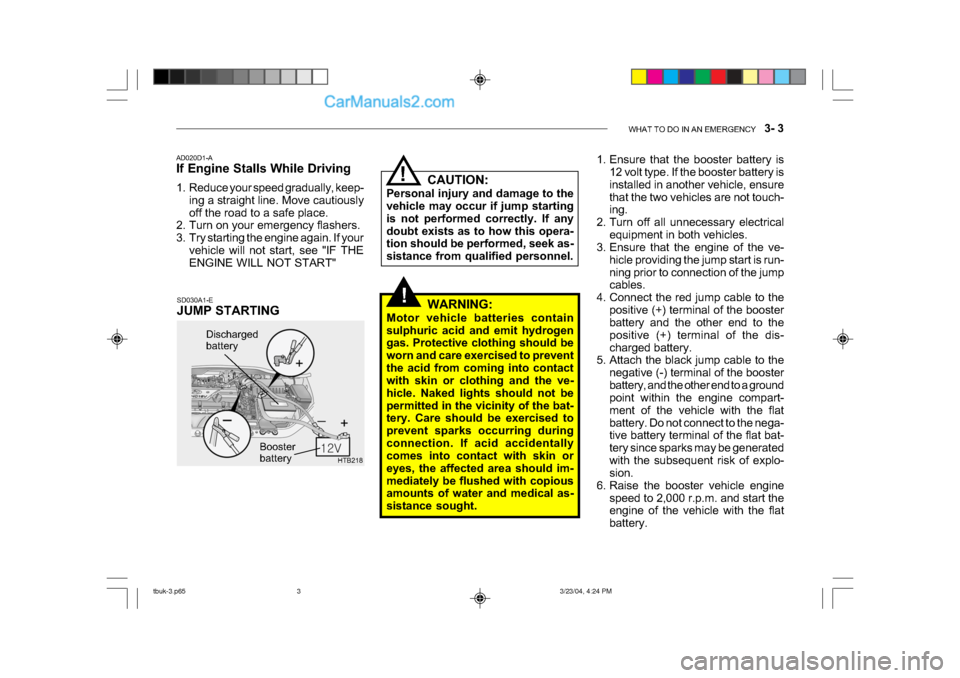
JUMP STARTING
AD020D1-A
If Engine Stalls While Driving
1. Reduce your speed gradually, keep-
ing a straight line. Move cautiously
off the road to a safe place.
2. Turn on your emergency flashers.
3. Try starting the engine again. If your
vehicle will not start, see "IF THE
ENGINE WILL NOT START"!
WARNING:
Motor vehicle batteries contain
sulphuric acid and emit hydrogen
gas. Protective clothing should be
worn and care exercised to prevent
the acid from coming into contact
with skin or clothing and the ve-
hicle. Naked lights should not be
permitted in the vicinity of the bat-
tery. Care should be exercised to
prevent sparks occurring during
connection. If acid accidentally
comes into contact with skin or
eyes, the affected area should im-
mediately be flushed with copious
amounts of water and medical as-
sistance sought. 1. Ensure that the booster battery is
12 volt type. If the booster battery is
installed in another vehicle, ensure
that the two vehicles are not touch-
ing.
2. Turn off all unnecessary electrical equipment in both vehicles.
3. Ensure that the engine of the ve-
hicle providing the jump start is run-
ning prior to connection of the jump
cables.
4. Connect the red jump cable to the positive (+) terminal of the booster
battery and the other end to the
positive (+) terminal of the dis-
charged battery.
5. Attach the black jump cable to the
negative (-) terminal of the booster
battery, and the other end to a ground
point within the engine compart-
ment of the vehicle with the flat
battery. Do not connect to the nega-
tive battery terminal of the flat bat-
tery since sparks may be generated
with the subsequent risk of explo-
sion.
6. Raise the booster vehicle engine speed to 2,000 r.p.m. and start the
engine of the vehicle with the flat
battery.
tbuk-3.p65 3/23/04, 4:24 PM
3
Page 416 of 445
DO-IT-YOURSELF MAINTENANCE 6- 25
!
!
o If battery electrolyte is spilled onto
skin or into eyes, the effected area
must be flushed with copious
amounts of water and medical assis-
tance sought.
o If battery electrolyte is ingested, copious amounts of water or milk
followed by an ant-acid (raw egg or
milk of magnesia) must be drunk.
Vomiting should not be induced and
medical assistance must be sought.
o Batteries must only be charged in well venti-lated areas from which
naked lights or sources of sparks are
excluded.
o Ensure that children, pets or other unauthorized persons are kept away
from batteries.
o Do not allow anything to bridge the positive (+) and negative (-) termi-
nals of the battery.
o Never invert the battery.
The battery fitted during production is of
the "Maintenance Free" type.
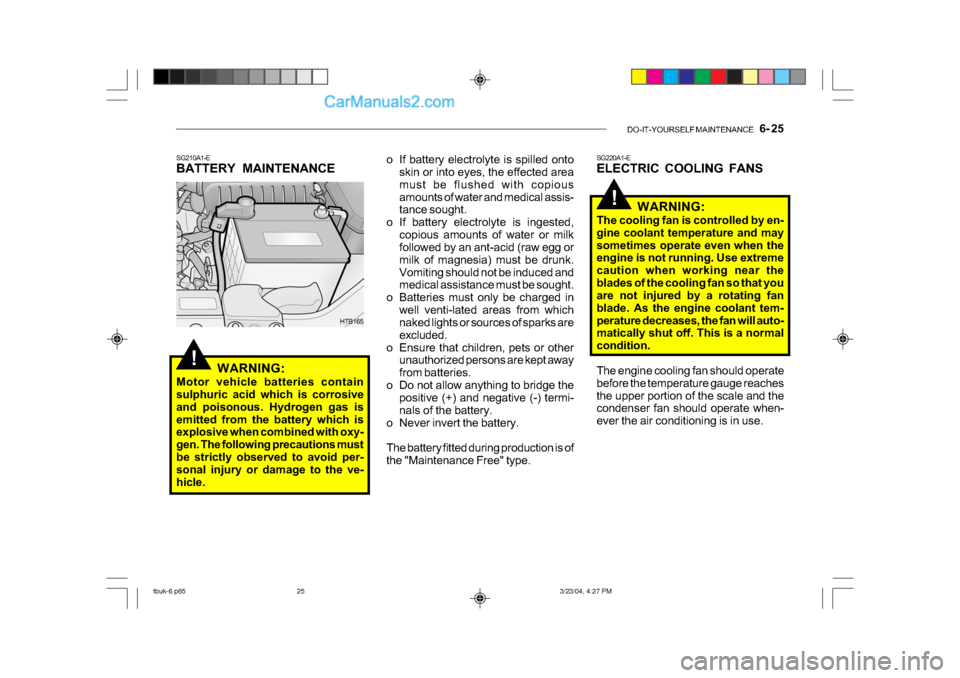
SG210A1-E
BATTERY MAINTENANCE
WARNING:
Motor vehicle batteries contain
sulphuric acid which is corrosive
and poisonous. Hydrogen gas is
emitted from the battery which is
explosive when combined with oxy-
gen. The following precautions must
be strictly observed to avoid per-
sonal injury or damage to the ve-
hicle.
HTB165 SG220A1-E
ELECTRIC COOLING FANS
WARNING:
The cooling fan is controlled by en-
gine coolant temperature and may
sometimes operate even when the
engine is not running. Use extreme
caution when working near the
blades of the cooling fan so that you
are not injured by a rotating fan
blade. As the engine coolant tem-
perature decreases, the fan will auto-
matically shut off. This is a normal
condition.
The engine cooling fan should operate
before the temperature gauge reaches
the upper portion of the scale and the
condenser fan should operate when-
ever the air conditioning is in use.
tbuk-6.p65 3/23/04, 4:27 PM
25