belt Hyundai Getz 2004 Manual PDF
[x] Cancel search | Manufacturer: HYUNDAI, Model Year: 2004, Model line: Getz, Model: Hyundai Getz 2004Pages: 445, PDF Size: 12.16 MB
Page 292 of 445

1- 34 FEATURES OF YOUR HYUNDAI
!
Side airbag
sensor
WARNING:
o The side impact airbag is supple- mental to the driver's and the
passenger's three point seat belt
systems and is not a substitute for
them. Therefore your seat belts
must be worn at all times whilst
the vehicle is in motion. The
airbags deploy only in certain side
impact conditions severe enough
to cause significant injury to the
vehicle occupants. HTB072-D
o For best protection from the side
airbag system and to avoid being
injured is by the deploying side
impact airbag, both front seat oc-
cupants should sit in an upright
position with the seat belt prop-
erly fastened. The driver's hands
should be placed on the steering
wheel at the 9:00 and 3:00 o'clock
positions. The passenger's arms
and hands should be placed in
their laps.
o Do not use any accessory seat covers.
o Use of seat covers could reduce or
prevent the effectiveness of the
system.
o Do not install any accessories on
the side or near the side impact
airbag.
o Do not use excessive force on the
side of the seat.
o Do not place any objects over the airbag or between the airbag and
yourself.
B990B04Y-EAT
Side Impact Airbag
Your Hyundai is equipped with a side
impact airbag in each front seat. The
purpose of the airbag is to provide the
vehicle's driver and/or the front passen-
ger with additional protection than that
offered by the seat belt alone. The side
impact airbags are designed to deploy
only during certain side impact colli-
sions, depending on the crash severity,
angle, speed and point of impact. The
air bags are not designed to deploy in all
side impact situations.
B990B02Y-D
tbuk-1a.p65
3/23/04, 2:22 PM
34
Page 295 of 445
FEATURES OF YOUR HYUNDAI 1- 37
B260B02TB-EAT
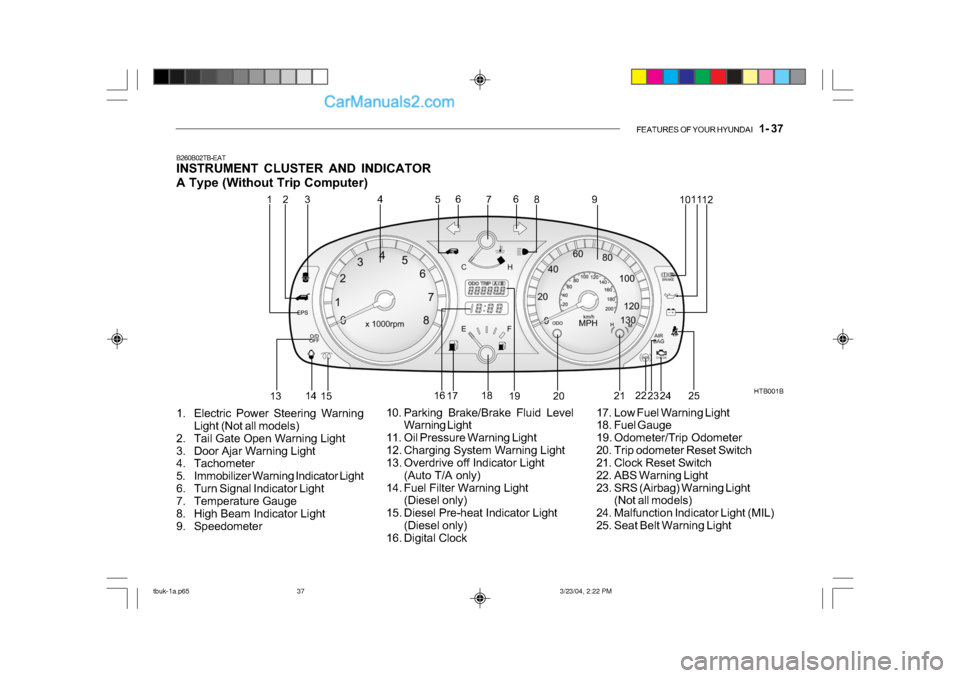
INSTRUMENT CLUSTER AND INDICATOR
A Type (Without Trip Computer)
1. Electric Power Steering Warning Light (Not all models)
2. Tail Gate Open Warning Light
3. Door Ajar Warning Light
4. Tachometer
5. Immobilizer Warning Indicator Light
6. Turn Signal Indicator Light
7. Temperature Gauge
8. High Beam Indicator Light
9. Speedometer HTB001B
10. Parking Brake/Brake Fluid Level Warning Light
11. Oil Pressure Warning Light
12. Charging System Warning Light
13. Overdrive off Indicator Light (Auto T/A only)
14. Fuel Filter Warning Light (Diesel only)
15. Diesel Pre-heat Indicator Light (Diesel only)
16. Digital Clock 17. Low Fuel Warning Light
18. Fuel Gauge
19. Odometer/Trip Odometer
20. Trip odometer Reset Switch
21. Clock Reset Switch
22. ABS Warning Light
23. SRS (Airbag) Warning Light
(Not all models)
24. Malfunction Indicator Light (MIL)
25. Seat Belt Warning Light
1
2
4
53 6
7 8
9 1011
12
13 14
15 16
17 18
19 20 21
22
23 24
6
25
tbuk-1a.p65 3/23/04, 2:22 PM
37
Page 296 of 445
1- 38 FEATURES OF YOUR HYUNDAI
B260C02TB-EAT
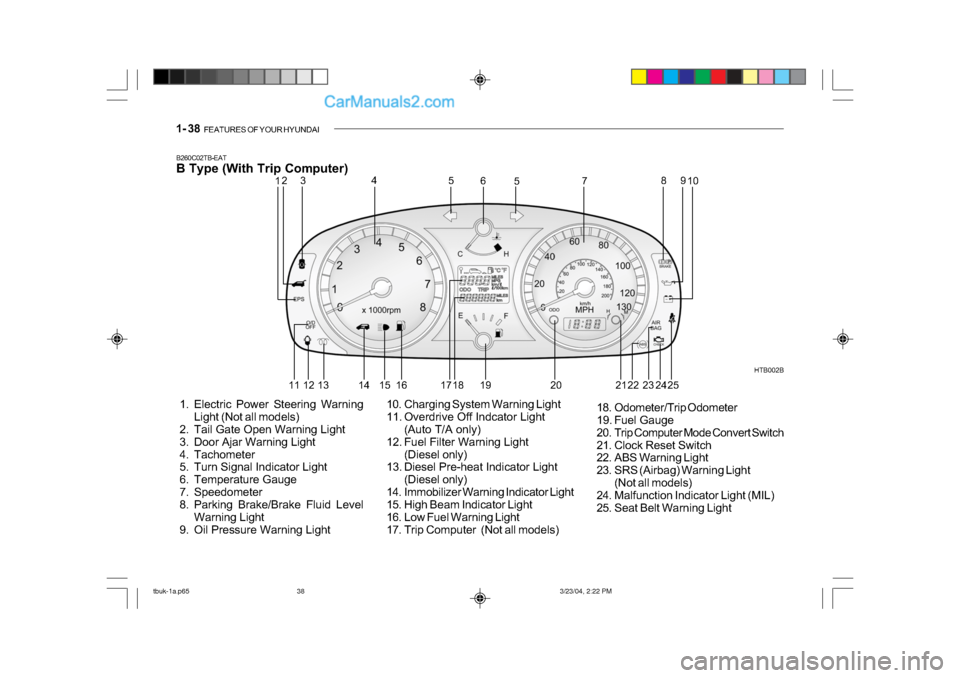
B Type (With Trip Computer)
1. Electric Power Steering Warning
Light (Not all models)
2. Tail Gate Open Warning Light
3. Door Ajar Warning Light
4. Tachometer
5. Turn Signal Indicator Light
6. Temperature Gauge
7. Speedometer
8. Parking Brake/Brake Fluid Level
Warning Light
9. Oil Pressure Warning Light HTB002B
10. Charging System Warning Light
11. Overdrive Off Indcator Light (Auto T/A only)
12. Fuel Filter Warning Light (Diesel only)
13. Diesel Pre-heat Indicator Light
(Diesel only)
14. Immobilizer Warning Indicator Light
15. High Beam Indicator Light
16. Low Fuel Warning Light
17. Trip Computer (Not all models) 18. Odometer/Trip Odometer
19. Fuel Gauge
20. Trip Computer Mode Convert Switch
21. Clock Reset Switch
22. ABS Warning Light
23. SRS (Airbag) Warning Light
(Not all models)
24. Malfunction Indicator Light (MIL)
25. Seat Belt Warning Light
12 3 4
5
5
6
78
910
11 12 13 14 15 16 17 18 19 20 22 23
24 2521
tbuk-1a.p65 3/23/04, 2:22 PM
38
Page 299 of 445
FEATURES OF YOUR HYUNDAI 1- 41
SB210M1-E
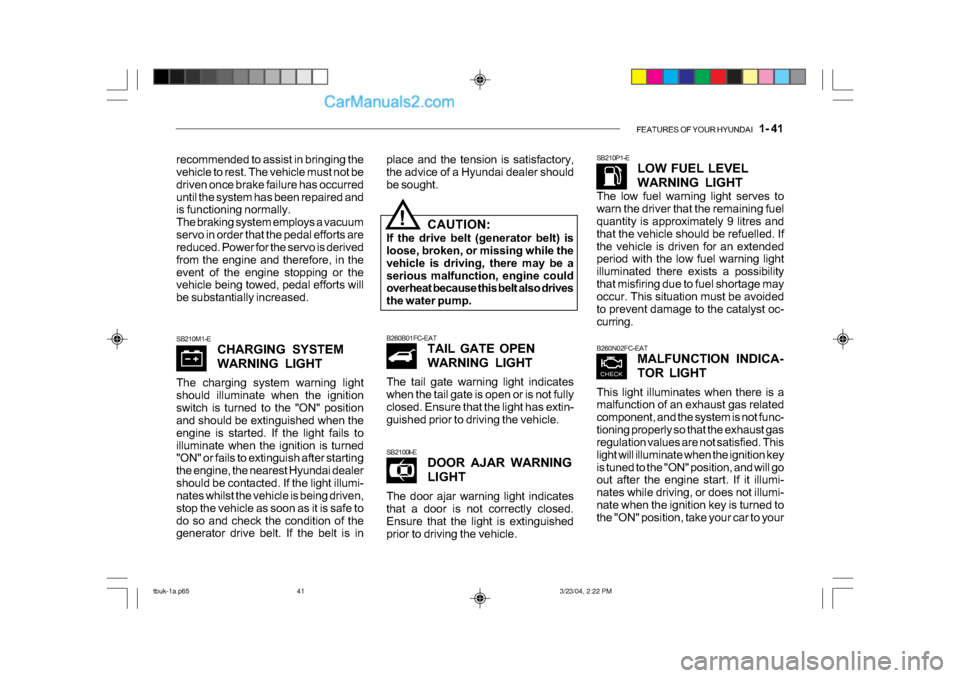
CHARGING SYSTEM
WARNING LIGHT
The charging system warning light
should illuminate when the ignition
switch is turned to the "ON" position
and should be extinguished when the
engine is started. If the light fails to
illuminate when the ignition is turned
"ON" or fails to extinguish after starting
the engine, the nearest Hyundai dealer
should be contacted. If the light illumi-
nates whilst the vehicle is being driven,
stop the vehicle as soon as it is safe to
do so and check the condition of the
generator drive belt. If the belt is in SB2100I-E
DOOR AJAR WARNING
LIGHT
The door ajar warning light indicates
that a door is not correctly closed.
Ensure that the light is extinguished
prior to driving the vehicle.
B260B01FC-EAT
TAIL GATE OPEN
WARNING LIGHT
The tail gate warning light indicates
when the tail gate is open or is not fully
closed. Ensure that the light has extin-
guished prior to driving the vehicle. SB210P1-E
LOW FUEL LEVEL
WARNING LIGHT
The low fuel warning light serves to
warn the driver that the remaining fuel
quantity is approximately 9 litres and
that the vehicle should be refuelled. If
the vehicle is driven for an extended
period with the low fuel warning light
illuminated there exists a possibility
that misfiring due to fuel shortage may
occur. This situation must be avoided
to prevent damage to the catalyst oc-
curring.
recommended to assist in bringing the
vehicle to rest. The vehicle must not be
driven once brake failure has occurred
until the system has been repaired and
is functioning normally.
The braking system employs a vacuum
servo in order that the pedal efforts are
reduced. Power for the servo is derived
from the engine and therefore, in the
event of the engine stopping or the
vehicle being towed, pedal efforts will
be substantially increased.
place and the tension is satisfactory,
the advice of a Hyundai dealer should
be sought.
CAUTION:
If the drive belt (generator belt) is
loose, broken, or missing while the
vehicle is driving, there may be a
serious malfunction, engine could
overheat because this belt also drives
the water pump.
!
B260N02FC-EAT MALFUNCTION INDICA-
TOR LIGHT
This light illuminates when there is a
malfunction of an exhaust gas related
component, and the system is not func-
tioning properly so that the exhaust gas
regulation values are not satisfied. This
light will illuminate when the ignition key
is tuned to the "ON" position, and will go
out after the engine start. If it illumi-
nates while driving, or does not illumi-
nate when the ignition key is turned to
the "ON" position, take your car to your
tbuk-1a.p65 3/23/04, 2:22 PM
41
Page 300 of 445
1- 42 FEATURES OF YOUR HYUNDAI
B260S01B-GAT
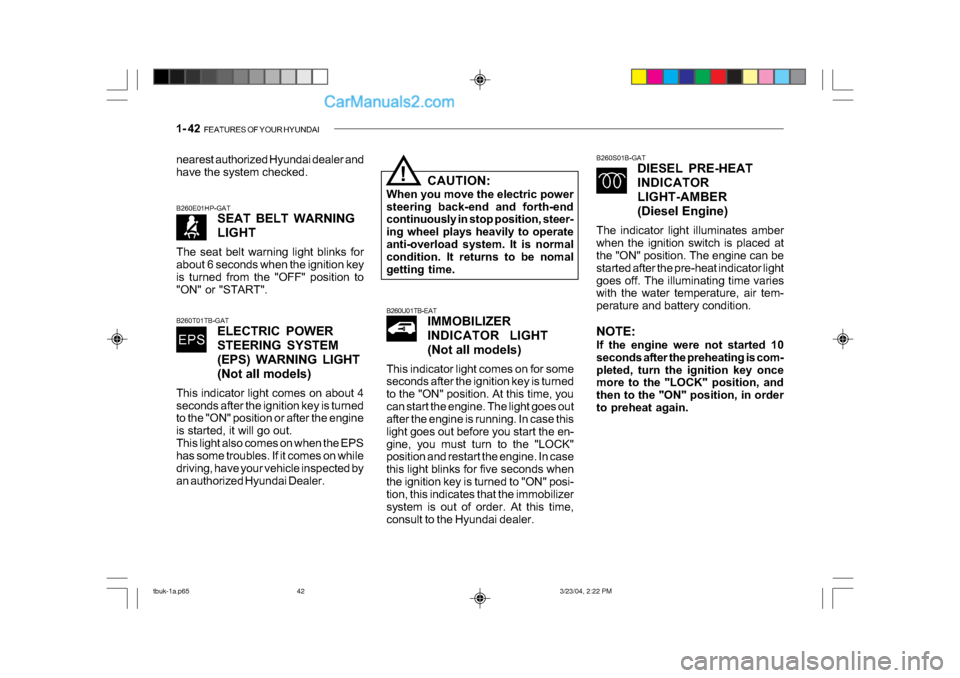
DIESEL PRE-HEAT
INDICATOR
LIGHT-AMBER
(Diesel Engine)
The indicator light illuminates amber
when the ignition switch is placed at
the "ON" position. The engine can be
started after the pre-heat indicator light
goes off. The illuminating time varies
with the water temperature, air tem-
perature and battery condition.
NOTE:
If the engine were not started 10
seconds after the preheating is com-
pleted, turn the ignition key once
more to the "LOCK" position, and
then to the "ON" position, in order
to preheat again.
B260T01TB-GAT
ELECTRIC POWER
STEERING SYSTEM
(EPS) WARNING LIGHT
(Not all models)
This indicator light comes on about 4
seconds after the ignition key is turned
to the "ON" position or after the engine
is started, it will go out.
This light also comes on when the EPS
has some troubles. If it comes on while
driving, have your vehicle inspected by
an authorized Hyundai Dealer. B260E01HP-GAT
SEAT BELT WARNING
LIGHT
The seat belt warning light blinks for
about 6 seconds when the ignition key
is turned from the "OFF" position to
"ON" or "START".
CAUTION:
When you move the electric power
steering back-end and forth-end
continuously in stop position, steer-
ing wheel plays heavily to operate
anti-overload system. It is normal
condition. It returns to be nomal
getting time.!
B260U01TB-EAT IMMOBILIZER
INDICATOR LIGHT
(Not all models)
This indicator light comes on for some
seconds after the ignition key is turned
to the "ON" position. At this time, you
can start the engine. The light goes out
after the engine is running. In case this
light goes out before you start the en-
gine, you must turn to the "LOCK"
position and restart the engine. In case
this light blinks for five seconds when
the ignition key is turned to "ON" posi-
tion, this indicates that the immobilizer
system is out of order. At this time,
consult to the Hyundai dealer.
nearest authorized Hyundai dealer and
have the system checked.
tbuk-1a.p65
3/23/04, 2:22 PM
42
Page 302 of 445
1- 44 FEATURES OF YOUR HYUNDAI
!
SB215B1-E
ENGINE COOLANT TEMPERA-
TURE GAUGE
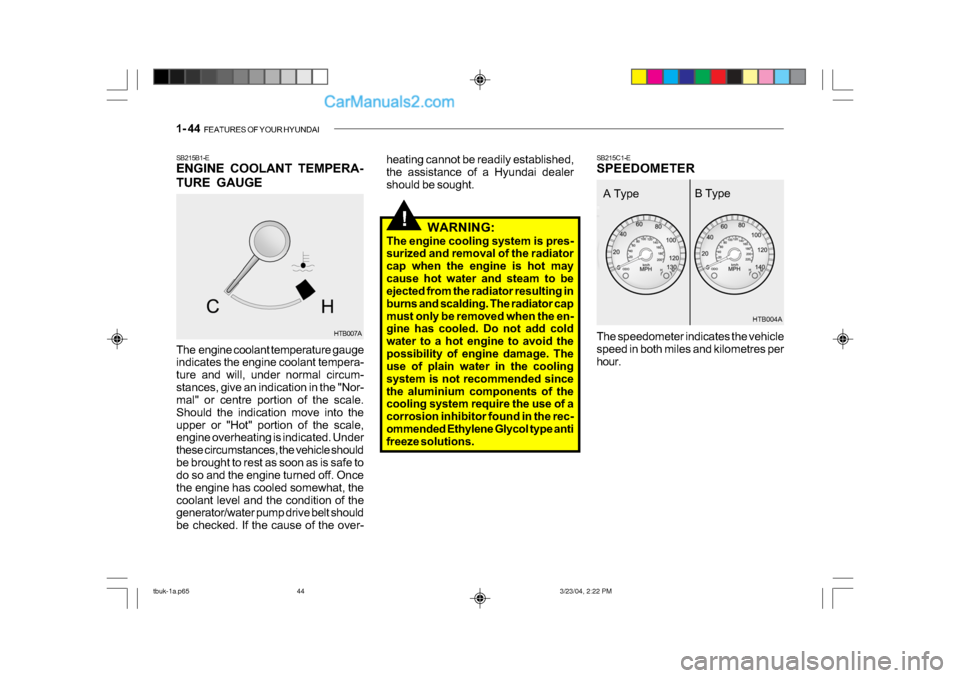
The engine coolant temperature gauge
indicates the engine coolant tempera-
ture and will, under normal circum-
stances, give an indication in the "Nor-
mal" or centre portion of the scale.
Should the indication move into the
upper or "Hot" portion of the scale,
engine overheating is indicated. Under
these circumstances, the vehicle should
be brought to rest as soon as is safe to
do so and the engine turned off. Once
the engine has cooled somewhat, the
coolant level and the condition of the
generator/water pump drive belt should
be checked. If the cause of the over- SB215C1-E
SPEEDOMETER
HTB007A
heating cannot be readily established,
the assistance of a Hyundai dealer
should be sought.
HTB004A
The speedometer indicates the vehicle
speed in both miles and kilometres per
hour.
WARNING:
The engine cooling system is pres-
surized and removal of the radiator
cap when the engine is hot may
cause hot water and steam to be
ejected from the radiator resulting in
burns and scalding. The radiator cap
must only be removed when the en-
gine has cooled. Do not add cold
water to a hot engine to avoid the
possibility of engine damage. The
use of plain water in the cooling
system is not recommended since
the aluminium components of the
cooling system require the use of a
corrosion inhibitor found in the rec-
ommended Ethylene Glycol type anti
freeze solutions.
A Type B Type
tbuk-1a.p65
3/23/04, 2:22 PM
44
Page 346 of 445
DRIVING YOUR HYUNDAI 2- 3
!
C020A01O-EAT BEFORE STARTING THE EN- GINE Before you start the engine, you should always:
1. Look around the vehicle to be sure
there are no flat tyres, puddles of oil or water or other indications of pos- sible trouble.
2. After entering the car, check to be
sure the parking brake is engaged.
3. Check that all windows, and lights are clean.
4. Check that the interior and exterior
mirrors are clean and in position.
5. Check your seat, seatback and
headrestraint to be sure they are intheir proper positions.
6. Close all the doors.
7. Fasten your seat belt and be sure
that all other occupants have fas- tened theirs.
8. Turn off all lights and accessories that are not needed.
9. When you turn the ignition switch to "ON" check that all appropriate warn-ing lights are operating and that youhave sufficient fuel. 10.Check the operation of warning
lights and all bulbs when key is inthe "ON" position.
WARNING: (DIESEL ENGINE)
To ensure that sufficient vacuum exists within the brake system dur-ing cold weather start-up condi-tions, it is necessary to run theengine at idle for several seconds after starting the engine. SC040A1-F COMBINATION IGNITION SWITCH AND STEERING LOCK To Start the Engine
o If your Hyundai is equipped with a
manual transaxle, place the shift lever in neutral and depress theclutch pedal fully.
o If your Hyundai has an automatic
transaxle, place the shift lever in "P" (park).
o To start the engine, insert the igni-
tion key and turn it to the "START" position. Release it as soon as theengine starts. Do not hold the key inthe "START" position for more that 15 seconds.
NOTE: For safety, the engine will not start if the shift lever is not in "P" or "N"Position (automatic transaxle).
tbuk-2.p65 3/23/04, 4:55 PM
3
Page 349 of 445
2- 6 DRIVING YOUR HYUNDAI
C050B01HP
NOTE: If the engine were not started 10 seconds after the preheating is com- pleted, turn the ignition key oncemore to the "LOCK" position, andthen to the "ON" position, in orderto preheat again.
C051A01O-EAT STARTING THE DIESEL ENGINE ENGINE COLD
o Turn the ignition key to position
"ON" and wait for the pre-heat indi-cator light to go out.
o Operate the starter until the engine runs.
ENGINE WARMOperate the starter. If the engine doesnot respond on the first attempt, waitseveral seconds and try again using the pre-heat. C050B02S-GAT NORMAL CONDITIONS The Starting Procedure:
1. Insert key, and fasten the seat belt.
2. Depress the clutch pedal fully and
place the gearshift lever (manualtransaxle) in neutral or the selector lever (automatic transaxle) in "P" (park) position.
3. After turning the ignition key to the
"ON" position, make certain all warn-ing lights and gauges are function-ing properly before starting the en- gine.
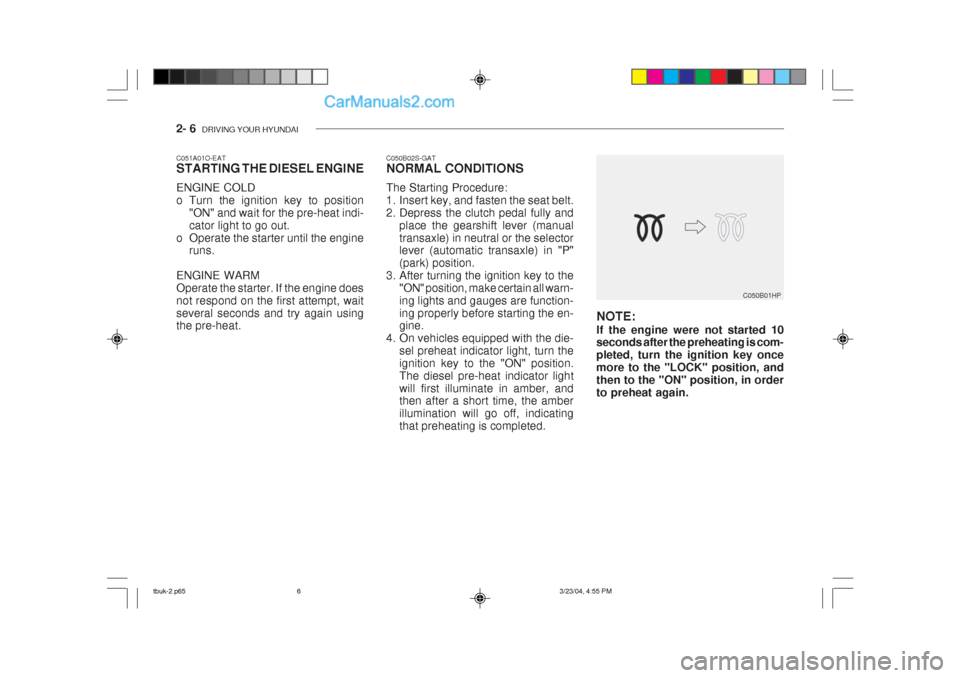
4. On vehicles equipped with the die-
sel preheat indicator light, turn the ignition key to the "ON" position.The diesel pre-heat indicator lightwill first illuminate in amber, and then after a short time, the amber illumination will go off, indicatingthat preheating is completed.
tbuk-2.p65 3/23/04, 4:55 PM
6
Page 358 of 445
DRIVING YOUR HYUNDAI 2- 15
o Keep your car in good condition. For
better fuel economy and reduced maintenance costs, maintain yourcar in accordance with the mainte-nance schedule in Section 5. If you drive your car in severe conditions, more frequent maintenance is re-quired (see Section 5 for details).
o Keep your car clean. For maximum service, your car should be keptclean and free of corrosive materi- als. It is especially important that mud, dirt, ice, etc. not be allowed toaccumulate on the underside of thecar. This extra weight can result inincreased fuel consumption and alsocontribute to corrosion.
o Travel lightly. Don't carry unneces-
sary weight in your car. Weight is anenemy of good fuel economy.
o Don't let the engine idle longer than necessary. If you are waiting (andnot in traffic), turn off your engine and restart only when you're ready to go.
o Remember, your car does not re-
quire extended warm-up. As soonas the engine is running smoothly,you can drive away. In very cold weather, however, give your engine a slightly longer warm-up period. o Don't "lug" or "over-rev" the engine.
Lugging is driving too slowly in toohigh a gear resulting in the enginebucking. If this happens to you, shiftto a lower gear. Over-revving is racing the engine beyond its safe limit. This can beavoided by shifting at the recom-mended speeds.
o Use your air conditioning sparingly.
The air conditioning system is oper- ated by the engine power so your fuel economy is reduced when youuse it.
SC160A1-F SMOOTH CORNERING Avoid braking or gear changing in cor- ners, especially when roads are wet.Ideally, corners should always be takenunder gentle acceleration. If you followthese suggestions, tyre wear will beheld to a minimum. SC170A1-E WINTER MOTORING The onset of winter conditions subject motor vehicles to greater operatingdemands. Therefore, the followingsuggestions will assist in maintainingpeak performance and reliability dur- ing these periods: ZC170B1-E Electrical System Winter conditions impose severe de- mands upon vehicle electrical systems, particularly the charging circuit. The battery condition and performancealong with the alternator performanceand drive belt condition should bechecked prior to the onset of winter.
tbuk-2.p65
3/23/04, 4:55 PM
15
Page 367 of 445
3- 4 WHAT TO DO IN AN EMERGENCY
!
!
D030A01TB-EAT
IF THE ENGINE OVERHEATS
If the temperature gauge indicates
overheating:
1. Pull off the road and stop as soon as
it is safe to do so.
2. Place the gear selector lever in "P" (automatic), or neutral (manual
transaxle) and set the parking brake.
If the air conditioning is on, turn it off.
3. If coolant is running out under the car
or steam is coming out from under
the bonnet stop the engine. Do not
open the bonnet until the coolant has
stopped running or the steaming has
stopped. If there is no visible loss of
coolant and no steam, leave the
engine running and check to be sure
the engine cooling fan is operating.
If the fan is not running, turn the
engine off.
4. Check to see if the water pump drive belt is missing. If it is not missing,
check to see that it is tight. If the
drive belt seems to be satisfactory,
check for coolant leaking from the
radiator, hoses or under the car. (If
the air conditioning had been in use,
it is normal for cold water to be
draining from it). WARNING:
Whilst the engine is running, keep
hands and clothing away from mov-
ing parts such as the fan and drive
belts to prevent injury.
7. Switch ON the main beam
headlamps before carefully remov-
ing the jumper cables in the reverse
order of attachment. Once the
jumper cables have been removed,
switch "OFF" the main beam
headlamps.
CAUTION:
If the jump cable is incorrectly in-
stalled, damage to the vehicle elec-
trical system may occur, in particu-
lar the electronic components such
as the Fuel Injection system com-
puter and the Automatic transaxle
computer. The battery must never
be disconnected whilst the engine
is running.
!
WARNING (Diesel only):
Never work on injection system with
engine running or within 30 sec-
onds after shutting off engine. High
pressure pump, rail, injectors and
high pressure pipes are subject to
high pressure even after the engine
stopped. The fuel jet produced by
fuel leaks may cause serious in-
jury, if it touch the body. People
using pacemakers should not move
than 30cm closer to the ECU or
wiring harness within the engine
room while engine is running, since
the high currents in the Common
Rail system produce considerable
magnetic fields.
tbuk-3.p65 3/23/04, 4:24 PM
4