light Hyundai Getz 2005 Owners Manual
[x] Cancel search | Manufacturer: HYUNDAI, Model Year: 2005, Model line: Getz, Model: Hyundai Getz 2005Pages: 437, PDF Size: 11.19 MB
Page 280 of 437

1- 68 FEATURES OF YOUR HYUNDAI
break the ice and release the lid. Do not pry on the lid. If necessary, spray around the lid with an ap-proved de-icer fluid (do not use radiator anti-freeze) or move the vehicle to a warm place and allowthe ice to melt.
B540A01FC-GAT TAIL GATE
HTB067-1WARNING:
The tail gate should always be kept completely closed while the vehicle is in motion. If it is left open or ajar,poisonous exhaust gases may en- ter the car resulting in serious ill- ness or death to the occupants. Seeadditional warnings concerning ex- haust gases on page 2-2.
o The tail gate can be locked or un- locked with a key.
o The tail gate is opened by pulling the outside handle up, raising the tail gate manually.
o To close, lower the tail gate, then
press down on it until it is closed. Tobe sure the tail gate is fully closed, always try to pull it up again withoutusing the outside handle.
HTB068-1
!!WARNING:
Fuel vapors are dangerous. Before refueling, always stop the engine and never allow sparks or open flames near the filler area. If youneed to replace the filler cap, use a genuine Hyundai replacement part. If you open the fuel filler cap duringhigh ambient temperatures, a slight "pressure sound" may be heard. This is normal and not a cause forconcern. Whenever you open the
fuel filler cap, turn it slowly.
TBENG_1A.P65 3/9/2005, 4:58 PM
68
Page 293 of 437

FEATURES OF YOUR HYUNDAI 1- 81
B740B02A-AAT AIR CONDITIONING OPERA- TION (Cooling)
B740C01A-AAT De-Humidified Heating
To use the air conditioning to cool the interior:
o Turn on the fan control switch (2).
o Turn on the air conditioning switch(4) by pushing in on the switch.The air conditioning indicator lightshould come on at the same time.
o Set the air intake control to the
position (5).
o Set the temperature control (1) to "Cool". ("Cool" provides maximumcooling. The temperature may bemoderated by moving the control toward "Warm".) HTB046-1
o Adjust the fan control (2) to the
desired speed. For greater cooling, turn the fan control to one of thehigher speeds or temporarily select
the position on the air intake control. For dehumidified heating:
o Turn on the fan control switch (2).
o Turn on the air conditioning switch
(4). The air conditioning indicator light should come on at the same time.
o Set the air intake control (5) to the fresh air ( ) position.
o Set the air flow control (3) to the face ( ) position.
o Adjust the fan control (2) to the
desired speed.
o For more rapid action, set the fan at one of the higher speeds.
o Adjust the temperature control (1) to provide the desired amount of warmth.
(1)
(2)
(3)
(4) (5) HTB046-1
(1)
(2)
(3)
(4) (5)
Tbeng_1b.p65 3/9/2005, 4:59 PM
81
Page 321 of 437
FEATURES OF YOUR HYUNDAI 1- 109
Storage When not in use, place your discs in their individual cases and store them ina cool place away from the sun, heat, and dust. Do not grip or pull out the disc with yourhand while the disc is being pulled into the unit by the self loading mechanism. Keep Your Discs Clean
B850A02F-AAT CARE OF DISC Proper Handling Handle your disc as shown. Do not drop the disc. Hold the disc so you willnot leave fingerprints on the surface. If the surface is scratched, it may cause the pickup to skip signal tracks. Do notaffix tape, paper, or gummed labels on the disc. Do not write on the disc. Damaged Disc Do not attempt to play damaged, warped or cracked discs. These could severely damage the playback mecha- nism. B850A01L
B850A02L-1
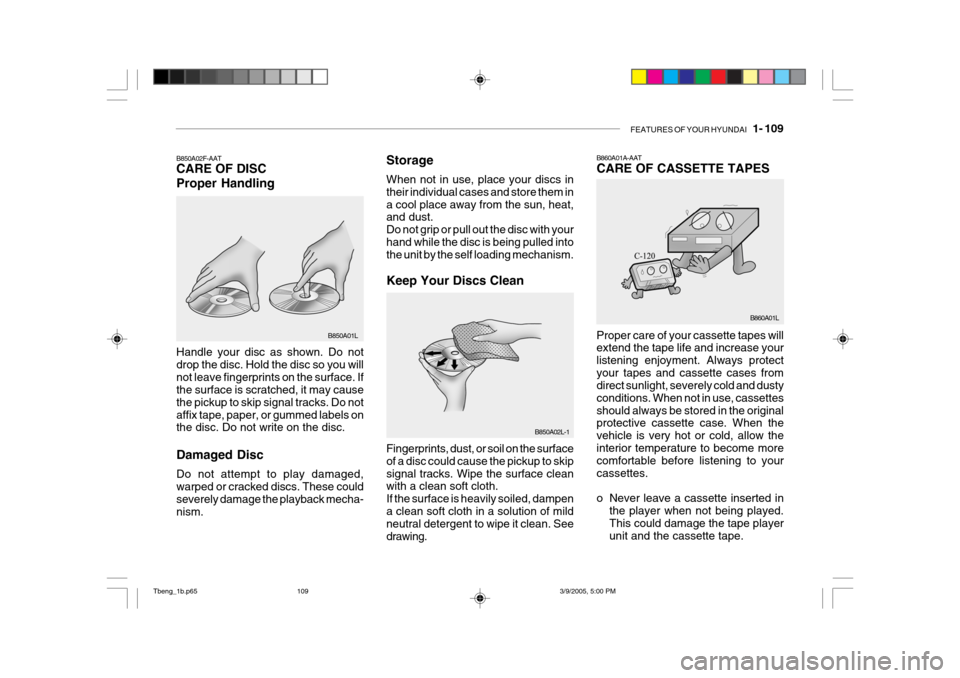
Fingerprints, dust, or soil on the surfaceof a disc could cause the pickup to skipsignal tracks. Wipe the surface clean with a clean soft cloth. If the surface is heavily soiled, dampena clean soft cloth in a solution of mild neutral detergent to wipe it clean. See drawing.B860A01A-AAT CARE OF CASSETTE TAPES Proper care of your cassette tapes will extend the tape life and increase your listening enjoyment. Always protectyour tapes and cassette cases from direct sunlight, severely cold and dusty conditions. When not in use, cassettesshould always be stored in the original protective cassette case. When the vehicle is very hot or cold, allow theinterior temperature to become more comfortable before listening to your cassettes.
o Never leave a cassette inserted in the player when not being played. This could damage the tape player unit and the cassette tape. B860A01L
Tbeng_1b.p65
3/9/2005, 5:00 PM
109
Page 326 of 437

DRIVING YOUR HYUNDAI 2- 3
C020A01O-GAT BEFORE STARTING THE EN- GINE Before you start the engine, you should always:
1. Look around the vehicle to be sure
there are no flat tires, puddles of oil, water or other indications of pos-sible trouble.
2. After entering the car, check to be
sure the parking brake is engaged.
3. Check that all windows, and lights are clean.
4. Check that the interior and exterior mirrors are clean and in position.
5. Check your seat, seatback and
headrest to be sure they are in theirproper positions.
6. Lock all the doors.
7. Fasten your seat belt and be sure
that all other occupants have fas- tened theirs.
8. Turn off all lights and accessories that are not needed.
9. When you turn the ignition switch to
"ON", check that all appropriate warning lights are operating and that you have sufficient fuel. 10.Check the operation of warning
lights and all bulbs when key is in the "ON" position.
!WARNING: (DIESEL ENGINE)
To ensure that sufficient vacuum exists within the brake system dur-ing cold weather start-up condi- tions, it is necessary to run the engine at idle for several secondsafter starting the engine. C030A01A-GAT COMBINATION IGNITION SWITCHTo Start the Engine
o If your Hyundai is equipped with a
manual transaxle, place the shift lever in neutral and depress theclutch pedal fully.
o If your Hyundai has an automatic
transaxle, place the shift lever in "P"(park).
o To start the engine, insert the igni-
tion key and turn it to the "START"position. Release it as soon as the engine starts. Do not hold the key in the "START" position for more than15 seconds.
NOTE: For safety, the engine will not start if the shift lever is not in "P" or "N"Position (Automatic transaxle).
TBENG_2.P65 3/9/2005, 5:00 PM
3
Page 328 of 437

DRIVING YOUR HYUNDAI 2- 5
C050A01A-AAT STARTING
C050A01E
WARNING:
Never run the engine in a closed or poorly ventilated area any longer than is needed to move your car inor out of the area. The carbon mon- oxide gas emitted is odorless and can cause serious injury or death.
!
C051A01O-GAT STARTING FOR THE DIESEL ENGINE ENGINE COLD
o Turn the ignition key to position "ON" and wait for the pre-heat indi- cator light to go out.
o Operate the starter until the engine
runs.
ENGINE WARMOperate the starter. If the engine doesnot respond on the first attempt, wait several seconds and try again using the pre-heat. C050B02S-GAT NORMAL CONDITIONS The Starting Procedure:
1. Insert key, and fasten the seat belt.
2. Depress the clutch pedal fully and
place the gearshift lever (manualtransaxle) in neutral or the selectorlever (automatic transaxle) in "P" (park) position.
3. After turning the ignition key to the "ON" position, make certain all warn-ing lights and gauges are function- ing properly before starting the en-gine.
4. On vehicles equipped with the die-
sel preheat indicator light, turn theignition key to the "ON" position. The diesel pre-heat indicator light will first illuminate in amber, andthen after a short time, the amber illumination will go off, indicating that preheating is completed.
TBENG_2.P65 3/9/2005, 5:00 PM
5
Page 335 of 437

2- 12 DRIVING YOUR HYUNDAI
C130A01A-AAT GOOD BRAKING PRACTICES
WARNING:
Nothing should be carried on top of the shelf panel behind the rear seat. If there were an accident or a sud-den stop, such objects could move forward and cause damage to the vehicle or injure the occupants.
o After being parked, check to be sure the parking brake is not engaged and that the parking brake indicator light is out before driving away.
o Driving through water may get the brakes wet. They can also get wet
when the car is washed. Wet brakes can be dangerous! Your car will not
stop as quickly if the brakes are wet. Wet brakes may cause the car to pull to one side. To dry the brakes,apply the brakes lightly until the braking action returns to normal, taking care to keep the car undercontrol at all times. If the braking
action does not return to normal, stop as soon as it is safe to do soand call your Hyundai dealer for assistance.
!
HTB217-1
C090P01A-GAT Overdrive Switch
When the overdrive switch is turned on, the transaxle will automatically upshift to the second, third and over-drive gears. When the overdrive switch is turned off, the transaxle will not upshift to the overdrive gear. For nor-mal driving, the selector lever should be left in the "D" position and the overdrive switch turned on.If you need to accelerate rapidly, press the accelerator pedal all the way to the floor. The transaxle will automaticallyshift to a lower gear, depending on the vehicle speed and load.
!wheels to lose traction and the ve- hicle to go out of control.
o Turn the overdrive switch on for
good fuel economy and smooth driv-ing. If engine braking is needed in the "D" range or if repeated upshift- ing and downshifting between 3rdand 4th gear is needed when climb- ing a gentle slope, it is recommended that the overdrive switch be turnedoff. Turn the overdrive switch back on immediately afterward.
WARNING:
o Avoid high cornering speeds.
o Do not make quick steering wheel movements, such as sharp lane changes or fast, sharp turns.
o Always wear your seat belts.
In a collision crash, an unbeltedperson is significantly more likely to die than a person wearing a seatbelt.
o The risk of rollover is greatly in- creased if you lose control ofyour vehicle at highway speeds.
o Loss of control often occurs if two or more wheels drop off theroadway and the driver oversteersto reenter the roadway.
o In the event your vehicle leaves
TBENG_2.P65 3/9/2005, 5:00 PM
12
Page 336 of 437

DRIVING YOUR HYUNDAI 2- 13
o Don't coast down hills with the car
out of gear. This is extremely haz-
ardous. Keep the car in gear at alltimes, use the brakes to slow down,
then shift to a lower gear so that engine braking will help you main-tain a safe speed.
o Don't "ride" the brake pedal. Rest-
ing your foot on the brake pedal
while driving can be dangerous be- cause it can result in the brakes overheating and losing their effec-tiveness. It also increases the wear of the brake components.
o If a tire goes flat while you are driving, apply the brakes gently andkeep the car pointed straight ahead while you slow down. When you are
moving slowly enough for it to be safe to do so, pull off the road and stop in a safe place.
o If your car is equipped with an auto- matic transaxle, don't let your carcreep forward. To avoid creepingforward, keep your foot on the brake
pedal when the car is stopped.
o Use caution when parking on a hill. Engage the parking brake and place
the gear selector lever in "P" (auto- matic transaxle) or in first or reverse gear (manual transaxle). If your car is facing downhill, turn the front wheels into the curb to help keep thecar from rolling. If your car is facing
uphill, turn the front wheels away from the curb to help keep the carfrom rolling. If there is no curb or if it is required by other conditions to keep the carfrom rolling, block the wheels.
o Under some conditions your park-
ing brake can freeze in the engagedposition. This is most likely to hap- pen when there is an accumulation of snow or ice around or near therear brakes or if the brakes are wet. If there is a risk that the parking brake may freeze, apply it only tem-porarily while you put the gear se- lector lever in "P" (automatic) or in first or reverse gear (manualtransaxle) and block the rear wheels so the car cannot roll. Then release the parking brake.
o Do not hold the vehicle on the up- grade with the accelerator pedal.This can cause the transmission tooverheat. Always use the brake pedal or parking brake. C120A02A-AAT ANTI-LOCK BRAKE SYSTEM (If Installed) The Anti-Lock Brake System (ABS) is designed to prevent wheel lock-up during sudden braking or on hazard-ous road surfaces. The ABS control module monitors the wheel speed and controls the pressure applied to eachbrake. Thus, in emergency situations or on slick roads, ABS will increase vehicle control during braking. NOTE: During ABS operation, a slight pul- sation may be felt in the brake pedalwhen the brakes are applied. Also, a noise may be heard in the engine compartment while braking. Theseconditions are normal and indicate that the anti-lock brake system is functioning properly.
TBENG_2.P65
3/9/2005, 5:00 PM
13
Page 337 of 437

2- 14 DRIVING YOUR HYUNDAI
o Drive at a moderate speed. The
faster you drive, the more fuel your car uses. Driving at a moderatespeed, especially on the highway, is one of the most effective ways to reduce fuel consumption.
o Don't "ride" the brake or clutch pedal. This can increase fuel consumptionand also increase wear on thesecomponents. In addition, driving with your foot resting on the brake pedal may cause the brakes to overheat,which reduces their effectiveness and may lead to more serious con- sequences.
o Take care of your tires. Keep them inflated to the recommended pres-sure. Incorrect inflation, either toomuch or too little, results in unnec- essary tire wear. Check the tire pres- sures at least once a month.
o Be sure that the wheels are aligned correctly. Improper alignment canresult from hitting curbs or drivingtoo fast over irregular surfaces. Poor alignment causes faster tire wear and may also result in other prob-lems as well as greater fuel con- sumption.
WARNING:
ABS will not prevent accidents due to improper or dangerous driving maneuvers. Even though vehicle control is improved during emer-gency braking, always maintain a safe distance between you and ob- jects ahead. Vehicle speeds shouldalways be reduced during extreme road conditions. The braking distance for cars equipped with an anti-lock braking system may be longer than for those without it in the following road con-ditions.
o Driving on rough, gravel or snow- covered roads.
o Driving with tire chains installed.
o Driving on roads where the road surface is pitted or has different surface height.
!During these conditions, the ve- hicle should be driven at reduced speeds. The safety features of anABS equipped vehicle should not be tested by high speed driving or cornering. This could endanger thesafety of yourself or others.
C140A01A-GAT DRIVING FOR ECONOMY You can save fuel and get more kilo- meters from your car if you follow these suggestions:
o Drive smoothly. Accelerate at amoderate rate. Don't make "jack- rabbit" starts or full-throttle shifts and maintain a steady cruisingspeed. Don't race between stop- lights. Try to adjust your speed to that of the other traffic so you don'thave to change speeds unneces- sarily. Avoid heavy traffic whenever possible.Always maintain a safe distance from other vehicles so you can avoid unnecessary braking. This also re-duces brake wear.
TBENG_2.P65 3/9/2005, 5:00 PM
14
Page 338 of 437

DRIVING YOUR HYUNDAI 2- 15
C150A01A-AAT SMOOTH CORNERING Avoid braking or gear changing in cor- ners, especially when roads are wet.Ideally, corners should always be taken under gentle acceleration. If you follow these suggestions, tire wear will beheld to a minimum.
o Keep your car in good condition. For
better fuel economy and reducedmaintenance costs, maintain yourcar in accordance with the mainte- nance schedule in Section 5. If you drive your car in severe conditions,more frequent maintenance is re- quired (see Section 5 for details).
o Keep your car clean. For maximum service, your Hyundai should bekept clean and free of corrosive materials. It is especially importantthat mud, dirt, ice, etc. not be al- lowed to accumulate on the under- side of the car. This extra weightcan result in increased fuel con- sumption and also contribute to cor- rosion.
o Travel lightly. Don't carry unneces- sary weight in your car. Weight re-duces fuel economy.
o Don't let the engine idle longer than necessary. If you are waiting (andnot in traffic), turn off your engineand restart only when you're ready to go.
o Remember, your Hyundai does not require extended warm-up. As soonas the engine is running smoothly, you can drive away. In very cold weather, however, give your engine a slightly longer warm-up period.
o Don't "lug" or "over-rev" the engine. Lugging is driving too slowly in toohigh a gear resulting in the engine bucking. If this happens, shift to alower gear. Over-revving is racing the engine beyond its safe limit. This can be avoided by shifting atthe recommended speeds.
o Use your air conditioning sparingly.
The air conditioning system is oper-ated by engine power so your fuel economy is reduced when you use it. C160A01A-AAT WINTER DRIVING The more severe weather conditions of winter result in greater wear andother problems. To minimize the prob- lems of winter driving, you should fol- low these suggestions: C160B01A-GAT Snowy or Icy Conditions To drive your vehicle in deep snow, it may be necessary to use snow tires or to install tire chains on your tires. If snow tires are needed, it is necessary to select tires equivalent in size and type to the original equipment tires.Failure to do so may adversely affect the safety and handling of your car. Speeding, rapid acceleration, suddenbrake applications, and sharp turns are potentially very hazardous prac- tices. During deceleration, use enginebraking to the fullest extent. Sudden brake applications on snowy or icy roads may cause skids to occur. Youneed to keep sufficient distance be- tween the vehicle in front and your vehicle. Also, apply the brake gently. Itshould be noted that installing tire
TBENG_2.P65
3/9/2005, 5:00 PM
15
Page 340 of 437

DRIVING YOUR HYUNDAI 2- 17
C160K01A-AAT Carry Emergency Equipment Depending on the severity of the weather where you drive your car, you should carry appropriate emergencyequipment. Some of the items you may want to carry include tire chains, tow straps or chains, flashlight, emer-gency flares, sand, a shovel, jumper cables, a window scraper, gloves, ground cloth, coveralls, a blanket, etc.
C160H01A-AAT Use Approved Anti-Freeze in
Window Washer System To keep the water in the window washer system from freezing, add an approved anti-freeze solution in accordance withinstructions on the container. Window washer anti-freeze is available from Hyundai dealers and most auto partsoutlets. Do not use engine coolant or other types of anti-freeze as these may damage the finish. C160I01A-AAT Don't Let Your Parking Brake Freeze Under some conditions your parking brake can freeze in the engaged posi- tion. This is most likely to happenwhen there is an accumulation of snow or ice around or near the rear brakes or if the brakes are wet. If there is a riskthe parking brake may freeze, apply it only temporarily while you put the gear selector lever in "P" (automatic) or infirst or reverse gear (manual transaxle) and block the rear wheels so the car cannot roll. Then release the parkingbrake. C160J01A-AAT Don't Let Ice and Snow Accumu- late Underneath Under some conditions, snow and ice can build up under the fenders and interfere with the steering. When driv-ing in severe winter conditions where this may happen, you should periodi- cally check underneath the car to besure the movement of the front wheels and the steering components is not obstructed.
C170A01A-AAT HIGHER SPEED MOTORING Pre-Trip Inspections 1. Tires: Adjust the tire inflation pressures to specification. Low tire inflation pres- sures will result in overheating andpossible failure of the tires. Avoid using worn or damaged tires which may result in reduced traction ortire failure. NOTE: Never exceed the maximum tire in- flation pressure shown on the tires. 2. Fuel, engine coolant and en- gine oil: High speed travel consumes 1.5 times more fuel than urban motoring. Do not forget to check both engine coolantand engine oil. 3. Drive belt: A loose or damaged drive belt may result in overheating of the engine.
TBENG_2.P65
3/9/2005, 5:00 PM
17