ABS Hyundai Getz 2005 User Guide
[x] Cancel search | Manufacturer: HYUNDAI, Model Year: 2005, Model line: Getz, Model: Hyundai Getz 2005Pages: 437, PDF Size: 11.19 MB
Page 180 of 437

DO-IT-YOURSELF MAINTENANCE 6- 35
G200E01TB-GAT Inner Panel
HTB260-DFUSE RATING10A 10A10A10A10A10A 10A 15A10A10A20A15A 10A 20A10A15A15A15A 20A 10A10A10A30A15A 10A 15A15APROTECTED COMPONENTS
Air conditioner
Stop/Tail Light (LH) A/Bag IndicatorAudio, Electronic Outside Mirror
Turn signal Light, Back-up Light
Stop/Tail Light (RH)Cluster Cigarette Lighter PCM, ABS controlAir BagDoor Lock System, SunroofRear Wiper Motor
Start Relay, 9oTheft alarm system Seat Warmer Rear window DefrosterECM
Stop Light, Power Window
Hazard Warning Light, ETACMFront Wiper Motor Rear Fog Light
Fog light, ETACM, Power Window, Headlight leveling Device
Blower, SunroofRear window DefrosterHeadlight (RH)Front Fog Light
High Beam Light Indicator, Headlight (LH) Room Lamp, Audio, Cluster
DESCRIPTION
A/C SW
TAIL LH
A/BAG IND
AUDIO
T/SIG
TAIL RH
CLUSTER C/LIGHT ECU 1
A/BAG
D/LOCK
RR/WPR STARTS/HTD
HTD MIR ECU2
STOP
HAZARD
FRT WPR R/FOG
IGNITION BLOWER PR/HTD
H/LP RH F/FOG
H/LP LH
POWER CONN & R/LP
Page 182 of 437

7- 2 EMISSION CONTROL SYSTEMS
SH010A1-E EMISSION CONTROL SYSTEMS (Not all models) Depending upon the market for which the vehicle is destined, the emissioncontrol system will comprise one or more of the following emission con- trol devices.
1) Crankcase emission control sys-
tem
2) Evaporative emission control sys-
tem
3) Exhaust emission control systemIn order that the proper functioning of the emission control systems may be ensured, it is recommended that the vehicle is inspected and maintainedby a Hyundai authorised repairer in accordance with the maintenance schedule in this manual. SH010B1-E
1. CRANKCASE EMISSION
CONTROLSYSTEM
The positive crankcase ventilation
system is employed to prevent airpollution caused by blow-by gasesbeing emitted from the crankcase by introducing fresh air to the crankcase through the air cleaner where thismixes with blow-by gases and then passes through the PCV valve into the intake manifold from where it sub-sequently enters the combustion chamber and is burned.
SH010C1-E
2. EVAPORATIVE EMISSION
CONTROL SYSTEM
The Evaporative Emission Control
System is designed to prevent fuel vapours from escaping into the atmo- sphere through the fuel tank ventila- tion system.
Whilst the engine is not running, fuel
vapours generated inside the fuel tankare absorbed and stored in a char-coal canister. When the engine is started, the vapours stored in the canister are drawn into the induction SH010D1-E
3. EXHAUST EMISSION CON
TROL SYSTEM
The exhaust emission control system
is a highly effective system whichcontrols exhaust emission while main- taining good vehicle performance.
system through the purge control so-lenoid valve and are subsequently burned.
The purge control solenoid valve is
controlled by the ECU; when the en-gine coolant temperature is low or the engine is idling, the purge control valve is closed and fuel vapours re-main stored in the canister. Under normal running conditions when the engine is warm, the valve opens andthe vapours are drawn into the inlet tract and subsequently burned in the combustion chamber.
Page 212 of 437

YOUR VEHICLE AT A GLANCE
B255A01TB-GAT INDICATOR SYMBOLS ON THE INSTRUMENT PANEL * A detail explanations of these items will be found on page 1-43
SRS (Airbag) Service Reminder Indicator ABS Service Reminder Indicator Turn Signal Indicator Lights High Beam Indicator Light Oil Pressure Warning Light Parking Brake/Brake Level Warning Light Charging System Warning Light Tail Gate Open Warning LightDoor Ajar Warning Light and Chime
Low Fuel Level Warning Light Malfunction Indicator Light Seat Belt Reminder Light
O/D OFF Indicator (Automatic transaxle only)
Electric Power Steering System (EPS)Warning Light
Diesel Pre-heat Indicator Light (Diesel only)
Fuel Filter Warning Light (Diesel only)
Immobilizer Indicator
TBENG_0.P65
3/9/2005, 4:55 PM
14
Page 237 of 437

FEATURES OF YOUR HYUNDAI 1- 25
your hips. If you lean forward in a slow, easy motion, the belt will extend and let you move around. If there is asudden stop or impact, the belt will lock into position. It will also lock if you try to lean forward too quickly. WARNING:
o When using the rear seat center belt, you must lock all metal tabs and buckles. If any metal tab or buckle is not locked, it will in-crease the chance of injury in the event of collision.
o Never unlock the metal tab (a)
and the buckle (b) with the fol-lowing exceptions.(1)In case of folding rear
seatbacks down.
(2)If transporting an object on
the rear seat may cause dam-age to the rear seat center belt.
o Lock the metal tab (a) and the buckle (b) immediately after fold-ing rear seatbacks up.
!
B220A02Y-D
B220C01Y-GAT To Release the Seat Belt (If installed)
When you want to release the seat belt, press the button in the locking buckle. HTB191
WARNING:
The center belt latching mechanismis different from those for the rear seat shoulder belts. When fasten- ing the rear seat shoulder belts orthe rear seat center belt, make sure they are inserted into the correct buckles to obtain maximum protec-tion from the seat belt system and assure proper operation.
!
TBENG_1A.P65 3/9/2005, 4:57 PM
25
Page 253 of 437
FEATURES OF YOUR HYUNDAI 1- 41
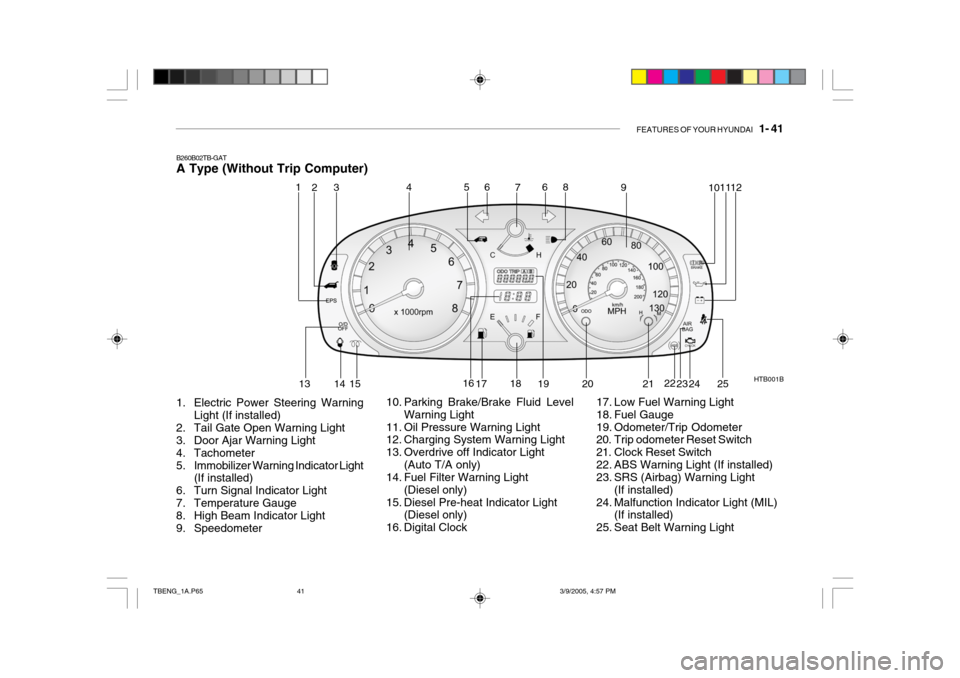
B260B02TB-GAT A Type (Without Trip Computer)
1. Electric Power Steering Warning Light (If installed)
2. Tail Gate Open Warning Light
3. Door Ajar Warning Light
4. Tachometer
5. Immobilizer Warning Indicator Light (If installed)
6. Turn Signal Indicator Light
7. Temperature Gauge
8. High Beam Indicator Light
9. Speedometer HTB001B
10. Parking Brake/Brake Fluid Level Warning Light
11. Oil Pressure Warning Light
12. Charging System Warning Light
13. Overdrive off Indicator Light (Auto T/A only)
14. Fuel Filter Warning Light
(Diesel only)
15. Diesel Pre-heat Indicator Light (Diesel only)
16. Digital Clock 17. Low Fuel Warning Light
18. Fuel Gauge
19. Odometer/Trip Odometer
20. Trip odometer Reset Switch
21. Clock Reset Switch
22. ABS Warning Light (If installed)
23. SRS (Airbag) Warning Light
(If installed)
24. Malfunction Indicator Light (MIL) (If installed)
25. Seat Belt Warning Light
1
2
453 6
7 8
9 1011
12
13 14
15 16
17 18
19 20 2122
23 24
6
25
TBENG_1A.P65 3/9/2005, 4:57 PM
41
Page 254 of 437
1- 42 FEATURES OF YOUR HYUNDAI
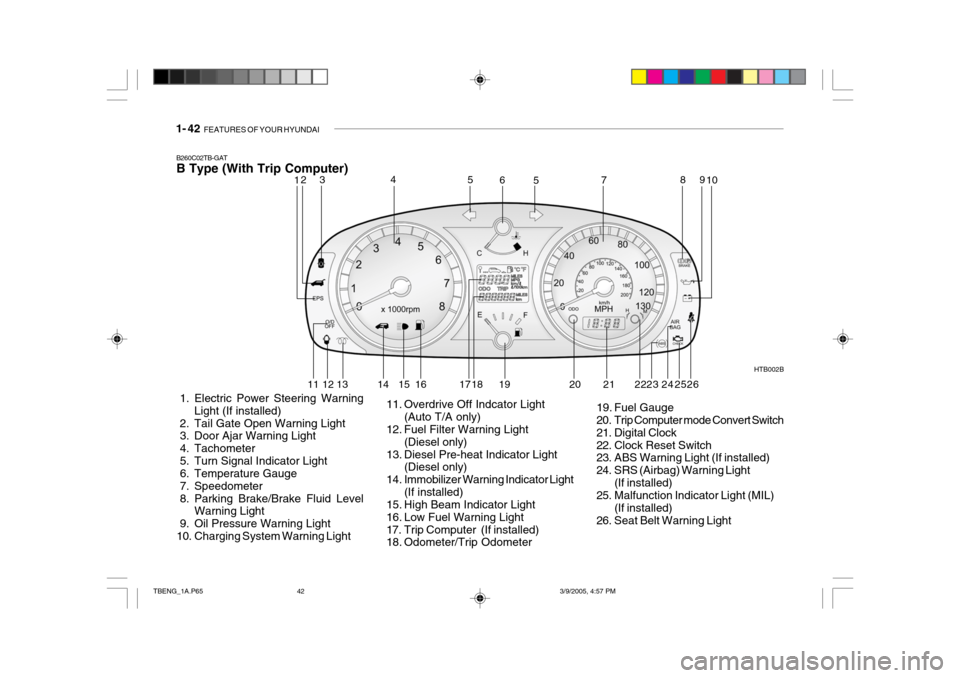
B260C02TB-GAT B Type (With Trip Computer)
1. Electric Power Steering Warning Light (If installed)
2. Tail Gate Open Warning Light
3. Door Ajar Warning Light
4. Tachometer
5. Turn Signal Indicator Light
6. Temperature Gauge
7. Speedometer
8. Parking Brake/Brake Fluid Level Warning Light
9. Oil Pressure Warning Light
10. Charging System Warning Light HTB002B
11. Overdrive Off Indcator Light (Auto T/A only)
12. Fuel Filter Warning Light
(Diesel only)
13. Diesel Pre-heat Indicator Light (Diesel only)
14. Immobilizer Warning Indicator Light (If installed)
15. High Beam Indicator Light
16. Low Fuel Warning Light
17. Trip Computer (If installed)
18. Odometer/Trip Odometer 19. Fuel Gauge
20. Trip Computer mode Convert Switch
21. Digital Clock
22. Clock Reset Switch
23. ABS Warning Light (If installed)
24. SRS (Airbag) Warning Light
(If installed)
25. Malfunction Indicator Light (MIL)
(If installed)
26. Seat Belt Warning Light
12 3 4
5
5
67 8
910
11 12 13 14 15 16 17 18 19 20 23 24
252221 26
TBENG_1A.P65 3/9/2005, 4:57 PM
42
Page 255 of 437

FEATURES OF YOUR HYUNDAI 1- 43
B260B01S-GAT
SRS (Airbag) Service Reminder Indicator (SRI)(If Installed)
The SRS service reminder indicator (SRI) comes on and flashes for about 6 seconds after the ignition key isturned to the "ON" position or after the engine is started, after which it will go out. This light also comes on when the SRS is not working properly. If the SRI doesnot come on, or continuously remains on after flashing for about 6 seconds when you turned the ignition key to the"ON" position or started the engine, or if it comes on while driving, have the SRS inspected by an authorizedHyundai Dealer. B260P02Y-GAT
ABS Service Reminder Indicator (SRI)(If Installed)
When the key is turned to the "ON" position, the Anti-Lock Brake System will come on and then go off in a fewseconds. If the ABS SRI remains on, comes on while driving, or does not come on when the key is turned to the"ON" position, this indicates that there may be a problem with the ABS. If this occurs, have your vehiclechecked by your Hyundai dealer as soon as possible. The normal braking system will still be operational, butwithout the assistance of the anti-lock brake system. B260C01A-AAT
O/D OFF Indicator (Automatic transaxle
only) (If Installed)
When the overdrive switch is turned on, the overdrive off indicator will go out. This amber indicator will be illumi-nated when the overdrive switch is turned off. B260D01A-AAT Turn Signal Indicator Lights
The blinking green arrows on the in- strument panel show the direction indi-cated by the turn signals. If the arrow comes on but does not blink, blinks more rapidly than normal, or does notilluminate at all, a malfunction in the turn signal system is indicated. Your dealer should be consulted for repairs.
WARNING:
If both ABS SRI and Parking Brake/Brake fluid level warning lights re-main "ON" or come on while driv- ing, there may be a problem with E.B.D (Electronic Brake Force Dis-tribution). If this occurs, avoid sudden stops and have your vehicle checked byyour Hyundai dealer as soon as possible.
!
TBENG_1A.P65 3/9/2005, 4:57 PM
43
Page 324 of 437

2. DRIVING YOUR HYUNDAI
2
Before starting the engine .............................................................. 2-3
Key position .................................................................................... 2-4Starting............................................................................................ 2-5
Operating the manual transaxle ..................................................... 2-7
Automatic transaxle ........................................................................ 2-9
Good braking practices ................................................................. 2-12
Anti-Lock brake system (ABS) ...................................................... 2-13
Driving for economy ...................................................................... 2-14
Winter Driving ............................................................................... 2-15
Trailer or vehicle towing ................................................................ 2-18
TBENG_2.P65 3/9/2005, 5:00 PM
1
Page 336 of 437

DRIVING YOUR HYUNDAI 2- 13
o Don't coast down hills with the car
out of gear. This is extremely haz-
ardous. Keep the car in gear at alltimes, use the brakes to slow down,
then shift to a lower gear so that engine braking will help you main-tain a safe speed.
o Don't "ride" the brake pedal. Rest-
ing your foot on the brake pedal
while driving can be dangerous be- cause it can result in the brakes overheating and losing their effec-tiveness. It also increases the wear of the brake components.
o If a tire goes flat while you are driving, apply the brakes gently andkeep the car pointed straight ahead while you slow down. When you are
moving slowly enough for it to be safe to do so, pull off the road and stop in a safe place.
o If your car is equipped with an auto- matic transaxle, don't let your carcreep forward. To avoid creepingforward, keep your foot on the brake
pedal when the car is stopped.
o Use caution when parking on a hill. Engage the parking brake and place
the gear selector lever in "P" (auto- matic transaxle) or in first or reverse gear (manual transaxle). If your car is facing downhill, turn the front wheels into the curb to help keep thecar from rolling. If your car is facing
uphill, turn the front wheels away from the curb to help keep the carfrom rolling. If there is no curb or if it is required by other conditions to keep the carfrom rolling, block the wheels.
o Under some conditions your park-
ing brake can freeze in the engagedposition. This is most likely to hap- pen when there is an accumulation of snow or ice around or near therear brakes or if the brakes are wet. If there is a risk that the parking brake may freeze, apply it only tem-porarily while you put the gear se- lector lever in "P" (automatic) or in first or reverse gear (manualtransaxle) and block the rear wheels so the car cannot roll. Then release the parking brake.
o Do not hold the vehicle on the up- grade with the accelerator pedal.This can cause the transmission tooverheat. Always use the brake pedal or parking brake. C120A02A-AAT ANTI-LOCK BRAKE SYSTEM (If Installed) The Anti-Lock Brake System (ABS) is designed to prevent wheel lock-up during sudden braking or on hazard-ous road surfaces. The ABS control module monitors the wheel speed and controls the pressure applied to eachbrake. Thus, in emergency situations or on slick roads, ABS will increase vehicle control during braking. NOTE: During ABS operation, a slight pul- sation may be felt in the brake pedalwhen the brakes are applied. Also, a noise may be heard in the engine compartment while braking. Theseconditions are normal and indicate that the anti-lock brake system is functioning properly.
TBENG_2.P65
3/9/2005, 5:00 PM
13
Page 337 of 437

2- 14 DRIVING YOUR HYUNDAI
o Drive at a moderate speed. The
faster you drive, the more fuel your car uses. Driving at a moderatespeed, especially on the highway, is one of the most effective ways to reduce fuel consumption.
o Don't "ride" the brake or clutch pedal. This can increase fuel consumptionand also increase wear on thesecomponents. In addition, driving with your foot resting on the brake pedal may cause the brakes to overheat,which reduces their effectiveness and may lead to more serious con- sequences.
o Take care of your tires. Keep them inflated to the recommended pres-sure. Incorrect inflation, either toomuch or too little, results in unnec- essary tire wear. Check the tire pres- sures at least once a month.
o Be sure that the wheels are aligned correctly. Improper alignment canresult from hitting curbs or drivingtoo fast over irregular surfaces. Poor alignment causes faster tire wear and may also result in other prob-lems as well as greater fuel con- sumption.
WARNING:
ABS will not prevent accidents due to improper or dangerous driving maneuvers. Even though vehicle control is improved during emer-gency braking, always maintain a safe distance between you and ob- jects ahead. Vehicle speeds shouldalways be reduced during extreme road conditions. The braking distance for cars equipped with an anti-lock braking system may be longer than for those without it in the following road con-ditions.
o Driving on rough, gravel or snow- covered roads.
o Driving with tire chains installed.
o Driving on roads where the road surface is pitted or has different surface height.
!During these conditions, the ve- hicle should be driven at reduced speeds. The safety features of anABS equipped vehicle should not be tested by high speed driving or cornering. This could endanger thesafety of yourself or others.
C140A01A-GAT DRIVING FOR ECONOMY You can save fuel and get more kilo- meters from your car if you follow these suggestions:
o Drive smoothly. Accelerate at amoderate rate. Don't make "jack- rabbit" starts or full-throttle shifts and maintain a steady cruisingspeed. Don't race between stop- lights. Try to adjust your speed to that of the other traffic so you don'thave to change speeds unneces- sarily. Avoid heavy traffic whenever possible.Always maintain a safe distance from other vehicles so you can avoid unnecessary braking. This also re-duces brake wear.
TBENG_2.P65 3/9/2005, 5:00 PM
14