change time Hyundai Getz 2005 User Guide
[x] Cancel search | Manufacturer: HYUNDAI, Model Year: 2005, Model line: Getz, Model: Hyundai Getz 2005Pages: 437, PDF Size: 11.19 MB
Page 318 of 437

1- 106 FEATURES OF YOUR HYUNDAI
B290H01TB-GAT
1. CD CHANGER Select Button
(CD ˆ
MP3)
When the CD changer magazine con- tains discs, press the "CD ˆ
MP3" button
and the CD changer can be used even if the radio or cassette player is being used. The Hyundai CD changer can hold up to six or eight discs. The discnumber will be lit, and the track number, and elapsed time will be displayed. 2. DISC Select Knob
(JOY STICK)
To select the CD you want push the DISC select knob (JOY STICK) to up and down. After selecting the desiredCD, push the change the disc number. 3. FF/REW ( / ) If you want to fast forward or reverse through the compact disc track, push and hold in the FF ( ) or REW ( )button. When you release the button, the com- pact disc player will resume playing.4. TRACK UP/DOWN
o The desired track on the disc cur- rently being played can be selected using the track number.
o Press once to skip forward to the
beginning of the next track. Press
once to skip back to the beginning of the track.
5. JOYSTICK You can skip the track by pushing the JOY STICK to the left or right. After selecting the desired track, pressthe JOY STICK to playback the track. If you do not press the JOY STICK within 5 seconds, the previous track willplayback again. 6. REPEAT
o To repeat the track you are listening to, press the RPT button. To cancel, press again.
o If you do not release RPT operation
when the track ends, it will automati-cally be replayed. This process will be continued until you push the button again.7. RANDOM (RDM) Press the RDM button to listen the tracks in random, rather than sequen-tial, order. Press it again to cancel random play.
8. SCAN
o Press the SCAN button to playbackthe first 10 seconds of each track.
o Press the SCAN button again within
10 sec. for the desired track.
9. EQUALIZER (EQ)Press the EQ button to select the CLAS- SIC, JAZZ, ROCK and DEFEAT MODEfor the desired tone quality. Each press of the button changes the display as follows;
CLASSIC JAZZ ROCK DEFEAT
Tbeng_1b.p65 3/9/2005, 5:00 PM
106
Page 325 of 437

2- 2 DRIVING YOUR HYUNDAI
C010A01O-AAT
WARNING: ENGINE EXHAUST CAN BE DANGEROUS!
Engine exhaust fumes can be extremely dangerous. If, at any time, you smell exhaust fumes inside the vehicle, open the windows immediately. o Do not inhale exhaust fumes. Exhaust fumes contain carbon monoxide, a colorless, odorless gas that can cause unconsciousness and death by asphyxiation. o Be sure the exhaust system does not leak. The exhaust system should be checked whenever the vehicle is raised to change the oil or for any other purpose. If you hear a change in the sound of the exhaust or if you drive over something that strikes the underneath side of the car, have the exhaust system checked as soon as possible by your Hyundai dealer. o Do not run the engine in an enclosed area. Letting the engine idle in your garage, even with the garage door open, is a hazardous practice. Never run the engine in your garage any longer than it takes to start the engine and back the car out. o Avoid idling the engine for prolonged periods with people inside the car. If it is necessary to idle the engine for a prolonged period with people inside the car, be sure to do so only in an open area with the air intake set at "Fresh" and fan operating at one of the higher speeds so fresh air is drawn into the interior. If you must drive with the tail gate open because you are carrying objects that make this necessary: 1. Close all windows. 2. Open side vents. 3. Set the air intake control at "Fresh", the air flow control at "Floor" or "Face" and the fan at one of the higher speeds.
To assure proper operation of the ventilation system, be sure the ventilation air intakes located just in front ofthe windshield are kept clear of snow, ice, leaves or other obstructions.
!
TBENG_2.P65 3/9/2005, 5:00 PM
2
Page 335 of 437

2- 12 DRIVING YOUR HYUNDAI
C130A01A-AAT GOOD BRAKING PRACTICES
WARNING:
Nothing should be carried on top of the shelf panel behind the rear seat. If there were an accident or a sud-den stop, such objects could move forward and cause damage to the vehicle or injure the occupants.
o After being parked, check to be sure the parking brake is not engaged and that the parking brake indicator light is out before driving away.
o Driving through water may get the brakes wet. They can also get wet
when the car is washed. Wet brakes can be dangerous! Your car will not
stop as quickly if the brakes are wet. Wet brakes may cause the car to pull to one side. To dry the brakes,apply the brakes lightly until the braking action returns to normal, taking care to keep the car undercontrol at all times. If the braking
action does not return to normal, stop as soon as it is safe to do soand call your Hyundai dealer for assistance.
!
HTB217-1
C090P01A-GAT Overdrive Switch
When the overdrive switch is turned on, the transaxle will automatically upshift to the second, third and over-drive gears. When the overdrive switch is turned off, the transaxle will not upshift to the overdrive gear. For nor-mal driving, the selector lever should be left in the "D" position and the overdrive switch turned on.If you need to accelerate rapidly, press the accelerator pedal all the way to the floor. The transaxle will automaticallyshift to a lower gear, depending on the vehicle speed and load.
!wheels to lose traction and the ve- hicle to go out of control.
o Turn the overdrive switch on for
good fuel economy and smooth driv-ing. If engine braking is needed in the "D" range or if repeated upshift- ing and downshifting between 3rdand 4th gear is needed when climb- ing a gentle slope, it is recommended that the overdrive switch be turnedoff. Turn the overdrive switch back on immediately afterward.
WARNING:
o Avoid high cornering speeds.
o Do not make quick steering wheel movements, such as sharp lane changes or fast, sharp turns.
o Always wear your seat belts.
In a collision crash, an unbeltedperson is significantly more likely to die than a person wearing a seatbelt.
o The risk of rollover is greatly in- creased if you lose control ofyour vehicle at highway speeds.
o Loss of control often occurs if two or more wheels drop off theroadway and the driver oversteersto reenter the roadway.
o In the event your vehicle leaves
TBENG_2.P65 3/9/2005, 5:00 PM
12
Page 344 of 437

DRIVING YOUR HYUNDAI 2- 21
!
6. Check the condition and air pres-
sure of all tires on the trailer and your car. Low tire pressure canseriously affect the handling. Also check the spare tire.
7. The vehicle/trailer combination is more affected by crosswind andbuffeting. When being passed by a largevehicle, keep a constant speed and steer straight ahead. If there is too much wind buffeting slow downto get out of the other vehicle's air turbulence.
8. When parking your car and trailer, especially on a hill, be sure to fol-low all the normal precautions. Turn your front wheel into the curb, setthe parking brake firmly, and put the transaxle in 1st or Reverse (manual) or Park (automatic). Inaddition, place wheel chocks at each of the trailer's tires.
9. If the trailer has electric brakes, start your vehicle and trailer mov-ing, and then apply the trailer brake controller by hand to be sure thebrakes are working. This lets you check your electrical connection at the same time. 10. During your trip, check occasion-
ally to be sure that the load issecure, and that the lights andany trailer brakes are still working.
11. Avoid jerky starts, sudden accel-
eration or sudden stops.
12. Avoid sharp turns and rapid lane changes.
13. Avoid holding the brake pedal down too long or too frequently. This could cause the brakes to over- heat, resulting in reduced brakingefficiency.
14. When going down a hill, shift into a
lower gear and use the engine brak-ing effect. When ascending a long grade, downshift the transaxle to a lowergear and reduce speed to reduce chances of engine overloading and/ or overheating.
15. If you have to stop while going uphill, do not hold the vehicle inplace by pressing on the accelera-tor. This can cause the automatic transaxle to overheat. Use the park- ing brake or footbrake. NOTE: When towing check transaxle fluid more frequently.
CAUTION:
If overheating should occur whentowing, (temperature gauge reads near red zone), taking the followingaction may reduce or eliminate the problem.
1. Turn off the air conditioner.
2. Reduce highway speed.
3. Select a lower gear when going uphill.
4. While in stop and go traffic, place
the gear selection in park or neu- tral and idle the engine at a higher speed.
TBENG_2.P65 3/9/2005, 5:00 PM
21
Page 386 of 437
DO-IT-YOURSELF MAINTENANCE 6- 11
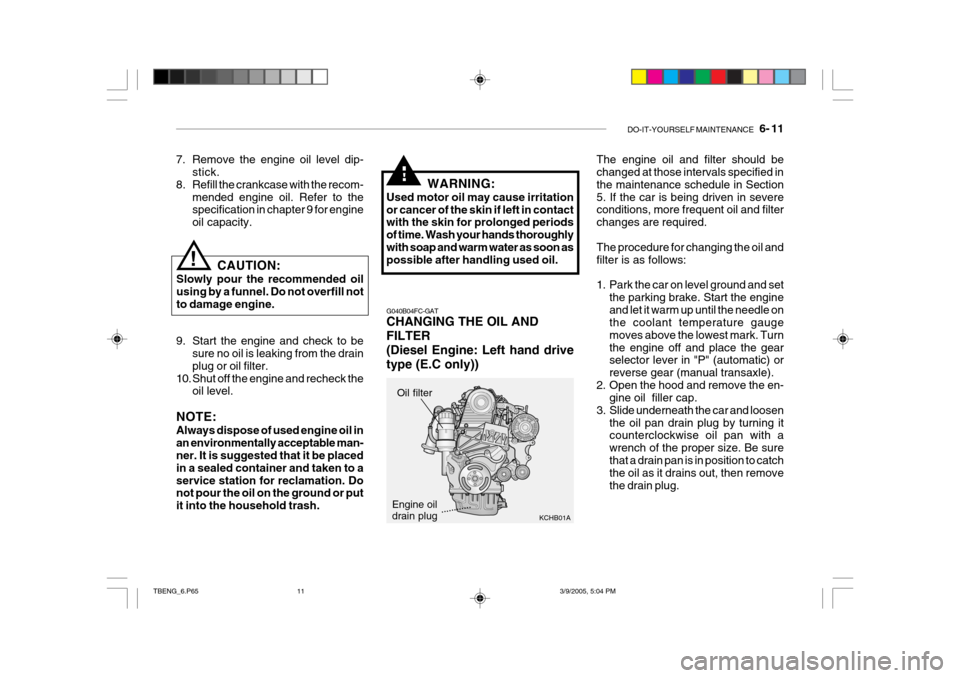
G040B04FC-GAT CHANGING THE OIL AND FILTER
(Diesel Engine: Left hand drive type (E.C only)) The engine oil and filter should be changed at those intervals specified in the maintenance schedule in Section5. If the car is being driven in severe conditions, more frequent oil and filter changes are required. The procedure for changing the oil and filter is as follows:
1. Park the car on level ground and set
the parking brake. Start the engine and let it warm up until the needle on the coolant temperature gauge moves above the lowest mark. Turnthe engine off and place the gear selector lever in "P" (automatic) or reverse gear (manual transaxle).
2. Open the hood and remove the en- gine oil filler cap.
3. Slide underneath the car and loosen the oil pan drain plug by turning it counterclockwise oil pan with a wrench of the proper size. Be surethat a drain pan is in position to catch the oil as it drains out, then remove the drain plug.
7. Remove the engine oil level dip-
stick.
8. Refill the crankcase with the recom-
mended engine oil. Refer to the specification in chapter 9 for engine oil capacity.
!
Engine oil drain plugOil filter
KCHB01A............
WARNING:
Used motor oil may cause irritation or cancer of the skin if left in contact with the skin for prolonged periods of time. Wash your hands thoroughlywith soap and warm water as soon as possible after handling used oil.
CAUTION:
Slowly pour the recommended oil using by a funnel. Do not overfill notto damage engine.!
9. Start the engine and check to be sure no oil is leaking from the drain plug or oil filter.
10. Shut off the engine and recheck the oil level.
NOTE: Always dispose of used engine oil in an environmentally acceptable man- ner. It is suggested that it be placed in a sealed container and taken to aservice station for reclamation. Do not pour the oil on the ground or put it into the household trash.
TBENG_6.P65 3/9/2005, 5:04 PM
11
Page 390 of 437

DO-IT-YOURSELF MAINTENANCE 6- 15
HTB172
5. Start the engine, top off the radiator with water and then add engine coolant to the reservoir until the level is between "L" and "F".
6. Replace the radiator and reservoir caps and check to be sure the draincocks are fully closed and not leak-ing.
WARNING:
The cooling fan is controlled byengine coolant temperature and may sometimes operate even when the engine is not running. Use ex-treme caution when working near the blades of the cooling fan so that you are not injured by a rotating fan blade. As the engine coolant tem-perature decreases, the fan will au- tomatically shut off. This is a nor- mal condition.
!
G060B02S-GAT REPLACING THE SPARK PLUGS
CHAMPION NGK
RC10YC BKR5ES
Unleaded
engine Leaded
engine
RC10YC4 BKR5ES-11
G060A01L
Unleaded: 1.0 ~ 1.1 mm (0.039 ~ 0.043 in.) Leaded: 0.7 ~ 0.8 mm(0.028 ~ 0.032 in.)
The spark plugs should be changed at the intervals specified in the vehicle maintenances schedule in Section 5 or whenever engine performance indi-cates they should be changed. Symp- toms that suggest poor spark plug performance include engine misfiringunder load, loss of fuel economy, poor acceleration, etc. When spark plugs are replaced, always use spark plugs recommended by Hyundai. The use ofother spark plugs can result in loss of performance, radio interference or engine damage. NOTE: When replacing the spark plugs, always use genuine parts recom-mended. Recommended Spark Plugs:
TBENG_6.P65
3/9/2005, 5:04 PM
15
Page 391 of 437

6- 16 DO-IT-YOURSELF MAINTENANCE
WARNING:
It is recommended that the engine be cool or cold when changing the spark plugs. If the engine is hot, you couldburn yourself on the insulated con- nector, the spark plug or the engine itself.
4. When preparing to remove the old spark plug, guide the socket down over the spark plug, being careful not to damage the ceramic insulator.
5. To remove the spark plug, turn the
wrench handle in a counterclockwisedirection.
G060C01S-GAT Changing the Spark Plugs You will find it easier to change spark plugs if the engine is cold. Always change one spark plug at a time. This helps avoid getting the wires mixed up.
1. Remove the center cover on the en-
gine rocker cover. (DOHC engine only)
2. Using a clean cloth, remove any dirt
that has accumulated around the spark plug so it cannot fall into the cylinder when the spark plug is re-moved.
3. To remove the spark plug cable, pull
straight up on the insulated connec-tor, not the cable. Pulling on the cable may damage the carbon core conductor. HTB174-1
HTB175-1
HTB176-1!
6. To install the new spark plug, guidethe socket down over the spark plug, being careful not to damage the ce-ramic insulator.
NOTE: Spark plugs should be tightened firmly. Over-tightening can damagethe threads in the aluminum cylinder head. Leaving them too loose can cause the spark plugs to get very hotand possibly result in damage to the engine.
7. Replace the cable by pushing the insulated connector directly down onto the electrode. Check to be sure it has snapped into place and can'tfall off.
TBENG_6.P65 3/9/2005, 5:04 PM
16
Page 400 of 437

DO-IT-YOURSELF MAINTENANCE 6- 25
Water Pump Pulley
Alternator Pulley
Crankshaft Pulley 5.1~6 mm(0.2~0.24 in.)
G190A01A-GAT CHECKING DRIVE BELTS (Gasoline)
G180A01A-GAT CHECKING BRAKE PEDAL CLEARANCE
G180A01L
45.1 mm (1.78 in.)
You need a helper to check the brake pedal clearance. With the engine run- ning, have your helper press down on the brake pedal several times and thenhold it down with a force of about 490 N (50 Kg, 110 lbs). The brake pedal clearance is the distance from the topsurface of the brake pedal to the as- phalt sheeting under the floor mat. If the brake pedal clearance is notwithin the limits specified in the illustra- tion, have it inspected by your Hyundai dealer and adjusted or repaired if nec-essary. HTB186
1.1L
1.3L/1.6L Crankshaft pulley
Alternator
HTB220
Water Pump Pulley
9.5 ~11.0 mm (0.37 ~ 0.43 in.)
G170A01A-GAT CHECKING BRAKE PEDAL FREEPLAY
HXGS508
3 ~ 8 mm (0.12 ~ 0.31 in.)
With the engine off, press down on the brake pedal several times to reduce the vacuum in the brake booster.Then, using your hand, press down slowly on the brake pedal until you feel a change in resistance. This is thebrake pedal freeplay. The freeplay should be within the limits specified in the illustration. If it is not,have it inspected by your Hyundai dealer and adjusted or repaired if nec- essary.
TBENG_6.P65 3/9/2005, 5:04 PM
25