towing Hyundai Getz 2005 User Guide
[x] Cancel search | Manufacturer: HYUNDAI, Model Year: 2005, Model line: Getz, Model: Hyundai Getz 2005Pages: 437, PDF Size: 11.19 MB
Page 129 of 437
WHAT TO DO IN AN EMERGENCY 3- 13
HTB209
!
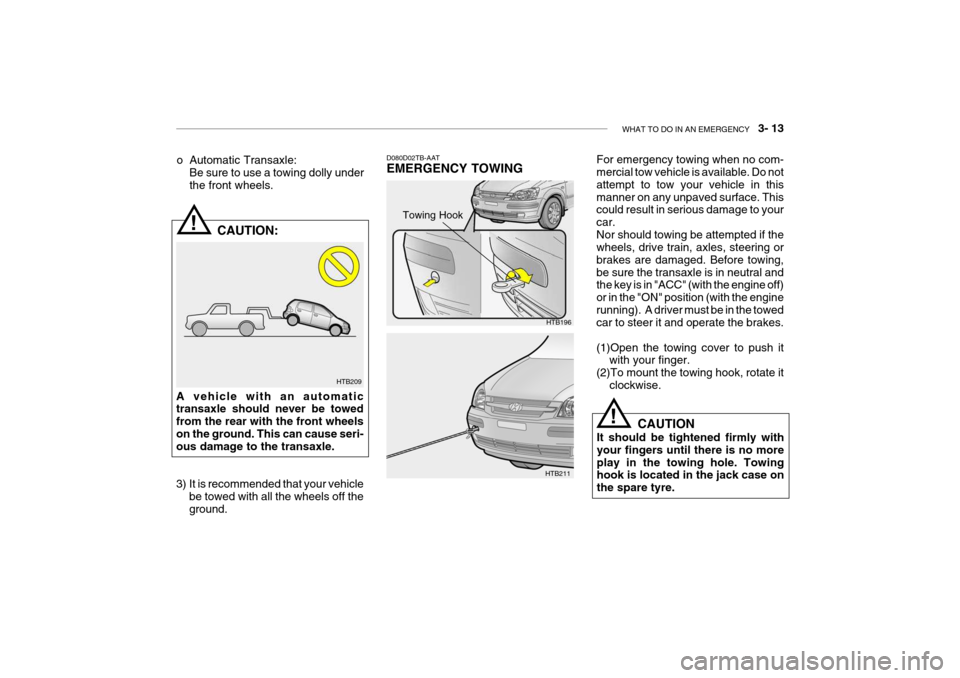
o Automatic Transaxle:
Be sure to use a towing dolly under the front wheels.
CAUTION:
A vehicle with an automatic transaxle should never be towed from the rear with the front wheelson the ground. This can cause seri- ous damage to the transaxle.
3) It is recommended that your vehicle be towed with all the wheels off the ground.
D080D02TB-AAT EMERGENCY TOWING For emergency towing when no com- mercial tow vehicle is available. Do not attempt to tow your vehicle in thismanner on any unpaved surface. This could result in serious damage to your car.Nor should towing be attempted if the wheels, drive train, axles, steering or brakes are damaged. Before towing,be sure the transaxle is in neutral and the key is in "ACC" (with the engine off) or in the "ON" position (with the enginerunning). A driver must be in the towed car to steer it and operate the brakes. (1)Open the towing cover to push it
with your finger.
(2)To mount the towing hook, rotate it clockwise.
HTB196
HTB211 CAUTION
It should be tightened firmly with your fingers until there is no moreplay in the towing hole. Towing hook is located in the jack case on the spare tyre.
!
Towing Hook
Page 130 of 437

3- 14 WHAT TO DO IN AN EMERGENCY
D120A01A-EAT IF YOU LOSE YOUR KEYS Information about the key of immobiliser system will be found on page 1-4. CAUTION:
If the car is being towed with allfour wheels on the ground, it can be towed only from the front. Be sure that the transaxle is in neu-tral. Do not tow at speeds greater
than 30 mph (50 km/h) and for more
than 15 miles(25 km).Be sure the steering is unlocked by placing the key in the "ACC" posi- tion. A driver must be in the towedvehicle to operate the steering and brakes.
!
(3)Attach a tow cable, chain or strap to
the towing hook on the front bumper.
Page 141 of 437

5- 6 VEHICLE MAINTENANCE REQUIREMENTS
MAINTENANCE UNDER SEVERE USAGE CONDITIONS
The following items must be serviced more frequently on cars normally used under severe driving conditions. Refer to the chart below for the appropriate maintenance intervals. R : REPLACE I : INSPECT AND, AFTER INSPECTION, CLEAN, ADJUST, REPAIRER OR REPLACE IF NECESSARY
F040A07A-EAT
ENGINE OIL AND FILTER AIR CLEANER FILTERSPARK PLUGSTIMING BELTBRAKE PADSREAR BRAKE LININGS AND CYLINDERSSUSPENSION AND STEERING SYSTEM MANUAL TRANSAXLE OIL AUTOMATIC TRANSAXLE FLUIDPOLLEN FILTER(FOR EVAPORATOR AND BLOWER UNIT) EVERY 4,500MILES OR 6 MONTHS
MORE FREQUENTLYMORE FREQUENTLY EVERY 37,000MILES OR 48 MONTHSMORE FREQUENTLY MORE FREQUENTLY MORE FREQUENTLYEVERY 60,000MILES EVERY 27,000MILES
MORE FREQUENTLY
MAINTENANCE OPERATIONMAINTENANCE ITEM
R RR RI II
RR R A, B, C, D, E, F, G, H, I, K C, EB, H D, E, F, G C, D, G, HC, D, G, HC, D, E, F A, C, D, E, F, G, H, I, J A, C, E, F, G, H, I C,E
MAINTENANCE INTERVALS
DRIVING
CONDITION
SEVERE DRIVING CONDITIONS
A - Repeatly driving short distance of less than 5miles(8km) in normal temperature or less than 10miles(16km) in freezing temperature
B - Extensive engine idling or low speed driving for long distances
C - Driving on rough, dusty, muddy, unpaved, graveled or salt- spread roads
D - Driving in areas using salt or other corrosive materials or in very cold weather E - Driving in sandy areas
F - Driving in heavy traffic area over 90°F(32°C) G - Driving on uphill, downhill, or mountain roadH - Towing a Trailer, or using a camper, or roof rack
I - Driving as a patrol car, taxi, other commercial use or vehicle towing
J - Driving over 100 MPH(170 Km/h)K - Frequently driving in stop-and-go conditions
Page 190 of 437

8- 6 CONSUMER INFORMATION
I100A01TB-EAT SPARE TIRE AND TOOLS
Your Hyundai is delivered with the fol- lowing: Spare tyre and wheel Wheel nut wrench, Wrench bar, Spanner, Screw driver Jack, Towing Hook HTB224
Page 196 of 437

10- 2 INDEX
A AIR BAG ................................................................... 1-30
AIR CONDITIONING SWITCH .................................1-74
AIR CONDITIONING SYSTEM MAINTENANCE ..... 6-19
AIR CLEANER FILTER ............................................. 6-14
ANTENNA ................................................................. 1-84
ANTI-LOCK BRAKE SYSTEM .................................. 2-13
ANTI-THEFT ALARM SYSTEM .................................. 1-7
ASHTRAY ................................................................. 1-54
AUTO FUEL CUT SW ITCH...................................... 1-68
AUTOMATIC TRANSAXLE ......................................... 2-9AUTOMATIC TRANSAXLE FLUID ...........................6-16
BBATTERY MAINTENANCE ......................................6-25
BEFORE STARTING THE ENGINE ...........................2-3
BONNET RE LEASE.................................................. 1-62
BRAKE PEDAL FREEPLAY .....................................6-22
BRAKE SYSTEM CHECKING ..................................6-18
CCARE OF DISC ......................................................... 1-82
CARE OF SEAT BELTS .... .......................................1-19
CARGO AREA COVER ............................................ 1-66
CATALYTIC CONVERTOR OPERATING PRECAUTIONS ...................................................... 7-3
CENTRAL DOOR LOCKS .......................................... 1-5
CHANGING A FLAT TYRE ......................................... 3-6 CHILD-PROOF REAR DOOR
LOCK .......................... 1-5
CHILD RESTRAINT SYSTEM ..................................1-22
CIGAR LIGHTER ...................................................... 1-53
CLUTCH PEDAL FR EEPLAY................................... 6-22
COMBINATION IGNITION SWITCH AND STEERING LOCK ................................................... 2-3
CONSOLE TRAY ...................................................... 1-54
COOLANT TEMPERATURE GAUGE .......................1-44
DDAILY OPERATING CHECKS .................................... 6-6
DIGITAL CLOCK ....................................................... 1-53
DOOR LOCK S ............................................................ 1-5
DOOR WINDOWS .................................................... 1-10
DRINK HOLDER ....................................................... 1-54
DRIVE BELTS ........................................................... 6-23
DRIVING FOR ECONOMY .......................................2-14
EEFFECTIVE BRA KING............................................. 2-13
ELECTRIC COOLING FANS ....................................6-25
EMERGENCY TOWING .... .......................................3-12
EMISSION CONTROL SYSTEM ................................ 7-2
ENGINE COMPARTMENT .................... ..................... 6-2
ENGINE COOLANT CHECKING AND REPLACING ......................................................... 6-10
ENGINE OIL AND FILTER REPLACEMENT .............. 6-9
ENGINE OIL CONSUMPTION ................................... 6-8
Page 199 of 437

INDEX 10- 5
SUPPLEMENTAL RESTRAINT (AIRBAG)
SYSTEM ............................................................... 1-30
STARTING THE ENGI NE ........................................... 2-5
STEERING WHEEL FREEPLAY ..............................6-21
STEERING WHEEL LOCK ......................................... 2-4 STEERING WHEEL TILT LEVER ............................. 1-69
STEREO SOUND SYSTEM ......................................1-80
SUN-VISOR .............................................................. 1-69
SUNROOF ................................................................ 1-55
TTACHOMETER ......................................................... 1-45
TAIL GATE ................................................................ 1-64
TOWING ATTACHMENTS ................. ...................... 2-17
TRAILER AND CARAVAN TOWING ........................2-17
TRIP ODOMETER .................................................... 1-45
TRIP COMPUTER .................................................... 1-46
TYPE PRESSURES .................................................... 8-3
TYRE BALANCING ..................................................... 8-5
TYRE CHAINS ............................................................ 8-4
TYRE REPLACEMENT ............................................... 8-5
TYRE ROTATION ....................................................... 8-4
U
UNDERBODY COATINGS ......................................... 4-2 V VALETING
.................................................................. 4-3
VEHICLE IDENTIFICATION NUMBER ....................... 8-2
VEHICLE SPECIFICATION ........................................ 9-2 VEHICLE TOWING OR RECOVERY ....................... 3-11
VENTILATION .......................................................... 1-71
W
WHEEL REPLACEMENT ..... ...................................... 8-5
WINDSCREEN WASHER RESERVOIR REPLENISHMENT ................................................ 6-15
WINDSCREEN WIPER BLADES ..............................6-14
WINDSHIELD WIPER/WASHER SWITCH ...............1-50
WINTER MOTORING ............................................... 2-15
Page 256 of 437
1- 44 FEATURES OF YOUR HYUNDAI
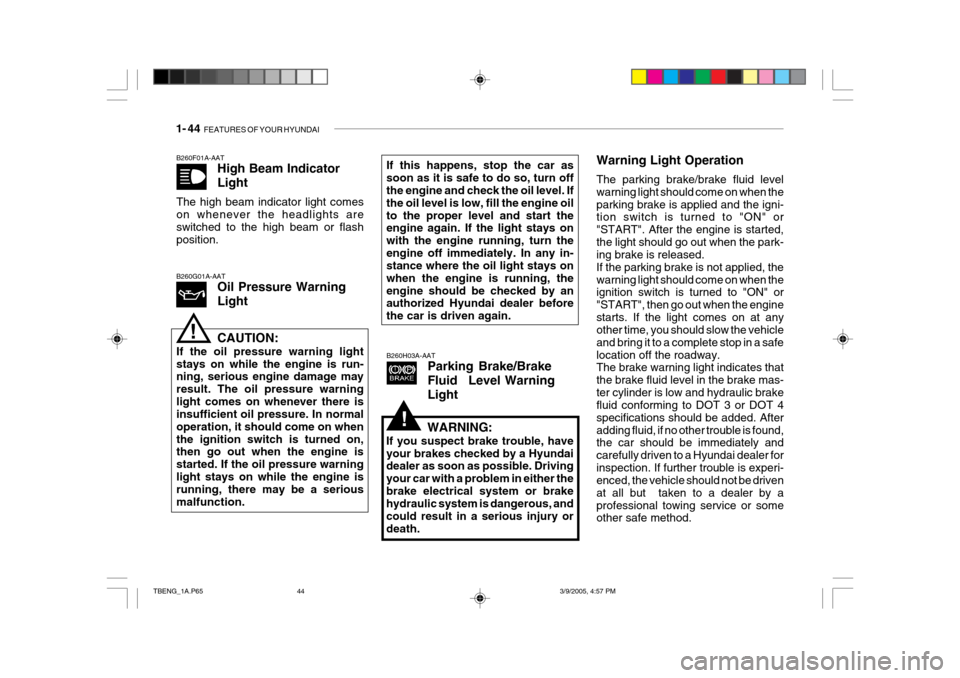
B260F01A-AAT
High Beam Indicator Light
The high beam indicator light comes on whenever the headlights are switched to the high beam or flashposition.
B260H03A-AATParking Brake/Brake
Fluid Level WarningLight
B260G01A-AATOil Pressure Warning Light
!CAUTION:
If the oil pressure warning light stays on while the engine is run- ning, serious engine damage may result. The oil pressure warninglight comes on whenever there is insufficient oil pressure. In normal operation, it should come on whenthe ignition switch is turned on, then go out when the engine is started. If the oil pressure warninglight stays on while the engine is running, there may be a serious malfunction. If this happens, stop the car assoon as it is safe to do so, turn off the engine and check the oil level. If the oil level is low, fill the engine oilto the proper level and start the engine again. If the light stays on with the engine running, turn theengine off immediately. In any in- stance where the oil light stays on when the engine is running, theengine should be checked by an authorized Hyundai dealer before the car is driven again.
Warning Light Operation The parking brake/brake fluid level warning light should come on when theparking brake is applied and the igni- tion switch is turned to "ON" or "START". After the engine is started,the light should go out when the park- ing brake is released. If the parking brake is not applied, thewarning light should come on when the ignition switch is turned to "ON" or "START", then go out when the enginestarts. If the light comes on at any other time, you should slow the vehicle and bring it to a complete stop in a safelocation off the roadway. The brake warning light indicates that the brake fluid level in the brake mas-ter cylinder is low and hydraulic brake fluid conforming to DOT 3 or DOT 4 specifications should be added. Afteradding fluid, if no other trouble is found, the car should be immediately and carefully driven to a Hyundai dealer forinspection. If further trouble is experi- enced, the vehicle should not be driven at all but taken to a dealer by aprofessional towing service or some other safe method.
WARNING:
If you suspect brake trouble, have your brakes checked by a Hyundai dealer as soon as possible. Driving your car with a problem in either thebrake electrical system or brake hydraulic system is dangerous, and could result in a serious injury ordeath.
!
TBENG_1A.P65 3/9/2005, 4:57 PM
44
Page 324 of 437

2. DRIVING YOUR HYUNDAI
2
Before starting the engine .............................................................. 2-3
Key position .................................................................................... 2-4Starting............................................................................................ 2-5
Operating the manual transaxle ..................................................... 2-7
Automatic transaxle ........................................................................ 2-9
Good braking practices ................................................................. 2-12
Anti-Lock brake system (ABS) ...................................................... 2-13
Driving for economy ...................................................................... 2-14
Winter Driving ............................................................................... 2-15
Trailer or vehicle towing ................................................................ 2-18
TBENG_2.P65 3/9/2005, 5:00 PM
1
Page 341 of 437

2- 18 DRIVING YOUR HYUNDAI
C190C03S-GAT Trailer Brakes If your trailer is equipped with a braking system, make sure it conforms to fed-eral and/or local regulations and that it is properly installed and operating cor- rectly. NOTE: If you tow a trailer or vehicle, your car will require more frequent main- tenance due to the additional load.See "Maintenance Under Severe Usage Conditions" on page 5-5.
CAUTION:
o Never connect a trailer brake sys- tem directly to the vehicle brake system.
o When towing a trailer on steep
grades (in excess of 12%) payclose attention to the engine cool- ant temperature gauge to ensure the engine does not overheat. Ifthe needle of the coolant tem- perature gauge moves across the dial towards "H" (HOT), pull overand stop as soon as it is safe to do so, and allow the engine to
!
C180A01A-AAT USE OF LIGHTS Check your lights regularly for correct operation and always keep them clean.When driving during the day in condi- tions of poor visibility, it is helpful to drive with headlights on low beam.This enables you to be seen as well as to see. C190A02A-GAT TRAILER OR VEHICLE TOWING If you are considering towing with your car, you should first check with your Province Department of Motor Vehicles to determine their legal requirements.Since laws vary from province to prov- ince, the requirements for towing trail- ers, cars, other types of vehicles, orapparatus may differ. Ask your Hyundai dealer for further details before towing. C190B01S-AAT Trailer Hitches Select the proper hitch and ball combi- nation, making sure that it's location iscompatible with that of the trailer or vehicle being towed. Use a quality non-equalizing hitch whichdistributes the tongue load uniformly throughout the chassis. The hitch should be bolted securely to the car and installed by a qualified technician. DO NOT USE A HITCHDESIGNED FOR TEMPORARY IN- STALLATION AND NEVER USE ONE THAT ATTACHES ONLY TO THEBUMPER.
!
CAUTION
Do not do any towing with your car during its first 2,000 km (1,200 miles) in order to allow the engine to prop- erly break in. Failure to heed thiscaution may result in serious en- gine or transaxle damage.
TBENG_2.P65 3/9/2005, 5:00 PM
18
Page 342 of 437

DRIVING YOUR HYUNDAI 2- 19
C190E02TB-GAT Trailer Weight Limit
Tongue load
Total trailer weight
C190E01L
C190D01A-GAT Safety Chains Should the hitch connection between your car and the trailer or vehicle youare towing fail, the trailer or vehicle could wander dangerously across other lanes of traffic and ultimately collidewith another vehicle. To eliminate this potentially dangerous situation, safety chains, attached between your car andthe trailer or towed vehicle, are re- quired in most provinces.
Tongue loads can be increased or decreased by redistributing the load in the trailer. This can be verified by checking the total weight of the loadedtrailer and then checking the load on the tongue. NOTE:
1. Never load the trailer with more
weight in the back than in the front. About 60% of the trailer load should be in the front halfon the trailer and the remaining 40% in the rear.
idle until it cools down. You mayproceed once the engine has cooled sufficiently.
2. The total gross vehicle weight
with trailer must not exceed the Gross Vehicle Weight Rating(GVWR) shown on the vehicle identification plate (see page 8- 1). The total gross vehicle weightis the combined weight of the vehicle, driver, all passengers and their luggage, cargo, hitch,trailer tongue load and other op- tional equipment.
3. The front or rear axle weight must not exceed the Gross Axle WeightRating (GAWR) shown on the vehicle identification plate (see
page 8-2). It is possible that your towing package does not exceed the GVWR but exceeds theGAWR. Improper trailer loading and/or too much luggage in the trunk can overload the rear axle.Redistribute the load and check the axle weight again.
4. The maximum permissible static vertical load on the coupling de-vice ; 44kg
TBENG_2.P65 3/9/2005, 5:00 PM
19