ECU Hyundai Getz 2005 Owner's Guide
[x] Cancel search | Manufacturer: HYUNDAI, Model Year: 2005, Model line: Getz, Model: Hyundai Getz 2005Pages: 437, PDF Size: 11.19 MB
Page 285 of 437

FEATURES OF YOUR HYUNDAI 1- 73
B610B01A-GAT HORN
Press the center hub of the steering wheel to sound the horn. HTB110-1
B600A01A-AAT STEERING WHEEL TILT LEVER (If Installed) To Adjust the Steering Wheel:
HTB085-1
1. Push the lever downward to unlock.
2. Raise or lower the steering wheel to the desired position.
3. After adjustment, securely tighten the lever by pulling it upward.
!WARNING:
Do not attempt to adjust the steer- ing wheel while driving as this may result in loss of control of the ve-hicle which may cause serious in- jury or death.
Your Hyundai is equipped with sunvisors to give the driver and front pas- senger either frontal or side ward shade.The sun visors are fitted on both sides on all models. To reduce glare or to shut out direct rays of the sun, turn thesun visor down to block the annoy- ance. A ticket holder is provided on the back of the sun visor for the driver.Vanity mirrors are provided on the back of the sunvisor for the driver and the front passenger (If installed). NOTE: The Supplemental Restraint Sys- tem (SRS) label containing useful information can be found on the front of each sun visor.
WARNING:
Do not place the sun visor in such a manner that it obscures visibility of the roadway, traffic or other ob-jects.
!
TBENG_1A.P65 3/9/2005, 4:58 PM
73
Page 341 of 437

2- 18 DRIVING YOUR HYUNDAI
C190C03S-GAT Trailer Brakes If your trailer is equipped with a braking system, make sure it conforms to fed-eral and/or local regulations and that it is properly installed and operating cor- rectly. NOTE: If you tow a trailer or vehicle, your car will require more frequent main- tenance due to the additional load.See "Maintenance Under Severe Usage Conditions" on page 5-5.
CAUTION:
o Never connect a trailer brake sys- tem directly to the vehicle brake system.
o When towing a trailer on steep
grades (in excess of 12%) payclose attention to the engine cool- ant temperature gauge to ensure the engine does not overheat. Ifthe needle of the coolant tem- perature gauge moves across the dial towards "H" (HOT), pull overand stop as soon as it is safe to do so, and allow the engine to
!
C180A01A-AAT USE OF LIGHTS Check your lights regularly for correct operation and always keep them clean.When driving during the day in condi- tions of poor visibility, it is helpful to drive with headlights on low beam.This enables you to be seen as well as to see. C190A02A-GAT TRAILER OR VEHICLE TOWING If you are considering towing with your car, you should first check with your Province Department of Motor Vehicles to determine their legal requirements.Since laws vary from province to prov- ince, the requirements for towing trail- ers, cars, other types of vehicles, orapparatus may differ. Ask your Hyundai dealer for further details before towing. C190B01S-AAT Trailer Hitches Select the proper hitch and ball combi- nation, making sure that it's location iscompatible with that of the trailer or vehicle being towed. Use a quality non-equalizing hitch whichdistributes the tongue load uniformly throughout the chassis. The hitch should be bolted securely to the car and installed by a qualified technician. DO NOT USE A HITCHDESIGNED FOR TEMPORARY IN- STALLATION AND NEVER USE ONE THAT ATTACHES ONLY TO THEBUMPER.
!
CAUTION
Do not do any towing with your car during its first 2,000 km (1,200 miles) in order to allow the engine to prop- erly break in. Failure to heed thiscaution may result in serious en- gine or transaxle damage.
TBENG_2.P65 3/9/2005, 5:00 PM
18
Page 343 of 437

2- 20 DRIVING YOUR HYUNDAI
C190F02A-GAT Trailer or Vehicle Towing Tips
1. Before towing, check hitch and
safety chain connections as well as proper operation of the trailerrunning lights, brake lights, and turn signals.
2. Always drive your vehicle at a mod- erate speed (Less than 100 km/h).
3. Trailer towing requires more fuel
than normal conditions.
4. To maintain engine braking effi- ciency and electrical charging per- formance, do not use fifth gear(manual transaxle) or overdrive (au- tomatic transaxle).
5. Always secure items in the trailer to prevent load shift while driving.
Tongue
44
(97)
Without Brake Type Trailer
700 (1,543)
1000 (2,204)
1,100 (2,425) 1,100 (2,425) 900(1,984)
1,100 (2,425) 450(992)
MANUAL
TRANSAXLE
AUTO
TRANSAXLE
1.1L 1.3L1.6L
Diesel 1.3L1.6L
With
Brake Type
kg. (Lbs)
Coupling point
HTB312
C190E02L
Gross Axle Weight
Gross Vehicle
Weight
!!
Maximum Towable
Weight
5. The maximum permissible over-
hang of the coupling point : 690 mm CAUTION:
The following specifications are rec-ommended when towing a trailer.The loaded trailer weigh cannot safely exceed the values in the fol- lowing chart. WARNING:
Improperly loading your car andtrailer can serious affect its steer- ing and braking performance caus- ing a crash in which could causeserious injury or death.
Type
TBENG_2.P65 3/9/2005, 5:00 PM
20
Page 344 of 437

DRIVING YOUR HYUNDAI 2- 21
!
6. Check the condition and air pres-
sure of all tires on the trailer and your car. Low tire pressure canseriously affect the handling. Also check the spare tire.
7. The vehicle/trailer combination is more affected by crosswind andbuffeting. When being passed by a largevehicle, keep a constant speed and steer straight ahead. If there is too much wind buffeting slow downto get out of the other vehicle's air turbulence.
8. When parking your car and trailer, especially on a hill, be sure to fol-low all the normal precautions. Turn your front wheel into the curb, setthe parking brake firmly, and put the transaxle in 1st or Reverse (manual) or Park (automatic). Inaddition, place wheel chocks at each of the trailer's tires.
9. If the trailer has electric brakes, start your vehicle and trailer mov-ing, and then apply the trailer brake controller by hand to be sure thebrakes are working. This lets you check your electrical connection at the same time. 10. During your trip, check occasion-
ally to be sure that the load issecure, and that the lights andany trailer brakes are still working.
11. Avoid jerky starts, sudden accel-
eration or sudden stops.
12. Avoid sharp turns and rapid lane changes.
13. Avoid holding the brake pedal down too long or too frequently. This could cause the brakes to over- heat, resulting in reduced brakingefficiency.
14. When going down a hill, shift into a
lower gear and use the engine brak-ing effect. When ascending a long grade, downshift the transaxle to a lowergear and reduce speed to reduce chances of engine overloading and/ or overheating.
15. If you have to stop while going uphill, do not hold the vehicle inplace by pressing on the accelera-tor. This can cause the automatic transaxle to overheat. Use the park- ing brake or footbrake. NOTE: When towing check transaxle fluid more frequently.
CAUTION:
If overheating should occur whentowing, (temperature gauge reads near red zone), taking the followingaction may reduce or eliminate the problem.
1. Turn off the air conditioner.
2. Reduce highway speed.
3. Select a lower gear when going uphill.
4. While in stop and go traffic, place
the gear selection in park or neu- tral and idle the engine at a higher speed.
TBENG_2.P65 3/9/2005, 5:00 PM
21
Page 346 of 437
3- 2 WHAT TO DO IN AN EMERGENCY
HTB165
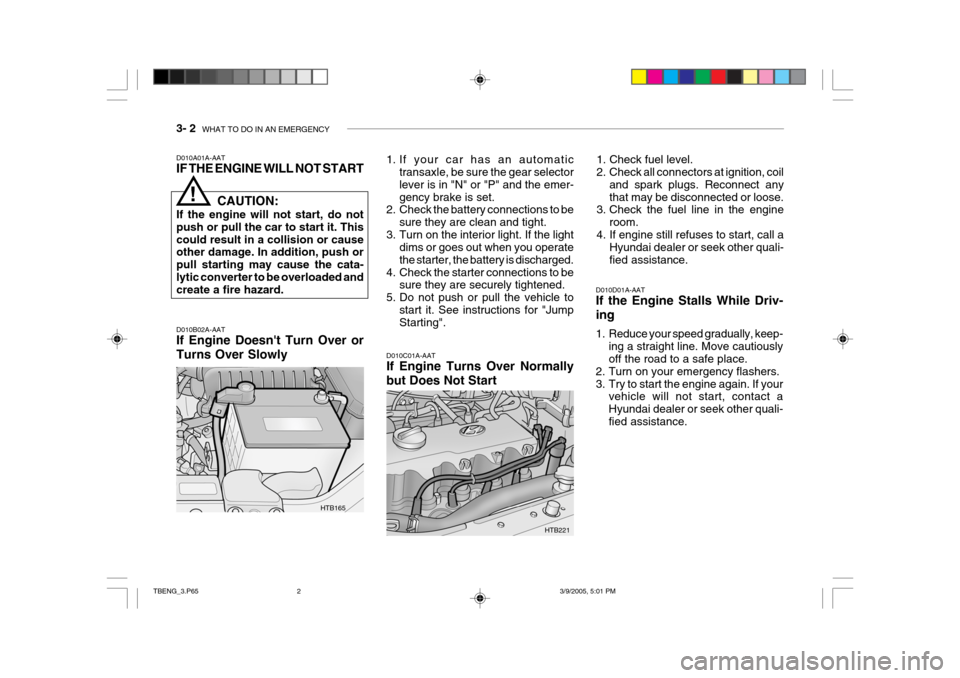
D010B02A-AAT If Engine Doesn't Turn Over or Turns Over Slowly 1. If your car has an automatic
transaxle, be sure the gear selector lever is in "N" or "P" and the emer-gency brake is set.
2. Check the battery connections to be
sure they are clean and tight.
3. Turn on the interior light. If the light dims or goes out when you operatethe starter, the battery is discharged.
4. Check the starter connections to be sure they are securely tightened.
5. Do not push or pull the vehicle to start it. See instructions for "Jump Starting".
D010C01A-AAT If Engine Turns Over Normally but Does Not Start 1. Check fuel level.
2. Check all connectors at ignition, coil
and spark plugs. Reconnect any that may be disconnected or loose.
3. Check the fuel line in the engine
room.
4. If engine still refuses to start, call a Hyundai dealer or seek other quali-fied assistance.
D010D01A-AAT If the Engine Stalls While Driv- ing
1. Reduce your speed gradually, keep- ing a straight line. Move cautiously off the road to a safe place.
2. Turn on your emergency flashers.
3. Try to start the engine again. If your vehicle will not start, contact aHyundai dealer or seek other quali-fied assistance.
D010A01A-AAT IF THE ENGINE WILL NOT START
CAUTION:
If the engine will not start, do not push or pull the car to start it. Thiscould result in a collision or cause other damage. In addition, push or pull starting may cause the cata-lytic converter to be overloaded and create a fire hazard.
!
HTB221
TBENG_3.P65 3/9/2005, 5:01 PM
2
Page 348 of 437
3- 4 WHAT TO DO IN AN EMERGENCY
D030A02TB-AAT IF THE ENGINE OVERHEATS If your temperature gauge indicates overheating, you experience a loss of power, or hear loud pinging or knock- ing, the engine is probably too hot. Ifthis happens to you, you should:
1. Pull off the road and stop as soon as
it is safe to do so.
2. Place the gear selector lever in "P"
(automatic), or neutral (manual transaxle) and set the parking brake. If the air conditioning is on, turn it off.
6. Carefully remove the jumper cables
in the reverse order of attachment.
If you do not know why your battery became discharged (because the lights were left on, etc.), have the chargingsystem checked by your Hyundai dealer. 3. If engine coolant is running out un-
der the car or steam is coming out from the hood, stop the engine. Donot open the hood until the engine coolant has stopped running or the steaming has stopped. If there is novisible loss of engine coolant and no steam, leave the engine running and check to be sure the enginecooling fan is operating. If the fan is not running, turn the engine off.
4. Check to see if the water pump drive
belt is missing. If it is not missing,check to see that it is tight. If the drive belt seems to be satisfactory,check for coolant leaking from the radiator, hoses or under the car. (If the air conditioning had been in use,it is normal for cold water to be draining from it when you stop). WARNING (Diesel only):
Never work on injection system with engine running or within 30 sec- onds after shutting off engine. High pressure pump, rail, injectors andhigh pressure pipes are subject to high pressure even after the engine stopped. The fuel jet produced byfuel leaks may cause serious in- jury, if it touch the body. People using pacemakers should not movethan 30cm closer to the ECU or wiring harness within the engine room while engine is running, sincethe high currents in the Common Rail system produce considerable magnetic fields.
WARNING:
While the engine is running, keep hair, hands, and clothing away from moving parts such as the fan anddrive belts to prevent injury.
!
!
5. If the water pump drive belt is bro- ken or coolant is leaking out, stop the engine immediately and call the nearest Hyundai dealer for assis-tance.
TBENG_3.P65 3/9/2005, 5:01 PM
4
Page 355 of 437

WHAT TO DO IN AN EMERGENCY 3- 11
Lower the car to the ground by turning the wheel nut wrench counterclock-wise. Then position the wrench as shown in the drawing and tighten the wheel nuts. Be sure the socket is seatedcompletely over the nut. Do not stand on the wrench handle or use an exten- sion pipe over the wrench handle.Go around the wheel tightening every other nut until they are all tight. Then double-check each nut for tightness.After changing wheels, have a techni- cian tighten the wheel nuts to their proper torque as soon as possible.
D060I01E-GAT 8. Lower Vehicle and Tighten Nuts
D060J01FC-GAT After Changing Wheels If you have a tire gauge, remove the valve cap and check the air pressure.If the pressure is lower than recom- mended, drive slowly to the nearest service station and inflate to the cor-rect pressure. If it is too high, adjust it until it is correct. Always reinstall the valve cap after checking or adjustingtire pressure. If the cap is not replaced, air may leak from the tire. If you lose a valve cap, buy another and install it assoon as possible.
Wheel nut tightening torque: Steel wheel & aluminium alloy wheel: 900-1,100 kg.cm (65-80 lb.ft)
HTB150
HTB151 After you have changed wheels, al- ways secure the flat tire in its place in the luggage room and return the jackand tools to their proper storage loca- tions. D080A01O-GAT IF YOUR VEHICLE MUST BE TOWED If your vehicle has to be towed, it should be done by your Hyundai dealeror a commercial tow truck service. This will help assure that your vehicle is not damaged in towing. Also, profes-sionals are generally aware of local laws governing towing. In any case, rather than risk damage to your car, itis suggested that you show this infor- mation to the tow truck operator. Be sure that a safety chain system is usedand that all local laws are observed. It is recommended that your vehicle be towed with a wheel lift and dollies orflatbed equipment with all the wheels off the ground.
TBENG_3.P65
3/9/2005, 5:02 PM
11
Page 372 of 437

5- 8 VEHICLE MAINTENANCE REQUIREMENTS
F060A01A-AAT EXPLANATION OF SCHEDULED MAINTENANCE ITEMS F060M01A-AAT
o Engine Oil and Filter The engine oil and filter should be changed at the intervals specified in the maintenance schedule. If the car is being driven in severe conditions,more frequent oil and filter changes are required. F060B01A-AAT
o Drive Belts Inspect all drive belts for evidence of cuts, cracks, excessive wear or oil and replace if necessary. Drive beltsshould be checked periodically for proper tension and adjusted as nec- essary. placement more frequently.
After installing a new filter, run the
engine for several minutes, and check for leaks at the connections. Fuel fil- ters should be installed by trainedtechnicians.
F060D01TB-AAT
o Fuel Lines, Fuel Hoses and
Connections
Check the fuel lines, fuel hoses and
connections for leakage and damage.Have a trained technician replace anydamaged or leaking parts immedi- ately. F060E01A-AAT
o Timing Belt
Inspect all parts related to the timingbelt for damage and deformation. Replace any damaged parts immedi-ately. F060G01A-AAT
o Vapor Hose and Fuel Filler Cap
The vapor hose and fuel filler cap should be inspected at those intervals specified in the maintenance sched-ule. Make sure that a new vapor hose or fuel filler cap is correctly replaced.
F060C01A-AAT
o Fuel Filter A clogged filter can limit the speed at which the vehicle may be driven, dam- age the emission system and cause hard starting. If an excessive amountof foreign matter accumulates in the fuel tank, the filter may require re-
!WARNING (Diesel only):
Never work on injection system with
engine running or within 30 sec- onds after shutting off engine. High pressure pump, rail, injectors and high pressure pipes are subjectedto high pressure even after the en- gine has been switched off. The fuel jet produced by fuel leaks maycause serious injury, if it contacts with the body. People using pace- makers should not move closerthan 30cm to the ECU or wiring harness within the engine room with the engine running, since the high currents in the Common Railsystem produce considerable mag- netic fields.
TBENG_5.P65
3/9/2005, 5:03 PM
8
Page 373 of 437
VEHICLE MAINTENANCE REQUIREMENTS 5- 9
F060H01A-AAT
o Air Cleaner Filter
A Genuine Hyundai air cleaner filter is recommended when filter is replaced. F060J01A-AAT
o Spark Plugs
Make sure to install new spark plugs
of the correct heat range. F070C01A-AAT o Engine Coolant The coolant should be changed at the intervals specified in the mainte- nance schedule. F070D01A-AAT
o Manual Transaxle Oil Inspect the manual transaxle oil ac- cording to the maintenance schedule. NOTE: If the oil level is low, check for possible leaks before adding oil. Do not overfill. F070E05A-AAT
o Automatic Transaxle Fluid The fluid level should be in the "HOT" range of the dipstick, after the engineand transaxle are at normal operating temperature. Check the automatic transaxle fluid level with the enginerunning and the transaxle in neutral, with the parking brake properly ap- plied. Use Hyundai Genuine ATF SP-III, DIAMOND ATF SP-III, SK ATF SP-III or other brands appraoved by Hyundai Motor Co., when adding orchanging fluid.
F060F01A-AAT
o Vacuum, Crankcase Ventila-
tion Hoses
Inspect the surface of hoses for evi-dence of heat and/or mechanical dam-age. Hard and brittle rubber, cracking, tears, cuts, abrasions, and excessive swelling indicate deterioration. Partic-ular attention should be paid to exam- ine those hose surfaces nearest to high heat sources, such as the ex-haust manifold.Inspect the hose routing to assurethat the hoses do not come in contact with any heat source, sharp edges or moving component which might causeheat damage or mechanical wear. Inspect all hose connections, such as clamps and couplings, to make surethey are secure, and that no leaks are present. Hoses should be replaced immediately if there is any evidenceof deterioration or damage. F070B01A-GAT
o Cooling System
Check the cooling system part, such
as radiator, coolant reservoir, hosesand connections for leakage and dam- age. Replace any damaged parts. F060N01X-GAT
o Valve clearances (1.1 L)
Incorrect valve clearance will not only
result in unsteady engine operation,but will also cause excessive noise and reduced engine performance. In-spect valve clearance and adjust as required while the engine is hot.
Valve-to-rocker arm clearance Intake valves ..... 0.2 mm (0.008 in.) Exhaust valves ... 0.25 mm (0.010 in.)
TBENG_5.P65 3/9/2005, 5:03 PM
9
Page 389 of 437

6- 14 DO-IT-YOURSELF MAINTENANCE
HTB171-1
G050C01A-GAT To Check the Coolant Level The coolant level can be seen on the side of the plastic coolant reservoir.The level of the coolant should be between the "L" and "F" lines on the reservoir when the engine is cold. If thelevel is below the "L" mark, add engine coolant to bring it up between "L" and "F". If the level is low, inspect forcoolant leaks and recheck the fluid level frequently. If the level drops again, visit your Hyundai dealer for an inspec-tion and diagnosis of the reason. G050D02A-AAT To Change the Coolant The coolant should be changed at those intervals specified in the vehiclemaintenance schedule in Section 5.
CAUTION:
Engine coolant can damage the fin-ish of your car. If you spill engine coolant on the car, wash it off thor- oughly with clean water.
!
1. Park the car on level ground, set the parking brake and remove the ra- diator cap when cool.
2. Be sure your drain receptacle is in place. Open the drain cock on theradiator. Allow all the engine coolantto drain from the cooling system, then securely close the drain cock.
3. Check Section 9 for the capacity of
the cooling system in your car. Then,following the manufacturer's direc- tions on the engine coolant contain-er, add the appropriate quantity of coolant to the radiator. 4. Turn the radiator cap counterclock-
wise without pressing down on it, until it stops. This relieves any pres- sure remaining in the cooling sys- tem. And remove the radiator capby pushing down and turning coun- terclockwise. Now fill the radiator with clean dem-ineralized or distilled water. Con- tinue to add clean demineralized or distilled water in small quantitiesuntil the fluid level stays up in the radiator neck.
TBENG_6.P65 3/9/2005, 5:04 PM
14