maintenance Hyundai Getz 2005 Service Manual
[x] Cancel search | Manufacturer: HYUNDAI, Model Year: 2005, Model line: Getz, Model: Hyundai Getz 2005Pages: 437, PDF Size: 11.19 MB
Page 163 of 437

6- 18 DO-IT-YOURSELF MAINTENANCE
G120E01TB-EAT Brake Fluid Level
SG120A1-EBRAKE SYSTEM CHECKINGcurrents in the Common Rail system produce considerable magnetic fields.
!
CAUTION:
The automatic transaxle unit is a precision engineered assembly andcorrect operation is dependant upon the exclusion of dirt and lint from the unit. Therefore, it is imperative thatonly lint free cloth (eg nylon) is used for wiping the dipstick and that the area around the dipstick is thor-oughly clean prior to level checking or adding fluid. Fluid Capacity The total fluid capacity of the transaxle unit is 6.1 litres. SG120C2-E Brake Fluid Recommendations Only brake fluid conforming to DOT 3 or DOT 4 specifications or higher may be used in the braking system. Care shouldbe taken to observe the instructions and precautions printed upon the con- tainer.
!
CAUTION:
Correct operation of the braking sys- tem is essential to the safe operation of the vehicle and therefore, any main-tenance operations other than those listed below should be entrusted to a Hyundai authorised repairer.
The fluid level in the brake fluid reser-voir should be checked periodically.The level should be between the "MIN" and "MAX" marks on the side of the reservoir. If the level is at or below the"MIN" mark, fluid should be added. It should be borne in mind that the brake fluid level will decrease slightly as thefriction linings of the pads and shoes become worn and that this is a normal condition.
HTB166
Page 164 of 437

DO-IT-YOURSELF MAINTENANCE 6- 19
!WARNING:
Brake fluid is hygroscopic and should never be stored in an un- sealed container. The presence ofwater in the braking system will cause vapour locks and increase the possi- bility of brake fade along with pro-moting corrosion within the braking system. The brake fluid must be changed at the specified time or mile-age interval to ensure continued safe operation of the system. Brake fluid will cause rapid and serious damageto paintwork. If accidental spillage occurs, the affected area must be rinsed with water immediately. Donot allow brake fluid to come into SG140A1-E AIR CONDITIONING SYSTEM MAINTENANCECondenser Ensure that the condenser is periodi- cally inspected and that accumulationsof dirt, dead insects and leaves etc, are removed to ensure that the efficiency of the system is not impaired. Care mustbe exercised to ensure that the con- denser fins are not damaged during cleaning.
G140D01TB-EAT Compressor Drive BeltG140D01TB
Power steering
Crank pully
A/C pully
0.19 ~ 0.21 in. (5 ~ 5.5 mm)
1.1L
To add brake fluid;
1) If it is necessary, remove the air
cleaner cover.
2) Wipe away any dirt then unscrew the
fluid reservoir cap.
3) Slowly pour the recommended fluid into the reservoir using by a funnel. Do not overfill.
4) Carefully replace the cap on the res- ervoir and tighten. contact with the eyes or to be in-gested and ensure that fluid is safelystored away form the reach of chil- dren.
CRANK PULLEY
HTB219
A/C
TENSION PULLEY 0.315 in. (8mm)
1.3/1.6L
Page 165 of 437

6- 20 DO-IT-YOURSELF MAINTENANCE
B145A01TB-EAT CHANGING THE POLLEN FIL-
TER (In Front of evaporator unit)(Not all models) The pollen filter is located in front of the evaporator unit behind the glove box. It operates to decrease pollutants fromentering the car and to filter the air.
1. Remove the adjusting pins on both
sides of the glove box to open half the glove box.
HTB290-D
SG140D1-E Off Season Maintenance The air conditioning must be run for ten minutes or so weekly during periodswhen the system would not normally be used to ensure that the compressor and seals are lubricated. If this precautionis not observed the compressor seals may become stuck to the compressor shaft and damaged when the system isnext used resulting in a loss of refriger- ant and damage to the compressor.
SG140C1-E Checking the Refrigerant
1. Start the engine and run at idle for
several minutes with the refrigera- tion system running at the coldest setting.
2. Open the bonnet and inspect the sight glass on the top of the receiverdryer.
3. If the refrigerant charge is insuffi- cient, a flow of bubbles will be ob-served through the sight glass.
4. If the refrigerant charge is satisfac- tory, no bubbles will be observedthrough the sight glass. CAUTION:
Running the air conditioning systemwith a low refrigerant level may dam-age the compressor.
!
The air conditioning compressor drive belt should be checked to ensure free- dom from damage or excessive wearand correct tension. The belt tension is correct when the belt deflects by about 0.3 inches (8 mm) (1.1L: 5 ~ 5.5 mm)when a force of 98 N is applied to the belt halfway between the compressor and crankshaft pulleys. Adjustment ofthe belt should be entrusted to a Hyundai authorised repairer.
Page 166 of 437

DO-IT-YOURSELF MAINTENANCE 6- 21
SG150A1-E STEERING WHEEL FREEPLAY Steering wheel freeplay should be checked to ensure that the specified value is not exceeded.
HTB293-D
4. Replace the two filters.
CAUTION:
Be sure to install the pollen filter in the direction of the arrow sign. Un- less, it may cause noise or deteriora- tion.
5. Installation is the reverse order of disassembly.
!
3. Remove the filter cover to push the upside of the filter cover.
HTB291-D
2. Remove the cable and the wiring from the filter cover.
HTB292-D HTB161
1.18 in. (30 mm)
Page 167 of 437

6- 22 DO-IT-YOURSELF MAINTENANCE
G180A01A-GAT CHECKING BRAKE PEDAL CLEARANCE
G180A01L
1.78 in. (45.1 mm)
You need a helper to check the brake pedal clearance. With the engine run- ning, have your helper press down on the brake pedal several times and thenhold it down with a force of about 490 N (50 Kg, 110 lbs). The brake pedal clearance is the distance from the topsurface of the brake pedal to the as- phalt sheeting under the floor mat. If the brake pedal clearance is notwithin the limits specified in the illustra- tion, have it inspected by your Hyundai authorised repairer and adjusted orrepairered if necessary.SG170A1-E BRAKE PEDAL FREEPLAY
HXGS508
0.12 ~ 0.31 in. (3 ~ 8 mm)
The brake pedal freeplay should be checked with the engine turned off. Thepedal to floor clearance should be checked with the engine running and a load of 490 N applied to the pedal. Ifeither value is incorrect, the necessary adjustment should be performed by a Hyundai authorised repairer. Pedal tofloor clearance: 1.97 in. (50 mm)SG160A1-E CLUTCH PEDAL FREEPLAY
G160A01E
0.24 ~ 0.51 in. (6 ~ 13 mm)
The clutch pedal freeplay should be checked against the specified value. If the freeplay is not correct, the clutch should be adjusted by a Hyundaiauthorised repairer.
Page 168 of 437

DO-IT-YOURSELF MAINTENANCE 6- 23
The various engine drive belts must be checked for condition, tension and free- dom from damage and excessive wear.The tension of a new belt must be checked after thirty minutes running following fitment of the new belt to allowfor the initial belt stretch. G190B01TB-GAT CHECKING DRIVE BELTS (Diesel)
A/C comp.
Auto tensioner Pulley
G190B01TB
AlternatorPower steering pump
At the scheduled maintenance inspec- tion, belts should be examined forcracks, wear, fraying or other evidence of deterioration and replaced if neces- sary.Belt routing should also be checked to be sure there is no interference be- tween the belts and other parts of theengine.
Crankshaft Pulley
SG190A1-E DRIVE BELTS (Gasoline)
1.1L
1.3L/1.6L Alternator
0.37 ~ 0.43 in. (9.5 ~11.0 mm)
Water Pump Pulley
Alternator Pulley
0.2~0.24 in.(5.1~6 mm)
HTB186
Crankshaft pulley
HTB220
Water Pump Pulley
Page 169 of 437
6- 24 DO-IT-YOURSELF MAINTENANCE
!!
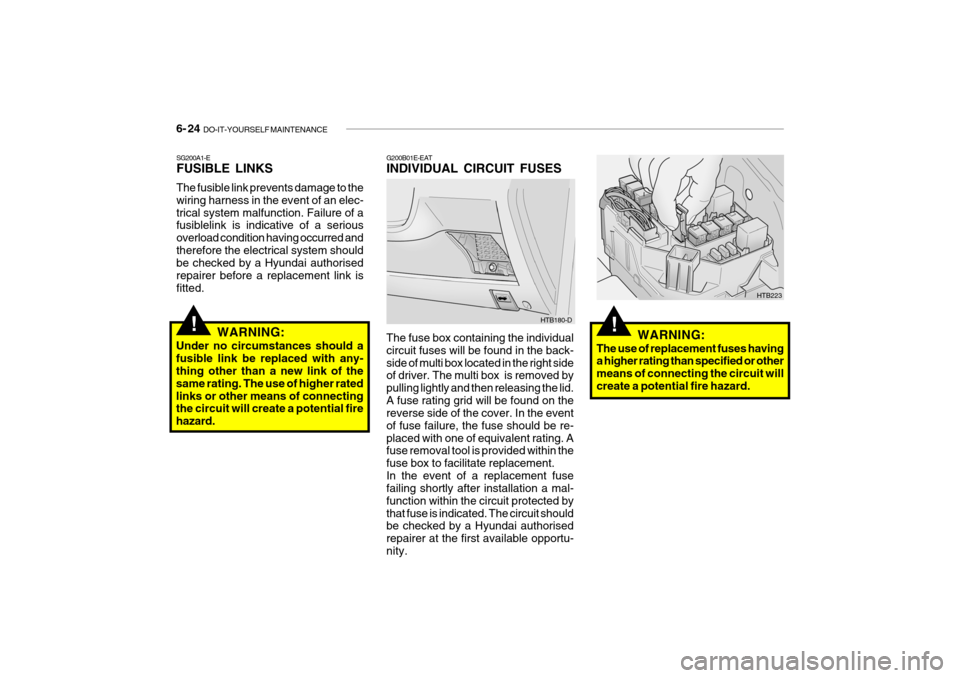
SG200A1-E FUSIBLE LINKS The fusible link prevents damage to the wiring harness in the event of an elec-trical system malfunction. Failure of a fusiblelink is indicative of a serious overload condition having occurred andtherefore the electrical system should be checked by a Hyundai authorised repairer before a replacement link isfitted.
WARNING:
Under no circumstances should afusible link be replaced with any- thing other than a new link of the same rating. The use of higher ratedlinks or other means of connecting the circuit will create a potential fire hazard.G200B01E-EAT INDIVIDUAL CIRCUIT FUSES The fuse box containing the individual circuit fuses will be found in the back-side of multi box located in the right side of driver. The multi box is removed by pulling lightly and then releasing the lid.A fuse rating grid will be found on the reverse side of the cover. In the event of fuse failure, the fuse should be re-placed with one of equivalent rating. A fuse removal tool is provided within the fuse box to facilitate replacement.In the event of a replacement fuse failing shortly after installation a mal- function within the circuit protected bythat fuse is indicated. The circuit should be checked by a Hyundai authorised repairer at the first available opportu-nity. HTB180-D
HTB223
WARNING:
The use of replacement fuses having a higher rating than specified or other means of connecting the circuit willcreate a potential fire hazard.
Page 170 of 437

DO-IT-YOURSELF MAINTENANCE 6- 25
!
!
o If battery electrolyte is spilled onto
skin or into eyes, the effected area must be flushed with copiousamounts of water and medical assis- tance sought.
o If battery electrolyte is ingested, copious amounts of water or milkfollowed by an ant-acid (raw egg or milk of magnesia) must be drunk.Vomiting should not be induced and medical assistance must be sought.
o Batteries must only be charged in well venti-lated areas from whichnaked lights or sources of sparks are excluded.
o Ensure that children, pets or other unauthorized persons are kept awayfrom batteries.
o Do not allow anything to bridge the positive (+) and negative (-) termi-nals of the battery.
o Never invert the battery. The battery fitted during production is of the "Maintenance Free" type.
SG210A1-E BATTERY MAINTENANCE
WARNING:
Motor vehicle batteries contain sulphuric acid which is corrosive and poisonous. Hydrogen gas isemitted from the battery which is explosive when combined with oxy- gen. The following precautions mustbe strictly observed to avoid per- sonal injury or damage to the ve- hicle.
HTB165 SG220A1-E ELECTRIC COOLING FANS
WARNING:
The cooling fan is controlled by en- gine coolant temperature and maysometimes operate even when the engine is not running. Use extreme caution when working near theblades of the cooling fan so that you are not injured by a rotating fan blade. As the engine coolant tem-perature decreases, the fan will auto- matically shut off. This is a normal condition. The engine cooling fan should operate before the temperature gauge reachesthe upper portion of the scale and the condenser fan should operate when- ever the air conditioning is in use.
Page 171 of 437

6- 26 DO-IT-YOURSELF MAINTENANCE
HTB287
SG230B1-E POWER STEERING HOSES Power steering hoses should be checked for damage, deterioration andleakage at each service.
steering fluid level is between the "MAX" and "MIN" level markings on the fluid reservoir. NOTE: Grinding noise from power steering pump may be heard immediatelyafter the engine is started in extremely
cold condition (below -4°F). If the noise stops during warm up, there isno abnormal function in the system. This is due to a power steering fluid characteristic in extremely cold con-ditions. FLUID RECOMMENDATION Only automatic transmission fluid meet- ing the specification of Dexron 2 shouldbe used in the power steering system.
G300A01TB-GAT REMOVAL OF WATER FROM THE FUEL FILTER(DIESEL ENGINE) If the fuel filter warning lamp illuminates during driving, it indicates that waterhas accumulated in the fuel filter. If this occurs, remove the water as described.
SG230A2-E POWER STEERING FLUID LEVEL The power steering fluid level should be checked daily.To check the power steering fluid level, be sure the ignition is "OFF", then check to make certain that the power
HTB163
Page 172 of 437

DO-IT-YOURSELF MAINTENANCE 6- 27
!
5. Open the bonnet.
6. Draw the vertical line (through the
center of each headlight beam pat-tern) and the horizontal line (throughthe center of each headlight beam pattern) on the aiming screen. And then, draw the horizontal paral- lel line at 1.18 in. (30 mm ) under the horizontal line.
7. Adjust each cut-off line of the low beam to the parallel line with a phillipsscrewdriver - VERTICAL AIMING.
8. Adjust each cut-off line of the low
beam to each vertical line with aphillips screwdriver - HORIZONTAL AIMING. HTB269
Horizontal Aiming
Vertical Aiming
G290A01FC-EAT HEADLIGHT AIMING ADJUST- MENT Before performing aiming adjustment, make sure of the following.
1. Keep all tyres inflated to the correct pressure.
2. Place the vehicle on level ground
and press the front bumper and rear bumper down several times. Place the vehicle at a distance of 118 in. (3,000 mm) from the test wall.
3. See that the vehicle is unloaded (except for full levels of coolant,engine oil and fuel, and spare tyre,jack, and tools).
4. Clean the head lights lens and turn
on the headlight (low beam). WARNING:
Be sure to carefully wipe away anywater drained out in this manner, because the fuel mixed in the water might be ignited and result in a fire.
1. Remove the engine cover.
2. Disconnect the air intake hose from air cleaner cover.
3. Loosen the drain plug at the bottom
of the fuel filter.
4. Tighten the drain plug when water no longer comes out.
5. Check to be sure that the warning lamp illuminates when the ignition key is turned to "ON", and that it goes off when the engine is started.If in doubt, consult your nearest Hyundai authorised repairer.
G300B01FC