Power Hyundai Getz 2005 Owner's Manual
[x] Cancel search | Manufacturer: HYUNDAI, Model Year: 2005, Model line: Getz, Model: Hyundai Getz 2005Pages: 437, PDF Size: 11.19 MB
Page 11 of 437

YOUR VEHICLE AT A GLANCE
B255A01TB-GAT INDICATOR SYMBOLS ON THE INSTRUMENT PANEL * A detail explanations of these items will be found on page 1-37
SRS (Airbag) Service Reminder Indicator ABS Service Reminder Indicator Turn Signal Indicator Lights High Beam Indicator Light Oil Pressure Warning Light Parking Brake/Brake Level Warning Light Charging System Warning Light Tail Gate Open Warning LightDoor Ajar Warning Light and Chime
Low Fuel Level Warning Light Malfunction Indicator Light Seat Belt Reminder Light
O/D OFF Indicator (Automatic transaxle only)
Electric Power Steering System (EPS)Warning Light
Diesel Pre-heat Indicator Light (Diesel only)
Fuel Filter Warning Light (Diesel only)
Immobilizer Indicator
Page 12 of 437

1. FEATURES OF YOUR HYUNDAI
Fuel Recommendations ................................................................... 1-2
Running In Your new Hyundai ......................................................... 1-3
Immobilizer system .......................................................................... 1-4
Door locks (Theft-alarm system) ..................................................... 1-5Power windows.............................................................................. 1-10
Seat ................................................................................................ 1-11
Seat Belt ......................................................................................... 1-17
Child restraint system .................................................................... 1-22
Supplemental restraint (AIRBAG) system .....................................1-30
Instrument cluster and indicator lights ............................................1-37
Warning Light and Indicator ............................................................ 1-39
Trip computer ................................................................................. 1-46
Multi-Function Light Switch............................................................ 1-48
Windshield wiper/Washer Switch ...................................................1-50
Sunroof ........................................................................................... 1-55
Mirror ......... ..................................................................................... 1-59
Bonnet Release .............................................................................. 1-62
How to use luggage Room ............................................................. 1-66
Heating and cooling control ............................................................ 1-71
Stereo sound system ..................................................................... 1-80
Antenna .......................................................................................... 1-84
1
Page 21 of 437

1- 10 FEATURES OF YOUR HYUNDAI
!
HTB257-D
SB060A1-E DOOR WINDOWS
The front door windows may be opened or closed by turning the window regula- tor handle. Ensure that when the win-dows are closed, nothing may become trapped between the glass and the door frame. HTB064-D
(1)
HTB066-D
In order to prevent operation of the passenger front and rear windows, a window lock switch is provided on thearmrest of the driver's door. To disable the power windows, press the window lock switch.To revert to normal operation, press the window lock switch a second time. Auto-Down Window (Driver's Side) The Auto-Down window is moved to its fully open position by pushing the switch. To stop at the desired positionpush the switch again.
B060A01E-EAT POWER WINDOWS (Not all models)
The power windows operate when the ignition key is in the "ON" position. The main switches are located on the driver's armrest and control the front and rearwindows on both sides of the vehicle. The windows may be opened by de- pressing the appropriate window switchand closed by pulling up the switch. To open the window on the driver's side, press the switch(1) down. The windowmoves as long as the switch is oper- ated.
WARNING:
When opening or closing the win- dows, make sure your passenger's arms and hands are safety out of the way.
Page 48 of 437
FEATURES OF YOUR HYUNDAI 1- 37
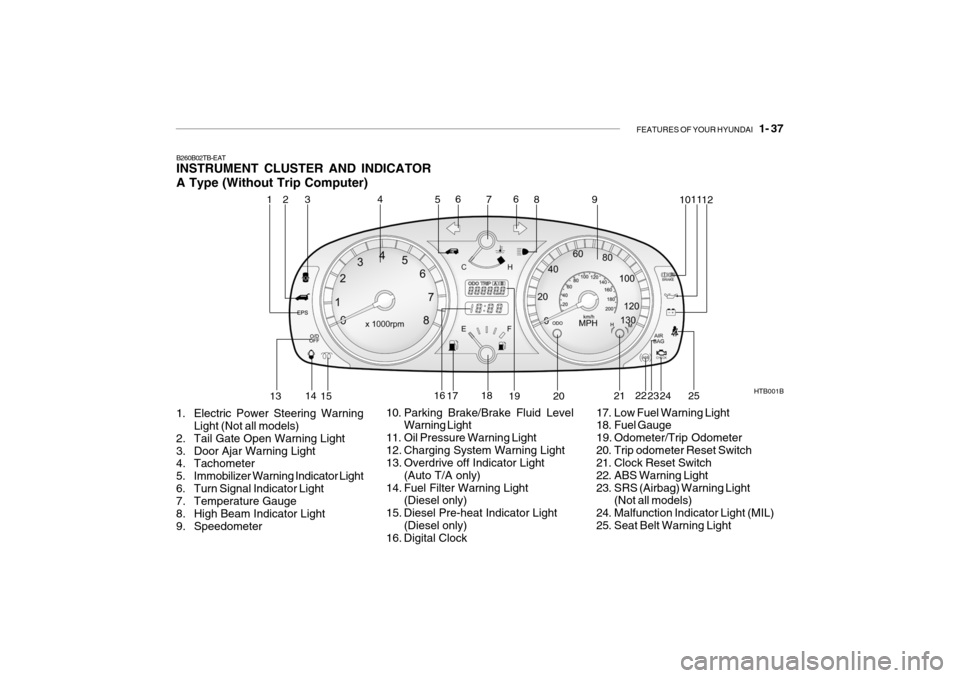
B260B02TB-EAT INSTRUMENT CLUSTER AND INDICATOR A Type (Without Trip Computer)
1. Electric Power Steering Warning Light (Not all models)
2. Tail Gate Open Warning Light
3. Door Ajar Warning Light
4. Tachometer
5. Immobilizer Warning Indicator Light
6. Turn Signal Indicator Light
7. Temperature Gauge
8. High Beam Indicator Light
9. Speedometer HTB001B
10. Parking Brake/Brake Fluid Level Warning Light
11. Oil Pressure Warning Light
12. Charging System Warning Light
13. Overdrive off Indicator Light (Auto T/A only)
14. Fuel Filter Warning Light (Diesel only)
15. Diesel Pre-heat Indicator Light (Diesel only)
16. Digital Clock 17. Low Fuel Warning Light
18. Fuel Gauge
19. Odometer/Trip Odometer
20. Trip odometer Reset Switch
21. Clock Reset Switch
22. ABS Warning Light
23. SRS (Airbag) Warning Light
(Not all models)
24. Malfunction Indicator Light (MIL)
25. Seat Belt Warning Light
1
2
4
53 6
7 8
9 1011
12
13 14
15 16
17 18
19 20 21
22
23 24
6
25
Page 49 of 437
1- 38 FEATURES OF YOUR HYUNDAI
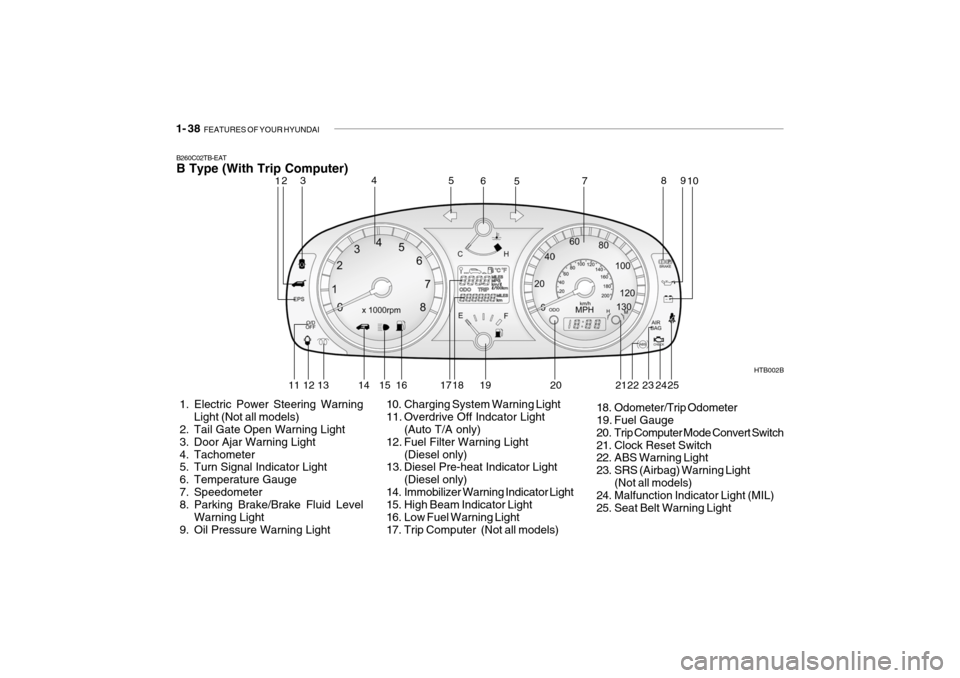
B260C02TB-EAT B Type (With Trip Computer)
1. Electric Power Steering Warning
Light (Not all models)
2. Tail Gate Open Warning Light
3. Door Ajar Warning Light
4. Tachometer
5. Turn Signal Indicator Light
6. Temperature Gauge
7. Speedometer
8. Parking Brake/Brake Fluid Level
Warning Light
9. Oil Pressure Warning Light HTB002B
10. Charging System Warning Light
11. Overdrive Off Indcator Light (Auto T/A only)
12. Fuel Filter Warning Light (Diesel only)
13. Diesel Pre-heat Indicator Light
(Diesel only)
14. Immobilizer Warning Indicator Light
15. High Beam Indicator Light
16. Low Fuel Warning Light
17. Trip Computer (Not all models) 18. Odometer/Trip Odometer
19. Fuel Gauge
20. Trip Computer Mode Convert Switch
21. Clock Reset Switch
22. ABS Warning Light
23. SRS (Airbag) Warning Light
(Not all models)
24. Malfunction Indicator Light (MIL)
25. Seat Belt Warning Light
12 3 4
5
5
6
78
910
11 12 13 14 15 16 17 18 19 20 22 23
242521
Page 52 of 437

FEATURES OF YOUR HYUNDAI 1- 41
SB210M1-E
CHARGING SYSTEM WARNING LIGHT
The charging system warning light should illuminate when the ignitionswitch is turned to the "ON" position and should be extinguished when the engine is started. If the light fails toilluminate when the ignition is turned "ON" or fails to extinguish after starting the engine, the nearest Hyundaiauthorised repairer should be contacted. If the light illuminates whilst the vehicle is being driven, stop the vehicle assoon as it is safe to do so and check the condition of the generator drive belt. If SB2100I-E
DOOR AJAR WARNING LIGHT
The door ajar warning light indicates that a door is not correctly closed. Ensure that the light is extinguishedprior to driving the vehicle.
B260B01FC-EAT
TAIL GATE OPEN WARNING LIGHT
The tail gate warning light indicates when the tail gate is open or is not fullyclosed. Ensure that the light has extin- guished prior to driving the vehicle. SB210P1-E
LOW FUEL LEVEL WARNING LIGHT
The low fuel warning light serves to warn the driver that the remaining fuel quantity is approximately 9 litres and that the vehicle should be refuelled. Ifthe vehicle is driven for an extended period with the low fuel warning light illuminated there exists a possibilitythat misfiring due to fuel shortage may occur. This situation must be avoided to prevent damage to the catalyst oc-curring.
recommended to assist in bringing the vehicle to rest. The vehicle must not be driven once brake failure has occurreduntil the system has been repairered and is functioning normally. The braking system employs a vacuumservo in order that the pedal efforts are reduced. Power for the servo is derived from the engine and therefore, in theevent of the engine stopping or the vehicle being towed, pedal efforts will be substantially increased.
the belt is in place and the tension is satisfactory, the advice of a Hyundai authorised repairer should be sought.
CAUTION:
If the drive belt (generator belt) is loose, broken, or missing while the vehicle is driving, there may be aserious malfunction, engine could overheat because this belt also drives the water pump.
!
B260N02FC-EAT MALFUNCTION INDICA- TOR LIGHT
This light illuminates when there is a malfunction of an exhaust gas related component, and the system is not func-tioning properly so that the exhaust gas regulation values are not satisfied. This light will illuminate when the ignition keyis tuned to the "ON" position, and will go out after the engine start. If it illumi- nates while driving, or does not illumi-nate when the ignition key is turned to the "ON" position, take your car to your
Page 53 of 437

1- 42 FEATURES OF YOUR HYUNDAI
B260S01B-GAT
DIESEL PRE-HEAT INDICATORLIGHT-AMBER(Diesel Engine)
The indicator light illuminates amber when the ignition switch is placed at the "ON" position. The engine can be started after the pre-heat indicator lightgoes off. The illuminating time varies with the water temperature, air tem- perature and battery condition. NOTE: If the engine were not started 10 seconds after the preheating is com-pleted, turn the ignition key once more to the "LOCK" position, and then to the "ON" position, in orderto preheat again.
B260T01TB-GAT
ELECTRIC POWER STEERING SYSTEM(EPS) WARNING LIGHT (Not all models)
This indicator light comes on about 4 seconds after the ignition key is turned to the "ON" position or after the engine is started, it will go out.This light also comes on when the EPS has some troubles. If it comes on while driving, have your vehicle inspected bya Hyundai authorised repairer. B260E01HP-GAT
SEAT BELT WARNING LIGHT
The seat belt warning light blinks for about 6 seconds when the ignition key is turned from the "OFF" position to "ON" or "START".
CAUTION:
When you move the electric power steering back-end and forth-end continuously in stop position, steer- ing wheel plays heavily to operateanti-overload system. It is normal condition. It returns to be nomal getting time.!
B260U01TB-EAT IMMOBILISER
INDICATOR LIGHT(Not all models)
This indicator light comes on for some seconds after the ignition key is turned to the "ON" position. At this time, youcan start the engine. The light goes out after the engine is running. In case this light goes out before you start the en-gine, you must turn to the "LOCK" position and restart the engine. In case this light blinks for five seconds whenthe ignition key is turned to "ON" posi- tion, this indicates that the immobiliser system is out of order. At this time,consult to the Hyundai authorised re- pairer.
nearest Hyundai authorised repairer andhave the system checked.
Page 92 of 437

FEATURES OF YOUR HYUNDAI 1- 81
!
B750A04L B750A05L
o Station Swapping - As a FM signal weakens, another more powerful signal near the same frequency may begin to play. This is because your radio is designed to lock onto theclearest signal. If this occurs, select another station with a stronger sig- nal.
o Multi-Path Cancellation - Radio sig- nals being received from severaldirections can cause distortion orfluttering. This can be caused by a direct and reflected signal from the same station, or by signals from twostations with close frequencies. If this occurs, select another station until the condition has passed.
o Fading - As your car moves away
from the radio station, the signal willweaken and sound will begin to fade. When this occurs, we suggest that you select another stronger sta-tion.
o Flutter/Static - Weak FM signals or
large obstructions between thetransmitter and your radio can dis- turb the signal causing static or flut- tering noises to occur. Reducing thetreble level may lessen this effect until the disturbance clears. B750B02Y-AAT Using a cellular phone or a two- way radio When a cellular phone is used inside the vehicle, noise may be produced from the audio equipment. This doesnot mean that something is wrong with the audio equipment. In such a case, use the cellular phone at a place as faras possible from the audio equipment.
!
CAUTION:
When using a communication sys- tem such a cellular phone or a radio set inside the vehicle, a separate external antenna must be fitted. When a cellular phone or a radio setis used with an internal antenna alone, it may interfere with the vehicle's electrical system and ad-versely affect safe operation of the vehicle.
WARNING:
Don't use a cellular phone when you are driving, you must stop at a safe place to use a cellular phone.
Page 93 of 437

1- 82 FEATURES OF YOUR HYUNDAI
Storage When not in use, place your discs in their individual cases and store them ina cool place away from the sun, heat, and dust. Do not grip or pull out the disc with yourhand while the disc is being pulled into the unit by the self loading mechanism. Do not pull the unit from the dashimmediately after a disc is inserted or the eject switch has been pressed. If the unit is pulled out before an opera-tion is completed, the disc will be un- stable in the unit and may be dam- aged.Do not attempt to insert a disc into the unit when the unit is out of the dash or the power is off.
B850A01F-AAT CARE OF DISC Proper Handling Handle your disc as shown. Do not drop the disc. Hold the disc so you willnot leave fingerprints on the surface. If the surface is scratched, it may cause the pickup to skip signal tracks. Do notaffix tape, paper, or gummed labels on the disc. Do not write on the disc. Damaged Disc Do not attempt to play damaged, warped or cracked discs. These could severely damage the playback mecha- nism.
B850A01L
B850A02L
Keep Your Discs Clean Fingerprints, dust, or soil on the sur- face of a disc could cause the pickup toskip signal tracks. Wipe the surface clean with a clean soft cloth. If the surface is heavily soiled, dampena clean soft cloth in a solution of mild neutral detergent to wipe it clean. See drawing.
Page 109 of 437
DRIVING YOUR HYUNDAI 2- 13
SC140B1-E ANTI-LOCK BRAKE SYSTEM (Not all models) The Anti-Lock Brake System (ABS) is designed to prevent wheel lock-upduring sudden braking or on hazard-ous road surfaces. The ABS controlmodule monitors the wheel speed and controls the pressure applied to each brake. Thus, in emergency situationsor on slick roads, ABS will increasevehicle control during braking. NOTE: During ABS operation, a slight pul- sation may be felt in the brake pedal when the brakes are applied. Also, a noise may be heard in the enginecompartment whilst braking. Theseconditions are normal and indicatethat the anti-lock brake system isfunctioning properly.
located in the instrument cluster will beilluminated. When the overdrive switchis turned "ON", the transaxle functionsas a fully automatic four speed unitwith the maximum fuel economy po- tential of the vehicle being realized. SC140A1-E EFFECTIVE BRAKING Braking system performance and fric- tion material life are greatly affected by the driving style adopted. The follow-ing suggestions are made to assist inachieving the best results from thebraking system.
o Anticipate the road and conditions
ahead in order that heavy braking may be avoided.
o When descending long gradients,
use the engine to assist in retardingthe vehicle to minimize the possibil- ity of brake fade occurring.
o When trailer towing, ensure that the
trailer brakes function correctly and use engine braking to assist thevehicle braking system. o Use only genuine Hyundai replace-
ment brake pads and shoes to en-sure consistent friction characteris-tics and wear rates.
o After driving through deep water (e.g. fording), the brakes may be-come wet and performance reduced.Always check brake efficiency afteremerging from the water and dry thebrakes by lightly depressing thebrake pedal several times whilst driving slowly.
o Apply the parking brake only when the vehicle is at rest.
o Since the power assistance pro- vided by the brake servo is derived from the engine, coasting with the engine turned off or towing of the vehicle with the engine turned offwill result in greatly increased pedalpressures being required to stop thevehicle.
o Do not hold the vehicle on the up- grade with the accelerator pedal.This can cause the transmission tooverheat. Always use the brakepedal or parking brake.